What Do Landscapers Charge Per Hour? 2026 Pricing Guide
Discover what do landscapers charge per hour in 2026. Our guide covers average rates ($50-$65/hr), key pricing factors, and tips to get an accurate estimate
Professional landscaping commonly costs $50 to $65 per hour for homeowners in the U.S. But that number can swing a lot depending on the kind of work, where you live, and whether the job is really being priced by the hour at all.
If you're staring at your yard, thinking about cleanup, planting, grading, or a full backyard refresh, the first quote can feel confusing fast. One company gives you an hourly number. Another gives you a fixed price. A third sounds expensive until you realize they're bringing a crew, equipment, insurance, and a plan.
That's where most homeowners get stuck. They want to know what property maintenance specialists charge per hour, but the key question is what that hourly number includes, and when it's the wrong number to focus on.
Your Guide to Understanding Landscaping Costs in 2026
You call for estimates on a yard cleanup, new mulch, and a small retaining feature. The first company gives you an hourly number. The second gives you a lump sum. The third asks detailed questions about access, drainage, and haul-away before they even talk price. For a homeowner, that can feel less like shopping and more like trying to compare apples, oranges, and a wheelbarrow.
The $50 to $65 per hour range is still a useful starting point for budgeting, based on national pricing guidance for these services from Thumbtack. What trips people up is that this number is the customer rate, not a simple reflection of what the person on site earns. It is a selling price built to cover labor, equipment, travel, insurance, downtime, and the company's overhead. Once you see it that way, quotes start to make more sense.
A retaining wall is a good example. On paper, it can sound like a basic add-on. In real life, slope, soil, access, drainage, excavation, and material delivery can change the total fast. If that kind of work is on your list, this guide on budgeting for a concrete sleeper wall shows how a project that sounds simple can carry very different labor and material costs.
Planning affects price more than many homeowners expect.
If a contractor has to sort out an unclear scope at the property, revise ideas several times, or guess what you want included, you usually pay for that one way or another. Clear measurements, photos, and a defined wish list make pricing tighter and easier to compare. Tools like Outdoorbrite can help homeowners get that clarity before collecting bids.
What usually confuses people
Three pricing questions cause the most frustration:
- Hourly rate vs take-home wage: The worker's pay and the rate billed to the homeowner are two different numbers.
- Crew pricing: One quote may cover a solo worker, while another covers a full crew with tools, truck, and cleanup.
- Hourly vs flat fee: Some jobs are easier to price by time, while others are safer and fairer to price as a full project.
If you compare only the headline hourly number, you can miss the real cost drivers behind the quote.
That is why two estimates for the same yard can land so far apart, even before materials enter the picture.
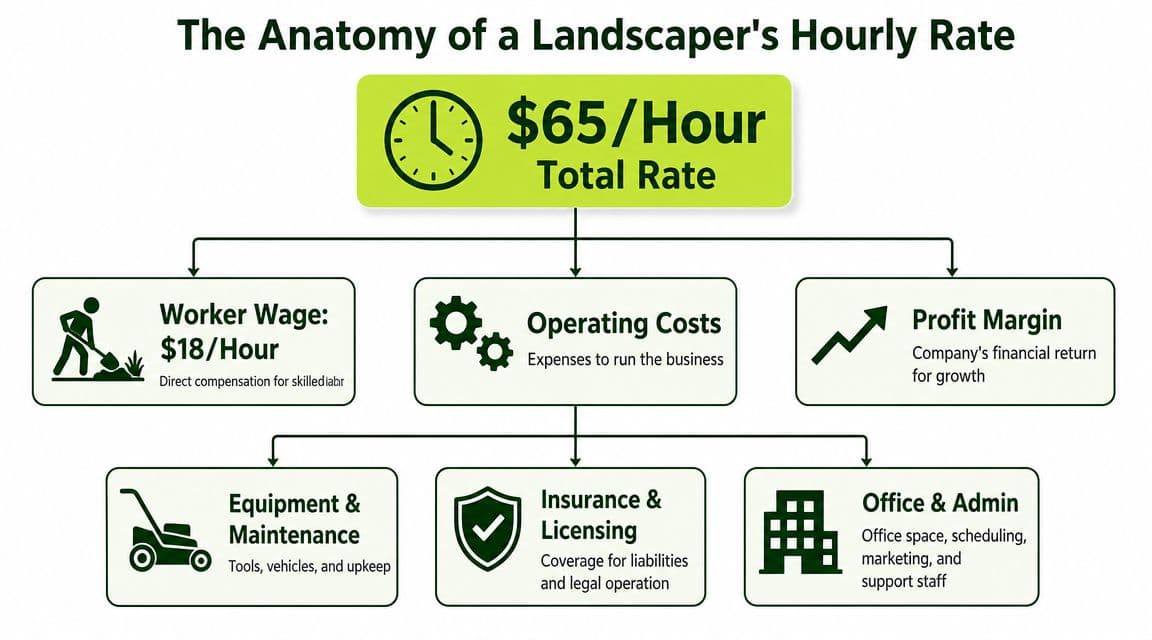
The Anatomy of a Landscaper's Hourly Rate
You call a company for a simple cleanup and hear a rate that sounds high for “one person with a mower.” That reaction is common. The confusing part is that you are not paying only for one worker's time. You are paying for a business that can show up on schedule, bring the right tools, carry insurance, fix mistakes, and still be there if you need them next month.
A contractor's hourly rate works a lot like an auto repair bill. Part of the charge covers the technician turning the wrench. The rest keeps the shop open, stocked, insured, staffed, and ready to do the work safely.
That same math applies in this industry. The number on your quote is usually much higher than the wage of the person on site, and that gap is not automatically padding. It is often the cost of running the operation behind the work.
What sits inside that rate
When a professional company bills by the hour, the rate usually includes several layers of cost at once:
- Worker pay: The crew member on your property has to be paid for time, skill, and physical effort.
- Payroll costs: Employers also cover payroll taxes and, in some companies, benefits and paid time off.
- Insurance: Liability coverage and workers' compensation protect the business and reduce risk for the homeowner.
- Vehicles and fuel: Trucks, trailers, travel time, and fuel are part of getting a crew to your home ready to work.
- Equipment: Mowers, trimmers, blowers, saws, compact machines, maintenance, and repairs all have ongoing costs.
- Office support: Someone answers calls, builds schedules, writes estimates, orders materials, and sends invoices.
- Profit: A healthy company needs money left over after expenses so it can replace equipment, train staff, and stay reliable.
Here is the part many homeowners miss. The worker's wage is only one slice of the pie.
Why the markup is not just “extra”
A simple way to read an hourly rate is to split it into two buckets. First, there is direct labor cost. Second, there is overhead, which is everything required to deliver that labor in a professional way.
Say a worker earns a decent hourly wage. The company still has to add taxes, insurance, equipment wear, office labor, fuel, scheduling time, and the cost of non-billable hours such as travel, rain delays, and shop prep. By the time those costs are spread across the hours a company can bill to customers, the break-even rate can be far above the employee's take-home pay.
That is why two rates that sound close on paper can represent very different businesses in practice. A solo operator with minimal overhead may charge less. A fully insured crew with newer equipment, office staff, and tighter scheduling usually has to charge more.
This also explains why specialty work jumps fast. If the job requires trained operators, expensive machines, or higher risk, the hourly number rises because the business costs rise with it. For a good example of how equipment changes pricing, see what to expect for stump grinding.
Practical rule: A homeowner's hourly rate reflects the cost of the whole company showing up for the job, not just the person holding the shovel.
Once you see the business math, a quote becomes easier to judge. Instead of asking only, “What does this worker make per hour?” ask, “What am I getting in that rate?” That question usually leads to smarter comparisons and better negotiation.
Key Factors That Influence Landscaper Pricing
Two yards can look almost identical from the curb and still produce very different quotes. One might need a simple cleanup. The other might need drainage correction, machine access, debris haul-off, and a crew that knows how to protect roots, irrigation lines, and hardscaping already in place.
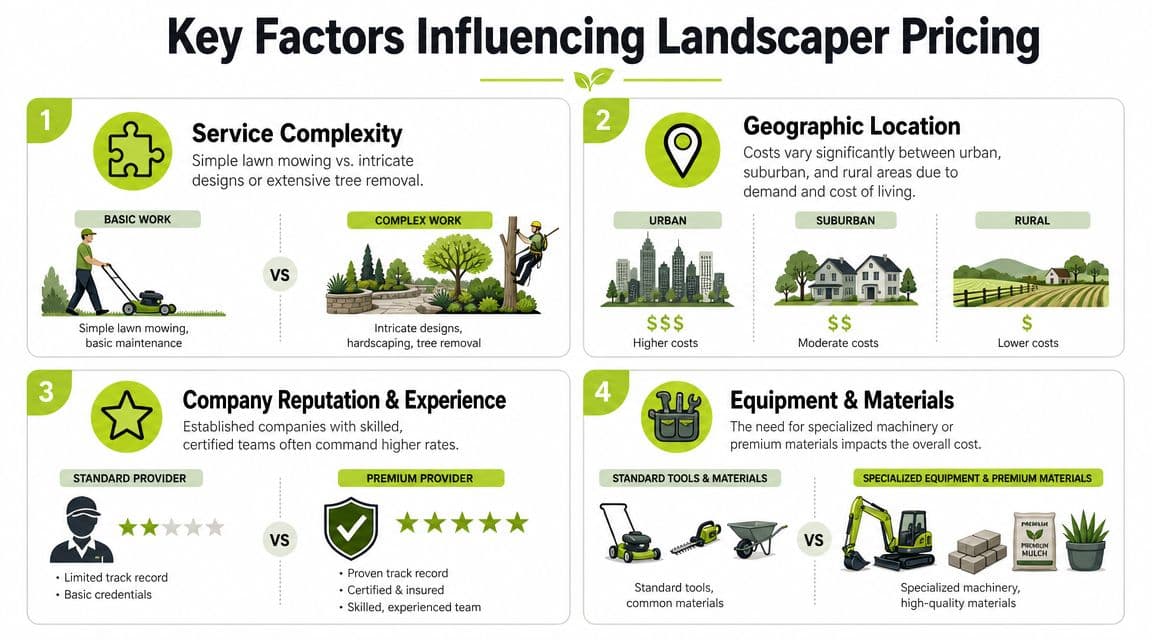
That is why pricing can feel inconsistent if you only compare hourly numbers. The rate is shaped by the kind of work, the skill level of the crew, local operating costs, and how clearly the job can be defined before anyone starts.
Service type changes everything
Routine maintenance usually costs less per hour than technical install or repair work. Weeding, trimming, and seasonal cleanup are fairly straightforward to estimate. Grading, drainage correction, irrigation troubleshooting, and jobs that require compact equipment usually cost more because they involve more planning, more setup time, and more risk if something goes wrong.
Equipment shifts the math quickly. A shovel-and-rake job is priced one way. A job that needs a stump grinder, trailer, fuel, and an operator trained to use the machine safely is priced another way. A good example is this guide on what to expect for stump grinding, which shows how a yard task can turn into an equipment-heavy service.
Experience affects labor value
Experience changes both speed and error rates. A newer worker may take longer to edge beds cleanly, identify plants correctly, or spot drainage problems before they become expensive callbacks. A seasoned crew leader usually works faster, makes fewer mistakes, and can solve problems on site without stopping the whole job.
Housecall Pro reports that workers with 0 to 2 years of experience earn about $14.35 per hour on average, intermediate workers earn about $18.55, and senior workers earn about $24.35, with some specialized roles above $25 per hour, according to its salary guide for these roles.
For a homeowner, that does not mean the highest-paid crew is always the best choice. It does mean cheaper labor can cost more if the work takes longer, needs rework, or produces a result that does not hold up.
Location matters more than people expect
This work is local. Rates rise and fall with wages, insurance premiums, fuel prices, dump fees, permit requirements, and how expensive it is to run trucks and crews in your area.
Housecall Pro notes that Washington, D.C. has the highest median annual grounds maintenance professional pay at about $47,300. Higher-cost markets often produce higher homeowner pricing for the same category of work because the company's day-to-day expenses are higher before the crew even arrives.
Scope changes the quote structure
Scope is the part homeowners often underestimate. “Clean up the yard” sounds simple, but that phrase can mean light leaf blowing, major overgrowth removal, bed reshaping, pruning, haul-off, or several return visits.
A useful way to look at it is this. Pricing works like packing a truck. The more unknowns you add, the harder it is for a contractor to give a tight number without building in extra cushion.
Here are the questions that usually move a quote up or down:
- How defined is the job? A clear task list usually produces cleaner, more confident pricing.
- How much equipment is involved? Machines add transport, setup, fuel, maintenance, and operator skill.
- Is access easy or awkward? Narrow gates, steep slopes, and long carry distances slow production.
- Will the crew need repeat visits? Travel and setup time matter, especially on smaller jobs.
A low quote may still be a good quote. It may also reflect a less experienced crew, lighter insurance coverage, fewer included services, or a simpler scope than you thought you were comparing.
When to Expect Hourly Rates vs Project-Based Fees
This is one of the biggest pricing misunderstandings in landscaping. Homeowners ask for an hourly rate, but many contractors would rather quote the total job.
That isn't evasive. It's often the better method.
Jobs that are often billed hourly
Hourly pricing tends to work best when the scope is loose or changes as the crew goes.
Common examples include:
- General garden cleanup: Especially when no one knows how much overgrowth is hiding in the beds.
- Weeding and trimming: Good for routine visits or catch-up maintenance.
- Seasonal touch-ups: Small jobs where time is the fairest measure.
- Ongoing maintenance: Recurring service is often easy to track by labor time.
Jobs that are often quoted as a flat fee
Defined projects are usually better priced as a single amount. That's especially true when materials, machinery, or a finished outcome matter more than raw hours.
One landscaping guide notes that lawn care and trimming are often hourly, while patio installation and sod installation are usually priced as a project. That distinction is explained well in this overview of hourly rates versus flat-rate landscaping work.
How to decide which is better for you
A simple rule helps.
| Pricing method | Best for | Main benefit | Main risk |
|---|---|---|---|
| Hourly | Open-ended maintenance and cleanup | You pay for actual time used | Total cost can drift if scope grows |
| Project-based | Defined installations and build work | Better budget certainty | Change orders can raise price if you alter the plan |
If the result matters more than the clock, ask for a project quote. If the job is messy, unpredictable, or ongoing, hourly pricing often makes more sense.
Estimating Your Landscaping Project Costs
You call three contractors about the same yard. One says the cleanup will probably take half a day. Another gives a flat price. The third asks for photos before saying anything. That can feel inconsistent, but the math underneath is usually similar. Each company is trying to estimate labor time, crew size, materials, dump fees, travel, and the risk of surprises.
A practical budget starts by translating each quote into the same language.
For open-ended work, use this simple formula:
Estimated cost = hourly rate × expected hours
For a defined install, the company often starts with labor hours too. Then it adds materials, equipment, overhead, and profit. That is why a project quote can look higher than the wage you imagine a worker earns. You are paying for the full operating cost of getting the job done correctly, not just the hands on site.
A simple way to budget maintenance
Recurring yard work is easier to price when your scope is clear. If your request is vague, the estimate usually gets padded to cover uncertainty. A tidy scope works like a grocery list. The clearer the list, the fewer surprises at checkout.
Ask each company the same four questions:
- How long does a typical visit take?
- What tasks are included?
- How many crew members usually arrive?
- How often do you recommend service?
If you want clearer quotes before making calls, backyard design ai can help you map the space and sort priorities. That gives contractors something more concrete than “clean it up and make it look better.”
Why larger project quotes often feel easier to trust
A flat bid for a bigger job can seem more predictable because the contractor has already done the hour-counting for you. They estimate crew time, then layer in the business costs homeowners do not always see at first: fuel, insurance, supervision, equipment wear, delivery coordination, and time spent picking up materials.
That wage-to-rate gap causes a lot of confusion. If a crew member earns one amount per hour, the client-facing rate will still be much higher, because the company has to cover every cost around that worker and still stay in business. Once you see that, project pricing feels less mysterious and easier to compare.
Sample Project Cost Estimates 2026
| Project Type | What usually drives the price | Best budgeting approach |
|---|---|---|
| Garden cleanup | Overgrowth, access, debris volume, haul-away | Ask for an hourly estimate with a not-to-exceed cap |
| Mulch refresh and bed touch-up | Bed size, mulch depth, hand work, delivery | Request labor and materials as separate line items |
| Sod installation | Site prep, grading, removal of old turf, watering access | Compare full project bids, not just labor |
| Small patio install | Excavation, base prep, material choice, cuts and edging | Expect a project quote with a defined scope |
| Irrigation adjustment or repair | Troubleshooting time, parts, valve or head replacement | Budget for diagnosis first, then repair pricing |
The smartest comparison is scope against scope.
If one quote includes cleanup, disposal, and material pickup while another leaves those items out, the lower number may only look cheaper. Ask each contractor to spell out what is included, what could change the price, and what would trigger an added charge. That is how you turn a rough estimate into a useful budget.
How to Reduce Costs and Plan Like a Pro
The easiest money to save in landscaping is the money you never waste on confusion. Clear planning cuts revisions, reduces on-site guesswork, and gives contractors less room to price for uncertainty.
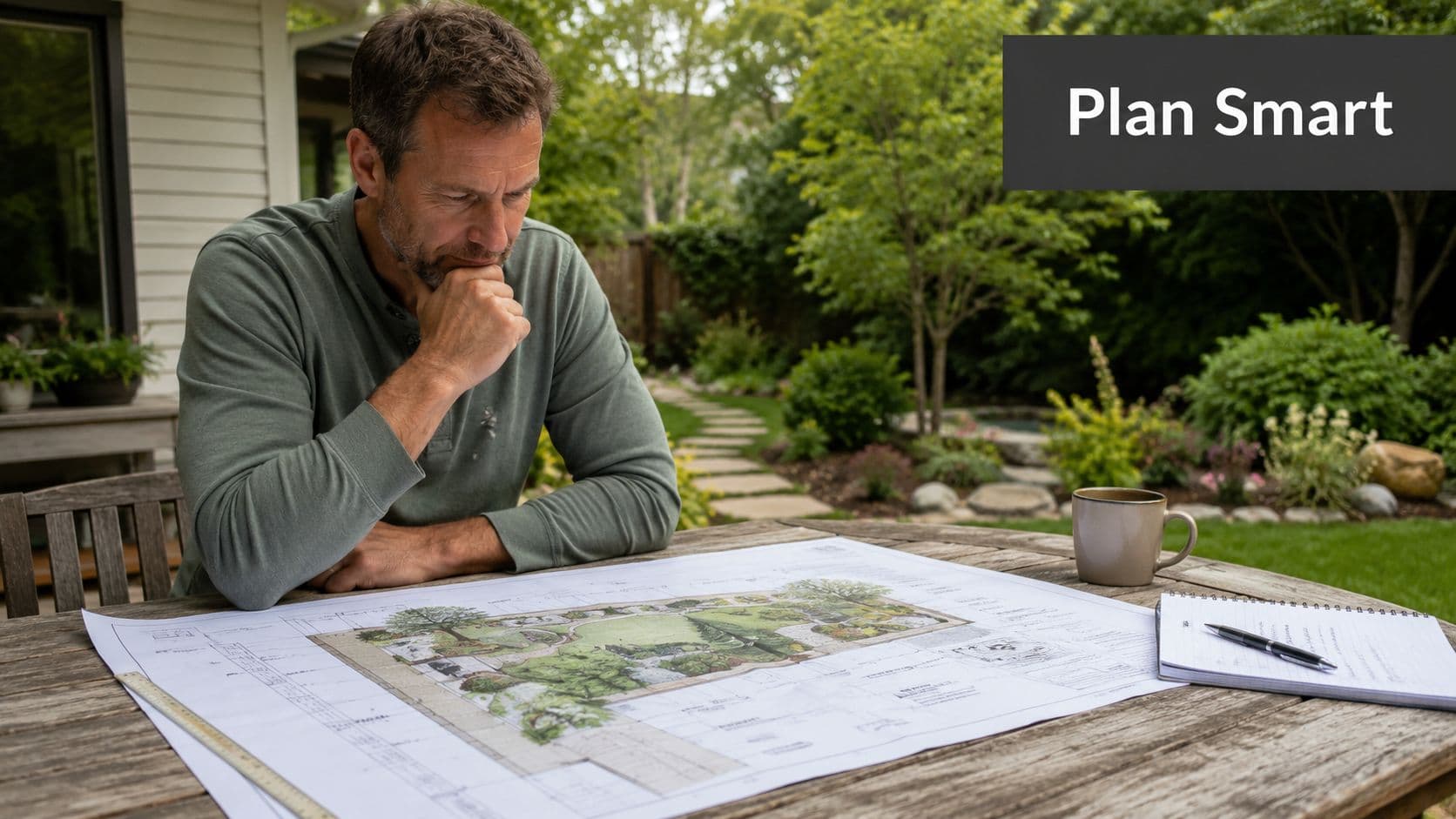
Start with a defined vision
A homeowner who can show exactly what they want usually gets better quotes than one who says, “I just want it to look nicer.” Contractors price uncertainty defensively. They have to.
That's why planning tools can save real money even before work begins. If you use ai for landscape design to create a clear concept, you can compare bids against the same idea instead of having each company interpret your yard differently.
Low-effort ways to control the budget
Some savings come from the project itself, not the rate.
- Handle easy prep yourself: Move patio furniture, clear toys, and remove obvious clutter before the crew arrives.
- Finalize decisions early: Mid-project changes usually cost more than homeowners expect.
- Prioritize phases: If the full project is too much at once, split it into must-do now and later upgrades.
- Choose simpler upkeep: Lower-maintenance planting plans often reduce future labor.
Clear plans make quotes easier to compare and harder to misunderstand.
A short walkthrough of planning and visualization can also help before you start collecting estimates:
Ask for cost clarity, not just a lower price
Instead of asking, “Can you do it cheaper?” ask better questions:
- What part of this quote drives the price most?
- What can I remove without hurting the result?
- Would phasing this work help?
- Is there a simpler material or scope option?
Good contractors usually respond well to that. It shows you're serious, prepared, and focused on value instead of just squeezing the number.
Finding and Vetting a Great Landscaper
You get two quotes for the same yard. One is far lower. At first glance, that feels like a win. But a bid that is much lower than the others often means something is missing, such as insurance, cleanup, material quality, or enough labor hours to do the job well.
That is why vetting matters as much as price. A contractor's hourly rate is not just worker pay. It also has to cover trucks, fuel, tools, admin time, insurance, taxes, and the risk of fixing mistakes. If a company prices too low, the money usually has to come from somewhere. Homeowners often feel that later through delays, change orders, or rushed work.
Use this checklist when comparing companies:
- Get at least three quotes: Similar bids usually show the realistic price range for your project.
- Ask for proof of insurance: If something goes wrong on your property, this matters fast.
- Request a written scope: Make sure it spells out labor, materials, cleanup, haul-away, and what is excluded.
- Review past jobs: Photos are useful, but references tell you how the company handled communication, timing, and problems.
- Clarify payment terms: Reasonable deposits are common. Large upfront demands with little paperwork deserve extra caution.
A written quote should read like a clear recipe, not a rough guess. If you cannot tell what you are paying for, you cannot compare one company to another in a fair way.
Watch for red flags such as:
- Vague estimates
- Pressure to sign right away
- No clear business presence
- No written breakdown of labor, materials, or cleanup
The best contractor is usually not the cheapest or the most expensive. It is the one who explains the math clearly, answers questions directly, and gives you enough detail to judge whether the price makes sense.
If you want to plan your yard before you start calling contractors, OutdoorBrite makes it easy to turn a photo of your space into realistic design ideas you can use when comparing quotes. It's a practical way to show what you want, avoid expensive miscommunication, and start your project with more confidence.
See your yard reimagined
Start creating