8 Before and After Landscape Photos That Transform Any Yard
Explore 8 before and after landscape photos with design breakdowns, material costs, and AI tips for your next outdoor makeover.
Before and after outdoor photos convert 3x better than sequential images because side-by-side contrast is easier for people to process at a glance, according to Propstage's analysis of before-after real estate imagery. That single detail explains why these visuals work so well for outdoor projects. A homeowner doesn't need to imagine improvement in the abstract. They can compare the same yard, from the same angle, and decide whether the redesign feels believable.
That matters because yard transformation work is expensive, disruptive, and hard to reverse. Good before and after yard transformation photos reduce that uncertainty. They also create a planning workflow: capture the existing yard, generate a concept, pressure-test materials and layout, then document the finished result in a way that helps with resale, contractor communication, and future updates.
The strongest galleries do more than inspire. They pair visuals with style logic, practical sequencing, and decisions you can copy. If you're upgrading a patio, front entry, pool surround, or edible garden, the right comparison image can show what changed, why it changed, and what should happen next.
If you're also refining listing imagery, AI real estate photo enhancement fits naturally into the same visual workflow.
Table of Contents
- 1. Small Urban Patio Transformation
- 2. Large Backyard Overhaul
- 3. Front Yard Curb Appeal Upgrade
- 4. Japanese Zen Garden Minimalist Transformation
- 5. Native Plant Garden Conversion
- 6. Pool Area Luxury Resort Transformation
- 7. Vegetable Garden Expansion
- 8. Modern Contemporary Hardscape Transformation
- Before & After: 8 Landscape Transformations
- Next Steps for Your Own Landscape Makeover
1. Small Urban Patio Transformation
A bare concrete patio often looks like a space problem, but it's usually a layering problem. In Brooklyn townhouse yards, San Francisco balconies, and Manhattan rooftops, the most convincing before and after outdoor space photos don't show more square footage. They show better vertical use, stronger texture contrast, and a clearer focal point.
The Mediterranean approach fits small patios because it combines structure and softness. A plain slab becomes more livable when you add raised planters, gravel or stone bands to break up the hard surface, climbing greenery on trellises, and warm lighting that makes the space useful after sunset. AI render tools help early because you can test whether olive-toned foliage, pale stone, and terracotta accents feel calming or crowded before buying anything.
Mediterranean style works when square footage is tight
A strong “after” image in this category usually includes three moves. First, the perimeter gets built up with planters or benches so the center stays open. Second, the eye gets pulled upward with vines, wall-mounted pots, or a slatted screen. Third, furniture shrinks slightly below what looks ideal in a showroom, which keeps the patio readable in photos and usable in real life.
Practical rule: In compact yards, don't start with plants. Start with circulation. If two people can't cross the space comfortably in the concept image, the finished patio will feel smaller than the photo.
Try these tactics when building your own gallery and plan:
- Test seasonal foliage: Use AI previews to compare how the patio reads in greener months versus leaner months.
- Choose drought-tolerant planting: Mediterranean styling works best when the palette stays restrained and water-wise.
- Add one lighting layer: Wall sconces, step lights, or under-planter lighting often do more than string lights in tight spaces.
- Keep one material dominant: Too many finishes make a small patio look fragmented in both photos and person.
The best version of this transformation doesn't chase abundance. It edits aggressively, then lets texture do the emotional work.
2. Large Backyard Overhaul
The hardest backyard to design is often the empty one. A big lawn looks flexible, but without structure it usually photographs as unfinished. That's why a full-yard before-and-after works best when the redesign turns one undifferentiated field into a sequence of destinations.
Early concepting matters here because furniture, paving, and planting all compete for visual authority. A side-by-side comparison lets a homeowner see whether the dining zone is too exposed, whether a lounge area lacks enclosure, or whether the play space interrupts the main view from the house.
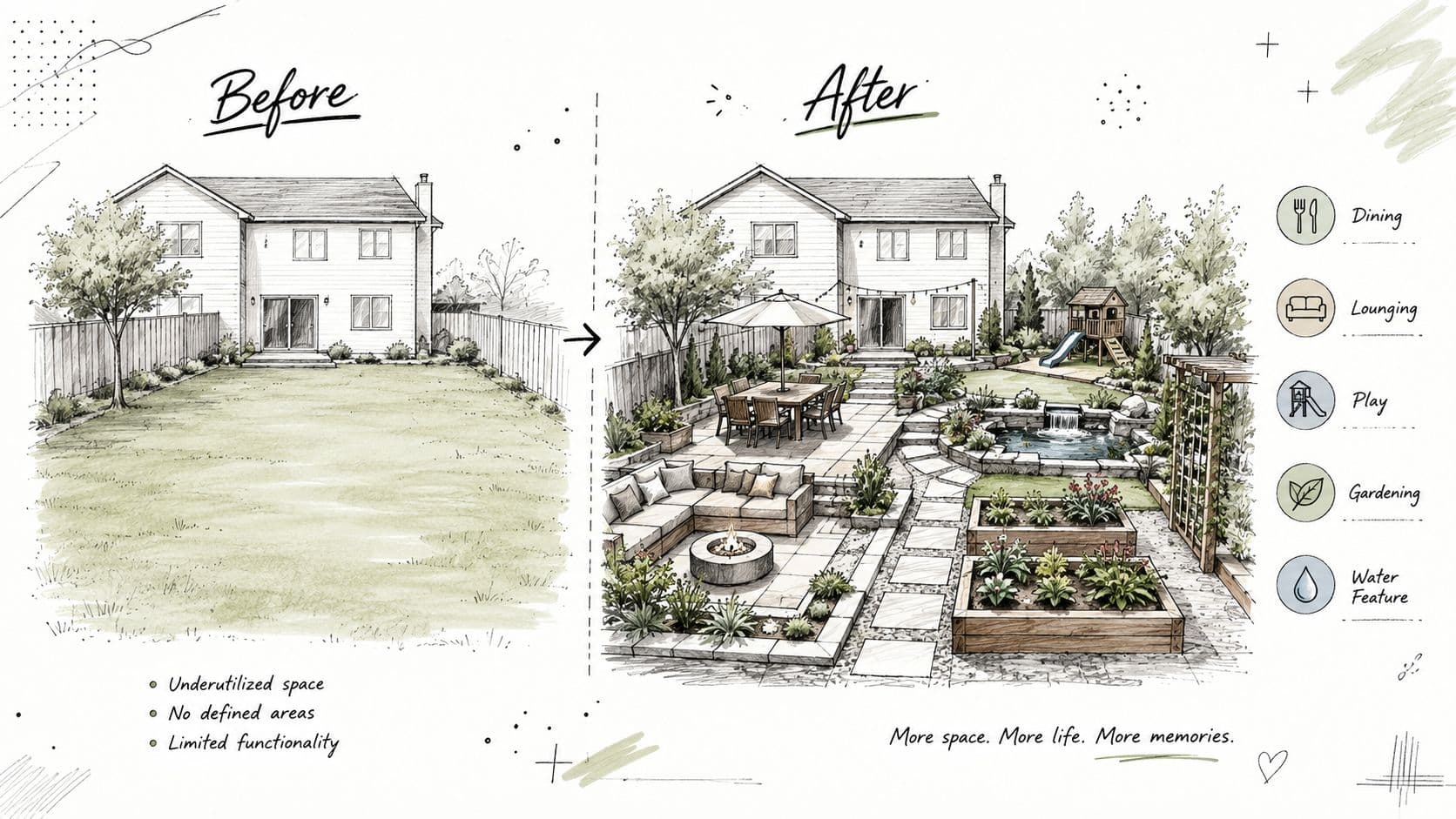
Suburban properties in Dallas, Phoenix, Atlanta, and California wine country often follow the same successful formula. The “after” image shows a dining terrace closest to the home, a lounge or fire feature beyond it, planting beds to define the perimeter, and one flexible open area that keeps the yard from feeling overbuilt.
Break one big lawn into linked destinations
If you want to design your backyard online free, use the image comparison to solve sequencing, not just style. Start by mapping where people will sit, where they'll cross the yard, and what they'll see from indoor windows. Then test whether paths, plant masses, and furniture backs create clean edges between zones.
A useful planning stack looks like this:
- Anchor the first zone near the house: Dining usually belongs closest to the kitchen or main exit.
- Plan irrigation before planting: Once hardscape is in, changes get slower and more expensive.
- Layer by viewing distance: Low detail near windows, medium mass in the midground, taller planting at the perimeter.
- Photograph from inside too: The best backyard redo improves both outdoor function and indoor views.
A 2026 roundup found that 35% of marketers name images and graphics as the single best element for lifting landing page conversions. For backyard projects, that pushes the gallery image above the fold. Don't bury the transformation proof below paragraphs of explanation.
Use motion when stills can't show circulation clearly. This walkthrough helps illustrate how a yard starts to feel cohesive once zones connect visually and physically.
3. Front Yard Curb Appeal Upgrade
Front yards carry more pressure than backyards because they have to perform instantly. A sparse entry with thin planting and an unclear walkway can make the whole property feel less finished, even when the house itself is strong. That's why before and after outdoor photos matter most at the curb. They compress value, maintenance expectations, and emotional first impression into one glance.
Real estate examples across Los Angeles, New England, Arizona, and Midwestern suburbs show the same pattern. The strongest “after” frame doesn't just add more plants. It clarifies arrival. Walkways become legible, the entry gains a focal point, and the planting scale starts matching the architecture.
Front-yard photos carry financial weight
Professional landscaping often raises perceived home value by 15% to 20%, and the same source cites Virginia Tech research showing a 5.5–12.7% increase for high-quality landscaping versus none, with exceptional designs reaching up to 20% in some cases, according to Vision Constructors' summary of landscaping and home value. That's why front-yard comparison photos aren't decorative. They document one of the clearest visual levers a seller or homeowner can pull.
For a front-yard redesign, AI mockups are especially useful when you're balancing architecture and planting style. A ranch house may need lower, wider masses. A Colonial often benefits from symmetry. A contemporary townhouse can handle bolder contrast and cleaner geometry. Testing those options in landscape design software helps avoid buying shrubs that fight the house.
A good front-yard “after” should guide the eye to the front door in one beat, not scatter attention across unrelated features.
A few decisions improve both the photo and the built result:
- Keep sightlines open: Don't block windows, driveway visibility, or the main entry sequence.
- Use lighting with restraint: Uplighting should support structure, not flatten it.
- Treat utilities as design problems: Mailboxes, meters, and exposed service areas need screening or integration.
- Match color to facade materials: Hardscape and foliage should reinforce brick, siding, stucco, or stone rather than compete with them.
For homeowners in mountain and high-plains markets, these curb appeal ideas for Colorado Springs homes are a useful regional complement.
4. Japanese Zen Garden Minimalist Transformation
A cluttered garden usually fails in photos before it fails in person. Too many specimen plants, disconnected ornaments, and inconsistent edging create visual noise that reads even louder in a side-by-side gallery. A Zen-inspired transformation fixes that by removing elements first and composing the remaining ones with intention.
This style works well in Pacific Northwest homes, California wellness-oriented properties, and urban roof terraces where people want retreat rather than abundance. The most successful “after” image usually contains fewer species, stronger evergreen structure, one carefully placed focal stone or water feature, and visible negative space.
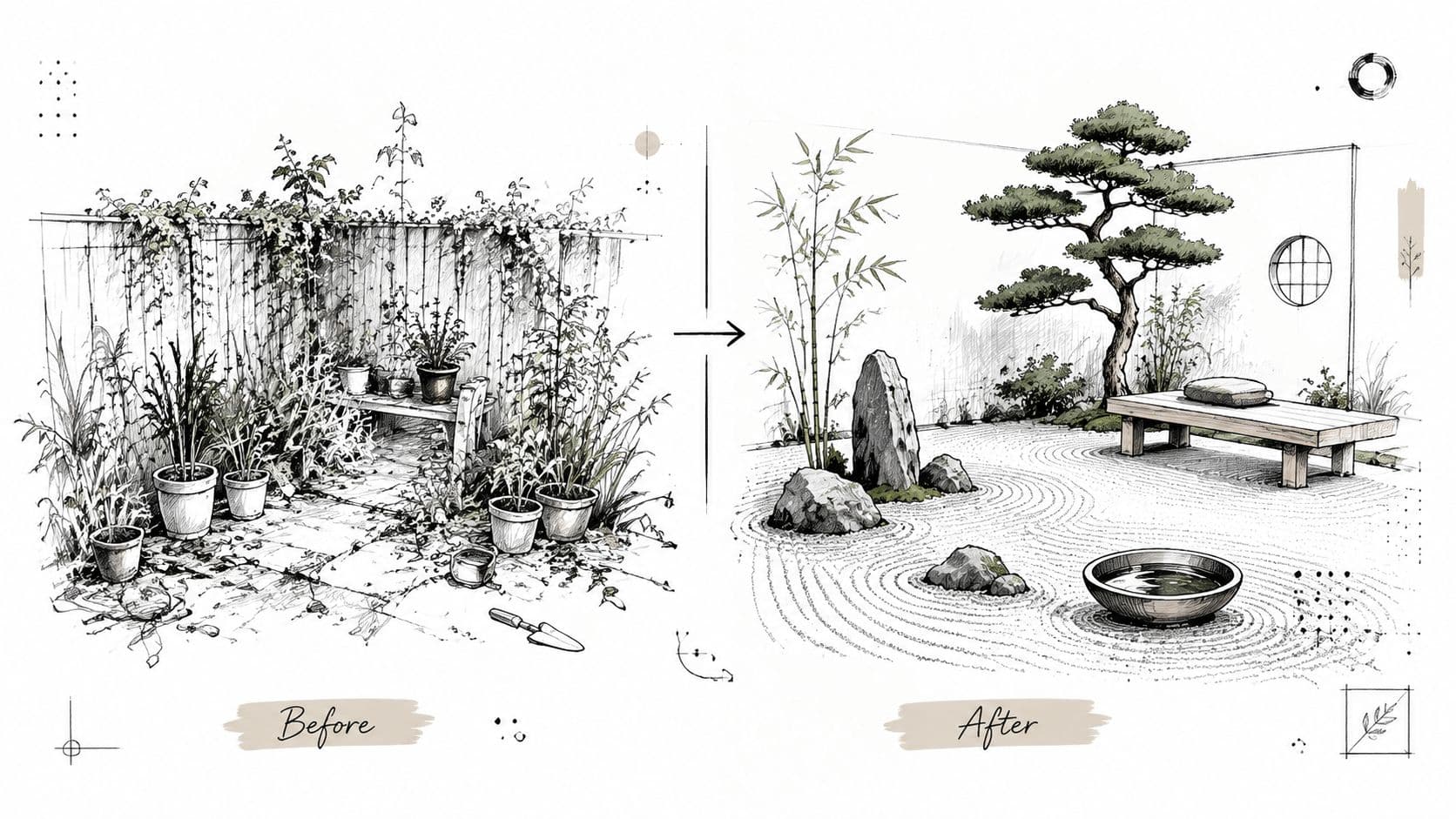
Minimalism needs disciplined framing
A Zen garden only works in before and after outdoor photos if the camera angle stays disciplined. You need consistent framing because the transformation is about proportion, spacing, and tension between objects. Shift the camera too much, and the “after” looks like a different yard rather than a better-composed one.
Use AI previews to test maturity and winter structure before installation. Minimal gardens can look complete in spring but exposed in colder months if all the interest comes from soft foliage. Evergreen anchors, stone rhythm, gravel fields, and pruned forms carry the composition when flowering plants disappear.
Design insight: Minimalist landscapes are less forgiving than lush ones. Every misplaced rock, oversized lantern, or awkward shrub becomes visible immediately.
What to pressure-test before building:
- Winter silhouette: The garden should still feel intentional when leaves drop.
- Night lighting: Subtle lighting can reveal texture, but overlighting ruins the calm.
- Viewpoints from inside: Zen gardens often perform best when framed from a single window, deck, or sliding door.
- Sound control: If you add water, make sure its scale matches the quiet visual language.
The best “after” doesn't look empty. It looks edited.
5. Native Plant Garden Conversion
A non-native ornamental bed can produce a polished “after” photo on day one and still disappoint later if the planting scheme never settles into the site. Native garden transformations are different. Their strongest before-and-after galleries don't just show immediate improvement. They show how the yard becomes more regionally coherent over time.
That makes documentation more demanding. Many guides focus on taking the before and after outdoor photos from the same angle, which is correct, but they stop too early. Native plantings change shape, density, and seasonal character much more visibly than static foundation beds, so a single finished photo can hide whether the design remains attractive once bloom cycles shift.
Native gardens need multi-season proof
One underused planning angle is seasonal verification. A source highlighting this gap notes that 78% of homeowners abandon landscaping projects due to underestimating maintenance needs post-installation. For native gardens, that means the “after” image should be treated as a checkpoint, not a final verdict.
In practical terms, an AI rendering should answer several questions before installation:
- What does the garden look like outside peak bloom?
- Will seed heads, grasses, and dormant structure still read as intentional?
- Does the design become messy at the edges or stronger with maturity?
- Can the homeowner maintain the look through seasonal cutback cycles?
Native projects in Texas, California, the Midwest, the Pacific Northwest, and Florida benefit from this approach because regional identity matters more than generic lushness. A planting list that's ecologically appropriate but visually unresolved won't persuade a homeowner from a single glamour shot. A series of comparison images across multiple months is far more credible.
That's where AI can become a verification tool instead of a mood board. Use it to preview bloom sequencing, mature spacing, and dormancy patterns, then compare those predictions against real follow-up photos once the garden is established.
6. Pool Area Luxury Resort Transformation
Basic pool areas usually have one problem: the water is doing all the work. The pool might be clean and functional, but the surrounding deck, furniture, planting, and lighting don't create a complete environment. In before and after outdoor photos, that reads as a utility feature rather than a destination.
The strongest resort-style transformations in Scottsdale, Miami, Southern California, Texas Hill Country, and high-end Southeast markets follow a hospitality logic. They build layers around the pool so the space feels intentional even when no one is swimming. Shade, enclosure, texture, and evening lighting matter as much as the waterline.
Luxury reads as composition, not just expense
A convincing luxury “after” image usually has a hierarchy. The pool remains the center, but the eye also lands on a lounge cluster, a spa edge, a fire element, or a sculptural planting mass. Material transitions do a lot of the work. Smooth coping against textured paving, soft planting against hard geometry, and warm lighting against reflective water create depth that plain concrete decks never achieve.
This is also where AI design tools outperform loose sketches. You can test how pale stone changes glare, whether dark furniture disappears at night, and how a pergola affects sightlines from the house. You can also render day and evening scenarios, which is critical because luxury pool areas often earn their strongest emotional response after sunset.
A useful sequence for planning:
- Start with circulation: Map where wet feet travel, where towels land, and how guests move between water and seating.
- Define one premium focal point: Spa spillway, linear fire feature, or statement planting. Choose one leader.
- Coordinate architecture: Mediterranean homes, modern homes, and transitional homes need different deck and furniture language.
- Render after-dark use: If the space only looks good at noon, it isn't finished.
Pool makeovers succeed when the after photo looks livable, not staged for a brochure.
7. Vegetable Garden Expansion
A few patio containers can prove interest, but they rarely create a productive system. The best vegetable-garden transformations show a shift from scattered enthusiasm to repeatable workflow. That's why the strongest before-and-after image in this category isn't about lushness alone. It shows order: raised beds, clear paths, trellises, compost access, and irrigation that matches how people garden.
Urban rooftops in New York and Chicago, suburban family yards, and rural homestead-style properties all benefit from the same core principle. Production gardens are logistics projects disguised as pretty scenes.
Production gardens succeed on logistics
Use AI planning to map sunlight, bed spacing, and vertical support before you build. It's much easier to test whether tall trellises throw shade across lower crops in a concept image than to discover it midseason. If you're exploring layouts, the best free garden design software can help organize beds, pathways, and functional zones.
The most effective “after” image usually includes:
- A path system: Wide enough for harvest, watering, and cleanup.
- Vertical structures: Trellises or arches that turn limited ground area into growing area.
- Support spaces: Compost, potting area, tool storage, or rain-barrel access.
- Visual rhythm: Repeated bed dimensions and edging that keep the garden legible in every season.
Don't judge an edible garden transformation by harvest-season fullness alone. Judge it by whether the space stays navigable and maintainable when everything is growing at once.
A productive design should still read clearly in photos taken early, mid, and late season. If the “after” only works for one peak month, the design needs more structure.
8. Modern Contemporary Hardscape Transformation
Traditional lawns often photograph as background. Contemporary hardscape transformations flip that relationship and make the ground plane the design feature. In Los Angeles, San Francisco, Miami, Austin, Brooklyn, Portland, Seattle, and other design-led markets, the appeal comes from geometry, proportion, and restraint.
That's why this category is harder than it looks. A modern yard can seem clean in a rendering but feel cold once built if the paver scale is wrong, the plant palette is too sparse, or the hardscape doesn't relate to the house.
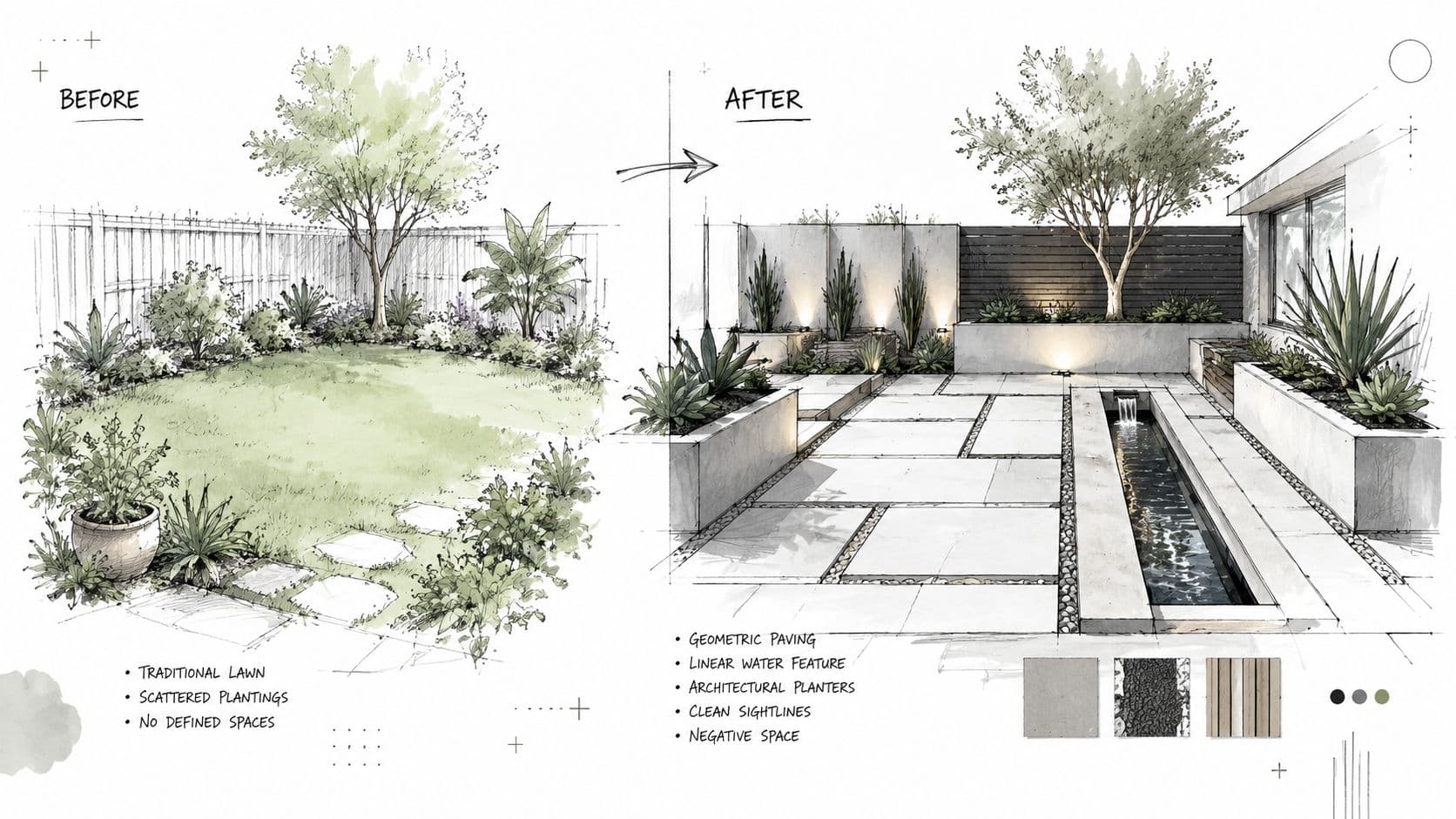
Modern yards depend on proportion
The strongest before and after garden photos in this style show clear spatial order. Pavers align with architecture. Planting is sculptural rather than fluffy. One water feature or fire element acts as a visual anchor instead of a pileup of amenities.
Modern hardscape is where AI previews become unusually practical because small proportional shifts change the whole result. You can test larger or tighter paver spacing, compare porcelain against concrete or stone, and check whether the design still feels balanced when viewed from a second-story window, a patio door, or the far corner of the yard.
Use these filters before committing:
- Match geometry to the house: A crisp hardscape next to a traditional cottage often feels disconnected.
- Limit the palette: Too many finishes weaken the modern effect.
- Use plants as punctuation: Agaves, grasses, clipped shrubs, or architectural forms should reinforce line and scale.
- Render shadow patterns: In modern spaces, sunlight and shadow are part of the composition.
The best “after” image in this category feels inevitable. Not flashy, not overcrowded, just resolved.
Before & After: 8 Landscape Transformations
| Example | Implementation Complexity (🔄) | Resource Requirements (⚡) | Expected Outcomes (📊) | Ideal Use Cases | Key Advantages (⭐) | Quick Tip (💡) |
|---|---|---|---|---|---|---|
| Small Urban Patio Transformation: Concrete to Mediterranean Oasis | Medium 🔄, careful vertical and multi-level planning | Low–Medium ⚡, planters, lighting, select hardscape | High 📊, strong visual impact and increased curb appeal | Urban patios, balconies, townhouses | Maximizes small footprints; high perceived value ⭐ | Use vertical planters; choose drought-tolerant species |
| Large Backyard Overhaul: Lawn to Multi-Zone Entertainment Space | High 🔄, zoning, circulation, utilities coordination | High ⚡, extensive hardscaping, irrigation, labor | Very High 📊, multiple functional zones and property value lift | Suburban estates, large lots, entertainment-focused homes | Creates distinct activity hubs; scalable ROI ⭐ | Plan irrigation and sightlines early; document options |
| Front Yard Curb Appeal Upgrade: Barren to Welcoming Entrance | Low–Medium 🔄, focused interventions with sightline care | Low–Medium ⚡, plants, walkways, lighting | High 📊, immediate first-impression improvement and ROI | Sellers, staging, quick-value upgrades for homes | Fast ROI; relatively quick implementation ⭐ | Choose hardy low-maintenance plants; add uplighting |
| Japanese Zen Garden Minimalist Transformation: Cluttered to Serene | Medium–High 🔄, requires design restraint and precision | Medium ⚡, quality stonework, selective planting | High 📊, strong serenity/aesthetic appeal; niche market | Wellness spaces, meditation areas, luxury homes | Timeless, low-water aesthetic; strong luxury appeal ⭐ | Emphasize negative space; use evergreens for structure |
| Native Plant Garden Conversion: Non-native to Ecological Paradise | Medium 🔄, research and staging for regional species | Low–Medium ⚡, plants, soil prep; long‑term lower inputs | High 📊, biodiversity gains and water savings (50–75%) | Eco-conscious homeowners, conservation projects | Supports wildlife, reduces water and chemicals ⭐ | Verify species for your region; plan bloom sequencing |
| Pool Area Luxury Resort Transformation: Simple to Hospitality-Style | High 🔄, complex mechanical, landscape, and lighting work | Very High ⚡, premium materials, specialist contractors | Very High 📊, major property value and luxury appeal | Luxury estates, resort-style renovation projects | Creates premium entertainment destination; strong ROI ⭐ | Visualize nighttime lighting and spa integrations |
| Vegetable Garden Expansion: Container to Full Production Garden | Medium 🔄, layout, rotation, and irrigation planning | Medium ⚡, raised beds, compost, trellises | Medium–High 📊, increased food production and sustainability | Urban growers, families, self-sufficiency projects | Fresh produce, education, reduced grocery costs ⭐ | Map sun exposure; plan crop rotation and trellises |
| Modern Contemporary Hardscape Transformation: Grass to Sleek Minimalist Design | Medium–High 🔄, precise geometry and material coordination | High ⚡, quality hardscape materials and installation | High 📊, striking visual impact and lower maintenance | Contemporary homes, urban yards, architectural projects | Low-maintenance, strong architectural integration ⭐ | Balance hardscape with architectural plants to soften look |
Next Steps for Your Own Landscape Makeover
The practical lesson from these eight transformations is simple. Before and after photos of outdoor spaces work best when they stop being inspiration-only assets and start acting like decision tools. A patio image should help you test circulation and lighting. A front-yard comparison should clarify resale logic and entry hierarchy. A native garden sequence should verify whether the design still works after peak bloom. A pool rendering should show both daytime function and nighttime atmosphere.
That shift matters because outdoor renovations create expensive mistakes when people decide from isolated snapshots. A beautiful single “after” can hide weak spacing, poor seasonal structure, awkward furniture scale, or maintenance demands that weren't obvious during planning. Side-by-side visuals reduce that risk because they force the eye to compare the same space before and after, under comparable framing.
If you're building your own playbook, start with a clean photo of the existing yard from the angle you'll want to repeat later. Then generate several concepts instead of falling in love with the first one. Compare them for movement paths, privacy, focal points, material consistency, and how the yard reads from inside the house. After that, translate the winning direction into a phased build sequence. Hardscape first, then irrigation, then planting, then lighting, then furniture and accessories.
That's also where estimating becomes more useful than inspiration. Once you know which concept survives comparison, move into materials lists, scope definitions, and contractor-ready visuals. For firms and homeowners trying to tighten that process, Exayard landscaping estimating software is one relevant tool in the workflow.
OutdoorBrite fits naturally into the visualization stage because it lets users upload a yard photo, test styles, and generate photorealistic redesign concepts. For homeowners, that can reduce guesswork before any demolition or planting starts. For contractors and designers, it can speed up client communication because the conversation moves from abstract preferences to visible options. If financing enters the picture, OutdoorBrite Money may be one option to review alongside the project scope.
The strongest makeover process is straightforward. Capture the existing yard, compare multiple directions, pressure-test the concept for seasonality and maintenance, then build from a plan that the homeowner and contractor can both see clearly. That's how before and after yard photos become more than satisfying visuals. They become evidence that the design holds up before the first shovel hits the ground.
OutdoorBrite Money can support homeowners who want to pair AI yard design visualization with a clearer path to project planning and execution. Explore OutdoorBrite Money if you want to review design ideas, compare outdoor renovation options, and move from concept images to an actionable yard project.
See your yard reimagined
Start creating