8 Fire Pit Area Ideas for Backyard Spaces in 2026
Explore 8 fire pit area ideas for backyard layouts, from stone rings to gas patios, with materials, seating, safety, and lighting tips for your project.
You're looking at a square of grass, a fence, and the patio chairs you already own, trying to work out where a fire pit could go. Near the house would be convenient, but the fence is close. Farther down the lawn looks better until you notice the slope, and you still don't know whether you're pricing a gravel pad or an excavation job.
Start with the yard you have, not the photo you saved. The useful fire pit area ideas for backyard spaces aren't just different finishes around the same flame. They solve different problems, from an exposed patio that catches every gust to a sloping lot where a level gathering space requires retaining work.
Before buying anything, watch where wind carries leaves, where rainwater collects, and how people walk between the back door and the lawn. Think about who'll sit there, too. A family roasting marshmallows needs a different arrangement from a couple who want a gas flame beside their evening drinks.
Placement first: A smaller fire feature in a safe, comfortable location is a better investment than a large one squeezed between combustible boundaries.
These layouts are practical starting points, not construction drawings. Choose the shape that fits your ground, circulation, climate, and appetite for DIY, then check the actual appliance requirements and local rules before committing to materials.
Table of Contents
- 1. Classic Stone Ring Fire Pit with Gravel Surround
- 2. Sunken Fire Pit
- 3. Gas Fire Pit on a Paver Patio
- 4. Built-In Seat Wall Fire Pit
- 5. Modern Linear Fire Feature
- 6. Portable Fire Bowl on a Deck or Patio
- 7. Woodland Fire Circle with Log Seating
- 8. Xeriscape Fire Pit with Gravel and Drought-Tolerant Plantings
- How the eight fire pit area layouts compare
- Pick One Layout, Test It on Your Yard, Then Build
1. Classic Stone Ring Fire Pit with Gravel Surround
A stone ring with a gravel surround suits a reasonably level lawn where you want an informal gathering place without paving an entire outdoor room. Think of a suburban yard with movable Adirondack chairs and a clear approach from the patio, not a ring tucked tightly into a fenced corner.
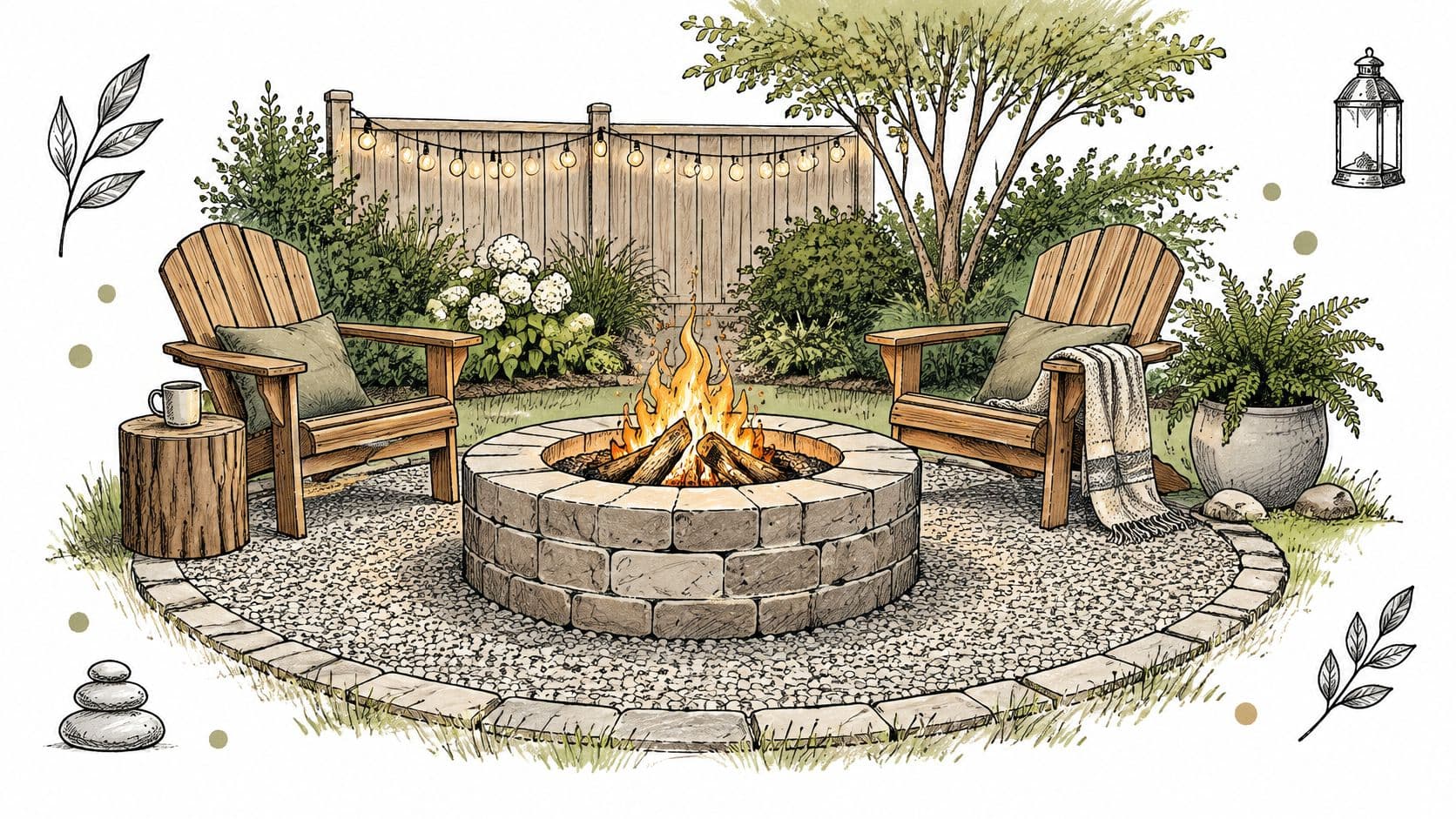
Mark the safety zone before the gravel outline. The U.S. Fire Administration recommends positioning outdoor fire pits at least 10 feet from a home or anything else that can burn, including fences and vegetation. Local requirements and appliance instructions may demand more space, so that minimum isn't permission to squeeze a pit into an unsuitable yard.
Build the base, not just the ring
Remove turf and organic material, establish a stable mineral base, and install edging so gravel doesn't migrate into the lawn. Angular crushed aggregate generally stays under chair legs better than rounded pea gravel. Neither is as convenient as firm paving for a wheelchair, walker, or rolling drinks cart.
- Choose a compatible kit: Use a fire-pit system with a specified liner and masonry components, rather than assuming decorative wall block or collected river stones can tolerate direct flame.
- Separate weeds from heat: Keep combustible garden fabric out of the combustion area and follow the kit's base detail.
- Leave an opening: Arrange chairs so someone can approach with extinguishing equipment without stepping between occupied seats.
This is a realistic DIY option when the ground is already suitable. It stops being simple when you need retaining walls, major grading, or a drainage system. In rainy climates, confirm that the proposed pad won't become the yard's collection basin.
2. Sunken Fire Pit
A sunken fire pit can make a large, exposed yard feel more enclosed. On a hillside, it can also create a gathering terrace within the slope, with steps approaching from above and a more open entrance on the downhill side.
The excavation is the easy part to picture. The drainage is the part to solve. A depressed patio collects runoff unless the design intercepts water and gives it a dependable outlet. A gravel sump isn't a universal fix, particularly in clay soil or where groundwater sits close to the surface.
The video offers a visual reference for the sunken arrangement.
Decide whether the slope helps or hurts
Say your lawn falls away from the house. A contractor may be able to cut a seating terrace into the upper ground while preserving a level entrance from the lower garden. That can work better than excavating a fully enclosed bowl in a flat, wet yard.
Before excavation, arrange utility locating and investigate where roof drains, irrigation pipes, and buried services run. Retaining walls need structural and drainage details appropriate to the soil and loading.
Don't buy a sunken layout for wind protection alone. Lowering the seating area doesn't make strong-wind burning safe or guarantee that smoke will miss your guests.
Use slip-resistant paving, clearly visible step edges, and lighting that reveals changes in level without shining into seated faces. If anyone needs step-free access, resolve the approach before approving the shape. This is generally a hire-out layout, especially when excavation, retaining work, gas service, or drainage outlets are involved.
3. Gas Fire Pit on a Paver Patio
For a household that wants to sit outside after dinner without storing firewood or clearing ash, a gas fire pit on a paver patio is a practical choice. Place it beside the main circulation route rather than directly in it, with enough room to pull chairs back without blocking the kitchen door.
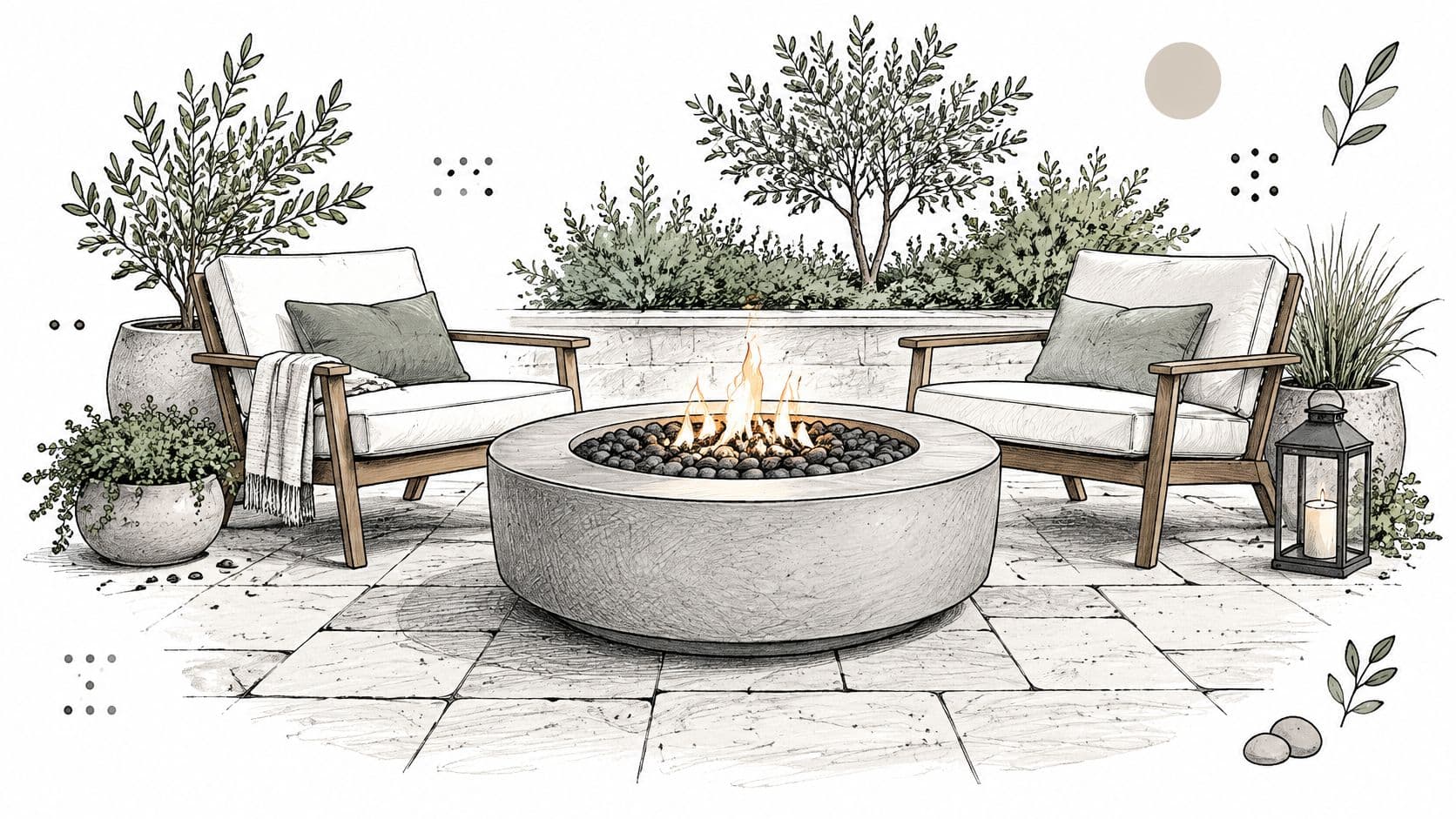
Fuel choice affects more than convenience. The U.S. Environmental Protection Agency states that natural-gas and propane appliances reduce harmful air pollutants compared with wood burning, while identifying children, older adults, and people with certain heart and lung conditions as particularly sensitive to wood smoke. Gas still requires appropriate outdoor ventilation and clearances.
Choose the fuel before laying the patio
A propane model avoids a permanent gas-line route, but you'll need compliant cylinder storage and access for replacement. Natural gas removes that handling task but adds installation work. Have a qualified gas professional size and connect a permanent supply, and keep shutoffs accessible.
- Plan the service route: Don't run a loose fuel hose across a walking path.
- Check overhead conditions: A pergola in an inspiration image isn't proof that a particular burner is approved beneath it.
- Specify the paving: Compare slip resistance, frost suitability, and installation requirements when weighing porcelain versus stone for outdoor spaces.
For a patio that also handles dining, use ai backyard patio design as a visual comparison step, then mark the proposed furniture and appliance footprint on the ground. Keep the burner assembly level while grading the surrounding patio to drain away from the house.
4. Built-In Seat Wall Fire Pit
Built-in seating works best where you already need a strong patio edge. A masonry wall can separate the gathering area from a lawn or raised garden while reducing the number of loose chairs you have to move and store.
The trade-off is permanence. If the wall sits too close to the flame, guests can't move it back. Test the seating position with movable chairs and the selected appliance's clearance requirements before approving the wall radius.
For a family patio, an open-sided arc usually offers more flexibility than a closed circle. It leaves room for movable chairs, access to the fire feature, and a direct route back toward the house.
Leave space for people, not just masonry
The U.S. Forest Service accessibility guidance calls for clear ground space extending at least 48 inches around all usable sides of fire rings and similar features in its applicable setting. That's a useful planning reference, not a substitute for checking the standards that apply to your project or the appliance's heat clearances.
- Provide a level approach: A beautiful seat wall doesn't compensate for a loose-gravel entrance or awkward step.
- Allow seating choice: Include room for a wheelchair user to join the group without sitting in the access opening.
- Detail the wall correctly: A wall retaining soil needs drainage and structural consideration beyond that of a freestanding garden seat.
In cold climates, have the footing and base designed for local frost conditions. In hot climates, compare cap samples in direct sun before selecting a dark finish. Keep combustible cushions and timber details outside required clearances, even when the wall underneath is masonry.
5. Modern Linear Fire Feature
A long, narrow yard often suits a linear gas feature better than a circular pit. Position the trough parallel to the main seating group so it defines the lounge without forcing people to walk around a central obstacle.
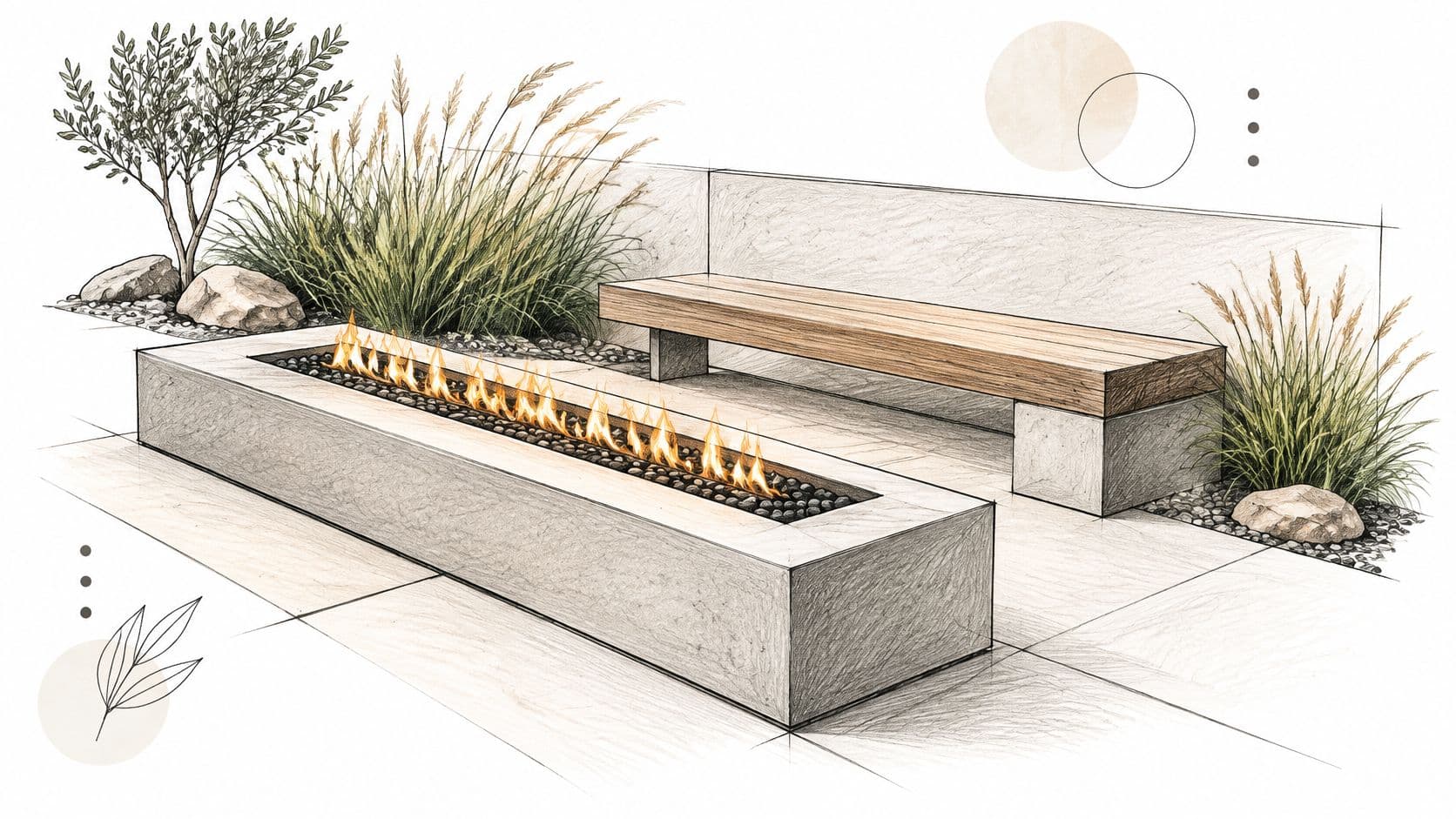
For example, a rectangular patio outside sliding doors could have dining near the house and a linear burner facing a sofa farther into the yard. That arrangement preserves a clear route along the side. It works less well if the trough narrows the only passage to the garden.
Keep the feature visually simple, but don't simplify away its servicing requirements. Burner controls, ventilation openings, drainage provisions, and access panels all need a place in the design. Have the installer coordinate them before the enclosure is clad.
Treat wind as a placement constraint
Long flames can lean toward nearby furniture in crosswinds. Observe the proposed location during the hours you'll use it, and choose a burner system suitable for the exposure. Only use a glass wind guard if it's compatible with the appliance.
Design check: A fire trough should define the edge of a gathering space, not become an obstacle people step over.
Avoid recessing an unguarded flame channel flush into a walking surface. Give the feature a visible, deliberate boundary and keep planting outside its required clearances. Ornamental grasses may suit the appearance, but dry foliage doesn't belong beside the burner.
This is a contractor-led option when it involves a custom enclosure or permanent fuel connection. DIY effort is better spent on furniture placement and surrounding finishes than improvising burner ventilation or gas plumbing.
6. Portable Fire Bowl on a Deck or Patio
Portable doesn't mean suitable for every surface. A freestanding bowl is useful when you want seasonal flexibility, but moving it onto a wooden deck, composite boards, or a balcony can introduce restrictions that don't exist on an open masonry patio.
A typical good fit is a homeowner testing a conversation area on an existing, level concrete patio. The bowl can be stored when cold, and the furniture can change with the gathering. A cramped deck beneath an overhang is a different proposition, even if the product looks compact.
Make the surface decision first
Check both the appliance instructions and the rules governing the property. Don't assume a protective mat makes a wood-burning bowl acceptable on decking. For a deck layout, use ai deck design to compare circulation and seating, but establish appliance suitability independently.
If you're considering a secondary-combustion model, understand the limits of the smokeless label. A U.S. Forest Service Fire Sciences Laboratory study measured average fine-particulate emissions of 2.2 grams per kilogram of firewood across the recreational pits tested, approximately 80% below the traditional-fire-pit emission factor used for comparison. That finding doesn't establish the performance of every commercial model.
- Use suitable fuel: Store seasoned wood under cover with ventilation, and follow the appliance's loading instructions.
- Keep equipment ready: Maintain an unobstructed route to suitable extinguishing equipment.
- Move it cold: Don't relocate a bowl containing hot fuel, ash, or embers.
In windy or seasonally restricted areas, portability is useful because you can store the appliance rather than designing the whole patio around something you can rarely operate. It isn't a workaround for a burn ban.
7. Woodland Fire Circle with Log Seating
A woodland fire circle earns its look at the edge of a clearing, where the trees form a backdrop rather than a roof. Set deep under a canopy or beside accumulated leaf litter, the same layout becomes a fire spread risk, no matter how good it photographs.
Take a rural yard that fades from mown lawn into native woodland. The fire area belongs on the open side: a mineral-surface path leading in, bare ground or stone under the seating zone, and the tree line kept back from the heat. Cutting a small pocket out of dense growth and dropping a ring into it leaves low branches, dry undergrowth, and trapped heat overhead.
Keep the rustic appearance, remove the traps
Log seats look right here and cause the most complaints. They're heavy, they go unstable as they decay, and guests can't shift them to follow the conversation or escape the smoke side of the pit. Set each log on a firm, level base, check it for rot at the start of each season, and keep it outside the clearance the pit manufacturer specifies. Add a few conventional chairs with backs and arms, since a low log is a hard seat for anyone with knee or back trouble.
- Manage ground fuel: Rake out fallen leaves, needles, and twigs across the fire area and the path in, and cut back dry growth that creeps toward the ring over the season.
- Avoid mulch at the flame: Stop the bark path where the gathering zone starts and switch to gravel, stone, or bare mineral soil around the pit.
- Preserve tending access: Leave enough open ground beside the pit to reach the fire, work a poker, and bring in water without stepping over seating.
Before lighting any outdoor fire, contact your local fire department. Burn restrictions vary by area and can tighten during dry or windy periods, and in fire-prone regions the permission to burn at all can change week to week.
For DIY work, this layout is one of the more forgiving ones: most of the job is clearing, leveling, and setting seating. Hire out when the clearing needs tree assessment, significant grading, or drainage changes. Never remove major branches or fell trees to force a fire pit into a spot that doesn't suit one.
8. Xeriscape Fire Pit with Gravel and Drought-Tolerant Plantings
A xeriscape fire area suits a sunny yard where you want less irrigated lawn and a durable gathering surface. The strongest layout usually combines a firm seating pad, gravel beyond it, and planting beds arranged around movement rather than packed against the fire feature.
For a dry-climate courtyard, consider stone or concrete seating surfaces with agave or yucca placed away from chair backs and paths. In a Mediterranean-style yard, keep woody shrubs and seasonal dry growth separated from the combustion zone. Drought-tolerant doesn't mean noncombustible.
Design for heat as well as low water use
Gravel and masonry can make an exposed sitting area uncomfortable before sunset. Test material samples outside, consider when you'll use the space, and locate any shade structure well away from the appliance's restricted overhead zone. Don't solve afternoon sun by placing the burner beneath an unsuitable canopy.
An ai generated backyard design can help compare a planted perimeter with a more open gravel arrangement. Keep the final decision tied to actual walking routes, mature plant size, and site measurements rather than the rendering alone.
- Keep sharp plants back: Allow for people pulling chairs out or walking past in low light, not just the plant's current nursery size.
- Group irrigation needs: Separate planting zones so low-water plants aren't watered on a lawn schedule.
- Stabilize the seating surface: Loose aggregate can shift under narrow chair legs; firm paving is often better where people sit and turn.
On sloping ground, gravel needs containment and runoff planning. In windy conditions, think about dust, displaced lightweight materials, and where dry leaves collect. Choose fuel only after checking local fire and air-quality restrictions, especially where dry weather limits recreational burning.
How the eight fire pit area layouts compare
| Item | Best For | Installation Effort | Seating Style | Key Trade-Off |
|---|---|---|---|---|
| Classic Stone Ring Fire Pit with Gravel Surround | Affordable, casual backyard gatherings | Low; often a weekend DIY project | Separate chairs or a bench | Low cost and easy to place, but seating is not built in |
| Sunken Fire Pit | Cozy, sheltered outdoor conversation areas | High; excavation and drainage planning required | Built-in ledges or step-down seating | Intimate and wind-sheltered, but harder to drain and maintain |
| Gas Fire Pit on a Paver Patio | Convenient, low-maintenance patio use | Moderate to high; gas hookup may need a professional | Patio lounge or dining seating | Quick, clean flames, but higher upfront cost and less wood-fire ambiance |
| Built-In Seat Wall Fire Pit | Permanent outdoor rooms with integrated seating | Moderate to high; masonry construction required | Fixed masonry seat wall | Durable, space-defining seating, but difficult to rearrange |
| Modern Linear Fire Feature | Contemporary, narrow, or minimalist outdoor spaces | High; custom work and professional gas installation may be needed | Low-profile integrated bench or nearby seating | Sleek and space-efficient, but costly and less suited to rustic styles |
| Portable Fire Bowl on a Deck or Patio | Renters, small yards, and flexible setups | Low; no construction required | Movable chairs | Portable and affordable, but requires a safe, level surface |
| Woodland Fire Circle with Log Seating | Informal gatherings in wooded or rural settings | Low to moderate; site clearing and basic setup | Logs, stumps, or rough-hewn timber | Natural and low-cost, but seating is less comfortable and fire risk can be higher |
| Xeriscape Fire Pit with Gravel and Drought-Tolerant Plantings | Dry climates and water-conscious landscaping | Moderate; requires thoughtful planting and surface planning | Low-profile seating, often stone | Low-water and durable, but gravel needs upkeep and spiny plants need careful placement |
Pick One Layout, Test It on Your Yard, Then Build
The right layout is the one that fits your yard without requiring you to ignore its awkward parts. A gravel circle can be a sensible DIY project on level ground. A sunken terrace can suit a slope, but only when drainage and access work. A gas table may serve a frequently used patio better than a wood fire that sends smoke toward the house.
Choose the location and fuel before choosing the finish. Stone color is easy to debate and comparatively easy to change on paper. A poorly positioned gas line, obstructed access route, or retaining wall is a much more expensive mistake.
Use this decision checklist before ordering materials or requesting final quotes:
- Confirm permission and clearances: Check local fire rules, permit requirements, property restrictions, and the selected appliance's instructions. Include fences, sheds, vegetation, overhead branches, and combustible furniture in the placement review.
- Read the ground: Identify slope, wet areas, drainage outlets, buried services, and any retaining work. Don't assume a gravel finish eliminates the need for base preparation.
- Observe wind and smoke routes: Spend time in the proposed location during your likely gathering hours. Consider neighboring windows and patios as well as your own seating.
- Mock up the whole gathering: Mark the appliance, occupied chairs, access opening, and walking routes. Pull chairs back and carry a tray through the space.
- Match the job to your skills: Keep gas connections, structural retaining work, and complicated drainage with qualified professionals. DIY the parts you can execute and inspect properly.
Compare a small set of layouts on the same yard photo before spending money on stone or gas. Our OutdoorBrite AI fire pit design lets homeowners and DIYers add a fire pit to a photo of their own backyard and weigh styles, seating, and materials before committing. Use those concepts to discuss appearance and arrangement, then verify dimensions and construction requirements on site.
A rendering isn't a survey, permit, or appliance installation plan. Pair the preferred concept with measurements, the chosen product's documentation, and a clear scope for whoever builds it. Ask contractors to distinguish base preparation, drainage, utility work, appliance installation, and finishes in their proposals so you can compare the actual work.
Finally, leave room to change your mind about furniture. Permanent paving and safely installed services should support the gathering, not lock every guest into a fixed position. When the plan gives people comfortable seating, a clear way through, and appropriate separation from the flame, you're ready to select the materials.
OutdoorBrite turns a photo of your backyard into redesign concepts, including fire-pit layouts with seating and surrounding materials. Visit OutdoorBrite, upload a clear photo, and compare a rustic circle with a patio-based gas layout before you buy materials or brief a contractor.
See your yard reimagined
Start creating