8 Planting Ideas for Retaining Walls That Work in 2026
Discover 8 planting ideas for retaining walls, from groundcovers and sedum pockets to native grasses, with species picks, planting tips, and design advice.
You have a two-foot block wall above the lawn, and after every storm a ribbon of soil ends up in the grass. The cap bakes in afternoon sun. Last spring's pretty flat is half dead, and the wall still looks like a curb. The plant that thrives on a cool, shaded timber bank will rot or starve on this one.
Height, sun, and drainage should pick the planting, not a photo from someone else's yard. A low, dry, south face wants a shallow mat. A taller wall with wet clay behind it needs roots that hold soil and a drain that still flows. A wall under a mature tree is a third job, because changing the grade can starve roots that were already doing the work.
These eight planting ideas for retaining walls match those conditions. Each one names species, a way to set them, and the trade-off that makes it fail. I would rather you skip three options than force a look that fights the wall.

Table of Contents
- 1. Creeping Ground Covers for Sunny Walls
- 2. Ornamental Grasses for Texture and Movement
- 3. Deep-Rooted Shrubs for Structure
- 4. Sedum and Succulent Pockets for Dry Walls
- 5. Trailing and Cascading Plants Over the Wall Top
- 6. Flowering Perennials for Seasonal Color
- 7. Climbing Vines on Wall Faces
- 8. Native Drought-Tolerant Plantings for Water-Wise Walls
- How the Eight Retaining Wall Planting Options Compare
- Matching Your Wall to the Right Planting Plan
1. Creeping Ground Covers for Sunny Walls
Say the front wall is stone, about knee high, and it faces the street with almost no shade. Creeping thyme, creeping phlox, and sedum can knit a mat over the top course and soften the face without a deep root ball. That is the right scale for a two-foot wall. A shrub here would outgrow the bed before the thyme has even filled in.
The USDA Forest Service treats this kind of cover as erosion control, not decoration. Herbaceous plants with dense, fibrous roots protect soil from surface erosion, while foliage intercepts rainfall and cuts the force of raindrops on bare ground. On a sunny crest, that mat is doing both jobs between storms.
What makes the mat succeed
- Plant in spring or early fall: Roots need mild weather before heat or a hard freeze.
- Use a gritty mix: Heavy, wet soil rots thyme and sedum at the crown.
- Space plugs 6 to 12 inches apart: Closer spacing fills faster on a short run.
- Match the hardiness zone: A Mediterranean thyme that loves your July will still die in a zone it was never bred for.
A Mediterranean front yard can carry thyme along the cap, with sedum mats on the drier terrace below where you barely water. For layout ideas on a street-facing wall, OutdoorBrite's retaining wall guide is a useful pass before you buy flats.
Practical rule: If the soil stays soggy a day after rain, do not plant a mat. Fix the drain, or move the color into a bed that is not sitting on the backfill.
2. Ornamental Grasses for Texture and Movement
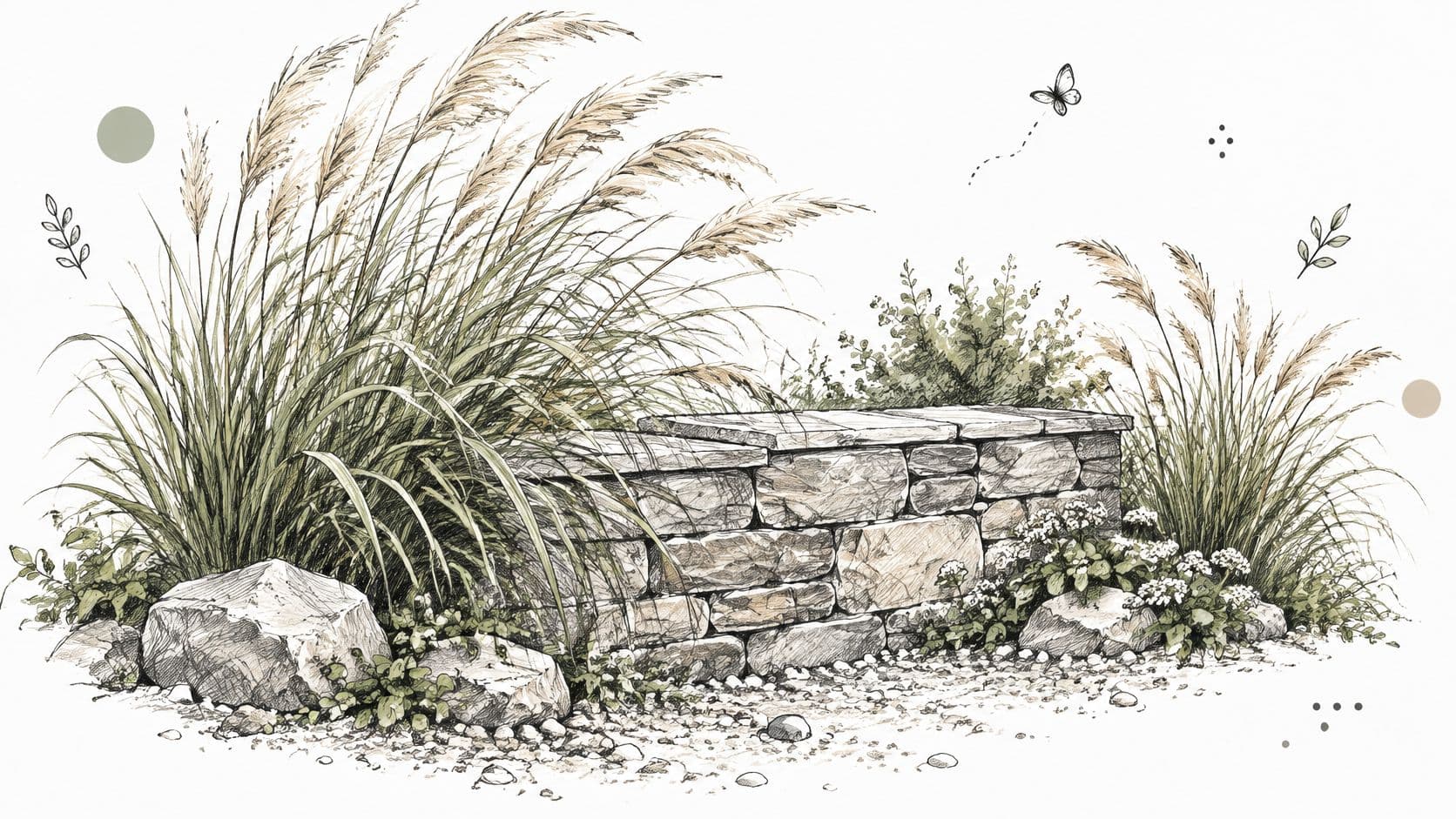
Choose ornamental grasses by the conditions above and behind the wall. Blue fescue stays compact and suits a short cap or a dry, sunny face. Little bluestem and switchgrass bring taller structure and movement, but their mature height can overwhelm a low wall or flop onto the lawn. For a two-foot wall, use fescue. Reserve taller grasses for a higher wall where their winter seed heads will not crowd the space below.
Sun and drainage narrow the choice further. Blue fescue paired with sedum can suit a dry south-facing wall, where the planting does not need frequent summer watering. In shade or persistently damp soil, choose a grass suited to those conditions rather than forcing a sun-loving clump into a poor fit. Working drainage behind the blocks matters: gravel backfill and a pipe outlet help move water away. Use clean topsoil in planting pockets, and avoid daily irrigation that keeps the backfill wet.
Keep the clumps honest
- Plant in groups of three or more: A single fescue can look isolated; a group gives the wall a deliberate rhythm.
- Leave seed heads through winter: They provide structure after the growing season and food for birds.
- Divide every three to four years: Older clumps can thin in the center, leaving a ragged outline.
- Keep irrigation off the crest: Normal rain is fine. Daily spray into the backfill can leave roots sitting wet.
Use the Prestonwood Commercial Landscape Services grass guide to compare grasses for heat and long dry seasons. Avoid running grasses at the wall. Clumping varieties stay contained and are easier to lift and reposition if their size or placement proves wrong.
3. Deep-Rooted Shrubs for Structure
Where a tall wall makes ground cover look undersized, creeping juniper, cotoneaster, and dwarf winged euonymus can add mass and soften the transition from lawn to terrace. Juniper can spill over a tiered commercial wall; cotoneaster can suit a backyard block wall. Both need planting space outside the drainage rock. A shrub placed in that rock can interfere with the wall's drainage.
A peer-reviewed study of ecological reinforced-soil walls found that higher root density in the active zone reduced four measured response parameters by averages of 43%, 15%, 25%, and 52% compared with an unrooted wall. The study also reported improved stability and bearing capacity, and that roots can offset some reinforcement loss from aging and creep, as described in that Bulletin of Engineering Geology and the Environment paper. For a planted wall, this supports choosing shrubs with many branching roots rather than forcing a large woody plant into a tight space.
Set the shrub where the wall can live with it
Keep the root ball well clear of the block face, weep holes, and drainage rock. Choose a cultivar that stays below the cap, place the root ball slightly above grade, and mulch without covering the crown. These details matter on a narrow or poorly drained terrace, where a shrub that outgrows its space can obstruct drainage or press against the wall.
Large trees need a designer's review. Wind, weight, and the stakes used to hold a new tree can load the wall, even if mature roots may help reinforce soil. Match the shrub's mature size to the wall's height and available planting area.
For tiered backyard walls, backyard landscaping ideas with retaining walls can help you plan where the shrub mass belongs before digging. Keep planting clear of drainage outlets, so foliage does not hide a problem that needs attention.
Dense roots can help bind soil, but they do not replace checks for sliding, overturning, bearing, and groundwater.
4. Sedum and Succulent Pockets for Dry Walls
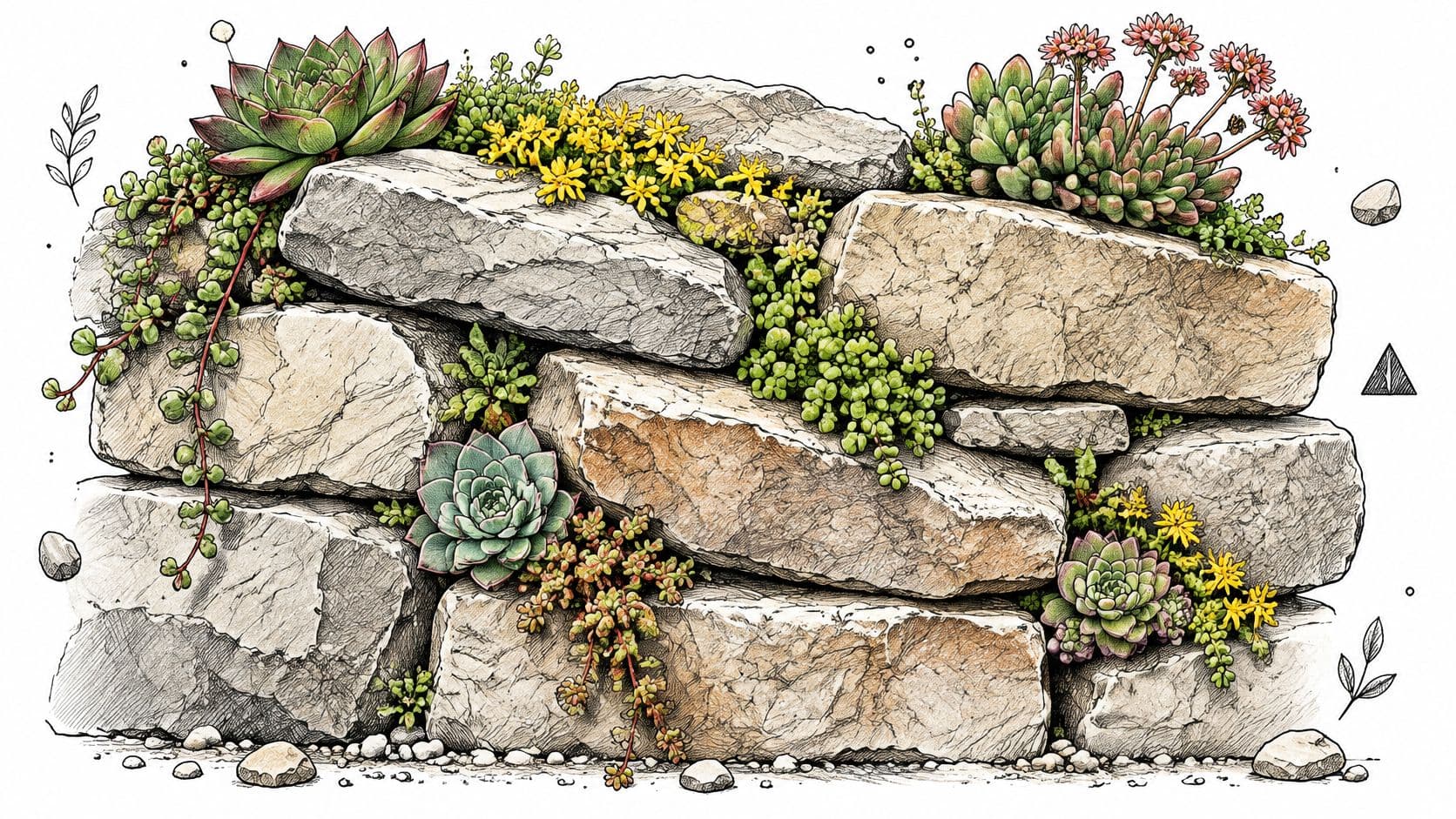
Sedum, hens-and-chicks, and other succulents suit dry-stacked joints and pockets that drain quickly. Their fleshy leaves store moisture, making them a practical choice for a hot, sunny wall where regular irrigation is limited. They struggle where water stays behind the stone, so check drainage before planting rather than treating every gap as a suitable pocket.
For a drainage benchmark, Snohomish County specifies a drainage-rock zone at least 1 foot wide and a perforated PVC outlet at least 4 inches in the lowest layer. The pipe should slope slightly, and nonwoven geotextile helps keep soil from clogging the drainage rock. Your local permit may use a different specification, but the planting still needs to leave weep holes, outlets, and the water-carrying swale clear. Keep pockets out of the drainage zone.
Pocket mix and watering
Fill a planted joint or pocket with cactus soil mixed with pumice or gravel. Water new plugs for a few weeks, then reduce watering; persistent moisture works against these plants. Skip joints that show water after rain. For more examples of suitable wall placements, browse these planting ideas for retaining walls.
A short walk-through shows how to tuck a plug into a joint:
This approach suits a low wall in full sun with little irrigation. Height matters too: pockets should be reachable for planting and occasional checks, while the wall's drainage path stays open. A mortared wall without purpose-built soil pockets is a poor fit. Forcing a succulent into a narrow crack can leave it with too little growing room and put soil where the joint was meant to remain clear.
5. Trailing and Cascading Plants Over the Wall Top
Creeping jenny, trailing rosemary, and vinca minor earn their place when the face is plain and you want the eye to drop. Rosemary over a sunny Mediterranean stone wall smells like the climate it came from. Vinca over a shaded suburban wall covers faster, and that speed is also the risk. Check whether vinca is listed as invasive where you live before it leaves the pot.
Plant in a pocket at the cap, or just behind the cap stone, not in the drainage chimney. Cascading plants dry out faster than a mat on flat ground, so they need more water, but that water has to leave through the face or a pipe. Dead stems left in the tangle rot and host pests. Strip them.
Walls that already have a tree
The unanswered question on a lot of lots is whether you can plant a wall beside a mature tree without suffocating it. University of Wisconsin Extension warns that a grade change alters the air, water, and nutrients reaching established roots. Adding soil behind a new wall can bury them. Cutting a footing can sever structural roots. A “safe” trailing plant does not fix either mistake.
Keep the original grade inside the root zone, curve or shorten the wall, and dig by hand near large roots. Do not aim irrigation so water pools at the trunk or against the blocks. A low trailer at the crest can work in shade. Do not use a woody shrub to hide a wall that already cut the tree. I would rather see less planting under the canopy and more interest farther out, where you are not spending the tree to decorate the stone.
6. Flowering Perennials for Seasonal Color

Salvia, catmint, coneflower, and penstemon can turn a retaining wall into the back edge of a flower border. Match the plants to the wall's conditions. On a sunny terrace with well-drained soil, salvia and catmint handle heat and provide a long bloom period. For a prairie-style bed, combine penstemon with coneflower for a pollinator-friendly planting that needs less frequent watering than a lush cottage-garden mix.
Terraced retaining walls are an ancient way to hold soil and direct water toward planted beds. In a home garden, the same practical principle applies: create a usable bed while keeping water moving through or away from the wall. Flowers add seasonal color, but they do not replace sound drainage.
Drift them, do not dot them
- Plant in groups of threes or fives: A single coneflower can look isolated; grouped plants read as a deliberate drift.
- Put taller plants behind shorter ones: Keep the wall cap visible, especially on a low wall where tall growth can hide the stone.
- Favor regional natives: They can better match local rainfall and provide food for local insects.
- Mulch lightly: Cover bare soil, but keep mulch off the plant crowns.
Wall height and soil depth affect how well perennials establish. A shallow bed at the crest dries quickly, so choose drought-tough plants rather than a thirsty mix. Sun exposure matters too: heat-loving choices suit a sunny wall, while plants that need more moisture may struggle in the same thin soil. Check drainage before planting. Perennials can fail in a narrow layer of soil over construction fill, or when frequent watering leaves the bed, and potentially the wall, too wet. Keep a fuller, water-hungry border where you can soak the soil without sending excess water toward the structure.
7. Climbing Vines on Wall Faces
Climbing hydrangea on a mesh trellis can turn an older stone wall into a green backdrop. Virginia creeper can do the same on a rural stone face. Tendrils, aerial roots, and adhesive pads are not the same attachment, and adhesive pads on block or mortar are a commitment you will regret at repaint time.
This is the option I am pickiest about. It wants a sturdy, solid wall, a separate trellis or wire, and a prune twice a year so growth stays out of joints, weep holes, and any gutter above. Skip English ivy and anything your state lists as invasive. On a tall or load-bearing wall, talk to a structural engineer before the vine is more than a suggestion.
A planted face is not automatically a manufactured living wall, and the price gap is the point. A 2026 market report estimates ground-bound green façades with climbing aids at about €100–€300 per square meter, against about €400–€1,000 per square meter for wall-bound living walls, according to Dataintelo's green walls market report. A vine on wire is the cheaper path when the wall is already sound. It is the wrong path when the face is failing and you were hoping foliage would hide the crack.
If you cannot point to the weep holes after the vine leafs out, you planted too much.
8. Native Drought-Tolerant Plantings for Water-Wise Walls
Little bluestem with regional wildflowers on a terrace, or California buckwheat and sage on a dry Southwestern wall, is the planting that matches rainfall instead of fighting it. You water thoroughly and not often in the first season, then you mostly stop. Mulch with shredded wood or gravel, and buy from a native-plant nursery or society that grows local stock, not a big-box lookalike.
Check local rules before you assume “native” or “xeriscape” is unrestricted. Some cities still police front-yard plant lists, height, and what counts as maintained. A water-wise wall can look intentional. An unmowed weed strip in front of a new wall reads as unfinished, and that is a design problem, not a plant problem.
The wall itself is the expensive part. A 2026 contractor pricing page puts installed retaining walls at $20–$50 per square foot, with many professional builds landing between $3,500 and $10,000, per Colonial Landscape's cost guide. Spending that and then soaking a crest until the backfill stays wet is an expensive way to grow sage. Fewer plants immediately behind the wall, and more of the show in a separate bed you can water on purpose, protects both the plants and the structure.
I use this palette when sun is high, irrigation is limited, and you want the wall to disappear into the slope within two seasons. I do not use it in deep shade, or on a wall that still ponds. Drought-tolerant plants drown on schedule.
How the Eight Retaining Wall Planting Options Compare
| Item | Best Exposure | Maintenance Level | Water Needs |
|---|---|---|---|
| Creeping Ground Covers for Sunny Walls | Full sun | Low once established | Low; many tolerate drought |
| Ornamental Grasses for Texture and Movement | Full sun | Low; cut back seasonally | Low once established |
| Deep-Rooted Shrubs for Structure | Full to part sun | Low to moderate | Low to moderate once established |
| Sedum and Succulent Pockets for Dry Walls | Full sun | Low | Very low |
| Trailing and Cascading Plants Over the Wall Top | Sun or shade, depending on species | Moderate; regular trimming | Moderate; exposed plants may need extra water |
| Flowering Perennials for Seasonal Color | Full sun | Moderate | Low once established |
| Climbing Vines on Wall Faces | Part shade to full sun | Moderate to high; regular pruning | Moderate during establishment and dry spells |
| Native Drought-Tolerant Plantings for Water-Wise Walls | Suited to local conditions | Low once established | Low after establishment; water during establishment |
Matching Your Wall to the Right Planting Plan
Start beside the wall, not with a plant catalogue. Measure its height, note where the sun falls in midafternoon, and check what happens after rain: does water exit through the face, or does soil stay wet above the cap? Those three conditions narrow the options before you buy.
For a low wall in full sun with freely draining soil, try creeping thyme or sedum. Add blue fescue for movement. Skip deep-rooted shrubs and vines in a narrow, dry planting strip. If the soil remains wet after rain, address drainage first. A planting will not fix water trapped behind the wall; clear outlets and a working drainage path matter more than adding flowers.
A taller wall with sound soil can support juniper or cotoneaster, planted back from the face. For seasonal color, group salvia, catmint, or coneflower beside the wall, away from drainage outlets. A vine trained on wire can soften a bare face, but keep weep holes accessible for inspection and flow. Where watering is limited, choose native grasses and shrubs suited to local rainfall rather than plants that depend on a hose.
Check your hardiness zone and local invasive-plant list before choosing vinca, ivy, or anything known to spread aggressively. Test a short stretch for one season before planting the full run. A small failed planting is easier to replace than a long bed that needs rebuilding.
A manufactured living-wall system is a separate option, with a different cost from planting into a retaining-wall bed. One 2026 market estimate puts living-wall systems near $66 per square foot, according to Grand View Research. For many home walls, a suitable plant and drainage that continues to work are the practical priorities.
Sketch the wall and mark its height, sun exposure, and drainage. Then shortlist three options that fit those conditions. To preview planting beds on a photo of your own yard before buying block or plants, OutdoorBrite can generate redesign concepts of your space, and its elements editor lets you add planting beds to compare options before you commit. Take the shortlist to a contractor or use it to plan a DIY planting.
See your yard reimagined
Start creating