Retaining Wall Ideas Front Yard: 8 Designs for 2026 Curb
Explore retaining wall ideas front yard to boost curb appeal in 2026. Compare materials, costs, drainage tips, and permits in this guide.
A sloped front yard can look harmless from the curb and still become the place where mulch slides downhill, puddles sit where you want a path, and the entry feels awkward every time you pull into the driveway. That's usually when homeowners start searching for retaining wall ideas front yard, because the wall has to do two jobs at once, hold soil and make the property look finished. The challenge is choosing a design that fits the house, the grade, and the budget without overbuilding a small front yard into a full civil project.
The practical way to shortlist ideas is to compare material, height, drainage, DIY difficulty, and permit risk before you buy stone or call a contractor. That matters because retaining wall costs vary sharply by material and complexity, with typical installed pricing around $20 to $50 per linear foot for concrete block, $30 to $75 per linear foot for natural stone, $15 to $25 per linear foot for timber, and broader market estimates of $40 to $200 per linear foot depending on the build (YardCast retaining wall ideas). A small wall can also stop being “decorative” very quickly, since about one-third of the wall's total height should be buried below grade, so a 3-foot visible wall needs roughly 1 foot of buried support (YardCast retaining wall ideas).
The eight ideas below are meant for homeowners who want a real shortlist, not a mood board. Each one pairs style with cost expectations, skill level, drainage needs, permit thresholds, and a simple way to visualize the result on your own front yard photo before you commit.
Table of Contents
- 1. Tiered Stone Retaining Wall
- 2. Modern Steel or Composite Retaining Wall
- 3. Concrete Block or Segmental Retaining Wall
- 4. Natural Fieldstone Dry-Stack Wall
- 5. Gabion Basket Retaining Wall
- 6. Brick or Masonry Retaining Wall
- 7. Raised Planting Bed Retaining Wall
- 8. Living Green Retaining Wall With Vegetation
- 8 Front-Yard Retaining Wall Options Compared
- Visualizing Your Front Yard Retaining Wall Before You Build
1. Tiered Stone Retaining Wall
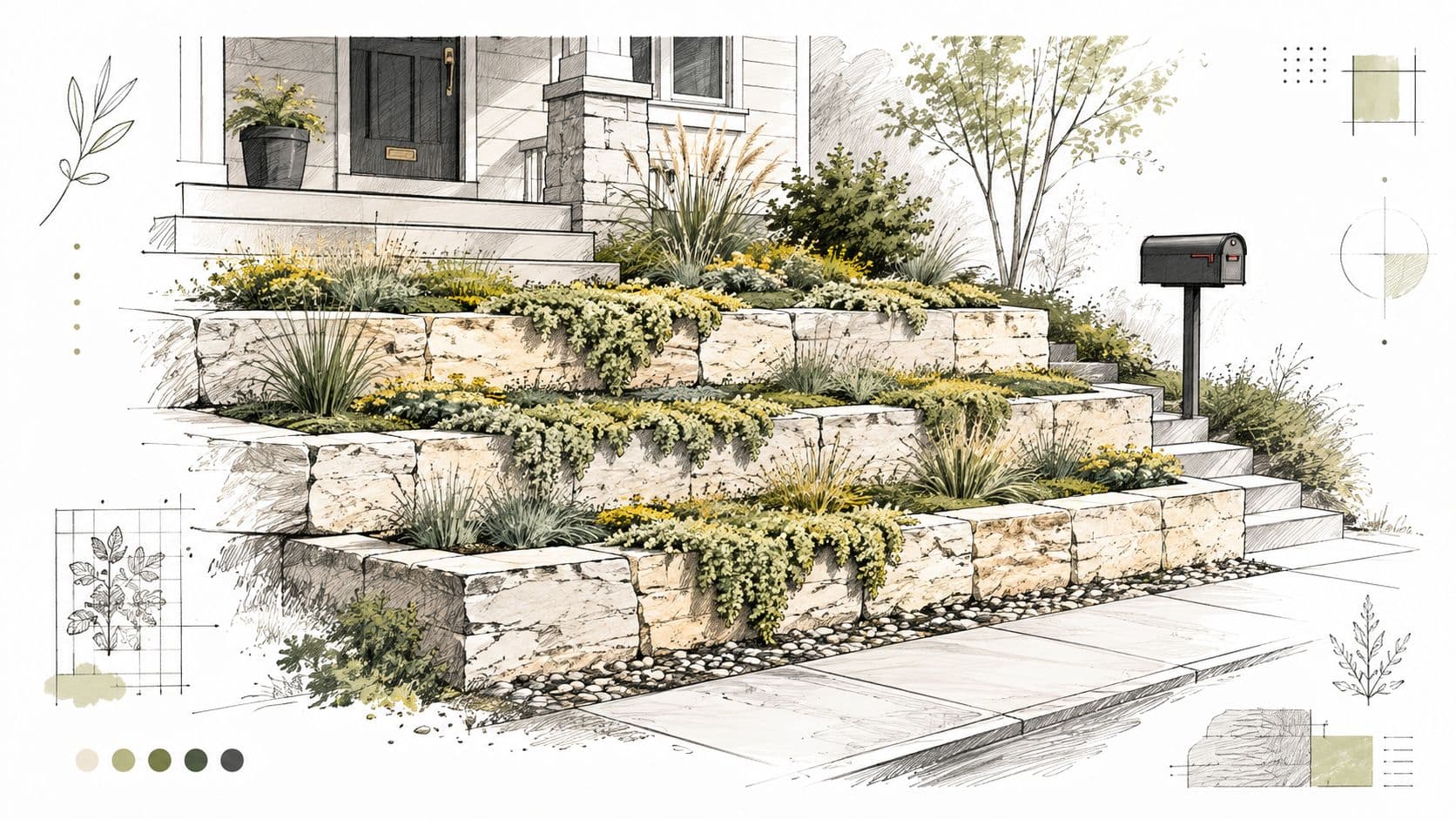
A tiered stone wall is the most forgiving way to manage a front yard slope when you want the site to feel established, not engineered. Natural stone or cut limestone lets the grade change happen in smaller steps, which usually looks better than forcing one tall wall across an awkward slope. It also fits homes that already have masonry, traditional trim, or a garden with mature trees and layered planting.
Where it works and what it costs
Tiered stone is a strong fit for moderate grades, especially when the front yard needs both planting room and a more graceful arrival sequence. If you're comparing costs, natural stone typically lands around $30 to $75 per linear foot, which makes it a higher-end choice than concrete block or timber (YardCast retaining wall ideas). That pricing makes sense when the wall is visible from the street and you want the material to carry the look of the whole front elevation.
Practical rule: tiered walls are usually better than one tall wall when the slope is moderate and the yard needs planting space as much as support.
A homeowner in a hillside California neighborhood might use stacked limestone to frame a driveway edge, while a New England colonial can use terraced fieldstone beds to make the entry feel older and more settled. In the Pacific Northwest, slate or darker stone tones often blend well with dense planting and wet-season runoff.
Construction details that matter
Tier spacing matters visually and structurally. Leaving roughly 18 to 24 inches between tiers creates planting pockets without crowding the front yard, and each tier should have its own drainage path rather than relying on one hidden outlet. Current wall guides consistently treat drainage as essential, with common recommendations for a 4-inch perforated drainpipe, about 12 inches of clean stone behind the wall, and filter fabric to keep fines out of the system (Reimagine Home retaining wall ideas).
For visualization, try mocking up the tier locations against your driveway edge, porch steps, and window lines before ordering stone. OutdoorBrite's ai front yard design tool is useful here because the difference between elegant tiering and cluttered tiering often comes down to how the wall sits relative to the house.
2. Modern Steel or Composite Retaining Wall
Steel and composite walls solve a different problem. They're for homeowners who want the grade corrected without making the yard feel heavy, rustic, or overly traditional. Powder-coated steel, corten steel, and composite materials read as clean and deliberate, especially on newer homes with simple siding, black windows, or minimal planting.
Why this look works
Modern materials help the wall disappear into the architecture instead of competing with it. A corten wall, for example, can look sharp next to concrete walks and structured grasses, while powder-coated steel can match trim colors or outdoor lighting fixtures. In tech-heavy suburban settings, the appeal is often the crisp line itself, not ornament.
The trade-off is that these walls can look cold if the planting is weak. Pair them with ornamental grasses, perennials, or low shrubs so the front yard doesn't feel like an exposed service area. That softening is especially important near driveways, where hard edges can otherwise dominate the view.
Skill level, drainage, and visualization
This is not the easiest DIY path if the wall is tall or if the site holds water. The material may be sleek, but the drainage behind it still needs the same discipline as any retaining system. The current residential guidance on drainage applies here too, because runoff from roofs and driveways can push water pressure into the wall even when the exterior surface looks simple and modern (Reimagine Home retaining wall ideas).
For cost planning, steel and composite projects usually depend more on fabrication and site conditions than on raw material alone, so they tend to land in the “call for quotes” category rather than a casual weekend build. If you want to test whether dark steel helps or hurts your curb appeal, use OutdoorBrite's element controls to compare wall color against siding, roof color, and front walk material before you buy anything.
A good example is a modern Denver or Austin house with a narrow front planting strip. In that setting, a low steel wall can create a sharper entry edge than stacked stone, while still letting the garden feel intentional instead of improvised.
3. Concrete Block or Segmental Retaining Wall
Concrete block is the practical workhorse of front yard retaining walls. It's the best answer when you want cost control, predictable construction, and a wide range of looks without paying for hand-cut stone. Segmental retaining wall units can mimic stone, read as modern, or stay purely functional depending on the finish you choose.
The practical case for block
Typical installed cost for concrete block walls runs about $20 to $50 per linear foot, which makes them one of the most accessible options for homeowners who need real structural support but don't want to overinvest in a small front yard (YardCast retaining wall ideas). That range is one reason you see so many suburban front yards built with block. It's efficient, scalable, and familiar to contractors.
A second reason is lifespan. Segmental concrete block walls are commonly rated at 50+ years, which is a strong long-term fit for curb appeal investments that should outlast paint colors and plant palettes (Reimagine Home retaining wall ideas). The wall still needs correct base prep, but once it's in, it's usually easier to live with than timber.
What separates a solid block wall from a cheap one
The base matters more than the block color. A compacted gravel foundation, fabric behind the wall, and perforated drainage pipe are the basics that keep the wall from shifting or bowing over time. The same source guidance that treats drainage as essential also notes that walls over 4 feet typically require a permit and stamped engineering plan, while walls under 3 feet often avoid permits in many jurisdictions (Reimagine Home retaining wall ideas).
For DIYers, this is the most realistic project on the list if the wall is low and the site is stable. For many homeowners, though, it becomes a weekend-plus project because the digging, leveling, and base work take more effort than the stacking itself. If you're planning a small front wall, the guide on designing a small retaining wall is a useful planning reference before materials are ordered. The right block color can also help disguise stains from splashback, which is why texture usually beats smooth finishes in visible front yards.
A simple block wall can look expensive if the proportions are right and the planting finishes the edges.
Video can also help homeowners judge scale before they start digging.
4. Natural Fieldstone Dry-Stack Wall
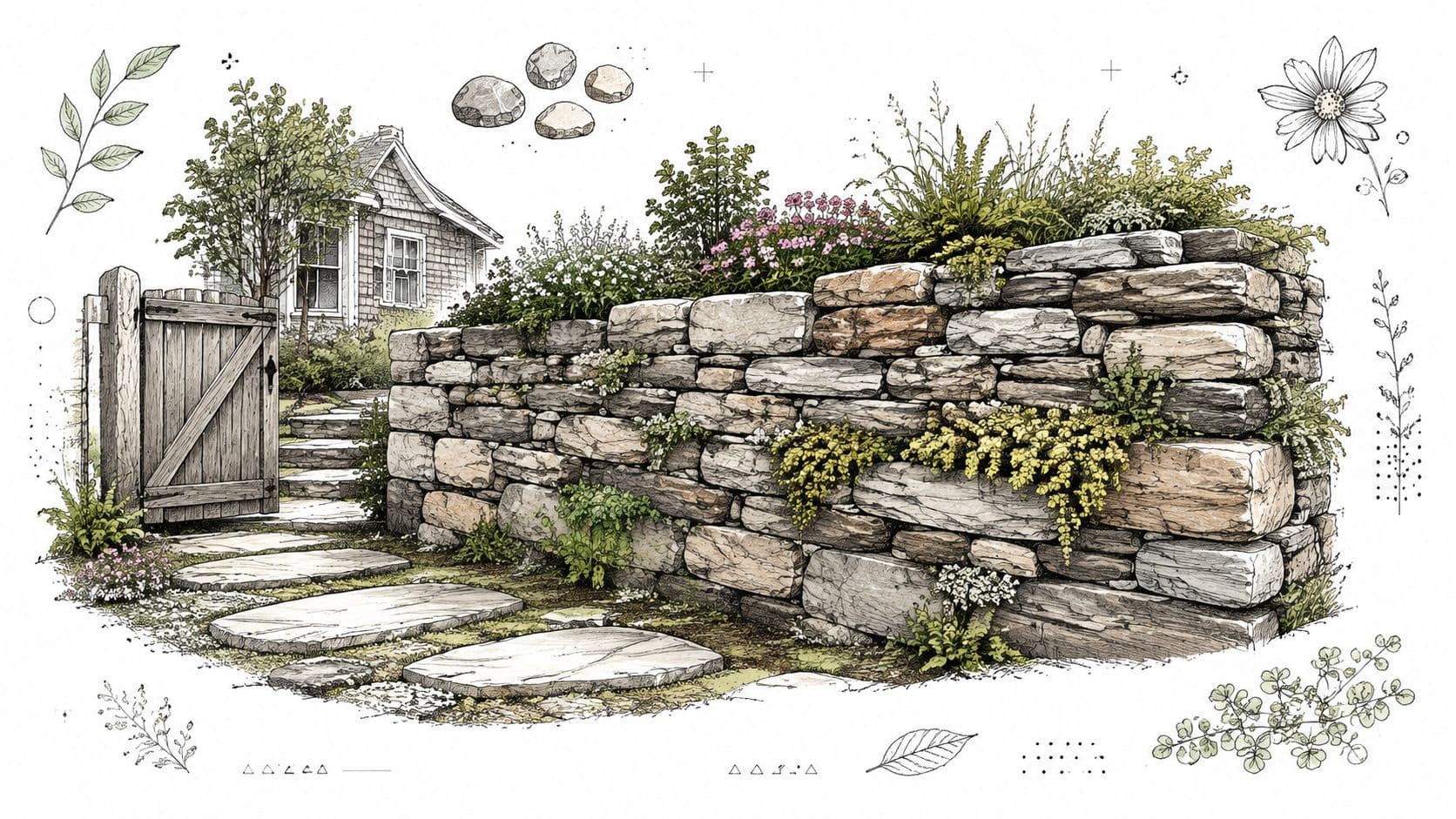
Fieldstone dry-stack walls are the right answer when the house already has history in its bones. They don't try to hide age, irregularity, or texture. Instead, they lean into them, which is why they fit historic New England properties, mountain homes, and cottage-style renovations so well.
Why this wall feels timeless
Dry-stack fieldstone has a softness that machine-made materials can't fake. If the stone is locally sourced, the wall tends to look like it belongs to the property rather than sitting on top of it. That matters on older streets where the front yard should feel consistent with the neighborhood's scale and character.
This is not a good place to improvise. A dry-stack wall depends on stone selection, fit, and patience, so it's better handled by an experienced mason than by a first-time DIY crew. The wall may also keep settling for months, so a finished look shouldn't be judged immediately. Allowing time for the structure to bed in is part of the craft.
What to expect on cost and maintenance
Natural stone pricing varies widely, and fieldstone can land toward the higher end of that range when labor and sorting are included (YardCast retaining wall ideas). The wall itself may last a very long time, but the visual style changes as moss, lichen, and plants move into the joints. In a lot of yards, that aging is part of the appeal, not a defect.
A realistic front-yard use case is a colonial in the Hudson Valley with a low stone edge wrapping a planting bed near the walk. Another is a Berkshire hillside property where the wall needs to feel native, not manufactured. If you're trying to visualize the result, use a cottage or farmhouse style render and compare fieldstone against your roof color, shutters, and porch materials before you source stone locally.
Practical rule: dry-stack stone looks best when the wall height stays modest and the surrounding planting is allowed to look loose, not clipped.
5. Gabion Basket Retaining Wall
Gabions are for people who want the wall to look engineered in a good way. Wire baskets filled with stone, gravel, or mixed rock create a rugged, linear look that feels contemporary without needing the finesse of carved stonework. They work especially well when the front yard needs drainage-friendly structure and a bit of visual edge.
Where gabions make sense
Urban and mountain-adjacent homes often suit gabions because the material reads as durable and a little industrial. They're also easy to customize by changing the fill, which means the same wire cage can look very different depending on whether you use uniform stone or mixed textures. That flexibility makes them useful for front yards where the house already has metal railings, concrete walkways, or modern siding.
The biggest priority is the cage itself. Quality wire matters because cheap mesh can rust, bulge, or age badly. If you're going to use gabions in a visible front yard, PVC-coated cages are worth the attention. Fill cost can be managed by sourcing stone locally, but the structure should never be the place where you cut corners.
Trade-offs, planting, and nighttime appearance
Gabions usually don't have the same polished finish as masonry, so plantings matter. Ornamental grasses, flowering perennials, and low shrubs can break up the hardness and keep the wall from feeling like a retaining cage in a commercial lot. Backlighting the baskets can be effective too, especially on a narrow front yard where texture is visible from the street at night.
Drainage is easier in some respects because gabions are permeable, but that doesn't mean the site can ignore slope planning. Water management still matters behind and below the wall, especially if roof runoff or driveway runoff feeds the area. A front yard in Seattle or Denver can use gabions to hold a grade change while still looking current, but the visual result depends on keeping the fill intentional and the planting soft.
If your yard needs a wall that feels modern without pretending to be delicate, gabions are one of the clearest front yard options. They're not the cheapest build once quality materials and labor are included, but they can be strong candidates for a home where the wall should read as part of the architecture, not decoration.
6. Brick or Masonry Retaining Wall
Brick is the safest style choice for homeowners who want the front yard to feel composed, traditional, and unmistakably tied to the house. It's especially effective on colonial, craftsman, and older city homes where brick already appears on the façade, chimney, or walk.
Why brick still works
Brick gives you a formal edge without forcing the wall to look heavy. Running bond, a clean cap, and the right mortar line can make even a small front yard feel finished. On historic homes, the material often looks right because it echoes the building itself rather than trying to introduce a new visual language.
The main practical drawback is that masonry demands good workmanship. Mortar quality, joint consistency, and drainage behind the wall all matter. A visually perfect brick wall can still fail if water is trapped behind it, so the same drainage principles apply, including perforated pipe and clean stone backfill (Reimagine Home retaining wall ideas).
Cost, maintenance, and visual balance
Brick can sit in the middle of the cost spectrum depending on labor and site complexity, but the bigger issue is maintenance. Mortared masonry usually needs periodic repointing, especially on exposed front elevations that take freeze-thaw stress and water splash. That's the trade-off for a sharper, more formal appearance.
For front yards, brick often works best when it's not the only material in play. A natural stone cap can break up the visual density, and flowering vines can soften the vertical surface at the base without hiding the wall. In places like Pennsylvania, Virginia, Charleston, or older New England neighborhoods, brick walls often feel most successful when the color aligns with the home's existing masonry or trim.
If you're planning a brick wall for a slope near the sidewalk, it's smart to test the wall color against the house exterior before any contractor quote gets locked in. OutdoorBrite's designing a small retaining wall resource is useful here because front-yard brick walls live or die on proportion and placement, not just material choice.
7. Raised Planting Bed Retaining Wall
A raised planting bed wall is one of the smartest front yard solutions when you need support but don't want the property to look like a construction site. Instead of pretending the wall is only structural, this approach gives the wall a second job, supporting flowers, shrubs, herbs, or seasonal color.
The best use case
These walls are usually kept low, often around 18 to 30 inches high, which makes them more approachable both visually and structurally. That height range is useful for front-yard planting because it creates a defined edge without dominating windows, porch railings, or the path to the door. Materials can include cedar, composite wood, galvanized steel, or stone, depending on the style of the house and how much maintenance the homeowner wants.
Composite has a strong argument here because material lifespan can stretch past cedar, and the lower maintenance is appealing when the wall is mainly there to frame planting rather than hold major grade. For homeowners who want a simple way to make the front yard look maintained in every season, this is one of the most practical options.
Drainage, soil, and layout decisions
A raised planting bed still needs proper wall construction. Dense soil packed behind the face can create pressure and reduce drainage, so the fill should be appropriate for planting and not treated like ordinary backyard topsoil. Drip irrigation helps busy homeowners keep the bed alive without overwatering the wall zone, and weed barrier can reduce maintenance if the front yard is highly visible.
Practical rule: if the wall is meant to showcase plants, the planting mix and irrigation plan matter as much as the wall material.
Visualizing the planting bed in the actual front yard photo helps a lot, because a bed that looks balanced in a render can crowd a walkway in real life. OutdoorBrite's ai for garden design tool is useful for checking whether the bed height helps the entry or blocks it.
A real-world example is a modern cottage front yard where layered perennials, a compact shrub, and dark mulch turn a simple retaining edge into a seasonal focal point. This approach works best when the planting palette is disciplined and the wall height stays modest.
8. Living Green Retaining Wall With Vegetation
A living green retaining wall is the most ambitious option on this list, but it can also be the most rewarding when stormwater, erosion, and curb appeal all need to be solved together. These systems use vegetation and structure as one design, often with soil retention mats, cellular confinement grids, or terraced planting bands.
When a green wall makes sense
This is a strong choice for homeowners who want the front yard to look softer and more climate-aware. Instead of hiding the slope, the wall turns it into a planted system that helps manage runoff and adds habitat. It fits naturally with water-wise or ecological front-yard goals, especially in places where hardscape-heavy solutions feel too blunt.
The catch is maintenance and plant selection. A green wall is not a set-it-and-forget-it install. It needs a thoughtful plant palette, drip irrigation during establishment, and close monitoring during the first growing season. In freeze-thaw climates, the plants must also be cold-hardy enough to survive seasonal stress.
How to keep the concept realistic
Sedum and sedge varieties are often practical choices because they handle slope conditions better than delicate ornamentals. Native plants are a smart default when you want the wall to feel integrated rather than ornamental-only. If the wall is part of a broader drainage strategy, combining it with permeable pavers or a rain garden can make the whole front yard work better as a system.
Visualization matters even more than usual. A green wall that looks rich in concept can become visually noisy if the plant masses are too tight or too tall for the house. Use OutdoorBrite's xeriscape or tropical style presets to test whether the planted slope supports the home instead of overpowering it.
A front yard in Seattle, Austin, or coastal California can use this concept well if the homeowner is prepared for seasonal care and plant replacement as needed. If you're looking for a wall that does more than hold soil, and you want the structure to feel alive, this is one of the strongest possibilities, but it's also one of the least forgiving of poor planning.
8 Front-Yard Retaining Wall Options Compared
| Option | 🔄 Implementation complexity | ⚡ Resources / efficiency (materials, cost, speed) | 📊 Expected outcomes / impact | 💡 Ideal use cases / tips | ⭐ Key advantages |
|---|---|---|---|---|---|
| Tiered Stone Retaining Wall | High, multi-level, skilled masons | High materials & labor; slower install; space-intensive | Strong curb appeal; terraced planting; good drainage | Front yards with moderate grades; space tiers 18–24"; add perforated drain | Timeless look; usable flat space; versatile styles |
| Modern Steel or Composite Retaining Wall | Moderate, precision fabrication & installation | Higher upfront material cost; faster install than stone; lightweight | Sleek, contemporary aesthetic; durable 20–50+ yrs; low upkeep | Modern homes; test colors; soften with plantings; consider corten patina | Clean lines; customizable color; quick install; low maintenance |
| Concrete Block / Segmental Retaining Wall | Low–Moderate, modular, DIY-friendly | Most cost-effective; quick assembly; wide availability | Functional, uniform appearance; reliable engineered drainage | DIY suburban projects; plan compacted gravel base & drainage | Affordable; repairable sections; many finishes/colors |
| Natural Fieldstone Dry-Stack Wall | Very high, expert stonemasonry, labor-intensive | Very high cost; long timeline; locally sourced stone preferred | Authentic, rustic character; excellent natural drainage; unique result | Historic/cottage properties; hire experienced masons; allow settling time | Distinctive natural look; high curb appeal; each wall is unique |
| Gabion Basket Retaining Wall | Moderate, modular but heavy handling | Cost-effective for large runs; requires quality cages and equipment | Industrial-contemporary aesthetic; highly permeable; durable | Urban/contemporary sites; use PVC-coated cages; mix stone sizes; soften with plants | Flexible shapes; excellent drainage; customizable fills |
| Brick / Masonry Retaining Wall | High, skilled bricklayers, mortar work | Moderate–high cost; heavy labor; long-lasting if maintained | Classic, elegant appearance; long lifespan with repointing | Traditional/colonial homes; match brick color; ensure drainage | Timeless appeal; strong resale impact; repairable over time |
| Raised Planting Bed Retaining Wall | Low, simple builds, many material options | Moderate cost; ongoing plant maintenance; fast to build | Functional planting area; improved curb appeal; comfortable gardening | Garden-forward homes; use composite for longevity; plan irrigation | Dual-purpose (retention + planting); flexible seasonal plantings |
| Living / Green Retaining Wall with Vegetation | High, specialized systems, establishment period | Higher initial cost; irrigation & plant establishment needed | Sustainable stormwater control; habitat creation; natural finish | Sustainable projects; choose natives; install drip irrigation; best <4 ft | Eco-friendly; stormwater benefits; enhances biodiversity |
Visualizing Your Front Yard Retaining Wall Before You Build
The smartest retaining wall projects start with a clear read on the site, not a pile of materials. Before you choose stone, block, steel, or brick, check the slope, water flow, and where runoff comes from, especially if the front yard receives water from the roof, driveway, or a downhill lawn. That matters because drainage behind the wall is not optional, and the standard residential guidance keeps coming back to the same basics, perforated drainpipe, clean stone backfill, and filter fabric (Reimagine Home retaining wall ideas).
Height is the other line you shouldn't ignore. In many jurisdictions, walls under 3 feet often avoid permits, while walls over 4 feet usually require a permit and stamped engineering plan (Reimagine Home retaining wall ideas). That's one reason small front-yard walls can still become technical fast, especially once you account for buried base depth and buried support. A wall that looks simple from the street may need more excavation and drainage work than homeowners expect, and the design should be checked against local rules before any final purchase.
The most useful question is not “Which wall looks best online?” It's “Which wall fits this exact yard, this house, and this amount of slope?” For many front yards, the right answer is a terraced layout instead of one tall wall, because shorter tiers can reduce visual bulk, create planting space, and better match the grade. For others, a low block wall or raised planting bed is enough, and anything more would be overbuilding.
A photo mockup saves money because it shows proportion before labor starts. Use your own front yard image, test the wall against the driveway, the porch, the steps, and the planting strip, and compare the result in context rather than in isolation. OutdoorBrite is useful for that kind of preconstruction check because you can explore wall styles and placement before you rent equipment or commit to a contractor.
The cheapest wall is rarely the one with the lowest material price. It's the one whose design has already been validated on your property, with the right height, drainage plan, and visual scale. If you take that step first, the finished wall is much more likely to look intentional the day it's built and still make sense years later.
If you want to test a retaining wall against your actual front yard photo before hiring a contractor, visit OutdoorBrite. It lets you compare wall styles, planting layouts, and stepped terrace ideas in seconds, so you can narrow down the right look before spending on materials or excavation.
See your yard reimagined
Start creating