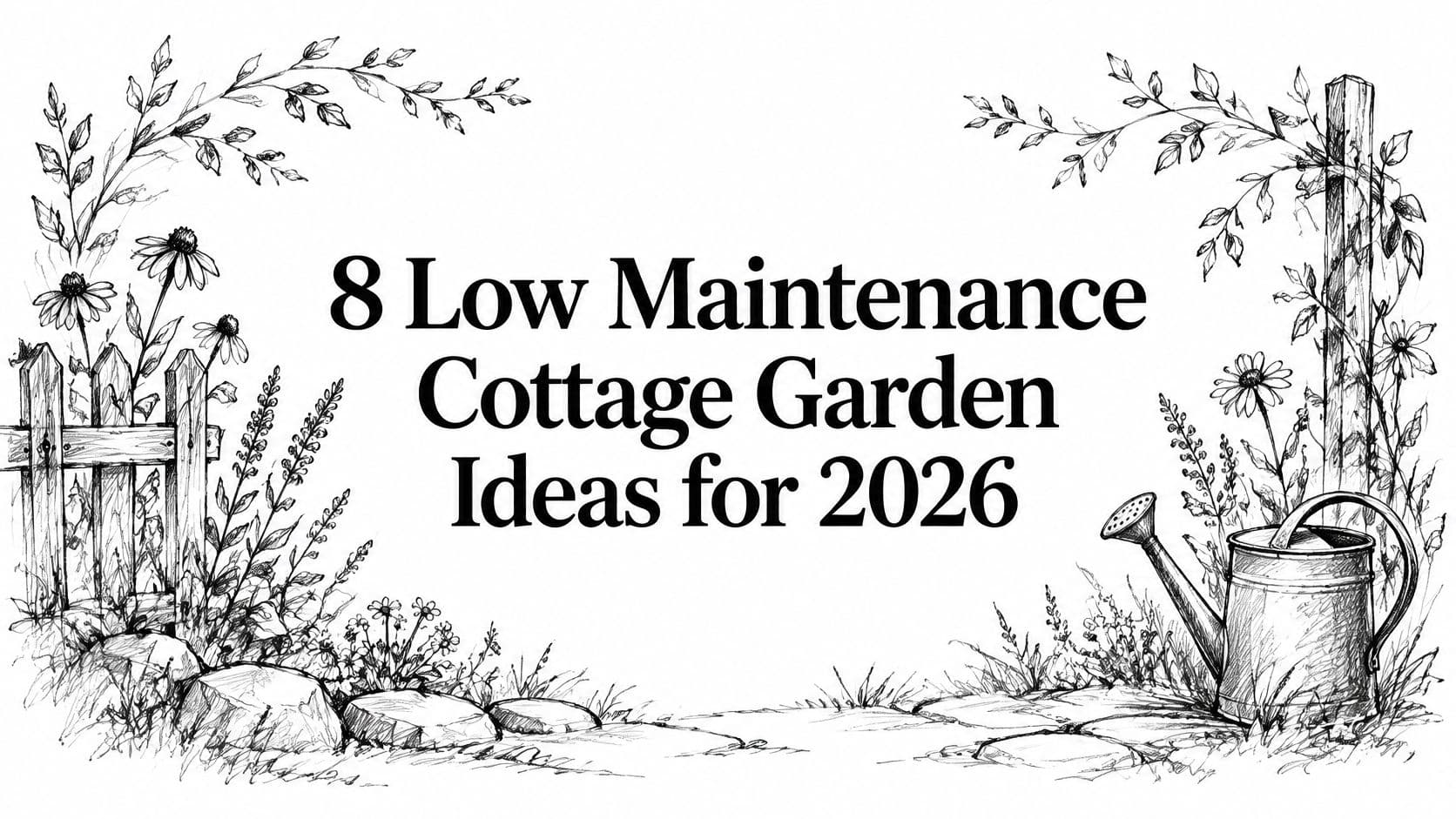
8 Low Maintenance Cottage Garden Ideas for 2026
Discover 8 low maintenance cottage garden ideas with plant picks, layouts, mulching tips, and seasonal care to keep your beds full with less upkeep.
You've inherited a garden full of sprawling stems, stubborn weeds, and gaps where something clearly used to grow. You spend Saturday pulling grass out of the border, then buy another tray of flowers to fill it. By the following weekend, the weeds are back and the color still looks patchy.
The problem usually isn't the cottage style. It's bare soil, mismatched plants, and a layout that creates repetitive jobs. A border that needs constant watering, staking, and replacement won't become easier just because you let its edges look informal.
Good low maintenance cottage garden ideas remove a particular chore. Groundcovers reduce exposed soil. Flowering shrubs replace some of the plants you'd otherwise divide. A gravel border can simplify watering, but only if the soil and planting suit it.
Start with the chore you resent most. A garden that needs less pruning isn't much help if watering is what consumes your evenings.
If you're designing a front yard cottage garden, keep the entrance, paths, and sightlines clear before planning the flowers. That visible structure lets the planting stay relaxed without looking neglected.
Each approach below shifts the work somewhere else. The useful question isn't whether a bed is maintenance-free. It's which tasks remain, when they happen, and whether you're willing to do them while the planting settles.
Table of Contents
- 1. Self-Seeding Perennial Border
- 2. Gravel Garden Cottage Border
- 3. Shrub-Anchored Cottage Border
- 4. Native Plant Pollinator Cottage Garden
- 5. Disease-Resistant Shrub Rose Cottage Garden
- 6. Evergreen Groundcover Cottage Carpet
- 7. Raised Bed Cottage Garden
- 8. Perennial Potager Cottage Garden
- Maintenance level, best use, and main trade-off for each low maintenance cottage garden idea
- Pick One Bed to Start and Plan Its Layout First
1. Self-Seeding Perennial Border
A self-renewing border suits gardeners who enjoy choosing what stays but dislike buying replacement plants. Start with durable, locally reliable perennials, then allow selected plants to seed into the spaces between them.
This approach has a genuine cottage-garden precedent. The Royal Horticultural Society's East Lambrook Manor garden profile recognizes Margery Fish's garden, associated with relaxed planting, unusual perennials, and self-seeding flowers. The useful lesson is selective intervention, not abandoning the border.
For a sunny fence-line bed, repeat a dependable perennial framework, then introduce suitable reseeders such as columbines or species coneflowers where local conditions support them. Check their regional behavior before buying. A welcome seedling in one garden can become an aggressive spreader in another.
The comparison below shows the difference between renewing a border through seedlings and repeatedly filling it with bedding plants.
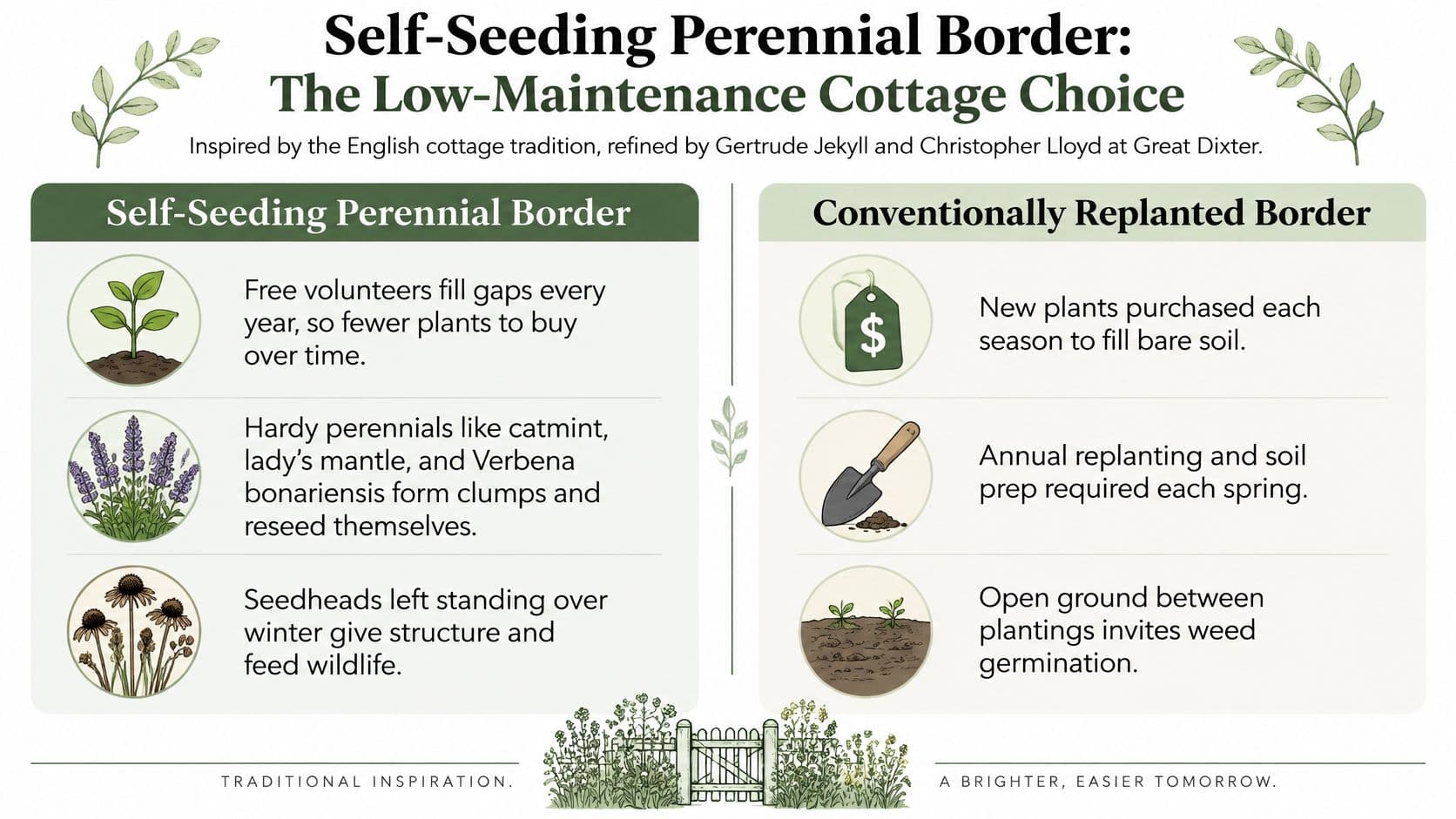
Swap Replanting for Selective Thinning
- Keep useful seedlings: Move young plants while their roots are manageable.
- Control enthusiastic seeders: Remove their fading flowers before seeds mature.
- Leave germination pockets: Heavy mulch everywhere can prevent the seedlings you want.
- Protect the framework: Don't let volunteers crowd slow-growing permanent plants.
The settling stage lasts until the permanent plants cover their intended space and you can recognize their seedlings. Until then, weed carefully and mulch areas where you don't want germination.
Use garden ai design to compare the permanent bed shapes before deciding where volunteers can wander. Keep that freedom inside a clear edge, rather than across the path.
2. Gravel Garden Cottage Border
Gravel suits a sunny, freely draining site where watering is the main burden. It doesn't turn wet soil into a dry garden, and it won't stop weeds growing from windblown seed.
The reason to consider a low-water layout is substantial. The U.S. Environmental Protection Agency's outdoor water-use guide reports that outdoor household water use accounts for about 30% of household water consumption nationally in the United States. Reducing irrigated lawn and grouping compatible plants can make the garden easier to manage without sacrificing flowers.
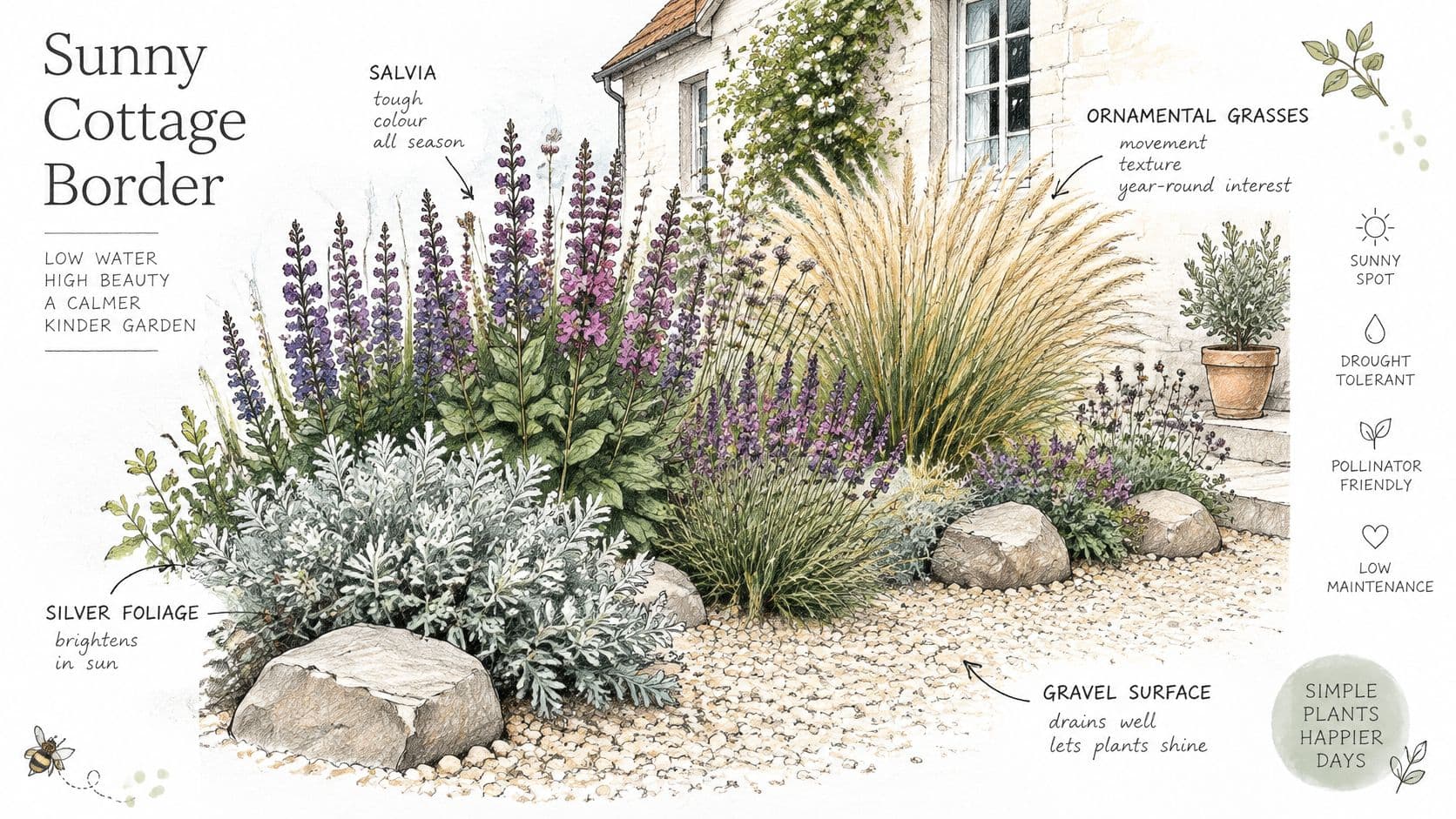
For a hot driveway border, consider a loose arrangement of locally suitable salvias, compact ornamental grasses, and drought-adapted flowering plants. Lavender belongs only where drainage, winter conditions, and humidity suit it. Don't choose it just because it appears in cottage-garden photographs.
This illustration shows the airy planting effect to aim for, with room between mature clumps.
Prepare the Soil Before Adding Stone
Remove perennial weeds and resolve drainage problems before spreading gravel. Fit a firm edge where stone meets lawn or paving, and keep plant crowns clear rather than burying them.
You remove some watering and organic-mulch replacement, but add debris removal and occasional seedling weeding. Nearby deciduous trees can make this exchange unattractive because fallen leaves collect between the stones.
The bed hasn't settled just because the gravel looks finished. Water new root balls according to soil moisture while roots establish beyond them, then adjust watering to the plants and weather. Frequent shallow sprinkling defeats the purpose of this layout.
3. Shrub-Anchored Cottage Border
If dividing, staking, and replacing perennials wear you down, give flowering shrubs more of the bed. A well-chosen shrub occupies space without needing the same treatment as a collection of small flowering clumps.
Say you have a broad border beneath the front windows. Use naturally compact shrubs as anchors, then connect them with drifts of hardy geraniums, catmint, or other compatible perennials. Hydrangeas may suit a moisture-retentive, partly shaded position; a sunny, drier bed needs a different shrub selection.
Choose for mature spread, not nursery-pot size. A shrub that eventually blocks a window or leans across the walk creates a permanent pruning job.
A naturally fitting shrub is easier to maintain than an oversized shrub you keep trying to make small.
Prune for the Plant, Not the Calendar
Blanket pruning advice causes avoidable work and lost flowers. Identify the species and cultivar, then establish whether it flowers on older growth or new shoots before cutting.
- Leave expansion room: Keep neighboring perennials outside the shrub's future central framework.
- Preserve natural shape: Remove damaged, crossing, or misplaced branches instead of routinely shearing everything.
- Keep access open: Leave somewhere to stand when reaching the back of the border.
The trade-off is slower fullness in exchange for less recurring division. Mulch the open ground while the shrubs expand, rather than packing every gap with plants you'll later have to remove.
Deciduous shrubs provide winter branching, not evergreen foliage. If winter greenery matters, include a suitable evergreen deliberately. Don't expect a summer-flowering shrub border to look equally full in every season.
4. Native Plant Pollinator Cottage Garden
A pollinator border works best when you choose plants for both the site and the insects you want to support. Native status alone doesn't tell you whether a plant tolerates your compacted soil, afternoon shade, or dry slope.
The Pacific Northwest common-garden study published in Environmental Entomology compared native plants with cultivars across 78 plant-pair comparisons. Native plants were preferred in 37.2% of comparisons, while neither was preferred in 55.1%. That's a reason to evaluate actual plants, not assume every cultivar is useless or every native equally valuable.
For a sunny front-yard border, select regional flowering perennials with overlapping bloom periods, then add an appropriately sized native shrub. In parts of eastern North America, suitable asters, mountain mints, and black-eyed Susans might contribute. Use your regional native plant society or extension office to narrow the list.
The layered planting below illustrates the cottage effect without requiring every flower to be deadheaded.

Accept Some Winter Stems and Chewed Leaves
You reduce cosmetic cleanup, but add selective editing. Leave suitable seedheads, stems, and leaf litter where they won't obstruct paths or smother small plants. Remove invasive weeds and thin vigorous species before they displace their neighbors.
Establishment still requires watering and close weeding around young plants. The bed becomes easier once the intended plants occupy their space, not when you stop paying attention.
A crisp path edge is especially useful here. It makes retained stems look deliberate and keeps the garden usable while wildlife benefits from a less thoroughly tidied border.
5. Disease-Resistant Shrub Rose Cottage Garden
Roses become a lower-maintenance choice when you stop asking unsuitable varieties to perform in the wrong place. Disease resistance, mature size, and local performance matter more than the flower photograph.
For a sunny entrance bed, a rose such as a locally proven Knock Out cultivar may be worth considering. Some David Austin English roses can also suit mixed borders, but the brand name alone doesn't establish disease resistance or hardiness. Check the individual cultivar against your conditions.
Plant roses where air can circulate through their mature growth. Keep companion plants from pressing into the lower branches, and direct irrigation toward the root zone rather than routinely wetting the foliage.
Decide Which Rose Jobs You'll Accept
A relaxed shrub-rose border should not require exhibition-style grooming. Choose plants whose natural form and spent flowers you can tolerate.
- Reduce spraying pressure: Favor cultivars with documented local resistance rather than planning around routine corrective treatment.
- Keep pruning accessible: Position roses where you can reach their bases without pushing through neighboring plants.
- Deadhead selectively: Remove spent blooms when the cultivar benefits and the task fits your schedule.
- Match companion moisture needs: Don't assume lavender and roses belong on the same irrigation routine.
You may remove staking and intensive flower grooming, but you retain thorny pruning, inspections, and occasional cleanup. Disease-resistant doesn't mean immune to disease, insects, or poor growing conditions.
During establishment, resist filling the rose's future spread with permanent neighbors. Use mulch to manage the gaps. Judge the settled border by healthy growth and manageable access, not by whether every branch carries a perfect bloom.
If handling thorny stems is already a chore you avoid, choose a flowering-shrub border instead. The cottage look doesn't depend on roses.
6. Evergreen Groundcover Cottage Carpet
Bare soil between cottage flowers creates a recurring weeding assignment. Groundcovers can occupy that space, but the wrong spreader replaces weed removal with plant removal.
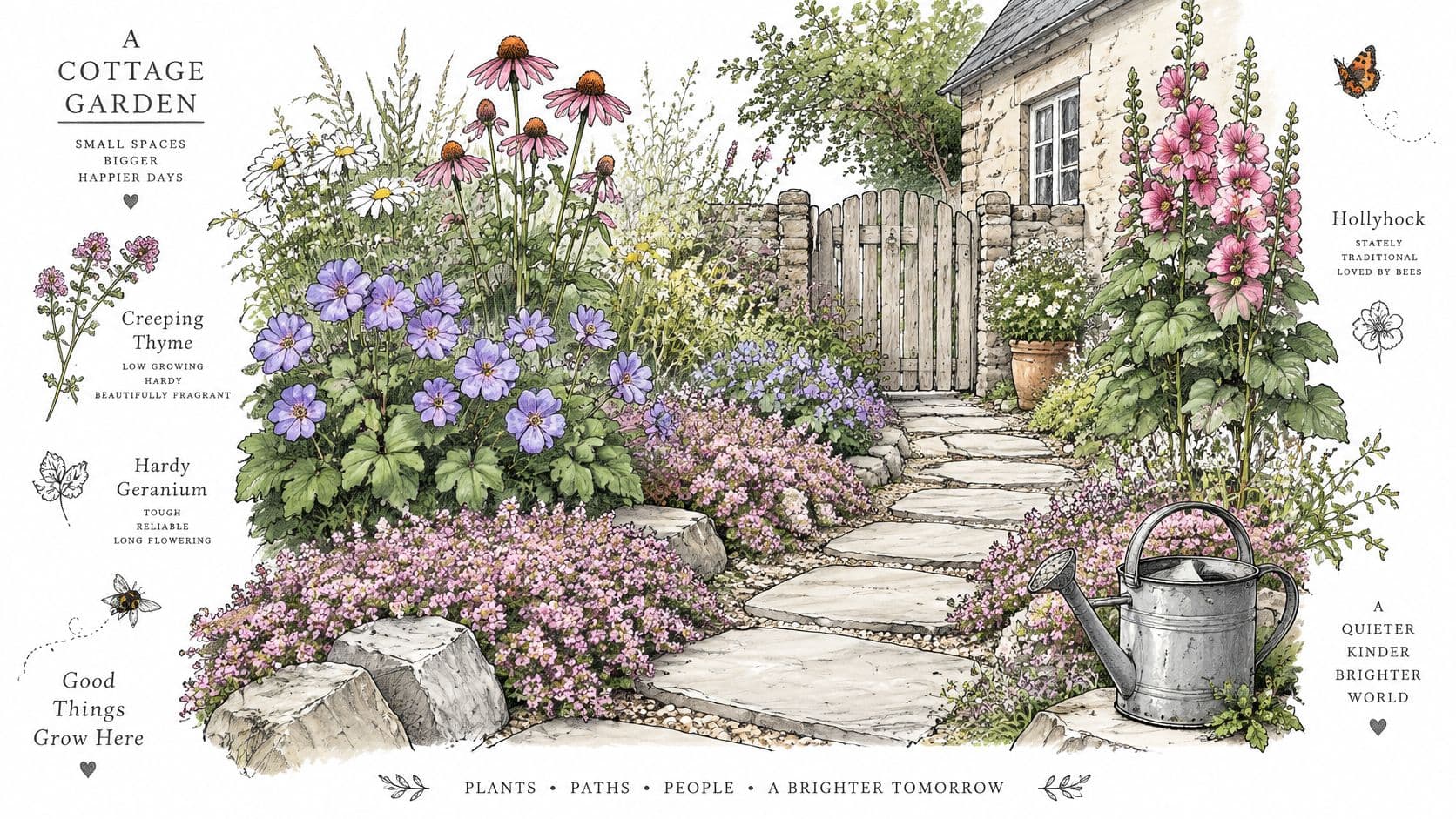
Use a low carpet beneath taller perennials or along a path, matching the groundcover to light, moisture, and foot traffic. Creeping thyme can suit sunny, freely draining paving gaps. A shade-tolerant hardy geranium may suit a woodland edge, although it won't necessarily remain evergreen through your winter.
Evergreen behavior is climate-dependent. Check local performance rather than relying on the plant's label, and check invasive status before introducing vigorous plants such as some Lamium selections.
This layered border shows how low planting can connect taller flowers while leaving the path readable.
Weed Thoroughly Before the Carpet Closes
Remove persistent weed roots before planting. Pull new weeds while you can still see and reach them, because grass woven through a dense groundcover is awkward to extract.
- Space for mature coverage: Follow the plant's expected spread rather than crowding small pots together.
- Protect smaller neighbors: Keep spreading growth away from vulnerable crowns.
- Maintain the boundary: Trim runners back from paving and lawn before they root.
You exchange repeated open-soil weeding and mulch spreading for edge trimming and occasional thinning. That's worthwhile only if the groundcover behaves within the available space.
The early stage needs more attention than the finished carpet. Don't leave a newly planted groundcover bed unattended and expect it to beat established weeds. Its workload drops after healthy growth covers the soil, provided you keep the edges under control.
7. Raised Bed Cottage Garden
A raised cottage bed can make gardening physically easier without reducing every task. It brings planting and maintenance closer to you, defines the border clearly, and can help where the existing ground is difficult to cultivate.
For a courtyard beside a paved path, use a reachable raised bed with compact flowering plants and low edging plants. Keep the planting below the sightline you need for windows, seating, or access. A tall shrub in a raised bed can become far larger visually than expected.
Plan reach, access, and planting zones with OutdoorBrite's raised bed planning guide before choosing the wall material. You should be able to maintain the planting without climbing into the bed.
The video below offers additional visual context for planning a cottage-style planting.
Better Access Can Mean More Watering
The Royal Horticultural Society's plants-for-water-resilience guidance distinguishes low-water-use plants from drought-tolerant plants and emphasizes the effects of soil, microclimate, weather, and establishment. A raised position doesn't remove those differences.
Fill the bed with suitable topsoil and compost rather than compost alone. Account for settling, provide drainage, and keep woody stems and plant crowns clear of mulch.
You reduce bending and make soil preparation more contained, but add construction upkeep and potentially closer moisture monitoring. Install accessible drip irrigation if hand-watering would otherwise become the main chore.
During establishment, check moisture inside the original root balls as well as the surrounding fill. Damp soil nearby doesn't guarantee that a newly planted root ball is wet. The bed becomes easier when roots spread through the available soil and the irrigation routine matches actual conditions.
8. Perennial Potager Cottage Garden
Chives flowering beside a path, a permanent rhubarb clump, and herbs spilling near the kitchen door can give a cottage garden practical value. A perennial potager reduces repeated sowing and planting, but it still needs harvesting, weeding, and control of spreading crops.
Start with edibles you use. Chives and suitable culinary herbs fit compact spaces; rhubarb and asparagus need dedicated room where their roots won't be disturbed by regular digging. Strawberries need accessible edges so you can collect fruit and manage runners.
The interest in combining attractive planting with lower inputs fits the emphasis on water-wise gardening, native plants, and naturalistic design described in Southern Living's garden-trend coverage. The practical test, however, is whether your food plants suit the same growing conditions as their ornamental neighbors.
Keep the Dry Herbs Separate
A kitchen-door bed might pair chives with compatible flowering perennials, while thyme occupies a separate, freely draining edge. Don't irrigate drought-adapted herbs as though they were moisture-demanding crops.
- Reserve permanent positions: Keep established perennial crops outside areas you'll dig for seasonal vegetables.
- Leave harvesting access: Avoid reaching through roses or fragile flower stems to collect food.
- Control spreading growth: Remove unwanted strawberry runners and divide congested herbs when needed.
- Treat annual flowers as optional: Calendula and nasturtiums add color, but don't assume they'll solve pest problems.
You remove some annual replanting but retain crop-specific care and seasonal harvesting. Permanent edible crops also need establishment time before they deliver dependable harvests; follow guidance for the crop rather than harvesting heavily as soon as growth appears.
Use the best free garden design software roundup to compare planning approaches, then mark permanent crops, access points, and separate watering areas before planting.
Maintenance level, best use, and main trade-off for each low maintenance cottage garden idea
| Item | Maintenance Level | Best For | Key Trade-off |
|---|---|---|---|
| Self-Seeding Perennial Border | Low after the first 1 to 2 seasons | Medium to large beds in full sun to part shade | Seedlings may spread into unwanted areas and need thinning |
| Gravel Garden Cottage Border | Very low once established | Sunny, well-drained sites and dry climates | Higher upfront material costs; less suitable for shade or moisture-loving plants |
| Shrub-Anchored Cottage Border | Low to moderate, mostly annual pruning | Front yards, foundation beds, and medium-sized backyard borders | Slow to establish, and shrubs can overwhelm small beds |
| Native Plant Pollinator Cottage Garden | Low once established | Sunny to partly shaded yards where pollinator habitat is a goal | Some natives spread aggressively, and local nursery stock may be harder to find |
| Disease-Resistant Shrub Rose Cottage Garden | Low to moderate, mostly pruning and occasional deadheading | Sunny beds, entryways, and cottage-style front yards | Roses still need sun, good drainage, and annual pruning |
| Evergreen Groundcover Cottage Carpet | Low after establishment | Pathways, edges, and beds where weeding is the biggest maintenance task | Some groundcovers spread aggressively; establishment requires careful weeding |
| Raised Bed Cottage Garden | Low to moderate, with easier access for care | Small yards, patios, and sites with poor native soil | Higher upfront costs, and beds may dry out faster in summer |
| Perennial Potager Cottage Garden | Low to moderate, mostly harvesting and seasonal care | Backyards with sun and an interest in home-grown food | Harvesting and pest management add regular tasks; some crops take years to produce |
Pick One Bed to Start and Plan Its Layout First
Choose the idea that removes your biggest recurring chore, not the one with the most appealing photograph. If watering keeps you tied to the house, investigate a climate-adapted gravel border or compatible low-water planting. If weeding consumes your weekends, focus on eliminating persistent weeds and covering exposed soil.
If pruning is the job you dislike, don't fill the bed with shrubs that need constant size correction. If bending is the problem, a reachable raised bed may help more than changing the plant palette. Low maintenance is a match between the garden's remaining tasks and your available effort.
Plan the work as well as the flowers. Mark where you'll stand to weed, prune, divide, and reach the irrigation fittings.
Start with a manageable bed and record its light, drainage, existing plants, and access. Sketch the boundaries, then draw plants at mature spread. Leave room for doors, bins, meters, windows, and the route you use through the yard.
Test alternative layouts on a photo of your own space before buying plants or moving soil. Compare a shrub-led border with a perennial-led version, or a gravel scheme with a groundcover carpet. A visual concept helps you judge shape and density, but confirm plant identity, mature dimensions, and local suitability before treating it as a shopping list.
Give Establishment Its Own Care Plan
New planting needs more attention than an established bed. Keep weeds from competing with young roots, check moisture where those roots are, and replace failures only after working out why they failed. Repeating the same unsuitable plant rarely reduces maintenance.
Once the bed fills out, concentrate effort into seasonal visits rather than constant grooming. Spring cutbacks, autumn mulching where appropriate, and dividing congested clumps every few years can keep the planting workable. Leave useful winter habitat, avoid burying crowns, and divide according to plant performance rather than a rigid calendar.
Keep a note of the tasks that repeatedly interrupt your week. A plant that constantly flops, sprawls across the path, or needs rescue watering may be wrong for that position, even if it survives.
Start with one clear change and judge the result by the work it removes. A smaller border that stays healthy with predictable seasonal care is a better foundation than a whole yard of plants that need attention every weekend.
At OutdoorBrite, we turn a photo of your yard into realistic redesign concepts so you can compare cottage-style layouts before buying plants. Upload your garden photo, choose a cottage style, and request low-maintenance changes to explore tougher planting, less lawn, and more mulch and structure.
See your yard reimagined
Start creating