Pruning Bushes in the Spring: Timing Guide for 2026
Pruning bushes in the spring? Get timing by shrub type, the right cuts for flowering bushes, and aftercare tips to keep your garden thriving.
The lilac is covered in swollen buds, its branches are leaning across the path, and you've finally got a dry afternoon to tidy the garden. Cutting it back would clear the walkway, but those plump buds are exactly what you've been waiting all winter to see open.
Pruning bushes in the spring starts with that trade-off: are you removing unwanted wood, or the flowers you want to keep? Before picking up the saw, identify the shrub, check its stage of growth, and decide whether you're doing routine shaping or a deliberate renovation.
Table of Contents
- Which Shrubs to Prune in Spring and When
- Tools and Cuts for Spring Pruning
- How to Prune Summer-Blooming Shrubs in Early Spring
- Adjusting Pruning Time for Climate and Late Frost
- Recovery Care After a Spring Cut
- Confirm the Timing Before Your First Cut
Which Shrubs to Prune in Spring and When
Flowering cycle matters more than the calendar. A shrub that looks bare may already carry its entire coming flower display. Another may need fresh shoots before it can produce any flowers at all.
Old wood means stems produced during the previous growing season. Lilac, forsythia, mockorange, weigela, azalea, and rhododendron generally develop their flower buds during the previous summer and fall. Shortening those stems before bloom removes flowers along with the wood.
New wood is the current season's growth. Summer- and autumn-flowering shrubs commonly produce their flowers on these fresh shoots, making dormant-season or early-spring pruning a useful way to manage their framework.
Match the shrub to its pruning window
Use the table to separate flowering maintenance from hedge trimming and major renovation. The last row is a different job altogether: rescuing an overgrown shrub may mean accepting a reduced flower display.
Spring pruning timing by shrub type
| Shrub type | Examples | Flowers form on | Prune when |
|---|---|---|---|
| Spring bloomers | Lilac, forsythia, mockorange, weigela, azalea, rhododendron | Old wood, produced the previous season | Right after flowering |
| Early bloomers | Bigleaf hydrangea | Old wood, with some cultivars also flowering on new growth | Right after flowering; preserve living stems in spring |
| Summer and autumn bloomers | Butterfly bush, panicle hydrangea, rose of Sharon | New wood, produced the current season | Late winter or early spring, before leaves open |
| Evergreen hedges | Boxwood, yew | Not a main flowering display | Mid-spring, after frost risk has passed |
| Overgrown or rejuvenation cut | Any woody shrub in poor shape, after checking its tolerance | Follow the species' flowering habit | Late winter or early spring while dormant, only for shrubs that tolerate renovation |
Bigleaf hydrangea deserves particular care. Don't treat it like panicle hydrangea because both carry the same common name; preserve living, bud-bearing stems unless you've confirmed the cultivar's pruning requirements.
Likewise, “overgrown” doesn't mean every shrub can survive being cut to the ground. Some respond well to renewal from the base, while others leave permanent bare patches.
Check the space as well as the plant
Look at the bush today, note its swollen buds, and find its row before deciding what to remove. If you're still identifying plants, OutdoorBrite's guide to flowering shrubs can help you distinguish useful candidates for the border.
For shrubs crowding an entrance, check the gate's full swing before shaping the planting. If you're also changing the entrance itself, the garden gate by-law tips from FenceScape are a useful planning resource alongside your local requirements.
Working timing rule: Penn State Extension uses roughly mid-June as a practical boundary: prune earlier-flowering shrubs after bloom and later-flowering shrubs in late winter or early spring.
Tools and Cuts for Spring Pruning
Start with the stem, not the tool already in your hand. If you have to twist the handles, squeeze repeatedly, or wrench the branch sideways, move to a tool with greater cutting capacity.
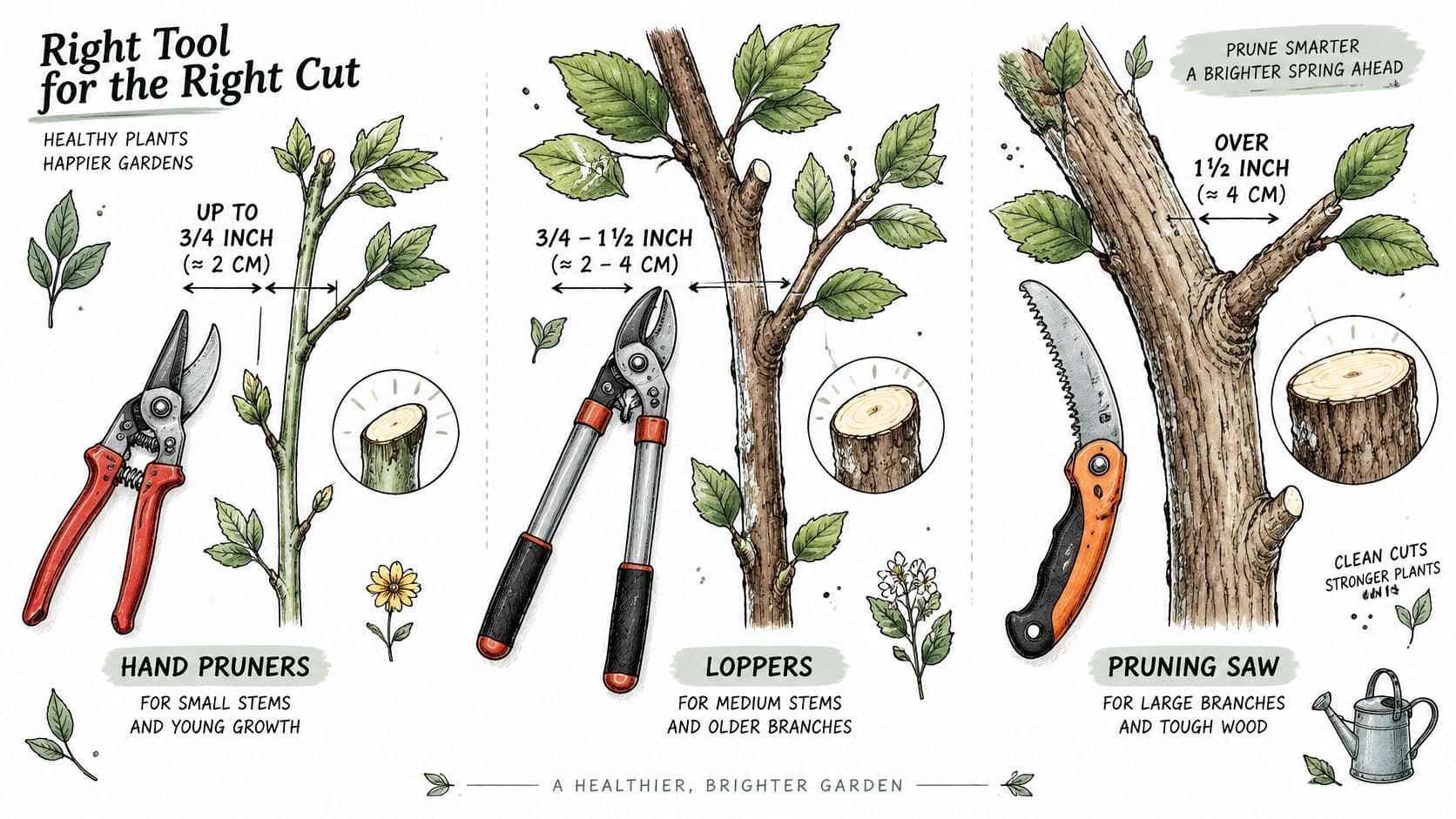
Bypass pruners make clean cuts through live shoots because their blades pass each other. Loppers provide extra force and reach, while a pruning saw removes wood that's too substantial for a clean closing cut.
Choose a tool that cuts without force
Manufacturer capacities differ, so treat the tool's rated capacity as a ceiling rather than a target. Dry, hard wood may require a saw even when a similarly sized green stem cuts easily.
Pruning tools and the stem sizes they handle
| Tool | Largest stem it cuts cleanly | Best use |
|---|---|---|
| Bypass hand pruners | A slender stem that fits fully inside the jaws and cuts without straining | Live green stems and flowering shoots |
| Loppers | A medium woody stem within the tool's rated capacity | Deep inner branches and reaching over the shrub |
| Fine-tooth pruning saw | Wood too thick or hard for loppers; clearance must allow an unobstructed stroke | Thick old wood during rejuvenation cuts |
| Hedge shears | Thin new growth only | Shaping evergreen hedges after frost risk passes |
Use the illustration to compare the tools before tackling the shrub.
Make cuts that preserve the framework
A heading cut shortens a shoot to a healthy bud. Cut just above an outward-facing bud, leaving enough stem to protect it but not a long stub; use a slight slope away from the bud rather than a steep, exposed cut.
A thinning cut removes a branch at its origin. Preserve the branch collar, the slightly swollen junction at the base, rather than cutting flush into the supporting stem.
For a heavy branch, make an undercut farther out from the intended finished cut, then cut from above to remove its weight. Finish at the collar once the branch can no longer pull down and strip bark.
- Clean blades: Remove sap and debris, then disinfect between plants and after diseased cuts with a blade-safe disinfectant, observing its contact time.
- Use shears selectively: Shear soft hedge growth, not woody flowering branches. Repeated surface clipping creates a dense shell while leaving the interior crowded.
- Practise placement: The same careful stem selection used in these precise deadheading tips for weekend gardeners helps you avoid cutting adjacent buds.
Wear gloves and eye protection, keep blades sharp, and reposition yourself rather than reaching into a loaded blade.
How to Prune Summer-Blooming Shrubs in Early Spring
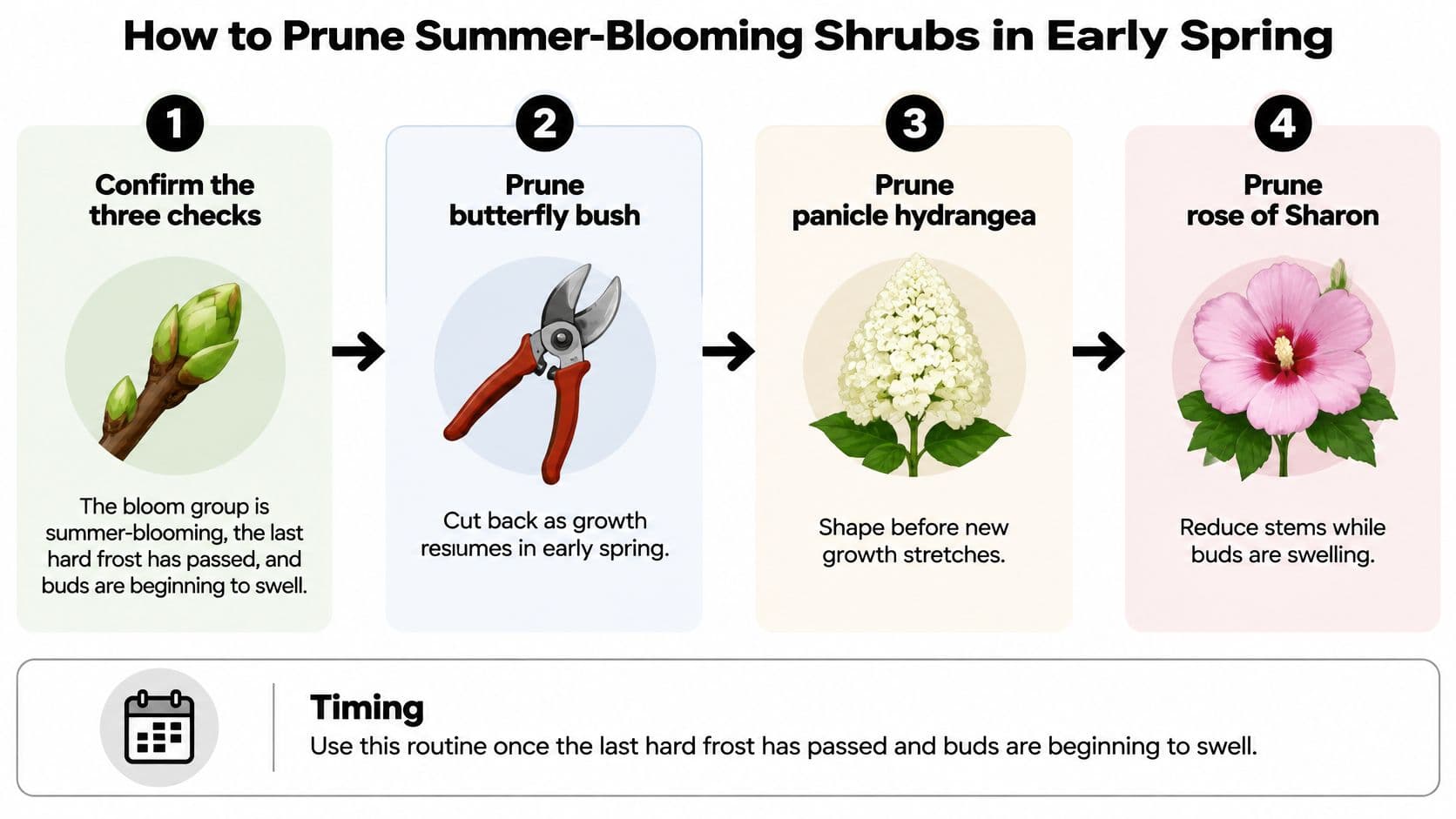
Butterfly bush, panicle hydrangea, and rose of Sharon can all be managed before their new shoots stretch, but they don't need identical treatment. Butterfly bush often suits stronger annual reduction; panicle hydrangea usually needs a sound supporting framework; rose of Sharon may need little beyond selective thinning.
Pruning intensity should follow the plant's condition and your goal. A healthy shrub with enough room doesn't need a hard cut just because it flowers on new wood. Excessive shortening can produce vigorous shoots where a lighter intervention would have preserved a better shape.
Work from obvious problems to optional shaping
Before structural pruning, confirm the flowering group, check that severe frost risk is substantially past, and look for dormant or just-swelling buds.
The visual below summarizes the timing and plant-specific approach.
-
Confirm the plant and conditions. Check the label or identify the shrub before removing living stems. If it's already flowering or carrying conspicuous old-wood flower buds, pause rather than applying a summer-bloomer routine blindly.
-
Remove dead, damaged, and diseased wood. Follow broken or dead shoots back to sound tissue or their point of origin. On uncertain winter-damaged tips, look for living buds before deciding how far down to cut.
-
Resolve crossing branches. Keep the better-positioned branch and remove the competitor where they rub. Choose for strong attachment and useful direction, not merely whichever stem looks thicker.
-
Shorten flowering shoots where appropriate. For shrubs suited to this pruning method, the Royal Horticultural Society's pruning groups guidance describes cutting the previous year's flowering stems back to one or two buds above the older woody framework. Don't turn that into a compulsory hard cut for every panicle hydrangea or rose of Sharon; retain sound structure when light shaping meets the goal.
-
Thin weak interior growth. Remove spindly shoots that crowd stronger branches rather than clipping every tip. Keep useful leafy growth, especially on a shrub that's weak or recovering from stress.
-
Check the outline from different positions. Step away and view the plant from the path, doorway, and side of the bed. Stop when the branches have room to develop, even if the bare framework isn't perfectly symmetrical.
-
Record the work and watch the response. Note what you removed and monitor where buds open. Fresh growth along retained stems is more useful feedback than whether the shrub looks instantly smaller.
Know when enough is enough
A finished shrub should have clean cut ends, visible living buds, and a framework that suits its natural habit. It shouldn't look hollowed out or stripped just to make every branch easy to see.
Leave a naturally arching shrub with room to arch. Trying to turn it into a compact ball usually means more clipping later and a poorer-looking plant between trims.
Adjusting Pruning Time for Climate and Late Frost
A fixed calendar date doesn't travel well. In a mild coastal garden, buds may already be moving while an inland garden remains frozen, so matching your neighbour's pruning weekend isn't a reliable test.
Compare the growth stage and exposure instead.

Read the plant and the forecast together
Swollen buds show that growth is approaching, not that freezing weather is over. Check the forecast and the shrub's position: an exposed corner, sheltered courtyard, and low frost pocket can behave differently within the same property.
For healthy spring-flowering shrubs, Iowa State Extension recommends pruning immediately after flowering, while rejuvenating overgrown shrubs is generally a late-winter or early-spring job. The distinction is the purpose of the work, not merely the weather.
Use these cues when conditions don't match your usual routine:
- Recent frost: Delay cosmetic removal of questionable tips until living growth makes the damage clearer.
- Active leaf emergence: Avoid a major reduction merely to catch up with a missed dormant window.
- Finished flowering: Make selective corrections promptly rather than repeatedly shearing through the growing season.
- Heat stress: Postpone optional shaping when foliage is wilting and the root zone is dry.
Adjust the job when the window closes
In hot, dry gardens, waiting for a familiar “spring” weekend may leave you pruning into stressful weather. Plan around the plant's bloom cycle and its ability to recover with available moisture.
If you've missed the best window, reduce the scope instead of forcing the original job through. Removing an obstructing branch is different from renovating the entire shrub.
For a demonstration of shrub-pruning technique, watch the following video.
Repeated winter injury may also mean the plant is poorly matched to the site. Before replacing a tender shrub, compare cold-hardy gardenia varieties and check suitability for your conditions; a local extension office can confirm local pruning timing.
Recovery Care After a Spring Cut
Water according to soil moisture, not because you've pruned. During dry spells, soak the root zone slowly and check beneath the surface before watering again; saturated soil won't help a stressed shrub recover.
Spread an even layer of organic mulch over the root area, keeping the stems and crown clear. Mulch helps moderate moisture and temperature, but piling it against bark creates a damp hiding place for decay and pests.
Support recovery without forcing growth
Don't automatically follow pruning with heavy fertilizer. A healthy established shrub may already have what it needs, while an excessive feed can encourage soft growth that needs more water and further trimming.
Check the remaining stems as leaves develop. If a tip dies back, trace it to healthy tissue and remove the failed portion with a clean blade; widespread decline calls for checking roots, drainage, and disease rather than making more shaping cuts.
Light-pruning benchmark: Kansas State University's shrub-pruning guidance states that light pruning of no more than 10% can be performed at any time of year.
That benchmark isn't permission to keep taking another light cut whenever the shrub looks untidy. Consider the cumulative removal and the plant's condition, especially after a substantial spring reduction.
- Check moisture: Keep the root zone from becoming severely dry without leaving it waterlogged.
- Inspect regrowth: Look for firm, normally coloured leaves and shoots rather than judging recovery by speed alone.
- Stop shaping: Once clearance and structure are adequate, let the shrub rebuild foliage.
Say a rose of Sharon extends into a path in midsummer: selectively shortening the obstructing shoot is a light correction, while cutting the whole shrub hard risks losing flowers and creating unnecessary stress. If moisture, foliage, and new growth look healthy afterward, leave it alone for the rest of the season.
Confirm the Timing Before Your First Cut
The best pruning decision may be to leave the saw in the shed. A healthy shrub that fits its space doesn't need annual size reduction, and an unidentified shrub shouldn't become a guessing exercise with irreversible consequences.
Make a short inspection before beginning. Separate branches that genuinely need attention from those you merely feel tempted to tidy.
Make the decision at the plant
- Name the shrub. Confirm the species and, where it changes pruning needs, the cultivar. Match it to the timing table rather than relying on a broad label such as hydrangea or evergreen.
- Inspect its current stage. Look for swollen buds, open flowers, faded blooms, and expanding leaves. If a spring bloomer hasn't flowered yet, schedule routine shaping for after its display.
- Check the weather and purpose. For a summer or autumn bloomer, proceed when conditions suit early-spring work. Decide whether you need clearance, healthier structure, or removal of damaged wood.
- Treat renovation separately. If the shrub is overgrown and dormant, confirm that it tolerates rejuvenation before making major cuts. Stage the work where practical rather than stripping a struggling plant.
- Record your decision. Put the planned cut date on your calendar and photograph the plant before starting. Include a note about flowering so next season's decision is quicker.
When you're changing a bed's shape, OutdoorBrite lets you start previewing a different planting layout with a photo of the beds or borders you want to change. Use that view to judge spacing and balance, not as evidence that a shrub will tolerate a particular cut.
The first cut is the easiest to plan and the hardest to undo.
OutdoorBrite turns a photo of your garden into planting and border design concepts you can compare before committing to changes. Visit OutdoorBrite to test a new layout before deciding which shrubs to retain, reshape, or replace, then confirm plant suitability and pruning needs before starting work.
See your yard reimagined
Start creating