10 Curb Appeal Landscaping Ideas for 2026
Discover 10 top curb appeal landscaping ideas for 2026. From modern designs to native plants, find inspiration and tips to transform your front yard.
You pull into your driveway and see it right away. The front yard isn't terrible, but it isn't helping either. The beds feel flat, the walkway looks forgotten, and the whole entrance lacks the kind of polish that makes a home feel finished when you return home.
That uncertainty stops a lot of projects before they start. Most homeowners can spot that something feels off, but they can't always tell whether the fix is better plants, a stronger entry path, cleaner lines, or less visual clutter. Then the bigger problem shows up. If you guess wrong, you can spend real money on shrubs, stone, lighting, or planters and still end up with a front yard that feels busy, undersized, or disconnected from the house.
That's why smart curb appeal landscaping ideas start with two things. First, they need to suit the architecture and scale of the home. Second, they need to be easy to picture before you install anything. A good-looking idea on someone else's house can fall flat on yours if the proportions, materials, or planting style don't match.
The good news is that you don't have to rely on guesswork anymore. These 10 ideas cover practical upgrades that work across budgets, from low-maintenance planting plans to more structural changes like walkways, lighting, and hardscape. If you're selling, it helps to know that 92 percent of REALTORS® recommend improving curb appeal before listing a home. If you're staying put, the payoff is simpler. Your home feels better every time you arrive.
If you want extra inspiration before choosing a direction, this curb appeal infographic is a useful visual starting point.
Table of Contents
- 1. Modern Minimalist Front Yard Design
- 2. Colorful Foundation Planting Schemes
- 3. Welcoming Entry Pathways and Walkways
- 4. Strategic Tree and Large Specimen Plant Placement
- 5. Accent Lighting and Outdoor Illumination
- 6. Low-Maintenance Native Plant Gardens
- 7. Raised Garden Beds and Planter Design
- 8. Hardscape Features and Outdoor Living Spaces
- 9. Symmetrical and Balanced Landscape Composition
- 10. Year-Round Interest Through Seasonal Plant Selection
- 10-Point Curb Appeal Comparison
- Visualize Your Perfect Front Yard Today
1. Modern Minimalist Front Yard Design
Minimalist front yards work best when the house already has strong lines. Think modern townhomes, updated ranches, boxy new builds, or homes with simple facades that benefit from a restrained planting palette rather than a cottage-style mix.
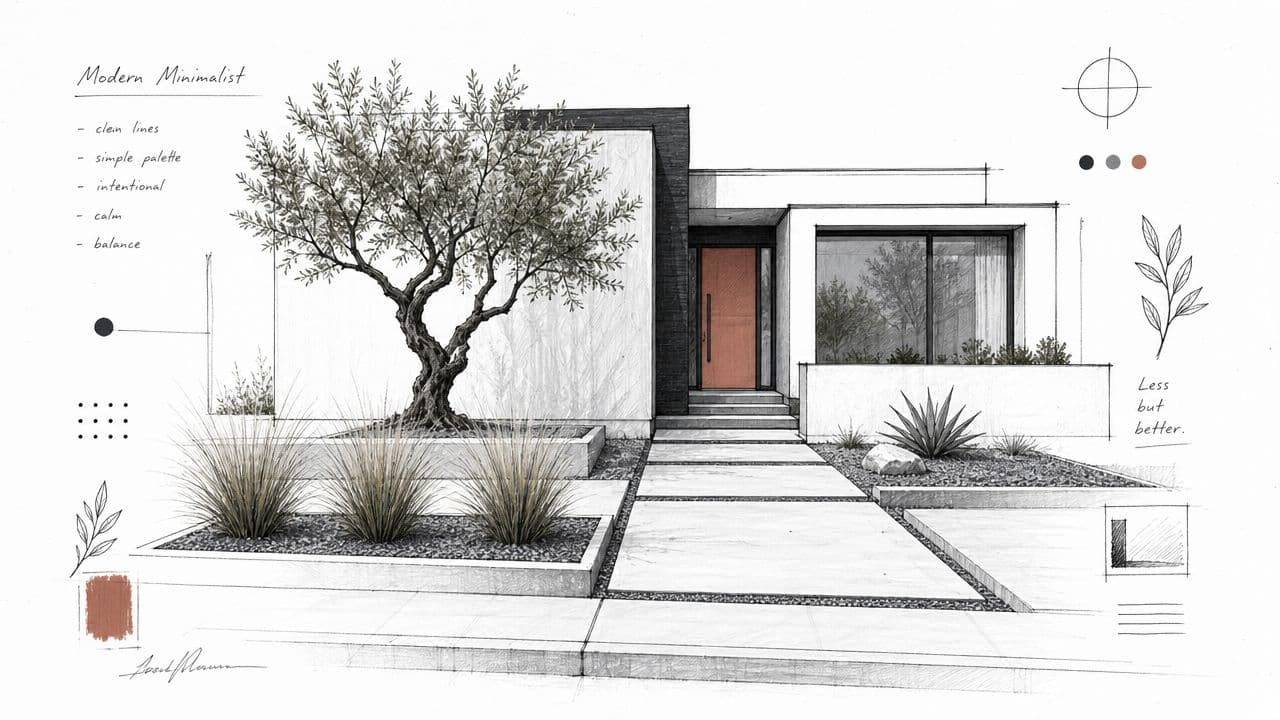
The biggest mistake I see with this style is adding too much. Homeowners say they want clean and modern, then install six shrub varieties, bright seasonal flowers, and decorative edging in three materials. That doesn't read as minimalist. It reads unfinished and indecisive.
Edit harder than you add
Use fewer plant types and repeat them. Ornamental grasses, clipped evergreens, upright shrubs, gravel bands, concrete pads, and steel edging usually do more for modern curb appeal than a crowded bed full of small flowering plants.
A good real-world example is a narrow front yard with a straight concrete walk, black steel edging, three masses of one grass variety, and a single specimen tree offset near the entry. That approach gives the eye somewhere to land. It also keeps maintenance predictable.
- Repeat plant forms: Choose two or three species and use them across the front yard for cohesion.
- Match the house lines: If the home has strong geometry, echo it with rectangular beds, squared pavers, or linear gravel strips.
- Use one focal point: A specimen tree, sculptural pot, or standout front door color is enough.
Practical rule: In minimalist landscapes, empty space is part of the design. If every bed is packed, the style falls apart.
This is also one of the easiest styles to test before you buy materials. With landscape design ai, you can upload your actual front yard and preview whether a gravel-forward, low-planting layout looks polished or too sparse on your home. That matters because minimalist designs depend on proportion more than decoration.
2. Colorful Foundation Planting Schemes
Foundation planting gets a bad reputation because so much of it is done badly. Rows of identical shrubs shoved under windows can make a house look shorter, darker, and older than it is.
Done right, foundation planting frames the house, softens the base, and adds seasonal color without hiding the architecture. It's one of the most dependable curb appeal landscaping ideas because it can work on almost any house style, from brick colonials to simple suburban builds.
Build the bed in layers
Think of the bed in three heights. Low plants near the front edge, medium shrubs and perennials in the middle, and taller elements placed where they won't block windows or crowd the entry. That layering creates depth from the street instead of a flat hedge line.
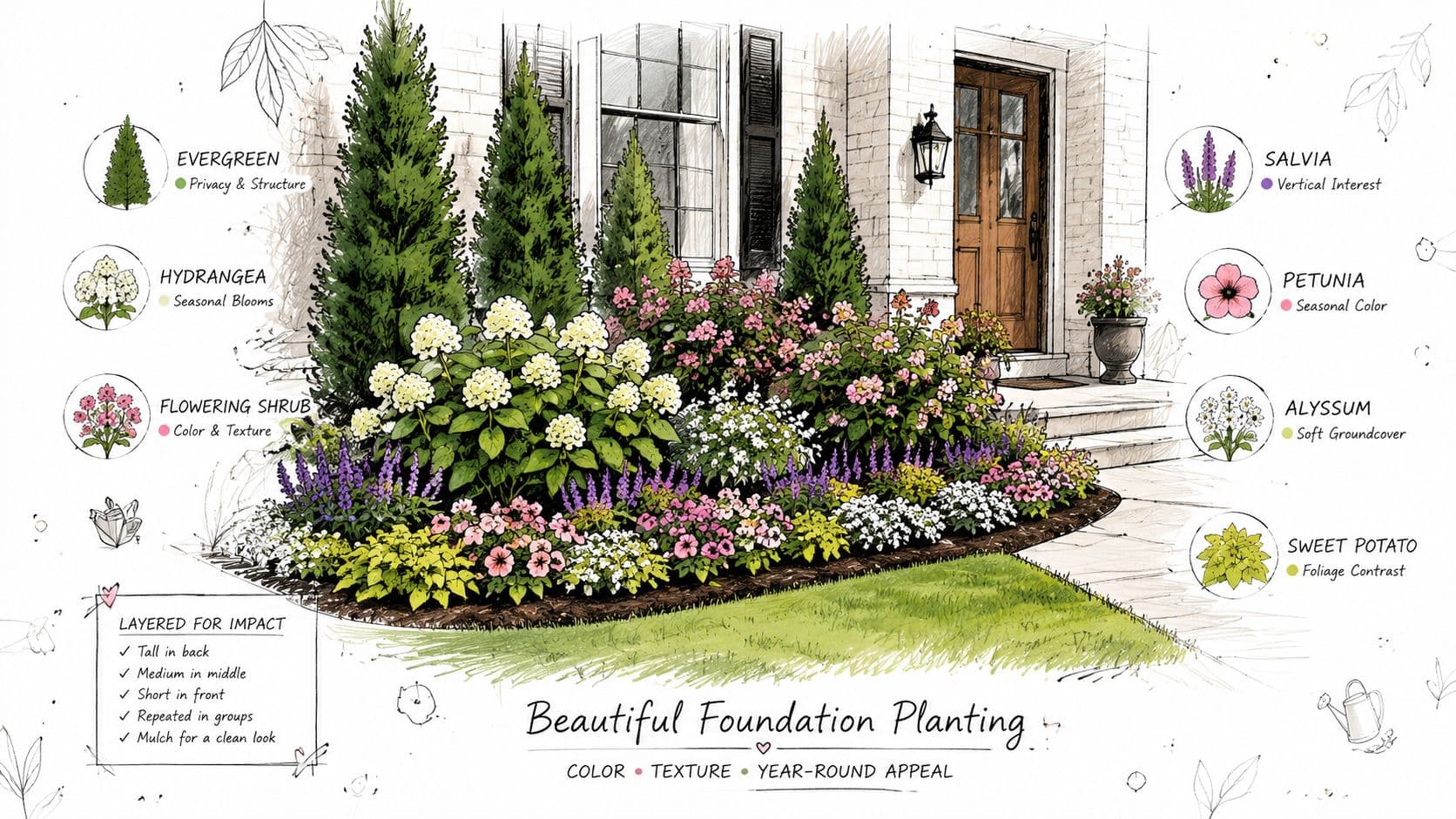
A practical scheme might use evergreen shrubs for structure, then add perennials and annual accents for changing color. On a sunny front yard, that could mean upright evergreens in key corners, mounding shrubs below windows, and drifts of salvia, coneflower, or seasonal annuals toward the front edge. On a shadier lot, the same structure can come from foliage contrast rather than bloom power.
What works:
- Stagger bloom times: Mix plants so something carries the display beyond one short peak.
- Use foliage on purpose: Silver, burgundy, lime, and blue-green foliage can do as much as flowers.
- Leave breathing room: Beds look better after a season or two when plants have space to mature.
What doesn't:
- Planting by nursery pot size: Small plants look harmless now, but mature spread is what matters.
- Using all one height: A straight line of medium shrubs rarely looks designed.
- Ignoring window lines: Plants shouldn't swallow the lower facade.
OutdoorBrite's seasonal controls are especially useful here because foundation beds can look balanced in spring and awkward by late summer. Previewing across seasons helps you catch gaps before you buy.
3. Welcoming Entry Pathways and Walkways
A front walkway does more than connect the driveway to the door. It tells visitors where to go, and it tells the eye how to move across the property. When a house feels uninviting from the street, the path is often part of the problem.
Some homes need a strong, direct walk. Others benefit from a softer route with a little curve. The right choice depends on the architecture, the front setback, and whether the door is centered or off to one side.
Choose materials that age well
Pavers, natural stone, gravel, and stamped concrete can all work. The wrong move is choosing a material because it looked good online without considering your climate, maintenance tolerance, and home style.
For example, a crisp paver walk suits many suburban homes because it feels finished and is easy to edge with planting. Gravel can be attractive in cottage or modern outdoor spaces, but it needs firm edging and regular upkeep or it starts to spread into beds and lawn. Natural stone adds character, though it needs careful installation if you want an even walking surface.
A walkway should feel proportionate to the house. Too narrow, and the front entrance feels stingy. Too wide, and a small yard loses planting space fast.
A solid front-yard layout often looks like this:
- Defined edges: Steel, brick, or stone edging keeps the path from visually dissolving into the lawn.
- Low side planting: Soft plantings frame the route without grabbing sleeves or obscuring sightlines.
- Subtle lighting: Small path lights or low uplighting make the route usable after dark.
If you're deciding between straight pavers, stepping stones, or a looser gravel look, AI visualization is useful because pathways read very differently once laid over your actual facade and yard width. This is one of those upgrades where scale is hard to judge from a mood board alone.
4. Strategic Tree and Large Specimen Plant Placement
A single well-placed tree can do more for curb appeal than a truckload of small plants. It gives the yard structure, creates a focal point, and helps the outdoor space feel established instead of newly installed.
The catch is that specimen planting is where expensive mistakes happen. Homeowners often buy for the current pot size, not the mature canopy, root spread, or branching habit. Five years later, the front yard feels crowded and the house looks pinched.
Think in mature scale
There's one sizing issue worth taking seriously. A claim provided in the source material says plants exceeding 65% of the home's facade height can reduce perceived home value by 12% in urban and suburban markets, cited through Pretty Purple Door's curb appeal tips reference. Whether you treat that as a strict rule or a design warning, the practical lesson is sound. Oversized plants can make a front elevation feel smaller and less approachable.
That's why columnar evergreens often work near garages or property edges, while broad-canopy trees usually need more setback room. A Japanese maple near an entry court can be elegant. The same tree jammed under a front window usually isn't.
- Frame, don't block: Trees should accent rooflines, corners, or entry views rather than hide them.
- Use one specimen with confidence: Most front yards don't need several competing focal trees.
- Check utilities and foundation spacing: Beautiful placement on paper can become a costly conflict later.
Planting a tree is easy. Choosing where it will look right ten years from now is the actual design work.
This is another area where visualization earns its keep. Previewing a flowering tree, an upright evergreen, or a multi-stem specimen on your home photo helps you spot whether the placement adds presence or just adds bulk.
5. Accent Lighting and Outdoor Illumination
Lighting changes curb appeal more at night than almost any planting upgrade. A flat, forgettable front yard can suddenly feel warm, layered, and intentional once the key features are lit properly.
The common mistake is over-lighting. Too many fixtures, too much brightness, or the wrong beam angle can make the house feel harsh instead of welcoming.
Light the architecture, not everything
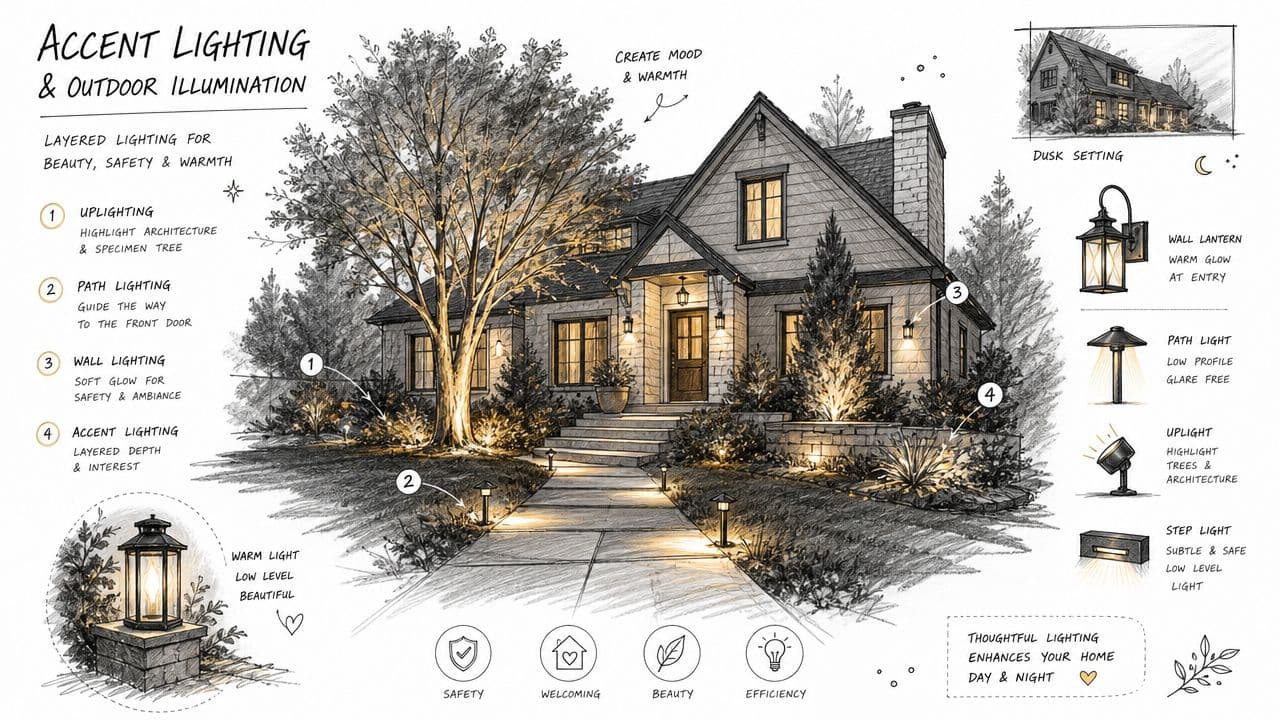
Good outdoor lighting has hierarchy. Start with the front door area, the walkway, and one or two standout features like a specimen tree, textured wall, or architectural column. If every shrub gets its own spotlight, the effect turns noisy fast.
Warm white light usually feels better on residential facades than cooler tones. Path lights should guide, not glare. Uplights should reveal texture and form, not throw harsh shadows across the garage door.
A practical setup often includes:
- Entry emphasis: A clear, warm-lit front door area.
- Path definition: Low fixtures spaced to mark the route safely.
- Feature lighting: One tree or one facade element worth highlighting.
For a quick visual example of how lighting changes a front elevation after dark, this short video is useful before you choose fixture types or placement:
What doesn't work is scattering solar stakes everywhere and hoping the yard feels designed. Cheap fixtures can help on a tight budget, but they still need a plan. Even a modest lighting layout looks better when it follows the architecture and planting structure instead of fighting them.
6. Low-Maintenance Native Plant Gardens
A front yard can look polished in spring, tired by July, and expensive by fall if the plant palette fights the site. Native planting solves a lot of that. Species adapted to local rainfall, soil, and temperature swings usually need less watering, fewer replacements, and less coaxing once established.
The trade-off is visual control.
A native garden needs structure from the street. On a front yard, that usually means repeated groupings, clean bed lines, and a simple framework that holds up even when perennials are cut back or grasses go dormant. Loose planting can work well, but only when the layout reads clearly from the sidewalk and driveway.
Native planting works best with a strong framework
The best results usually come from limiting the palette and repeating it. Use one or two grasses, a few dependable flowering perennials, and shrubs that keep some presence through winter. That approach cuts maintenance and keeps the yard from feeling scattered.
A practical example is a sunny front yard where turf struggles or adds little value. Remove one broad section of lawn, shape a bed with a crisp edge, and fill it with regional grasses, long-blooming perennials, and shrubs sized for the house. The planting can still feel relaxed, but the outline should stay sharp.
Native gardens look better when the planting feels intentional, not accidental.
Research from Virginia Extension on property value found that attractive outdoor spaces can raise perceived home value, and it identified design quality as the biggest driver of that response, ahead of plant size alone, according to Virginia Extension's research on property value. That applies here. Native plants reduce upkeep, but the arrangement still has to look considered.
If you want to test plant groupings before buying anything, ai for garden design helps you compare different native layouts against your actual house and entry conditions. That is useful because a planting plan that looks great in a reference photo can feel too busy, too sparse, or out of scale once it is placed on your own frontage. For homeowners weighing water use, upkeep, and material choices, Templeton Built's sustainable landscaping is also a helpful companion read.
7. Raised Garden Beds and Planter Design
Raised beds aren't just for backyard vegetables. In the front yard, they can add shape, solve awkward grade transitions, and create a cleaner planting presentation than in-ground beds on difficult sites.
They work especially well near porches, along broad front walks, or in homes where the base of the house sits a little too high above the yard. That vertical lift helps connect the house to the outdoor space instead of leaving a blank stretch of foundation and mulch.
Use planters to solve layout problems
When a front yard feels flat or disorganized, raised elements can create order fast. A pair of low masonry planters near steps makes an entry feel anchored. Tiered cedar or metal-edged beds can break up a sloping lawn. Long rectangular planters suit modern homes where curved foundation beds would look out of place.
The trade-off is permanence. Large built-in planters need the right material and the right proportions from the start. If they're too small, plants outgrow them quickly. If they're too tall, the front of the house can feel boxed in.
A few rules help:
- Match materials to the house: Cedar, stone, steel, and composite all send different style signals.
- Keep access practical: You still need room to walk, weed, and water.
- Simplify plantings: Raised beds look best when the planting palette is edited.
One smart use case is a small suburban lot where turf struggles near the driveway because of reflected heat. A clean raised bed with ornamental grasses, compact shrubs, and seasonal color often looks sharper than trying to force lawn where it doesn't want to grow.
8. Hardscape Features and Outdoor Living Spaces
Not every curb appeal upgrade is plant-driven. Sometimes the strongest improvement is adding structure. A retaining wall that fixes grade, a small patio near the entry, wider steps, or a sitting area tucked into the front yard can make the entire property feel more finished.
Budget discipline matters. Hardscape usually costs more than planting, and mistakes are harder to undo. Start with the elements that solve a problem, not just the ones that look attractive in photos.
Start with grade and drainage
If water moves toward the house, if the front steps feel undersized, or if a slope makes planting awkward, hardscape can do more than any new shrub list. Retaining walls can create usable terraces. Paver landings can make a front entry feel proportional. Low seat walls can define space and give a wide-open yard some needed shape.
A practical example is a home with a broad but plain front lawn and a short entry walk. Extending the walk into a small landing, adding edge walls, and integrating planted side beds often does more for curb appeal than refreshing the existing beds.
- Fix function first: Drainage, steps, and grade should lead the plan.
- Limit the palette: Two complementary materials often look better than four.
- Blend hard and soft: Stone and pavers need planting around them or the yard can feel severe.
If you're considering a front patio, expanded landing, or retaining feature, the ai patio design generator is useful for testing scale before you commit. For broader inspiration on layout and material choices, Gates Furniture's guide to designing a beautiful patio offers helpful examples.
9. Symmetrical and Balanced Landscape Composition
Some front yards feel expensive even when the plant list is simple. Usually that comes down to composition. The beds relate to the house. The focal point is clear. The visual weight feels stable from one side to the other.
Balance is one of the most overlooked curb appeal landscaping ideas because people focus on individual features instead of the whole front elevation. They'll choose a pretty tree, a nice light fixture, and a fresh walkway, but never check whether everything still reads as one composition.
Balance is not always symmetry
On a centered colonial entry, symmetry often works beautifully. Matching pots, mirrored shrubs, and evenly spaced beds reinforce the architecture. On a modern or asymmetrical house, forced symmetry can feel stiff. In that case, balance might come from offsetting a larger tree on one side with a wider bed or grouping of lower plants on the other.
What matters is visual weight. A tall dark evergreen mass on one side of the house needs an answer somewhere else, even if it isn't a duplicate.
A useful field test is to stand at the street and squint. If one side disappears and the other side feels heavy, the composition probably needs adjustment.
- Repeat something: Color, plant form, edging, or material should carry through the yard.
- Create one focal point: Don't make the eye choose between five.
- Leave some open space: Lawns, gravel courts, or clean mulch beds can help the stronger features stand out.
Good balance doesn't always look formal. It looks intentional.
AI previews offer surprising practicality. They let you compare a symmetrical entry layout against an asymmetrical one on the same photo, which is much easier than trying to imagine the difference from a plant list alone.
10. Year-Round Interest Through Seasonal Plant Selection
A front yard shouldn't peak for six weeks and then disappear. The best outdoor arrangements keep their shape through spring growth, summer fullness, fall color, and winter dormancy.
Many homeowners build around bloom alone. That creates a nice moment in season, then leaves a weak structure the rest of the year. Evergreens, bark texture, seed heads, branching habit, berries, and hardscape all matter if you want the yard to hold up in the off months.
Plan the off-season on purpose
Use spring bulbs and flowering shrubs as accents, not the whole strategy. Pair them with plants that carry visual weight later, such as evergreen forms, ornamental grasses, strong shrub structure, or small trees with standout branching.
A reliable sequence might look like this: bulbs and early flowering shrubs in spring, perennials and foliage contrast in summer, grasses and leaf color in fall, then evergreen structure and persistent seed heads in winter. That kind of layering keeps the front yard from going blank when the flowers are gone.
One source in the provided material claims homeowners often notice a drop in perceived appeal during dormancy periods and cites the need for evergreen structure and winter-hardy accents through Lehnhoff's landscaping curb appeal article. Even without leaning on the exact figures, the design lesson is obvious on any winter street. Houses with structure still look cared for. Houses built only around bloom don't.
What works especially well:
- Evergreen anchors: Boxwood forms, junipers, or other climate-appropriate structure plants.
- Plants with winter character: Grasses, red-twig types, or attractive branching.
- Seasonal overlap: Beds should hand off from one season to the next, not stop and start.
10-Point Curb Appeal Comparison
| Design Option | Implementation Complexity 🔄 | Resource Requirements ⚡ | Expected Outcomes ⭐📊 | Ideal Use Cases 💡 | Key Advantages ⭐ |
|---|---|---|---|---|---|
| Modern Minimalist Front Yard Design | Moderate, precise hardscape/plant placement required | Moderate, quality hardscape materials and skilled labor | High curb appeal and low maintenance (⭐⭐⭐⭐) | Contemporary homes; owners wanting low-upkeep sophistication | Clean visual impact; easy updates; reduced maintenance |
| Colorful Foundation Planting Schemes | Moderate, layered planting and seasonal planning | Moderate, ongoing plant purchases and watering | Strong seasonal color and framed entry (⭐⭐⭐) | Traditional or cottage-style homes; adding warm, welcoming color | Dramatic color; hides foundation; supports pollinators |
| Welcoming Entry Pathways and Walkways | Moderate–High, site prep and durable installation | Variable, from low-cost gravel to high-end stone | Immediate improvement in navigation, safety, and first impressions (⭐⭐⭐) | Properties needing defined access or improved safety | Guides visitors; enhances curb appeal; integrates lighting |
| Strategic Tree & Large Specimen Placement | Moderate, requires long-term planning and placement | High, purchase, planting equipment, and potential professionals | Major long-term visual impact, shade, and value (⭐⭐⭐⭐) | Larger lots; long-term investment, privacy or shade goals | Adds maturity; energy savings; wildlife habitat |
| Accent Lighting & Outdoor Illumination | Moderate–High, electrical work and lighting design | Moderate, fixtures, wiring, and power or solar options | High nighttime curb appeal and improved safety (⭐⭐⭐) | Homes showcased at night; security-focused or entertaining spaces | Extends use after dark; highlights architecture; automation |
| Low-Maintenance Native Plant Gardens | Low–Moderate, requires species knowledge for design | Low ongoing, initial establishment water, low inputs later | Sustainable, low-water landscape with ecological benefits (⭐⭐⭐) | Drought-prone areas; eco-conscious homeowners | Low water/cost; supports pollinators; low long-term upkeep |
| Raised Garden Beds & Planter Design | Low, straightforward construction and placement | Moderate, materials, soil, and irrigation setup | Adds dimensional interest and accessibility quickly (⭐⭐) | Small yards, kitchen gardens, poor-soil sites | Improved drainage/soil control; ergonomic gardening; modular |
| Hardscape Features & Outdoor Living Spaces | High, complex grading, drainage, and skilled construction | High, premium materials, pro labor, ongoing maintenance | Significant increase in usable space and property value (⭐⭐⭐⭐) | Entertaining yards; homeowners seeking outdoor rooms | Functional living areas; strong value-add; focal points |
| Symmetrical & Balanced Landscape Composition | Moderate, design-focused; requires proportion knowledge | Low–Moderate, depends on chosen plants/hardscape | Sophisticated, cohesive appearance that reads as professional (⭐⭐⭐) | Formal architecture or projects aiming for polished design | Timeless harmony; predictable, repeatable results |
| Year-Round Interest Through Seasonal Plant Selection | High, detailed plant selection and staging | Moderate, more species and seasonal management | Continuous visual appeal across seasons; dynamic landscapes (⭐⭐⭐) | Climates with distinct seasons; owners wanting evolving displays | Sustained curb appeal; multi-season wildlife support |
Visualize Your Perfect Front Yard Today
A better front yard doesn't come from chasing trends. It comes from making clear design choices that suit your house, your lot, and the amount of upkeep you're willing to handle. That's the thread running through all of these curb appeal landscaping ideas. The most successful upgrades aren't always the biggest. They're the ones that make the property feel intentional from the street.
Sometimes that means simplifying. A modern home may need fewer plant types, not more. A traditional home may need stronger foundation layering and a better walkway instead of another ornamental accent. A yard with poor night presence may get its biggest lift from lighting, not from replanting every bed. A front elevation that feels flat may need one excellent tree in the right place rather than a dozen smaller shrubs.
That's also why planning matters so much. Landscaping mistakes are expensive because they're physical. A plant that outgrows the space, a path that feels too narrow, a retaining wall that dominates the facade, or a planter that blocks circulation doesn't stay theoretical once it's installed. You have to live with it or pay to redo it.
OutdoorBrite helps close that gap between inspiration and execution. Instead of trying to imagine how a minimalist scheme, layered foundation bed, new pathway, or front patio might look, you can upload a photo of your actual home and test those ideas directly on the property you're working with. That changes the decision process in a very practical way. You can compare styles, swap materials, experiment with layout, and see whether a concept supports the house or fights it.
That's especially useful for front-yard projects because proportion is everything. A design that looks balanced on a sample image may feel too dense on a small lot or too sparse on a wide facade. With AI visualization, you can catch those issues before you buy plants, order pavers, or schedule labor. Homeowners can use it to reduce uncertainty. Contractors and designers can use it to show options faster and get alignment earlier in the process.
If you're tackling curb appeal in phases, this kind of visual planning also helps you decide what should come first. You may realize the walkway needs attention before the planting beds. Or that a specimen tree solves more than another row of shrubs. Or that lighting and clean edging get you most of the way there for now, while a patio or wall can wait for a second phase.
OutdoorBrite also supports testing environmental conditions like season and lighting, which matters when you're choosing for year-round presence rather than just peak bloom. That feature is particularly helpful for front yards because they're on display every day, not just when the garden is at its best.
If financing is part of the conversation, OutdoorBrite Money may be one practical option to explore while planning the project. The main point is simpler. Don't guess your way through a curb appeal upgrade when you can preview it first.
Start with one photo of your home. Test the ideas that fit your style. Refine the details until the front yard looks right. Then build with confidence.
If you're ready to move from ideas to a real plan, OutdoorBrite Money connects your front-yard inspiration with OutdoorBrite's AI design tools so you can visualize changes, compare options, and make landscaping decisions with a clearer picture of the result.
See your yard reimagined
Start creating