8 Front Yard Landscaping Ideas with Trees for 2026
Transform your curb appeal with our 8 front yard landscaping ideas with trees. Discover specimen trees, native clusters, privacy screens, and more for 2026.
Your front yard probably already has the basics. A strip of lawn, a path to the door, maybe a foundation bed that never quite feels finished. The missing piece is often a tree. Trees give a front yard height, structure, shade, and a sense that the grounds are integrated with the house rather than just sitting in front of it.
They also change how the whole property reads from the street. A well-placed tree can soften a boxy facade, frame an entry, screen an awkward view, and make even a modest yard feel intentional. That's why so many homeowners who want to improve your home's curb appeal eventually come back to the same question. Which tree goes where, and what should go around it?
This guide gives you eight practical front yard landscaping ideas with trees, but not as vague inspiration. Each one includes a working layout approach, species suggestions by climate range, companion planting ideas, maintenance realities, and honest effort levels. Some ideas are fast to install but slow to mature. Others look polished right away but need tighter pruning and better siting. That trade-off matters.
Start with the yard you have, not the one in a magazine. Measure the distance to the house, driveway, walk, utilities, and overhead lines. Then choose the tree concept that fits your architecture, your maintenance tolerance, and the amount of space you can give the tree at maturity.
Table of Contents
- 1. Specimen Tree Focal Point Design
- 2. Mixed Tree Layering (Canopy, Understory, Shrub Layers)
- 3. Symmetrical Tree Allee (Double Tree Approach)
- 4. Native Tree Clustering (Ecological & Regional Authenticity)
- 5. Weeping & Pendulous Tree Forms (Graceful Drooping Canopies)
- 6. Ornamental Flowering Tree Display (Spring & Seasonal Color)
- 7. Privacy Screen & Windbreak Tree Rows (Functional Barriers)
- 8. Seasonal Color Succession & Multi-Season Tree Design
- Front Yard Tree Landscaping: 8-Option Comparison
- Design Your Dream Yard With Confidence
1. Specimen Tree Focal Point Design
A specimen tree works when the yard needs one clear anchor. Instead of spreading attention across many small plants, you let one tree carry the composition and use the rest of the planting to support it. This is one of the most reliable front yard landscaping ideas with trees for small and medium lots.
Good candidates include Japanese maple for Zones 5 to 8, flowering cherry for Zones 5 to 8, crape myrtle for Zones 6 to 9, and weeping katsura for milder climates where it's well suited. Match the species to your region first, then your style. A Japanese maple suits a sheltered courtyard entry, while a crape myrtle often reads better in sunny Southern yards with cleaner architectural lines.
Choose the tree first, then build the bed
Don't start by drawing a kidney-shaped mulch bed and then dropping a tree in the middle. Start with the mature canopy, viewing angle, and entry sequence. The Arbor Day Foundation recommends planting far enough from structures that the distance equals about half the tree's mature spread, with the example of a tree expected to reach 40 feet high being planted roughly 20 feet from a house in its tree placement guidance.
That spacing rule saves you from the most common mistake. Homeowners place a beautiful young tree too close to the facade, then spend years fighting branch clearance, root pressure, and blocked windows.
Practical rule: If the tree is the star, everything under it should be quieter. Let foliage texture and leaf color do the work.
Use low companions that won't compete visually. Hellebores, dwarf mondo grass, sedges, liriope, heuchera, and shade-tolerant ferns all work depending on climate and light. Keep the bed broad and simple, with a clean edge and open mulch area near the trunk.
If you want to test scale before buying, use ai for landscape design to mock up different specimen trees against your actual facade. That's especially useful when choosing between upright, rounded, or cascading forms.
Budget and effort
- Low to medium budget: One quality specimen tree, soil prep, mulch, and a restrained underplanting.
- Medium effort: Watering matters most during establishment, especially through the first growing seasons.
- Best use case: Entry courtyards, center-lawn placements offset from the door, and open corners that need one strong visual move.
2. Mixed Tree Layering (Canopy, Understory, Shrub Layers)
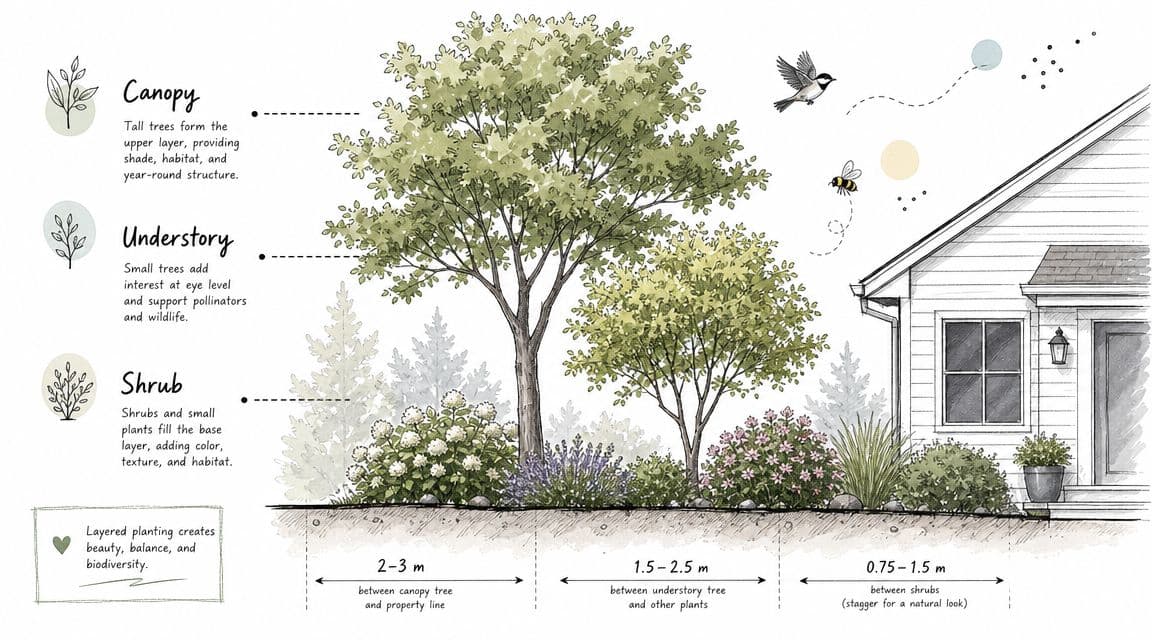
Layering fixes the flat-front-yard problem. If your house sits exposed behind a lawn with a few scattered foundation shrubs, adding canopy, understory, and shrub layers creates depth fast. It also gives the eye somewhere to travel besides the front door and garage.
A workable palette might pair an oak or maple canopy tree in the right climate with redbud, dogwood, or serviceberry beneath it, then evergreen shrubs and low perennials at the front edge. In the Pacific Northwest, a layered combination might lean more woodland. In the Mid-Atlantic, you can blend broad-canopy shade with spring-flowering understory trees.
Early in the planning stage, it helps to see the vertical structure clearly.
Build depth without blocking the house
The design rule that keeps layered planting from becoming a thicket is simple. Put the tallest elements in the back and layer shrubs and low plants forward, with trees acting as the main vertical anchors. Lowe's also recommends evergreen trees to preserve winter structure and notes that a 2 to 3 inch mulch layer is commonly used around tree beds to help suppress weeds and retain moisture.
That rule matters most near entries and windows. You want depth, not a screen wall across the front of the house.
Try a composition like this:
- Back layer: A canopy tree with a higher branching habit.
- Middle layer: One or two understory trees offset from the canopy, not centered beneath it.
- Front layer: Evergreen shrubs, ornamental grasses, hostas, hellebores, or ferns depending on sun exposure.
How to phase it in
Layered planting doesn't need to happen all at once. Many homeowners do better planting the canopy tree first, then adding understory trees and shrubs in later seasons. That approach gives you time to watch shade patterns and drainage before committing to everything.
The pruning style is different here too. Raise lower limbs on the canopy gradually so the understory remains visible. Don't limb it up too fast or the canopy loses presence.
If you want a visual walkthrough of how layered plant masses read in a residential yard, this clip helps show the structure from street view to foundation line.
Budget and effort
- Medium to high budget: More plants and more bed preparation.
- Medium effort: More pruning decisions, but each plant usually has a clear role.
- Works best for: Wide frontages, sloped lots, and homes that need visual softening.
3. Symmetrical Tree Allee (Double Tree Approach)
Some houses want balance, not looseness. Colonial, Georgian, Mediterranean, and many transitional homes look stronger when the front yard mirrors the architecture. A double-tree approach can frame the walk, the drive, or the front door with very little clutter.
The mistake is choosing trees that are too broad. In front yards, narrow or strongly upright forms usually perform better because they keep the center view open and hold the architecture in place. Columnar oak, Italian cypress in suitable climates, hornbeam, and fastigiate yew are common choices depending on region and style.
Where symmetry works best
This approach succeeds when the house has a visible centerline or a clearly defined entry axis. If the front door is offset and the garage dominates the facade, perfectly matched trees can make the imbalance more obvious. In that case, a loose asymmetrical composition usually looks better.
When symmetry does fit, be exact. Centerline errors show immediately in formal designs. Match trunk spacing, setback from the walk, irrigation exposure, and soil volume as closely as possible.
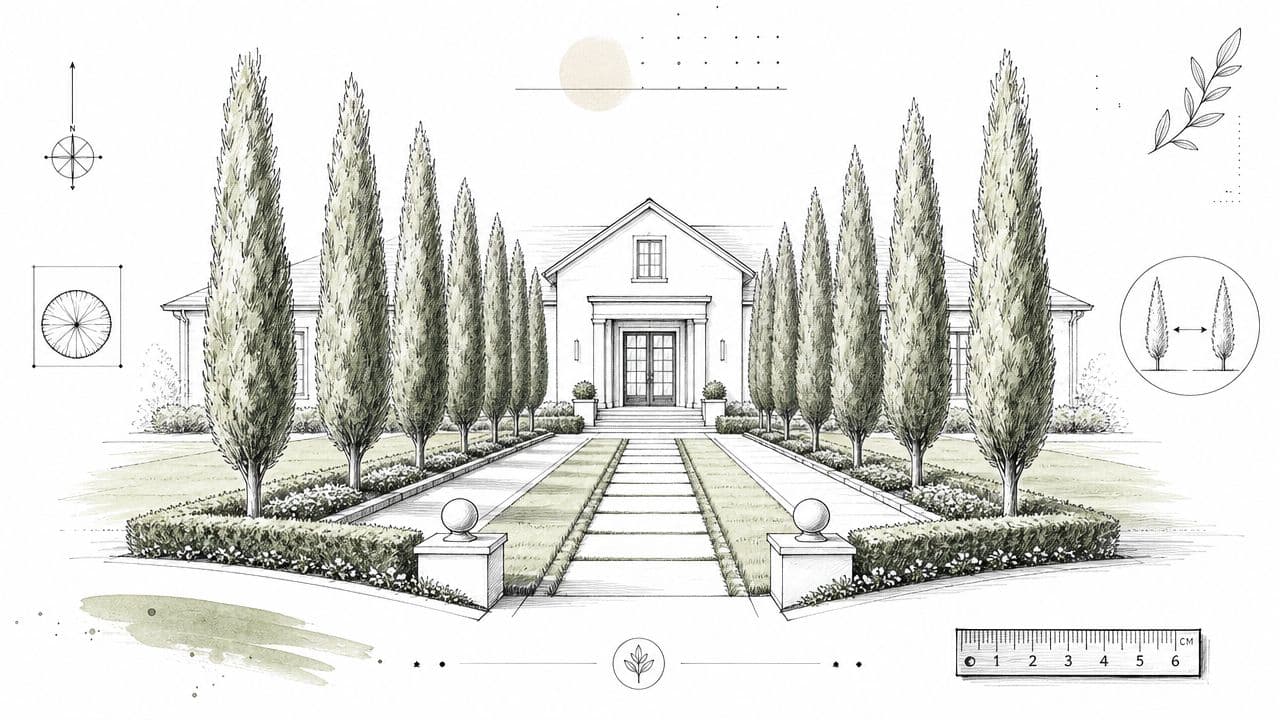
A formal tree pair only looks expensive when both trees grow at the same rate. Uneven water and light will ruin the effect faster than a bad plant choice.
Companion planting should stay restrained. Use clipped evergreen mounds, lavender where climate allows, or repeating masses of one low perennial rather than a mixed cottage palette. This is one of the few designs where repetition matters more than diversity.
Budget and effort
- Medium budget: Two matched trees often cost more than one larger focal specimen because finding closely matched material takes time.
- Medium to high effort: Formal pruning and regular monitoring keep both sides even.
- Best for: Straight walks, centered entries, and homes with strong symmetry already built in.
4. Native Tree Clustering (Ecological & Regional Authenticity)
Native tree groupings feel settled in a way imported specimen planting sometimes doesn't. They also make practical sense for homeowners who want a front yard to handle local weather, local soils, and local pests with less fuss. The look is looser, but it still needs discipline.
A cluster works best when you plant in small groups with different heights and habits. In the Midwest, that might be oak, redbud, and serviceberry. In the Southeast, live oak or sweetbay magnolia can pair with smaller regional companions. In drier regions, species choice shifts with rainfall and soil, which is why native planning often overlaps with drought tolerant front yard designs.
Cluster like a landscape, not a parking lot
Don't space three trees in a perfect triangle and call it natural. Real clusters have one dominant tree, one secondary tree, and one support tree or large shrub offset from them. The group should read as one composition from the street, not as separate circles of mulch.
Homeowners often overplant. Young native trees look sparse at install, so people tuck in too much. A few years later, the bed is crowded and the trunks are too close for healthy canopy development.
Use companion plants that share the same moisture and light conditions. Woodland sedges, native ferns, asters, inkberry, switchgrass, or regional groundcovers are usually easier to maintain than forcing unrelated ornamentals into the same bed.
Field note: Native design still needs editing. A regional plant palette doesn't automatically produce a clean front yard.
Budget and effort
- Medium budget: Costs vary by species availability in local nurseries.
- Low to medium effort: Once established, native groupings often need less intervention, but they still need shaping and bed management.
- Best for: Naturalistic homesites, corner lots, and yards where you want softness instead of formality.
5. Weeping & Pendulous Tree Forms (Graceful Drooping Canopies)
Weeping trees bring movement to a front yard. They also change the emotional tone of the space. Upright trees feel structured and architectural. Pendulous forms feel softer, more reflective, and more garden-like.
That softness can be beautiful near modern facades, cottage-style homes, and simple ranch exteriors that need one sculptural element. Good examples include weeping cherry in Zones 5 to 8, weeping birch in colder regions where it performs well, weeping hemlock in appropriate climates, and selected weeping pines for a more rugged look.
Use weeping forms as contrast, not filler
A weeping tree needs room around it. If you jam it between a driveway edge and a foundation bed, the form gets chopped up and loses its whole purpose. The best placement is somewhere the canopy can drape naturally without blocking a walkway or creating a sightline issue when backing out of the drive.
This style also exposes weak maintenance habits. If nobody lifts the skirt selectively or removes awkward crossing branches, the tree starts looking neglected instead of graceful.
A dependable planting mix is to place the weeping tree against stronger upright shapes. Boxwood, inkberry, yew, juniper, or upright grasses give the drooping canopy something to play against. At the base, keep low growers simple so the branch structure remains visible.
Budget and effort
- Medium budget: Specialty forms can cost more than standard shade trees.
- Medium effort: Occasional shaping is part of owning one.
- Avoid if: The front yard is tight, heavily trafficked, or already visually busy with lots of gables, columns, and hardscape detail.
6. Ornamental Flowering Tree Display (Spring & Seasonal Color)
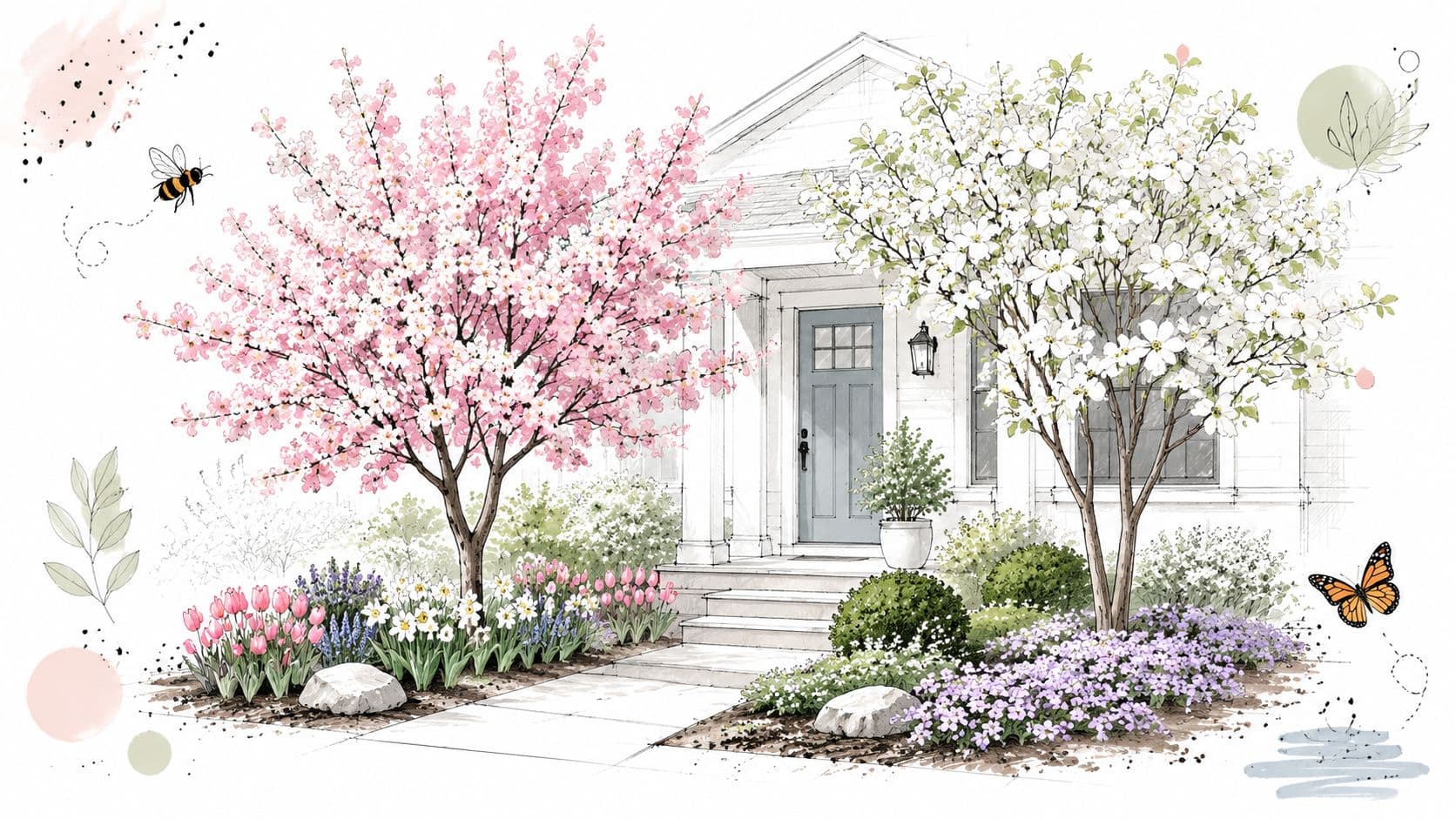
If your front yard feels dull for most of the year and you want one strong seasonal moment, flowering trees are hard to beat. Crabapple, dogwood, magnolia, flowering cherry, and ornamental plum all create that high-impact spring display people remember from the street.
This is one of the most popular front yard landscaping ideas with trees because it gives quick emotional payoff. People respond to bloom. The catch is that bloom season is brief, so the tree has to earn its keep the rest of the year too.
Plan for the weeks after bloom
Choose flowering trees for branch structure, leaf quality, bark, and fruit habit, not just blossom color. A dogwood can carry layered branching. A magnolia can hold a bold evergreen or broadleaf presence in the right region. A crabapple may offer fruit and fall character, but some selections create more cleanup than others.
Underplanting should stretch the season. Bulbs for early spring, then low perennials or groundcovers that look good after petals drop. Daffodils, tulips, catmint, creeping phlox, hardy geranium, and hellebores are all useful depending on climate and exposure.
The best siting is usually where morning light catches the flowers and where fallen petals won't create a slick mess on the main walk. If you want to preview bloom-heavy layouts before planting, an ai garden design generator can help compare fuller versus cleaner planting schemes.
Budget and effort
- Low to medium budget: Many ornamental flowering trees are accessible in common nursery sizes.
- Medium effort: Cleanup and disease monitoring vary by species.
- Best for: Entry views, lawn islands with enough room, and side-of-walk focal moments.
7. Privacy Screen & Windbreak Tree Rows (Functional Barriers)
Not every front yard tree plan is about beauty first. Sometimes the job is to block a second-story view, hide a busy road, reduce wind, or soften a neighboring drive. In those cases, tree rows and staggered screens do real work.
Evergreen choices like arborvitae, hemlock in suitable climates, or other dense screen plants are common because they hold through winter. Mixed screens often age better than single-species rows because they avoid the brittle look that comes from repeating one plant over and over.
Screen the problem, not the whole yard
Most homeowners overscreen. They plant a wall across the frontage and lose openness, light, and connection to the house. A better move is to target the exact angle you want to block, then leave the rest of the front yard more open.
That's especially important around existing mature trees. The design gap many people miss is how to design the area near established roots without harming the tree. Guidance highlighted by Home Depot notes that many front yards already have mature trees, and the issue is long-term survival and drainage, not just appearance, in its discussion of landscaping around existing roots.
A practical screen layout often uses a staggered line rather than a single file. That creates better density while keeping individual plants from fighting for the same narrow root zone.
- For tight side screening: Use narrow upright forms and keep the front edge clean.
- For broad street buffering: Mix evergreen structure with a few deciduous trees to avoid a flat green wall.
- For wind control: Start the screen where the wind enters the site, not where it's easiest to plant.
Budget and effort
- Medium to high budget: Screening usually requires more plant material than focal-tree designs.
- Medium effort: Watering, staking in exposed sites, and pruning for density matter early.
- Best for: Suburban lots, corner lots, and homes facing traffic or neighboring windows.
8. Seasonal Color Succession & Multi-Season Tree Design
The most well-designed front yard planting doesn't peak once. It changes on schedule. One tree carries spring bloom, another handles summer texture or fruit, another delivers fall color, and an evergreen or bark-forward tree holds winter interest.
This approach works best in larger front yards or in long frontages where you can create a sequence instead of a single focal point. It's less about collecting favorite trees and more about arranging visual handoffs across the year.
Sequence matters more than variety
Homeowners often pick one spring bloomer, one red fall tree, and one evergreen without checking whether they look good together in midsummer. That's how you end up with a yard that has isolated moments but no overall composition.
Use a written plan. Note which tree is the spring performer, which one carries summer mass, which one glows in fall, and which one keeps the yard from collapsing visually in winter. Arbor Day also emphasizes combining trees and shrubs to create texture and dimension while reducing pest and disease risk through plant diversity in its landscape tree design advice.
A common four-part sequence might look like this:
- Spring: Serviceberry, dogwood, or flowering cherry where climate allows.
- Summer: Japanese maple foliage, magnolia leaf mass, or a well-shaped shade tree.
- Fall: Maple, sweetgum, or tupelo in regions where they perform well.
- Winter: Spruce, holly, pine, birch bark, or a strong branching silhouette.
Plant for the season you dislike most. If your yard feels bleak in winter, solve that first.
There's also a value case here. Opendoor notes that a single mature shade tree can add $1,000 to $10,000 to appraised property value. Multi-season design is one of the clearest ways to make that value visible from the street because the yard keeps performing beyond a short bloom window.
Budget and effort
- High budget: More species, more planning, and more coordination.
- Medium effort: Once the framework is right, maintenance becomes more predictable because each plant has a clear role.
- Best for: Homeowners planning a long-term yard design, resale-minded upgrades, and broad front yards that need year-round presence.
Front Yard Tree Landscaping: 8-Option Comparison
| Design | Implementation Complexity 🔄 | Resource & Time ⚡ | Expected Outcomes 📊 | Ideal Use Cases | Key Advantages & Tips ⭐💡 |
|---|---|---|---|---|---|
| Specimen Tree Focal Point Design | Low–Moderate, single planting, careful siting | Moderate cost; 3–5 yrs to maturity; specimen prices vary | High visual impact, shade, curb appeal | Small–medium yards; modern, contemporary, transitional homes | ⭐ Immediate curb appeal; 💡 Place 15–25 ft from house; deep-water 2–3 yrs |
| Mixed Tree Layering (Canopy/Understory/Shrub) | High, multi-tier planning and species coordination | High initial cost ($3k–$10k+); 5–7 yrs to maturity | Strong privacy, biodiversity, resilience; layered visual depth | Large yards; woodland, naturalistic, sustainable designs | ⭐ Ecological benefits & resilience; 💡 Stagger planting and space 15–25 ft |
| Symmetrical Tree Allee (Double Tree) | Moderate, precise alignment and ongoing pruning | Moderate cost; ongoing maintenance for symmetry | Formal, grand entrance; strong framing and curb appeal | Traditional, Mediterranean, formal or transitional homes | ⭐ Elegant, low-footprint formality; 💡 Use identical cultivars and matched irrigation |
| Native Tree Clustering (Ecological Authenticity) | Moderate, requires regional species knowledge | Lower long-term costs; establishment 5–10 yrs; low maintenance | High ecological value, drought tolerance, reduced inputs | Eco-conscious homeowners, restoration projects, dry climates | ⭐ Low maintenance & supports wildlife; 💡 Plant in groups of 3–5 and consult local experts |
| Weeping & Pendulous Tree Forms | Moderate, needs space planning and specialist pruning | Moderate cost; may need more water for some species; maintenance every 2–3 yrs | Distinctive, graceful focal points with seasonal interest | Contemporary, cottage, romantic styles with ample space | ⭐ Strong artistic impact; 💡 Verify mature spread and moisture needs before planting |
| Ornamental Flowering Tree Display | Low–Moderate, species selection for bloom timing | Moderate cost; peak bloom short (2–4 weeks) | Dramatic seasonal displays; attracts pollinators; high photo appeal | Small–medium yards; high curb appeal and seasonal emphasis | ⭐ Spectacular seasonal impact; 💡 Choose disease-resistant and staggered bloomers |
| Privacy Screen & Windbreak Tree Rows | Moderate–High, layout, species mix, irrigation planning | High initial cost ($2k–$8k+); 3–5 yrs to effective screening | Highly effective privacy, noise reduction, and wind protection | Suburban and urban lots needing separation or wind buffering | ⭐ Functional barrier with microclimate benefits; 💡 Stagger rows and mix species to reduce disease risk |
| Seasonal Color Succession & Multi-Season Design | Very High, orchestrated species timing and placement | High cost and management; 5–7 yrs to full effect; professional recommended | Continuous year-round interest; maximized property appeal | High-end, experiential landscapes and gardens emphasizing seasonality | ⭐ Exceptional year-round curb appeal; 💡 Map bloom calendars and visualize across seasons before planting |
Design Your Dream Yard With Confidence
You walk the front path every day, so the tree plan has to work from every angle. It needs to fit the house scale, leave clearance at walks and windows, handle your light and soil conditions, and match the amount of pruning, watering, and cleanup you will keep up with.
That is where front-yard tree projects usually succeed or fail. A tree that is too small leaves the entry feeling underbuilt. A tree that is too large can crowd the roofline, block windows, lift paving over time, and force corrective pruning that weakens the form you paid for in the first place. I tell homeowners to decide on mature size first, then appearance second. That order prevents a lot of expensive regret.
Root-zone decisions matter just as much as species selection. Guidance on planting near exposed roots warns to keep "a few feet" between the trunk and added soil or plant material because piling material near the trunk can encourage fungus and limit gas exchange, and it also recommends root-safe finishing approaches like mulch, rocks, and shallow plantings in its advice on planting around tree roots. In practice, that means avoiding raised beds against an established trunk and keeping any companion planting light, shallow-rooted, and well outside the flare.
Mulch is part of the installation, not an optional finishing touch. Arbor Day advises mulching newly planted trees because mulch helps hold soil moisture and can reduce disease pressure, as noted earlier. Keep the mulch ring wide and flat, and keep it off the trunk.
The strongest plans are tested before anything goes in the ground. A tool like OutdoorBrite lets you upload a photo of your yard and compare tree sizes, bed outlines, and layered planting combinations against the house itself. That is useful if you are choosing one focal-point tree, spacing a screen row, or mapping a multi-season plan with bloom, bark, fall color, and winter structure in mind.
This article is built to help you make those choices with less guesswork. Each option gives you a usable blueprint, including species recommendations by zone, companion planting direction, maintenance expectations, and a realistic sense of budget and effort. That matters because a Japanese maple, serviceberry, tulip tree, and columnar arborvitae can all be "good choices" in the abstract, but they behave very differently once they are tied to your frontage width, foundation distance, irrigation, and cleanup tolerance.
If your project also involves grading, edging, retaining work, or other site changes, it helps to pair the planting plan with expert structural solutions for your yard so paved areas, drainage, and root zones work together over time. If you are comparing those design choices against renovation costs, OutdoorBrite Money may be one relevant place to start exploring options while you plan.
The best front yard tree ideas hold up after summer heat, winter dormancy, leaf drop, root growth, and several years of maintenance. That is the standard I would design to.
If you're planning a tree-focused yard upgrade and want to compare layouts before spending on plants and labor, OutdoorBrite Money can help you start that process alongside OutdoorBrite's visualization tools.
See your yard reimagined
Start creating