8 Landscape Ideas for Small Areas That Work
Smart landscape ideas for small areas: 8 practical designs for tiny yards, patios, balconies and narrow strips, with layout, plant and hardscape tips.
People who call a yard too small are describing a layout problem, not a space problem. In 2025, 77% of surveyed U.S. consumers said they underused their outdoor living space, while only 23% used it as much as they wanted, per a Wakefield Research survey for the International Casual Furnishings Association (Tucson.com). The land was there. The plan wasn't.
Small areas punish vagueness and reward precision. Every square foot is visible from the kitchen window, so a badly placed shrub or a bed that's 12 inches too deep reads instantly as a mistake, and a good decision reads instantly as design. On a quarter acre you can hide a weak corner. On a 12 by 16 foot patio you can't.
That's the perspective for these ideas for small areas. Each one is evaluated based on footprint, sightlines, and maintenance load per square foot, not on how it photographs. Some are inexpensive, some require a contractor, and a few are more effective combined than alone.
If your project touches the boundary of the property, whether that's a new screen, a gate, or a rebuilt deck edge, browse fence and deck ideas for backyards before you fix the layout, because boundary decisions constrain everything inside them.
Table of Contents
- 1. Vertical Garden (Living Wall)
- 2. Container and Pot Garden
- 3. Japanese Zen (Karesansui) Garden
- 4. Xeriscape (Drought-Tolerant Garden)
- 5. Raised Bed Kitchen Garden
- 6. Cottage Garden
- 7. Pollinator and Native Plant Strip
- 8. Compact Outdoor Room with Pergola and Fire Pit
- 8 Small-Area Landscape Ideas at a Glance
- Test Your Layout Before You Buy a Single Plant
1. Vertical Garden (Living Wall)
A vertical garden grows plants on a wall or freestanding frame instead of in the ground, using modular pockets, trellises, or mounted planters. On a narrow side yard, townhouse courtyard, or patio with no open soil, it adds greenery without taking floor space from the walking line. It also has little margin for error: every pocket holds limited soil, and watering mistakes show quickly.
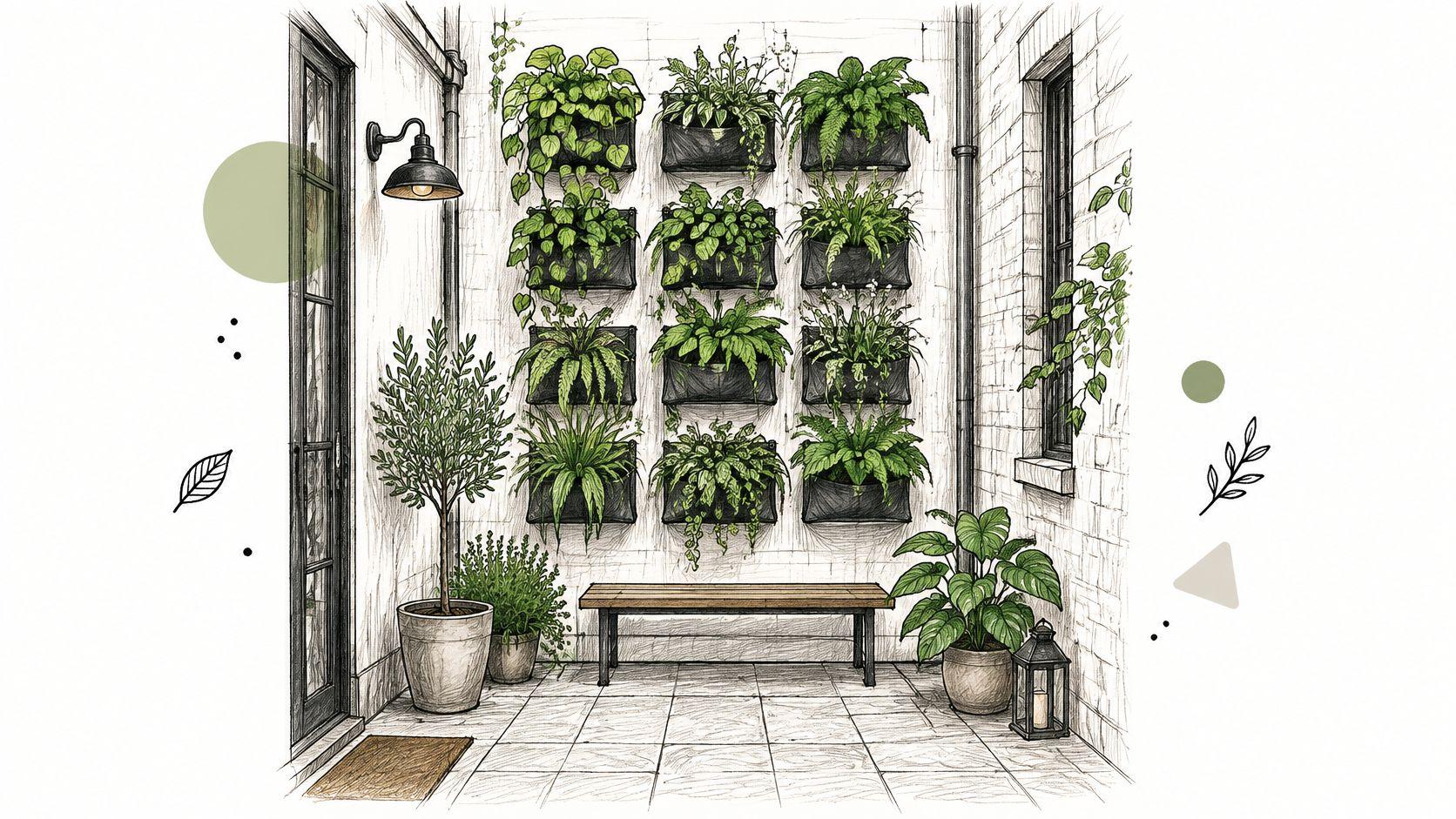
Compact-yard gardeners most often cite limited space, insufficient sunlight, and watering difficulties as their main barriers. A living wall solves the first while making the other two more demanding. Match the plants to the available light before choosing the frame, then plan irrigation from the top down because the upper row drains through every row beneath it and dries out first.
Practical rule: hold the planted face a few inches off the wall for airflow, and fix the frame to structure, not to siding or render.
What survives a wall
- Shallow-rooted, low-demand plants: ferns, heuchera, sedum, and small herbs, grouped by water need rather than by color.
- A drip line on a timer: emitters on every row, checked in July rather than in April.
- A 3 to 4 foot test section: one full season of real watering before committing an entire facade.
Scale matters when copying a reference. Patrick Blanc's planted facade at the Musée du quai Branly in Paris is the famous version; the model that fits a small area is a herb wall on a balcony rail, at a fraction of the weight and without crowding the floor.
A reliable drip layout separates a wall lasting three years from one lasting one:
2. Container and Pot Garden
A 6 by 10 foot concrete slab behind a townhouse, a lease that forbids digging, and a June deadline are exactly the constraints containers solve. They put color and herbs on the footprint you have, with no trench, no bed cut, and no argument with the landlord.
For many homeowners, the first outdoor upgrade is planting: shrubs, seasonal color, and the beds that frame a doorway. Pots are an inexpensive way to make that same change above grade, but the trade-off is maintenance density. A dozen small pots can turn one slab into twelve separate watering jobs, while fewer larger containers hold moisture longer and read calmer from the door.
Five decisions carry the load:
- Drainage holes, always. A pot without them is a bucket, and the plant drowns by August.
- Potting mix, not garden soil. Garden soil compacts in a container and suffocates roots.
- Group by thirst. Thirsty annuals together, succulents and grasses together, so one watering can covers a whole zone.
- Two or three colors, repeated. A matched palette reads as design; twelve unrelated pots read as a collection.
- Set heavy pots before filling. A 24 inch pot of damp mix does not move once it is full.
Worked example: front steps with three matched pots of boxwood, geraniums, and trailing ivy, scaled one size down toward the door so the sightline stays open. On a narrow balcony, swap the ivy for one tall grass and railing planters; the greenery sits above the walking line instead of stealing floor width.
3. Japanese Zen (Karesansui) Garden
Restraint is the hardest thing to sell, and it's exactly why a karesansui works in a courtyard that would look cluttered with anything else. Gravel, sand, stone, and moss suggest water, mountains, and islands without a single gallon.
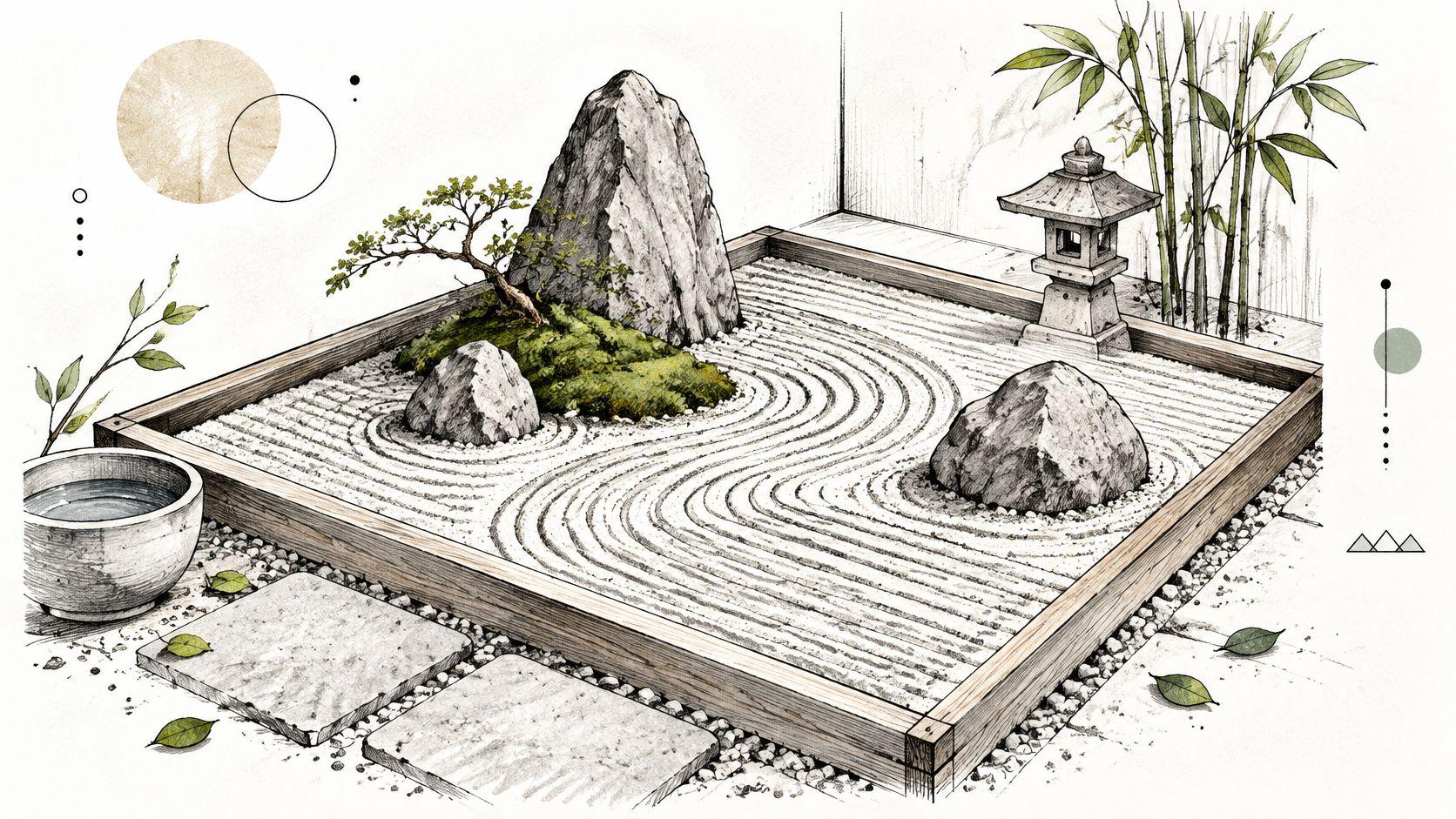
Ryoan-ji in Kyoto is a well-known reference. The small-yard version is a raked rectangle beside a door, with one dominant stone, two supporting ones, and moss at the base of each.
Build it in this order:
- Contain the gravel first with bamboo fencing or steel edging set flush, or it migrates into the path with every storm.
- Set stones a third of their height into the ground, which makes them look settled rather than dropped.
- Limit the composition to three to five elements, with one main stone as the focal point.
- Rake with fine tines in one direction, then ring the main stone with concentric circles.
Then the honest part. Gravel and stone need no irrigation, but they aren't maintenance-free. Leaf litter collects between stones, weeds germinate in the fines, and your raking pattern disappears in a windy week. Drought-tolerant landscaping is being promoted in 2025 as a way to cut water use while keeping the look (WSBT's water restrictions coverage), which is fair, but a dry garden still needs a seasonal refresh.
Time check: about 20 minutes a week in growing season for raking and weeding, plus one afternoon a year to top up gravel.
Sketch the arrangement on your own courtyard photo before you order stone, because a composition that works as a plan often fails in perspective. An ai for garden design view of the same corner in three variations is cheaper than moving a 200 pound rock twice.
4. Xeriscape (Drought-Tolerant Garden)
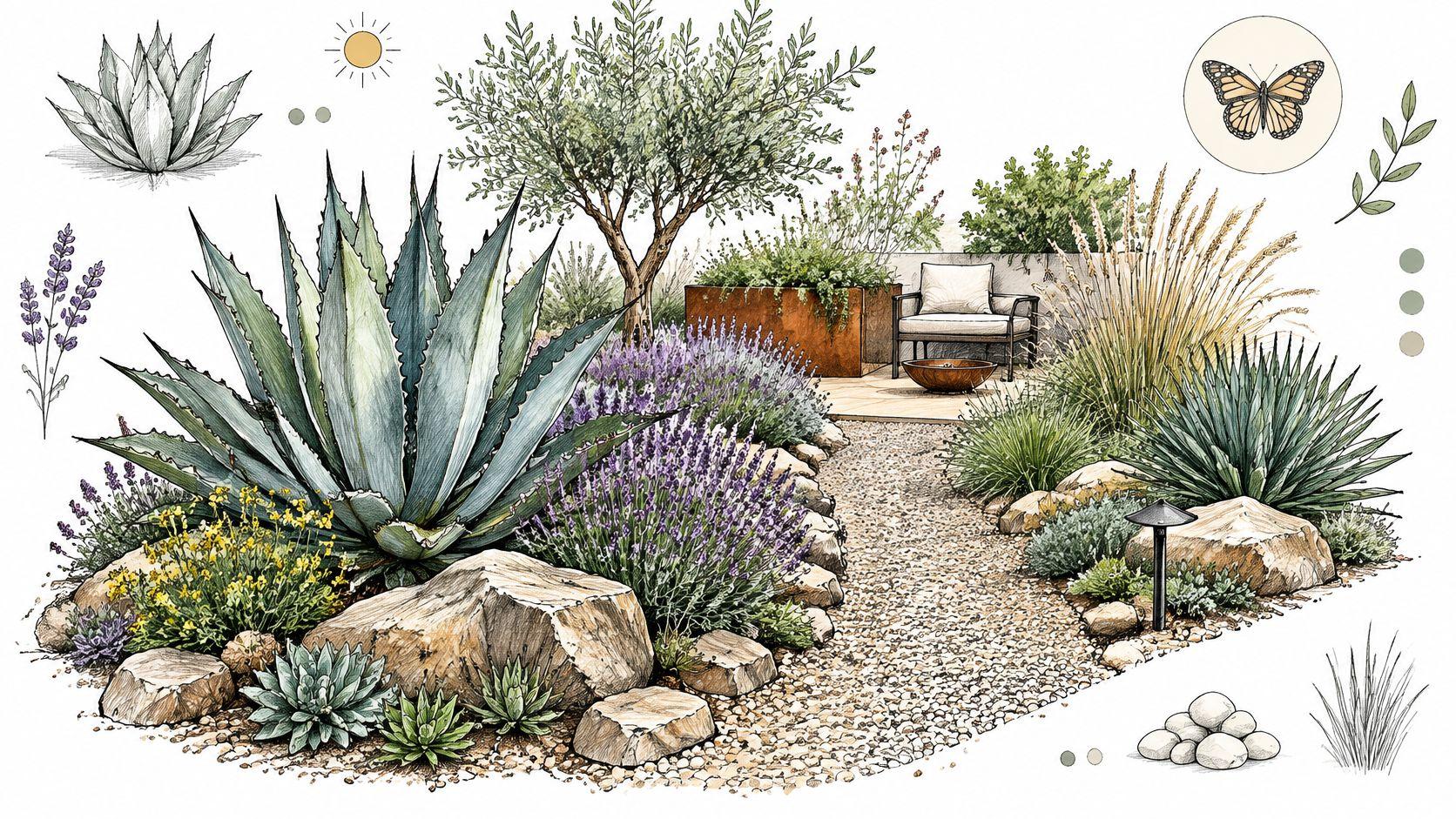
A small xeriscape fails when it gets treated as a gravel delivery instead of a planted design. Denver Water coined the term in 1981 for a designed, planted, water-efficient yard, and the planting half is what makes the approach work on a small footprint.
The savings justify the effort when the conversion is deliberate. A five-year Southern Nevada Water Authority residential study found that replacing at least 500 square feet of turf with xeriscape cut outdoor water use by about 30%, an average saving of roughly 96,000 gallons per household annually. New Mexico State University's water conservation guide, which reports that study, also cites about 79 gallons per square foot per year for lawn against 17 gallons for newly planted xeriscape.
On a compact lot, partial conversion beats demolition. A small yard reads as one composition, so keep one tight lawn panel where kids or dogs use it, then convert the perimeter strips, the side yard nobody sees from a window, and the awkward corner behind the shed. Converted edge to edge, the yard reads as a parking strip, while planted masses along the borders hold the view.
Zones beat plant lists
Group plants by water need into hydrozones, putting the thirstiest species nearest the house where a hose or watering can reaches them. Mulch beds 2 to 3 inches, run drip irrigation on a timer, and check that timer seasonally. Then take the plant list from your local extension office rather than a national catalog. The wrong species doubles the irrigation demand and still looks wrong, a failure a small footprint cannot hide.
5. Raised Bed Kitchen Garden
The Victory Garden movement settled the productivity argument decades ago. The National Park Service's Victory Gardens account records that by 1944 approximately 18.5 million American gardeners were cultivating them, and those gardens supplied about 40% of the nation's fresh vegetables. Productivity never needed acreage.
A raised bed puts soil where you control it: usually 3 to 4 feet wide so you can reach the middle from either side, and 10 to 12 inches deep for greens, herbs, and roots.
Rules that keep a small bed productive:
- Mix, don't dump. Roughly equal parts compost, topsoil, and an aeration material such as coarse sand or pine fines beats straight topsoil.
- North to south. Beds aligned that way share light evenly through the day.
- 18 to 24 inches between beds. That's the access lane for a wheelbarrow and a kneeling body.
- Tall crops on the north edge. Tomatoes and trellised beans go behind lettuce and carrots, never in front of them.
A worked example: a 10 by 12 foot side yard takes two 4 by 8 foot beds with a 2 foot path between them, plus a narrow herb strip along the fence. That's 64 square feet of growing area in a space often used for a hose reel.
Lay the beds out on a photo of the yard with best free garden design software before you build, because bed orientation and path width are the two decisions you can't fix after the timber is cut.
6. Cottage Garden
Cottage planting is the densest, most generous look on this list, and the most demanding to keep. In a small yard the trade-off sharpens, because one collapsed perennial leaves a hole the whole garden can see.
The upkeep load is real. In a 2025 U.S. market estimate, maintenance accounted for 44.32% of market share and residential properties made up 60.28%, according to Mordor Intelligence's U.S. landscaping market report. A style built on layered, fast-growing perennials asks for steady deadheading, staking, and cutting back, so size the border to the hours you will give it. In a 3 foot bed, that means choosing plants that hold their shape over ones that sprawl.
Keeping it from collapsing
Plant in drifts of three to five of the same variety rather than dotting one of everything, and the bed reads as intentional even when a few plants fail. Choose perennials that return each year, so the border refills itself in spring without a nursery trip.
Set a hard edge, in brick, stone, or a low fence, so loose planting doesn't spill into the path. Then leave a single 18 inch tending route through the bed, wide enough to deadhead and stake without stepping on the front row.
A worked example: a front border along a picket fence, 3 feet deep and 12 feet long, planted as three drifts with roses at the back, lavender mid-border, and low catmint at the edge. Add a bench at one end and the style reads as a room rather than a strip.
Cottage gardens usually fail from kindness. Feed less, space plants slightly wider than the label says, and cut back hard in late winter.
7. Pollinator and Native Plant Strip
The strip is the small-space format most garden plans ignore: the 2 foot band along a driveway, the gap between a fence and a shed, the frontage beside a walk. Planted with natives, it becomes habitat rather than leftover ground.
Mixing species beats any single wonder plant. A 2023 University of Texas performance study reported that drought-tolerant plant selection and diverse native plant palettes can improve water conservation, support pollinators, and reduce maintenance impacts at the same time (the 2023 University of Texas landscape performance study). Layering a small shrub, perennials, and a groundcover creates more functional habitat per square meter than a single-species bed.
One caution from the same body of work: a "lawn alternative" isn't automatically a low-water one. The study's comparative green-space analysis found clover maintained as a green lawn could consume more water per square meter than turfgrass, so the label on the seed packet proves nothing on its own.
Build the strip like this:
- Native to your ecoregion. Use a local native plant database, not a national wildflower mix.
- Continuous bloom. At least one plant flowering in each season, so pollinators have a reason to stay.
- Light mulch, no pesticides. Bare soil dries and weeds; a thick mat smothers ground-nesting bees.
- Stems standing through winter. Hollow stems are overwintering habitat, and seed heads feed birds.
8. Compact Outdoor Room with Pergola and Fire Pit
An outdoor room is the most expensive idea here and the one that changes how a small yard gets used. In 2025, the average U.S. patio installation or remodel cost approximately $4,600, with typical projects running from $2,300 to $9,100, according to Thumbtack figures cited by Bob Vila's summary of patio cost data.
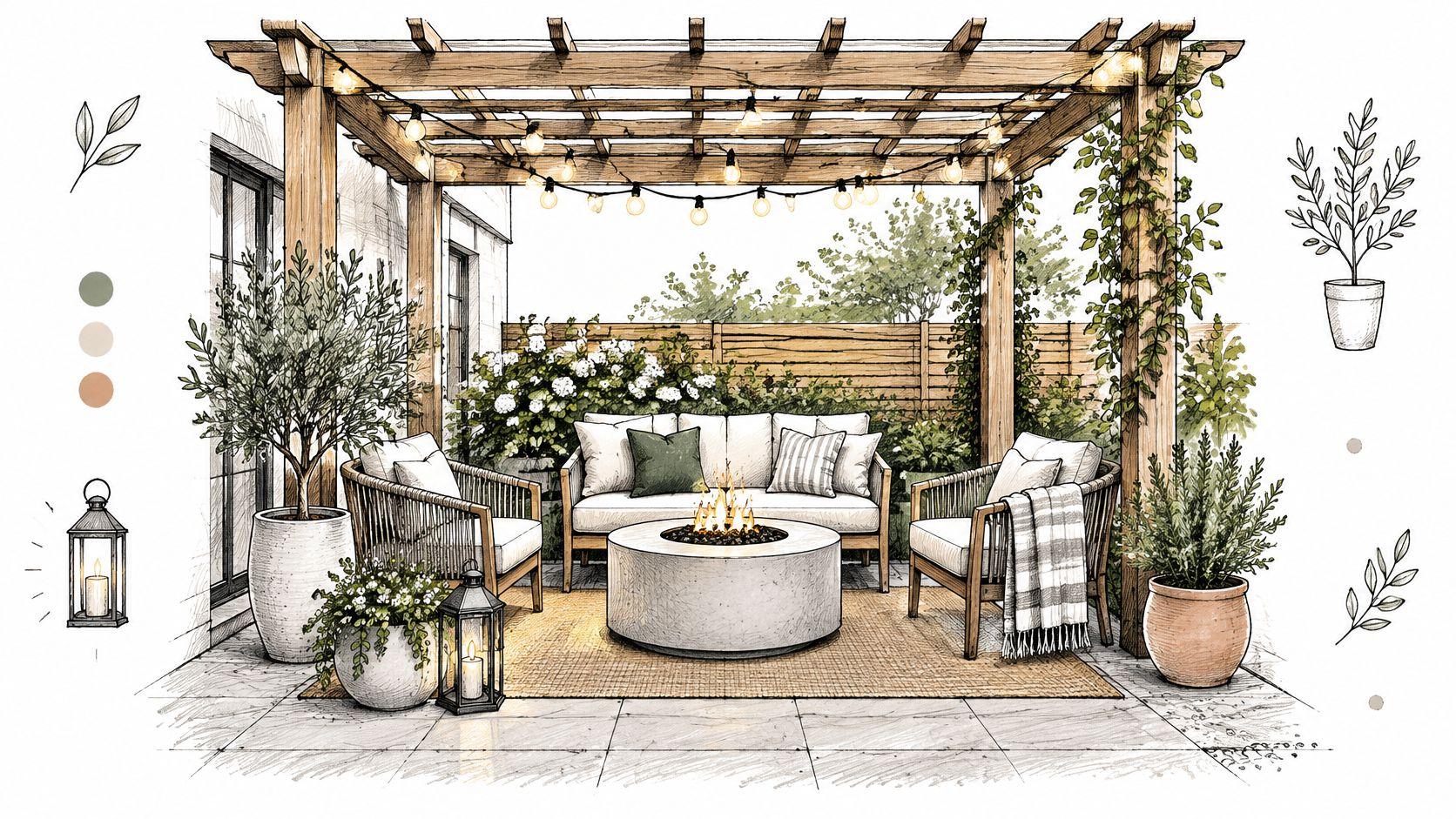
The structure does the work: a pergola defines the ceiling, a fire pit or fire table anchors the seating, and a defined floor stops the space reading as leftover lawn.
- Fire clearance first. Keep at least 10 feet between a fire pit and structures or overhanging branches, or follow local code where it's stricter.
- Draw the floor. A rug or paver band marks the seating zone and keeps chairs from drifting.
- Size the pergola for walking room. Leave a clear path around the furniture, not just space for it.
- Layer the light. Overhead string lights, one low path light, and firelight at the center do more than a single bright fixture.
A worked example: a 10 by 12 foot pergola over a compact sofa, two chairs, and a gas fire table on a 16 by 20 foot patio, with a planted edge outside the posts. The remaining strip of lawn stays for drainage and for the dog.
For roof lines that change the feel without changing the footprint, look through inspiring covered patio styles, then test the proportions on your own patio photo with an ai outdoor patio design view before you buy a single post.
8 Small-Area Landscape Ideas at a Glance
| Idea | Best Space | Maintenance Level | Water Needs | Key Benefit |
|---|---|---|---|---|
| Vertical Garden (Living Wall) | Narrow yards, walls, balconies | High | Frequent; pockets dry quickly | Adds greenery and privacy without using floor space |
| Container and Pot Garden | Patios, balconies, steps | Moderate | Frequent, especially in heat | Portable and easy to rearrange |
| Japanese Zen (Karesansui) Garden | Small courtyards and side yards | Low | Minimal | Creates a calm, uncluttered focal point |
| Xeriscape (Drought-Tolerant Garden) | Small yards in dry climates | Low once established | Low once established | Reduces water use and irrigation costs |
| Raised Bed Kitchen Garden | Small backyards and side yards | Moderate | Regular; beds can dry out quickly | Produces a high yield in a small footprint |
| Cottage Garden | Small front yards and narrow beds | High | Regular, depending on plant selection | Makes a small area feel full and welcoming |
| Pollinator and Native Plant Strip | Narrow side yards, driveway strips, borders | Low to moderate | Low once established | Supports pollinators and local wildlife |
| Compact Outdoor Room with Pergola and Fire Pit | Small patios and backyards | Moderate | Low; mainly for surrounding plants | Creates a functional outdoor gathering space |
Test Your Layout Before You Buy a Single Plant
Every idea in this list succeeds or fails on layout. A living wall that shades the only window, a raised bed that blocks the gate, a fire pit 6 feet from a fence: plant choices are recoverable, layout mistakes usually aren't.
Test on your real space, not on a mood board. Take one photo of your yard, patio, or balcony in flat daylight, and put the design onto that photo before you spend anything.
OutdoorBrite, an AI garden design tool, turns a single photo of your backyard, garden, patio, or front yard into realistic redesign concepts in seconds. You pick a style, from cottage to Japanese zen to xeriscape, compare several versions of the same corner, and use the elements editor to drop in pergolas, fire pits, and planting beds before committing money to plants, pavers, or a contractor. Each style changes the plants and the structure rather than just the color palette.
That comparison is cheap insurance. In 2024, 65% of homeowners who hired professionals for landscaping renovations used a professional contractor or specialist, per Houzz figures summarized by This Old House's roundup of outdoor living trends. A pro who arrives to a drawing, even a rough one, prices the job faster than a pro who arrives to a question.
One concrete step tonight: photograph your small space, generate two or three style concepts, and choose the one you can maintain for five years. Then work out the furniture inside it, using patio ideas from Guynn Furniture & Mattress as a starting point for circulation, and let the layout settle before a shovel touches the ground.
Small areas get better fast when you can see the design on your own ground instead of someone else's photo. OutdoorBrite turns one picture of your yard, patio, or balcony into several realistic redesigns in the style you choose, so you can compare a cottage border against a xeriscape bed before buying a single plant. Upload a shot of your space at OutdoorBrite and start comparing options tonight.
See your yard reimagined
Start creating