8 English Garden Design Styles to Plant in 2026
Explore 8 English garden design ideas, from cottage borders to walled kitchen gardens and wildflower meadows, with planting tips for every yard.
The beds are tired, the lawn is patchy, and the fence has seen better decades. You know you want something that reads as English, but "English garden" stretches from a cottage tangle of hollyhocks to a Capability Brown sweep of parkland, and those two ask completely different things of a plot.
That's the trap: shopping style before site. A cottage garden wants sun and a blind eye to bare February soil. A parterre wants geometry and a pair of shears. A woodland garden wants shade and patience. Get the match wrong and you'll spend three summers fighting the plot instead of planting it.
So this is a list judged the way a planner judges it. Each of the eight styles gets scored on the same four things: how much room it needs, how many hours a week it takes, what light and soil it wants, and the first realistic move for a beginner with a normal back garden.
Read the notes, measure your plot, then pick. Buy plants before that step and you'll be digging them up again in eighteen months, which is how English garden design gets a reputation for being expensive.
Table of Contents
- 1. Cottage Garden
- 2. Jekyll-Style Herbaceous Border
- 3. English Landscape Garden
- 4. Formal Knot and Parterre Garden
- 5. Walled Kitchen Garden
- 6. English Woodland Garden
- 7. English Rose Garden
- 8. Wildlife and Wildflower Meadow Garden
- How the eight English garden styles compare
- Choosing the Right English Garden Style for Your Yard
1. Cottage Garden
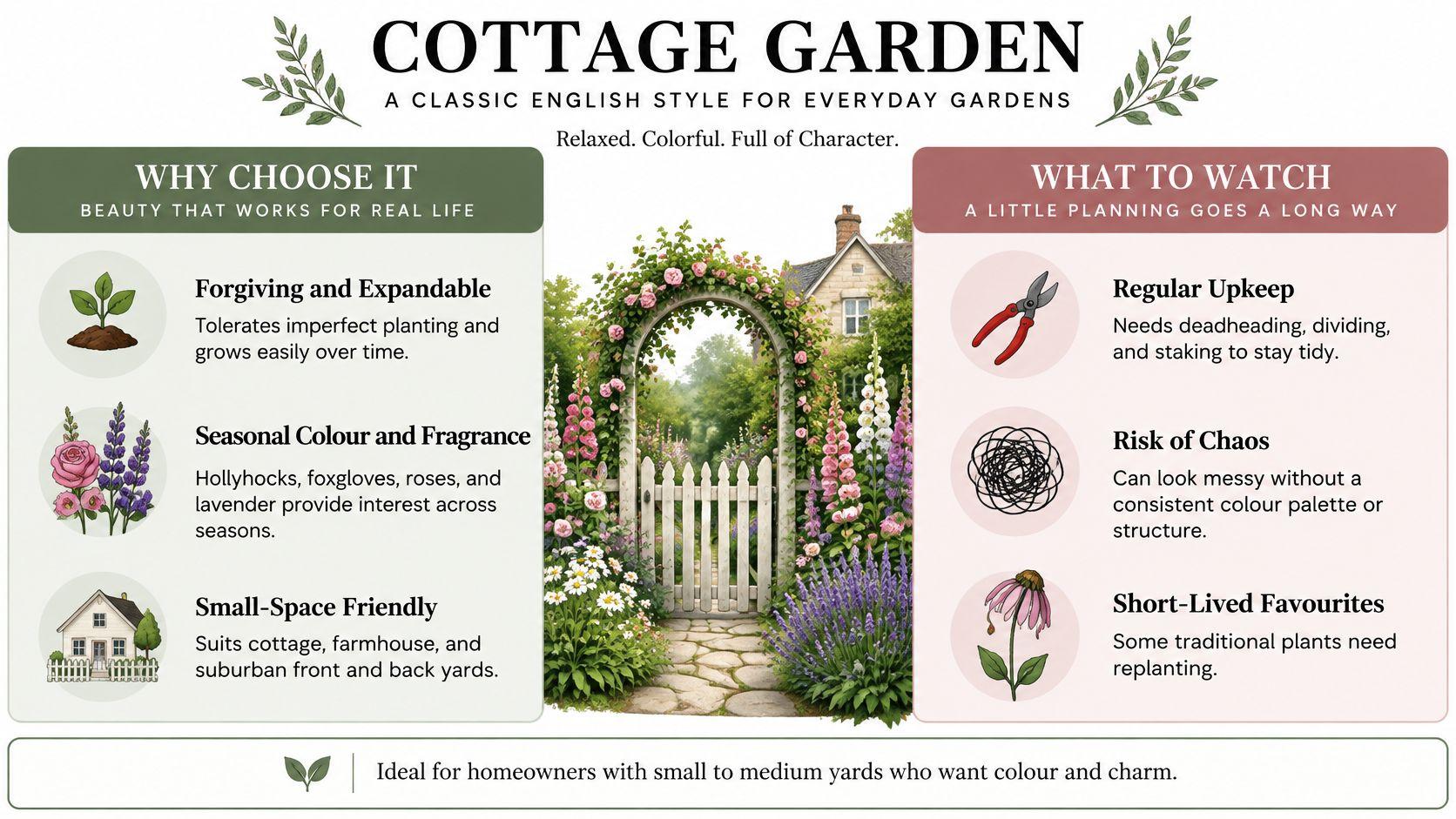
A cottage garden is the style many people picture: flowers, herbs and a few vegetables packed into dense, informal beds so that by July no soil shows. Hollyhocks, delphiniums, aquilegia, foxgloves, oriental poppies, phlox and one repeat-flowering rose carry the look. Walk Hidcote Manor in Gloucestershire, Sissinghurst in Kent or Great Dixter in East Sussex before you spend a penny. All three show how much self-seeding the style tolerates, and how little bare ground it leaves.
The site it suits
Full sun, six hours or more, and soil that drains. A north-facing fence with less than that will not carry hollyhocks, poppies or roses, and staking will not fix the light. It is the most space-efficient style here. The average UK garden is around 207 square metres, according to the RHS State of Gardening report, so a 1.2m border down one fence plus a 2m by 3m island bed is already a complete scheme. Cottage planting suits a mainstream beginner. Gaps fill with seedlings, so a learning curve shows less than it does in a formal layout.
What it costs in hours
Three to four hours a week from May to September. Stake tall perennials before wind does it for you. Deadhead to keep flowers coming. Cut delphiniums and hardy geraniums back in June for a second flush.
Practical rule: plant three colours and repeat them. Apricot, deep purple and silver holds together at any garden size. Twelve colours turn to confetti.
Two mistakes sink it. No evergreen bones, and the bed is bare mud in February: add box, lavender or yew. No height on the boundary, and the fence stays a blank wall. I would start there. A climbing rose or clematis on that fence is the first realistic move, then repeat the three colours through the 1.2m border.
2. Jekyll-Style Herbaceous Border
The double border at Hestercombe shows how colour grading works at full scale. Watch the first two minutes and you'll see the mechanism: plants in drifts, cool tones running into hot ones, no single variety dotted about.
Gertrude Jekyll designed these borders with the architect Edwin Lutyens, and her working method was colour theory plus repetition. Group plants in odd-numbered drifts of three, five or seven, and move from blues and whites at one end to yellows and oranges at the other. Munstead Wood in Surrey was her own garden; Barnsley House in Gloucestershire carried the idea forward under Rosemary Verey.
What it asks of your yard
Length matters more than width. A border under 4m reads as a strip. Six to nine metres long and 1.5m to 2m deep is where drifts start to work. Full sun for six hours, and soil that holds moisture: heavy clay improves with grit and compost, thin sandy soil needs organic matter every spring.
Upkeep and the real cost
Four to six hours a week from April to October, peak in May when everything needs staking. Then the big jobs: cutting down in late winter, dividing crowded clumps every three to five years.
Drifts need five or seven of the same plant, so buy three of each variety instead of one of twelve, and divide them after two seasons.
If you're mapping plant choices before you dig, designing a timeless English-style border sets out a planting order that survives a wet winter. And plan the cutting: seasonal blooms to cut in August keeps a border earning its space indoors.
3. English Landscape Garden
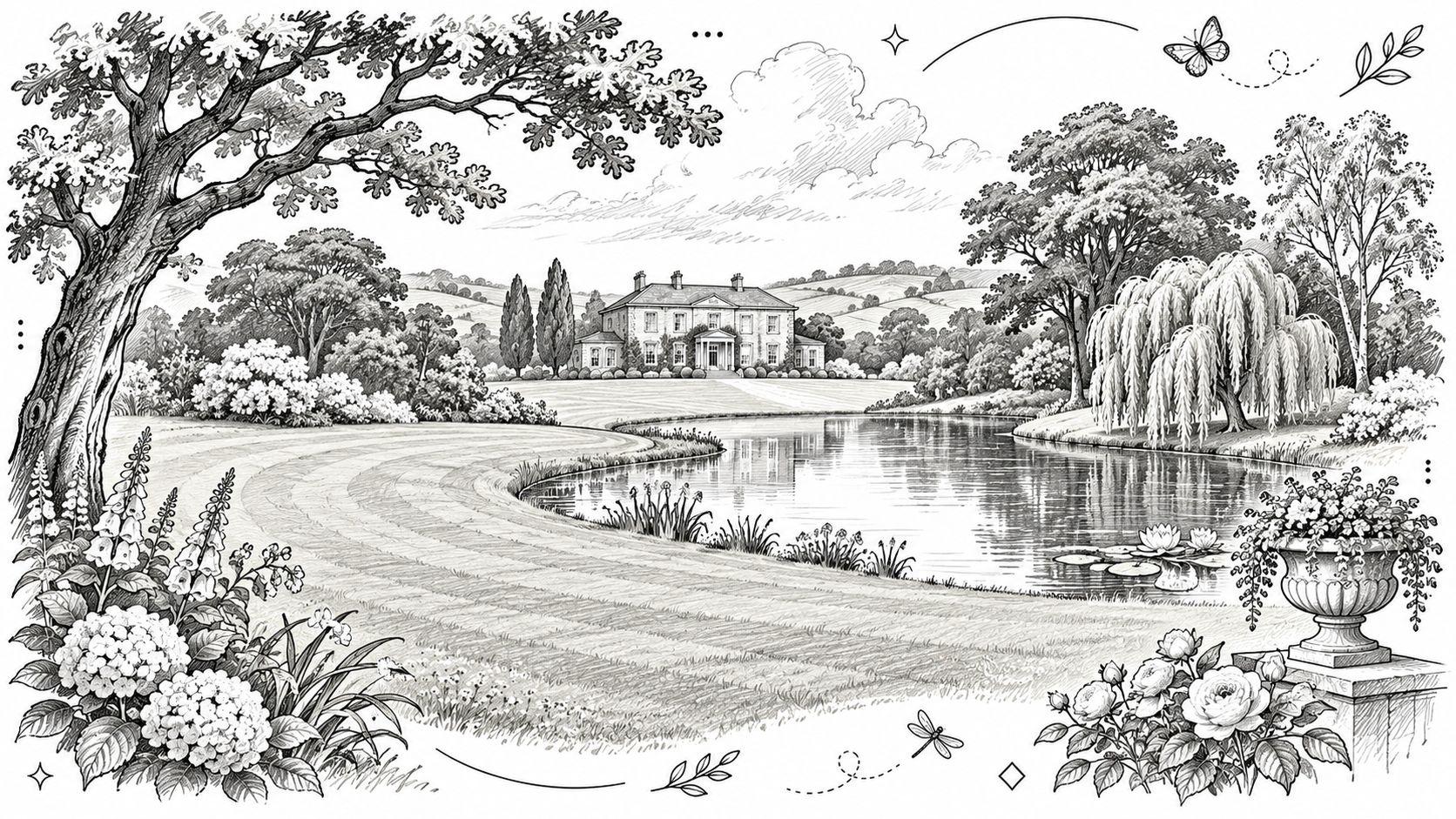
Start from the longest view out of your main window. On a normal plot this style asks for three things only: a curved lawn edge, a clump of trees at the boundary, and one deliberate gap in a hedge that frames whatever sits beyond the fence.
Tudor and Stuart gardens were geometric affairs of walled compartments, knot gardens, avenues and clipped trees. Through the early Georgian period, roughly 1714 to 1780, designers replaced that symmetry with gardens built to look untouched, and Lancelot "Capability" Brown (1715 to 1783) made the style his own. English Heritage credits Brown and his followers with creating "hundreds" of expansive parks in the generation after the 1750s, at estates including Audley End and Wrest Park. Those jobs moved earth, water, roads and woodland, not just plants.
What a small plot can actually hold
Brown's vocabulary was broad lawns, serpentine water, tree clumps, long carriage drives and framed views. The lake and the drive need estate acreage. A domestic boundary can still take the curved edge, the tree clump and the framed gap, and those three carry the look.
Lawn hours against plant range
It is the least plant-diverse style on this list and the thirstiest in lawn. Grass does almost all the work, so habitat value stays low if that is what you want from the garden. Once the trees mature, the running work is mowing plus an annual tree safety check, roughly one to two hours a week in summer. Curves take longer to mow than straight lines, so budget the extra passes.
If you want to test the layout before committing to turf shapes, ai for garden design can show curved beds and planting layouts on a photo of your own plot. Stand at your main window first, find the longest view you have, and mow a single S-curve toward it.
4. Formal Knot and Parterre Garden
A formal knot needs accurate lines and regular clipping. Knot gardens use interlacing patterns of low hedging; parterres arrange broader beds in geometric designs. Both depend on a clear layout and year-round structure, so choose a spot where the pattern can be seen and maintained.
Measure, then draw to scale
Allow at least 2.4m by 2.4m for a four-square knot, plus room to reach the edges. Draw the design to scale before buying plants. Even a small mismatch between corners can throw off the pattern when viewed from the house. Free garden design software can handle the scaling arithmetic if graph paper isn't your thing.
Plants that clip well
- Dwarf lavender: Lavandula angustifolia 'Hidcote' holds a compact outline and flowers in the gaps.
- Germander: Teucrium chamaedrys suits low knots and tolerates regular clipping.
- Yew: Taxus baccata grows more slowly and looks darker than box.
- Box alternatives: Where box blight is a concern, Ilex crenata or Euonymus japonicus 'Microphyllus' can provide a slightly looser edge.
Clip in early summer and again in early autumn. Use shears and a taut line to keep the edges even. Historic examples at Hatfield House, Levens Hall and Packwood House show how repeated clipping maintains the pattern over time.
The trade-off is space: a parterre leaves little room for changes once planted. A shrub added in the middle can interrupt the design, so settle the layout before planting. Budget one to two hours every fortnight during the growing season for clipping and other hand-tool work.
5. Walled Kitchen Garden
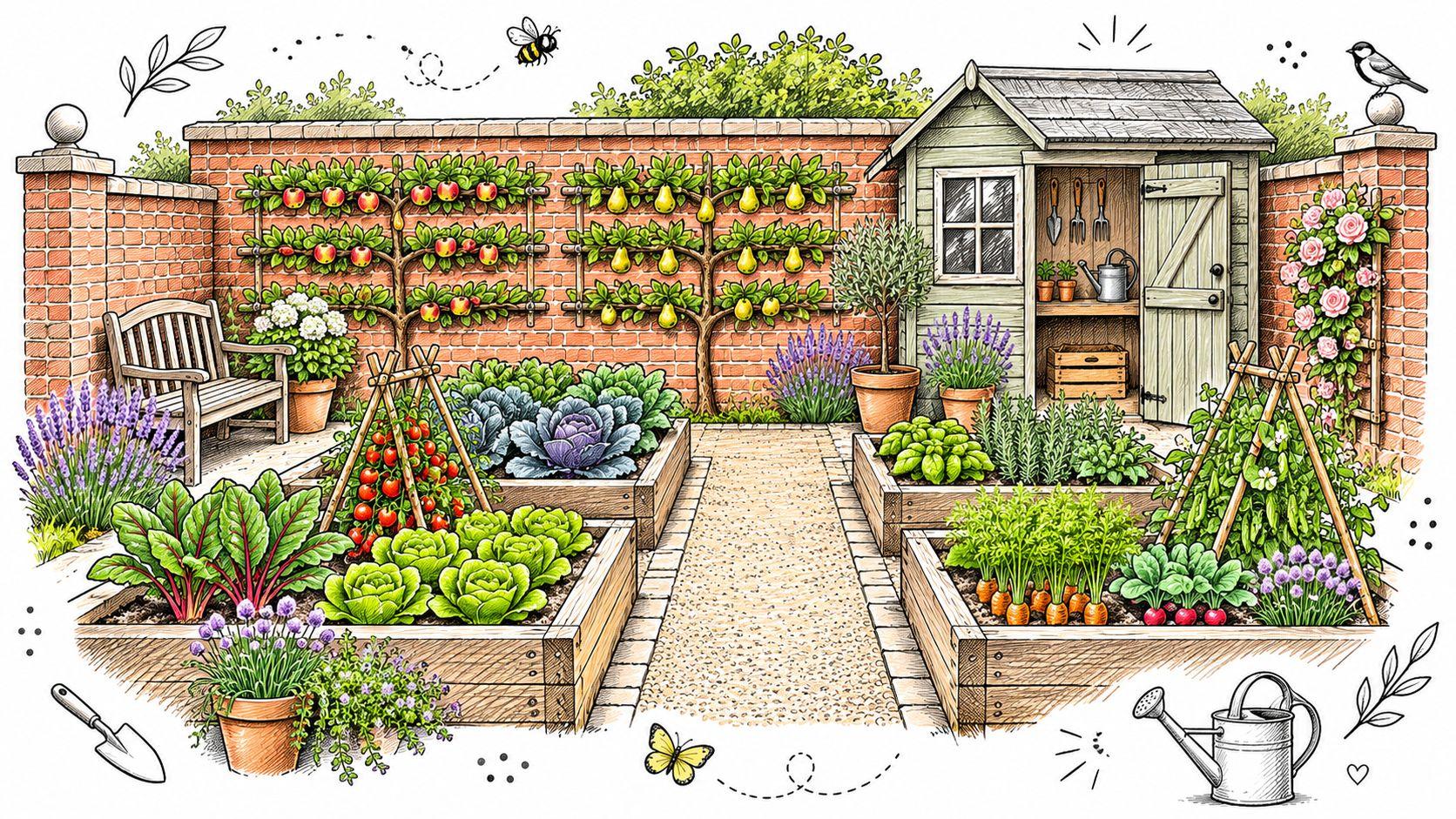
Walls do two jobs at once: they block wind and they store heat, which buys you two to three weeks at each end of the season. Historically these gardens fed whole estates; Chatsworth in Derbyshire, Heligan in Cornwall and the kitchen garden at Sissinghurst all show the format. Espaliered apples and pears along the wall, raised beds in the middle, paths wide enough for a wheelbarrow.
The honest trade-off
A 1.8m brick wall is the single most expensive element across all eight styles. The budget version works almost as well: the south or south-west facing wall of the house, plus a 60cm hurdle fence to cut wind at the end of the plot. Orient the long axis east to west so the wall casts the smallest shadow on the beds.
First season, first step
Two raised beds of 1.2m by 2.4m against the sunniest wall. Fill them with a 60/40 mix of topsoil and compost, plant one espalier apple, and add a water butt within hose reach. Expand only once you've grown a season and know where the frost pockets sit.
Upkeep runs four to five hours a week from May to August: watering, successional sowing, netting brassicas against pigeons, and cutting back. It's the most demanding style here in summer and the most productive in autumn.
6. English Woodland Garden
A shaded corner beneath established trees can support a woodland garden, while an exposed, sunny plot usually cannot. The design layers small trees and shrubs over bulbs and shade-tolerant ground cover. Westonbirt in Gloucestershire, Sheffield Park in East Sussex and Bodnant in Conwy show the effect mature planting can achieve.
Why it earns its place now
A tree canopy reduces direct sun on the soil, and fallen leaves add organic matter as they break down. A wooded corner also gives butterflies, amphibians, birds and small mammals more cover and food than open lawn does. The RHS sets out practical water-management strategies for gardens in its Science and Collections Plan.
What it demands and what it gives back
Begin by checking the soil and the amount of light beneath the canopy. Spread 5cm of leaf mould or compost around the planting area, keeping it clear of tree trunks. Plant snowdrops and bluebells for early colour, then use epimedium, Geranium macrorrhizum and pachysandra as ground cover. Bark chip helps suppress weeds.
Year one may look sparse. Woodland planting takes time to fill in, so start with ground cover and add trees only where there is room for them to mature.
Once established, upkeep is about one or two hours a week, mainly clearing leaves from paths and keeping them passable. The trade-off is a slow start in exchange for a lower-maintenance planting scheme.
7. English Rose Garden
Roses are the highest-maintenance plant on this list and the style lives or dies on whether you'll do the work. The modern English Rose class, bred by David Austin from the 1960s, combines old-fashioned fragrance and form with repeat flowering, which is why it now dominates domestic planting. Mottisfont Abbey in Hampshire holds the historic collection; the display gardens in Shropshire show the modern range.
Site requirements, plainly
Six hours of direct sun, good air movement, and soil close to neutral. A rose planted in a still corner against a warm wall gets blackspot and powdery mildew by August. Space bush roses 60cm to 90cm apart so air moves between them, and never plant a new rose where an old one died.
The upkeep number
Three to five hours a week in season. Prune hard in late winter, deadhead through summer for repeat flowers, feed in spring and again after the first flush, and watch for blackspot from June.
- Disease resistance first: choose varieties rated for it rather than spraying something susceptible all summer.
- Underplant with lavender or catmint: both suppress weeds and extend the season.
- Climbers on arches: height without sacrificing bed space.
A realistic first move is three roses in a 1.5m by 3m bed, not twelve in a mixed border. If your site gets less than five hours of sun, spend the money on the woodland style instead; roses in shade sulk for years and flower once.
8. Wildlife and Wildflower Meadow Garden
The newest style on the list and the one most often done badly. The intent is sound: swap a fed, mown lawn for native flowers and grasses that carry insects through the season. The demand is real. The HTA's garden industry statistics report that 46% of British adults already use their gardens to feed, watch or encourage wildlife.
What it asks of your plot: open sun for most of the day, low fertility, and patience. A meadow mix sown on rich, shaded ground gives you grass and nettles, not flowers.
The fertility problem
Meadow seed needs poor soil. A lawn that's been fed and mown for a decade holds a seedbank of grass, docks and dandelions, and sowing wildflower mix straight into it is money in the bin.
Strip the top 5cm, or spend two seasons sowing yellow rattle to bleed nitrogen out of the grass. There's no third shortcut.
Yellow rattle is semi-parasitic on grass roots, weakening the turf so oxeye daisy, knapweed and bird's-foot trefoil get a foothold. Sow it in autumn, because the seed needs a winter chill to germinate. Where the soil is already thin, skip the stripping and sow direct.
Maintenance isn't zero
Two cuts a year, timed after seed has set, with every cutting raked off. Leave the arisings on the ground and you feed the soil, undoing the whole point. Mow a 60cm edge along paths and boundaries so the space reads as intentional.
The upkeep is an hour or two twice a year plus the edging, the lightest workload on this list. The trade-off is visual: a meadow sits flat and brown from November to April, so decide now whether you'll tolerate that. Knepp Estate in West Sussex, RHS Garden Wisley and the Hampton Court meadow displays show the range.
First step: stop feeding, mow an edge, sow yellow rattle in autumn.
How the eight English garden styles compare
| Item | Ideal For | Key Feature | Main Drawback |
|---|---|---|---|
| Cottage Garden | Homeowners with small to medium yards who want colour and charm | Dense, informal planting of flowers, herbs, and vegetables | Needs regular upkeep and can look chaotic without structure |
| Jekyll-Style Herbaceous Border | Homeowners with a medium to large garden seeking a designed, colour-led border | Deep perennial borders arranged in colour-graded drifts | Requires considerable space, investment, and planting expertise |
| English Landscape Garden | Homeowners with large grounds or rural properties seeking a naturalistic look | Sweeping lawns, tree groups, and serpentine water features | Requires substantial land and costly installation |
| Formal Knot and Parterre Garden | Homeowners seeking a structured design with year-round form | Symmetrical patterns formed by clipped low hedges | Hedge clipping is labour-intensive, and box may be affected by pests or disease |
| Walled Kitchen Garden | Homeowners and DIYers who want productive planting in an attractive, structured layout | Sheltered, organised beds for vegetables, fruit, flowers, and herbs | Walls can be costly, and the garden needs year-round labour |
| English Woodland Garden | Homeowners with shady yards or larger plots seeking a natural, layered look | Layered shade-loving plants beneath a tree canopy | Takes years to establish, and deep shade limits flowering |
| English Rose Garden | Homeowners who love fragrance and colour and are willing to maintain roses | Fragrant roses arranged in beds, borders, or garden rooms | Requires regular pruning, feeding, and disease control |
| Wildlife and Wildflower Meadow Garden | Homeowners seeking a low-maintenance, eco-friendly alternative to a traditional lawn | Native wildflowers and grasses that support pollinators and wildlife | Can look untidy without defined edges and takes time to establish |
Choosing the Right English Garden Style for Your Yard
Measure first, then choose. Walk the plot with a tape and note the length and depth of every bed you could realistically plant. A 1.2m deep border along 6m of fence gives you about 7 square metres of planting, enough for one cottage bed or a short Jekyll border, not both.
Then audit light properly. Check each potential bed at 9am, noon and 4pm in June, or track sun with a phone app for a week. Six hours of direct sun keeps roses and delphiniums on the table. Four hours pushes you toward woodland planting, and under three means ferns, epimedium and structure.
Set an honest weekly hour budget. Up to two hours suits a woodland garden, a knot garden or a meadow. Three to six hours covers a rose garden or a herbaceous border, and plan to be home in May when the staking needs doing. A cottage garden sits at the demanding end too, because dense planting means steady deadheading, dividing and gap-filling through summer.
Shortlist two or three styles that pass all three tests. Sketch a rough layout on graph paper at 1:50, mark the paths, and check you can still get a wheelbarrow from the gate to the compost heap. Circulation kills more designs than plant choice does.
Test before you buy in bulk. Plant three of your chosen varieties in one bed for a season and see whether the soil suits them. Cheap plants in the right place beat expensive plants in the wrong one.
Get drainage, retaining structures and any hard landscaping checked by a qualified professional before you dig. A soil test costs little and tells you the pH and texture you are working with, which narrows the plant list faster than any style guide.
Whatever style survives the three tests, seeing it on your own plot beats guessing. OutdoorBrite turns one photo of your yard into realistic redesign concepts in seconds: upload the image, pick a style such as cottage, and the garden comes back replanted with bed layouts you can take to a nursery. Because the design builds on your own photo, it keeps your layout and your house, so what you compare is your border rather than a stock garden.
See your yard reimagined
Start creating