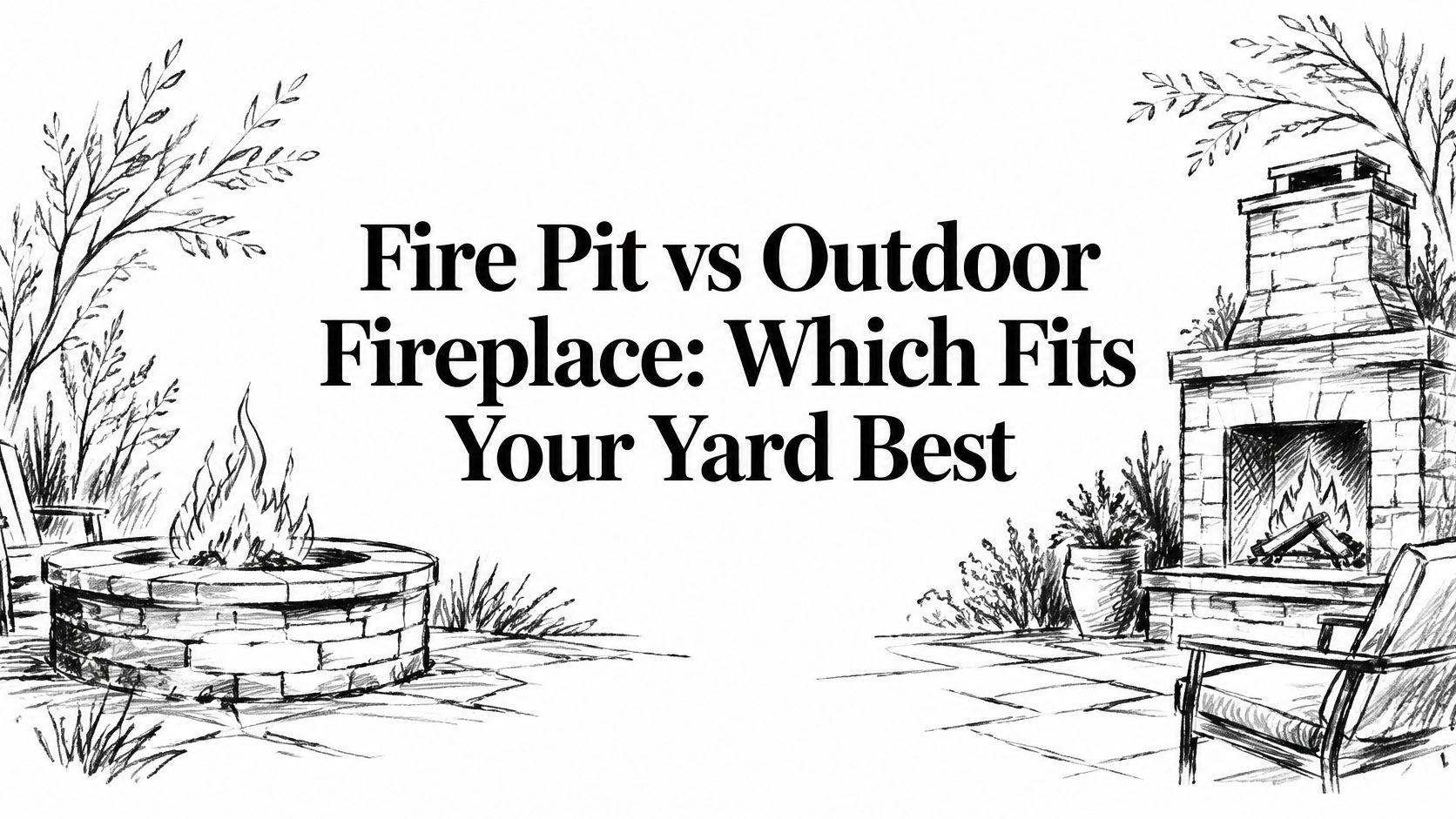
Fire Pit vs Outdoor Fireplace: Which Fits Your Yard Best
Fire Pit vs Outdoor Fireplace compared on cost, space, heat, smoke, safety and upkeep, with a clear verdict for each type of yard.
The advice you hear most often is that a fireplace sends smoke away and a fire pit gathers people in a circle. That advice treats shape as the predictor. Shape is the weakest clue to how a fire feature behaves once it is lit.
Smoke from a masonry fireplace can drop onto seating when chimney draft and the prevailing wind work against each other. A well-run gas fire pit on a calm night produces little beyond heat. Same kind of purchase, opposite evenings. Fuel, enclosure, and placement relative to wind, walls, and neighbors decide the difference.
I rank these options by smoke exposure and fuel system first, then cost, codes, upkeep, and yard geometry. If you are about to spend on masonry or a gas line, know which of those choices changes the evening.
Start here: settle wood versus gas before you settle pit versus fireplace. Almost every other trade-off follows from that first choice.
Table of Contents
- Fire Pit vs Outdoor Fireplace at a Glance
- Fuel and Enclosure Decide the Real Risk
- Heat, Smoke and Fuel Choices Compared
- Installation Costs, Codes and Hidden Expenses
- Upkeep Tasks and How Often to Do Them
- Match Your Yard Shape and Pick the Feature
Fire Pit vs Outdoor Fireplace at a Glance
The answer most readers don't expect is that these two features solve different problems entirely, and that fuel, enclosure and seating layout predict the outcome better than appearance does. A fire pit radiates heat around a full circle. A fireplace throws heat at one front zone. Those are two different social arrangements, and no amount of stone veneer changes the geometry underneath.
The market already shows how much of this decision is about flexible, low-commitment seating. Grand View Research valued the global fire-pits market at USD 8.4 billion in 2025, with outdoor fire pits accounting for 66.0% of the market by end use (Grand View Research fire pits market report).
| Factor | Fire Pit | Outdoor Fireplace |
|---|---|---|
| Typical installed cost | Lowest of the two; a prefab bowl on a paver ring or gravel pad, with no chimney or flue | Highest; footing, firebox, flue and chimney work, plus permit fees |
| Footprint | Round or square, typically 3 to 5 ft across, sitting inside the seating circle | A wall-length structure, usually 6-10 ft wide, set against a rear wall |
| Heat direction | Radiates in all directions around the seating circle | Concentrates radiant heat toward the open front |
| Installation | Often a paver ring or gravel pad; prefab units can be a weekend job | Footing, firebox, flue and chimney; usually permitted and built by a mason |
| Maintenance | Ash removal after cooling, spark screen and grate checks, cover when idle | Annual chimney and flue sweep, firebox and mortar inspection |
| Typical fuels | Wood, propane, natural gas, or liquid alcohol (highest risk) | Wood or gas; wood requires a working flue |
| Best yard fit | Open lawns and patios with flexible placement | Defined seating wall, formal back patio, planned new build |
How to read those rows
Treat the table as a set of trade-offs rather than a scoreboard. Installed cost is the row readers scan first, and it's the row that moves most, because materials, gas versus wood, and whether a mason builds the firebox on site all swing it. A prefabricated unit on a paver ring and a full masonry fireplace with a footing and flue aren't in the same conversation.
Layout questions usually arrive before budget questions. The R.E. and Sons Landscaping comparison guide sets the two features against each other on seating and structure, which helps when you're standing in the yard trying to picture where chairs land.
One row deserves a flag. Liquid alcohol is a category of its own in the fuel line, not a budget alternative to propane, and the injury record behind it is the strongest argument in this entire comparison.
If your seating is open and your budget is finite, a pit usually fits. If you want a defined seating wall and a chimney, plan a fireplace, and put permits in the schedule before you buy a single paver.
Fuel and Enclosure Decide the Real Risk
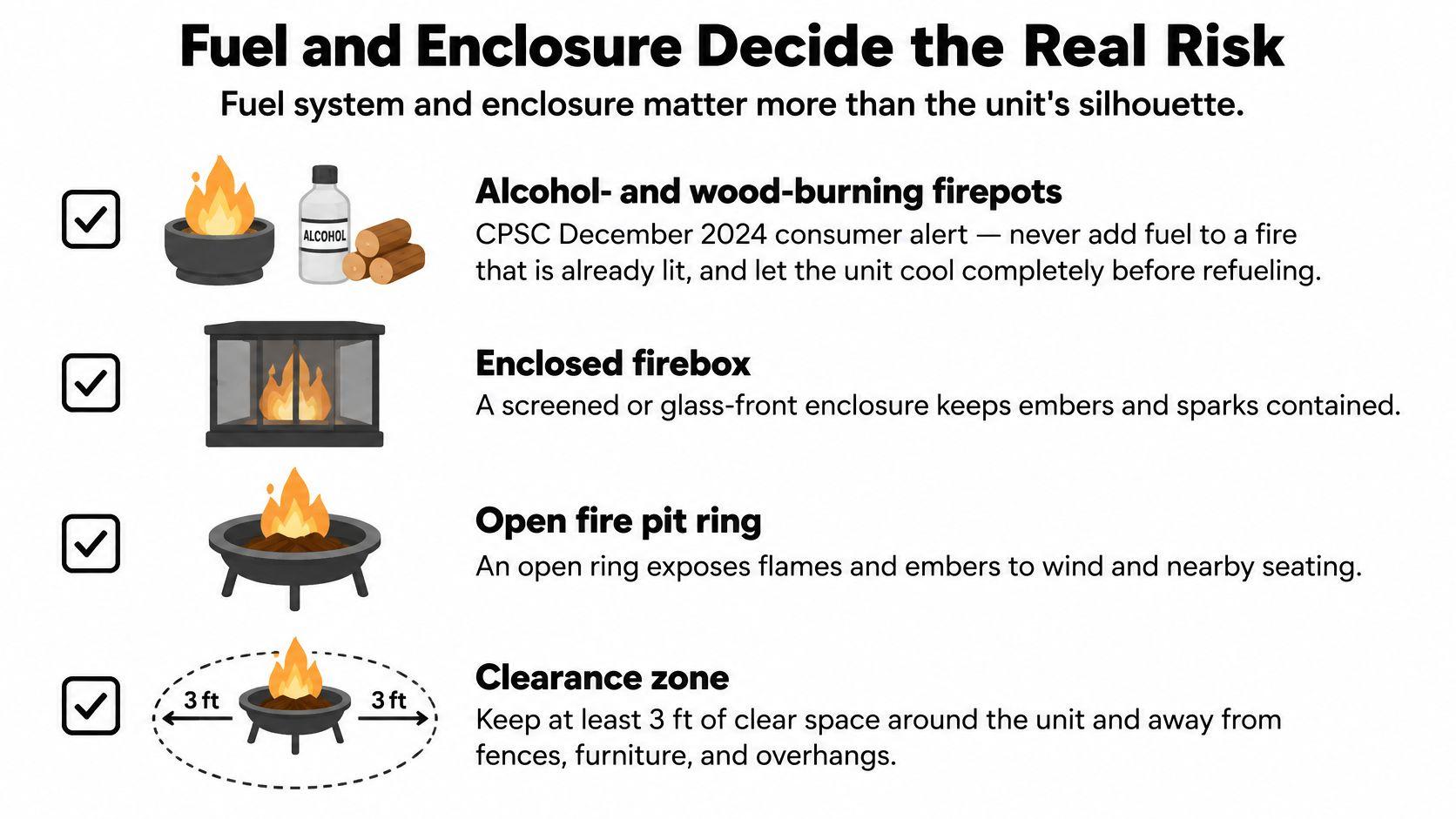
Safety data is where the appearance argument falls apart. In a 2025 consumer alert, the U.S. Consumer Product Safety Commission reported that alcohol- and other liquid-fuel-burning fire pits had been associated with two deaths and at least 60 injuries since 2019. The same alert says isopropyl alcohol, ethanol, bioethanol and similar fuels can burn above 1,600°F and cause third-degree burns in less than one second.
Two mechanisms drive those injuries. A pool fire happens when spilled or pooled fuel burns across a broad surface. Flame jetting happens during refilling, when fuel ignites and propels burning liquid outward.
The dividing line: the fuel system sets the risk. A chimney does not make a bad fuel safe, and an open ring does not make a listed gas burner dangerous.
Rank the options by smoke and fuel, not by how the masonry looks. A listed gas fire pit, with a factory burner and a screen, is often the lower-smoke choice next to a wood-burning masonry fireplace, because the wood fire still sends smoke and sparks out of the opening even when the flue is drawing. An open pit leaves the flame exposed and depends on a spark screen, clearance and careful placement. A built outdoor fireplace adds a masonry firebox, a chimney and more directional containment. A poorly designed fireplace still throws sparks, smoke and radiant heat, and the tabletop liquid-fuel category produces some of the fastest flash fires on the market.
Compact does not mean low consequence
Unit size tells you nothing about the injury a fuel system can produce. In a recall of Colsen-branded indoor/outdoor tabletop fire pits, CPSC counted 19 burn injuries from flame jetting and flames escaping the concrete container. Two incidents caused third-degree burns affecting more than 40% of victims' bodies, and at least six involved surgery, burn-facility admission, physical therapy or permanent disfigurement (CPSC recall notice).
Deck placement sharpens the clearance question further. If the feature sits on or beside a wooden surface, choosing a fire-safe pit for wood decks covers how deck-rated units differ from patio units and why an unrated bowl has no business up there.
What to verify before you buy
- A listed product. Tested to a recognized standard, with a data plate or label you can read, not a marketplace listing that mentions safety in the photos.
- An approved fuel system. Factory burner, factory valve, factory instructions. No field-fabricated fuel plumbing.
- A noncombustible surround. Concrete, stone, metal or masonry under and around the burn area, never a wood frame hidden behind veneer.
- Manufacturer clearances. Measured from the opening or burner to walls, overhangs, fences and furniture, and written into the layout.
- Local fire-code requirements. Your jurisdiction decides distance from structures and whether open burning is allowed at all this season.
Gas units have their own short list. Propane safety tips for homeowners from Irvington Gas Company covers tank placement and connection checks, and the test that matters at every joint is soapy water. Bubbles mean gas is escaping. Shut the supply off and call a licensed technician. Never chase a leak with a flame.
Heat, Smoke and Fuel Choices Compared
Two units can sit ten feet apart and treat the people around them completely differently. This is what the two layouts look like when they share a patio.
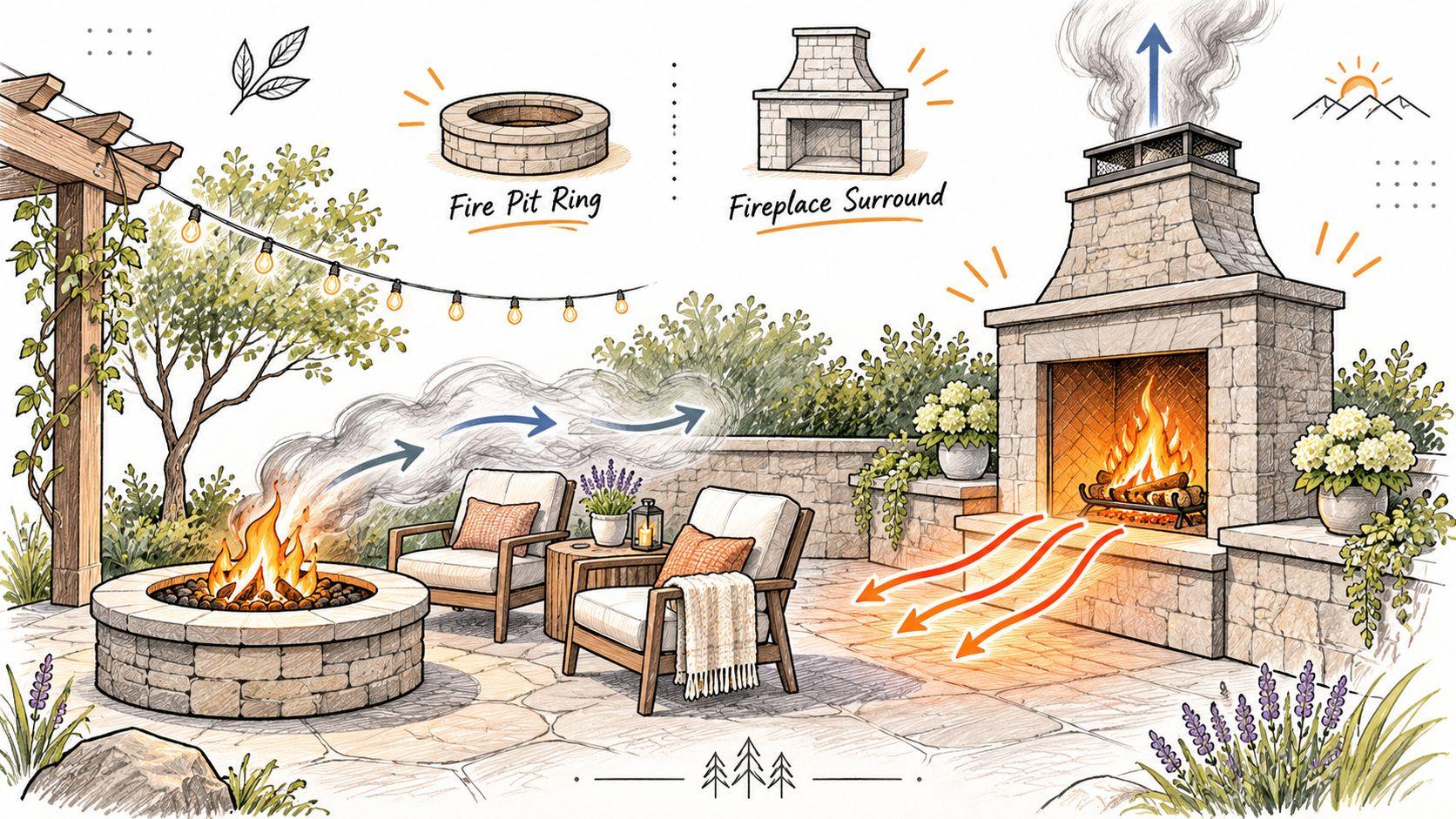
Most comparisons answer which one looks better and skip the question that affects your lungs and your neighbors' patience. That question is smoke exposure, and the honest answer isn't "fireplace."
Heat geometry decides where people sit
A fireplace uses a firebox and flue to send combustion gases upward while concentrating radiant heat at the open front, so the warm seats are in front of the opening and the seats to the side get very little. A fire pit exposes the fire around its perimeter and radiates across the whole circle, which suits a group that shifts around, adds chairs, and passes plates over the flame.
Heat direction drives furniture, not the other way around. Buy the fireplace and you've committed to one facing arrangement. Buy the pit and the circle can grow.
Fuel decides what you breathe
The U.S. Environmental Protection Agency says outdoor recreational fires can become a considerable source of fine-particle pollution, particularly in some metropolitan areas, and names children, older adults, and people with asthma, COPD, heart disease or lung disease as especially sensitive. The agency is equally direct that fireplaces are not EPA-certified wood heaters and still emit harmful air pollution, and it lists outdoor fire pits among residential smoke sources (EPA Burn Wise guidance on backyard recreational fires).
That reframes the whole decision. Wood burned incompletely produces PM2.5, carbon monoxide and toxic compounds whether it's in a pit or under a chimney, while natural gas and propane generally reduce harmful air pollutants. So compare wood versus gas first, then pit versus fireplace. A well-designed gas fire pit can be a lower-smoke choice than a masonry wood-burning fireplace, despite the fireplace's chimney and its more formal face.
| Fuel Type | Smoke Exposure | Heat Control | Key Precaution |
|---|---|---|---|
| Seasoned wood (about 20% moisture) | Highest fine-particle output when wet or smoldering | Limited; output drops as the wood burns down | Burn dry wood, keep air flowing, skip burning during air-quality alerts |
| Natural gas | Lower harmful emissions than wood | Adjustable flame with burner controls | Use a licensed installer and maintain manufacturer clearances |
| Propane (LP-gas) | Low, comparable to natural gas for harmful pollutants | Adjustable with a valve | Keep tank away from seating and follow NFPA 58 requirements |
| Liquid alcohol or bioethanol | No chimney smoke, but high flash-fire risk | Visible flame, hard to control | Avoid refillable liquid-fuel units; see the CPSC warnings |
If you want to watch the two behave before you commit, this walkthrough is worth a few minutes.
Two habits carry most of the smoke benefit. Check wind direction before you light and site the feature so smoke leaves the seating area, not crosses it. Then skip the fire entirely during an air-quality alert, and burn dry, seasoned wood at around 20% moisture rather than anything that sizzles.
Installation Costs, Codes and Hidden Expenses
A prefab steel pit on a paver ring or a compacted gravel pad is a weekend job for a confident DIYer. A gas pit changes the job description: a licensed installer runs the line, sets a shutoff valve and leak-tests every connection before the first light. A masonry fireplace is a construction project, with a footing, a firebox, a flue, a chimney, usually a permit, and a mason who understands what a spark arrestor and a proper crown do.
The two install paths diverge early, and the divergence is structural rather than cosmetic.
What the headline price leaves out
- Concrete footings. A masonry fireplace carries real weight and needs a base below the frost line. A gravel-and-sand pad won't hold it.
- A compacted base. Even a simple pit ring settles if the base isn't excavated and compacted in lifts.
- Gas-line trenching. Running a line from the meter to the patio means trenching, sleeving and inspection, and it's priced per foot.
- Permit fees. Permanent gas features and masonry fireplaces typically need one. Fence-line and side-yard installs can also trigger setback review.
- A chimney cap and spark protection. Small line items that decide whether embers land on your roof or your neighbor's lawn.
- Fence, pergola or planting changes. Meeting clearance often means moving something you already paid for.
If the feature sits on new hardscape, excavation and base work is the line that surprises people most. Our cost guide for homeowners planning patios breaks down where the money goes.
The code framework in plain terms
Nominal BTU rating is a poor way to compare these two. An outdoor fireplace uses its firebox and chimney to direct combustion gases upward while concentrating radiant heat toward the open front; a fire pit exposes the fire around its perimeter and spreads radiation across the seating circle. Compare usable heated area and where occupants sit, not the burner's advertised output, as this field guide to outdoor fire features lays out.
On the code side, wood-burning chimney design, spark protection and flue construction are governed in major U.S. applications by residential-code provisions and NFPA 211. Gas installations bring in NFPA 54 for natural-gas piping and NFPA 58 for LP-gas systems. The fireplace's permit and inspection path is almost always the longer of the two, and that timeline belongs in your project schedule, not in a surprise phone call.
Ask for quotes that list permits and utility work as separate line items so you can compare bids accurately. Then confirm feasibility with a qualified professional before anyone breaks ground.
Upkeep Tasks and How Often to Do Them
Upkeep is the quiet ownership cost, and the two features fail in different ways. A fire pit fails from neglect you can see: a rusted bowl, a cracked ring, a grate burned through in the middle. A fireplace fails from neglect you can't see: a creosote-coated flue, mortar joints opening after a freeze-thaw winter, a damper that no longer seats.
| Task | Fire Pit | Outdoor Fireplace | Interval |
|---|---|---|---|
| Ash removal | Empty pan or bin once cool | Clean firebox and ash pit | After each use |
| Spark screen and grate check | Inspect screen and grate for damage | Inspect firebox grate and damper | Each season |
| Chimney and flue cleaning | Not applicable | Sweep before the first burn of the season | Annually |
| Gas line and burner inspection | Check connections and burner ports | Same checks plus valve and shutoff | Yearly |
| Surface and masonry care | Cover when idle; check ring or pad for cracks | Check mortar and masonry after freeze-thaw | Yearly, after winter |
Read that as a schedule rather than a chore list. The pit's tasks are minutes per use, spread thin. The fireplace's tasks cluster into one annual service you should book before the first cold weekend, when every sweep in town is already booked.
The fuel side of upkeep is measurable, and it's where a design that looks efficient can waste money. EPA-supported emissions research reports that rising moisture content in firewood lowers radiant-heat yield, increases firewood consumption and increases emissions. A USDA Forest Service recreational-fire-pit study cited in the same work found that, at comparable radiant output and manufacturer-recommended operation, one tested Solo fire pit produced approximately twice the PM2.5 emissions of the Breeo and traditional fire pits.
That finding is the argument against judging any "smokeless" or enclosed-looking design by its silhouette. Fuel moisture, combustion-air delivery, loading practice and emissions per unit of useful heat matter more.
Three items belong on your calendar: ash removal after each use, the seasonal spark screen or grate check, and the annual chimney sweep or gas burner check. Store firewood under cover and off the ground, and never burn treated lumber.
Match Your Yard Shape and Pick the Feature
Yard geometry flips the answer faster than any product spec. A small or narrow side yard usually favors a pit, because a 3 to 5 ft ring fits and leaves the walkway open, while a fireplace needs rear wall space, flue height and clearance from the fence line. A sloped yard favors the pit too. It can sit on a flat patio section cut into the slope. A fireplace needs a level terrace and possibly a retaining wall.

Yard shapes that flip the answer
An open lawn with few neighbors rewards a pit. Seating works from every side, and nothing blocks the view lines across the property. A formal back patio with a defined seating wall rewards a fireplace. The masonry anchors the composition, and the chairs already face one direction.
The in-between lots are where the choice stalls. A long narrow lot with a fence on three sides can take a pit almost anywhere, but a fireplace only at one end. A corner patio under a roof overhang can take a small gas fireplace if the unit is rated for covered installation. It cannot take a wood pit at all.
Rank those layouts by smoke exposure and fuel, not by how the masonry photographs. On a tight lot, a gas fire pit keeps the flame low and the seating movable, and it avoids a tall wood-burning chimney that sends smoke into the fence line. A masonry wood fireplace can look more permanent and still put more smoke on neighbors when the wind turns.
The verdict, by situation
| Situation | Better Fit | Why |
|---|---|---|
| Small or narrow side yard | Fire pit | A 3 to 5 ft ring fits and keeps the walkway open; a fireplace needs rear wall space, flue height and clearance from the fence line |
| Sloped yard | Fire pit | Sits on a flat patio cut into the slope; fireplace needs a terrace and possible retaining wall |
| Open lawn with few neighbors | Fire pit | Full seating access from every side |
| Defined seating wall and formal back patio | Outdoor fireplace | Masonry anchors the design and heat goes to one front zone |
| Close neighbors or sensitive family members | Gas-fueled unit | Lower harmful emissions than wood burning |
| New build with planned masonry | Outdoor fireplace | Firebox and chimney designed into the plan from the start |
My recommendation splits three ways. Pick a fire pit for flexible placement, a lower budget and open group seating. Pick an outdoor fireplace for a defined focal point and fixed seating when permits and chimney work are acceptable. Pick a gas-fueled unit whenever smoke exposure to neighbors or a family member with asthma is the top concern. A well-designed gas fire pit is the lower-smoke choice more often than a masonry wood-burning fireplace's reputation suggests.
The photo test to run this week
Stand where the back door meets the patio and photograph the bare space with the house in frame. Both features look plausible in a showroom. Against your siding, fence height and walkway width, only one of them usually still fits.
That photo tests a fire pit layout, not a fireplace concept. The AI backyard design tool creates pool, deck, and fire-pit layouts on your real backyard, and the fire pit design lets you add a fire pit and weigh styles, seating, and materials side by side. OutdoorBrite lets you compare real outdoor styles on your own space and then build the one you choose. Save the design, set it next to the original photo, and hand it to a contractor with a quote request and patio layout tips for new homeowners.
Judge the concepts on four things: seating distance from the flame, walkway width behind the chairs, clearances to the fence and roof overhang, and the sightline from the kitchen door. OutdoorBrite does not replace an architect, designer, contractor, arborist, or horticulturist. Verify feasibility, plant suitability, materials, drainage, utilities, permits, and cost with a qualified professional before spending money or starting work.
You can settle most of the placement debate on your own patio instead of in a showroom. Upload one photo of the bare space and you get fire pit, pool, and deck layouts on that real backyard, with your siding, fence and walkway in frame. Clearance and seating questions show up before you spend a dollar. Bring the fire pit layout you prefer to your contractor as a starting point for real quotes.
See your yard reimagined
Start creating