Fire Pit Ideas for Deck: 8 Safe, Stylish Options for 2026
Explore fire pit ideas for deck spaces, from built-in and gas models to portable and electric options, with clearance, seating, and material tips.
You've got a compact wood deck, a railing only a few feet from the spot you had in mind, and just enough room for two chairs and a table. A fire pit would make the space more inviting, but the right choice isn't determined by the bowl's shape or the colour of its glass. It depends on clearance, framing, fuel access, overhead construction, deck loading, wind, and local or HOA rules.
Fire-safety guidance recommends keeping outdoor fires away from decks, railings, vegetation, and rooflines, with a conservative planning envelope of at least 10 feet from combustible materials. The appliance manual and local code still control the final installation, especially for gas units. The eight fire pit ideas below are ordered from the most permanent and construction-heavy to the most flexible, so you can match the feature to what your deck can physically support. If the deck itself needs attention first, review this practical maintenance guide for North Shore decks.
Table of Contents
- 1. Built-In Drop-In Fire Bowl on a Non-Combustible Hearth
- 2. Propane Gas Fire Table on Deck
- 3. Natural Gas Linear Fire Trough
- 4. Portable Smokeless Wood-Burning Fire Pit
- 5. Ethanol Burner Fire Bowl
- 6. Fire Pit with Built-In Bench or Seat Wall
- 7. Deck-Edge Fire Pit on a Separate Paver or Stone Hearth
- 8. Electric or LED Flame Fire Bowl
- 8-Option Deck Fire Pit Comparison
- Match the Fire to Your Deck Before You Buy
1. Built-In Drop-In Fire Bowl on a Non-Combustible Hearth
A built-in drop-in bowl gives a deck the strongest architectural look, but it also demands the most careful planning. The bowl sits in a framed opening and is surrounded by stone, tile, concrete pavers, or another non-combustible hearth. Done well, it reads as part of the deck rather than furniture placed on top of it.
That appearance can be misleading. A flush fire bowl still needs separation from combustible framing, siding, rails, eaves, furniture, and vegetation. The hearth protects the surface around the bowl, but it doesn't make an unsafe location safe. A wood-burning insert also introduces sparks and embers, while a gas insert brings fuel-line, shutoff, ventilation, and inspection requirements.
A raised composite deck might use a steel bowl inside a broad flagstone hearth, positioned well away from the railing and house wall. On a multi-level deck, a lower landing with its own stone zone can create better separation than placing the fire in the main seating area.
Build the safety zone before the deck boards
Ask the builder to design the hearth, framing, access panels, and fuel route together. A heat shield or ventilated air gap may be necessary between the insert and wood framing, depending on the product. The location should also account for prevailing wind, neighbouring windows, sun exposure, and how people move from the door to the stairs.
Practical rule: A built-in bowl belongs only where the structure, clearances, fuel system, and local approval have been resolved before the opening is framed.
Use a licensed gas professional for a gas insert, and ask the building department whether the built-in structure or gas work requires a permit. For visual planning, show the actual deck edge, railing, siding, eaves, trees, and proposed hearth. A realistic concept should make clearance measurable, not merely make the flame look attractive.
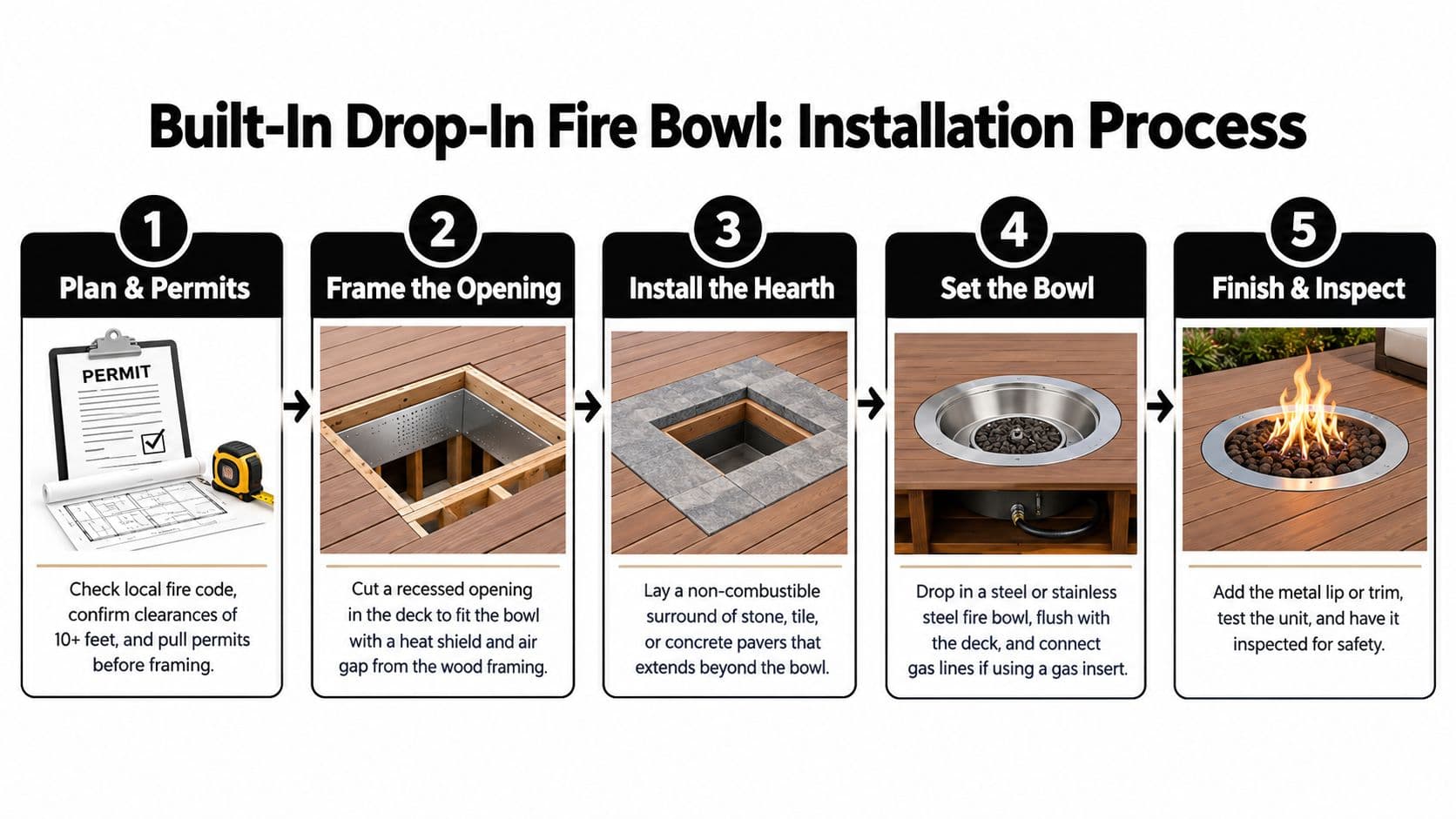
A flush bowl should look integrated, but the safest layout may place it on a lower, detached landing rather than directly within the primary deck structure.
2. Propane Gas Fire Table on Deck
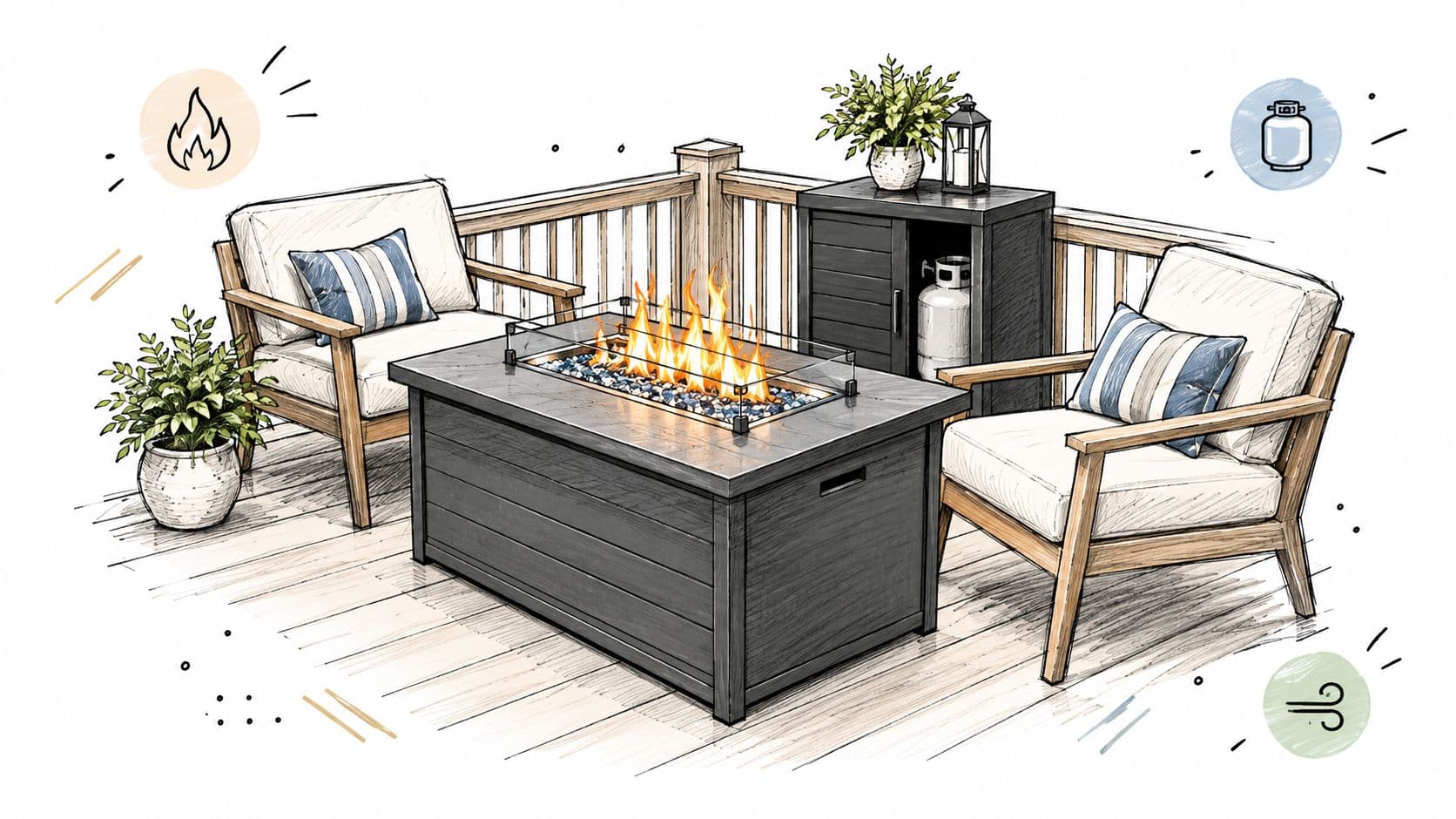
A propane fire table is usually easier to introduce into an existing deck because it doesn't need a permanent gas line. It combines a controlled flame with a table surface, which is useful on a small deck where a separate coffee table would consume valuable floor area. A square model can anchor two lounge chairs, while a longer table can divide dining and conversation zones.
The practical advantage is control. Push-button ignition and an accessible shutoff make it easier to end the fire when guests leave or wind changes. Propane also avoids the sparks and ash associated with a wood fire, although the unit still produces heat and remains an open flame.
The tank arrangement deserves more attention than the decorative top. Keep the cylinder upright, protect the connection from impact, and route the hose so nobody catches it with a chair or foot. Don't hide a tank in an unventilated enclosure unless the manufacturer specifically allows that arrangement.
Choose the table by footprint, not flame size
A compact square table works on a small corner deck when the seating stays outside the traffic route. A rectangular table suits a larger deck, but its length can push chairs toward the railing if the layout is too tight. A glass wind guard can stabilise the flame, but it shouldn't be treated as permission to place the unit beneath a low roof, pergola, or overhang.
Check for a recognised safety certification, automatic shutoff, stable legs, and a cover that keeps rain away from the burner. A heat-resistant mat can protect the decking from hot spots and spills, but it doesn't replace the manufacturer's clearance requirements.
Keep the cylinder accessible for inspection and emergency shutoff. Decorative screening is useful only when it preserves ventilation and access.
For a deck with a pergola, compare the fire location with these 7 fire pit pergola designs, but verify overhead clearance independently. The best placement rule is simple: use a propane table only where the entire table, flame, cylinder, and seating zone fit within the approved clearances without blocking an exit path.
3. Natural Gas Linear Fire Trough
A natural gas linear trough suits a contemporary deck where a long, narrow feature can replace a bulky round bowl. The burner may run beside a low bench, along a visual boundary, or parallel to the deck edge. Stainless steel, concrete, and dark stone surrounds pair well with composite boards and minimalist railings.
This is a permanent installation, not a portable upgrade. The gas line must be sized, routed, tested, and protected before finished decking closes the work area. Cutting through completed boards later can create weak points, awkward access panels, and visible patching.
A six-foot trough beside a low built-in bench can create a strong focal line, but the bench shouldn't press people toward the flame. On a raised deck, a linear feature along the edge may also expose the burner to wind from several directions. A glass or metal guard can help stabilise the flame where the manufacturer permits it.
Plan the fuel route with the framing
The licensed gas technician should coordinate with the deck builder rather than arrive after the structure is complete. Confirm the appliance's horizontal and overhead clearances, the location of the emergency shutoff, and the path for maintenance access. Natural gas removes the need to store or refill cylinders, but it doesn't remove the need for approved installation and local inspection.
The linear form can also tempt homeowners to install the trough beneath a pergola roof because the feature appears narrow. That is a common design mistake. Flame height, heat output, wind, and overhead materials matter more than the burner's footprint.
A narrow fire feature still needs a full safety envelope. Measure from the flame and hot surfaces, not just from the outside edge of the trough.
Place the trough only where the gas route can be installed without compromising joists, blocking drainage, or narrowing the main walking lane. If the finished deck can't provide that route and clearance, choose a detached hearth instead.
4. Portable Smokeless Wood-Burning Fire Pit
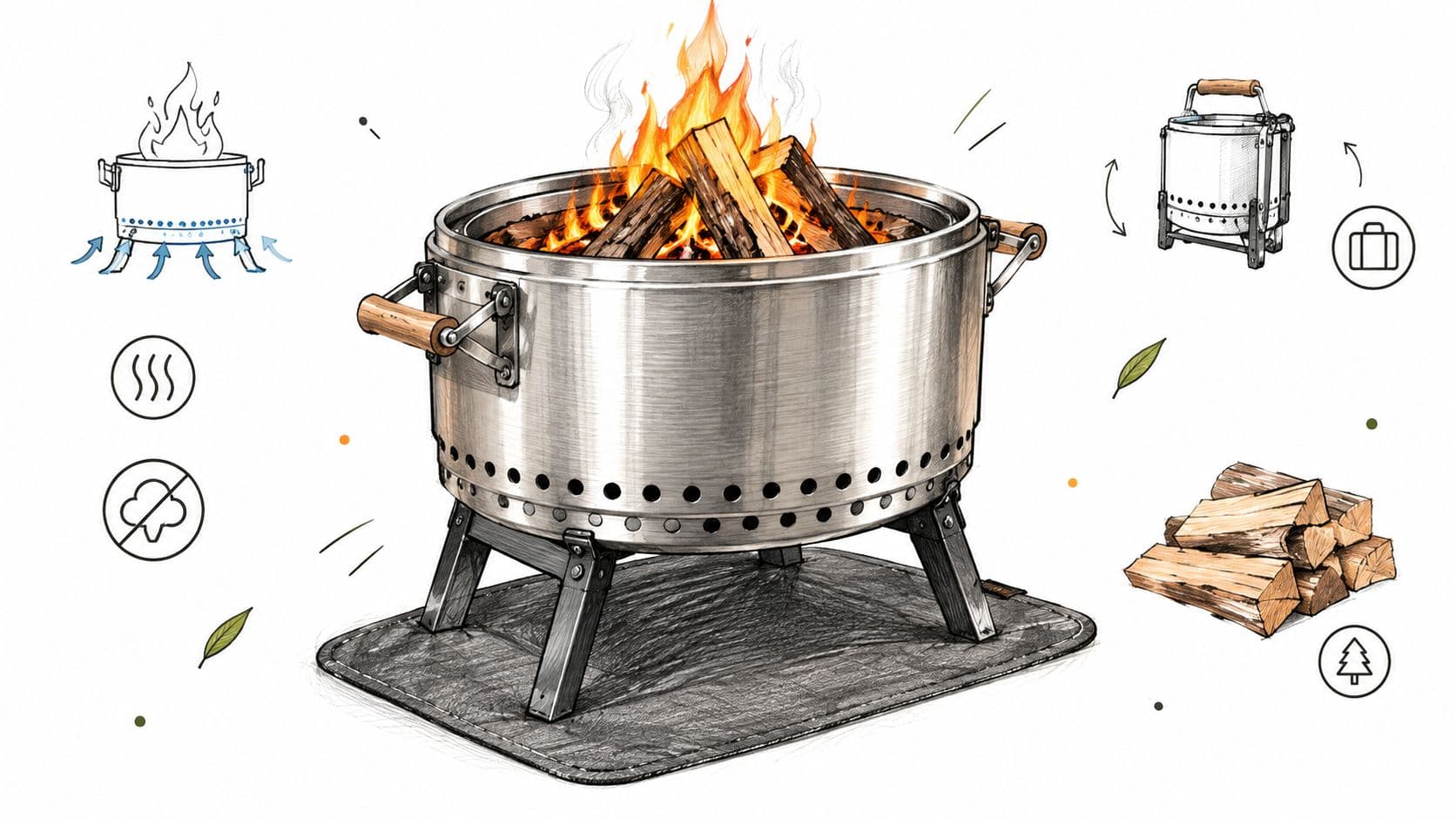
A portable smokeless pit offers the familiar sound and appearance of a wood fire without committing the deck to a permanent structure. Double-wall designs draw air through the lower body and feed it into the flame, which can reduce visible smoke when the fuel and operating conditions are right. They still burn wood, so “smokeless” doesn't mean risk-free or emission-free.
USDA Forest Service testing measured average fine-particle emissions of 2.2 grams per kilogram of dry wood from two low-smoke pits and a campground pit, compared with the U.S. EPA National Emissions Inventory factor of 11.3 grams per kilogram, about 80% lower in that testing. The Forest Service also stresses that performance depends on following the manufacturer's instructions and burning wood with less than 20% moisture. See the USDA Forest Service testing for the conditions behind those findings.
A 24-inch unit on a stainless stand may work at the far end of a large deck, while a small balcony-style deck might have no suitable location at all. The key issue isn't mobility. It's whether the pit can be moved to a safe place before each fire.
Treat it as a live wood fire
Use a purpose-made fire-resistant pad, stand, metal tray, or heat shield, and keep the pit stable on a level surface. Burn small amounts of dry, seasoned hardwood, keep a lid or spark-control method available if specified by the manufacturer, and never leave the fire unattended. Ash needs a safe cooling and disposal plan, not a quick sweep into a bin.
Local authorities may restrict fires during air-quality alerts, limit operating times, or require permits. HOAs can impose additional restrictions even when local rules allow the appliance.
Placement rule: Put a portable wood pit only on a non-combustible support in a clear, open zone that meets the manual and local rules. If that zone doesn't exist on the deck, move the fire to a detached hearth.
For a more formal built-in look, compare the layout principles in planning a built-in square fire pit, but don't copy a fixed design onto a combustible deck without checking the structure first.
5. Ethanol Burner Fire Bowl
An ethanol burner creates a small flame without wood, ash, or a gas connection. The burner sits in a metal or stone bowl, tray, or tabletop surround, making it appealing for compact decks where a full fire pit would crowd the furniture. It can also suit a property where storing logs or routing a gas line isn't practical.
The clean appearance shouldn't lead you to underestimate the fuel. Ethanol is a liquid fuel, and refilling a warm or burning burner creates a serious hazard. The flame can also be difficult to see in bright conditions, so users need to confirm that it is fully extinguished before adding fuel or moving the unit.
A square steel tray on a cedar deck can work as a visual centrepiece when it sits on a broad non-combustible slab. A tabletop bowl on a rooftop-style deck may be easier to supervise than a low floor unit, provided it cannot be knocked over and the surrounding furniture stays outside the heat zone.
Control the fuel before styling the surround
Use only the fuel specified for the burner, follow the fill level instructions, and let the unit cool completely before refilling. Store spare fuel in a cool, ventilated location away from the house, ignition sources, children, and the deck's main circulation route.
The base should extend beyond the burner and remain stable on a non-combustible mat or slab. Keep cushions, curtains, paper products, and dry plant material away from the flame. A decorative bowl doesn't replace the burner's required ventilation or clearance.
Never refill by guesswork. A dark or quiet burner may still be hot enough to ignite fresh fuel.
The placement rule is to use an ethanol bowl only as a supervised, freestanding feature on a stable non-combustible base, well away from railings and combustible décor. If the deck is too tight to maintain that buffer, choose an electric feature instead.
6. Fire Pit with Built-In Bench or Seat Wall
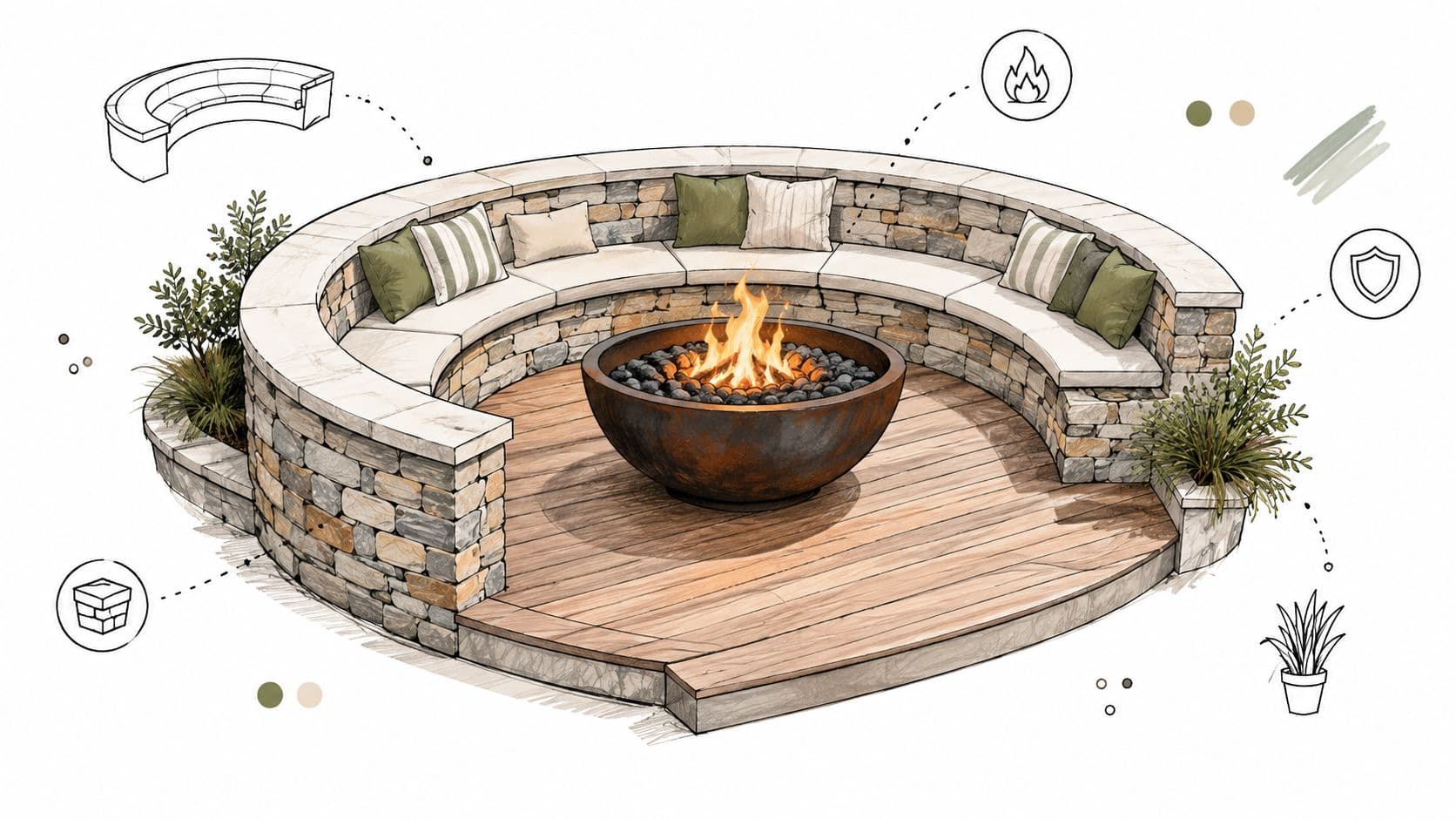
A fire pit surrounded by a bench or seat wall solves two layout problems at once. It defines the gathering area and provides seating without scattering chairs around the deck. Curved stone, a straight masonry wall, or a composite structure with a non-combustible cap can all create a finished outdoor room.
The construction needs to respect the fire before it accommodates the people. A seat wall that looks comfortable in a drawing may place knees, cushions, and clothing too close to the flame. It can also block access to a gas shutoff or make it difficult to move around the fire when the deck is busy.
A curved stone wall around a steel bowl works best on a broad deck extension or on a lower detached platform. A composite deck with a gas feature and a low bench on three sides can feel more integrated, but only if the bench, cushions, and burner maintain the clearances specified for the appliance.
Separate the seating zone from the heat zone
A comfortable bench is commonly planned at about 16 to 18 inches high and 16 to 20 inches deep, but the fire feature's manual and local code determine the required separation from the flame. Use a non-combustible cap near the heat source and select fire-rated materials for nearby surfaces.
Keep cushions removable. Store them away from the flame whenever the fire is lit, and don't use the bench as a place to stack blankets, toys, firewood, or serving trays.
A seat wall should frame the fire, not become a heat shield that traps people in place. Preserve an unobstructed way out on every side that people use.
For a compact garden, these small backyard fire pit ideas can help with proportion, but the seating distance must be checked against the actual appliance. Place the fire only where the bench leaves a clear traffic route and doesn't push occupants toward the railing.
7. Deck-Edge Fire Pit on a Separate Paver or Stone Hearth
For many wood decks, the most defensible design is to move the fire off the deck. A separate paver or stone hearth beside the deck creates a dedicated non-combustible zone while preserving the deck as the dining and lounge area. The two spaces can connect through a short step, a paver path, or a broad transition landing.
This arrangement also avoids loading the deck framing with a heavy masonry surround. A compacted gravel base, proper drainage, and a stable stone surface provide a better foundation than placing pavers over soil. The hearth shouldn't be fastened to the deck or used as a structural extension unless a professional has designed that connection.
A round bluestone pad with a steel bowl can sit beside a timber deck, with two stepping stones between the surfaces. A square paver zone beside a composite deck can include a gravel border and a low seat wall, creating a visual continuation without putting the flame on the boards.
Let the ground carry the fire
The National Fire Protection Association advises keeping outdoor fires away from decks and railings and recommends placing heat-producing equipment well away from the home, deck rails, eaves, and overhanging branches. Its guidance also supports a conservative 10-foot separation from combustible materials, while the appliance manual and local code may require more or specify different clearances. Review the NFPA fire-pit guidance before fixing the location.
A properly laid hearth also makes ash cleanup and furniture placement easier. Leave a visible gap between the hearth and deck framing, prevent mulch or dry leaves from collecting at the edge, and keep the route back to the house clear. For the paving work itself, follow this guide on how to lay patio perfectly.
Placement rule: If a fire can sit beside the deck on its own non-combustible foundation, that layout is usually easier to inspect, maintain, and defend than a fire placed directly over deck framing.
8. Electric or LED Flame Fire Bowl
An electric or LED flame bowl is the practical answer when open flame isn't allowed. It uses lights, mist, heated air, or a combination of effects to create a fire-like glow without combustion, sparks, ash, gas cylinders, or firewood. That makes it suitable for some rental properties, high-rise balconies, covered spaces, and HOA communities with strict restrictions.
The trade-off is warmth and realism. Some units create ambience rather than meaningful heat, and an LED flame may look convincing at dusk but less natural in full daylight. That isn't a weakness if the purpose is evening atmosphere, conversation lighting, or a visual focal point rather than a heating source.
An outdoor-rated tabletop bowl can sit on a glass-railed balcony deck, while a larger electric feature can define a seating corner without consuming the clearance required by an open flame. The unit still needs a stable base and protection from rain according to its rating.
Treat electricity as a layout constraint
Use a GFCI-protected outdoor outlet and keep the cord away from steps, chair legs, and wet areas. Don't run an extension lead through a main walking route just to reach a better-looking position. A weatherproof cover protects the unit when it's not operating, but it can't correct an unsuitable outlet or exposed connection.
Look for a realistic flame pattern, replaceable components, and a warranty that covers outdoor use. If the feature includes a heater, check its separate clearance and ventilation requirements instead of assuming it has the same low-risk profile as an LED-only bowl.
Placement rule: Put an electric feature where the outlet, cord, drainage, and weather exposure are safe first. The flame effect should fit the deck, not force a trip hazard.
Outdoor lighting principles, including weatherproof placement and protected connections, are also covered in this Palm Beach County lighting guide. For any deck where wood, gas, or ethanol is prohibited, an electric bowl can preserve the gathering point without introducing combustion.
8-Option Deck Fire Pit Comparison
| Option | 🔄 Implementation | ⚡ Resources & Setup | ⭐ Expected outcomes | 📊 Ideal use cases | 💡 Key tips |
|---|---|---|---|---|---|
| Built-In Drop-In Fire Bowl on a Non-Combustible Hearth | High, permanent recessed build; contractor and permits often required | Heavy: non-combustible hearth, steel bowl, possible gas line; setup days–weeks; higher cost | ⭐⭐⭐⭐⭐, seamless, high curb appeal and durable heat containment when installed correctly | New builds or major deck rebuilds wanting a permanent focal point | Plan clearances with code, add heat shield/air gap, route gas during framing |
| Propane Gas Fire Table on Deck | Low–Moderate, freestanding or semi-built; minimal trade work | Medium: certified table, propane tank (stored off-deck), optional cabinet; setup under 1 hour (freestanding) | ⭐⭐⭐⭐, smokeless, convenient table surface; good for dining and small groups | Small–medium decks where smoke is a concern and surface is needed | Keep tank upright outside deck footprint; use safety-rated unit and cover |
| Natural Gas Linear Fire Trough | High, permanent gas line and licensed installer required | Heavy: stainless/concrete trough, natural gas hookup, permits; setup days–weeks | ⭐⭐⭐⭐⭐, sleek continuous flame, high-end modern look, easy fuel supply | Modern homes/new builds with planned natural gas supply | Hire licensed gas tech, plan gas routing during framing, use wind guards |
| Portable Smokeless Wood-Burning Fire Pit | Low, plug-and-play portable unit; no permits for unit itself (check local rules) | Light: double-walled pit, heat-resistant pad, wood fuel; setup in minutes | ⭐⭐⭐⭐, authentic wood-fire experience with reduced smoke; movable | Renters, travelers, small decks, flexible or temporary setups | Use a heat pad, maintain clearance, burn seasoned wood, check local burn bans |
| Ethanol Burner Fire Bowl | Low, drop-in or tabletop; no utilities or permits in most areas | Light–Medium: burner inserts and ethanol fuel; setup 15–30 minutes; ongoing fuel cost | ⭐⭐⭐, clean, smokeless flame with limited heat output | Small decks, condos, or areas where wood/gas are restricted | Refill only when cool, use stable non-combustible base, store fuel safely |
| Fire Pit with Built-In Bench or Seat Wall | High, custom hardscape build; contractor and permits likely | Heavy: non-combustible materials, seat caps, possible gas; build takes weeks | ⭐⭐⭐⭐⭐, strong social focal point; maximizes seating and resale appeal | Families and entertainers wanting permanent, social gathering space | Set safe seating distance, use fire-rated materials, design for comfort (seat height) |
| Deck-Edge Fire Pit on a Separate Paver or Stone Hearth | Moderate, freestanding hearth beside deck; requires site prep | Medium: pavers/stone, compacted base, drainage; setup days–two weeks | ⭐⭐⭐⭐, safer separation from deck structure; durable, adaptable placement | Existing decks with adjacent yard space wanting a safer fire area | Build compacted base for drainage, leave gap from deck framing, use non-combustible border |
| Electric or LED Flame Fire Bowl | Low, plug-and-play; usually no permits | Light: electric/LED unit, GFCI outdoor outlet; setup under 30 minutes; low operating cost | ⭐⭐⭐, convincing ambiance without combustion; limited real heat | Renters, condos, balconies, HOA-restricted decks or burn-ban areas | Confirm outdoor/GFCI rating, hide/manage cords, choose higher-quality realism models |
Match the Fire to Your Deck Before You Buy
The best fire pit ideas for deck spaces begin with a measurement, not a product page. Measure from the proposed flame and hot surfaces to the house, siding, railings, eaves, pergolas, branches, furniture, and deck edge. Use 10 feet as a conservative planning baseline from combustible materials, then verify the appliance manual and local fire code. NFPA data shows why this deserves attention. From 2020 through 2024, U.S. fire departments responded to an annual average of 12,141 home fires involving grills, hibachis, or barbecues, causing average annual losses of 15 civilian deaths, 171 reported civilian injuries, and $241 million in direct property damage. These figures concern grills rather than fire pits, but both involve open flame or high heat near combustible outdoor structures. Review the NFPA grilling safety guidance as part of the planning process.
Then identify what the deck can support. A built-in bowl or seat wall may require structural design, non-combustible separation, framing changes, and permits. A natural gas trough needs a planned line, licensed installation, testing, and an accessible shutoff. A propane table needs cylinder access and hose protection. A wood-burning pit needs a genuine non-combustible zone, dry fuel, supervision, ash handling, and permission to burn.
Fuel restrictions can decide the design before aesthetics enter the discussion. USDA testing found lower fine-particle emissions from low-smoke pits under specific operating conditions, but those pits still burn wood and require dry fuel and correct use. If smoke, odour, dense housing, or local restrictions dominate, propane may be more practical. If your rules prohibit combustion altogether, electric or LED is the straightforward choice.
Make the final shortlist site-specific
Choose one or two options only after checking these conditions:
- Structure: Confirm whether the deck framing and footings can carry the appliance, hearth, masonry, or seating.
- Clearance: Measure actual distances to combustible and overhead materials instead of estimating from a rendering.
- Fuel access: Plan cylinder storage, gas routing, wood storage, electrical supply, and emergency shutoff access.
- Weather: Account for wind direction, exposed corners, rain, and the way smoke or heat will move toward neighbours.
- Rules: Check municipal requirements, burn bans, permits, and HOA approval before ordering equipment.
- Use: Decide whether the fire is for heat, cooking, ambience, occasional entertaining, or daily evening use.
OutdoorBrite can help you place different fire bowls, troughs, seating groups, and paving zones over a photo of your actual backyard. Treat those concepts as visual planning tools, not code approval or structural drawings. The safest design may be the one that moves the fire just beyond the deck, then uses coordinated paving and seating to keep the space connected.
Start by photographing the deck from the house and yard, measuring the key clearances, and marking the railing, roofline, trees, stairs, and utilities. Share that information with a qualified deck builder, gas professional, or building official before framing or purchasing. A beautiful fire feature works only when the deck can safely carry, separate, fuel, supervise, and shut it down.
OutdoorBrite lets you turn a photo of your real backyard into realistic deck and fire-pit concepts, so you can compare bowls, linear burners, seating, and paver layouts before spending on materials. Upload your space, test the fire pit ideas that fit your clearances and style, and visit OutdoorBrite to start planning.
See your yard reimagined
Start creating