8 Front Yard Landscaping Modern Ideas
Explore 8 front yard landscaping modern ideas with real-world design inspiration, budget adaptations, lot-size tips, and OutdoorBrite mockups.
Modern front yard landscaping doesn't have to mean more lawn, more watering, or a larger budget. Outdoor irrigation accounts for about 30% of the water people use outdoors in the United States, or approximately 7.8 billion gallons daily, according to estimates summarized by the U.S. Environmental Protection Agency. The better approach is to treat a modern front yard as a flexible design system, not one fixed look.
The eight concepts below show how to adapt clean geometry, native planting, xeriscaping, Japanese restraint, cottage warmth, sculptural plants, outdoor living, and bold materials to real constraints. A small urban lot needs a different composition from a wide suburban frontage. A starter project shouldn't copy the hardscape of a high-investment renovation, and a drought-prone yard can't rely on the same planting palette as a humid climate.
Start with the architecture, lot size, climate, maintenance tolerance, and spending limit. Then use OutdoorBrite to mock up your own property, compare concepts, and refine planting beds, paths, paving, and outdoor features before buying materials. A strong visual plan can also help make your home more welcoming without forcing you into a design your lot can't support.
Table of Contents
- 1. Minimalist Hardscape Design
- 2. Native Plant and Pollinator Gardens
- 3. Sustainable Contemporary With Xeriscaping
- 4. Contemporary Japanese-Inspired Zen Modern
- 5. Modern Cottage Contemporary Farmhouse Blend
- 6. Architectural Plant-Forward Design
- 7. Integrated Outdoor Living and Entertainment
- 8. Bold Color and Contemporary Hardscape Combinations
- Modern Front Yard Landscaping: 8-Style Comparison
- Turn Inspiration Into a Yard You Can Test
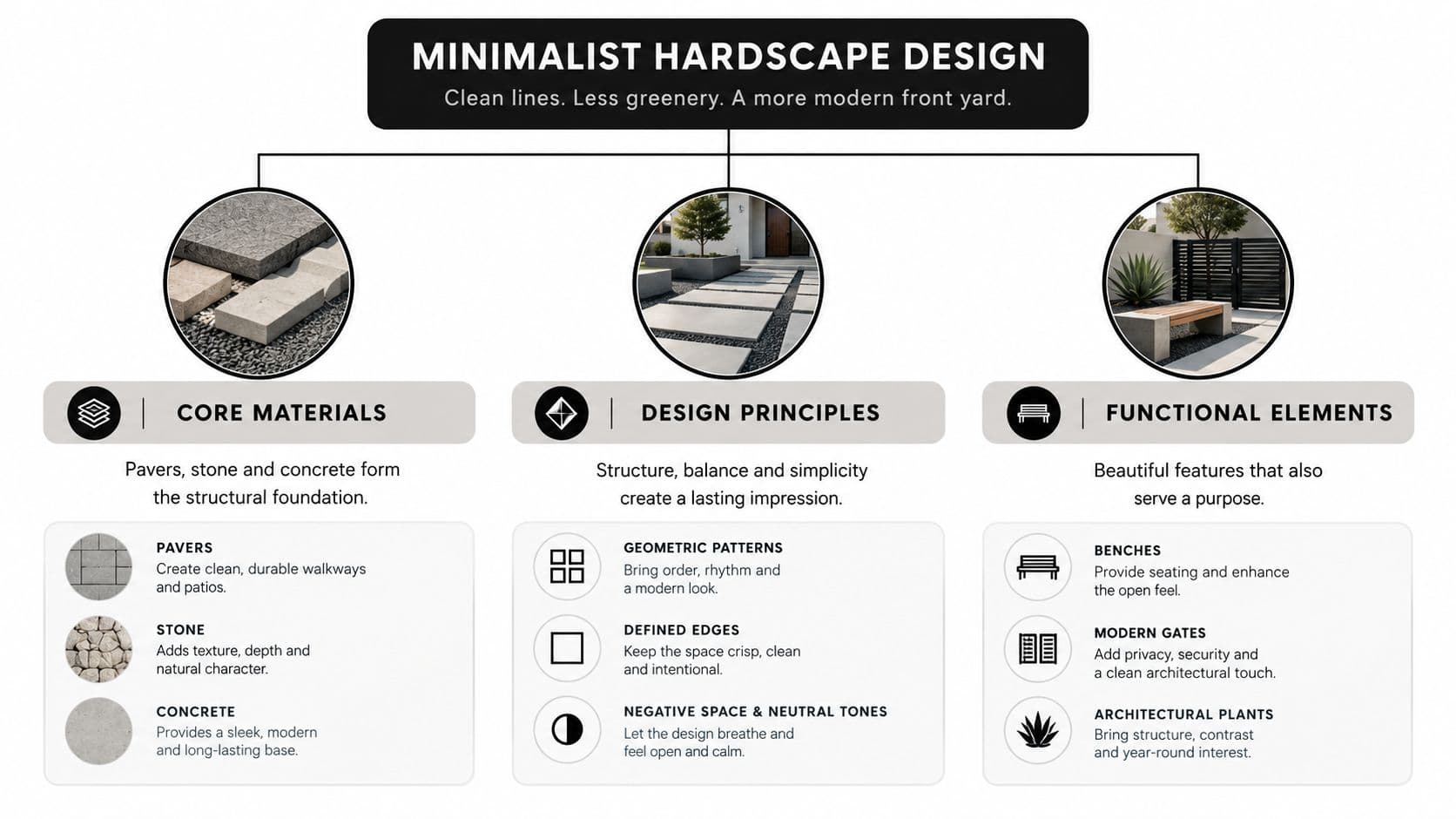
1. Minimalist Hardscape Design
A minimalist hardscape design gives the front yard a clear visual order. Straight paths, rectangular planting beds, concrete slabs, gravel fields, and steel edging create structure, while a restrained plant palette keeps the composition from looking busy. The result works particularly well beside contemporary, mid-century, and box-shaped homes, but the same principles can refresh a more traditional facade when the materials are used sparingly.
On a small lot, use one strong entry path and one compact planting bed rather than dividing the yard into many zones. A medium lot can support a paver court at the front door, a narrow gravel strip, and repeated shrubs or grasses. Larger properties need more than a large field of concrete. Break the hardscape into distinct arrival, planting, and drainage areas so the frontage still feels intentional.
Materials should earn their place
Choose one primary hardscape material and one accent. For example, pale concrete pavers with a narrow band of black stone create contrast without visual clutter. Corten steel can define a planting edge, but it should act as a focal detail rather than appear at every boundary. Permeable paving is useful where runoff is a concern, provided the base and drainage design suit local soil conditions.
Use ai for garden design to test running-bond, grid, and offset paver patterns on a photo of your actual entry. A pattern that looks elegant in a product sample can make a narrow approach feel shorter or make a broad facade appear disconnected.
Practical rule: A modern yard needs empty space. If every surface has a material, plant, light, or ornament, the design loses the calm that makes minimalism work.
Architectural grasses, structural shrubs, and a single small tree usually perform better than a long list of unrelated plants. Add low-profile lighting along the path or use subtle uplighting on one specimen. The trade-off is clear. Hardscape reduces mowing and simplifies edges, but it can increase heat, glare, and installation cost if the design lacks shade, drainage, or enough living material.
2. Native Plant and Pollinator Gardens
A native plant garden can look highly contemporary when the planting is organized into repeated masses instead of scattered randomly. Use a strong edge, a defined path, and broad drifts of regionally adapted plants. The yard then reads as intentional, while still supporting pollinators, birds, and other wildlife.
The EPA recommends native and low-water-use plants because established native species generally need little or no supplemental water beyond normal rainfall. That doesn't mean every native garden is maintenance-free. Young plants need establishment care, weeds need early attention, and the right species still depend on soil, sun, drainage, and local climate.
Design for seasonal structure
Small lots benefit from a limited palette of native sedges, grasses, flowering perennials, and one compact tree or shrub. In a medium yard, layer spring bulbs, summer bloomers, and fall seed heads inside a geometric bed. A larger property can use several connected masses, but repeat the same plant groups so the frontage doesn't become visually fragmented.
Research your local native plant society and hardiness zone before choosing a palette. A Texas yard might use native sage, yucca, and wildflower mixes, while a Pacific Northwest frontage could combine serviceberry, Oregon grape, and regionally suitable evergreen structure. Don't import a plant list from another climate just because the image looks modern.
- Use repetition: Repeat a few dependable species in clear groups rather than buying one of everything.
- Protect habitat: Delay some fall cleanup so stems and seed heads can provide seasonal shelter and food.
- Control water demand: Group plants by irrigation needs and keep thirsty species away from drought-tolerant beds.
- Keep the entry legible: Native planting should frame the walkway, not hide the door or house number.
A native garden can soften a stark facade without losing geometry. For planting ideas and habitat-friendly principles, consult this pollinator garden guide from Barefoot Organics. The main trade-off is appearance during transition. A new planting may look sparse at first, while a mature composition depends on seasonal change rather than constant uniformity.
3. Sustainable Contemporary With Xeriscaping
Xeriscaping works when it is designed as a complete water-management system, not as decorative rock scattered across a former lawn. Reduce irrigated turf, select climate-compatible plants, organize zones by water demand, and use efficient irrigation. Gravel, permeable paths, boulders, and mineral mulch then support the composition instead of replacing the yard entirely.
The World Economic Forum, citing Los Angeles County Public Works, reports that xeriscaping can reduce outdoor water use by approximately 50% compared with traditional yard design in the cited context. That performance depends on plant selection, irrigation, soil, climate, and establishment care. A yard covered in rock with poorly chosen plants and no drainage plan isn't automatically water-smart.
Scale the conversion to the property
On a small lot, remove the most visible or irrigation-intensive turf and create one planted gravel bed with a narrow lawn panel if you still need green space. A medium frontage can combine a defined lawn rectangle, a dry garden, and a permeable route to the door. Larger lots need careful zoning so the low-water areas don't appear like disconnected islands.
A Southern Nevada Water Authority conversion study provides a useful benchmark. Homes that replaced an average of roughly 1,500 square feet of turf with xeriscape reduced annual outdoor water consumption from approximately 166,000 to 100,000 gallons, a 41% reduction, or about 66,000 gallons per home annually. The study details tie the result to the converted area and the combined landscaping system, not to appearance alone.
Use OutdoorBrite xeriscaping inspiration to compare gravel colors, succulents, grasses, and planting pockets on your frontage before ordering materials. Then verify that the selected plants suit your actual winter temperatures, summer heat, soil, and rainfall.
The most convincing xeriscape has rhythm. Repeat plant forms, vary stone texture, and leave enough open space for the eye to rest.
Drip or low-precipitation irrigation can serve planting beds, while timers and soil sensors help prevent routine overwatering. Mulch can moderate soil temperature and reduce evaporation, but dark stone beside a hot wall may increase heat stress. The winning design is restrained, layered, and regionally appropriate, not merely empty.
4. Contemporary Japanese-Inspired Zen Modern
Japanese-inspired modern landscaping depends on editing. A few stones, a carefully placed tree, a restrained ground plane, and a path with deliberate direction can make a small front yard feel composed. The design isn't about filling the space with traditional objects. It is about balance, contrast, seasonal change, and the relationship between solid materials and living forms.
For a small frontage, build the composition around one statement plant and a gravel or moss-like ground plane suited to the local climate. A medium lot can add a subtle path, a second planting mass, and a small basin or water detail. Larger properties can create a sequence from the sidewalk to the entrance, but avoid turning the front yard into a collection of unrelated garden rooms.
Let the architecture stay visible
Japanese maples, clumping bamboo, carefully selected evergreen shrubs, and textured grasses can provide structure, but mature size matters. Bamboo needs a locally appropriate, non-invasive selection and a containment strategy where necessary. A water basin can add sound and ritual, yet it also brings cleaning, winterization, and safety responsibilities. If those tasks don't fit your routine, use stone, gravel, or a dry stream detail instead.
OutdoorBrite's Japanese zen template can help you compare focal-point placement, path direction, and stone groupings on your own property. Odd-numbered groupings are a useful compositional starting point, but proportion matters more than counting. A tiny yard overwhelmed by large boulders won't feel serene, and a wide lot with one undersized stone may look accidental.
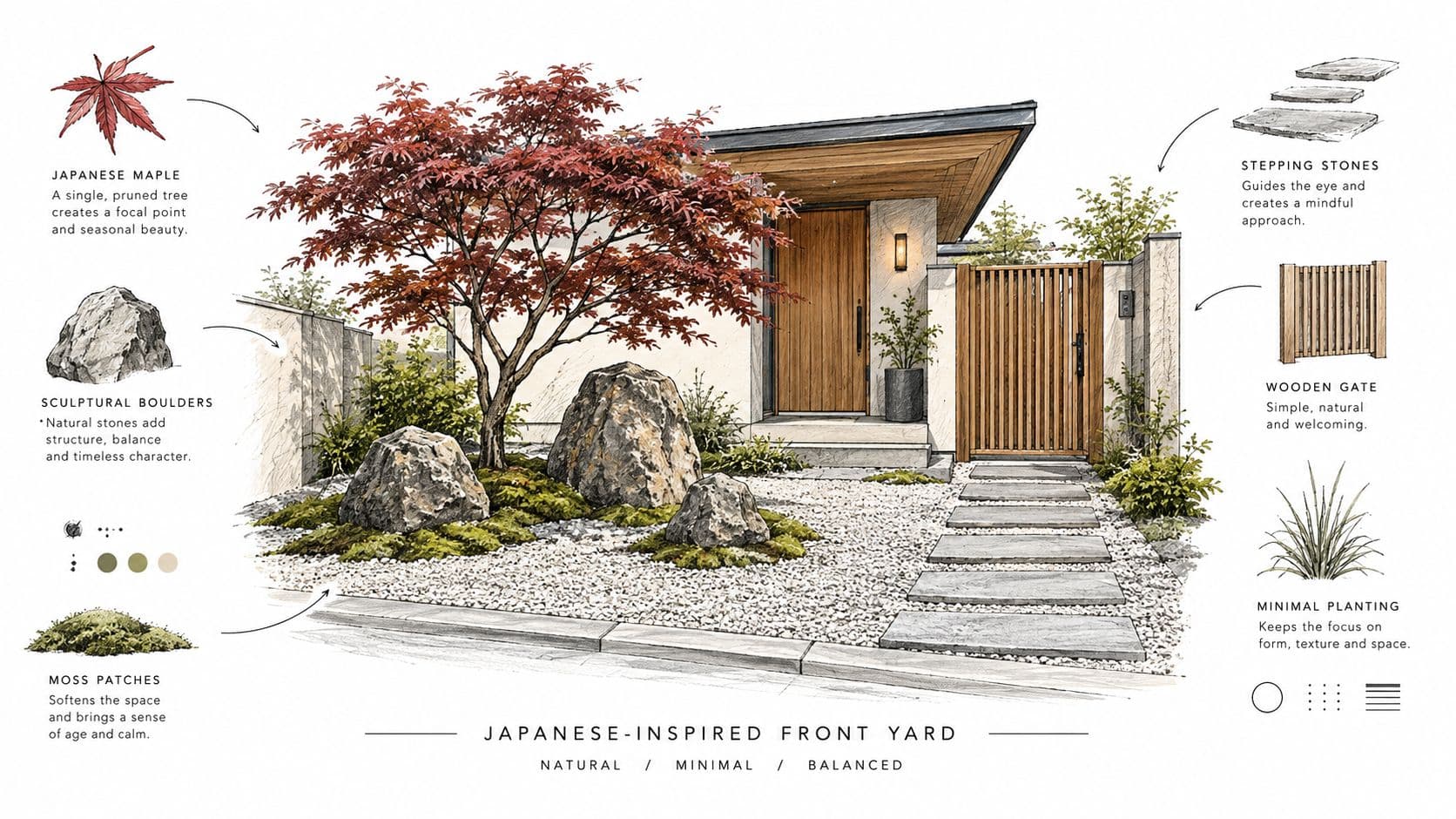
Use subtle path changes to guide visitors without forcing a winding route that wastes space. Keep sight lines open to the entrance, and choose gravel that stays stable under foot traffic. This style looks simple, but it demands precision. Uneven edging, random plant spacing, or too many decorative objects can undermine the quiet effect faster than a fuller planting scheme would.
5. Modern Cottage Contemporary Farmhouse Blend
Modern cottage landscaping combines abundance with control. The planting can feel generous and welcoming, but defined bed edges, clear paths, and a limited color palette prevent the yard from becoming untidy. It suits farmhouses, traditional homes, cottages, and newer houses that need warmth around a sharply modern facade.
On a small lot, use one continuous bed along the entry with a compact tree or shrub anchoring the composition. A medium yard can support layered planting, a simple arbor, or a wider walkway. Larger properties have room for multiple beds, but repeat the same colors and forms near the driveway, porch, and sidewalk so the design feels connected.
Keep softness inside a framework
Start with green foliage, white flowers, or soft pastel tones, then add ornamental grasses and structural shrubs for shape. Organize plants by mature height, bloom time, and water needs. The front door should remain visible from the street, and the walkway should be wide and direct enough for everyday use.
A contemporary cottage yard doesn't need every classic feature. One warm material, such as a timber arbor, brick path, or natural stone seat, can provide personality. Adding all three may push the design toward themed rather than modern. The same applies to plants. A dense mix may look attractive in a photograph but become difficult to weed, prune, and inspect once it fills in.
- Define the beds: Use crisp edging or a clear paving boundary to hold the informal planting inside a deliberate shape.
- Repeat the palette: Carry a few flower and foliage colors from the sidewalk toward the entry.
- Protect circulation: Keep plants from narrowing the path as they mature.
- Plan for winter: Include evergreen structure, stems, grasses, or visible hardscape so the frontage doesn't disappear outside the growing season.
OutdoorBrite's cottage template can provide a visual starting point, but edit it for your lot and climate. The strongest version balances charm with maintenance realism. If you don't have time for frequent deadheading or pruning, favor durable shrubs, grasses, and long-lived perennials over a high-density flower border.
6. Architectural Plant-Forward Design
Architectural plant-forward landscaping makes the plants the primary building materials. Instead of using vegetation to fill gaps between paving and walls, it selects specimens with strong silhouettes, unusual foliage, or distinctive seasonal form. Ornamental grasses, agaves, yuccas, phormiums, and bold broad-leaved plants can all create a modern composition when their mature scale is respected.
This approach is especially effective where the house has a simple facade. On a small lot, repeat one plant form in a narrow bed or use a single large specimen in a restrained gravel setting. A medium yard can combine three to five key plant types in repeated groups. A larger frontage can use a tree, grasses, and shrubs to create layers, but the palette should still feel edited.
Design around mature size
Many plant-forward yards fail because the installer spaces plants according to their container size. The bed looks sparse on installation day, so the homeowner adds more plants. Within a few seasons, forms overlap, paths disappear, and the clean composition becomes a pruning project.
Use a neutral hardscape background to show off foliage and stems. Combine spiky, feathery, broad-leaved, and fine-textured forms, but give each enough room to remain recognizable. In colder regions, choose plants that can survive the local conditions or decide in advance whether tender specimens will be replaced seasonally.
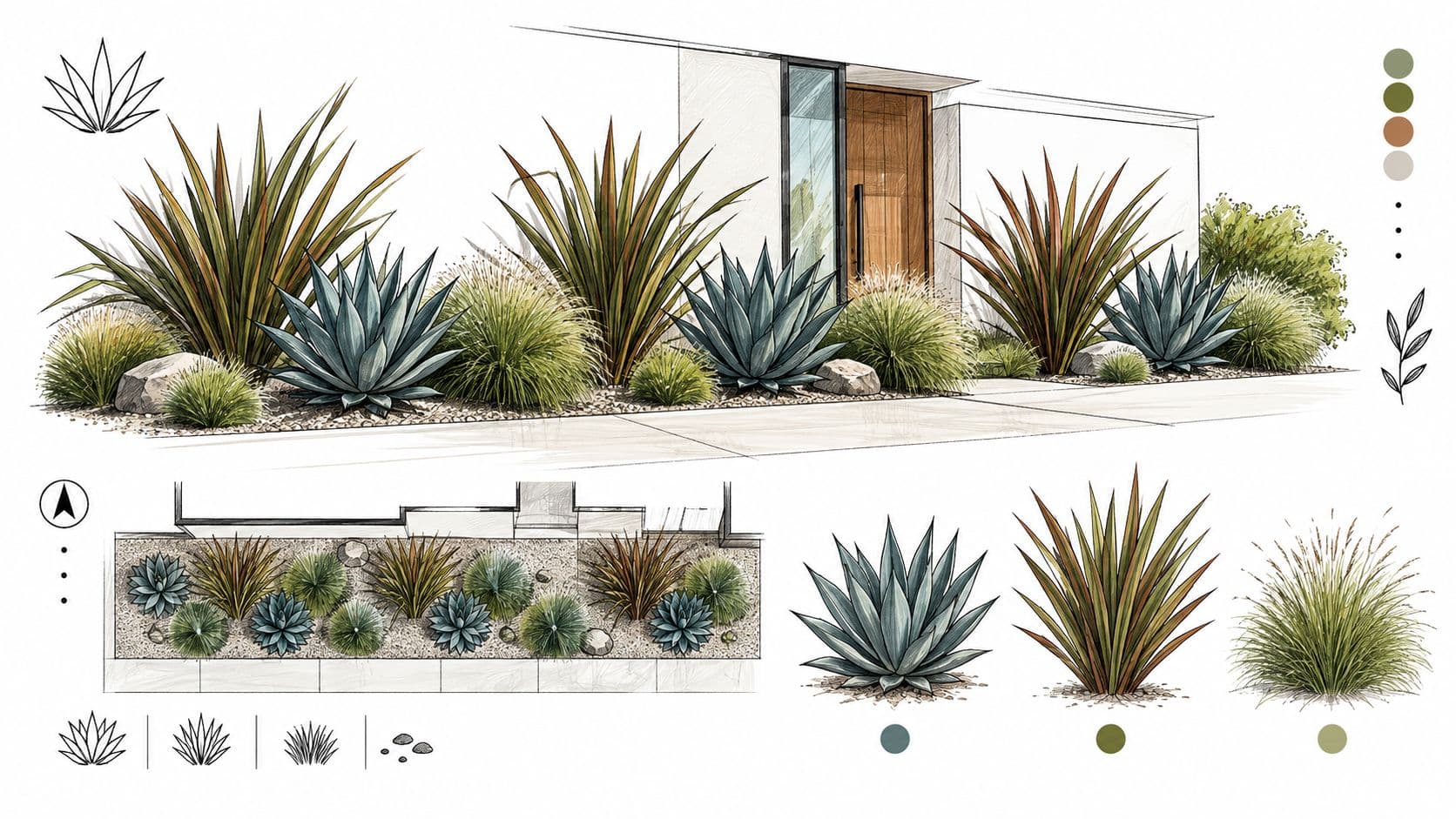
Use OutdoorBrite's modern template to test whether a sculptural plant improves the entry or competes with the architecture. Check the view from the sidewalk, driveway, and front windows, not just the straight-on image. A tall plant may provide drama from the street while blocking a driver's sight line or concealing the house number.
Fewer plant types don't guarantee less work. Repetition exposes every dead, damaged, or overgrown specimen, so choose plants that can handle the site.
Ask local nurseries about cultivar availability, irrigation needs, mature width, and seasonal behavior. The best selection looks strong in more than one season. Seed heads, bark, evergreen foliage, or winter stems can keep a plant-forward yard architectural after flowers fade.
7. Integrated Outdoor Living and Entertainment
A front yard can function as more than a display area, particularly when the porch, sidewalk, and street-facing space already support social activity. An integrated outdoor-living design adds seating, a fire feature, a pergola, lighting, or a small dining zone while preserving a clear route to the entrance. It turns the frontage into an extension of the home, but it also requires more planning than a decorative planting bed.
Small lots need a compact, clearly bounded zone. A built-in bench along a low wall may work better than freestanding furniture and a large fire pit. Medium lots can separate an entertaining area from the path with planting. Larger properties may support a pergola or outdoor kitchen, but those features shouldn't block the front door or dominate the facade.
Create three legible zones
Think in terms of arrival, transition, and gathering. The entry route should remain obvious. A planting buffer can give the seating area a sense of separation without creating a visual wall. The entertaining zone needs durable paving, comfortable circulation, and drainage that won't send runoff toward the house.
Use AI patio design to place a fire pit, pergola, bench, or seating arrangement on an image of the actual yard. Compare furniture clearances and sight lines before pouring concrete or ordering structural materials.
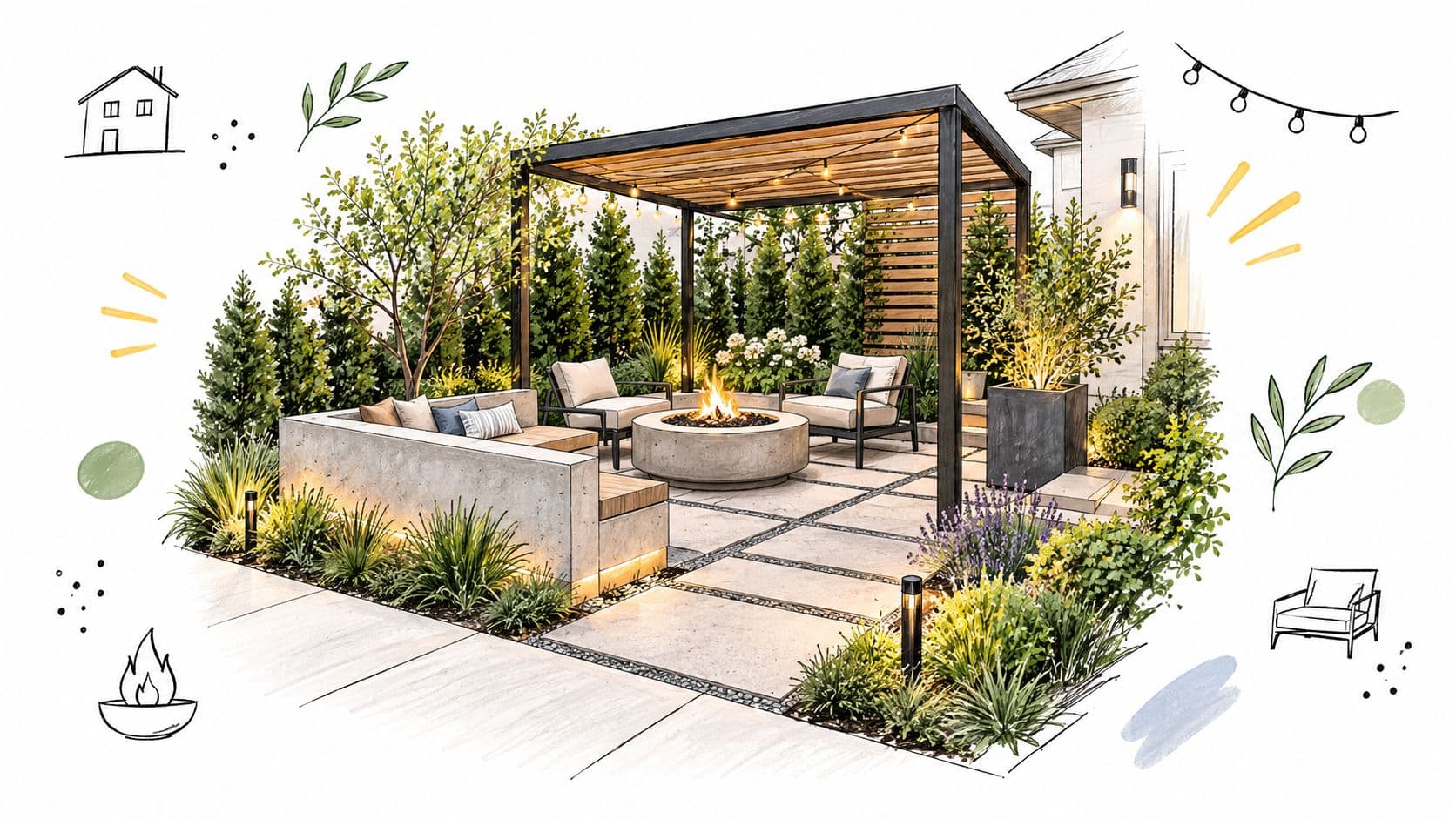
Lighting should work in layers. Use low-level path lighting for movement, ambient fixtures for seating, and restrained accent lighting for a tree, wall, or architectural plant. Check local requirements for fire pits, raised platforms, pergolas, electrical work, and property setbacks before construction.
A front entertaining space also needs privacy and weather planning. Screens and plants can soften the street view, but dense screening may reduce visibility and make the frontage feel closed. Shade, wind exposure, storage, and seasonal furniture removal matter as much as the visual concept. If you won't use the space regularly, invest first in the path, planting, and lighting rather than a large built structure.
8. Bold Color and Contemporary Hardscape Combinations
Bold color works best as a controlled interruption in an otherwise calm composition. A colored entry wall, painted gate, saturated planter, artistic screen, or vivid plant grouping can give a modern front yard a distinctive identity. The mistake is treating every surface as an opportunity for expression. Too many competing accents make the house and grounds look unrelated.
Small lots benefit from one color statement near the entry. A medium property can repeat that color in a planter, lighting detail, or mailbox element. Larger lots can support a stronger feature, such as a wall or screen, but the color should still connect to the architecture rather than float in the yard.
Choose the focal point before the palette
Decide whether the bold element will be paint, paving, plants, or art. Then keep surrounding materials neutral. Deep blue against pale concrete, rust-toned metal with grasses, or a vivid planter against charcoal stone can work because the contrast has a clear hierarchy. Limit the supporting palette to a few related accents and test samples in morning, midday, and evening light.
OutdoorBrite can help compare accent colors and hardscape arrangements on the actual facade before you commit to paint or permanent materials. The visual test won't replace physical samples, especially for reflective paving or paint exposed to strong sun, but it can reveal whether the feature competes with the front door, windows, or roofline.
Use architectural plants to keep expressive color from feeling juvenile. Grasses, clipped shrubs, succulents, or a carefully placed tree provide shape around a colorful wall or planter. In a starter budget, update planters, house numbers, and lighting first. A mid-range project might add a new path or accent screen. Higher-investment work can integrate color into concrete, masonry, or custom metal, but those elements are expensive to change if the trend stops feeling right.
**Bold design should be reversible where possible. Test the loudest idea in a planter or accessory before building it into the structure.
A strong modern front yard can be personal without becoming difficult to sell or maintain. Keep the path clear, preserve the home's proportions, and make sure the feature is visible from the approach. Color should sharpen the design, not compensate for weak layout, neglected edges, or unsuitable planting.
Modern Front Yard Landscaping: 8-Style Comparison
| Design Style | Implementation Complexity 🔄 | Resource Requirements ⚡ | Expected Outcomes ⭐ | Ideal Use Cases 💡 | Key Advantages 📊 |
|---|---|---|---|---|---|
| Minimalist Hardscape Design | Moderate–High: precise geometry and edging; may need pro installation | High upfront material/labor; low ongoing maintenance; faster install than plant-heavy schemes | High-quality modern aesthetic and durability; can feel austere if misapplied | Small/awkward yards, modern homes, low-maintenance priorities | Low maintenance, strong curb appeal, clear functional zones |
| Native Plant & Pollinator Gardens | Medium: requires regional research and phased planting | Low–Medium long-term water/inputs; moderate initial plant cost; possible rebates | High ecological benefit; supports pollinators; fills in over 1–2 seasons | Eco-conscious homeowners, wildlife habitat projects, conservation incentives | Supports biodiversity, reduced water/chemicals, resilient ecosystems |
| Sustainable Contemporary with Xeriscaping | Medium: soil prep and irrigation planning needed | Moderate–High upfront (soil, permeable hardscape, smart irrigation); low water bills | Large water savings (50–80%); durable, low-maintenance once established | Arid/semi-arid regions, water-restricted communities, sustainable builds | Significant water/utility reduction, sustainable aesthetics |
| Contemporary Japanese-Inspired (Zen Modern) | High: requires mastery of balance, placement, and materials | Medium–High (stone, water elements, quality plants); low ongoing plant variety maintenance | Calming, meditative atmosphere with year‑round structure; can seem sparse to some | Small courtyards, homeowners seeking tranquility, modern-architectural settings | Timeless elegance, strong compositional focus, low plant variety |
| Modern Cottage (Contemporary Farmhouse) Blend | Medium: balancing layered plantings with clean structure | Medium: more planting and seasonal care; moderate material costs | Warm, inviting curb appeal with strong seasonal interest | Homes wanting approachable, lived-in modern look; transitional architecture | Inviting, flexible design with rich seasonal variety |
| Architectural Plant-Forward Design | Medium–High: careful selection, spacing, and sourcing required | High upfront plant costs; lower hardscape spend; establishment maintenance | Striking, foliage-driven statements; high design impact and year‑round interest | Design-forward homeowners, showcase gardens, contemporary landscapes | Unique personality, visual hierarchy, multi-season structure |
| Integrated Outdoor Living & Entertainment | High: construction, systems integration, and permits often required | High upfront costs and pro installation; ongoing equipment maintenance | Enhanced functionality and property value; expands usable living space | Entertaining households, luxury properties, lifestyle-focused projects | Maximizes usability/value; strong lifestyle and hosting appeal |
| Bold Color & Contemporary Hardscape Combinations | Medium: requires strong color theory and material coordination | Medium–High for specialty finishes, art, and custom hardscape; maintenance of finishes | High visual/brand impact; can be polarizing for resale if over‑trendy | Design-forward homeowners, commercial fronts, social media-focused projects | Distinctive curb appeal, expressive and easily updated focal elements |
Turn Inspiration Into a Yard You Can Test
The best front yard landscaping modern concept isn't necessarily the most dramatic image in a gallery. It is the design language your house, lot, climate, and routine can support for years. Start by choosing the visual direction. Minimalist hardscape and architectural planting suit homeowners who want crisp geometry. Native and xeriscape designs support lower water demand when the plants and irrigation are matched to the region. Japanese-inspired layouts favor restraint and seasonal observation, while modern cottage designs bring softness without abandoning structure. Outdoor living and bold color require more decisions, but they can make the frontage feel personal and useful.
Match the planting system to the climate before matching it to a photograph. The EPA advises native and low-water-use plants because established native plants generally need little or no supplemental irrigation beyond normal rainfall. In drought-prone regions, reducing turf, hydrozoning beds, using efficient irrigation, and selecting adapted species can lower resource demand. In wetter or colder areas, the same modern principles may rely more on drainage, durable structure, native grasses, evergreen forms, and plants that tolerate seasonal extremes.
Scale the concept to the lot. Small yards usually benefit from one path, one focal plant or material, and a compact planting mass. Medium lots can separate arrival, planting, and gathering zones. Larger properties need repetition and hierarchy, otherwise the design becomes a collection of unrelated features. A narrow frontage rarely needs a pergola, multiple specimen trees, and several paving materials. A broad frontage may look unfinished if it receives only one small bed beside the door.
Budget should guide phasing rather than force a wholesale compromise. Start with grading, drainage, clear edges, and the route to the door. Add the planting framework next, then phase lighting, specialty paving, screens, seating, or a water feature. Houzz's 2017 U.S. survey found that 44% of homeowners undertaking outdoor projects were addressing their front yards, and 73% of minor outdoor projects cost $5,000 or less, according to its yard improvement survey. Those findings support a practical approach, a front yard can be improved in deliberate stages rather than treated as an all-or-nothing estate project.
Resale adds another constraint. Research cited by the University of Texas at Arlington found that homes with strong curb appeal sold for an average of 7% more than comparable homes in the same neighborhood, as reported in its curb appeal research summary. That doesn't mean every expensive feature pays back, or that a highly individual yard will suit every buyer. A clear entry, healthy plants, tidy edges, sensible circulation, and a design that fits the neighborhood are safer priorities than copying a costly gallery image.
Upload a front-yard photo to OutdoorBrite and test the concepts against your actual facade, driveway, sidewalk, and planting space. Compare modern, xeriscape, cottage, and Japanese-inspired directions, then refine beds, paths, plants, seating, and hardscape before purchasing materials or hiring a contractor.
OutdoorBrite lets you turn a front-yard photo into realistic redesign concepts, compare styles such as modern, cottage, Japanese zen, and xeriscape, and adjust elements like planting beds, paths, fire pits, and pergolas. Visit OutdoorBrite to test a design that fits your lot before you spend on plants, pavers, or construction.
See your yard reimagined
Start creating