10 Landscape Designs for Backyard Privacy in 2026
Explore 10 landscape designs for backyard privacy, from hedges and slatted fences to pergolas, bamboo screens, and layered plantings, with practical tips.
You sit down on the patio with a coffee, look toward the grill, and realize the neighbor's kitchen window has a direct view of everything you do outside. From the other side of the yard, your neighbor can see the seating area too. A single fence panel might block one angle, but it won't solve the view from an upstairs window, the gap beside the patio, or the exposed area behind the chairs.
Backyard privacy depends on which sightlines matter, how high the obstruction needs to be, and how quickly the solution must work. A hedge, fence, pergola, or planted screen can all be effective, but they differ in installation time, maintenance, permanence, cost, light levels, and fire risk.
The following backyard privacy designs match each approach to a specific problem. Use them to choose a solution that fits the way your yard is truly seen, not just the way a photograph looks.
Table of Contents
- 1. Living Hedges and Hedge Walls
- 2. Composite and Vinyl Privacy Fences
- 3. Slatted and Semi-Transparent Fences
- 4. Pergolas and Shade Structures with Screening
- 5. Water Features and Fountain Screening
- 6. Mixed-Media Privacy Walls
- 7. Bamboo Screening and Privacy Panels
- 8. Tiered and Terraced Planting Beds
- 9. Living Green Walls and Vertical Gardens
- 10. Combination Approaches with Strategic Sight-Line Placement
- Backyard Privacy Designs: 10-Option Comparison
- Building Your Privacy Plan One Sightline at a Time
1. Living Hedges and Hedge Walls
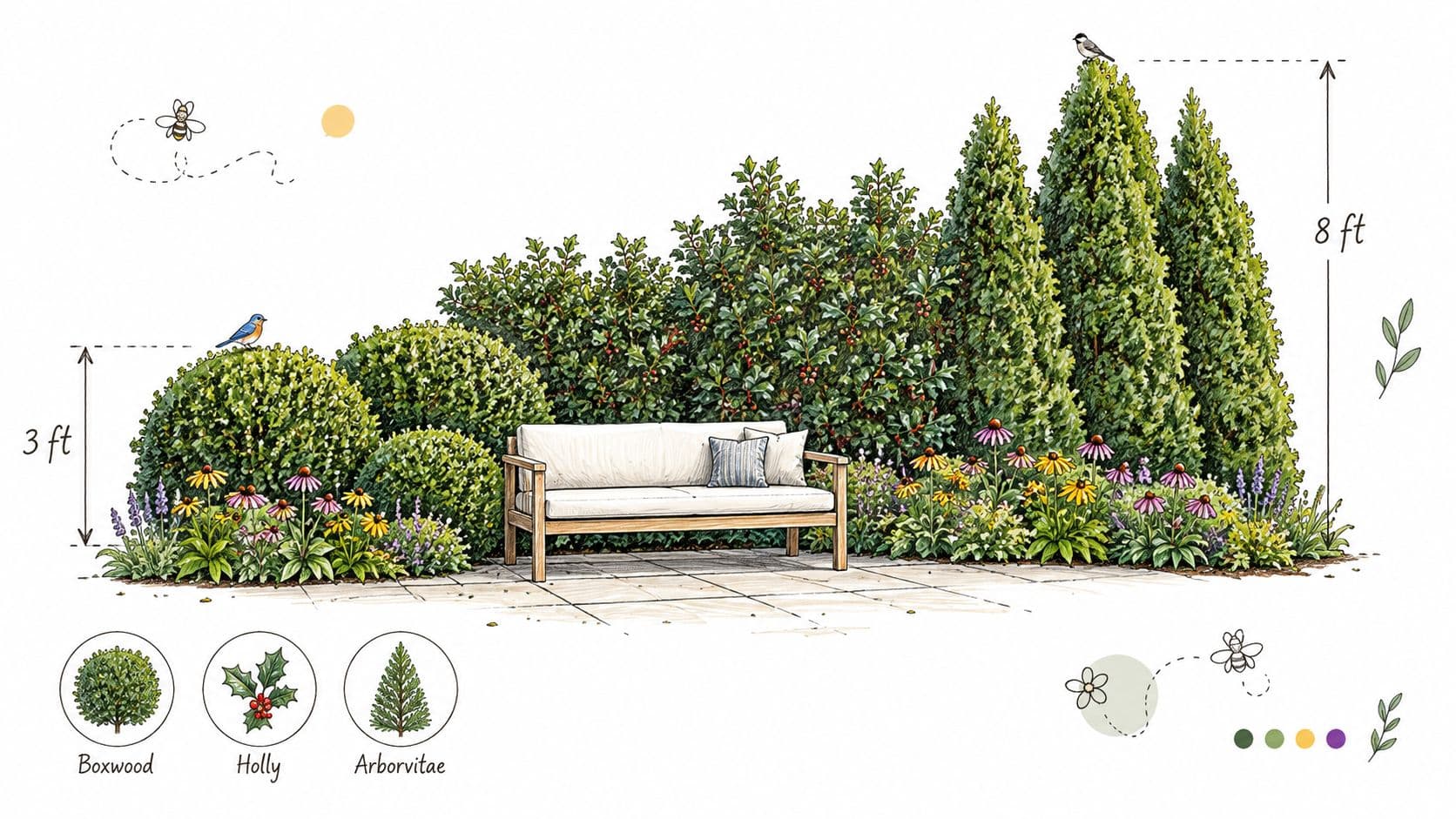
A living hedge suits a property edge where the unwanted view runs lengthwise and you want a softer boundary than a solid wall. Evergreen shrubs such as holly, arborvitae, privet, boxwood, and yew screen neighboring yards year-round. Deciduous shrubs and small trees add seasonal structure while allowing more winter light.
The sightline determines whether the hedge works. Measure from the chair, patio, or play area toward the neighbor's window, rather than measuring only from the property line. A low row may look full from the ground yet leave an upstairs window completely exposed. Stakes, string, or a ladder can mark the required height before planting.
Screening takes time. A newly planted hedge will not block the view on installation day, and planting shrubs too close together creates root competition, weak growth, and difficult pruning. The Washington State University Extension privacy-screening guide advises checking mature width and spacing plants for their eventual size, with at least 2 feet, and preferably 3 feet or more, between plants.
Practical rule: Design for mature width, not the size of the nursery container.
Layer the hedge rather than creating one dense fuel corridor. Place taller plants on the problem side, add lower shrubs near the seating area, and leave access for pruning. In fire-prone regions, FEMA homeowner guidance recommends fire-resistant, drought-tolerant, slow-growing, low-litter plants with low volatile-oil content and separation between plantings.
Preview the mature height and width with OutdoorBrite on stylish yard solutions before buying plants or materials. If pets use the yard, find pet-safe plants before choosing the planting palette. Check local planting and association rules first.
2. Composite and Vinyl Privacy Fences
A composite or vinyl fence solves the sightline problem immediately. It suits a patio that needs direct eye-level separation from an adjoining yard, especially when the homeowner doesn't want to wait for plants to mature or maintain a clipped hedge.
Solid panels create reliable visual blocking, but they can also make a narrow yard feel enclosed. Lighter colors usually sit more calmly in small spaces, while lattice sections, metal accents, or planting beds can break up a long uninterrupted run. Composite fencing can resemble painted or natural wood without requiring the same cycle of staining and sealing, while vinyl offers a clean, consistent finish.
Use the fence where it does the most work
Don't automatically make the entire boundary solid. A targeted panel beside the seating area may solve the main problem while leaving a lower or more open section elsewhere. This keeps light moving through the garden and preserves views you actually want.
Before ordering, measure each run carefully and account for gates, posts, grading changes, and the way standard sections meet. Check zoning restrictions and association rules before installation, particularly where a fence borders a sidewalk, driveway, or road intersection.
A fence also needs visual softening. Layer shrubs, ornamental grasses, or climbers on the yard side, but leave enough room for access and mature growth. In coastal locations, choose materials and fasteners suited to salt exposure. In wildfire regions, don't allow dry leaves, mulch, or other debris to collect against the fence base. Colorado State University guidance emphasizes clearing debris from fence bases and removing dead vegetation regularly.
3. Slatted and Semi-Transparent Fences
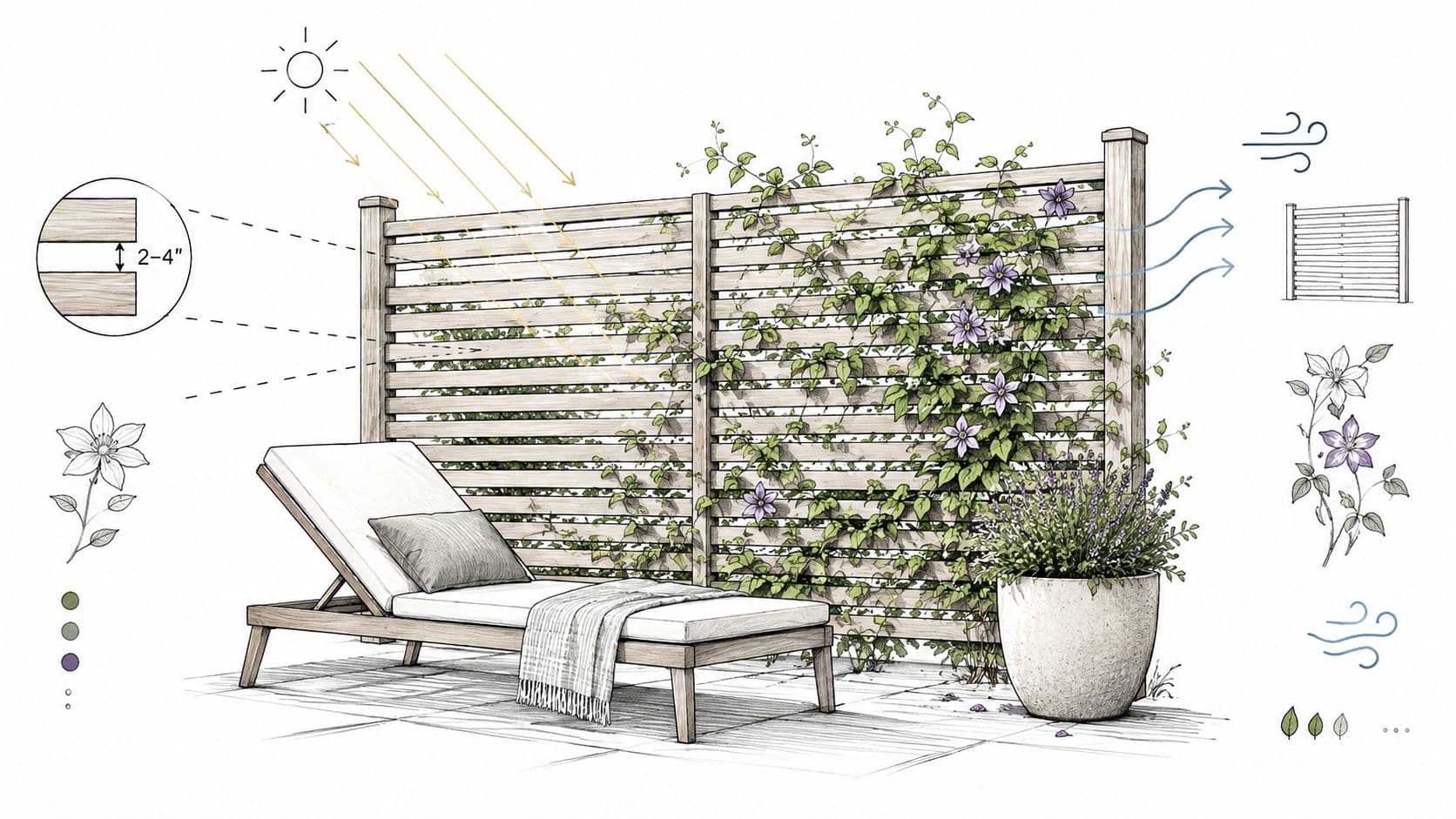
A slatted fence is useful when the problem is direct eye contact, but a solid barrier would make the patio feel closed in. Horizontal or vertical boards with controlled gaps interrupt the view at seated and standing height while allowing light and air to pass through.
This approach works particularly well in contemporary California gardens, compact urban yards, and Japanese-inspired spaces. Dark metal or stained timber can recede visually, while natural wood brings warmth. The key is to test the gap pattern from the actual seating position. A screen that looks private from the garden path may reveal the neighbor's face when viewed from a low lounge chair.
Create a privacy gradient
Use tighter spacing beside the grill, dining table, or hot tub, then open the pattern toward areas where you want morning light or a longer view. A solid section can handle the most exposed angle, while slats cover the less sensitive perimeter.
Climbers can increase coverage over time, but they add weight, pruning, and moisture concerns. Choose a support system that can carry mature growth, and don't let vines bridge directly into neighboring trees or structures. Planting on the inside of the screen gives the fence depth and reduces the stark appearance of a long panel.
Temporary stakes and horizontal strings can simulate the proposed screen before you buy materials. For a more realistic test, OutdoorBrite's fence design tool can help visualize fence height, color, style, and planting against a photo of your yard. That preview won't replace site measurements, but it can reveal whether the screen blocks the problem view without overpowering the house.
4. Pergolas and Shade Structures with Screening
A pergola solves an overhead sightline that a boundary fence can't reach. It can also define a private outdoor room over a dining table, lounge area, or spa without enclosing the entire yard.
The fastest version uses retractable fabric, outdoor curtains, or fixed screen panels. A planted pergola takes longer because vines need to climb, branch, and fill the structure. Deciduous vines provide summer shade and screening while allowing winter light, whereas evergreen climbers offer more consistent coverage but can create heavier maintenance and moisture loads.
Build for the site, not the photograph
Position the posts to block the neighbor's viewing angle from the places that matter. Don't place a pergola only where it looks balanced from the kitchen window. Stand at the seating area, look toward the neighbor's windows, and adjust the structure until its posts, beams, or screen panels intersect the unwanted view.
Sturdy construction matters. Posts and beams need to suit local wind conditions, and the footings must work with the soil and drainage. A poorly built pergola begins to look neglected quickly, particularly once fabric sags or vines become uneven.
Layer the overhead screen with lower shrubs or a raised planter. This handles the gap below the structure while the roof or climbing plants address higher views. The garden arbor and greenery guide offers ideas for integrating an arbor with planting instead of treating it as an isolated object.
For an initial preview, mark the post positions with stakes and stretch string between them. Check the view from each chair, then use a visual design tool to compare open rafters, solid side panels, and climbing plants before committing to construction.
5. Water Features and Fountain Screening
A fountain doesn't create privacy by itself. It works when you use it to redirect attention, occupy a strategic sightline, and add sound to a seating area that feels exposed.
Place a water wall, bubbling urn, rill, or compact waterfall between the seating area and the unwanted view, then combine it with planting or a low wall. The visual movement draws the eye inward, while the sound can soften incidental conversation, traffic, pumps, or neighboring activity. It won't replace a properly designed acoustic barrier, and it can't compensate for a clear view into the patio.
Design the sound and the screen together
A fountain facing inward toward the seating area usually feels more intentional than one positioned only for the neighbor's benefit. Recirculating systems limit water use, but they still need access for cleaning, pump maintenance, winterization, and water-level checks. Electrical connections must be planned safely, and splash zones shouldn't damage nearby paving, walls, or furniture.
Water features suit Mediterranean courtyards, Japanese-inspired gardens, and modern urban patios, but scale matters. An oversized installation can dominate a small yard and create a maintenance burden. A restrained water wall paired with evergreen shrubs may provide better privacy than a large pool surrounded by open paving.
Preview the feature from seated and standing positions. Use a temporary planter or screen to represent its visual mass, and listen to the intended seating area at the times when noise is most disruptive. A fountain can improve the experience of a private corner, but it won't make an open yard private without a physical or planted layer.
6. Mixed-Media Privacy Walls
A mixed-media wall suits a prominent sightline where privacy also needs to look architectural. Stone, brick, cedar, corten steel, and metal panels can be combined to echo the materials already used on the house, patio, or retaining walls.
This is one of the more permanent approaches, so it works best when the exposed view is unlikely to change. It can screen a neighboring window, frame an outdoor kitchen, or form the backdrop for a dining terrace. The drawback is that structural walls require more coordination than a simple fence. Foundations, drainage, grading, material transitions, lighting, and permits all affect the result.
Control proportion and visual weight
Use one dominant material and one or two supporting materials rather than turning the wall into a sample board. A stone base with warm wood above it may feel grounded, while narrow metal inserts can introduce light and shadow. Planters, shelves, or integrated benches can prevent a tall wall from reading as a blank barrier.
A professional designer or experienced masonry contractor should review the proportions and construction details. Drainage behind masonry, frost movement, footing depth, and attachment points aren't cosmetic issues. Poor planning can produce cracks, staining, leaning sections, or water trapped against the house.
The National Gallery of Art's account of fences in the designed American outdoors shows that fences and boundaries have long organized gardens, fields, parks, and access. Today's mixed-media wall continues that role, but it must still connect to the scale of the yard.
Use stakes, cardboard panels, or a digital preview to test height and material color. Keep planting beds along the base where space allows, and confirm local restrictions before construction.
7. Bamboo Screening and Privacy Panels
A neighbor's side window, an exposed deck edge, or a raised patio can demand a tall, narrow screen. Bamboo suits that sightline when you want strong vertical coverage and a tropical or Asian-inspired character. Panels and rolls provide privacy immediately. Living bamboo fills out more gradually, so the planting needs time before it reaches its intended density.
Choose the type carefully. Running bamboo can spread beyond its bed unless installed with a properly designed root barrier or another containment system. Clumping varieties are generally easier to control, although climate, soil, water, and winter conditions still determine performance.
Match the screen to the management required
Bamboo needs consistent water during establishment and enough room for mature spread. Keep it clear of fences, walls, drains, and narrow access routes. Its height can interrupt a raised view, but dense growth may shade nearby plants and make pruning, inspection, and access difficult.
Use a contained bed when a living screen fits the site and you can manage its spread. Choose panels when immediate privacy matters and long-term roots or shoots would create problems. Either option benefits from lower shrubs at the base, which soften the hard ground-level edge and add a second privacy layer.
In fire-exposed regions, dense evergreen growth may create a fuel pathway. Guidance from CAL FIRE on defensible space and vegetation management supports separating vegetation from structures and avoiding continuous fuel connections. That can make bamboo unsuitable near buildings in some locations.
Preview the sightline before buying anything. Set temporary poles at the proposed mature height and width, then photograph the yard from the neighbor's window, patio, or road. Compare living bamboo with panels, a hedge, or mixed planting, and confirm mature dimensions with a local nursery.
8. Tiered and Terraced Planting Beds
A tiered planting bed is effective when one straight hedge can't block several sightlines at once. By combining ground covers, shrubs, and small trees, you can interrupt views at patio level, standing eye level, and raised window level while keeping the garden visually open.
This approach is especially useful on a slope, beside a retaining wall, or along a deep boundary where plants can be arranged in staggered groups. It takes longer than a fence, but it looks less defensive and can provide seasonal texture, flowers, habitat, and shade.
Place each layer against a view
Start with the actual problem, not a generic three-row planting formula. A low shrub may block a neighbor's ground-floor seating area, while a small tree may be needed farther back to interrupt an upper window. Use native or regionally adapted plants where possible, and include evergreens if winter screening matters.
A staggered screen usually looks more natural than a perfectly straight row, but every plant still needs a clear job in the sightline.
Space plants for mature width rather than filling every gap on the first day. Overcrowding creates competition, weak airflow, and pruning work. Drip irrigation, mulch, and soil preparation help plants establish, but maintenance doesn't disappear. Shrubs still need renewal pruning, trees need structural attention, and fallen leaves can accumulate along walls or fences.
Mark the proposed planting positions with stakes and colored flags. From each seating area, photograph the view at eye level and compare the open gaps. A digital concept can then help you test taller trees, denser evergreen groups, or lower flowering layers before you dig.
9. Living Green Walls and Vertical Gardens
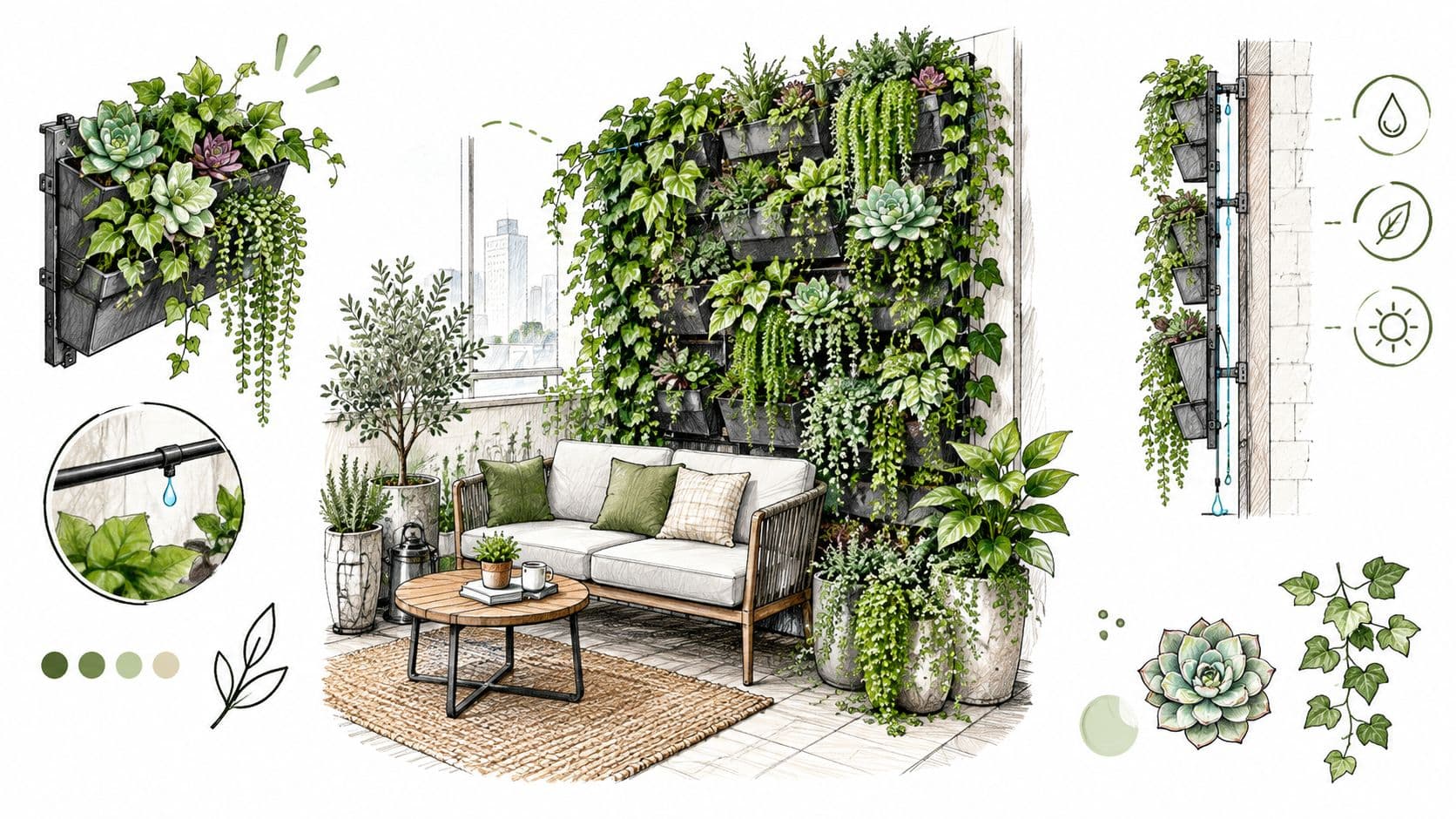
A green wall is a strong choice for a compact patio, balcony-like yard, or narrow side passage where there isn't enough ground width for a hedge. Trellised climbers, wall-mounted planters, espaliered fruit trees, and modular planted panels turn a vertical surface into a privacy layer.
The sightline it solves is usually close and specific. A vertical garden behind a bench can block the neighbor's window, hide a service area, or screen the end of a narrow patio without consuming the full width of the space. It won't solve a broad view from multiple directions unless you combine it with side screens or overhead structure.
Protect the wall and plan for access
Self-clinging vines may attach directly to some surfaces, but a trellis gives you more control and makes pruning easier. Modular systems need reliable irrigation, drainage, suitable light, and access for replacement plants. Shaded walls need shade-tolerant species, while hot reflective walls can stress plants that would thrive elsewhere in the yard.
Moisture damage is a common failure point. Keep drainage away from the building envelope, inspect irrigation lines, and make sure mature plant weight won't overload the support. Regular pruning is part of the design, not an optional finishing task.
For small-space ideas, see OutdoorBrite picks for backyard screening. Preview the wall from the chair or table it protects, then check the view again from the opposite side of the yard. The screen should block the intended angle without making the patio feel like a narrow corridor.
The following example shows how a vertical garden can combine planting, structure, and automated watering in a compact setting.
10. Combination Approaches with Strategic Sight-Line Placement
A neighbor's second-story window, a nearby deck, and an exposed seating area rarely share one privacy problem. Combine a fixed screen with living or flexible layers so each element addresses a specific viewing angle. A fence handles immediate separation, a hedge softens its face, and a pergola or tree canopy interrupts views from above. A water feature can turn attention toward the yard without serving as a wall.
Layering works only when each component has a job. Too many features crowd circulation, complicate irrigation, and create maintenance costs that exceed the original allowance. OutdoorBrite's ai generated backyard design lets you compare layered concepts over a photo of the actual yard before ordering plants or materials.
Map the views before choosing the elements
Stand at the patio, deck, grill, and every seat you intend to use. Then check the yard from the neighbor's likely positions, including windows and raised decks. Record each sightline's direction, height, and approximate distance. Position a screen across the line of view rather than running it parallel to the boundary.
Test the proposed height with temporary stakes, ladders, cardboard, or string. The same staging logic applies to small outdoor rooms, as the patio privacy ideas from Lucas Furniture & Mattress in Lafayette show for apartment-scale spaces. Keep useful views toward trees, gardens, or distant scenery. Use taller planting for long views, lower screens for close exposure, and a pergola or canopy when people can see into the yard from above.
Preview the design from every protected seat before installation. A screen that looks effective from the property line may miss the neighbor's actual window or block more light than expected.
Install permanent work first, including grading, walls, fences, drainage, and irrigation. Add annual vines or temporary panels while slower hedges and trees establish. A two-to-three-year phased approach spreads labor and gives you time to adjust a screen that casts too much shade or fails to cover the intended angle.
The National Association of REALTORS® Remodeling Impact Report gives outdoor-feature projects a typical Joy Score of 9.7, with 45% of respondents reporting satisfaction when viewing the finished project. Apply that test to privacy work. Effective screening should protect the view while keeping the patio usable, light, and maintainable.
Backyard Privacy Designs: 10-Option Comparison
| Option | Implementation Complexity 🔄 | Resources & Cost ⚡ | Expected Outcomes ⭐ / 📊 | Ideal Use Cases | Key Advantages 💡 |
|---|---|---|---|---|---|
| Living Hedges and Hedge Walls | Medium–High 🔄, planting, shaping & ongoing pruning; 3–5 yr maturity | Low–Moderate upfront; ongoing maintenance and time investment ⚡ | Effectiveness: ⭐⭐⭐⭐, gradual, year‑round privacy; improved sound absorption 📊 | Suburban & naturalistic yards; wildlife-friendly properties | Natural appearance, habitat value, air quality benefits |
| Composite and Vinyl Privacy Fences | Low 🔄, prefabricated panels; usually pro install | High upfront ($25–$40/ft installed); minimal maintenance ⚡ | Effectiveness: ⭐⭐⭐⭐, immediate, complete visual privacy; long lifespan 📊 | Homeowners wanting instant, maintenance‑free privacy | Durable, low‑maintenance, consistent appearance |
| Slatted and Semi-Transparent Fences | Low–Medium 🔄, straightforward install; customizable spacing | Moderate materials cost; may need plants to increase screening ⚡ | Effectiveness: ⭐⭐⭐, partial privacy with light & airflow; modern look 📊 | Small yards, modern/minimalist sites where light/airflow matter | Contemporary aesthetic; makes spaces feel larger; pairs well with vines |
| Pergolas and Shade Structures with Screening | Medium 🔄, structural work + plant/fabric integration; 2–3 yr vine coverage | Moderate cost; materials + plants; possible retractable fabric costs ⚡ | Effectiveness: ⭐⭐⭐, defined outdoor rooms and partial overhead privacy 📊 | Patios, seating/entertaining areas needing shade & ambiance | Architectural interest, shade, flexible seasonal privacy |
| Water Features and Fountain Screening | Medium–High 🔄, plumbing, electrical, siting considerations | Moderate–High install + ongoing energy/maintenance ⚡ | Effectiveness: ⭐⭐, excellent acoustic masking but limited visual screening 📊 | Courtyards & designs prioritizing noise masking and sensory appeal | Masks noise, creates focal point and therapeutic ambiance |
| Mixed-Media Privacy Walls (Stone/Brick/Metal) | High 🔄, custom design, structural work, permits; long timeline | Very high upfront ($40–$100+/ft); professional installation ⚡ | Effectiveness: ⭐⭐⭐⭐⭐, permanent, complete privacy and strong sound reduction 📊 | Luxury properties, architectural statements, permanent solutions | Highly durable, custom appearance, increases property value |
| Bamboo Screening and Privacy Panels | Medium 🔄, planting plus containment for running species; 2–3 yr to dense | Low–Moderate upfront; containment adds cost; water during establishment ⚡ | Effectiveness: ⭐⭐⭐⭐, very fast growth and dense screening when contained 📊 | Tropical/Asian‑inspired gardens, fast‑screen needs, eco‑projects | Rapid growth, renewable material, attractive natural look |
| Tiered and Terraced Planting Beds | Medium 🔄, layered design & species selection; 3–5 yr to fill in | Moderate cost; mixed plant sizes and possible irrigation ⚡ | Effectiveness: ⭐⭐⭐⭐, multi‑level privacy with strong ecological benefits 📊 | Sloped sites, naturalistic designs, habitat‑focused yards | Visual depth, biodiversity, effective multi-height screening |
| Living Green Walls and Vertical Gardens | High 🔄, structural support, irrigation, regular maintenance | High ($20–$50+/sq ft for modular); ongoing water & upkeep ⚡ | Effectiveness: ⭐⭐⭐, striking vertical privacy; modular = immediate, vines = 2–4 yrs 📊 | Small urban patios, balconies, walls needing space‑efficient screening | Space‑saving, dramatic visual statement, insulation & air quality |
| Combination Approaches: Layered Privacy Solutions | High 🔄, complex planning, sight‑line analysis; phased implementation | High overall but phasable; mixes costs of elements ⚡ | Effectiveness: ⭐⭐⭐⭐⭐, most effective, resilient, and tailored results 📊 | Complex sight‑line problems, high‑privacy needs, phased budgets | Customizable, redundant protection, preserves desirable views |
Building Your Privacy Plan One Sightline at a Time
Start with the place where privacy matters most. Sit in the patio chair, stand at the grill, and walk through the yard at the times you use it. Mark the neighbor's kitchen window, upper-floor windows, adjoining seating areas, and any direct views from nearby paths or driveways.
The 2024 homeowner survey summarized by Top Rail Fences reinforces why one solution rarely fits every yard. Only 19% of surveyed U.S. adults said privacy wasn't a concern, while 35% preferred some privacy but still wanted occasional interaction with neighbors. Respondents had used fences or screens, trees, and patio repositioning as different responses, which supports designing privacy around specific views instead of closing every boundary.
Choose one permanent element and one faster temporary or growing element. A slatted fence paired with shrubs can provide immediate eye-level screening and a softer edge later. A pergola with fabric panels can protect a seating area while vines establish. A mixed planting bed can block several angles, but it needs adequate width and patience. If wildfire exposure is relevant, separated plant groups, low-litter species, defensible space, and local fire guidance should take priority over a dense hedge or continuous fence-to-house fuel route.
Preview the design before spending money. Use stakes and strings for real-world scale, then compare a photo-based concept with the views from seated and standing eye levels. Check local fence heights, structure permits, property boundaries, drainage requirements, and homeowners-association rules before construction or planting.
Phase the work over two to three years when the design includes slow-growing hedges, trees, or layered planting. Begin by sketching the three most exposed views, then match each one to the design that blocks it fastest while preserving the views and light you want to keep.
OutdoorBrite lets you upload a photo of your backyard and test privacy concepts such as fences, pergolas, planting beds, and layered screens on the actual space. Visit OutdoorBrite to compare designs before you buy plants or materials, then use the preferred concept as a clearer brief for your own project or a garden design professional.
See your yard reimagined
Start creating