

Shrubs for Erosion Control: What to Plant and How
Learn how shrubs for erosion control stabilize slopes, plus cut plant picks by site, planting steps, and how they compare to other methods.
After a heavy storm, the warning signs are easy to spot. Soil collects at the bottom of the slope, narrow channels cut through the surface, and mulch or seed washes into the lawn below. You may be looking at a bare backyard bank, a driveway embankment, or a property edge where turf never establishes for long.
Shrubs for erosion control can help, but selecting them is not just a matter of picking a tough-looking plant. The useful question is whether the shrub's root architecture, canopy, stems, and moisture tolerance match the slope, soil, and rainfall. A plant that thrives beside a wet stream may fail on a dry sandy bank, while a shallow-rooted ornamental may look healthy without holding the soil where you need it most.
Table of Contents
- When Shrubs Make Sense on a Sloping Yard
- How Shrubs Actually Hold Soil in Place
- Shrubs vs Other Erosion Control Methods
- Best Shrubs to Plant by Region and Site
- Planting and First-Year Care That Sticks
- Matching Shrubs to Slope, Soil, and Rainfall
- Mistakes Homeowners Make with Erosion Shrubs
- Your Erosion Shrub Game Plan
When Shrubs Make Sense on a Sloping Yard
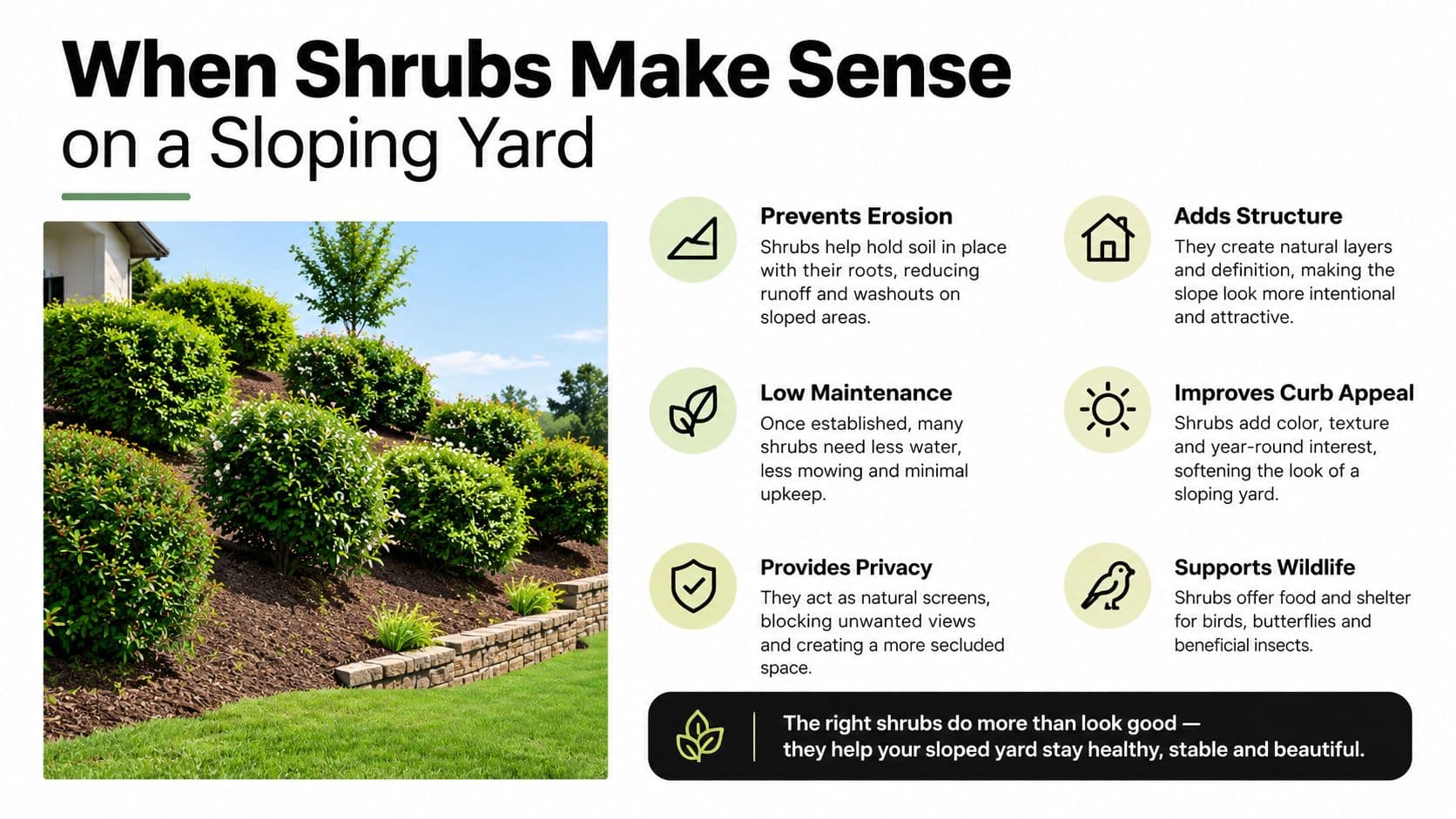
After each summer storm, Elena sees the same sequence. Water enters at the top of her side yard, crosses a bare incline, and leaves a fan of mud near the patio. Grass seed has not solved the problem. The surface dries between storms, then runoff moves the loose soil before the lawn can form a continuous cover.
A property manager may face the same pattern on a road embankment. The bank is too steep for comfortable mowing, seed slides downhill, and concentrated runoff cuts through exposed soil. Shrubs can give both sites a longer-lasting framework than turf alone, especially where the slope needs woody stems above ground and a spreading root network below.
Look at the slope as a water system
Start by tracing the water, not by choosing a plant. Shrubs fit sites where runoff crosses exposed soil, grass struggles to stay continuous, or mowing would disturb the bank. They are often practical on slopes around 3:1 or steeper, where repeated mowing becomes difficult, though soil, rainfall, and access still determine the right approach.
They can be particularly useful on:
- Bare banks and embankments, where stems slow sheet flow and roots help hold the surface.
- Moist or seasonally wet slopes, when the selected species can tolerate saturated soil.
- Disturbed ground, where several shrub layers can cover gaps as they establish.
- Slopes that are difficult to mow, where woody plants reduce repeated cutting and soil disturbance.
A lawn's fibrous roots can protect the upper surface, but turf may offer limited support when a slope is already shifting. Shrubs contribute different protection through their stems, canopy, and root spread. They cannot repair a failing retaining structure or stop an active landslide on their own.
Know when plants aren't enough
Rainfall intensity changes the planting decision. A gentle bank with established groundcover may need only targeted shrubs. A steep slope receiving concentrated water from a roof or driveway may first need diversion, wattles, an erosion blanket, terracing, or engineered drainage.
A vegetation study reports that shrub performance weakens as rainfall intensity rises. Its findings on rainfall, canopy, and root roles support treating planting as one part of a drainage plan, rather than the entire solution.
Before buying plants, follow the water from its entry point to its exit. Deep channels or large amounts of moving soil signal that the runoff source needs attention first. For broader planning ideas, see how to control erosion on a slope by combining planting with outdoor structures.
How Shrubs Actually Hold Soil in Place
Shrubs protect a slope through several actions that work together. Roots are only part of the answer. The canopy, stems, and fallen leaves also change how rain reaches and crosses the soil.
Roots create a living reinforcement system
A woody root system works somewhat like reinforcement inside concrete. Deep roots can cross weaker soil layers, while lateral roots spread outward and connect neighboring planting areas. That network helps resist shallow movement, particularly when roots occupy the soil rather than leaving broad bare gaps.
The World Bank plant manual describes several useful functions of woody vegetation. Roots mechanically reinforce soil, stems and foliage intercept rainfall, and plants reduce soil water through evapotranspiration. Deeper-rooted woody perennials generally provide more reinforcement at depth than shallow-rooted cover plants.
Root shape matters more than impressive top growth. A tall shrub with a weak or shallow root system may contribute less to slope stability than a shorter plant that spreads densely through the upper soil and sends stronger roots downward.
Canopies soften the first impact
Bare soil receives raindrops directly. Each impact loosens surface particles, and those particles can then move with sheet flow. A shrub canopy breaks the fall of rain, distributes water across leaves and branches, and gives the ground a less violent entry point.
Canopy structure also matters after rain reaches the plant. Dense branches and low foliage create obstacles that slow water moving across the slope. A shrub with an open crown and a bare lower stem may leave the most vulnerable part of the bank unprotected.
Stems and litter slow the surface
Flexible stems act like small check points across moving water. They don't stop every storm, but they can reduce the speed of shallow flow and encourage sediment to settle around the plant. Fallen leaves and small twigs then form a surface layer that shields soil from direct impact and adds organic material as it decomposes.
The scale of the possible benefit is substantial. The long-running erosion-control finding summarized in the forestry research review compares bare control plots losing 300 to 500 tonnes of soil per hectare per year with plots protected by grass or shrubs that dropped toward about 1 tonne per hectare per year after two to three years. The result doesn't promise that every home slope will perform the same way, but it shows why continuous vegetative cover can shift a site from extreme soil loss toward much more stable conditions.
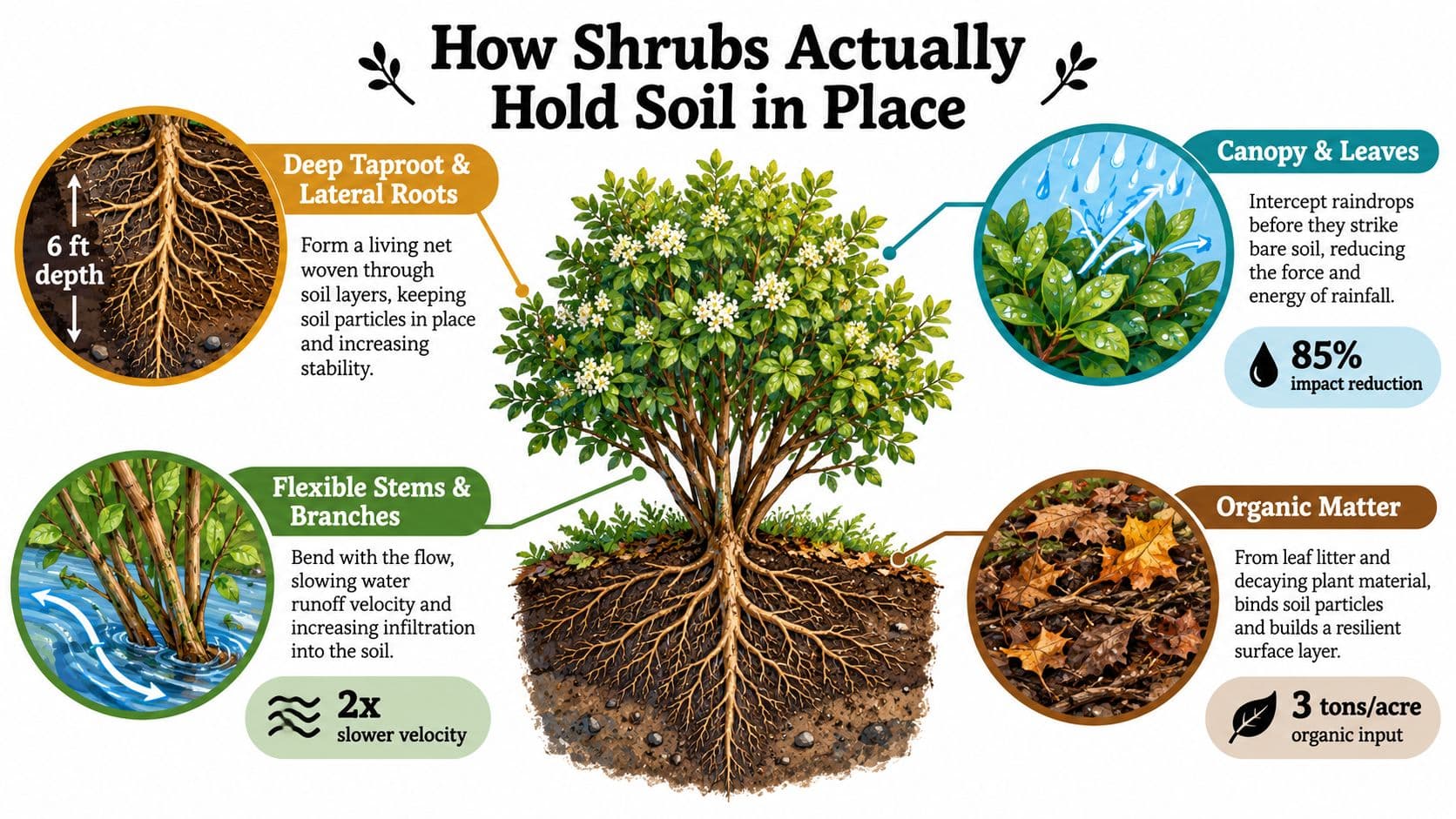
The practical lesson is simple. Choose shrubs for how they occupy the soil, not just for flowers, evergreen foliage, or mature height. Groundcovers and grasses can fill low layers, while shrubs add woody structure. Hard structures may still be necessary where water is concentrated or the soil is actively failing.
Shrubs vs Other Erosion Control Methods
No erosion-control method wins on every site. Shrubs offer living reinforcement and visual appeal, but they take time to establish. Blankets and structural systems can protect exposed soil sooner, while grasses and groundcovers may close surface gaps more quickly.
| Method | Root Depth | Time to Stabilize | Cost | Best Slope | Maintenance |
|---|---|---|---|---|---|
| Shrubs | Varies from shallow and spreading to deeper woody systems | Gradual, as roots and canopy develop | Moderate, depending on plant size and quantity | Slopes needing long-term planting structure | Watering, weeding, pruning, replacement |
| Groundcovers | Usually shallow, dense surface coverage | Often quicker surface coverage | Low to moderate | Gentle banks and spaces between shrubs | Weeding and seasonal trimming |
| Ornamental grasses | Dense fibrous roots, usually strongest near the surface | Often quick surface protection | Low to moderate | Broad slopes with moderate runoff | Cutting back and dividing |
| Retaining walls | No biological root hold, structural support instead | Immediate after proper construction | High relative to planting | Sites needing a grade change or reinforced edge | Drainage checks and repairs |
| Erosion-control blankets | No permanent root system | Immediate temporary surface protection | Low to moderate | Newly planted or disturbed slopes | Inspection until vegetation takes over |
Choose a layered system when conditions demand it
A steep bank may need an erosion blanket across exposed soil, shrubs planted through the blanket, and a dense groundcover between them. A water outlet may need stone or riprap at the toe, with woody plants farther upslope where roots can reinforce the soil without sitting in concentrated flow.
Walls deserve particular caution. They can hold a grade in a small space, but poor drainage can place pressure behind the wall and undermine the structure. If a planted structural solution fits the property, review an OutdoorBrite planted retaining walls guide before treating shrubs as a substitute for engineering.
Practical rule: Use shrubs for long-term biological support, but use blankets, drainage, or structural measures when the slope needs protection before roots can establish.
Shrubs are a poor primary choice for an active slide, a bank undercut by flowing water, or loose sand that moves before roots can take hold. They can still become part of the finished planting area, but stabilization should come first. A qualified planting contractor or geotechnical professional is appropriate when cracks widen, the ground bulges, foundations are threatened, or drainage cannot be controlled.
Best Shrubs to Plant by Region and Site
A regional plant list is only a starting point. Within the same region, a dry upper bank, a shaded woodland slope, and a wet stream edge may require completely different shrubs. Select by moisture, exposure, soil texture, and root behavior before considering bloom color.
| Region | Shrub Species | Root Habit | Best Site Condition | Mature Size |
|---|---|---|---|---|
| Pacific Northwest | Oceanspray | Fibrous, branching, moderately deep | Moist to dry slopes with sun or partial shade | Large shrub |
| Pacific Northwest | Snowberry | Fibrous and spreading, with vigorous suckering | Moist to dry banks needing dense cover | Low to medium shrub |
| Pacific Northwest waterways | Red-osier dogwood | Fibrous and spreading | Wet soil, stream edges, and damp banks | Medium to large shrub |
| Northeast and coastal sites | Bayberry | Woody, spreading habit suited to difficult coastal ground | Sandy, exposed, or coastal soils | Medium shrub |
| Northeast | Steeplebush | Dense woody base and fibrous coverage | Moist soils and open slopes | Low to medium shrub |
| Midwest | Gray dogwood | Spreading woody roots and multi-stem growth | Clay or compacted soils with suitable drainage | Medium shrub |
| Midwest | American plum | Woody, spreading habit that can form a thicket | Open banks where a broader planting is acceptable | Large shrub |
| Southeast | Wax myrtle | Dense, spreading woody system | Warm, moist, or sandy sites | Medium to large shrub |
| Southeast | Yaupon holly | Woody, branching root system | Sunny sites with well-drained soil | Medium shrub |
| Southwest | Manzanita | Woody roots suited to dry, well-drained ground | Dry slopes with excellent drainage | Low to medium shrub |
| Southwest | Fourwing saltbush | Deeply anchored, drought-adapted system | Dry, open, alkaline, or sandy ground | Medium shrub |
The Pacific Northwest recommendations above align with regional planting guidance that lists oceanspray, snowberry, red twig dogwood, and several willow species for different moisture conditions. The regional native-plant guide also emphasizes using several vegetation layers instead of relying on shrubs alone.
Match the plant to the wettest part of the slope
A stream bank needs different treatment from a dry upper shoulder. Red-osier dogwood and appropriate willow species can suit wet ground, while manzanita is a poor choice where drainage stays slow. Conversely, a moisture-loving shrub may decline on an exposed, drought-prone bank even if its roots would otherwise be useful.
Treat the table as a shortlist, not a shopping list. Check your local extension service, nursery, and invasive-species listings before ordering. A shrub that spreads helpfully on one site can become difficult to control in another, and local provenance may improve establishment.
Planting and First-Year Care That Sticks
Even a well-matched shrub can fail if its first growing season is poorly managed. The planting goal isn't to create a smooth, loose surface. It's to place roots into stable soil while keeping runoff from finding a clean downhill path between plants.
Prepare the slope without polishing it
Remove competing weeds and loose debris, but avoid raking the bank into a smooth chute. Preserve small surface irregularities that slow water. If soil is badly exposed, pair planting with a biodegradable erosion blanket or small check structures rather than asking new roots to handle every storm immediately.
Plant during a season that gives roots time to settle without heat or frozen ground stressing them. Container-grown shrubs offer a more established root ball, while bare-root plants can be useful for larger restoration projects when handled promptly and kept moist.
Set the shrub at the same soil level it had in its container or nursery bed. The hole should accommodate the roots without forcing them to curl, and the backfill should be firm enough to remove large air pockets without compacting the entire planting zone.
Give roots room and water deeply
Space shrubs according to their eventual root spread and the coverage you need, not only by the size of the plant you bring home. A single straight row can leave a downhill corridor between plants. Staggered rows in a diamond pattern interrupt runoff at several points and distribute coverage across the slope.
Water thoroughly enough to moisten the root zone, then allow the soil and local weather to guide the next irrigation. Frequent shallow sprinkling encourages roots to remain near the surface. Deep soaking at appropriate intervals supports better rooting, but don't irrigate a naturally dry slope so heavily that you create new runoff.
Add a two- to three-inch mulch layer where it won't wash away, keeping mulch clear of the stem. A mulch ring protects the surface and reduces competition, but mulch piled against bark holds moisture in the wrong place and can invite decay.
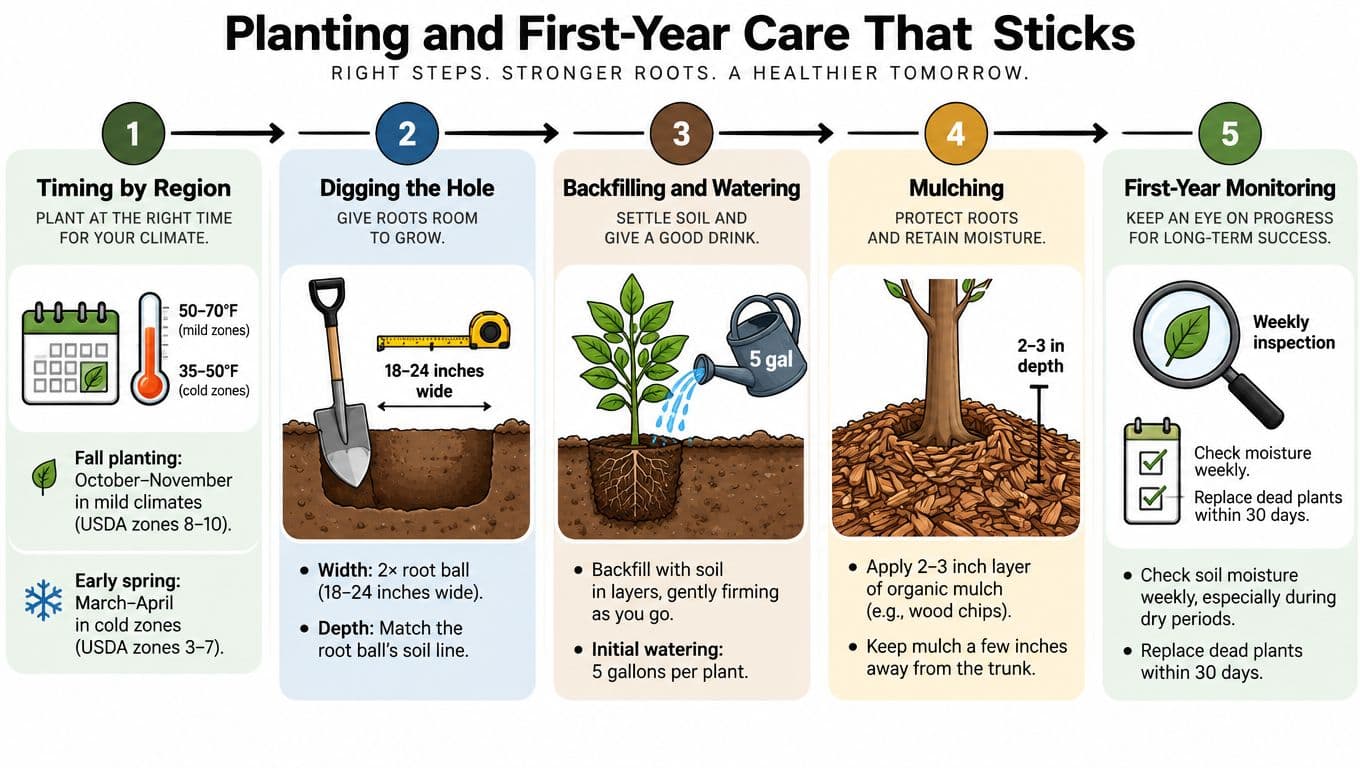
Inspect after storms. Replace soil around exposed roots, redirect small rills before they become channels, and protect young plants from concentrated flow with wattles or temporary barriers. This planting video provides a visual reference for the basic planting process, but a slope still requires site-specific drainage judgment.
Matching Shrubs to Slope, Soil, and Rainfall
Treat erosion planting as a matching problem with four inputs: slope shape, soil texture, rainfall behavior, and existing vegetation. The exact grade matters less than what water does on the ground. A short steep bank with dispersed runoff may be easier than a longer, gentler bank that receives water from a roof or driveway.
Use this decision sequence:
- Trace the water. Find the entry point, flow path, concentrated outlets, and low point.
- Feel and test the soil. Sandy soil drains quickly and may need dense, fibrous coverage. Clay can hold together when dry but shed water when compacted or saturated.
- Study the exposure. Sun, wind, shade, and seasonal moisture narrow the plant list.
- Choose a root strategy. Use deeper woody systems where the soil profile allows them, and spreading systems where surface binding and gap coverage matter.
- Mix compatible forms. Combine shrubs with grasses or groundcovers so roots occupy more than one layer.
Dense woody cover can reduce runoff and sediment, but the scale of the benefit depends on species and site conditions. In one 2025 study of forest-road slopes, the tested hawthorn treatment produced 255.42 mL m−2 of runoff and 8.23 g m−2 of soil erosion, while medlar produced 67.36 mL m−2 of runoff and 50.24 g m−2 of erosion, demonstrating that different shrub and root architectures can produce very different outcomes on the same general slope. The woody-plant erosion-control research illustrates why a plant name alone doesn't predict performance.
Rainfall can also change the best arrangement. Dense canopy may intercept falling rain, while roots can be more important for controlling runoff through the soil. A mixed shrub-grass community may outperform shrubs alone where the ground needs both woody structure and a continuous low layer.
Don't ask, “Which shrub stops erosion?” Ask, “Which combination can occupy this slope's soil and slow its water?”
Mistakes Homeowners Make with Erosion Shrubs
The first mistake is assuming that any shrub is an erosion shrub. A favorite ornamental may have attractive flowers and vigorous top growth but leave the soil poorly reinforced. Root depth, lateral spread, stem density, and tolerance of the site matter more than bloom color or the label “fast growing.”
The second mistake is treating planting day as the finish line. New shrubs need protection while roots expand. Weed competition, drying soil, mulch displacement, and storm damage can reopen gaps before neighboring plants provide cover.
Spacing creates either protection or a runoff lane
Plants placed too far apart leave bare corridors where water concentrates. Plants packed too tightly compete for moisture and light, which can weaken establishment. Use staggered rows and consider how mature branches and roots will occupy the slope, rather than copying spacing from a flat ornamental bed.
Another common error is ignoring water above the planting area. A shrub line at the bottom cannot solve runoff arriving from an unprotected upper bank. Roof downspouts, compacted paths, driveway edges, and neighboring drainage can all deliver more water than the plants were meant to handle.
Cheap isn't always durable
Fast-growing shrubs can look like a bargain until they fail under the site's heat, wetness, soil texture, or storm exposure. Replacing them repeatedly costs time and leaves the slope vulnerable between attempts. A slower plant that matches the conditions may establish more reliably and support a mixed planting that lasts longer.
Don't prune every shrub into an isolated ball. Low branches and layered growth often contribute to interception and flow resistance. Prune for access, safety, and plant health, while preserving the structure that helps cover the soil.
Your Erosion Shrub Game Plan
Before buying plants, walk the slope after rain and record what the water is doing. A practical plan should answer these questions:
- Where does water enter and leave? Mark roof runoff, driveway flow, natural drainage, and any growing channels.
- How long and steep is the slope? A short bank and a long hillside may need different planting density and supplemental controls.
- What does the soil do? Note whether it drains rapidly, stays wet, crusts over, or sheds water when compacted.
- Which shrubs fit the climate and exposure? Use the regional table as a shortlist, then confirm local availability and invasive-species guidance.
- How will plants be arranged? Draw staggered rows rather than one straight line, and leave room for compatible groundcovers or grasses.
- What protects the ground immediately? Use an erosion blanket, wattles, mulch, or another temporary measure on the most exposed areas while roots establish.
- Who will inspect the site? Schedule watering, weeding, mulch checks, and storm inspections through at least the early establishment period.
Sketch the planting from above and from the side. Photograph the slope in dry weather and after rain so you can see where bare patches and flow lines appear. If you're deciding between several layouts, an AI garden design tool can help you visualize shrub groupings and access paths on a photo of the actual yard before you dig.
Shrubs work best when they're part of a site-specific system. Match the root habit to the soil, match the canopy and density to the rainfall, and add structural protection where water is too powerful for young plants.
OutdoorBrite lets you upload a photo of your yard and create realistic design concepts with planting beds, paths, and other outdoor elements to compare before purchasing materials. Use OutdoorBrite to test a staggered erosion-control planting layout and refine the design before committing to plants or construction.
See your yard reimagined
Start creating