8 Potted Plants for Privacy: Create a Living Screen
Discover the best potted plants for privacy to create a lush, living screen on your patio or deck. Our 2026 guide covers bamboo, arborvitae, and more.
Your patio, balcony, or deck should feel like part of your home, not a stage set for the neighbors. Potted plants for privacy become a consideration when a chair, grill, or hot tub sits directly in someone else's line of sight, and a fence either isn't allowed, won't fit, or looks too heavy for the space. That's where container screening earns its keep.
Used well, potted screens create a visual barrier faster than a traditional hedge, especially in small outdoor spaces where flexibility matters. The Royal Horticultural Society notes that bamboos in pots have become popular as screens, and climbers can also be trained through fences or trellises to form a green barrier, which is why this approach works so well for patios, balconies, courtyards, and rentals with limited in-ground planting (RHS guidance on plants for privacy).
The mistake I see most often is chasing total enclosure when the actual problem is a specific angle. Block the upstairs window that looks onto your dining set. Screen the side yard view into the spa corner. Use plants at seated and standing eye level instead of building a solid wall everywhere. If you like architectural hardscape too, these modern breeze block ideas pair well with living screens.
Before you buy a single pot, decide three things. Where the unwanted sightline starts. Whether you need instant screening or can wait for fill-in. How much weight your deck or balcony can handle once soil is soaked.
Table of Contents
- 1. Bamboo (Fargesia robusta 'Campbell')
- 2. Emerald Green Arborvitae (Thuja occidentalis 'Emerald Green')
- 3. Citrus Trees - Lemon or Lime Varieties (Citrus limon / Citrus aurantifolia)
- 4. Laurel Hedge (Prunus laurocerasus 'Otto Luyken')
- 5. Clumping Heavenly Bamboo (Nandina domestica 'Obsessed')
- 6. Italian Cypress (Cupressus sempervirens 'Stricta')
- 7. Japanese Privet (Ligustrum japonicum)
- 8. Photinia 'Red Tip' (Photinia × fraseri)
- Potted Privacy Plants: 8-Item Comparison
- Your Private Oasis Is a Pot Away
1. Bamboo (Fargesia robusta 'Campbell')
If you want the fastest visual payoff, bamboo is usually where I start. The 'Campbell' cultivar of Fargesia has the upright, narrow look people want for screening, but without the same anxiety people have around running bamboo in the ground.
This is the plant I use when the privacy problem is vertical and immediate. Think a city patio with neighboring windows, a townhouse roof deck, or a side seating area where you need a green wall more than a specimen plant.
Best arrangement for bamboo screens
Use matching tall planters in a straight line when you need the screen to read clean and intentional. For a softer result, stagger the pots slightly so the canes overlap visually from the main viewing angle. That overlap matters more than perfect symmetry because partial gaps become obvious the moment wind moves the foliage.
Practical rule: Don't rely on one heroic pot. Privacy works better when several containers create overlapping sightline breaks.
A strong layout is a row along the patio edge, then a lower foreground planting near the seating area to hide the bare lower canes. In modern urban projects, that combination keeps the screen from feeling top-heavy.
- Container choice: Use large, stable pots with enough depth and width to support root mass and resist tipping in wind.
- Placement: Keep bamboo where irrigation is easy. A thirsty screen at the far end of the terrace often becomes a thin screen.
- Design preview: If you want to compare a strict modern row against a softer layered arrangement, test both with OutdoorBrite's style options before buying containers.
Maintenance is straightforward but not optional. Water thoroughly during active growth, check moisture often in hot spells, and remove weak or crowded canes to keep the planting fresh. Dense potted screens succeed when the plants are actively growing, not when they're surviving.
In practice, bamboo is excellent for West Coast courtyards, Brooklyn-style decks, and resort-style cabana screening. It's less convincing where winter exposure, drying wind, and inconsistent watering are constant problems.
2. Emerald Green Arborvitae (Thuja occidentalis 'Emerald Green')
Some plants shout for attention. Emerald Green arborvitae does the opposite. It creates privacy with a quiet, vertical form that suits formal patios, suburban side yards, and balconies that need year-round structure.
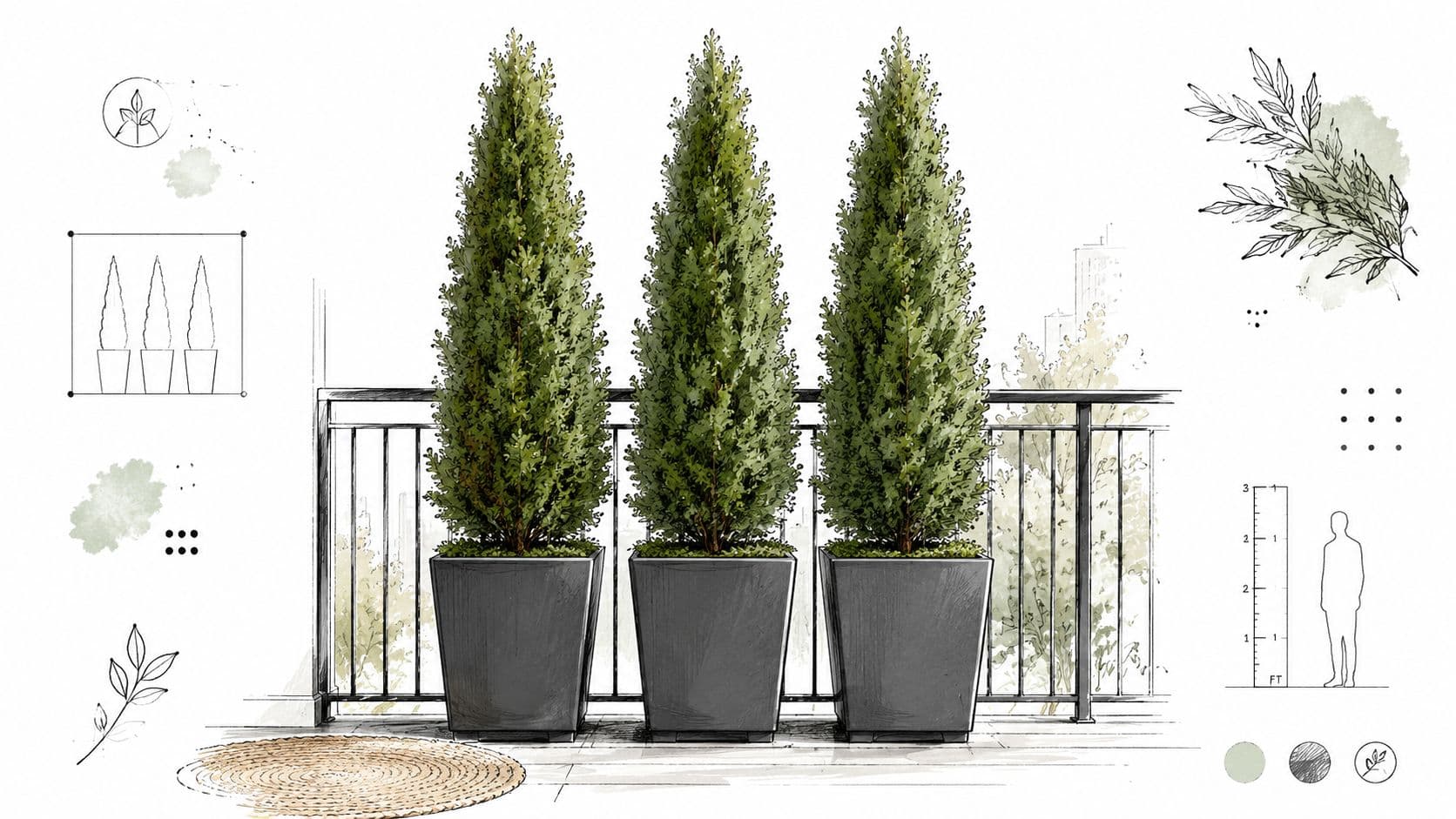
If your space leans traditional or orderly, this is one of the safest choices. It works especially well where you want privacy in winter, when deciduous options stop doing their job.
Where arborvitae works best
I like arborvitae in sets rather than as singles. Three to five planters create a stronger wall effect and look deliberate from inside the space as well as from the yard beyond. On a narrow deck, line them up evenly. In a wider terrace, use them to frame one “room” such as dining or lounging rather than trying to screen the entire perimeter.
The practical downside is patience. Container-grown evergreens can look narrow at first, and people often space them for mature width, then hate the temporary gaps. For potted plants for privacy, tighter visual overlap usually matters more than textbook spacing.
Arborvitae is a good screen for people who want structure first and softness second.
Maintenance is lighter than many broadleaf shrubs. Water consistently through establishment, especially in warm months and windy locations. Don't shear them into hard boxes unless the design needs it. Their natural column is usually the better look.
For planning, backyard ai design is useful here because arborvitae can look too rigid in some settings and exactly right in others. Try a Colonial or Traditional layout, then compare it with a more modern planter line before committing.
A final trade-off. Arborvitae gives dependable evergreen coverage, but it won't create the lush, loose effect that bamboo or laurel can. If you want a refined green wall, it delivers. If you want a softer resort feel, it may read too formal.
3. Citrus Trees - Lemon or Lime Varieties (Citrus limon / Citrus aurantifolia)
Citrus is the privacy plant for people who hate wasted space. It screens, smells good, and gives you something back. On the right patio, a row of lemon or lime trees feels like part privacy feature, part outdoor kitchen extension.
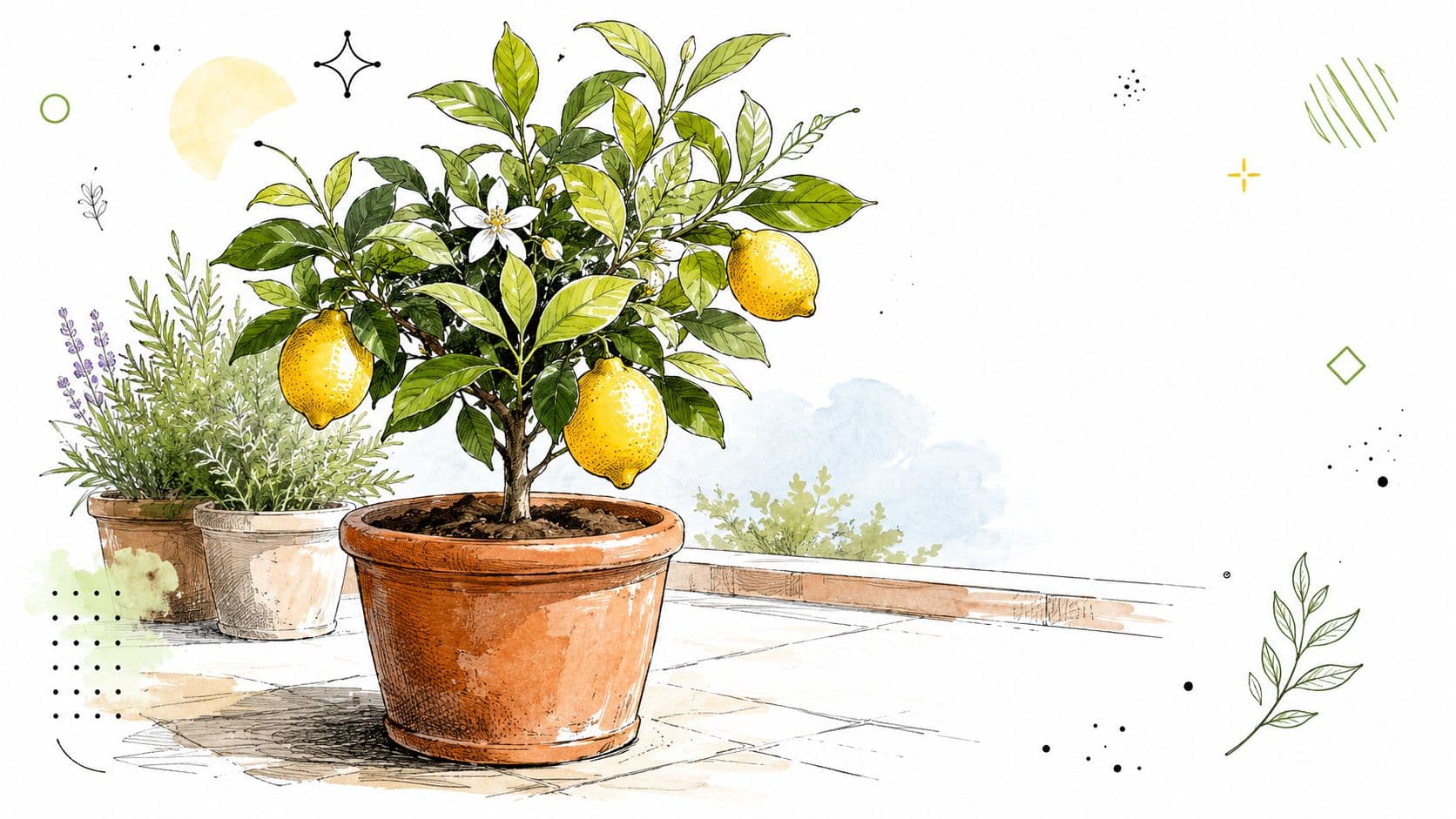
That said, citrus isn't a universal answer. It performs best where light is abundant, cold protection is manageable, and you're willing to do regular feeding and watering. If you skip that, the screen gets thin fast.
How to make citrus screen well
Citrus works best as a grouped screen, not as isolated accent pots. Use odd-numbered arrangements for a balanced look, and place them where people sit so the canopy blocks the view at eye level. A Mediterranean terrace, California courtyard, or protected sunny deck is ideal.
The biggest design mistake is placing the trees too far apart because they look “small now.” Give each one enough breathing room for light and air, but make sure the canopies will visually connect from the main viewpoint. Privacy is about the line of sight, not the overhead plan.
- Soil and drainage: Citrus hates wet feet. Use a free-draining potting mix and containers with reliable drainage.
- Seasonal care: Feed during active growth and prune after harvest or flushes of growth to keep the outline useful as a screen.
- Cold planning: In frost-prone areas, have a protection plan before you buy. Rolling saucers, sheltered walls, or temporary wrapping save a lot of regret.
Use ai backyard patio design to test whether citrus fits your architecture. It looks spectacular with Mediterranean and contemporary homes, but it can feel out of place against rustic or heavily shaded spaces.
If you want a quick visual on placement and canopy shape, this video is helpful:
The payoff is real. You get privacy with character. The trade-off is that citrus asks for attention year-round.
4. Laurel Hedge (Prunus laurocerasus 'Otto Luyken')
Laurel is what I reach for when a client wants dense green mass and glossy leaves without a rigid hedge look. 'Otto Luyken' stays compact enough for container use, and it fills out in a way that hides gaps better than many upright plants.
This is a strong option for townhouses, small front terraces, and side patios where you want privacy without towering height. It also bridges design styles well. It doesn't feel out of place in a cottage garden, but it can still sit comfortably in a cleaner contemporary layout.
The right use for potted laurel
Laurel works best in clusters or repeating runs. A single container can look handsome, but it rarely solves a privacy problem by itself. I prefer using several pots with slightly overlapping crowns so the planting reads as one mass from the seating zone.
The practical advantage is leaf density. The practical downside is water demand and ongoing shaping. If the root zone dries repeatedly, laurel can lose the fullness that made it attractive in the first place.
Southern Living's privacy guidance makes an important point. Layering partial obstruction often works better than chasing a perfect hedge look, especially when container screens have to function through seasonal change and shifting viewing angles (Southern Living privacy wall ideas).
Use laurel where you need broad coverage at moderate height. It's especially effective along a dining edge, in front of low railings, or as the middle layer behind lower seasonal planters. Prune after flowering if you want a tidier shape, and keep mulch on the soil surface to slow drying.
This isn't the plant for neglect. But if you keep up with watering and occasional trimming, laurel gives one of the most convincing hedge-like results available in containers.
5. Clumping Heavenly Bamboo (Nandina domestica 'Obsessed')
A patio can feel exposed without needing a solid green wall. That is where 'Obsessed' earns its keep. I use it on projects where clients want screening around chairs, railings, or a spa edge, but still want the planting to feel light and finished.
This cultivar is compact, upright, and colorful through much of the year. New growth comes in with strong red tones, then settles into a dense mound, effectively covering the lower half of a privacy layout. It will not solve a direct second-story sightline on its own. It does fix a common container problem. Tall screen plants often leave bare legs and too much visible pot.
Where nandina fits in a privacy plan
Use nandina as the front row, not the back wall. In practical terms, that means placing it in front of taller screening plants or at the ends of a planter run where the composition needs a softer finish.
A setup I like for small patios uses two taller screening containers at the back, then two medium pots of 'Obsessed' staggered in front. That arrangement blocks more views at seated height, hides container edges, and keeps the whole screen from reading like a barricade. On a balcony, one nandina pot at each end of a bench often does more visual work than people expect.
Here is where it performs best:
- Best role: Foreground layer for mixed privacy groupings, especially where lower-level coverage matters.
- Planter size: Start with a pot around 16 to 20 inches wide, with enough depth to keep roots from overheating.
- Spacing: Set pots close enough that the foliage nearly touches once mature, usually with a small gap at install.
- Light: Full sun gives the best red color and tighter growth. In lighter shade, it stays useful but looser and greener.
- Upkeep: Remove dead or weak stems in late winter. Skip constant shearing, which ruins the natural form.
Maintenance is straightforward, but there are trade-offs. Nandina is easier to manage than a thirsty hedge shrub, yet it will look sparse if the pot is too small or the soil swings from bone dry to soaked. Use a fast-draining potting mix, mulch the surface, and check irrigation more often in hot weather than the plant tag suggests.
For budgeting, this is usually one of the more flexible options in the article. A small-to-mid size 'Obsessed' plant is often affordable enough to use in pairs or trios, and the pots usually cost as much as, or more than, the plant itself. For a real project, I would price this as a layered screen component rather than a standalone privacy purchase.
Before buying, mock up the arrangement with AI garden design. Nandina is a good candidate for visualization because its value is not just height. It changes the proportion of the whole screen. In a modern scheme, it softens hard planters and straight lines. In a more natural planting, it adds color and structure without making the setup feel heavy.
Use it where you need polish, lower-level coverage, and a screen that feels designed instead of overbuilt. If the brief is full blockage, choose something denser for the main screen and let nandina handle the finishing work.
6. Italian Cypress (Cupressus sempervirens 'Stricta')
A client has a narrow terrace, a direct view from the building next door, and no room for a wide hedge. Italian cypress is one of the few container plants that can solve that problem without stealing the whole patio.
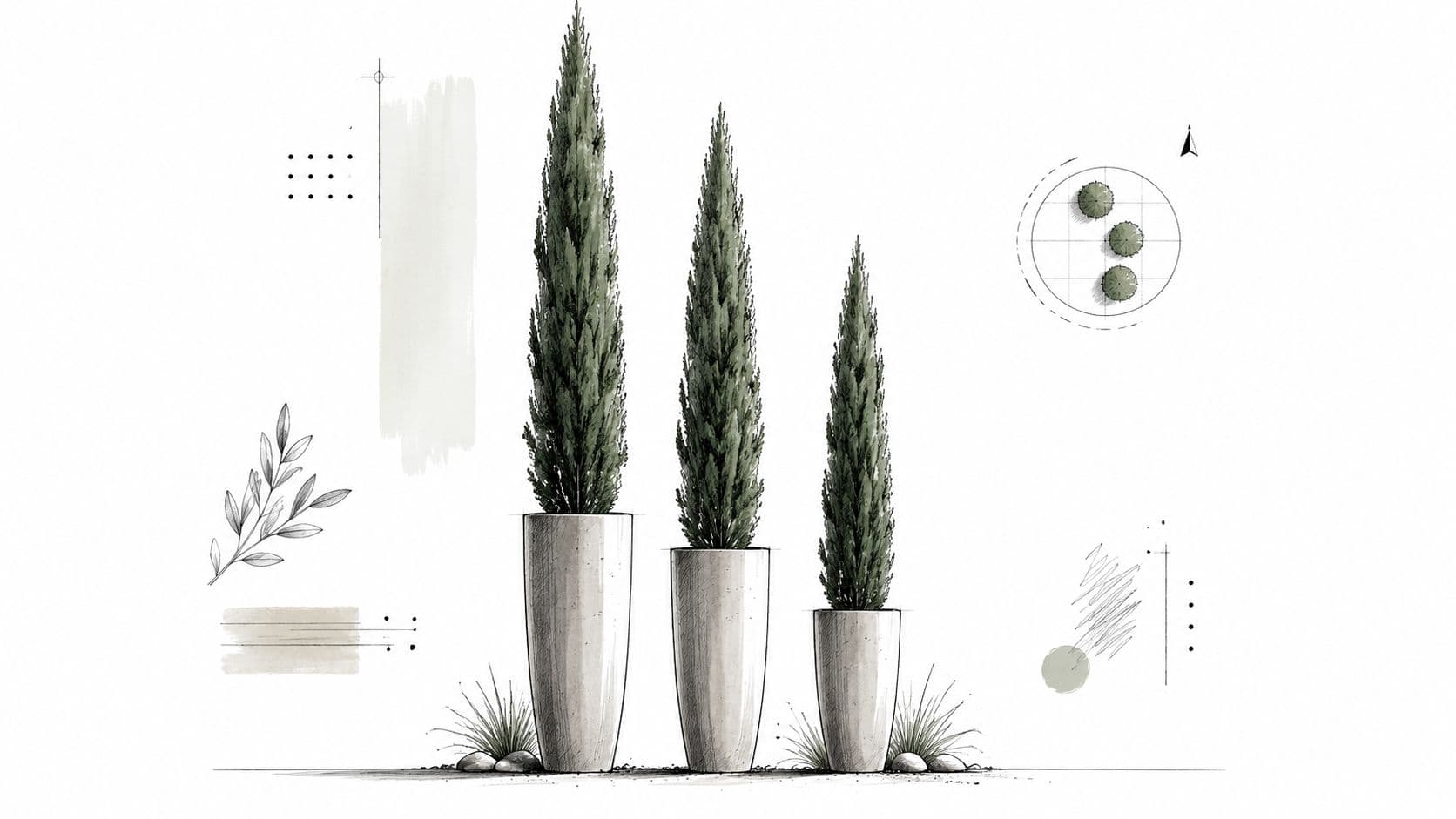
Its strength is shape. The column stays tight, formal, and vertical, so you get height where broader evergreens would sprawl. That makes it useful for screening second-story sightlines, framing a dining area, or creating a clean boundary on long, linear balconies.
The trade-off is tolerance. Italian cypress is less forgiving in pots than it looks. If the root zone stays wet, if air circulation is poor, or if the site is shaded and humid, decline shows fast. I use it only where drainage, sun, and airflow are clearly in its favor.
Best planter setups for a clean, vertical screen
This plant works best as a repeated architectural element, not a one-off specimen stuck in a corner. For most residential projects, I would use one of these layouts:
- Three matching tall planters spaced evenly along a railing or property edge for a formal privacy line.
- A pair flanking a seating zone where the goal is to block angled views rather than create full enclosure.
- Five slimmer pots in sequence on a long terrace where you want rhythm, height, and a Mediterranean feel without a bulky hedge.
Choose heavy pots with enough soil volume to buffer heat and drying. Lightweight plastic containers can work, but they often need more frequent watering and are easier to tip in exposed wind. A sharply draining potting mix is necessary here. Standard moisture-retentive container soil is often the reason these fail.
Maintenance is simple on paper and strict in practice. Water thoroughly, then let the top layer dry slightly before watering again. Do not keep the soil constantly damp. Check ties, staking, and wind rock after storms, especially in the first season. Pruning is light. Remove stray shoots and any dead interior growth, but avoid hard shearing that ruins the natural column.
For budgeting, Italian cypress usually costs more than softer screening plants because the look depends on scale and repetition. The plant is only part of the spend. Tall, stable planters and quality soil matter just as much. On a real project, I would price this as a premium screening option for warm, sunny sites, not as the cheapest way to get privacy.
Before ordering anything, test the spacing and height with AI garden design. This is one of the easiest privacy plants to visualize because the form is so defined. You can quickly see whether three columns are enough, whether five feels too rigid, and how much floor space the pots will consume.
Use Italian cypress when the brief calls for height, order, and a narrow footprint. Skip it if the site stays damp, shaded, or still. In the right conditions, it looks expensive and disciplined. In the wrong ones, it becomes a replacement project.
7. Japanese Privet (Ligustrum japonicum)
Japanese privet is one of the best choices when you want potted plants for privacy that can be shaped with precision. It doesn't just fill space. It responds to training, which makes it useful for formal terraces, boutique hotel-style courtyards, and anyone who likes a clean outline.
It's also more adaptable in style than people expect. Left a bit loose, it feels classic and garden-like. Trimmed regularly, it reads polished and almost architectural.
How to keep privet dense in pots
Privet rewards attention. If you prune lightly and regularly during active growth, it stays thick and useful as a screen. If you let it stretch and then cut it back hard only once in a while, it often looks leggy between maintenance cycles.
That's why I like privet for people who either enjoy garden upkeep or already have a maintenance routine. It's not difficult. It just wants consistency.
- Best layout: A repeating row for formal privacy, or paired groups flanking a seating area.
- Watering habit: Keep soil evenly moist rather than swinging from dry to drenched.
- Visual effect: Privet gives one of the neatest hedge-like looks in containers without needing the bulk of larger shrubs.
Bully Tools' overview of privacy plants points to a bigger issue many guides skip. Fast privacy and durable privacy aren't the same thing, and moisture-loving or climate-sensitive choices can look great quickly but struggle as long-term screens if container size, watering, and winter survival aren't handled well (privacy plant maintenance tradeoffs).
That warning fits privet too. It's dependable when the container size and pruning schedule match the plant's vigor. It underperforms when people treat it like a set-and-forget shrub. In warm-climate courtyards and formal Southern-style terraces, though, it's a strong performer.
8. Photinia 'Red Tip' (Photinia × fraseri)
If bamboo is about speed and arborvitae is about structure, red tip photinia is about presence. New growth flashes red against older green foliage, so the screen does more than block views. It adds color contrast that can carry an entire patio design.
This is the plant I use when privacy needs to look bold, not hidden. In southern outdoor spaces, contemporary suburban backyards, and transitional outdoor rooms, photinia can become the visual anchor.
Best setup for red tip photinia
Photinia needs room, sun, and air movement. Cram it into a shady corner and you'll get a weaker plant with more disease pressure and less of the color people buy it for. Put it in full sun with enough spacing around the containers, and it becomes a strong, fast-filling shrub.
The best arrangement is a run of large planters where each plant can develop a broad, dense crown. It's more forgiving than cypress about shape, but less forgiving about stagnant air. That's why I avoid pushing pots tightly against walls unless there's good circulation.
Don't judge photinia by the first flush alone. Its value as a privacy plant comes from repeat growth and controlled pruning, not one dramatic spring show.
Maintenance is active. Prune regularly during the growing season if you want dense branching and continued red new growth. Water thoroughly while plants establish and through hot weather, and remove any compromised foliage promptly so small problems don't spread through the row.
A real-world fit is a Texas or Oklahoma patio that needs screening from neighboring yards but still wants color and energy. Photinia gives more personality than many evergreens. The trade-off is labor. If you won't prune and monitor it, choose something calmer.
Potted Privacy Plants: 8-Item Comparison
If you are staring at a patio and trying to block one bad sightline before the weekend, this is the decision table I would use. Read it like a project worksheet, not a plant list. The right pick depends on planter size, weight, sun, irrigation, and how much pruning you are prepared to do. Before buying, mock up the screen in an AI yard visualizer such as OutdoorBrite so you can test height, spacing, and pot style against the existing view from your seating area.
| Plant | 🔄 Implementation complexity | ⚡ Resource requirements | 📊 Expected outcomes | Ideal use cases | ⭐ Key advantages | 💡 Quick tip |
|---|---|---|---|---|---|---|
| Bamboo (Fargesia 'Campbell') | Moderate. Best in oversized containers with room for root mass and steady irrigation | Large pots, regular deep watering, part sun to full sun, protection from hot reflected heat | Fast evergreen screen with a soft, leafy look and quick fill-in once established | Urban patios, modern living walls, quick privacy where a softer texture fits the design | Fast coverage, year-round foliage, contemporary look without a harsh wall effect | Use pots at least 18 to 24 inches deep. Plan on checking moisture several times a week in summer |
| Emerald Green Arborvitae (Thuja 'Emerald Green') | Low to moderate. Easy to stage and simple to keep tidy | Medium pots, even moisture, sun to light shade | Narrow upright screen with dependable evergreen density | Tight spaces, formal layouts, cold-climate screening | Slim footprint, strong winter presence, low pruning demand | Set them in a staggered row if you need coverage faster without crowding the roots |
| Citrus Trees (Lemon/Lime) | High. Needs feeding, cold protection, and closer pest watch than the evergreen options | Large heavy pots, full sun, regular fertilizer, winter shelter in cold areas | Mid-height screen that adds fragrance, flowers, and fruit | Sunny patios, edible privacy planting, resort-style terraces | Privacy plus harvest, glossy foliage, strong seasonal appeal | Budget for rolling saucers or casters early. Mature citrus in big pots gets heavy fast |
| Laurel Hedge (Prunus 'Otto Luyken') | Low. Compact habit makes it easier to manage than taller hedge shrubs | Medium to large pots, regular water, sun to part shade | Dense lower screen with polished evergreen foliage | Small gardens, low hedges around seating areas, traditional designs | Naturally dense, neat appearance, useful where you need privacy below eye level | Use this where you want to block the lower half of a fence or railing, not a second-story view |
| Clumping Heavenly Bamboo (Nandina 'Obsessed') | Low. Straightforward planting and light seasonal cleanup | Small to medium pots, moderate water, several hours of sun for best color | Compact screen with red-toned new growth and reliable structure | Layered container groupings, small patios, Asian-inspired planting | Color through much of the year, low upkeep, easy to mix with taller plants | Treat it as a filler and lower layer in a privacy composition, not the whole screen |
| Italian Cypress (Cupressus 'Stricta') | Moderate. Height comes with stricter drainage and climate demands | Very large pots, sharp drainage, full sun, dry air is preferred | Strong vertical screening and architectural height in a narrow footprint | Mediterranean schemes, pool decks, narrow patios needing upright accents | Tall, dramatic form, minimal width, strong formal effect | Skip this choice in humid sites with poor airflow. It performs better in dry climates |
| Japanese Privet (Ligustrum japonicum) | Moderate. Regular clipping keeps it dense and refined | Medium pots, steady moisture, sun to bright partial sun | Dense mid-height hedge or clipped screen with a clean outline | Formal hedges, topiary-style containers, transitional spaces | Accepts pruning well, fills in reliably, often priced better than specialty evergreens | If you want a polished look, schedule light shaping every few weeks during active growth |
| Photinia 'Red Tip' (Photinia × fraseri) | Moderate to high. Fast growth means more pruning and closer disease watch | Large pots, full sun, regular water, feeding during the growing season | Fast colorful screen with bold red flushes and dense branching when maintained | Statement screens, high-contrast planting, larger patios with good airflow | Strong color, quick fill, more visual personality than plainer evergreens | Give each pot breathing room. Crowded placement increases leaf problems and weakens the screen |
A few real trade-offs matter more than the catalog description. Bamboo and photinia fill space quickly, but both ask for more active management. Arborvitae and laurel are easier to keep orderly, though they are slower to solve an urgent privacy problem. Citrus earns its floor space with fruit and fragrance, but only where winter protection is realistic. Italian cypress gives height with very little width, yet it is less forgiving of wet feet and humid exposure.
For budgeting, I usually break container privacy projects into three tiers. Nandina, privet, and smaller laurel installs are the entry point. Arborvitae and bamboo sit in the middle once you factor in larger planters and better soil volume. Citrus, photinia, and Italian cypress often cost more because the plants, pots, and maintenance commitment all go up together.
Use the table to build a layout before you buy anything. Start with the sightline you need to block, choose the mature width the planters can handle, then test the arrangement in OutdoorBrite with the actual pot dimensions. That step prevents the two mistakes I see most often. Screens that are too short from the seated view, and containers packed so tightly that pruning and watering become a chore.
Your Private Oasis Is a Pot Away
Good privacy planting isn't about memorizing a list of species. It's about solving a sightline problem with the right structure, height, density, and maintenance level. That's why the best potted plants for privacy often come from a mix of roles. One plant gives height. Another fills the lower gap. A third softens the line so the screen feels like part of the design instead of a green barricade.
The biggest shift I'd recommend is this. Stop asking which plant is “best” in the abstract. Ask which plant matches your exact exposure, climate, watering habits, and tolerance for upkeep. Bamboo can be brilliant on a protected urban terrace and frustrating on an exposed windy deck. Citrus can turn a sunny patio into a useful edible screen and fail completely where frost protection is unrealistic. Arborvitae and privet can look elegant for years, but only if the spacing and maintenance rhythm are thought through from the start.
Container privacy also works best when you design for real use, not for a catalog photo. Screen the dining table, not the whole yard. Hide the hot tub corner, not every inch of fencing. Create overlap from the key viewing angle. In many small spaces, that targeted approach feels more open and more comfortable than trying to wall everything off.
There's also a practical reason this method keeps gaining ground. Container screens are modular, movable, and adaptable to patios, balconies, rental yards, and courtyards where in-ground planting is limited. They let homeowners adjust the layout as furniture moves, views change, or a season exposes a new angle. If you want more atmosphere around that private zone, this guide to creating backyard ambiance has some useful ideas that pair well with planting.
Before you buy, visualize the layout. That step saves money, prevents overcrowding, and helps you judge whether the screen will feel lush, formal, soft, or too heavy for the space. OutdoorBrite lets you upload a photo and preview different styles so you can test bamboo against arborvitae, compare planter sizes, and see whether a layered design will solve the problem before you start hauling soil and containers home.
If you want to plan your screen with fewer mistakes, OutdoorBrite Money is a smart place to start. You can upload a photo of your patio, balcony, yard, or garden, try different privacy plant layouts in photorealistic styles, and make decisions before spending money on heavy planters, soil, and plants that may not fit the space.
See your yard reimagined
Start creating