What Plants to Grow in Fall for a Better Garden
Learn what plants to grow in fall with zone-aware picks for edibles, ornamentals, and cover crops, plus timing tips that beat the first frost.
Summer has run out of steam, the tomato vines are fading, and empty beds are starting to look like the season is over. Don't shut the garden down yet. Fall can give you a productive second window for greens, roots, bulbs, trees, shrubs, and hardy perennials, but only if you stop treating the calendar as your planting guide.
The right question isn't just “what plants grow in fall?” It's which plants can establish or mature before your local cold arrives. Soil temperature, frost probability, crop maturity, and winter moisture matter more than a generic list of autumn favorites.
Table of Contents
- Why Fall Is a Second Growing Season, Not the End
- The Two Signals That Decide What You Can Still Plant
- Edibles That Mature Before Hard Frost
- Spring Bulbs and Hardy Ornamentals to Set Now
- Trees, Shrubs, and Perennials That Love Autumn Roots
- Risky Fall Picks Most Lists Skip
- Maintenance That Decides Whether Fall Plantings Survive
- Putting Your Own Fall Plan Together
Why Fall Is a Second Growing Season, Not the End
A garden can still produce after summer crops fade. Soil often remains warm while air temperatures cool, giving roots and cool-season crops time to grow without summer heat stress. The window is shorter, so every planting needs a clear purpose.
Decide whether you need a harvest this fall or a plant that will establish for spring and next year. Radishes, spinach, and lettuce must mature before severe cold slows them. Trees, shrubs, perennials, and bulbs can succeed with a different goal: growing roots before the ground freezes, even if their top growth stops.
Start with the first killing frost
Find your local average first killing-frost date and count backward from it. Nebraska Extension recommends using a crop's days to maturity, then adding a 14-day fall factor. Frost-sensitive crops may need another 14 days of buffer in some situations (Nebraska Extension's fall vegetable guidance).
That calculation separates dependable choices from risky ones. With ample time, plant cabbage or carrots. As the window narrows, choose radishes, spinach, or leaf lettuce. If freezing weather is close, stop sowing slow crops and plant bulbs, hardy ornamentals, or protected crops intended to overwinter.
Use frost-date lookups such as find your Michigan frost dates to establish your local baseline. Apply the same method in zone 3 or zone 9. Your climate changes the date, not the decision process.
The fall factor: Shorter days and cooler temperatures slow maturity, so a crop that normally reaches harvest quickly may need extra time in autumn.
Fall planting works on timing, not instinct. Before buying seed or plants, record your average first killing frost, the crop's maturity range, and whether it must mature before frost or only establish roots before winter. That checklist favors reliable plants over pretty but poorly timed picks, including flowering mums that may look seasonal without offering the same establishment value.
The Two Signals That Decide What You Can Still Plant
A fall planting succeeds when two conditions line up: soil temperature and frost timing. The calendar helps, but it cannot tell you whether seed will germinate or whether a young plant has time to establish. Use these two signals to separate dependable choices from pretty but risky purchases, including flowering mums that may look seasonal without offering the same establishment value.
University of Minnesota Extension places the useful soil range for direct-seeding peas, spinach, lettuce, and radishes at 40–50°F (4–10°C) (University of Minnesota Extension guidance). Other crops need warmer soil, around 50–60°F (10–16°C). If the bed remains hot below the surface, cool-season seed may sit, rot, or germinate unevenly. Check with a soil thermometer instead of judging by the afternoon air.
Lettuce, peas, and spinach germinate poorly once soil reaches 85°F (29°C) or higher, according to Purdue Extension. That is why late-summer sowing can outperform midsummer sowing even while the air stays warm.
Soil temperature and frost tolerance at a glance
| Crop | Soil temp for germination | Frost tolerance |
|---|---|---|
| Radishes | 40–50°F (4–10°C) | Light frost |
| Spinach | 40–50°F (4–10°C) | Light frost |
| Lettuce | 40–50°F (4–10°C) | Light frost |
| Peas | 40–50°F (4–10°C) | Light frost |
| Beets | 50–85°F (10–29°C) | Light frost |
| Kale | 50–85°F (10–29°C) | Several frosts |
| Cabbage | 50–85°F (10–29°C) | Several frosts |
| Carrots | 50–85°F (10–29°C) | Several frosts |
Frost timing also carries risk. The average first-frost date represents a 50% chance of frost, while a 32°F (0°C) event has about a 10% chance two weeks before that average date, according to Purdue. Treat the date as a risk window, not a hard deadline.
Measure the soil, check your local frost window, and choose a crop that can either mature or establish before winter. That is the reliable fall-planting rule for zone 3, zone 9, and every garden between them.
Edibles That Mature Before Hard Frost
The first-frost window is closing, and your garden bed is still open. Plant the crops that can finish quickly or keep producing through cold weather. I would choose reliable greens and roots before gambling on tender vegetables that need a long, warm season.
Quick crops for a narrowing window
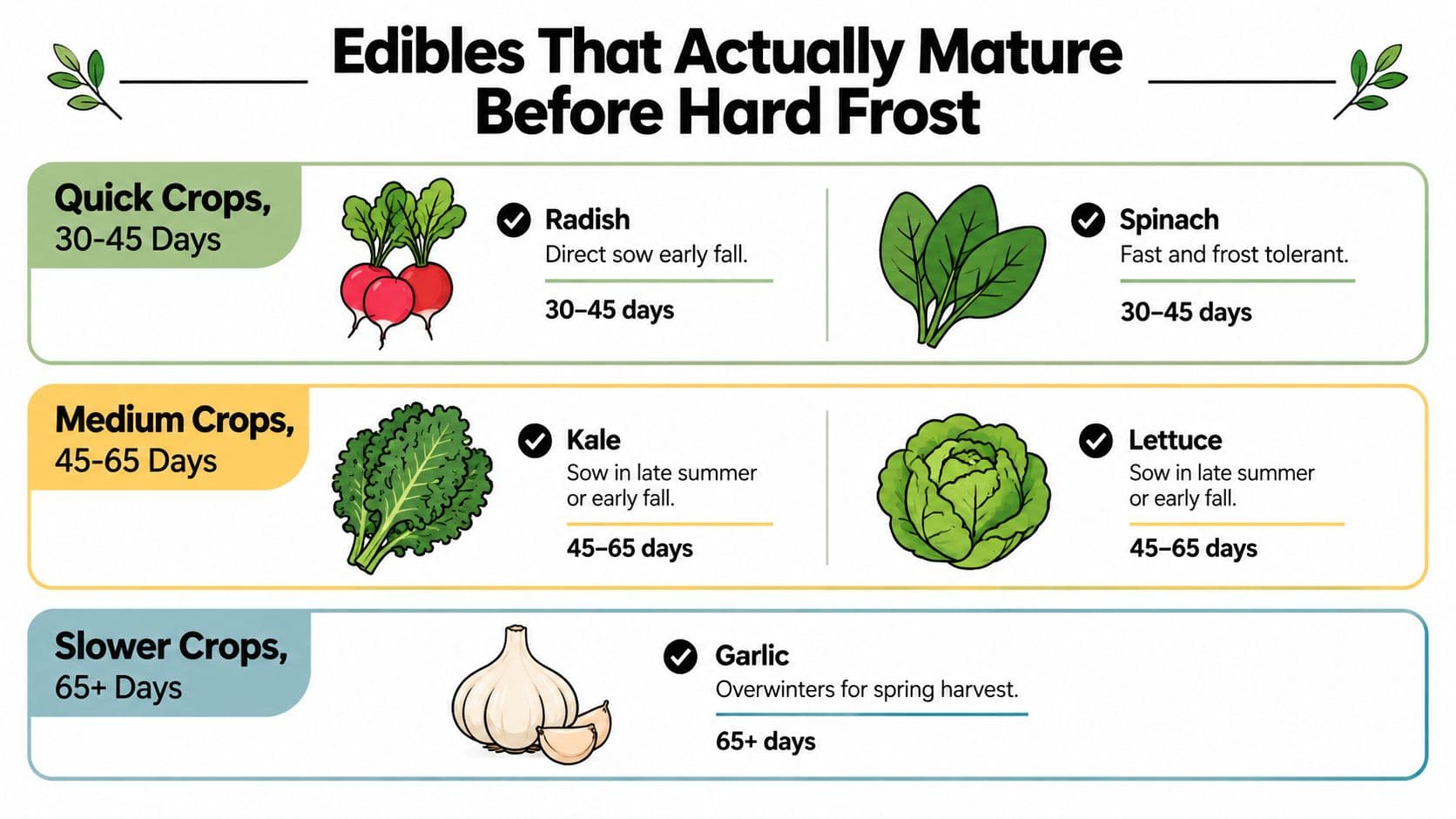
Radishes mature in roughly 30–60 days, spinach in 35–45 days, and leaf lettuce in 40–60 days, based on the maturity benchmarks cited earlier. These are my first choices after summer, provided the soil has cooled enough for even germination.
Radishes give the fastest, simplest harvest. Spinach is the better choice when frost is near because it tolerates light frost. Leaf lettuce earns space when you want repeated cuttings. Sow small batches rather than filling the whole bed at once, so one hot spell or early freeze does not eliminate the entire harvest.
Medium crops for a solid fall harvest
Kale reaches maturity in roughly 40–65 days, while carrots need about 50–75 days under the same benchmarks. Beets and mustard fit a dependable fall schedule when enough growing weather remains. Kale is my strongest recommendation for uncertain timing because it tolerates several frosts and stays useful after more tender vegetables stop producing.
Sow lettuce, radishes, spinach, and mustard in succession at approximately weekly to biweekly intervals. Staggered seedings spread the harvest and give later sowings a chance to replace crops damaged by heat, drought, or an early freeze.
Slower crops need an early start
Cabbage takes roughly 50–90 days, and long-season carrots require more lead time than radishes or leafy greens. Broccoli, cauliflower, Brussels sprouts, turnips, rutabagas, and kale belong in the hardier group, but frost tolerance cannot compensate for immature plants. Once severe cold arrives, an underdeveloped crop may stop growing.
Nebraska Extension classifies beets, Chinese cabbage, collards, potatoes, lettuce, mustard, radishes, spinach, Swiss chard, and green onions as semi-hardy crops that tolerate light frost around 30–32°F (−1–0°C). Cabbage, broccoli, cauliflower, Brussels sprouts, carrots, turnips, rutabagas, and kale are hardier and can tolerate several frosts, often continuing to grow until temperatures approach approximately 20°F (−7°C) (Nebraska Extension's crop classifications).
Skip tomatoes, peppers, eggplant, okra, beans, cucumbers, summer squash, and corn for late planting. Frost kills these crops, so harvest them well before freezing weather or leave them for the next warm season.
For a practical layout before buying seed, use these 2026 garden planning tips to place quick crops in accessible beds and reserve protected space for slower plantings. This approach works in zone 3 and zone 9 because it follows local soil conditions and the first-frost window, not a generic calendar.
Spring Bulbs and Hardy Ornamentals to Set Now
Spring bulbs are among the most dependable fall plantings because their schedule is built around winter. They establish roots in autumn, rest through cold weather, and emerge when conditions suit them in spring. This is one category where “plant them and leave them alone” is often sound advice.
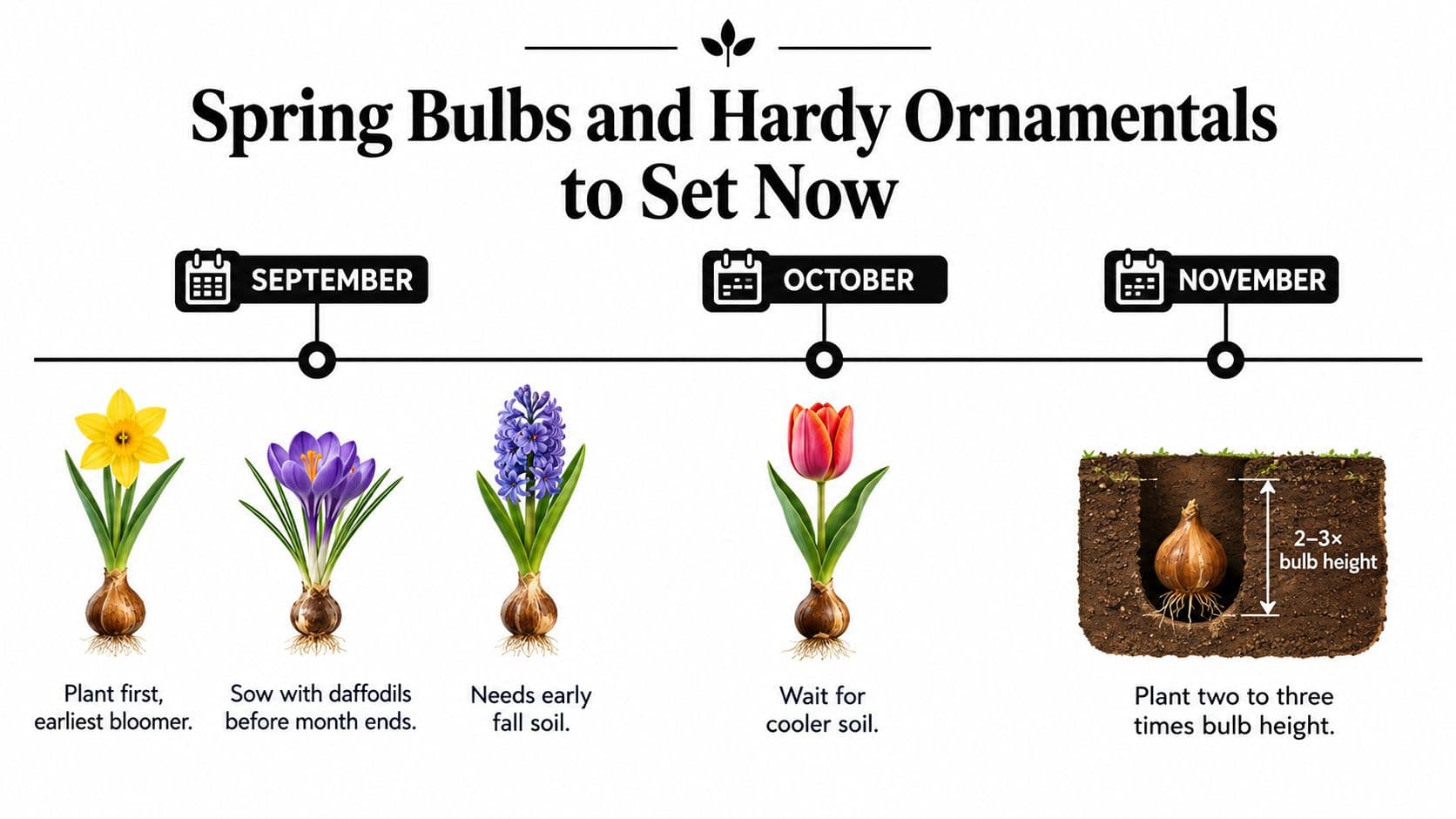
The Royal Horticultural Society recommends daffodils, crocuses, and hyacinths by the end of September. Plant hardy summer-flowering bulbs such as lilies and alliums in September–October, then wait until November for tulips (Royal Horticultural Society bulb guidance).
Plant bulbs for the right reason
Don't plant bulbs merely because the package looks attractive. Choose a location with suitable drainage, enough light for the mature plant, and room for the clumps to expand. Water after planting if the soil is dry, then let the seasonal weather do most of the work.
Daffodils, crocuses, and hyacinths deserve priority when the early autumn window is closing. Tulips can wait for cooler soil, which is why their recommended timing comes later. The order matters because bulbs need time to produce roots before the ground becomes too cold to support meaningful establishment.
Hardy non-woody perennials can also benefit from autumn planting, particularly when they're installed early enough to root in before winter. Choose locally hardy plants, avoid waterlogged beds, and don't confuse a perennial planted for long-term structure with a flowering container plant bought for immediate color.
Trees, Shrubs, and Perennials That Love Autumn Roots
If you've been postponing a tree or shrub, autumn is often the season I'd choose, provided the site drains properly and the plant has enough time to establish before the ground freezes. Cooler air reduces transpiration and heat stress, while residual soil warmth supports root activity.
The University of Georgia Extension identifies approximately 55–75°F (13–24°C) soil as the most favorable range for root growth. The Royal Horticultural Society also recommends completing perennial, shrub, and tree planting at least four to six weeks before the ground typically freezes (autumn root-growth guidance).
Put roots ahead of flowers
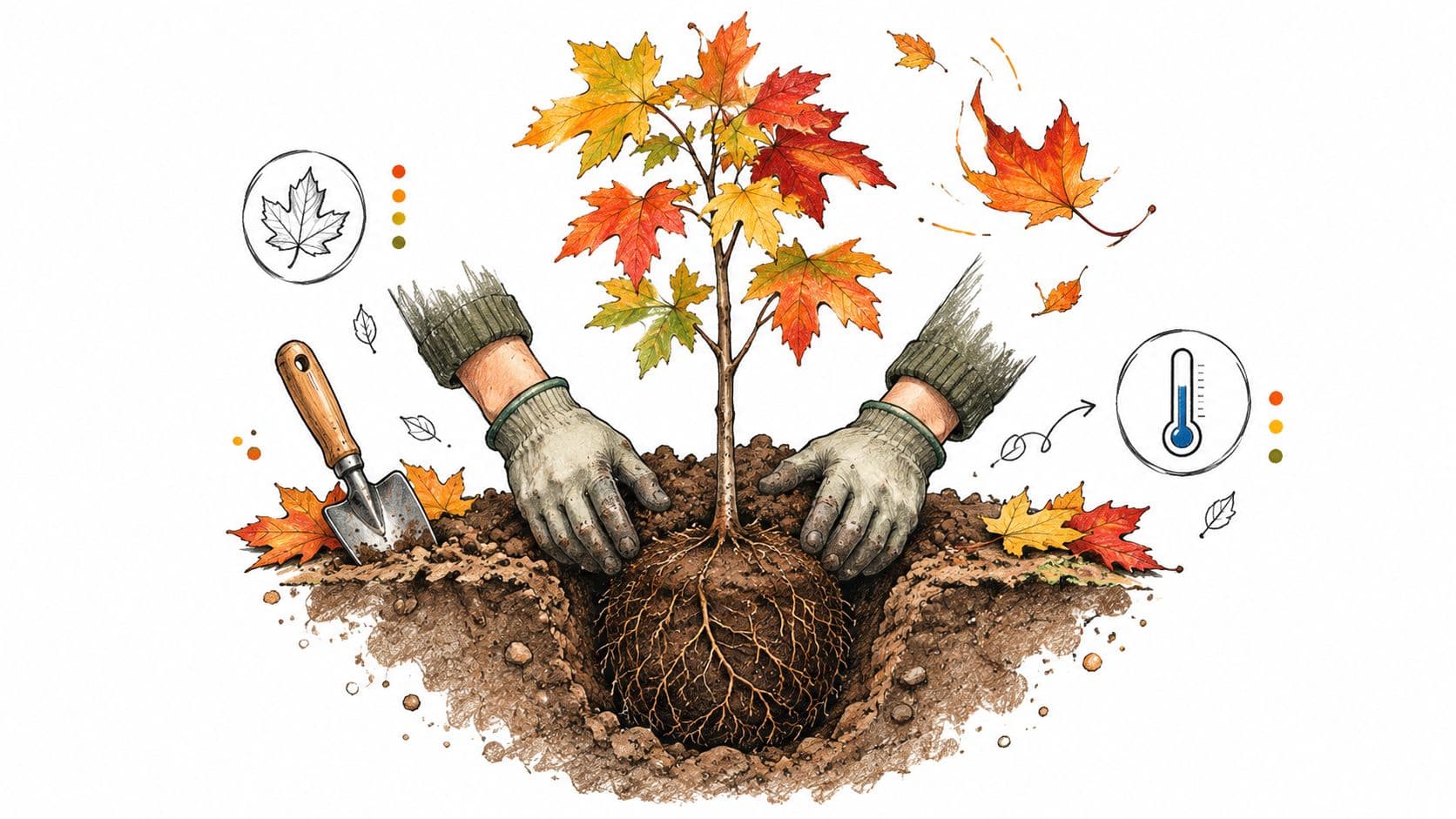
Deciduous trees, shrubs, climbers, and hardy perennials are the strongest candidates. Their above-ground growth naturally slows, so the plant can direct resources toward roots rather than maintaining a full canopy through hot weather.
Plant at a depth sufficient to support the root ball, but don't bury the trunk flare or perennial crown. Water the root zone thoroughly after planting, then keep checking moisture during dry spells. Autumn reduces water demand, but it doesn't remove it.
Know when to stop planting
A plant installed too close to ground freeze may enter winter with an underdeveloped root system. In practical terms, count backward from the point when your soil usually becomes unworkable. If you're inside the four-to-six-week cutoff, choose a spring planting instead unless the plant is exceptionally hardy and your site offers protection.
Drainage is essential. Waterlogged soil lacks oxygen, and oxygen-starved roots can be damaged before winter arrives. Mulch the root zone, keep mulch away from the trunk, and plan to irrigate through future dry periods, including the following summer.
Pruning is a separate task from planting. If you're working in a hot region, a resource such as when to prune Arizona trees can help you separate local pruning timing from your autumn planting schedule.
Risky Fall Picks Most Lists Skip
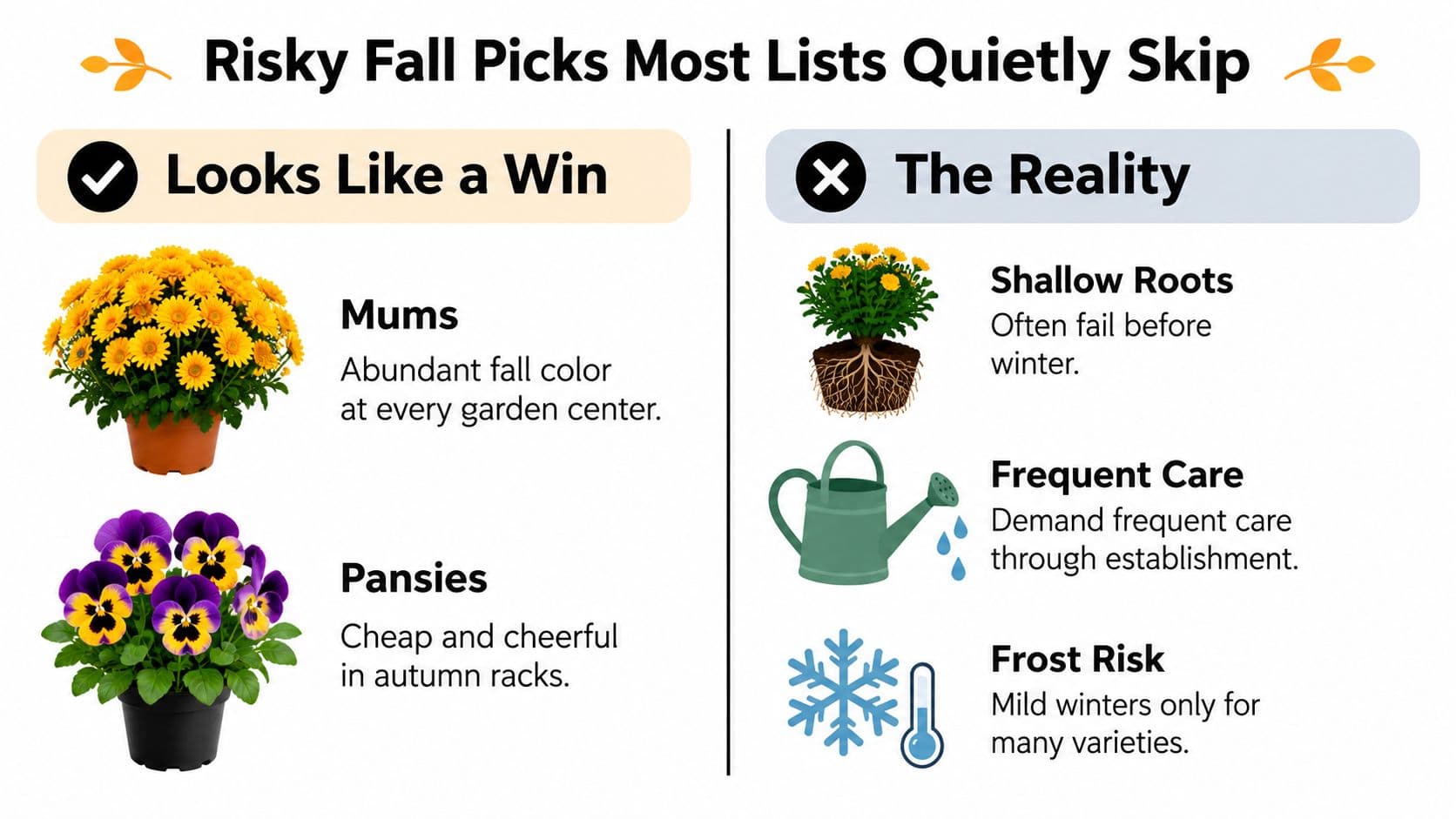
A bright autumn display can mislead you. Garden centers sell immediate color, but a flowering plant that looks excellent in October may have little time to establish before the first hard freeze. Judge every fall purchase by soil temperature, your local first-frost window, and whether the plant is building roots or merely displaying flowers.
Garden mums are the clearest warning. Iowa State Extension reports that fall-planted garden mums often fail to survive winter, even with protection, because flowering takes energy that could support root establishment. Many plants labeled “hardy mums” are not reliably hardy when planted in fall, so treat them as seasonal color unless the cultivar and planting date fit your climate (Iowa State's perennial guidance).
Plant these with confidence
Set spring bulbs, garlic, many deciduous trees and shrubs, and established hardy perennials suited to your conditions. They can establish roots during cool weather and do not depend on tender flowers surviving the first severe freeze. In zone 3, plant early enough for root growth before the local cutoff. In zone 9, the longer cool season gives you more flexibility, but warm soil and a late first frost still do not make every nursery plant a good choice.
Plant only with protection
Recently planted perennials, shallow-rooted plants, and exposed beds may need shelter from drying wind and sharp temperature swings. Use approximately six to eight inches of straw, pine needles, or similar material around tender or recently planted perennials after late-fall conditions arrive, following Iowa State perennial protection advice.
Keep mulch off crowns and trunks. Its job is to moderate soil temperature and protect roots, not bury the plant.
Skip unless conditions favor them
Choose flowering mums only when you know the cultivar is hardy locally, the soil remains workable, and enough time remains before the first hard freeze. Newly planted evergreens also deserve caution because winter foliage continues losing moisture, especially when the soil is dry.
Use the display for temporary color, then reserve permanent planting space for bulbs, shrubs, and perennials that match your site's winter conditions.
Maintenance That Decides Whether Fall Plantings Survive
A plant can be suited to your zone and still fail before spring. Dry autumn soil leaves new roots vulnerable, while late watering can freeze before the root zone is fully moist. Maintenance, not the planting list alone, determines which fall additions establish.
Water newly planted trees, shrubs, perennials, and bulbs whenever autumn weather stays dry. Soak the root zone thoroughly, then check the soil by hand instead of following a fixed calendar routine. The Illinois Extension's fall gardening guidance supports fall planting during drought when plants receive thorough water while establishing.
Use a simple survival routine
- Check moisture: Feel the soil around the root ball, especially after warm, windy weather.
- Water evergreens: Their foliage continues losing moisture through winter. Give recently planted evergreens deep, infrequent watering in fall, stopping before the ground freezes.
- Cover bare soil: Apply mulch to moderate temperature changes and slow moisture loss. Keep it away from trunks and perennial crowns.
- Protect exposed plants: Use suitable organic material around tender or recently planted perennials once late-fall conditions arrive. Follow the Iowa State protection guidance cited above for the appropriate mulch depth.
- Clear empty beds: Remove diseased debris and keep soil covered to reduce erosion and temperature swings.
Use the watering schedule guide OutdoorBrite to organize checks around beds and garden plants, then adjust for rainfall, soil type, plant size, and local conditions.
Inspect container-grown plants and recent installations most carefully. Their smaller or disturbed root zones dry faster, and winter injury may not appear until later, after autumn moisture loss has already weakened the plant. Rain alone is not proof that the root ball is wet. Check it before the ground freezes.
Putting Your Own Fall Plan Together
Start with your local hardiness zone and average first-frost date. Measure the soil temperature, then list the crops that fit your remaining maturity window. Add bulbs, trees, shrubs, and perennials only if they can establish before the ground typically freezes.
Sketch the planting areas before shopping. Mark the quick crops, slow crops, bulb border, permanent woody plants, and any seasonal color that you're treating as temporary. A garden ai design tool can help you visualize those choices on a photo of your actual yard before you buy plants.
Your five decisions are simple:
- When will frost arrive?
- What is the soil temperature now?
- Which crops can mature in time?
- Which plants will establish roots before winter?
- What will need water or protection after planting?
Answer those questions and you'll have a fall garden plan that works for your yard, not a generic list copied from a different climate.
OutdoorBrite turns a photo of your yard into garden and design concepts, so you can test bulb borders, vegetable beds, seasonal mums, trees, and shrubs before spending money. Visit OutdoorBrite to visualize your fall planting plan and refine the layout around your actual space.
See your yard reimagined
Start creating