10 Transformative Large Yard Ideas for 2026
Unlock your property's potential with these large yard ideas. From entertainment zones to native habitats, find inspiration and visualize it all with AI.
Your big yard can feel like a gift and a burden at the same time. You look out the window, see all that space, and still have no clear answer for what should go where. That's common. A large yard gives you options, but too many disconnected ideas usually lead to one of two outcomes: a giant patch of lawn that doesn't get used, or a crowded plan that's expensive to build and annoying to maintain.
The fix is zoning. The University of Florida IFAS recommends organizing a yard by major areas, including the front yard, back yard, and side yard, and starting with a site inventory of soil, drainage, climate conditions, and existing vegetation in its landscape planning guidance. In practice, that means you stop thinking in isolated features and start thinking in outdoor rooms with a purpose.
That approach matters even more in a large property because mistakes scale fast. A bed that's too big becomes hours of weeding. A path in the wrong place gets ignored. A thirsty planting scheme becomes a recurring cost. Water-smart planning helps. EPA WaterSense guidance summarized in that same IFAS reference supports grouping plants with similar watering needs into hydrozones and using mulch at 3 to 4 inches for most plants.
The good news is that there's plenty you can do with a big yard without making it look overworked. The best large yard ideas balance layout, maintenance, and the way you live. Some spaces should be active and social. Others should stay quiet, simple, and easy to keep up.
1. The All-Season Entertainment Zone
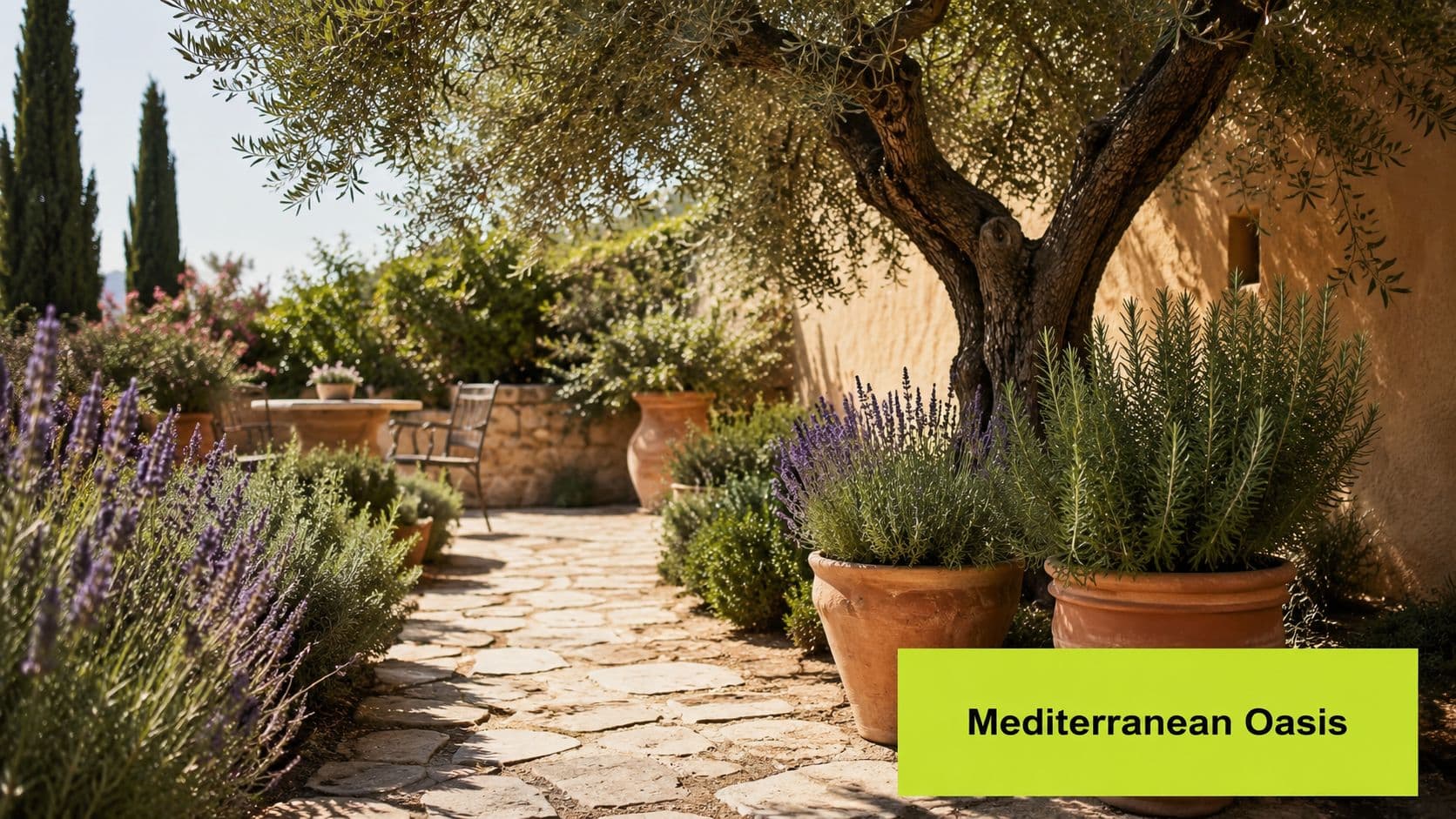
If your yard is where people naturally gather, give it a clear center instead of scattering furniture across a patio and hoping it works. In a large yard, the strongest entertainment layouts usually place cooking, dining, and lounging close enough to feel connected, but far enough apart that each area has breathing room.
Start by anchoring this zone near the house. That keeps traffic simple when you're carrying food, plugging in lights, or moving between indoors and outdoors. Then extend outward in layers: dining first, lounge second, and play or overflow seating beyond that.
Layout that works
A good entertainment zone needs edges. Use paving, a pergola, low walls, or planting beds to define space so the yard doesn't swallow the gathering area.
- Cooking zone: Keep grill, prep surface, and storage on the house side where utilities and access are easier.
- Dining zone: Place it on the flattest surface. People tolerate a rustic garden path. They don't tolerate a wobbling table.
- Lounge zone: Add softer seating slightly away from the grill so smoke and foot traffic don't dominate the conversation.
Practical rule: If every feature wants to be the focal point, none of them will be.
For style planning, it helps to test how hardscape, furniture scale, and planting mass will look together before you build. OutdoorBrite's ai for landscape design is useful for visualizing that mix in your own yard photo.
For furniture direction, Longwood's outdoor furniture inspiration can help you narrow the look before you commit.
2. The Wildflower Meadow and Native Habitat
A huge lawn often looks clean from a distance and feels empty up close. Converting part of it to meadow is one of the smartest large yard ideas for sunny spaces that don't need constant foot traffic.
This works best when you're honest about your tolerance for a looser look. A meadow isn't a clipped border. It changes through the season, leans in the wind, and can look messy if it isn't framed properly.
How to keep it intentional
The trick is contrast. Put the meadow behind something crisp, like a mown edge, gravel path, or simple fence line. That tells the eye the wildness is deliberate.
A practical plant palette starts with regional natives suited to your site. Dry slope, low basin, and open field conditions should not get the same mix. Grouping plants by water needs is especially important on large properties because irrigation mistakes get expensive fast.
- Best use case: Broad sunny areas where you want beauty without intensive weekly care.
- What to avoid: Dropping a meadow right in the middle of high-traffic lawn without paths or boundaries.
- Maintenance reality: Lower input once established, but not no maintenance. Expect seasonal cutting, editing, and some patience.
The broader market is moving toward enhancement-focused outdoor work, not just mowing and maintenance. Mordor Intelligence projects the global grounds care and gardening services market at USD 125.77 billion in 2026, growing to USD 169.36 billion by 2031, with landscape and garden enhancements as the fastest-growing service area at 8.32% CAGR. That lines up with what many homeowners want now: fewer empty lawns, more purposeful outdoor areas.
3. The Multi-Use Sport Court
Some yards need beauty. Others need a place for kids and adults to burn energy without tearing up the lawn. A sport court earns its keep when the household uses it several times a week.
Placement matters more than people think. Put the court too close to the house and noise becomes an issue. Put it too far away and younger kids often won't use it unless an adult goes with them. I usually prefer a visible but slightly offset location with planting around the perimeter to soften the hard edges.
What works and what doesn't
Multi-use sounds efficient, but not every sport combines well. A casual basketball and general play court is easy. Trying to satisfy every possible game can produce a layout that isn't satisfying for any of them.
- Best surface strategy: Choose one surface and one primary use, then allow secondary uses around it.
- Best visual move: Screen the sides with trees or shrubs rather than boxing it in with tall fencing everywhere.
- Common mistake: Treating the court like an isolated utility slab instead of integrating it with paths, seating, and shade.
If basketball is the main draw, outdoor basketball hoops can help you compare style and setup options before you finalize the court layout.
A sport court should solve a family habit, not create a maintenance-heavy monument to a hobby that fades in one season.
4. The Natural Swimming Pond
A natural swimming pond gives you water, reflection, habitat, and recreation in one move. It also asks for commitment. This is not the right choice for someone who wants a sharply geometric pool deck and a highly controlled look.
The appeal is that it sits in the natural setting instead of fighting it. In a large yard, that can be a huge advantage because the pond can belong to the site, especially if you already have informal planting, a wooded edge, or a broad view to borrow.
Trade-offs to think through
Natural systems look relaxed, but the planning shouldn't be. You need the right siting, circulation, and a clear relationship between swimming area and planted regeneration area.
What usually works best is giving the pond enough surrounding quiet space. Don't cram it between a fire pit, play set, and active patio. Let it be one of the yard's slower rooms.
- Good fit: Homeowners who want a naturalistic outdoor design and are comfortable with seasonal change.
- Poor fit: Anyone who wants a sterile look, heavy pool parties, or lots of inflatable clutter.
- Design tip: Keep nearby materials restrained. Stone, gravel, and massed planting usually age better here than a patchwork of competing finishes.
5. The Tiered Terrace Garden
A sloped yard doesn't need to be “fixed.” It needs to be edited. Terracing is one of the most practical large yard ideas when grade changes make mowing awkward and limit usable space.
Done well, terraces turn a difficult hillside into a sequence of destinations. Done poorly, they look like a retaining wall catalog dropped into the yard. The difference usually comes down to proportion and restraint.
Where terracing pays off
Make fewer, stronger levels instead of many shallow ones unless the site demands more steps. Too much fragmentation can make a large yard feel busy and reduce usable area instead of increasing it.
Houzz-style guidance often encourages dividing awkward yards with curves and zones, but the unresolved problem is knowing when the design gets over-segmented. That's a real issue in large spaces, where every extra wall, bed edge, and path adds future upkeep, as noted in this discussion of design solutions for oddly shaped backyards.
For concepting a slope before you move soil or build walls, AI garden design can help you test stepped layouts, planting mass, and circulation in a visual way.
6. The Modern Farm-Style Garden
This is one of the best ways to make a large yard feel useful without losing style. A modern farm-style garden combines raised beds, clean geometry, and a small production mindset. You get structure first, then crops.
The reason it works in big spaces is simple: order. A grid of beds, straight paths, and repeated materials gives the eye a pattern to follow. That makes the yard feel designed instead of random.
The right way to scale it
Keep the bed count lower than your initial enthusiasm suggests. Food gardens expand quickly, and upkeep lands right in the middle of summer when people are busiest.
- Materials: Corten steel, simple timber, gravel, and metal edging all support the modern farm look.
- Planting mix: Combine vegetables, cutting flowers, herbs, and one or two upright accents such as trellised beans or espaliered fruit.
- Big mistake: Building a beautiful edible garden too far from a water source or everyday path.
The U.S. lawn and garden products market is projected by Mintel to rise 28.3% between 2025 and 2026 to nearly USD 94 billion, with growth to USD 99.6 billion by 2030. Homeowners are clearly spending on outdoor improvement inputs. A productive garden is one of the clearest places to direct that spending with visible daily value.
7. The Secluded Outdoor Office or Studio
A detached office, art studio, or writing room changes how a big yard functions. It gives the property a destination that isn't purely recreational.
The best locations are usually quiet corners with a sense of enclosure, but not total isolation. You want enough privacy to focus, plus a clear path that feels safe and convenient in bad weather or early morning light.
Make the walk part of the experience
This is one place where a path matters emotionally as much as functionally. Gravel, stepping stone, or boardwalk-style access can make a small structure feel intentional instead of dropped in place.
What doesn't work is surrounding the studio with fussy planting that blocks windows and adds maintenance. Keep the structure crisp. Let the area around it be calm.
A backyard office should lower friction. If it feels inconvenient to reach, people drift back to the kitchen table.
A simple palette works best here: ornamental grasses, evergreens, and one shade tree if the site allows it.
8. The Strategic Privacy Grove
Large yards can feel surprisingly exposed. The fix usually isn't one long line of identical evergreens. That approach screens views, but it often looks flat, feels heavy, and can become a maintenance headache if one species struggles.
A privacy grove uses layers. Tall canopy trees, mid-height evergreens, deciduous shrubs, and lower foreground planting create depth and soften sightlines. You get privacy that looks natural, not a barrier.
Build it in layers
Start with the views you want to block and the ones you want to keep. Then stagger the planting so it feels natural from inside the yard, not just effective from the property line.
- Back layer: Larger evergreen or semi-evergreen anchors for year-round structure.
- Middle layer: Deciduous trees or big shrubs for seasonal softness.
- Front layer: Lower plants that keep the base from looking bare.
This is also where site analysis matters. Soil, drainage, climate conditions, and existing vegetation should drive species selection, not a generic privacy planting list. Large yards magnify plant failures, so repeating the right plant in the right place is better than collecting too many varieties.
9. The Grand Formal Parterre Garden
A parterre works when you want the yard to make a statement from a terrace, upper window, or long axis view. It's less about casual use and more about visual order. In the right setting, that can be stunning.
This is not a forgiving design style. Symmetry shows mistakes. Uneven growth shows. So does deferred maintenance. If you love clipped shapes, repeated geometry, and a strong centerline, it can be worth it. If not, skip it.
Why restraint matters here
The hardest part isn't the initial layout. It's keeping the pattern legible over time. Low hedging, gravel lines, restrained flower color, and a limited material palette usually produce the strongest result.
The U.S. landscaping industry reached an estimated $184.1 billion market size in 2025, with more than 1.4 million people across 692,777 landscaping service businesses, and average employment growth of 4.2% between 2020 and 2025. For homeowners considering a formal garden, that scale matters because specialist help exists. You're not limited to a niche trades market if you need installation or maintenance support.
10. The Fire Pit Circle with Built-In Seating
This is one of the most reliable gathering features you can add to a large yard. A fire pit circle gives the eye a destination and gives people a reason to stay outside longer.
Built-in seating is what elevates it. Loose chairs drift, tip on uneven ground, and never quite create a complete room. A curved wall or integrated bench makes the space feel permanent and settled.
Keep the circle simple
Use one paving material and one seating material if possible. The beauty comes from the shape and the social layout, not from cramming in too many decorative moves.
- Best location: Slightly away from the main patio so it feels like a second destination.
- Best companion features: A path, low lighting, and a nearby wood or cushion storage point.
- Mistake to avoid: Making the fire feature oversized while leaving too little room to move around it comfortably.
For layout testing, ai backyard patio design can help you preview circle size, seating curves, and surrounding materials before you commit.
Top 10 Large Yard Ideas Comparison
| Idea | Implementation Complexity 🔄 | Resources & Budget ⚡ | Expected Outcomes 📊 | Ideal Use Cases ⭐ | Key Tip 💡 |
|---|---|---|---|---|---|
| The All-Season Entertainment Zone | High, multi-zone build with utilities and weatherproofing | High ($20k–$100k+), large footprint, medium–high maintenance | Year‑round hosting, multifunctional outdoor living | Large properties focused on entertaining and hospitality | Define clear flow; place kitchen near house and use a covered hub |
| The Wildflower Meadow & Native Habitat | Low, site prep and seeding, simple establishment | Low–Medium ($500–$3k), needs sunny open area, low maintenance | High biodiversity, seasonal color, low watering once established | Sunny large yards favoring low‑effort ecological landscapes | Thoroughly clear turf, use regional seed mixes and mow walking paths |
| The Multi-Use Sport Court | Medium–High, grading, surfacing, possible permits | High ($15k–$75k+), substantial flat area, low routine maintenance | Dedicated recreation space, improved activity and resale appeal | Active families, sports-focused households | Orient N–S, add screening and consider professional installation |
| The Natural Swimming Pond | High, specialized excavation, plumbing, and ecology design | Very High ($50k–$150k+), moderate upkeep for planting zones | Chemical‑free swimming, strong aesthetic and habitat benefits | Eco‑minded owners wanting a natural swimming feature | Design swim vs regeneration zones (≈50/50) and consult a specialist |
| The Tiered Terrace Garden | Medium–High, retaining walls, drainage planning required | Medium–High ($10k–$80k+), suits sloped sites, medium maintenance | Erosion control, multiple usable levels, strong visual layering | Sloped properties needing functional terraced spaces | Use durable wall materials, plan drainage and wide terrace depths |
| The Modern Farm-Style Garden | Medium, construction of raised beds and irrigation | Medium ($5k–$25k), organized layout, high seasonal maintenance | High productivity with a clean, modern aesthetic | Home gardeners wanting productive, design‑forward vegetable plots | Use uniform beds, install drip irrigation, and add protective fencing |
| The Secluded Outdoor Office or Studio | Medium, structure plus utilities and insulation | High ($15k–$60k+), moderate footprint, low maintenance once built | Private workspace or retreat that boosts property utility | Remote workers, artists, or those needing quiet separation | Site in a secluded corner, run power/internet, add a welcoming path |
| The Strategic Privacy Grove | Medium, staging and species planning for layered screening | Medium ($2k–$10k+), initial work then low maintenance once established | Year‑round privacy, noise buffering, habitat creation | Properties needing natural screening and aesthetic buffers | Plant staggered layers, mix species and sizes for resilience |
| The Grand Formal Parterre Garden | High, precise, symmetrical layout and ongoing clipping | Medium–High ($5k–$30k+), intensive pruning and upkeep | Formal, high‑impact focal garden with strong visual order | Owners seeking classical, view‑oriented garden statements | Lay out axis precisely and use dwarf boxwood for low hedges |
| The Fire Pit Circle with Built-in Seating | Low–Medium, masonry and seating wall construction | Medium ($5k–$20k), compact footprint, low maintenance | Central social hub, extends evening use and gatherings | Social households wanting an anchored outdoor gathering spot | Sit at least 15–20 ft from structures; size seating wall for comfort |
From Idea to Reality
A large yard doesn't need more stuff. It needs a clearer plan. That's the difference between a property that looks impressive for a month and one that keeps working for years.
Start with the parts of the yard that already suggest a use. The sunny open stretch might want to become a meadow or garden. The area near the house might be the entertainment zone. The sloped edge might be perfect for terraces. When you assign each area a job, the whole property starts to make sense.
Then be honest about maintenance. Many large yard ideas go wrong concerning this aspect. Homeowners often choose features for the reveal moment, not for the fifth month of care. A formal parterre can be beautiful, but it asks for consistency. A meadow gives more back with less weekly effort, but it needs a tolerance for seasonal roughness. A sport court is excellent for an active family, but not if the household's habits don't support regular use.
It also helps to decide where simplicity should win. Not every section of a big yard needs a feature. In fact, one of the best design moves is leaving some areas quiet. Open lawn, broad groundcover, and restrained tree planting can give the more detailed spaces room to breathe. That's especially important in irregular or oversized yards, where too many paths, beds, and focal points can make the property feel smaller and more complicated than it is.
If you're still unsure, don't start by buying materials. Start by testing layouts. Seeing a concept in your own yard photo is often what turns a vague idea into a plan you can trust. That's where a tool like OutdoorBrite can be useful. You can try different styles, compare stronger and softer zoning moves, and see whether a fire pit circle, terrace garden, privacy grove, or outdoor studio fits the space before you build.
The goal isn't perfection on the first try. It's clarity. Once you know which parts of the yard should be social, productive, private, or quiet, your decisions get easier. Plant choices get easier. Budget choices get easier. Even the projects you postpone become clearer, because they fit into a larger plan instead of floating around as disconnected ideas.
Big yards reward patience. They also reward bold decisions made in the right places. Choose a few strong moves. Give them room. Let the rest of the surroundings support them. That's how a large yard stops feeling overwhelming and starts feeling like an asset you use.
If you're ready to test these large yard ideas in your own space, try OutdoorBrite. Upload a yard photo, explore different outdoor styles, and compare concepts before you commit to plants, hardscape, or construction.
See your yard reimagined
Start creating