10 Mediterranean Garden Plants for a Sun-Loving Yard
Discover 10 Mediterranean garden plants, with growing tips, design pairings, and practical ways to build a drought-tolerant, sun-loving garden.
The hose hasn't moved in three weeks. The gravel is warm underfoot, the lavender is loud with bees, and the rosemary throws its scent the moment a rare shower passes over. Nothing in this bed has been watered since June, and nothing is sulking about it.
That's the trade Mediterranean garden plants offer. A lawn needs water, mowing and feeding to look decent, and most border perennials want rich soil and steady moisture. This palette wants the opposite: lean ground, sharp drainage, a baking summer and a cool, wet winter. Give it those and the garden improves as you do less to it.
The ten plants below are organized by design job rather than by shopping list. Each one comes with the role it performs best, whether that's a vertical accent, a structural hedge, a groundcover or a focal point, plus the conditions it needs and the neighbors it looks right beside. Work through them in that order and you'll finish with a planting scheme, not a collection of pots waiting for a gap.
Table of Contents
- 1. Lavender (Lavandula angustifolia)
- 2. Rosemary (Rosmarinus officinalis)
- 3. Olive Tree (Olea europaea)
- 4. Bay Laurel (Laurus nobilis)
- 5. Italian Cypress (Cupressus sempervirens 'Stricta')
- 6. Common Sage (Salvia officinalis)
- 7. Common Thyme (Thymus vulgaris)
- 8. Rockrose (Cistus albidus)
- 9. Pomegranate (Punica granatum)
- 10. Common Myrtle (Myrtus communis)
- 10 Mediterranean Garden Plants at a Glance
- Put the Whole Planting Scheme Together on Your Own Yard
1. Lavender (Lavandula angustifolia)
Design job: the low hedge that lines a path, edges a terrace, or separates gravel from a border without blocking the view behind it.
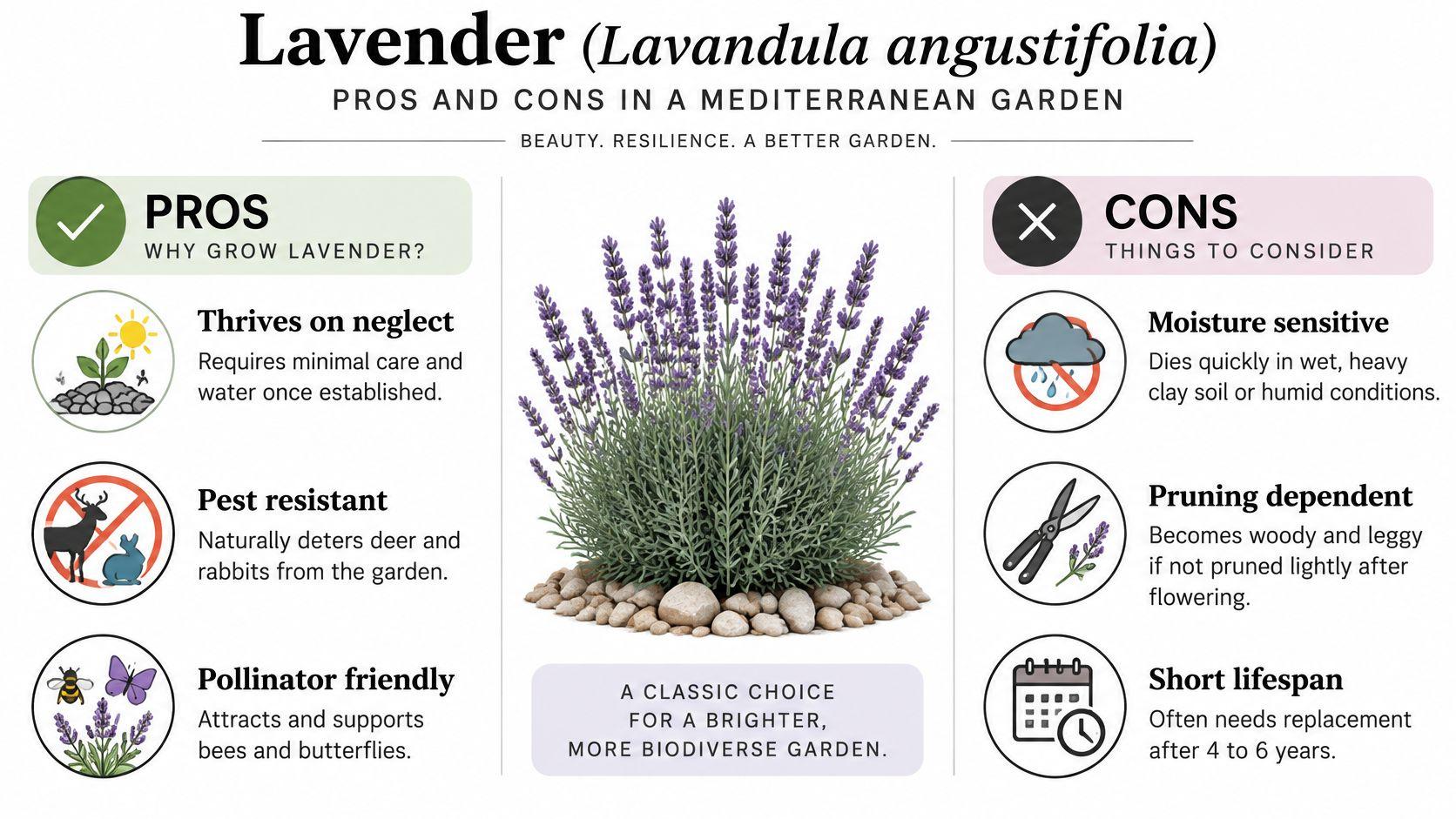
English lavender holds its grey-green shape through winter, flowers for weeks in early summer, and releases oil onto your legs every time you brush past. It's the hardiest of the lavenders and the one that survives cold, wet winters best.
What lavender needs and what kills it
Full sun, gritty soil, and a crown that stays dry. On clay, dig coarse grit or sharp sand through the whole bed rather than just the planting hole, and set each plant an inch or two proud of the surface so water sheds away from the stem. Prune after flowering, taking about a third off the leafy growth, and stop before you reach bare old wood on a mature plant, because it rarely reshoots from there.
- Spacing for a hedge: 45 to 60 cm (18 to 24 in) apart, tighter for a formal run, wider where airflow matters more than a solid line.
- Mulch: gravel or nothing at all. Bark and compost held against the crown through a wet winter is the quickest way to lose a plant.
- Lifespan: treat lavender as a shrub with a shelf life. On heavy soil, five to seven years is realistic, so take cuttings or budget for replacements.
I'd rather see the path edge drawn before buying anything, which is why I sketch beds in ai garden design software and plant to the layout instead of guessing with pots on the lawn.
Here's the practical version of how to keep a lavender hedge tight and long lived:
2. Rosemary (Rosmarinus officinalis)
A rosemary planted at the top of a sunny slope can anchor a border while spilling gently over stone below. Upright varieties form a loose evergreen hedge or a grey-green backdrop; prostrate forms soften retaining walls, steps, and raised-bed edges.
Design job: evergreen structure with a culinary harvest. Place rosemary beside a path or kitchen door, where its aromatic leaves are easy to pick. Regularly cut whole stems through spring and summer to keep the plant dense.
Give rosemary sharp drainage. A raised bed, slope, or gravel-mulched bank suits it; flat, waterlogged clay does not. Newly planted rosemary needs regular watering during its first year. As roots establish, taper to occasional watering, then water thoroughly but infrequently once the plant is established. In heavy soil, improve drainage across the bed rather than relying on a planting hole that can hold water.
Pair upright rosemary with lavender and low-growing thyme for a layered, fragrant border. Set prostrate forms above a wall or at the edge of a gravel bed, where their trailing habit can soften hard lines.
3. Olive Tree (Olea europaea)
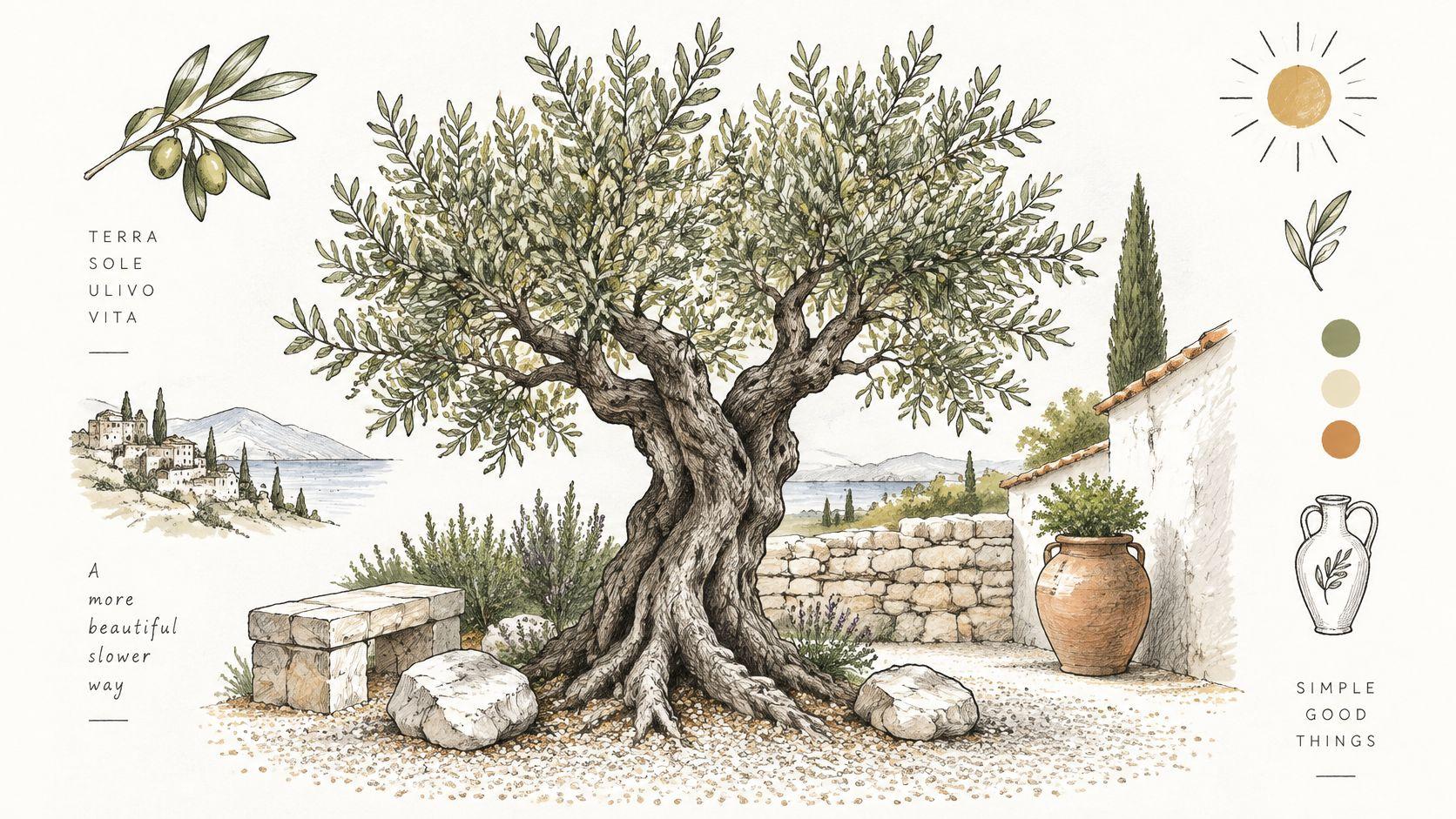
Design job: the focal point. One olive in a gravel courtyard, underplanted with lavender and thyme, does more for a garden than a dozen smaller shrubs. The silver-green canopy catches light from below, the trunk twists with age, and the tree holds its shape all year.
The olive is not a fashion import. Olive and fig cultivation in the Central Jordan Valley dates to roughly 7,000 years ago, and olive horticulture was well established in parts of the southern Levant by about 6,000 years ago (archaeobotanical research on early fruit cultivation). You're planting something humans have pruned and harvested for millennia.
Planting and shaping
Full sun and free-draining soil are essential; a waterlogged site will kill an olive faster than cold. Water thoroughly through the first two summers, then sparingly, letting the topsoil dry between soakings. Prune in late winter to open the canopy and let light into the center, because a dense olive shades out its own fruiting wood. In an entry garden or near a patio, choose a fruitless or low-pollen cultivar so you're not sweeping up drops in autumn.
Container olives fail for boring reasons: tight roots, a saucer left full of water, and a shaded corner. If yours is losing leaves indoors, the fix is almost always light and drainage, which is covered in this guide to reviving a struggling potted olive tree. Before you commit to a specimen, test the placement on a photo of your own yard with backyard design ai so the tree sits where its shade falls.
4. Bay Laurel (Laurus nobilis)
Two bay standards in terracotta pots, one either side of a front door, is the cheapest way I know to make an ordinary entrance read as Mediterranean. The glossy leaves reflect light, the plants clip into tight balls and cones, and you get cooking leaves off the trimmings.
Design job: clipped structure and container formality. Bay takes shearing better than almost any other culinary shrub, which makes it the plant for standards, pyramids and low formal hedges where box blight or cold has ruled out the usual suspects.
Grow it in partial shade or full sun, in soil that stays moist but never sodden. Shelter young plants from cold winds for the first two winters, and prune in late spring or summer once growth has hardened, not in the depths of winter.
- Pots: use a soil-based compost with grit added, and raise the pot on feet so winter rain drains straight through.
- Hard frost: move containers into a sheltered corner or against a south wall, and wrap the pot rather than the foliage.
- Harvesting: pick leaves and dry them whole; they keep their aroma far better than crushed ones.
5. Italian Cypress (Cupressus sempervirens 'Stricta')
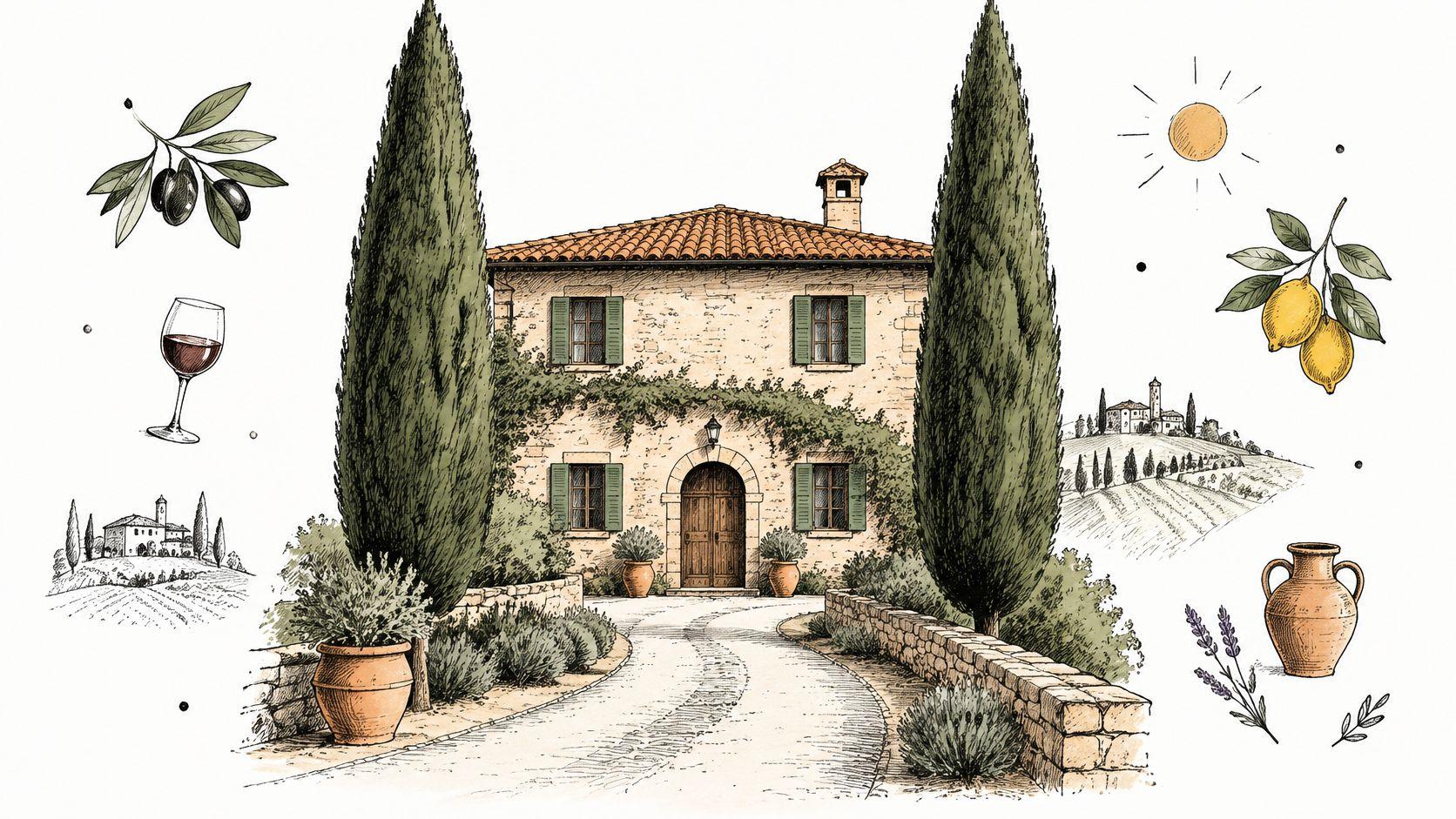
Design job: the vertical accent. Nothing else in this palette gives you height in a two-metre-wide strip. A row along a drive, a pair flanking a gate, or a trio breaking up a long boundary will do more for the composition than any flowering plant.
Plant in full sun in deep, well-drained soil. Space plants about 1 to 1.5 m (3 to 5 ft) apart for a continuous screen, wider if you want individual columns. Once established, resist the urge to irrigate; cypress in a wet bed with warm soil is a recipe for root problems.
Source certified, disease-free nursery stock. Cypress canker has taken out whole screens in warm climates, and cheap bare-root liners are a false economy when the plants are meant to stand for thirty years.
Where the vertical accent belongs
Use it where height solves a problem: a neighbor's window, a bare gable end, or the end of a gravel path that needs a stop. Don't use it in the middle of a small border, where a three-metre column will look stranded. Sketching the sightlines first helps, and ai for landscape design will show you how a screen sits against the actual house before you order trees that arrive taller than your ladder.
6. Common Sage (Salvia officinalis)
Sage is the plant that holds the front of the border together while everything behind it flowers and fades. Soft grey-green leaves, purple-blue spikes in early summer, and a scent that sharpens every time you water nearby.
Design job: edging and texture at the front of a bed. Set it in a run along a path or in a herb parterre, where the foliage reads as a low grey ribbon rather than a single lonely plant.
Not all Mediterranean plants want the same water, and sage is where that bites. A systematic review of ornamental irrigation thresholds found Ballota acetabulosa, Helichrysum orientale and rosemary held up at irrigation equal to 25% of Class A pan evaporation, while Greek sage and lemon balm needed at least 50% to keep acceptable growth (irrigation thresholds for Mediterranean ornamentals). Zone your beds accordingly.
Design rule: put the thirstiest herbs closest to the tap and the toughest ones at the far, driest end. Grouping by water demand rather than by color saves plants and irrigation.
Plant sage in full sun and free-draining soil. Prune after flowering and again in spring to keep it compact, and replace tired plants every few years rather than coaxing a woody skeleton back into shape. 'Purpurascens' gives you purple foliage for contrast against silver neighbors.
7. Common Thyme (Thymus vulgaris)
Twenty square metres of paving, joints full of creeping thyme, is the swap I recommend most often to anyone replacing a front lawn. It takes foot traffic, smells extraordinary when stepped on, and needs no mower.
Design job: groundcover and living joint filler. Common thyme fills the gaps between flagstones and gravel margins; creeping varieties such as Thymus serpyllum knit a low mat over wider areas.
Water-system design matters as much as the plant list here. Research on Mediterranean urban planting reports that xerophytic planting can cut irrigation by roughly 65% compared with conventional mesic vegetation, with results varying by species and site (Mediterranean urban landscape water use). The saving comes from grouping plants into hydrozones and irrigating those zones separately, not from scattering drought-tolerant plants across a bed that still gets a lawn schedule.
- Soil: sandy or gravelly, with grit worked into the top 10 cm.
- After flowering: shear the plants back lightly to keep the mat dense rather than leggy.
- Refresh: divide or replant every few years, because old thyme thins from the middle outward.
8. Rockrose (Cistus albidus)
Design job: cover on a dry bank where nothing else will hold the soil. Rockroses take the slope, the reflected heat and the thin soil, and they flower for weeks in the process.
The flowers are papery, open in the morning and drop by evening, which sounds like a fault until you see a plant producing fresh ones daily for a month. The grey-green foliage stays through winter and the whole thing asks for nothing except sun and drainage.
The Mediterranean basin holds roughly 25,000 vascular plant species on about 1% of Earth's land surface, and around a quarter of the species assessed in the cited IUCN analysis were classed as threatened (IUCN's Mediterranean biodiversity assessment). That richness is why the palette is so wide, and why it's worth choosing locally suited species rather than whatever looks Mediterranean on a label.
Plant in full sun and lean, very well-drained soil. Skip the fertilizer entirely, since rich ground pushes soft growth that dies back in summer. Prune lightly after flowering to keep the shape, and accept that rockroses are short lived; plan to replace them or let them self-seed on a bank where that's welcome.
9. Pomegranate (Punica granatum)
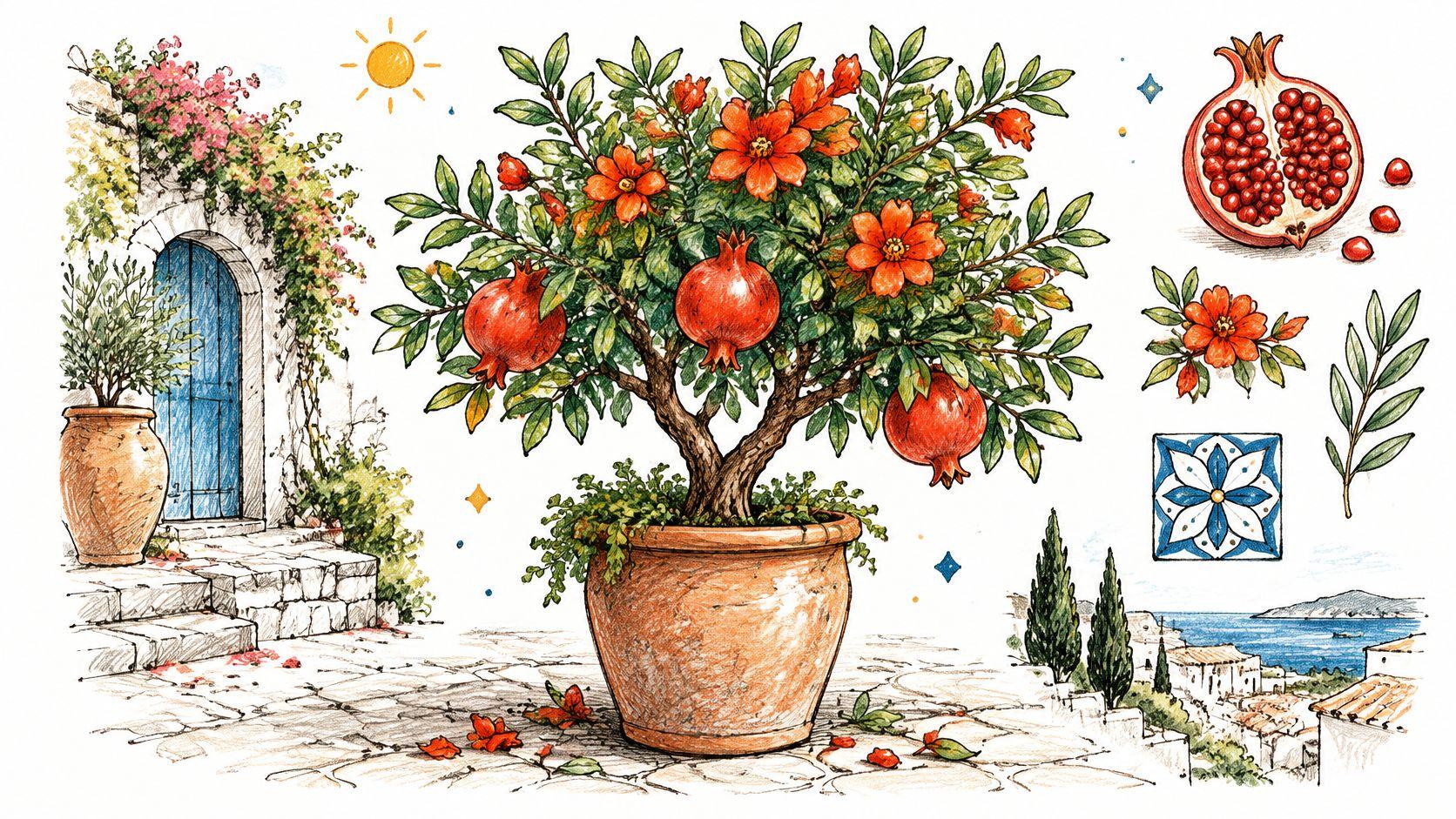
A pomegranate hedge along a courtyard wall gives you three seasons of interest from one plant: scarlet-orange flowers in late spring, heavy fruit in autumn, and yellowing leaves before it drops them. The bark stays interesting in winter.
Design job: fruiting focal point or flowering hedge. In a small courtyard, use a dwarf cultivar in a large pot on a sunny patio. In a larger garden, plant a run at 2 m spacing and clip it as a loose screen.
Full sun and well-drained soil, with regular water through fruit development, because uneven moisture is what splits the fruit just before harvest. Prune in late winter, removing suckers from the base and any branches crossing through the middle of the shrub. If fruit matters to you, choose a named fruiting cultivar such as 'Wonderful' rather than a seedling of unknown parentage.
10. Common Myrtle (Myrtus communis)
Design job: a dense evergreen hedge or clipped substitute for boxwood in warm climates. Myrtle's glossy, aromatic leaves provide year-round structure, while white summer flowers and dark autumn berries add seasonal interest.
Plant in full sun or partial shade, in well-drained soil. Shelter young plants from frost during their first winters. Prune after flowering to keep the hedge dense without cutting away the summer blooms.
Choose plants suited to your region, especially where drought-tolerant ornamentals can spread beyond gardens. A review of invasive or potentially invasive ornamentals used in Mediterranean landscaping lists Ailanthus altissima, Lantana camara, Agave americana, Bougainvillea spectabilis, Casuarina equisetifolia and Opuntia ficus-indica, and discusses how warming and increasing aridity may favor their spread (review of invasive Mediterranean ornamentals). Myrtus communis is a regional native that clips well and offers flowers for pollinators.
10 Mediterranean Garden Plants at a Glance
| Item | Design Job | Height | USDA Zones | Water Needs |
|---|---|---|---|---|
| Lavender (Lavandula angustifolia) | Fragrant borders, hedges, and pollinator plantings | 2–3 ft | 5–8 | Low; drought-tolerant once established |
| Rosemary (Rosmarinus officinalis) | Evergreen hedge, groundcover, or culinary herb | 3–6 ft upright; spreading forms available | 7–10 | Low; water deeply but infrequently once established |
| Olive Tree (Olea europaea) | Architectural focal tree for courtyards and gravel gardens | 15–30 ft | 8–10; some cultivars tolerate zone 7 | Low once established |
| Bay Laurel (Laurus nobilis) | Clipped hedge, topiary, or container feature | 10–30 ft; smaller with pruning | 8–10 | Moderate; prefers moist, well-drained soil |
| Italian Cypress (Cupressus sempervirens 'Stricta') | Vertical accent, screen, or windbreak | 30–60 ft | 7–10 | Low once established |
| Common Sage (Salvia officinalis) | Edging, border, or culinary herb | 18–30 in | 5–8 | Low once established |
| Common Thyme (Thymus vulgaris) | Low groundcover, paving filler, or culinary herb | 6–12 in | 5–9 | Low; drought-tolerant |
| Rockrose (Cistus albidus) | Shrub for dry slopes, rock gardens, and low-water landscapes | 2–5 ft | 8–10 | Very low once established |
| Pomegranate (Punica granatum) | Fruiting specimen, hedge, or courtyard plant | 6–20 ft | 7–10 | Low once established; water regularly during fruit development |
| Common Myrtle (Myrtus communis) | Dense hedge, specimen shrub, or container plant | 3–10 ft | 8–10 | Low once established |
Put the Whole Planting Scheme Together on Your Own Yard
Build the garden in three layers and the plant list stops being overwhelming.
- Vertical layer: one Italian cypress, a pair of them, or a single olive. Choose one and commit.
- Structural layer: a clipped hedge of myrtle or bay to give the space walls and a winter skeleton.
- Fragrant layer: lavender, rosemary, sage and thyme in drifts of three, five or seven along the edges and between the paving.
Then check every pick against your USDA zone before you spend money. English lavender and common thyme handle cold winters that myrtle and pomegranate won't, and a plant that's marginal in your zone will always look it, however good the drainage is.
If you'd rather see the finished composition before buying, upload a photo of your yard to OutdoorBrite and pick the Mediterranean style. The style changes the plants, not just the colors, and the design comes back with bed layouts and a plant list you can take straight to a nursery. Where a species on that list doesn't suit your climate or your water budget, ask for a drought-tolerant swap and the plan shifts toward tougher plants, less lawn and more mulch and structure. I'd also press for the boring questions while you're still in the planning stage: how much water will this exact scheme need in its first summer, and what changes after establishment. Those two answers decide whether the garden survives year three.
Keep in mind that a design tool is a design tool. It won't tell you your soil is heavy clay, that the bed sits in a frost pocket, or that the drainage falls toward your foundation. Those final calls belong to your climate, your site and, for anything structural, a qualified professional.
OutdoorBrite turns a photo of your own yard into Mediterranean planting concepts in seconds, complete with bed layouts and a plant list you can hand to a nursery. If you're weighing cypress against olive, or lavender against myrtle, it lets you compare the whole scheme on your actual ground before you buy a single plant. Upload a photo at OutdoorBrite and see which of these ten belongs in your garden first.
See your yard reimagined
Start creating