
8 Pathway Lighting Ideas to Illuminate Your Home
Explore 8 creative pathway lighting ideas, from solar to smart LEDs. Get tips on placement, cost, and design to beautifully illuminate your home's exterior.
You're standing at your front walk after sunset, noticing the same thing many homeowners notice too late. The path works during the day, then disappears into shadow at night. Maybe you've got one porch light doing all the work. Maybe you bought a few stake lights that looked good in the box and underwhelmed the first week outside.
Good pathway lighting fixes more than visibility. It changes how your home feels after dark, helps guests move confidently, and gives the outdoor area shape when daylight is gone. It can also make a modest yard feel finished.
The hard part isn't finding options. It's narrowing them down. The global outdoor lighting market was valued at USD 12.49 billion in 2023 and is projected to reach USD 22.01 billion by 2030, with pathway lighting sitting at the center of that growth as more homeowners invest in curb appeal, safety, and longer outdoor use hours, according to Grand View Research's landscape lighting market report. That means there are more products, more styles, and more mixed-quality advice than ever.
Most galleries only show pretty photos. They don't explain why one fixture works on a narrow brick walk but fails on a shaded side yard, or why some installs look polished and others look like a runway. These pathway lighting ideas focus on trade-offs, placement, maintenance, and installation difficulty. They also show where AI rendering with OutdoorBrite can save you from buying the wrong fixtures before a shovel ever hits the ground.
1. Solar LED Pathway Lights
Solar stakes are the easiest entry point. Push them into the soil, let them charge, and they switch on at dusk without trenching or transformers. That simplicity is why they remain so popular.
They're also a category people oversimplify. Solar works well on open, sun-drenched front walks, along short garden edges, and in rental situations where permanent wiring isn't practical. I'd look at collections such as Malibu Lights solar pathway fixtures, Philips Solar Lights for clean modern installs, or URPOWER Solar Stake Lights for simple DIY use in community gardens and shared spaces.
The market momentum is real. The outdoor solar pathway light market was valued at $1.8 billion in 2025 and is projected to reach $3.1 billion by 2034, according to Market Intelo's outdoor solar pathway light market report.
Where solar works and where it disappoints
The biggest mistake is treating solar as universal. In open sun, it's convenient and affordable to install. In tree cover, beside tall fences, or on north-facing walks, performance becomes inconsistent.
Guidance on pathway lights from Yardtopia notes that solar can fail in many shaded, urban, or northern-climate yards, while low-voltage LED systems tend to be more consistent over time. That tracks with what I see in real projects. Homeowners often blame the product when the actual issue is poor siting.
Practical rule: Use solar where the panel gets strong direct sun. Use wired low-voltage where shade is part of the site, not an exception.
A few installation habits make solar look better:
- Choose matte finishes: Matte black, aged bronze, and muted finishes disappear into planting beds better than shiny caps.
- Test before buying a full set: Buy a small batch first and check them at actual dusk, not in full darkness.
- Use them for rhythm, not floodlighting: Solar is best for gentle guidance, not high-output security lighting.
OutdoorBrite is useful here because you can mock up fixture style and placement first, then decide if the soft, dotted look is enough for the path you use.
2. Low-Voltage Halogen Pathway Lighting
If solar is the easiest system, low-voltage halogen is the old-school dependable one. It runs from a transformer, gives you steady output, and doesn't care whether the day was cloudy. That makes it useful on long front walks, heavily shaded side paths, and properties where you want the lighting to behave the same every night.
You still see Kichler low-voltage systems in upscale residential work and resort-style settings because halogen has a familiar warm glow. It can flatter stone, brick, and traditional architecture especially well.
Why fewer designers lead with halogen now
Halogen's weakness isn't appearance. It's efficiency, heat, and maintenance. Bulbs need more attention than LED systems, and once a property owner starts replacing lamps regularly, the lower upfront comfort tends to fade.
If you already have a halogen system in place, it may still be worth maintaining, especially when the fixture bodies are good quality. If you're building from scratch, I'd only choose halogen when there's a very specific reason tied to look or an existing compatible setup.
A sound install matters more than the bulb type:
- Size the transformer correctly: Don't guess. A bad transformer choice creates weak performance and short component life.
- Protect the cable path: Keep wire runs tidy and out of places where edging tools and shovels will find them.
- Automate the schedule: A timer or photocell keeps the system useful without wasting runtime.
What low-voltage does better than cheap solar is consistency. If the path must be lit every evening, every season, this category still has a place. I'd use OutdoorBrite before any permanent wiring decision because moving a fixture in a rendering is easy. Moving one after trenching isn't.
3. Smart LED Pathway Lighting
Smart lighting makes sense when the pathway is part of a broader outdoor routine. You want the front walk on at sunset, the side yard dimmed later, and the entertaining zone on a different scene. That's where products like Philips Hue outdoor fixtures, Nanoleaf Essentials, or adapted LIFX-compatible setups become interesting.
The category is growing much faster than conventional outdoor lighting. Smart outdoor lighting is projected to grow at a 19.20% CAGR from 2026 to 2034, reaching USD 19.83 billion by 2034, according to Future Market Insights coverage of smart outdoor lighting within the roadway lighting sector. That tells you where the market is heading. Homeowners increasingly want control, automation, and integration rather than simple on-off fixtures.
What smart lighting gets right
Scheduling is the obvious benefit. Better systems let you align with sunset, create scenes, and adjust brightness instead of blasting the same output all night. That's useful when your front walk needs one mood for daily use and another when guests arrive.
The risk is complexity. Outdoor Wi-Fi dead zones, app issues, and product ecosystems can turn a smart purchase into a troubleshooting project.
Buy smart fixtures with a simple fallback mode. If the app misbehaves, the lights should still turn on.
Before buying into a whole system, test one small zone. Use backyard design ai to preview whether a cooler, cleaner smart-fixture look fits your house and planting style. Modern products can look sharp on contemporary homes and awkward on cottage gardens if the fixture shape is wrong.
4. Uplighting and Accent Pathway Lighting
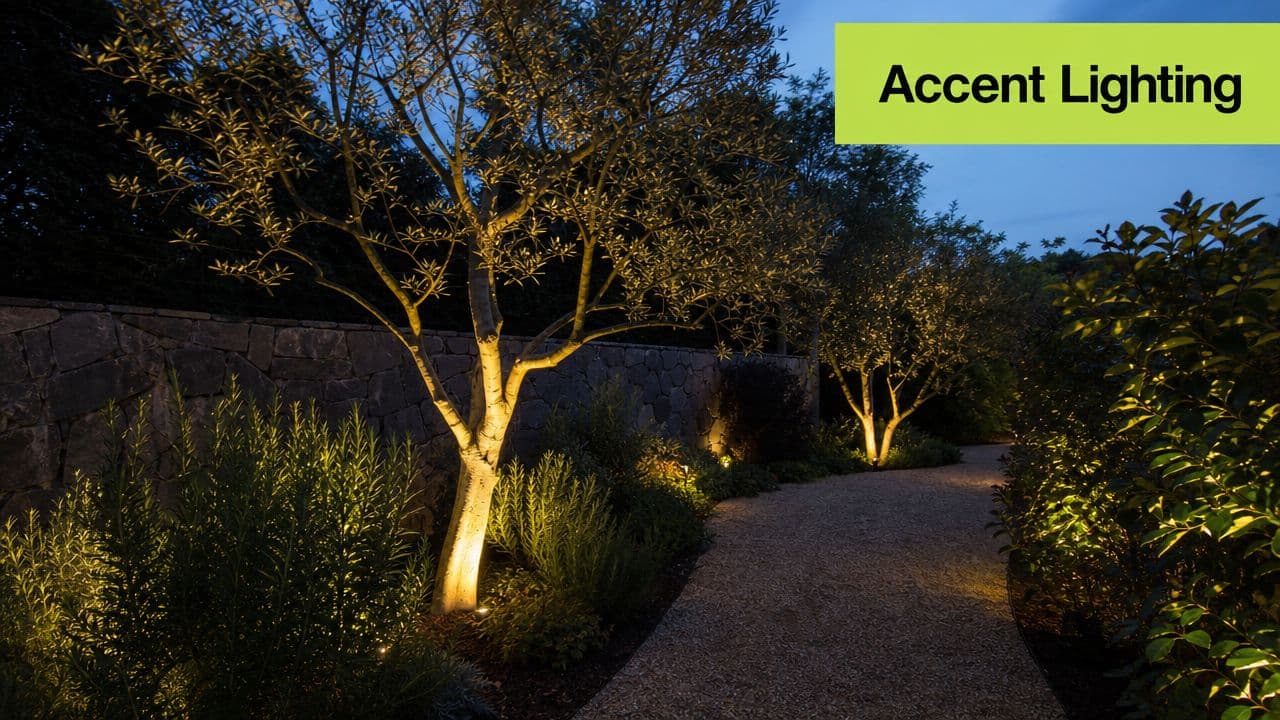
Not every pathway needs more path lights. Sometimes it needs better supporting light. Uplighting can turn an ordinary walk into a composed nighttime scene by pulling trees, grasses, stone walls, or entry columns into view.
This works especially well in outdoor settings where the path already has enough functional illumination but still feels flat. A pair of warm uplights under an olive tree, a sculptural agave, or a textured stone wall can do more for atmosphere than adding four extra stake lights.
Use accent light with restraint
For primary path visibility, the recommended light output is 50 to 100 lumens per fixture, with fixtures placed 1 to 2 feet from the path edge and aimed downward so the light falls on the walking surface rather than into eyes or the sky, based on Lapis Patios guidance for garden path lighting. Accent lighting is different. It supports the path. It shouldn't replace clear, safe wayfinding where people walk.
That's why I treat uplighting as a secondary layer. It creates depth, helps define focal points, and keeps the grounds from disappearing into a black border around the path.
A few habits keep it elegant:
- Aim for texture: Bark, stone, grasses, and architectural plants respond better than flat surfaces.
- Watch the spill: Badly aimed uplights shine into windows and neighboring yards.
- Use fewer fixtures than you think: A small number of accents usually reads as intentional.
If you want to test how that layered look will feel, ai for landscape design is a practical way to compare a plain path-light layout against one with selective tree or wall accents before you buy anything.
5. Recessed Step and Deck Lighting
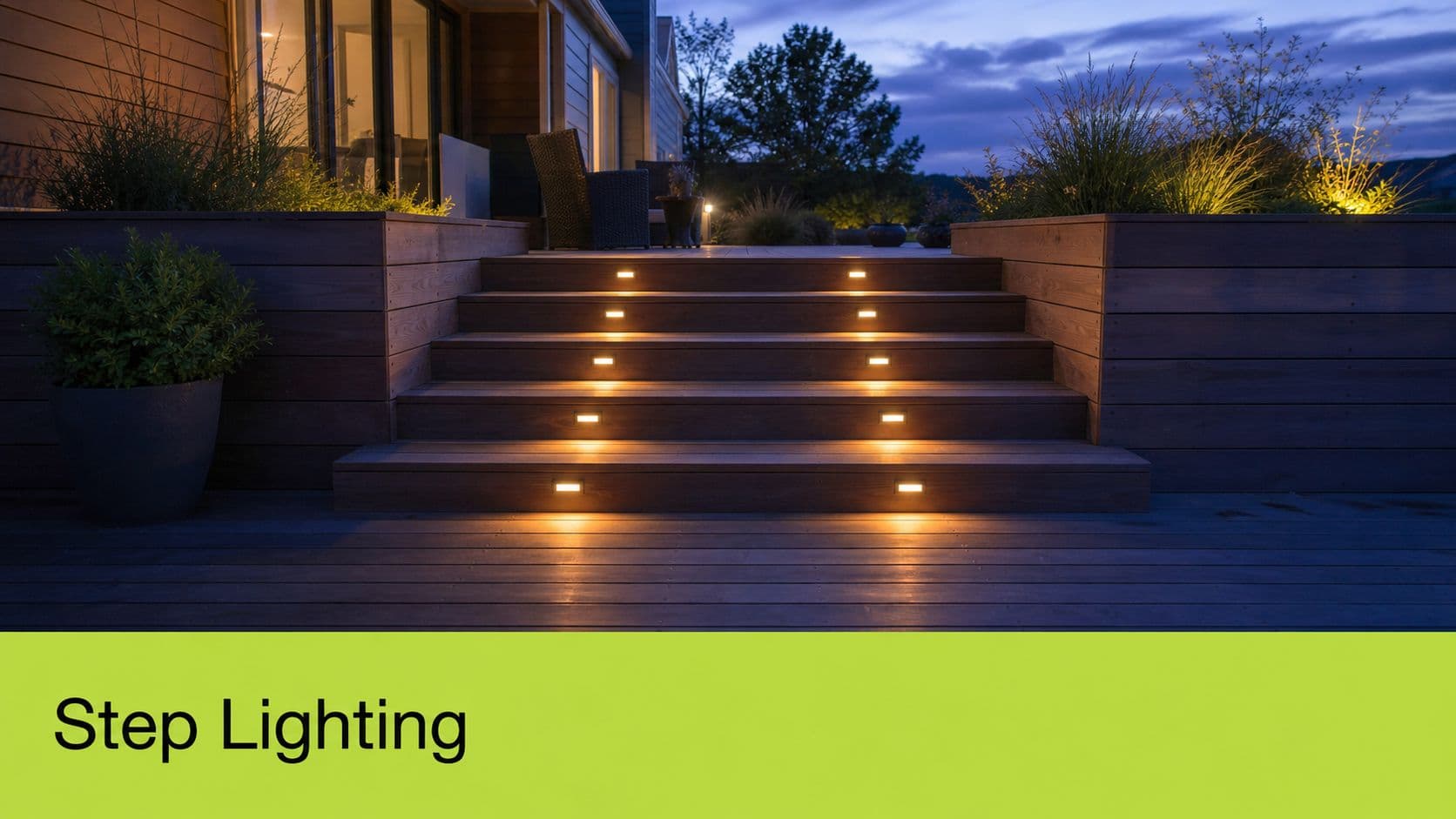
Recessed lights solve a specific problem well. You want safe edges and a clean look, but you don't want fixtures sticking up into the circulation zone. Built into steps, deck risers, seat walls, or retaining walls, they make modern outdoor areas feel polished.
They're especially strong on properties with level changes. A dark stair transition is where pathway lighting stops being decorative and starts being critical. Recessed fixtures define each step without cluttering the route with posts or stakes.
The cleanest look usually takes the most planning
This isn't the casual DIY option. Recessed lighting needs coordination with hardscape work, drainage, and wiring access. If the step design is already built, retrofit options exist, but they're rarely as well-integrated.
For larger walkways and broader circulation zones, taller pathway lights between 850mm and 1100mm are recommended, while smaller pathways work better with 450mm to 650mm fixtures, according to Homebuilding's guide to garden path lighting ideas. Recessed lights bypass that height question entirely, which is part of their appeal. They light from the structure itself.
This short video shows the effect clearly:
A few details matter:
- Plan drainage first: Water pooling around recessed housings shortens fixture life.
- Use diffused lenses on reflective materials: Wet pavers and hardwood can throw harsh glare.
- Layer with surrounding light: Recessed step lights define edges well, but they rarely light the whole outdoor area on their own.
For patios, stairs, and connected walkways, ai patio design generator helps you see whether flush fixtures alone are enough or whether the space also needs path lights or plant accents.
6. Bollard Pathway Lighting
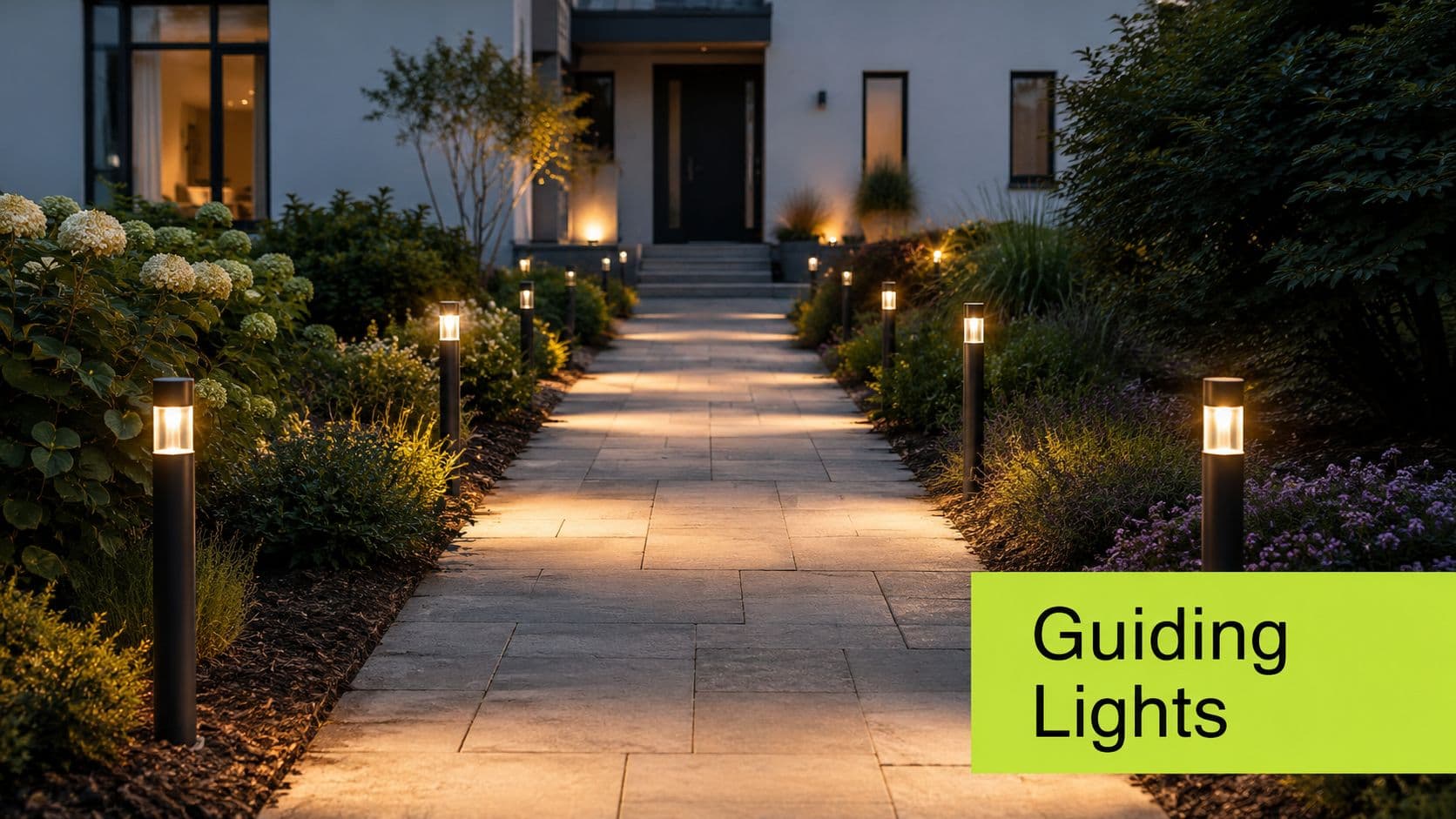
Bollards are more architectural than standard stake lights. They visibly mark the path, create a stronger sense of boundary, and suit wider walks, drive approaches, and contemporary gardens especially well. In the right setting, they look deliberate and substantial.
Many homeowners either get it very right or very wrong. The right bollard style reinforces the architecture. The wrong one looks like commercial site lighting dropped into a front yard.
Spacing matters more than most guides admit
Many generic articles push a rigid 6 to 8 foot rule, but spacing depends on beam spread and fixture height. Moonlight Design's guidance on arranging garden path lighting explains that smaller paths often suit 450mm to 650mm fixtures spaced 5 to 8 feet apart, while larger paths and taller fixtures often need 10 to 15 feet to avoid glare and visual clutter.
That tracks with practice. On a broad path, tightly packed bollards can feel aggressive. On a narrow walk, oversized posts dominate the space and make the route feel smaller.
A good bollard layout frames movement. A bad one turns the path into a line of obstacles.
Choose finish and form carefully. Sleek stainless models fit minimalist homes. Brass or stone-look bollards can work better in Mediterranean or traditional settings. If there's no existing power nearby, solar bollards can be a smart compromise, provided the site gets enough sun.
7. In-Ground Well Lights and Flush-Mount Fixtures
Well lights are subtle almost to the point of disappearing. That's their strength. You don't see a prominent fixture body, only a pool or shaft of light emerging from the ground. For minimalist grounds, Japanese-inspired gardens, and planting beds bordering a path, they can look elegant.
They're less useful as standalone pathway lighting than many people assume. A well light can define a specimen plant or wash a low wall beautifully, but by itself it often doesn't guide footsteps as clearly as a proper path light.
Best used as support, not as the whole plan
This category performs best when paired with another lighting layer. Use it to lift the canopy of a small tree near the walk, graze a textured trunk, or add soft glow beside a modern paver path. Don't rely on it alone where people need clear directional guidance.
Maintenance is also a real issue. Leaves, mulch, and soil collect fast at ground level. In wet climates, fixture quality matters a lot, and stainless steel or anodized aluminum bodies are worth favoring.
The practical upside is visual quiet. If you dislike the look of posts, caps, or stakes, well lights let the natural surroundings stay dominant during the day. That's hard to beat on clean, modern projects where every visible object matters.
8. Smart Motion-Sensor Pathway Lighting
Motion-sensor lighting works best where people need responsive light, not constant glow. Side yards, backyard connectors, service walks, and secondary entrances are ideal candidates. These are the areas where always-on lighting can feel wasteful or visually harsh.
Good motion-sensor fixtures make a property feel attentive. Someone rounds the corner and the route lights up. That's useful for safety, guests, pets, and late-night trips to bins, gates, or garages.
Put motion where movement actually happens
Many installs fail because the sensor points at the wrong thing. It catches passing cars, swaying branches, or nothing at all. Slightly higher sensor placement and real-world evening testing matter more here than fixture style.
This category pairs well with modern LED systems because LED has become the baseline for efficient outdoor lighting. According to Inside Lighting's report on LED adoption, LED accounted for approximately 48% of installed lighting units globally in 2020, up from 8% in 2015. In practical terms, motion sensing and LED belong together. You get instant-on performance with less upkeep than older lamp types.
A strong layout often uses two layers:
- Always-on lighting for the main front path: This keeps the primary entry welcoming and legible.
- Motion activation for side and rear routes: This adds safety without keeping every corner lit all night.
If you're trying to balance privacy, efficiency, and usability, this hybrid setup is usually smarter than putting motion sensors everywhere.
8-Option Pathway Lighting Comparison
A comparison table helps, but only if it reflects real installation trade-offs. The right fixture is not just the one that looks best in a product photo. It is the one that fits the path, the power source, the maintenance tolerance, and the level of nighttime use.
Use this chart to narrow the field before you buy. Then mock up the strongest options on your actual home with AI rendering in OutdoorBrite so you can test scale, spacing, and style before trenching cable or ordering fixtures.
| Item | Implementation Complexity 🔄 | Resource Requirements ⚡ | Expected Outcomes 📊 | Ideal Use Cases 💡 | Key Advantages ⭐ |
|---|---|---|---|---|---|
| Solar LED Pathway Lights | Low, stake-mounted and DIY-friendly, no wiring 🔄 | Low, direct sun + rechargeable battery; periodic battery or fixture replacement ⚡ | Moderate illumination; output varies with sun exposure and panel quality 📊 | Sunny residential paths, garden walks, quick upgrades 💡 | No wiring, low upfront effort, easy to test layout changes ⭐ |
| Low-Voltage Halogen Pathway Lighting | Moderate to high, requires cable runs and transformer sizing; pro install often makes sense 🔄 | High, transformer, buried wiring, lamp replacements, ongoing power use ⚡ | Strong, reliable brightness with warm output night after night 📊 | Long paths, entry routes, safety-focused installations, upscale properties 💡 | Bright output, dependable performance, familiar warm tone ⭐ |
| Smart LED Pathway Lighting | Moderate, requires power planning plus app and network setup 🔄 | Medium, wired or battery power, stable Wi‑Fi or Bluetooth, occasional firmware updates ⚡ | Adjustable brightness, color temperature, scheduling, and scene control with efficient operation 📊 | Tech-focused homes, front entries, owners who want control without rewiring later 💡 | Remote control, scheduling, tunable light, easier long-term adjustment ⭐ |
| Uplighting and Accent Pathway Lighting | Moderate, depends on aiming, layering, and restraint in the layout 🔄 | Medium, focused fixtures, power source, and more planning than standard path lights ⚡ | Strong visual depth and selective highlighting rather than full route illumination 📊 | Highlighting trees, architectural details, focal plantings, high-impact entry sequences 💡 | Adds depth, improves curb appeal, creates a more intentional nighttime composition ⭐ |
| Recessed Step and Deck Lighting | High, built into steps, walls, or decking with careful waterproofing and exact placement 🔄 | High, best planned during construction or renovation, durable fixtures, skilled labor ⚡ | Clean, integrated safety lighting with subtle edge definition 📊 | New builds, decks, stairs, retaining walls, contemporary outdoor living areas 💡 | Low visual clutter, strong safety benefit, polished built-in look ⭐ |
| Bollard Pathway Lighting | Moderate, needs proper spacing, alignment, and stable mounting 🔄 | Medium, bollards, base prep, and either wiring or solar components ⚡ | Clear path definition with broader light distribution than small stake lights 📊 | Public paths, formal gardens, larger entries, shared-use walkways 💡 | Strong guidance, architectural presence, works well on wider routes ⭐ |
| In-Ground Well Lights & Flush-Mount Fixtures | High, requires recessed installation, drainage planning, and careful sealing 🔄 | Medium, low-voltage supply, sealed housings, routine cleaning to prevent debris buildup ⚡ | Low-profile illumination and subtle uplight effects with little daytime visibility 📊 | Minimalist gardens, hardscape edges, feature lighting where visible fixtures would feel intrusive 💡 | Nearly invisible by day, refined effect at night, minimal visual impact ⭐ |
| Smart Motion-Sensor Pathway Lighting | Moderate, depends on sensor aiming, trigger range, and sometimes app setup 🔄 | Low to medium, sensors plus solar or wired power, occasional recalibration ⚡ | Light appears only when needed, improving efficiency and short-term visibility 📊 | Side yards, service walks, secondary paths, security-focused routes 💡 | Lower energy use, responsive safety lighting, less unnecessary nighttime glow ⭐ |
Visualize Your Perfect Pathway Before You Begin
The best pathway lighting ideas don't start with a fixture. They start with the path itself. How wide is it, how often is it used, where does it fall into shade, and what should the yard feel like after dark. Those questions matter more than whether a product photo looks good online.
That's why so many disappointing installs come from copying a generic formula. A narrow brick front walk doesn't need the same solution as a broad poured-concrete side path. A sunny open yard can use solar effectively, while a tree-covered garden usually needs wired reliability. Recessed lights can look beautiful in steps, but they won't replace proper guidance across an entire route. Bollards can add architecture, but they can also overpower a small entry if the scale is off.
The technical side matters too. Beam spread, fixture height, edge offset, glare control, and maintenance access all affect the result. A path can have expensive fixtures and still look wrong if the spacing is too tight, the output is too harsh, or the accents compete with the walking surface. Good lighting feels easy when you use it, even though the planning behind it is not.
That's where visualization saves money. Before you trench for low-voltage cable, commit to smart fixtures, or order a dozen solar stakes, it helps to see the concept on your actual house and yard. OutdoorBrite makes that practical. Upload a photo, test different fixture styles, compare layout options, and get a realistic sense of how the space may read at night. It's a faster way to answer the questions people usually answer too late, after installation.
For homeowners and renters, that reduces guesswork. For DIY gardeners, it helps sort out what's worth doing now versus later. For anyone trying to improve curb appeal without wasting money, it's one of the easiest ways to avoid buying fixtures that fight the home instead of fitting it.
Pathway lighting should guide, flatter, and simplify movement after dark. If it's doing those three things, you're on the right track.
OutdoorBrite helps you test pathway lighting ideas before you spend money on fixtures, wiring, or hardscape changes. Upload a yard photo to OutdoorBrite, generate photorealistic concepts in seconds, and compare styles for front walks, garden paths, patios, and side yards with far less guesswork.
See your yard reimagined
Start creating