Pergola Design Ideas: Transform Your Backyard in 2026
Explore stunning pergola design ideas, from modern minimalist to rustic farmhouse. Get practical tips to transform your backyard.
You're standing in a backyard that almost works. The patio feels unfinished, the seating area has no real definition, and the afternoon sun makes the whole space less usable than it should be. A pergola changes that fast, because it gives the yard structure, shade, and a clear reason to go outside.
Pergolas also have deep roots. Their history stretches back to around 1400 BCE in ancient Egypt, where early pergola-like structures created shaded walkways and entryways in hot climates, which is a useful reminder that the core job of a pergola has always been practical, not just decorative (pergola history). That's why the best pergola design ideas still start with use first, style second.
Today, the right design depends on how you want to live outside. Some pergolas should frame a dining table, others should calm a garden path, and some need to handle real weather, not just look good in a rendering. If you're comparing styles, materials, and layouts, the fastest way to move from inspiration to a workable plan is to visualize the space before you build. For exterior lighting inspiration that pairs well with pergola planning, the Golden Lighting exterior fixtures resource is a useful reference point.
Table of Contents
- 2. Mediterranean Pergola with Climbing Vines
- 2. Mediterranean Pergola with Climbing Vines
- 3. Japanese Zen Pergola
- 4. Rustic Farmhouse Pergola
- 5. Retractable/Adjustable Shade Pergola
- 6. Attached Pergola House-Integrated
- 7. Tropical Paradise Pergola
- 8. Industrial Modern Metal Pergola
- 9. Curved Arched Pergola Design
- 10. Multi-Level Tiered Pergola System
- 10 Pergola Designs, Quick Comparison
- Visualize Your Vision Before You Build
2. Mediterranean Pergola with Climbing Vines
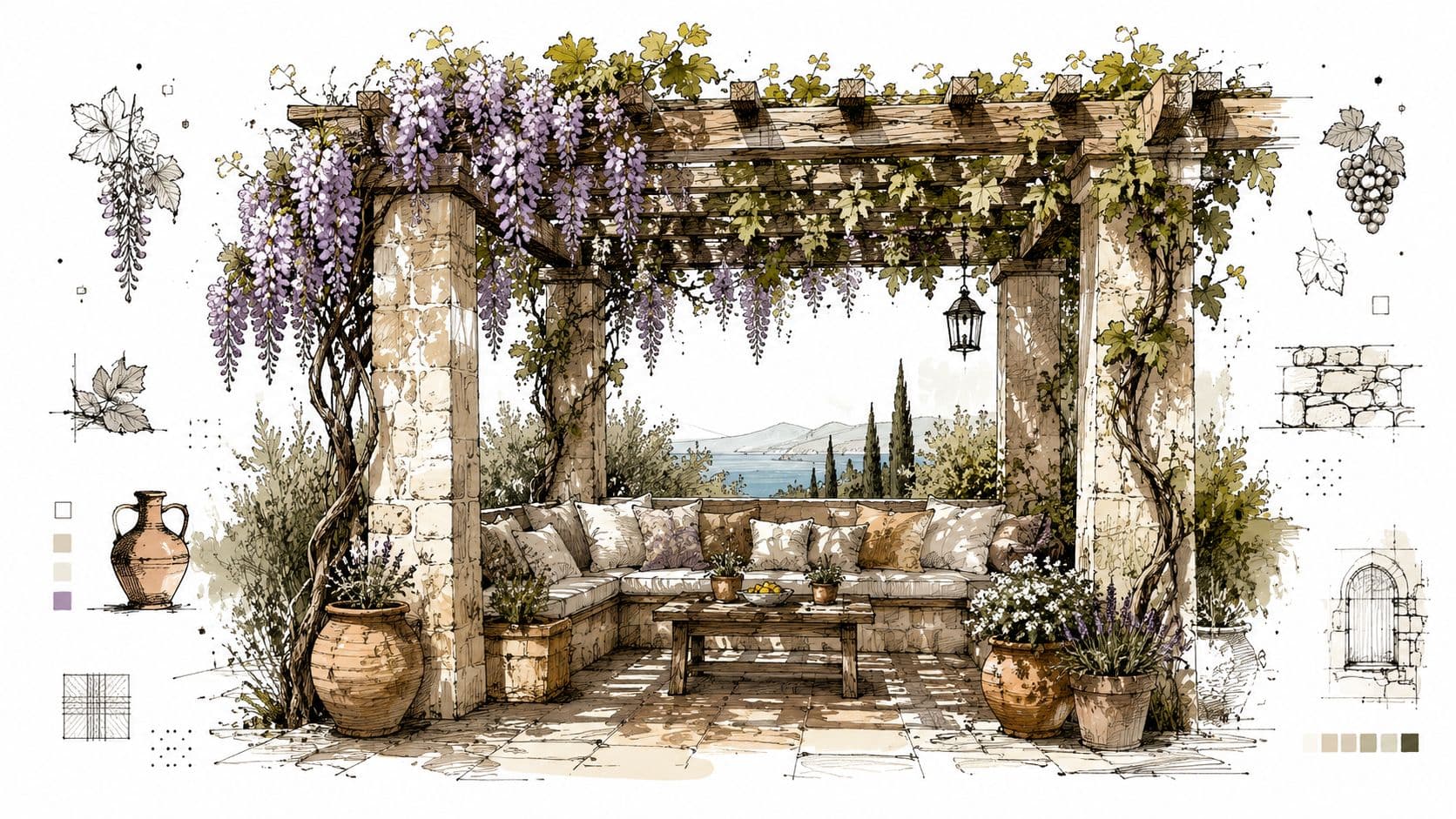
A Mediterranean pergola works well if you want a yard that feels settled rather than newly installed. Timber posts, stone paving, and climbing plants soften hard edges, and the result is a space that looks rooted in the property instead of added as an afterthought. It suits homeowners who want warmth and character, but it also asks for patience, because the planting has to grow into the structure.
The biggest trade-off is coverage. Vines do not fill a frame overnight, so the first seasons often feel open and airy before the canopy thickens. That matters for both shade and privacy, and it means the bare structure needs to look good on its own while the planting matures. A pergola like this should be planned as a long-term composition, with the frame, paving, and plants working together from the start.
Design choices that age well
Clematis, honeysuckle, and climbing roses suit this style because they bring softness without making the pergola feel heavy. Terracotta pots, warm stone flooring, and simple rustic seating reinforce the Mediterranean feel, especially near an outdoor dining table or in a sheltered courtyard. The frame itself should stay calm and straightforward so the plants remain the main visual layer.
Material choice matters here too. Wood gives the most natural look, but it needs more upkeep than metal or composite options. Stone or stone-look paving helps ground the design, while lighter finishes can keep the space from feeling too dense once the vines fill in. If your climate is windy or very sunny, choose plants and finishes that can handle exposure without constant repair.
Use garden ai design to test how the pergola will read once the vines start climbing. A bare frame and a mature one are two very different spaces, so it helps to compare early-stage, mid-stage, and full-growth views before you buy materials. That visual check also makes it easier to judge whether the structure still feels balanced from the patio, the kitchen door, and the main seating area.
For a calmer, more restorative layout, refer to Pinnacle Property Media's backyard guide. A Mediterranean pergola works best when the rest of the yard supports that feeling, with planting, circulation, and seating arranged to keep the space quiet and usable rather than crowded.
2. Mediterranean Pergola with Climbing Vines
A Mediterranean pergola gets better with age, which is why it's one of the most forgiving styles for homeowners who want romance without fuss. Wooden posts, stone pavers, and climbing plants create a lived-in feel that softens hard edges and makes the backyard feel established.
This style has to account for plant performance, not just plant color. Existing pergola inspiration content notes that climbing vines may reach only 60% to 80% coverage after 2 to 3 seasons, which means the early years will look airy rather than fully shaded (shade and vine performance notes). That's a real trade-off, but it's also part of the appeal if you want a pergola that matures naturally.
Design choices that age well
Clematis, honeysuckle, and climbing roses suit this look because they bring texture without making the frame feel bulky. Terracotta pots, warm stone flooring, and rustic seating reinforce the style, especially around a dining table or a side courtyard.
Use garden AI design to visualize how dense vine coverage will look in two or three growing seasons, not just on install day. That matters because a pergola that feels perfect when bare may look very different once the plants establish. Seasonal controls are especially useful here, since you can compare summer fullness with winter openness and see whether the structure still feels balanced in both states.
3. Japanese Zen Pergola
A Japanese Zen pergola works best when every detail feels intentional. The proportions are calm, the materials are natural, and the planting is restrained enough that the structure never loses its sense of quiet.
Natural wood is the usual starting point, but the key difference comes from placement. A Zen pergola near a water basin, stone path, or meditation seat creates a visual pause in the yard rather than a large social zone. That makes it a strong choice for small courtyards and for homeowners who want one corner of the property to feel separate from the rest of daily life.
Build the mood, not just the frame
Use OutdoorBrite's Japanese Zen preset to test beam spacing, roof height, and the relationship between the pergola and nearby plantings. Japanese maple and bamboo can work well, but only if the composition stays simple enough for the eye to rest.
Keep the palette quiet, then let texture do the work.
The lighting should be subtle, not theatrical. Soft illumination at ground level, a stone lantern, or a low wash on the posts usually feels more authentic than bright overhead fixtures. A garden guide focused on meditation spaces also pairs well with this approach, especially the Pinnacle Property Media backyard guide, which aligns with the same calm, retreat-like use case.
4. Rustic Farmhouse Pergola
Rustic farmhouse pergolas work because they feel easy to live with. Thick wooden beams, weathered finishes, and cottage-garden planting give the space a familiar character, so it reads as part of the yard instead of a display piece. That makes it a natural fit for family backyards and casual entertaining areas.
This style is a strong choice if you want warmth over polish. It pairs well with string lights, relaxed seating, and mixed planting, and it does not depend on perfect symmetry to feel finished. A farmhouse pergola also tends to age well, especially when the wood finish complements the home's siding, porch trim, or fencing.
Where the style can go wrong
The most common mistake is making it too delicate. A rustic farmhouse pergola should feel sturdy, and the proportions need to match the scale of the house. If the posts are too thin, the structure starts to look like decoration instead of part of the architecture.
A practical way to test the look is to upload a photo of the house into OutdoorBrite and compare stain options before you build. That helps you judge whether a darker, weathered tone or a cleaner natural finish works better with the exterior. Climbing roses, hydrangeas, and flowering vines help the frame feel rooted in the setting, while vintage lanterns and soft seating keep the area from feeling staged.
For this type of pergola, the layout should hold together in layers, wood, plants, light, then furniture. If one layer is missing, the result usually feels unfinished.
Use the patio design ai tool to test the beam depth, post spacing, and finish against your actual yard photo before you commit to materials. If you plan to add motorized sun control, The Drapery Company's sun shade guide at https://draperycompany.com/motorized-sun-shades-for-patio/ is a useful reference for choosing a system that suits a pergola used for everyday shade and casual outdoor meals.
5. Retractable/Adjustable Shade Pergola
A retractable pergola solves a problem that static designs can't. Morning sun, afternoon glare, light rain, and changing seasons all call for different levels of coverage, so adjustable roofs and sliding panels give you control instead of forcing one fixed outcome.
Performance matters more than decoration. Market guidance notes that fixed louvers or slats can provide about 70% to 90% shade, while polycarbonate inserts can deliver full rain protection while still admitting light (roof treatment performance notes). That's useful because the right roof depends on whether you care most about cooling, daylight, or weather protection.
Match the system to the way you use the space
Motorized louvers make sense for outdoor dining areas, because you can open them for sky views and close them when the sun shifts. Retractable canopies work well when you want a softer feel and don't need hard-weather protection all year.
Use OutdoorBrite to test open and closed positions against your actual yard photo, then compare shadow patterns at different times of day. That helps you see whether the structure will shade the seating zone or just the table edge. If you plan to connect the system to a smart home setup, do it early in the design process so the controls don't feel bolted on later.
Video reference for this style can be helpful when you want to study motion and coverage. A guide from The Drapery Company sun shade guide fits naturally with the same adjustable-shade conversation.
6. Attached Pergola House-Integrated
An attached pergola is the strongest choice when you want the backyard to feel like a direct extension of the house. It creates a smooth transition from interior to exterior, and it usually performs best over a patio or deck that sits right off the main living area.
This type of structure needs careful sight-line planning. Existing design guidance suggests a dining pergola should be at least 12 ft × 12 ft for a 6-seat table, with about 36 inches of chair pullback on all sides, while another layout approach recommends a 10 ft × 10 ft lounge pergola or adding roughly 2 feet per side beyond the furniture footprint (pergola sizing guidance). Those sizing cues matter more here than in a freestanding garden feature, because an attached pergola affects the feel of the room inside the house too.
Make the transition look intentional
Match the pergola to the home's existing trim, roof color, and column profile. If the connection to the wall looks improvised, the whole structure loses its value.
Use patio design ai to test how the pergola lines up with doors and windows before installation. That's especially useful if you're trying to avoid darkening a family room or blocking a view from the kitchen. A well-placed attached pergola should define the patio without making the interior feel closed in.
This is the style I'd choose for homeowners who entertain often and want the easiest indoor-outdoor flow.
7. Tropical Paradise Pergola
A tropical pergola works when the planting feels abundant and layered. Broad leaves, bright accents, and water nearby create a resort-like atmosphere, but the design only succeeds if the structure can handle visual richness without turning chaotic.
The trick is to keep the architecture simple and let the natural setting do the talking. In tropical-inspired yards, the pergola often acts as a frame for lush plantings rather than the star of the show. That means strong posts, a clear roof rhythm, and enough open space for air movement.
Use color with restraint
Bright cushions, warm accent lighting, and natural textures like rattan or teak can support the look without overwhelming it. If you're adding torches or a water feature, place them with purpose so the scene feels layered, not crowded.
Upload existing yard photos to OutdoorBrite and preview different tropical planting schemes before buying materials. That lets you see whether your space can carry bold foliage or whether it needs a lighter, more open version of the style. The best tropical pergolas usually work with the house instead of competing with it, especially in compact yards where too much planting can make the area feel smaller.
A tropical pergola should feel like a vacation, but it still needs circulation, shade, and clear access paths. If people have to squeeze through plants to use it, the mood falls apart quickly.
8. Industrial Modern Metal Pergola
An industrial metal pergola has a strong presence because it doesn't hide how it's built. Steel, iron, or aluminum frames create a direct, architectural look that suits homes with loft-style interiors, monochrome exteriors, or sharp contemporary landscaping.
This style is often the right answer when you want durability and low maintenance without giving up visual strength. As noted earlier, aluminum is one of the fastest-growing material directions in the market, and that aligns well with the industrial look because slim metal profiles can feel precise instead of heavy. It's a good option for homeowners who want the structure to hold its own against stone, concrete, or black-framed glass.
Soften the edges without losing the style
Warm lighting under the beams helps a lot here. Without it, the space can feel too cold or severe at night.
Pair the frame with container plants instead of dense climbing vines if you want to keep the form crisp. Black, corten, and natural aluminum finishes all work, but the best choice depends on how much contrast the home already has. If the landscaping includes a fire feature or a modern water element, the pergola can echo those materials and feel much more integrated.
Industrial doesn't have to mean harsh. It works best when the lighting and planting temper the metal, not when they compete with it.
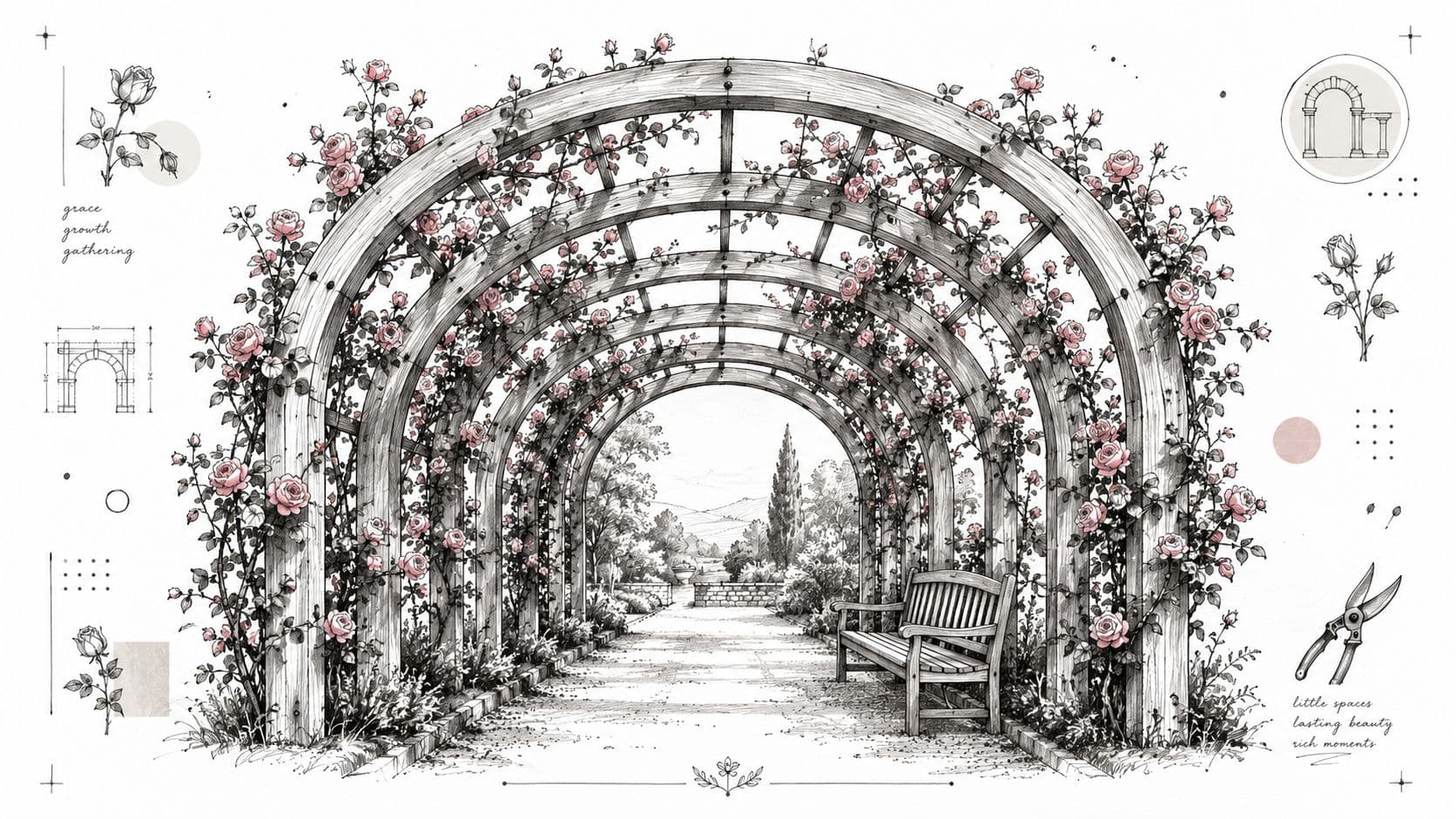
9. Curved Arched Pergola Design
A curved or arched pergola brings softness to a yard that otherwise relies on straight lines. The shape feels more formal and romantic, which is why it works beautifully as a garden entry, a path marker, or a focal point at the end of a vista.
This style deserves more room than many homeowners expect. Because the curve is the feature, it needs clear viewing angles and enough depth for the shape to register. On smaller lots, an arch can feel decorative in a good way. On larger properties, it can become a real destination.
Make proportion do the heavy lifting
Train climbing roses or clematis along the curve if you want the structure to feel alive rather than purely architectural. Light placed from below can make the arch dramatic at night, especially when the pergola sits between two garden zones.
Use OutdoorBrite to preview the shape from multiple angles, not just head-on. That's important because arched structures often look best in perspective, and a camera view can reveal whether the curve is too shallow or too tall for the space. This style pairs well with formal planting, historic homes, and properties where the garden already has a sense of procession.
10. Multi-Level Tiered Pergola System
A multi-level pergola system is the most ambitious option on this list, and it makes sense when the property has elevation changes or when you want separate outdoor zones that still feel connected. Different heights can define dining, lounging, and transitional spaces without building walls.
This is also the style that benefits most from planning tools, because small mistakes in level changes or post placement can make the whole layout feel awkward. Use OutdoorBrite to test the structure on a sloped site and compare how the tiers read from the house, the garden, and the primary seating area. If the levels don't relate to each other visually, the design can feel fragmented rather than cohesive.
Use layers to organize movement
Distinct materials or finishes can help each level feel intentional, especially when the upper structure shades one zone and the lower structure frames another. Accessibility and circulation matter here, because a tiered design should guide movement rather than force it.
The ai deck design tool fits naturally with this kind of layered planning, especially if your pergola needs to coordinate with stairs, decks, and terraced planting beds. That coordination is what makes tiered systems feel elegant instead of overbuilt.
On sloped properties, the best pergola isn't always the simplest one. It's the one that follows the land without fighting it.
10 Pergola Designs, Quick Comparison
| Style | 🔄 Implementation Complexity | ⚡ Resources & Maintenance | ⭐ Expected Outcome | 📊 Ideal Use Cases | 💡 Key Tip |
|---|---|---|---|---|---|
| Modern Minimalist Pergola | Medium, precision fabrication; often pro install | Premium metals/composites; higher upfront cost; low upkeep | ⭐⭐⭐⭐, Sleek, upscale look; partial shade; photogenic | Modern homes; small urban patios; real-estate staging | Soften with plants and add integrated lighting or motorized shades |
| Mediterranean Pergola with Climbing Vines | Medium, carpentry + planting over time | Timber or stone; ongoing pruning/treatment; moderate cost | ⭐⭐⭐⭐, Romantic, sun‑dappled aesthetic that improves in 2–3 yrs | Mediterranean/wine‑country homes; established gardens; romantic entertaining | Select fast‑growing vines and plan irrigation and pruning schedules |
| Japanese Zen Pergola | High, requires design knowledge and skilled installation | Natural woods (cedar/teak) with sealing; specialty materials; moderate‑high cost | ⭐⭐⭐⭐⭐, Tranquil, meditative retreat; strong property appeal | Wellness/meditation spaces; Japanese gardens; Zen enthusiasts | Prioritize proportion, native plantings, and subtle water features |
| Rustic Farmhouse Pergola | Medium, conventional carpentry with attention to finish | Reclaimed/weathered wood; regular staining and plant care; budget‑flexible | ⭐⭐⭐⭐, Warm, inviting gathering space; widely appealing | Farmhouse homes; family gathering areas; garden enthusiasts | Use vintage lighting, abundant plantings, and cozy seating for authenticity |
| Retractable/Adjustable Shade Pergola | High, motorized systems and electrical work; complex install | Motorized louvers, smart controls; highest upfront cost; ongoing maintenance | ⭐⭐⭐⭐⭐, Maximum flexibility; extends outdoor season; weather protection | Tech‑forward homeowners; hot climates; luxury properties | Integrate with smart home systems and plan for maintenance/drainage |
| Attached Pergola (House‑Integrated) | High, structural tie‑in, permits, engineer review required | Higher installation cost; matched materials; requires permits/pro install | ⭐⭐⭐⭐, Seamless indoor‑outdoor extension; functional and cohesive | Patio extensions; deck coverings; homeowners seeking integrated design | Consult a structural engineer and test sight lines/shadowing before building |
| Tropical Paradise Pergola | Medium, planting complexity; water features add systems work | Lush tropical plantings, irrigation, possible water features; ongoing care | ⭐⭐⭐⭐, Resort‑style, immersive vacation feel; highly photogenic | Warm‑climate homes; vacation properties; resort‑style entertaining | Layer plant heights, add water features, and test bright accent colors |
| Industrial/Modern Metal Pergola | Medium‑High, expert welding and precise installation | Steel/aluminum; high upfront cost; very durable; low routine maintenance | ⭐⭐⭐⭐⭐, Bold architectural statement; extremely long‑lasting | Industrial conversions; urban lofts; contemporary modern homes | Soften with warm lighting and container plantings; preview patina and finishes |
| Curved/Arched Pergola Design | High, custom fabrication; skilled carpentry/welding needed | Custom materials and fabrication; higher cost; specialized labor | ⭐⭐⭐⭐, Dramatic, romantic focal point; frames views | Formal gardens; estates; garden entries and pathways | Use as a focal element; train climbing vines and verify proportions carefully |
| Multi‑Level/Tiered Pergola System | Very High, complex engineering and coordination | Multiple connected structures; terraced landscaping; high cost & upkeep | ⭐⭐⭐⭐⭐, Maximizes usable space; creates varied functional zones | Sloped/hillside properties; large estates; multi‑zone entertaining | Plan sight lines, accessibility between levels, and differentiate materials/finishes |
Visualize Your Vision Before You Build
Choosing a pergola is really about choosing how you want the backyard to behave. A modern minimalist frame gives you clean geometry and control, while a vine-covered Mediterranean pergola builds character over time. A retractable system solves sun and weather problems, and an attached pergola turns an ordinary patio into a true extension of the home.
The smartest part of the process is not buying first, it's visualizing first. OutdoorBrite lets you upload a photo of your yard and see how different pergola design ideas look in your actual space, with materials, plantings, lighting, and seasonal conditions all playing a role in the preview. That matters because the same pergola can feel elegant in one yard and oversized in another, especially when you're dealing with shade, circulation, or sight lines from the house.
Use the visual plan to answer the questions that matter before you commit. Does the pergola block a window? Does the seating fit without crowding? Will the roof treatment give enough shade for how you really use the space? Those answers are easier to see in a rendering than in a rough sketch, and they help you avoid expensive changes later.
OutdoorBrite also supports fast concept testing for homeowners, DIY renovators, and professionals who need to compare options quickly. If you're trying to narrow down materials, check proportions, or see how a pergola will integrate with a patio or deck, a photo-based preview is the most practical next step.
If you're ready to turn a rough backyard idea into a pergola plan you can trust, visit OutdoorBrite Money and upload a photo of your space. You can compare styles, test layouts, and see how a pergola will fit before you spend on materials or construction.
See your yard reimagined
Start creating