10 Best Plants That Require Little Water for 2026
Create a beautiful, low-maintenance garden with our list of plants that require little water. Discover top succulents, perennials, and shrubs for any climate.
High water bills usually show up before most homeowners realize the underlying issue. The lawn is thirsty, the border plants are mismatched, and the “low-maintenance” shrubs still need regular irrigation because they were planted in the wrong spot or never established properly. By midsummer, the yard looks tired and the water use keeps climbing.
A better approach starts with plants that require little water and a layout that treats water as a design constraint, not an afterthought. Drought-tolerant design isn't just a style choice. It's a water-management strategy built around plant groups that can survive with little or no supplemental irrigation once established. The New York Botanical Garden recommends organizing outdoor areas into high-, moderate-, and low-water-use zones, with the largest number of plantings in the low-water-use zone, where established plants need no supplemental irrigation, as outlined in its drought-tolerant landscaping guidance.
That's the part many plant lists skip. “Low water” doesn't mean “plant it and walk away.” Most drought-tolerant plants need careful watering early on while roots develop, then they settle into a much easier rhythm. Once you understand that trade-off, the plant palette opens up fast. You're not limited to cactus and gravel.
Below are ten plants I'd use for a water-wise yard, along with practical placement advice and ways to preview them with OutdoorBrite before you plant anything.
1. Agave (Agave americana)
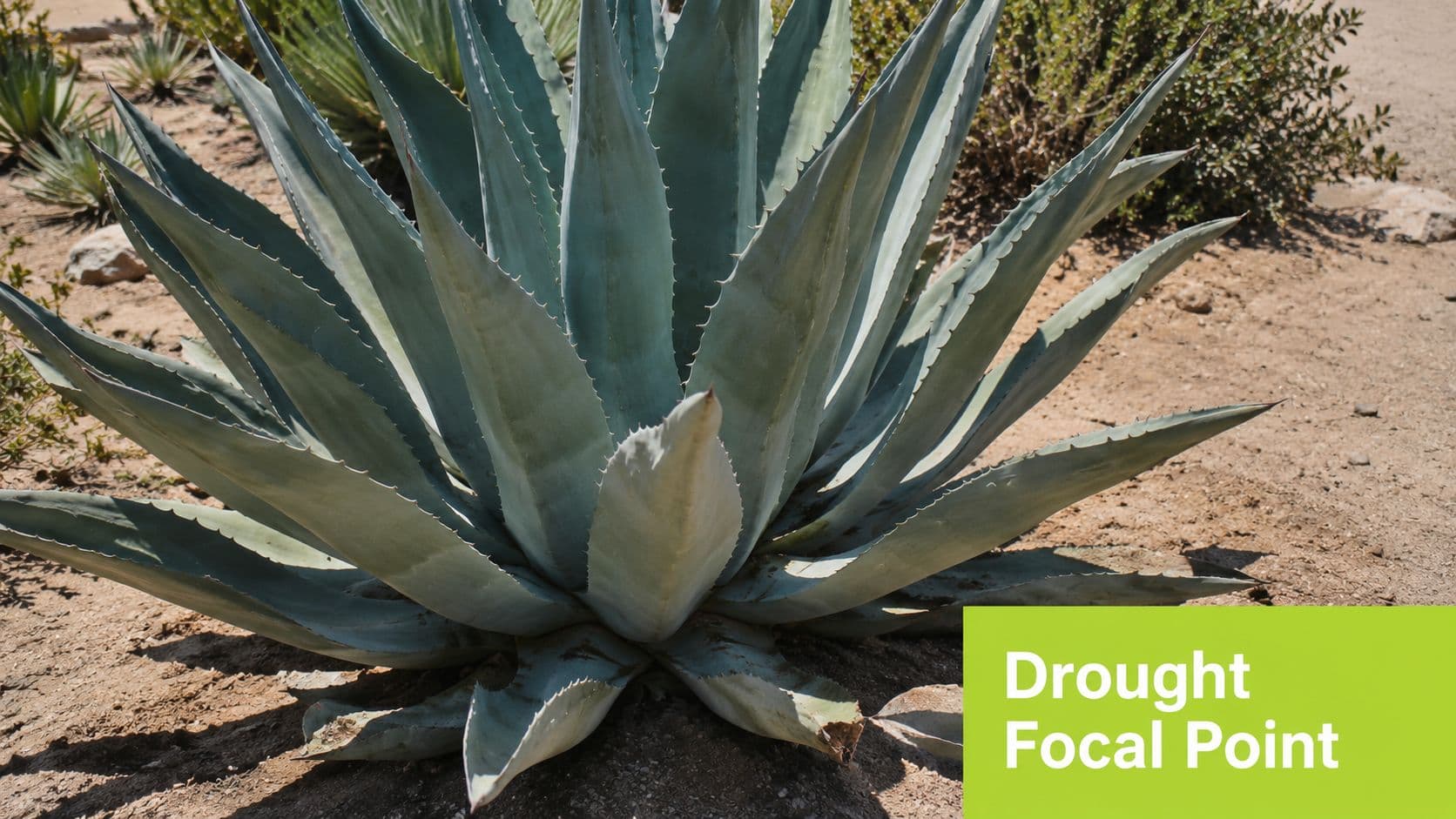
Agave is one of the clearest focal-point plants in dry-climate design. It brings structure immediately. One mature rosette can anchor a gravel bed, define an entry sequence, or give a modern front yard the kind of strong geometry that softer perennials can't provide.
What works is restraint. Agave looks best where the form has room to read cleanly. What doesn't work is tucking it near walkways, play areas, or tight porch steps where the leaf tips become a hazard.
Best use in the landscape
If you want a bold front-yard composition, start by testing agave in OutdoorBrite with the Modern or Mediterranean styles. That's especially useful when you're trying to find sustainable front yard makeovers without guessing at scale.
A few practical rules matter here:
- Give it breathing room: Keep agave well away from foot traffic.
- Use it as an anchor: Pair it with lower companions so the rosette stays dominant.
- Skip rich soil: Agave performs better in lean, fast-draining conditions than in heavily amended beds.
Practical rule: The sharper and more architectural the plant, the more negative space it needs around it.
Container growing is a smart option for renters or anyone testing a temporary layout. It also lets you use agave near patios without committing to an in-ground planting. I like it with gravel mulch, boulders, and a few softer accents such as fine-textured grasses or low succulents.
2. Russian Sage (Perovskia atriplicifolia)
A bed can have all the right low-water plants and still look stiff by midsummer. Russian sage fixes that. It brings movement, a silvery cast, and weeks of color, which is why I use it to loosen compositions that feel too heavy or too static.
Its best role is not as a specimen. Russian sage reads strongest as a repeated layer that catches light and softens harder forms nearby. Plant it where full sun can dry the crown quickly and where the flower spikes have room to arch without flopping onto a path.
Where it shines
I get the best results by using it in groups, usually behind mounding perennials or alongside upright grasses. The contrast in texture does the design work. You get a soft blue-violet veil in summer, but you still need to respect the trade-off. In rich soil or frequent irrigation, Russian sage often grows too lush and loses its shape.
If you want to test that balance before planting, AI design software is useful for previewing spacing, mature scale, and color pairings. Russian sage can read as airy and intentional or messy and oversized, depending on how tightly you pack the bed. Seeing it in a visual plan helps you decide whether it should sit as a middle layer, edge a walk with enough setback, or bridge stronger plants such as agave and sedum.
A few practical guidelines help:
- Plant in groups: Three or more usually reads better than a single isolated plant.
- Keep the soil lean: Average to fast-draining soil gives you better structure than heavily amended beds.
- Pair by contrast: Use bold forms or rounded plants nearby so the fine texture stands out.
- Give it sun: Less light means weaker stems and fewer flowers.
Cut it back in early spring once new growth starts to show. If the site stays wet in winter or after irrigation, choose something else or improve drainage first. Russian sage is forgiving in heat and dry air. It is much less forgiving of soggy roots.
3. Desert Marigold (Baileya multiradiata)
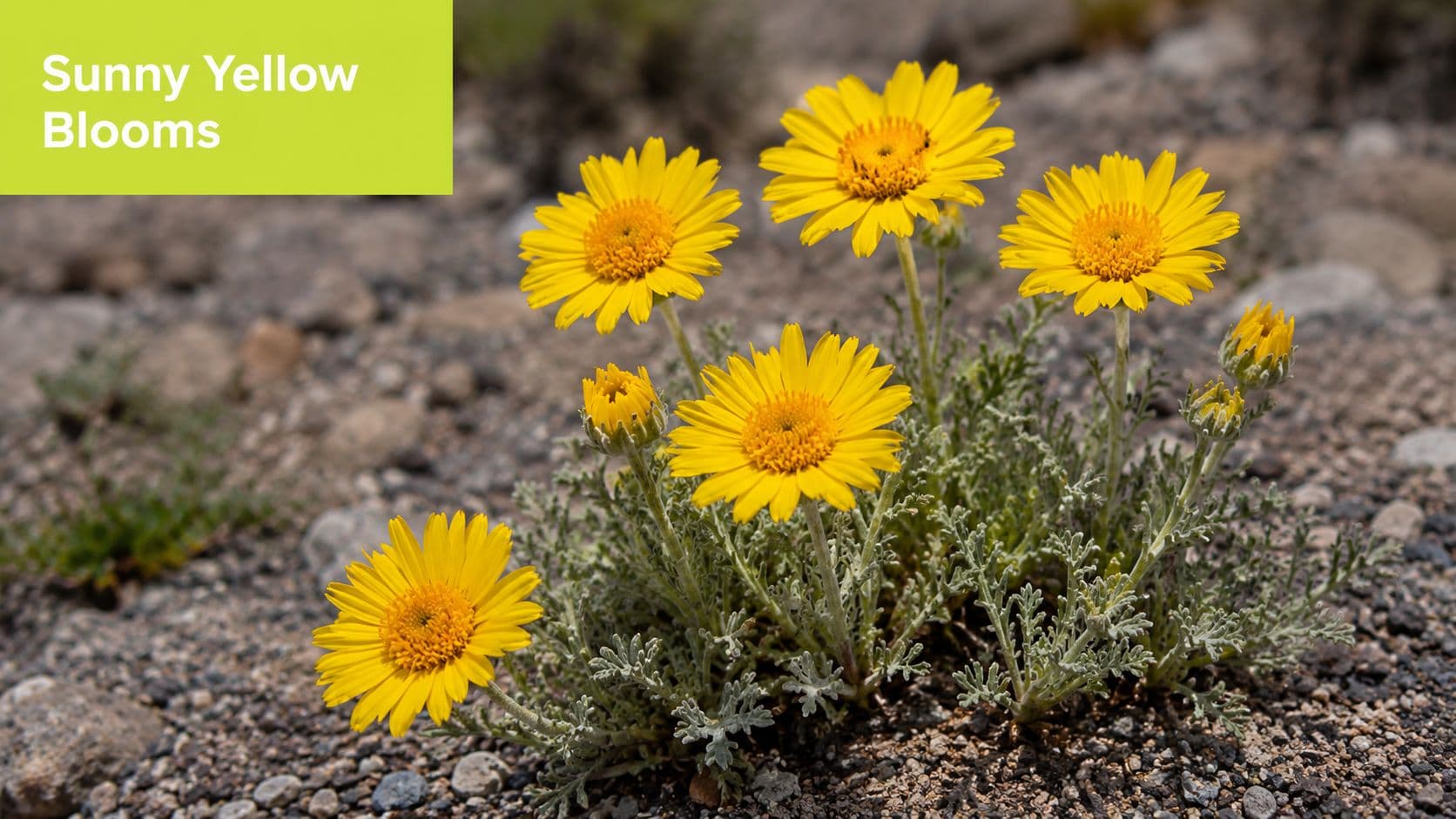
Desert marigold brings cheerful color without asking for much. The gray-green foliage already looks adapted to dry conditions, and the yellow flowers read clearly from the street, which makes this a useful plant for curb appeal in arid or semi-arid designs.
This is a better choice for relaxed, naturalistic beds than for formal gardens. It wants to look easy. If you force it into a rigid border with clipped shrubs and tight symmetry, it can feel out of place.
How to make it look intentional
The best move is massing. Desert marigold is more convincing in a drift than as a single specimen. Let it repeat across a gravel garden or weave it through decomposed granite with a few stronger structural plants nearby.
A good visual pairing is yellow against purple or blue-flowering neighbors. That contrast does a lot of work, especially in hot-sun settings where subtle color differences can disappear at a distance.
Use OutdoorBrite's Southwestern or Natural Garden styles to preview whether the planting reads as crisp and curated or too sparse.
Go easy on mulch around the crown if your soil stays damp. This is one of those plants that tends to do better with less fuss. Too much pampering can be the problem.
4. Autumn Sage (Salvia greggii)
Autumn sage is one of the most useful small shrubs for warm, sunny gardens. It stays manageable, flowers generously, and fits almost anywhere a designer needs reliable color without building a thirsty planting scheme around it.
It also carries one of the most practical lessons in low-water gardening. Drought resistance is not immediate. Guidance summarized in a municipal extension-style resource emphasizes that drought-resistant plantings still need proper irrigation during establishment and that deep, less frequent watering helps roots grow down, not just out, in this establishment-focused overview.
Why it earns repeat use
Autumn sage works in front-yard beds, pollinator gardens, mailbox plantings, and patio-adjacent borders. It's tidy enough for contemporary homes but relaxed enough for naturalistic plantings.
I'd use it when you want:
- Long color presence: It keeps the bed lively.
- A compact shrub layer: It fills the middle zone well.
- Flexible palette options: Red, pink, coral, and white all play differently against stone and stucco.
What usually fails is overwatering or over-pruning. Hard shearing makes it look stiff. Constant moisture shortens its life. Give it sun, let it breathe, and shape it lightly.
OutdoorBrite is especially useful here because flower color matters. A salvia that looks perfect against tan stone may clash with red brick. Testing cultivar colors against your house before buying saves a lot of second-guessing.
5. Sedum (Stonecrop)
A bed that bakes against a driveway or stone path is where sedum starts to prove its value. In spots like that, many flowering plants look stressed by midsummer. Sedum usually holds its shape, keeps the planting clean, and gives you texture without asking for frequent irrigation.
Its strength is range. Some sedums stay low and knit across the soil. Others stand upright and read more like compact perennials in a mixed border. That gives you options a lot of drought-tolerant plants do not.
Best roles for sedum
Low sedums earn their keep in the hardest little spaces. Use them between stepping stones, at the edge of a gravel bed, over the face of a retaining wall, or in shallow containers that dry fast. Upright types work better where the planting needs a stronger silhouette late in the season.
I use sedum when a design needs a visual pause. Agave, salvia, and flowering perennials can do a lot of the talking. Sedum handles the connective tissue between them.
If you're testing a layout before buying plants, garden ai design helps you preview a practical question that matters with sedum: scale. A mat-forming variety can disappear in a large bed if the spacing is too timid, while an upright selection can look heavy if it sits too close to fine-textured grasses or narrow edging. It's a good plant to mock up with gravel, boulders, corten steel, and warm-toned stone because those pairings often look better in a rendering than they do in your head.
A few design notes:
- Mix forms: Pair creeping sedums with upright selections so the planting does not go flat.
- Repeat with intention: Use the same sedum in several pockets to connect separate beds.
- Keep crowns clear: Don't pack mulch over the foliage or against the base, especially in tighter plantings.
Here's a useful visual reference before you commit to placement:
Sedum also gives beginners a low-risk way to improve a space fast. It handles containers well, fills gaps cleanly, and usually looks best when you resist fussing over it. The main trade-off is drainage. In wet soil, sedum is short-lived and messy. In the right dry, open spot, it looks deliberate with very little effort.
6. Desert Rose (Adenium obesum)
Desert rose looks exotic because it is. The swollen trunk, glossy leaves, and bright flowers give it a sculptural quality that feels more like a collector plant than a standard garden shrub.
That said, it's not universally easy. In warm climates or containers, it can be excellent. In cold regions, it's a seasonal or movable plant, not a plant-and-forget shrub.
Where it actually works
Use desert rose where the container itself is part of the composition. A simple pot on a sunny patio, entry court, or pool terrace lets the plant read like living sculpture. It's especially effective in tropical-modern or clean contemporary settings.
What works:
- Sharp drainage: This is essential.
- Full sun: Better light usually means better flowering.
- Dry-side watering: It's safer to underwater than overwater.
Desert rose fails faster from excess moisture than from a little neglect.
What doesn't work is treating it like a leafy tropical that wants constant water and rich soil. If you do that, the plant declines quickly. I'd rather see one excellent specimen in a pot than several struggling ones in a wet bed.
7. Blanket Flower (Gaillardia x grandiflora)
A front bed can feel flat for most of summer if every low-water plant stays in the silver, blue, and sage-green range. Blanket flower fixes that fast. The red, orange, and yellow blooms read clearly from the street, so a small grouping can carry more visual weight than a larger drift of quieter plants.
It earns its keep in dry gardens because it gives strong color without demanding rich soil or frequent watering. I use it where a bed needs warmth and movement, especially near walks, mailboxes, or patio edges where people see the flowers up close.
Best way to use it well
Blanket flower looks strongest when it repeats in clusters instead of standing alone. Pair it with finer textures such as grasses, airy salvias, or compact gray foliage so the bloom color feels intentional rather than noisy. In very formal layouts, the saturated tones can fight the structure, so placement matters.
A few practical notes:
- Deadhead if appearance matters: You'll get a cleaner plant and usually a longer bloom period.
- Skip rich soil: Extra fertility often leads to floppy growth and fewer flowers.
- Give it full sun: Shade cuts flowering fast and makes the plant look tired.
OutdoorBrite is especially useful with blanket flower because color placement changes the whole composition. Use it to preview how a band of warm blooms will read against stone, gravel, fencing, and nearby foliage, then adjust spacing so the planting feels bold instead of scattered.
8. Texas Privet (Forestiera pubescens)
Texas privet is the most functional plant on this list. It's less about flashy bloom and more about screening, structure, and habitat value. If you need privacy, wind buffering, or a natural-looking shrub layer in a dry environment, this is the kind of plant worth considering.
This is also where many homeowners oversimplify “low water.” A plant can tolerate dry conditions and still perform poorly if the site is wrong. Broader home-garden guidance emphasizes matching low-water plants to region, sun exposure, soil, and microclimate rather than treating every drought-tolerant option as interchangeable, as discussed in this climate-and-placement overview.
Best fit for real yards
Texas privet makes sense along property lines, around utility zones, or as a looser native hedge. It doesn't want to be clipped into a formal rectangle unless you're willing to fight its natural character.
Use it when you need:
- Screening with a softer look
- A native-style shrub mass
- A backbone plant behind showier perennials
What doesn't work is underestimating mature size. Always place screening shrubs with the long view in mind. In design mockups, use OutdoorBrite to test height against windows, fences, and neighboring plant layers so the screen feels purposeful, not crowded.
9. Esperanza (Tecoma stans)
Esperanza is for homeowners who want visible color and don't want to wait years for presence. It reads loudly. The golden trumpet flowers stand out from the street, and the shrub has enough size and vigor to hold a corner, entry, or sunny side yard.
This one is especially useful in warm regions where many water-wise gardens risk looking too muted. Esperanza brings brightness back into the design.
How to keep it from looking messy
The trick is placement. Give it room to become a shrub, not a cramped filler. It works as a specimen, a loose screen, or part of a warm-color planting scheme near stucco, gravel, or masonry.
What works:
- Full sun and heat
- Occasional shaping, not constant shearing
- A strong background, such as a wall or darker evergreen mass
What doesn't:
- Cold, exposed sites
- Overcrowded mixed beds where it swallows smaller neighbors
I'd pair esperanza with cooler companion tones nearby. Purple-flowering plants, silver foliage, and dark mulch or gravel all help the yellow flowers look sharper and less overwhelming.
10. Lavender (Lavandula spp.)
Lavender is one of the most requested low-water plants, and it's also one of the most misused. People buy it for fragrance and color, then plant it in heavy soil with too much mulch and too little airflow. The result is usually disappointing.
When lavender is matched correctly, it's excellent. It suits dry borders, gravel gardens, herb beds, and sunny containers. But it needs the right climate and drainage more than it needs extra care.
What makes lavender succeed
Michigan State University Extension explains that drought-tolerant plants often show traits such as reduced leaf area and waxy, silvery, or hairy foliage that limit water loss, detailed in its drought-tolerant plant characteristics guide. Lavender's gray foliage fits that look and function well.
Use lavender well by following a few basics:
- Prioritize drainage: Heavy, wet soil causes more trouble than drought.
- Leave space between plants: Airflow matters.
- Use it where scent counts: Along paths, patios, and entries.
Lavender is a climate match plant, not a universal plant. In dry summer regions it can be outstanding. In humid, wet sites it often struggles.
For design, lavender is a strong connector plant. It ties Mediterranean materials together easily, softens stonework, and adds a calm, restrained color note that works with modern and traditional homes alike.
Comparison of 10 Low-Water Plants
A plant list is useful. A side-by-side decision tool is better, especially when you are trying to balance looks, maintenance, and mature size in one yard. Here's a quick comparison of these ten plants to help you choose, and to help you mock up combinations in OutdoorBrite before you plant.
| Plant | Best For | Avoid If | Visual Role in a Design | Maintenance Reality | OutdoorBrite Preview Tip |
|---|---|---|---|---|---|
| Agave (Agave americana) | Bold focal points, gravel beds, dry entry plantings | You need soft edges near walkways or small planting beds | Strong sculptural anchor with year-round presence | Low watering, but spacing matters and sharp leaves can become a hazard | Drop one near corners, boulders, or gates to test mature spread and clearance |
| Russian Sage (Perovskia atriplicifolia) | Loose drifts, long color, pollinator planting | You want a tight formal outline or heavy shade tolerance | Airy filler that softens stone, walls, and hard lines | Cut back seasonally and give it room to billow | Use repeated groupings to preview how it connects larger shrubs and perennials |
| Desert Marigold (Baileya multiradiata) | Fast color in hot, dry beds and naturalistic groupings | You want a long-lived structural plant | Bright seasonal accent in open, sunny areas | Easy to grow, but often shorter-lived than woody drought plants | Test it in clusters to see where yellow carries best without looking spotty |
| Autumn Sage (Salvia greggii) | Hummingbird planting, long bloom, mixed dry borders | You want a zero-pruning shrub or a rigid geometric look | Compact flowering shrub that adds color at eye level | Occasional shaping keeps it dense and flowering well | Try several color forms together to compare contrast against walls, gravel, or mulch |
| Sedum (Stonecrop) | Groundcover, containers, rock gardens, roof planting | Your soil stays wet or you need tall screening | Low mat or tidy clump, depending on variety | Very easy if drainage is sharp. Rot is the usual failure point | Preview it as a foreground layer to close gaps between stone, pots, and upright plants |
| Desert Rose (Adenium obesum) | Patio containers, collector specimens, hot sheltered spots | Your winters are cold and you do not want to move plants | High-impact container specimen with unusual trunk form | Best for gardeners willing to manage frost protection and container care | Use OutdoorBrite to test pot size, pedestal height, and placement near seating areas |
| Blanket Flower (Gaillardia x grandiflora) | Long seasonal color, pollinator beds, informal mixes | You want a neat evergreen look all year | Warm, cheerful color that reads well in repeated drifts | Usually easy, though cleanup and replacement can be part of the cycle | Place it in broad sweeps to check whether the color feels lively or too busy |
| Texas Privet (Forestiera pubescens) | Low-water screening, habitat planting, loose property edges | You need an instant hedge or a very small shrub | Background mass and privacy screen | Slower payoff than faster shrubs, but durable once established | Map it at mature width first so screening works without crowding paths or windows |
| Esperanza (Tecoma stans) | Big summer color, warm-climate screening, statement planting | You need strict formality or have limited space | Large flowering shrub with strong seasonal presence | Vigorous growth means periodic size control | Preview its full height next to doors, fences, and smaller plants before committing |
| Lavender (Lavandula spp.) | Fragrance near paths, dry borders, herb gardens, containers | Your soil is heavy or your climate stays humid in summer | Neat mounded form with soft color and texture contrast | Good plant in the right site. Poor drainage shortens its life fast | Use it along walks and seating areas to judge spacing, rhythm, and scent placement |
This comparison works best as a selection filter, not just a summary. In practice, the right choice often comes down to role. Agave and Desert Rose are statement plants. Sedum and Desert Marigold help cover ground and tie spaces together. Texas Privet earns its space when privacy matters, while Russian Sage, Autumn Sage, Blanket Flower, Esperanza, and Lavender carry more of the color work.
OutdoorBrite is especially useful at this stage because plant names alone do not show proportion. A five-gallon shrub, a mature hedge, and a rosette that eventually spreads wide create very different results. Previewing scale, spacing, and pairings before you buy keeps the composition intentional and helps you avoid the common mistake of mixing good plants that do not fit together visually.
Design Your Water-Wise Oasis with Confidence
You stand at the patio door, look across a dry, bright yard, and know the plant list alone is not enough. The real question is what each plant will look like from the house, how much space it will claim in two or three seasons, and whether the whole composition will read as intentional instead of pieced together.
That final design step is where low-water gardens usually succeed or fall apart. Good drought-tolerant plants can still produce a weak result if the agave crowds a path, the lavender disappears against pale gravel, or the Russian sage grows into a soft blur with no structure around it. I see this often. The plant choice was reasonable. The layout was not.
OutdoorBrite helps turn that decision from guesswork into a visual plan. Upload a photo of your yard, test plant groupings, and check how height, spread, and texture work together before you buy anything. That matters with low-water design because these gardens rely heavily on form. You notice silhouette, spacing, repetition, and contrast more than you do in a lush mixed border where extra foliage can hide mistakes.
Use the tool the way a designer would. Start with one anchor plant, such as agave, desert rose, or Texas privet. Then layer in supporting plants that solve a visual job. Russian sage and lavender soften hard edges. Sedum and desert marigold connect open ground. Blanket flower, autumn sage, and esperanza carry seasonal color. Seeing those roles on your actual site is much more useful than reading another generic list of “best drought-tolerant plants.”
Scale is the issue I would check first.
A plant that looks compact in a nursery pot can dominate a narrow bed, while a plant with strong flower color can disappear if it sits too far from the main viewing angle. OutdoorBrite lets you test those problems early. You can preview whether a row of lavender has enough rhythm along a walk, whether Texas privet blocks too much of a window line, or whether one bold agave needs a quieter planting around it to look deliberate.
It also helps with pairings. Some combinations look good on paper and fall flat in the yard because the texture is too similar, the spacing is too tight, or every plant peaks at once and leaves the bed dull afterward. A quick visual draft gives you a better read on balance. Gravel, decomposed granite, and mulch also change the way foliage color reads, so it helps to compare the same plants in different finish materials before installation.
If you want more regional inspiration for arid-style spaces, browse Phoenix Desert Botanical Garden services. Then shape a planting plan that fits your light, your views, and the way you use the yard.
OutdoorBrite makes that planning step much easier. Upload a photo of your yard to OutdoorBrite, try different styles, and preview how plants that require little water will look in your space before you start digging.
See your yard reimagined
Start creating