Simple Landscaping Ideas for Front of House: Transform Your
Explore 8 simple landscaping ideas for front of house to boost curb appeal in 2026. Get inspired with easy, budget-friendly designs that transform your home!
Tired of looking at a front yard that feels flat, messy, or just unfinished? You're not alone. Most homeowners know the front of the house matters, but the jump from "I should fix this" to "I know exactly what to do" is where people stall. The good news is that strong curb appeal usually comes from a few clear moves, not a giant overhaul.
Simple landscaping ideas for front of house projects work because they focus on visibility. A cleaner path, better plant placement, fresh mulch, and a more intentional entry can change the whole read of a property from the street. That matters whether you're staying put or trying to increase home value before selling. A 2021 Remodeling magazine Cost vs. Value report, cited by The Happy Housie, found that a midrange minor upscale landscaping project returned about 112% at resale in the U.S., with a typical project cost around $4,000 to $5,000 and a scope that closely matches simple front yard upgrades like planting beds, shrubs, mulch, edging, and walkways (The Happy Housie landscaping summary).
You don't need a master plan with twenty plant varieties. You need a direction you can picture on your house. That's where pairing each idea with an AI mockup step helps. Instead of guessing, you can test layouts, materials, and planting styles in OutdoorBrite before you buy anything.
Table of Contents
- 1. Minimalist Front Garden with Native Plants
- 2. Modern Raised Planting Beds with Clean Lines
- 3. Curved Planting Borders with Layered Texture
- 4. Mixed Hardscape with Permeable Pathways
- 5. Symmetrical Foundation Planting Classic Approach
- 6. Low-Maintenance Evergreen Screens and Windbreaks
- 7. Entry-Focused Focal Point Landscaping
- 8. Seasonal Color Flow with Perennials and Shrubs
- 8-Option Front-of-House Landscaping Comparison
- From Idea to Reality Visualize Your New Front Yard Today
1. Minimalist Front Garden with Native Plants
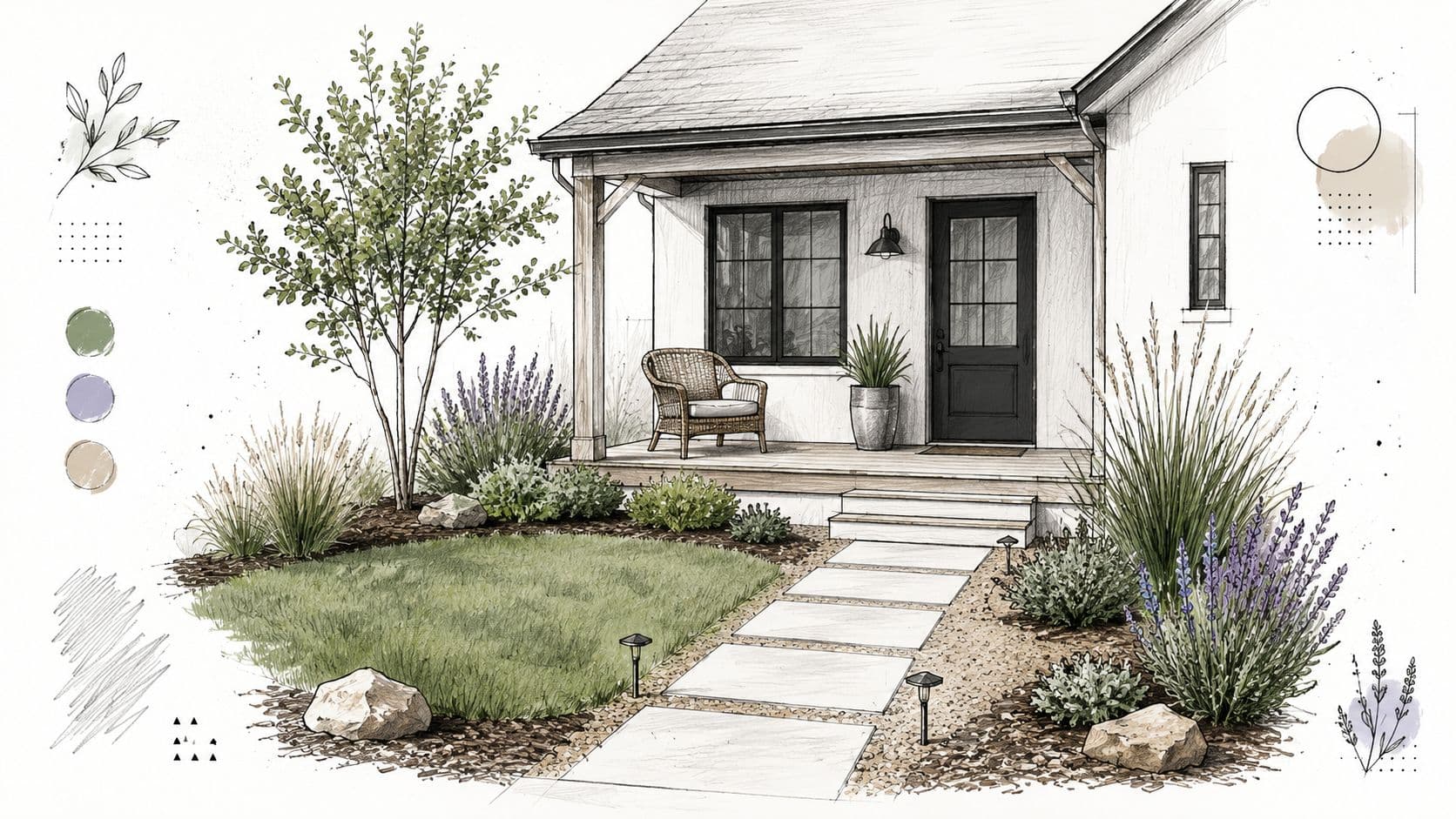
A minimalist front garden looks easiest, but it takes discipline. The best versions don't try to fill every open patch of soil. They use fewer plant types, repeat them on purpose, and cut back on needy lawn where grass always struggles.
Native plants make this style much more practical because they already fit your local rainfall, soil, and pest pressures. That's especially useful in regions dealing with drought or water restrictions, where generic plant lists often fail to account for climate realities. Lowes notes the gap clearly in its discussion of front yard ideas, pointing out that many consumer guides still aren't region-specific enough for water-sensitive areas or differing climates (Lowes front yard landscaping ideas).
Keep the palette tight
I usually recommend one structural plant, one seasonal bloomer, and one ground-layer plant to start. In a dry climate, that might mean gravel mulch with native grasses and a compact shrub. In a cooler or wetter climate, it could mean layered evergreens and a simple perennial drift.
What doesn't work is mixing desert plants, cottage flowers, and thirsty turf in the same small front yard. It reads confused, and maintenance becomes constant.
- Check your region first: Use your hardiness zone and local native plant guidance before shopping.
- Group by water needs: Keep plants with similar moisture demands together so irrigation stays simple.
- Mulch the open space: Mulch makes a sparse design look finished and helps suppress weeds.
- Reduce lawn strategically: Remove the awkward strips that are hard to mow or irrigate well.
Practical rule: If a plant needs special treatment to survive in your front yard, it probably isn't the right plant for a simple design.
Try this in OutdoorBrite by uploading a straight-on photo of your house and prompting three versions: native minimalist, dry garden, and soft meadow-style. Seeing those side by side usually makes the right direction obvious fast.
2. Modern Raised Planting Beds with Clean Lines
Raised beds give the front yard a frame. That's why they work so well with modern homes, urban lots, and houses where the existing soil is poor, compacted, or uneven. Even a basic rectangle of cedar or steel can make planting look intentional.
There's also a broader shift toward simple structural upgrades in residential outdoor spaces. Industry reporting summarized in the verified data notes that 70% to 80% of residential outdoor projects in North America now include at least one simple structural feature such as defined walkways, low-current LED lighting, or foundation plantings. Raised beds fit naturally into that same "small structure, big clarity" approach.
Where raised beds work best
They're most useful when your front yard has one of three problems: bad drainage, weak soil, or no visual organization. Raised planters solve all three at once. You control the soil, define the shape, and stop the yard from looking like a loose collection of random plants.
Material choice matters more than people think. Corten steel looks sharp against dark trim and contemporary facades. Cedar softens modern lines and works well on Pacific Northwest style homes. Composite makes sense if you want a crisp look without the weathering of wood.
A common mistake is building beds that are too narrow for the plants chosen. If the bed only has room for one crowded row, you'll spend the next few years shearing everything into submission.
For layout experiments, I like using a design mockup before anyone starts cutting lumber. OutdoorBrite can help you compare bed height, spacing, and finish choices, and if you want more options, these Best landscape design apps give a useful sense of how different tools handle front-yard planning.
Raised beds should simplify maintenance, not create a trim-every-week obligation.
Use OutdoorBrite to test one long bed under the front windows versus two smaller beds that flank the entry. On many homes, the second option feels more balanced and leaves the facade less boxed in.
3. Curved Planting Borders with Layered Texture
If your house feels stiff from the street, curves can fix that quickly. A wide, gentle planting border softens straight foundations, front walks, and driveways without making the yard look informal in a sloppy way.
This approach also lines up with older, proven planting principles. Home Depot's front yard landscaping overview notes that extension programs and landscaping organizations have long promoted mass plantings of a few species, layering by height, and using evergreens for structure. That advice has held up because it works on real houses, not just in magazine shoots (Home Depot front yard landscaping ideas).
How to keep curves from looking messy
The curve should be broad enough to read from the street. Tiny wavy edges don't look elegant. They look accidental. Lay out the line first with a hose or rope, then step into the street and check it from the same angle visitors see.
Layering is where the border starts to feel professional. Put your tallest anchors in back, mid-height fillers in the center, and low plants at the front edge. Repeat those layers instead of inventing a new mix every few feet.
- Limit the plant list: Three to five plant types usually looks stronger than ten.
- Use one evergreen anchor: That keeps the bed from disappearing in winter.
- Repeat texture on purpose: Fine foliage next to broad leaves gives contrast without clutter.
- Leave room for mature size: Crowding is the fastest way to ruin a soft border.
A curved bed is also one of the easiest designs to preview digitally. Upload your house photo and test a few border depths using OutdoorBrite's AI garden design tool. It helps you see whether the curve should barely hug the house or sweep farther into the yard.
4. Mixed Hardscape with Permeable Pathways
Some front yards don't need more plants first. They need better movement. If people cut across the lawn, track mud to the porch, or miss the entry path at night, the outdoor space is failing in a basic way.
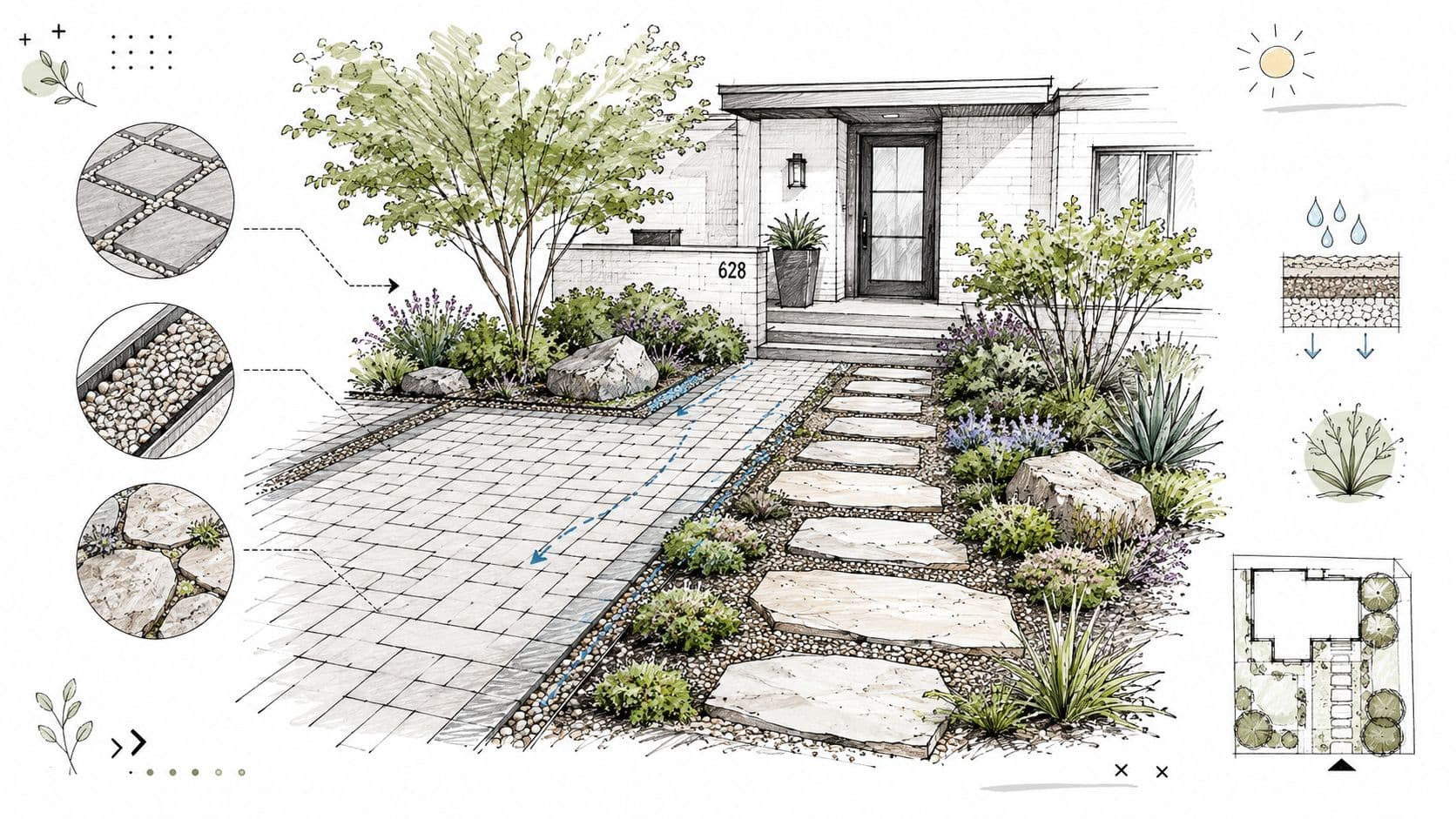
A mixed hardscape approach solves that by using materials with different roles. Gravel can fill side zones. Pavers can define the main route. Mulch can calm planting areas. Stone can signal the front step or porch transition.
Use materials with a job to do
The biggest mistake I see is mixing materials just for variety. If every surface changes texture, color, and scale without a reason, the yard feels busy. Good mixed hardscape uses contrast with restraint. One path material, one loose fill, one bed mulch is usually enough.
Permeable pathways are especially useful where runoff, puddling, or compacted soil creates trouble. Gravel, decomposed granite, and permeable pavers all let water move differently than a solid slab. They also tend to look lighter and less bulky in smaller front yards.
There's a practical upside too. Verified industry data notes that 62% of front-yard redesigns for single-family homes in 2022 to 2024 included replacing or improving front paths with pavers, gravel, or concrete. That tracks with what homeowners notice first: the route to the door.
Before you choose materials, check proportion. A path that is too narrow feels mean. A path that is too wide can overpower a modest house. The same is true with gravel fields. A little can look crisp. Too much can make the front yard feel like parking overflow.
Later in the process, it helps to watch installation details in motion.
Use OutdoorBrite to test gravel with square pavers, or a softer stone-and-mulch combination, before ordering materials. It's much easier to adjust pattern and color on a screen than after a pallet gets dropped in your driveway.
5. Symmetrical Foundation Planting Classic Approach
Symmetry is the fastest path to a front yard that feels orderly. If your house has a centered door, evenly spaced windows, shutters, columns, or a traditional facade, mirrored planting often looks right immediately.
This isn't a flashy move. It's a calming one. Matching shrubs or repeated foundation groupings tell the eye that the house is cared for and easy to read.
What symmetry gets right
A classic setup might place one taller anchor near each side of the entry, with lower shrubs and a tidy ground layer repeating out toward the corners. Colonial, transitional, and many suburban homes carry this especially well.
The danger is scale. Homeowners often buy plants too small, then overbuy to compensate, or they install large growers too close to windows and porches. Both lead to the same ending: constant pruning.
A 2019 National Association of Realtors survey of more than 1,400 homeowners and 1,400 real estate agents found that 31% of homebuyers were willing to pay more for a house with landscaping rated excellent, amounting to a 5% to 10% premium versus homes with average gardening. That's one reason symmetrical, well-maintained foundation planting remains such a reliable curb-appeal strategy. It sends a clean maintenance signal without changing the house itself.
Don't mirror every single plant. Mirror the structure, then let a few softer plants keep it from looking rigid.
For an OutdoorBrite mockup, upload a front elevation photo and test two versions: strict symmetry and softened symmetry. You may find that matched evergreens with a looser layer of perennials give the best balance between polish and warmth.
6. Low-Maintenance Evergreen Screens and Windbreaks
Evergreens do the quiet work in front-yard design. They block an awkward view, frame a corner, calm winter emptiness, and give the yard shape when everything else is dormant.
They also solve practical problems. If your front door catches wind, if your windows stare directly at a neighbor, or if your lot line feels exposed, a well-placed evergreen screen can help without needing a fence-first approach.
Screen without creating a wall
The goal isn't to plant a green barricade. It's to create enough density where you need it while keeping the front yard open and welcoming. That usually means stepping heights, mixing forms, or stopping a hedge before it reaches the porch axis.
Spacing is the trade-off that matters most. Plant too far apart and the screen takes forever to knit. Plant too close and shrubs compete, thin out inside, or become a pruning burden.
In practice, I prefer a staggered, layered screen over a single hard line unless the architecture is very formal. A looser arrangement feels better on most homes and handles wind more naturally.
Verified data also notes that low-voltage LED path lighting shows up in a large share of front-yard redesigns, with 58% incorporating it in 2022 to 2024. Pairing evergreen structure with subtle lighting works especially well because the shrubs give the light something to define after dark.
- Choose for mature shape: Upright, rounded, and mounded forms each solve different visibility problems.
- Water thoroughly while establishing: Young evergreens fail more from inconsistent establishment care than from cold.
- Prune lightly: Don't shear the life out of naturally graceful plants.
- Leave sightlines open: Keep windows, address numbers, and the front door readable.
Use OutdoorBrite to test screen height after a few growing seasons, not just at planting day. That's the easiest way to avoid building a dark green wall that swallows the house.
7. Entry-Focused Focal Point Landscaping
A lot of front yards feel scattered because nothing leads the eye to the door. An entry-focused focal point fixes that. Instead of trying to decorate every edge, you choose one element that tells people where to look.
That focal point can be a specimen shrub, a small ornamental tree, a statement planter pair, or a hardscape feature with strong shape. The supporting plants should stay quiet enough that the main feature still wins.
Make one thing memorable
This works especially well on small lots or simple facades. A Japanese maple near a contemporary stoop, a sculptural grass mass beside broad steps, or a pair of substantial planters at a covered porch can completely change the composition.
What doesn't work is competing focal points. If the path, tree, flower bed, porch decor, and lighting all demand attention, none of them lead the eye.
Real estate data in the verified set also shows that properties with visible, well-maintained front yards spend fewer days on market, which is another reason entry clarity matters. Buyers understand the house faster when the approach is obvious and cared for.
A focal point should feel deliberate from the street and natural when you're standing at the door.
To test this idea, generate a few concepts with OutdoorBrite's ai for landscape design tool. Try one version centered on a specimen plant and another focused on hardscape plus planters. On some homes, the stronger answer isn't a plant at all. It's a cleaner, better-framed route to the entry.
8. Seasonal Color Flow with Perennials and Shrubs
Seasonal color can be beautiful, but it's where simple front yard plans often go off the rails. People buy what looks good that weekend, plant one of everything, and end up with bursts of color followed by long dull stretches.
A better approach is sequencing. Pick a spring moment, a summer moment, and a late-season moment, then tie them together with evergreen structure or ornamental grasses so the yard still looks composed between bloom cycles.
Plan bloom in sequence
One shrub can carry spring. A drift of perennials can take summer. A textured grass or evergreen can hold the bed when flowers fade. That's enough. You don't need constant bloom in every square foot.
This approach also benefits from grouping. Repeated clumps of the same plant read more clearly from the street than single scattered specimens. That's one of the easiest upgrades a DIY planter can make.
The spending pattern behind this kind of project is realistic for many homeowners. Verified data indicates that about 40% of U.S. homeowners spend between $500 and $2,000 annually on lawn and property maintenance, with a growing share going toward smaller aesthetic improvements instead of major redesigns. Seasonal color layering fits that budget mindset well because you can build it over time.
A few practical rules keep this style manageable:
- Choose a restrained color palette: Purple, white, yellow, or pink can each work well when repeated.
- Map bloom windows before buying: Don't rely on memory at the garden center.
- Use shrubs as the backdrop: Flowers alone often look temporary and flat.
- Expect some maintenance: Deadheading, cutting back, and seasonal cleanup come with the territory.
For your OutdoorBrite test, generate the same front yard in spring, summer, and fall moods. If the design only looks good in peak bloom, it needs more structure before you plant it.
8-Option Front-of-House Landscaping Comparison
| Design | Implementation Complexity 🔄 | Resource Requirements ⚡ | Expected Outcomes 📊 | Ideal Use Cases 💡 | Key Advantages ⭐ |
|---|---|---|---|---|---|
| Minimalist Front Garden with Native Plants | Medium 🔄🔄, plant research and establishment | Low ⚡⚡, low water, modest materials | Sustainable, low‑maintenance; wildlife support 📊 ⭐⭐⭐⭐ | Water‑restricted areas, busy homeowners, eco‑conscious | Low water/use; cost‑effective; supports pollinators |
| Modern Raised Planting Beds with Clean Lines | High 🔄🔄🔄, construction and soil work | High ⚡⚡⚡, materials, soil fill, possible irrigation | Clean, structured aesthetics; improved drainage 📊 ⭐⭐⭐⭐ | Urban/poor‑soil sites, contemporary homes, small yards | Soil control; accessible beds; strong modern look |
| Curved Planting Borders with Layered Texture | Medium 🔄🔄, layout and layering | Medium ⚡⚡, more plants and mulch | Soft depth, layered seasonal interest; forgiving composition 📊 ⭐⭐⭐⭐ | Traditional/transitional homes seeking warm curb appeal | Natural flow; flexible plant mixes; guides sight lines |
| Mixed Hardscape with Permeable Pathways | High 🔄🔄🔄, base prep and drainage planning | Medium‑High ⚡⚡⚡, varied materials, installation | Improved drainage and stormwater management; contemporary impact 📊 ⭐⭐⭐⭐ | Eco‑conscious homeowners, runoff-prone sites, modern yards | Better water management; design flexibility; reduced heat island |
| Symmetrical Foundation Planting (Classic) | Low 🔄, mirrored planting, simple layout | Low ⚡⚡, few, paired plants | Formal, balanced curb appeal; strong resale presentation 📊 ⭐⭐⭐⭐ | Traditional homes, sellers, formal aesthetics | Timeless look; easy to plan; high first‑impression value |
| Low‑Maintenance Evergreen Screens and Windbreaks | Medium 🔄🔄, spacing and species selection | Medium ⚡⚡, higher initial planting cost | Year‑round privacy and wind/noise reduction 📊 ⭐⭐⭐⭐ | Privacy seekers, windy or neighboring properties | Continuous screening; low ongoing upkeep; raises property value |
| Entry‑Focused Focal Point Landscaping | Low‑Medium 🔄🔄, single specimen placement | Low ⚡⚡, one strong plant or feature | High visual impact with minimal planting; directs visitors 📊 ⭐⭐⭐⭐ | Small properties, design‑forward homeowners, modern entries | Strong focal impact; cost‑effective; simple maintenance |
| Seasonal Color Flow with Perennials and Shrubs | High 🔄🔄🔄, sequencing and timing knowledge | Medium‑High ⚡⚡⚡, many plants, ongoing care | Continuous multi‑season color and dynamic curb appeal 📊 ⭐⭐⭐⭐⭐ | Garden enthusiasts, home sellers, those wanting year‑round interest | Evolving color; great for pollinators and photos; layered structure |
From Idea to Reality Visualize Your New Front Yard Today
The hardest part of any front-yard project usually isn't the labor. It's committing to a design before you know how it'll look on your actual house. That's why so many homeowners delay, overbuy, or end up with a patchwork of decent ideas that never become a coherent front yard.
The good news is that simple landscaping ideas for front of house upgrades don't need to stay abstract. You can take a photo of your home, test a minimalist native garden, compare raised beds against curved borders, swap gravel for pavers, and see whether symmetry or a focal-point entry makes more sense before you spend on plants and materials. That kind of preview helps you catch scale problems early. It also makes budgeting easier because you can narrow the concept before shopping starts.
OutdoorBrite fits well into that planning step. You upload a front-yard image, choose a design direction, and review photorealistic concepts that make plant placement, path layout, and structure easier to judge. That's useful for homeowners doing weekend upgrades, but it's also useful for contractors and agents who need a fast visual to align everyone on the same plan.
If you're selling, curb appeal isn't a side issue. Buyers react to the front approach before they process your kitchen or paint color. If you're staying, the front yard shapes how your house feels every time you pull in. Both situations benefit from seeing a few strong options first instead of improvising your way through a nursery cart.
I also like that visual tools help homeowners make smarter trade-offs. You can spot when a bed is too deep, a hedge is too heavy, or a focal tree steals light from the windows. That's the kind of edit that saves time and regret. And if you're exploring style ideas beyond your own neighborhood, it can help to look at broader design context too, like this piece on Exploring Atlanta architecture, where the relationship between home style and garden character becomes easier to notice.
If you want a practical next step, pick one of the eight ideas above and test it on your own house today. Don't aim for the perfect master plan. Aim for a front yard that looks intentional, fits your climate, and feels manageable to maintain. If a planning workflow that includes rendering, revisions, and budgeting support matters to you, OutdoorBrite Money may be one relevant option to review alongside the design features.
If you're ready to move from inspiration to an actual plan, try OutdoorBrite Money to visualize your front yard, compare design directions, and make decisions before you buy plants, edging, lighting, or hardscape materials.
See your yard reimagined
Start creating