10 Stunning Tree Landscape Ideas for Every Yard
Discover 10 transformative tree landscape ideas for any yard. From modern designs to privacy screens, find inspiration and visualize them with AI.
You're probably standing in the yard right now, looking at one tree that feels underused, overgrown, or oddly isolated. That's where most good outdoor spaces start, with one living anchor that could do more if the space around it were designed with intention. Trees aren't just background plants. A global assessment estimated 3.04 trillion trees on Earth, about 422 trees per person, and found tree numbers have fallen by roughly 46% since the start of human civilization Yale's tree assessment. That's a strong reminder that mature canopy is worth preserving, because new plantings take time to replace shade, structure, and cooling.
Good tree landscape ideas solve more than curb appeal. The U.S. Forest Service says 100 trees remove 53 tons of carbon dioxide, 430 pounds of other air pollutants per year, and catch about 139,000 gallons of rainwater annually. It also says strategically placed trees can save up to 56% on annual air-conditioning costs, while evergreens can cut heating costs by about 3% U.S. Forest Service tree benefits. That's why the best designs think like a builder, not a decorator.
The practical question isn't just what looks good. It's what fits your yard, your climate, and your maintenance tolerance. The biggest mistake is piling on mulch, rock, flowers, and hardscape without reading the tree's root zone first. The smartest move is to test ideas visually before you dig, especially around mature trees where soil compaction and root disturbance can create long-term problems.
Table of Contents
- 1. Layered Tree Canopy Design
- 2. Specimen Tree Focal Points
- 3. Native Tree Clusters
- 4. Allee and Avenue Tree Plantings
- 5. Seasonal Interest Tree Mix
- 6. Privacy Screen and Windbreak Trees
- 7. Modern Minimalist Tree Design
- 8. Pollinator and Wildlife Support Trees
- 9. Tree Grove and Woodland Edge Planting
- 10. Xeriscaping With Drought-Tolerant Trees
- Comparison of 10 Tree Landscape Ideas
- Start Planting: Turn Your Vision into a Reality
1. Layered Tree Canopy Design
A layered canopy works because it copies how healthy woodlands feel, tall above, medium in the middle, and smaller accents below. In a suburban lot, that structure can turn a plain backyard into a space that feels finished from every angle, not just from the patio. It also gives you more privacy without relying on one dense wall of greenery, which can look heavy and age poorly.
Use OutdoorBrite's 80+ curated styles to compare layered looks before you buy a single tree. The garden ai design tool is useful here because you can test how a tall canopy tree, an understory tree, and a smaller ornamental read together in one frame. That matters when you're trying to avoid the common mistake of placing trees that compete for light or overwhelm a narrow yard.
Build from the top down
Start with the tallest structural tree first, then place the middle layer, then fill with smaller accents. Mature height matters more than nursery size, because a tiny tree can grow into a dominant mass fast. In practice, that means you're designing for the future, not decorating the current gap.
Practical rule: leave enough room for light to pass through the composition. A layered yard should feel sheltered, not sealed shut.
For example, a Japanese forest garden in Portland, a native woodland edge on a coastal California property, and a multi-story privacy screen in a suburban neighborhood all rely on the same principle, staggered height. OutdoorBrite helps you test seasonal views, so the design doesn't look strong only in spring. If winter form disappears, the whole composition can feel flat.
2. Specimen Tree Focal Points
A specimen tree changes the reading of an entire yard. One well-placed tree can anchor an entry, hold a lawn visually together, or give a courtyard a sculptural center. The strongest choices usually have more than one season of interest, not just a single showy bloom.
A detailed illustration of a vibrant red Japanese maple overlooking a stone pathway and garden.
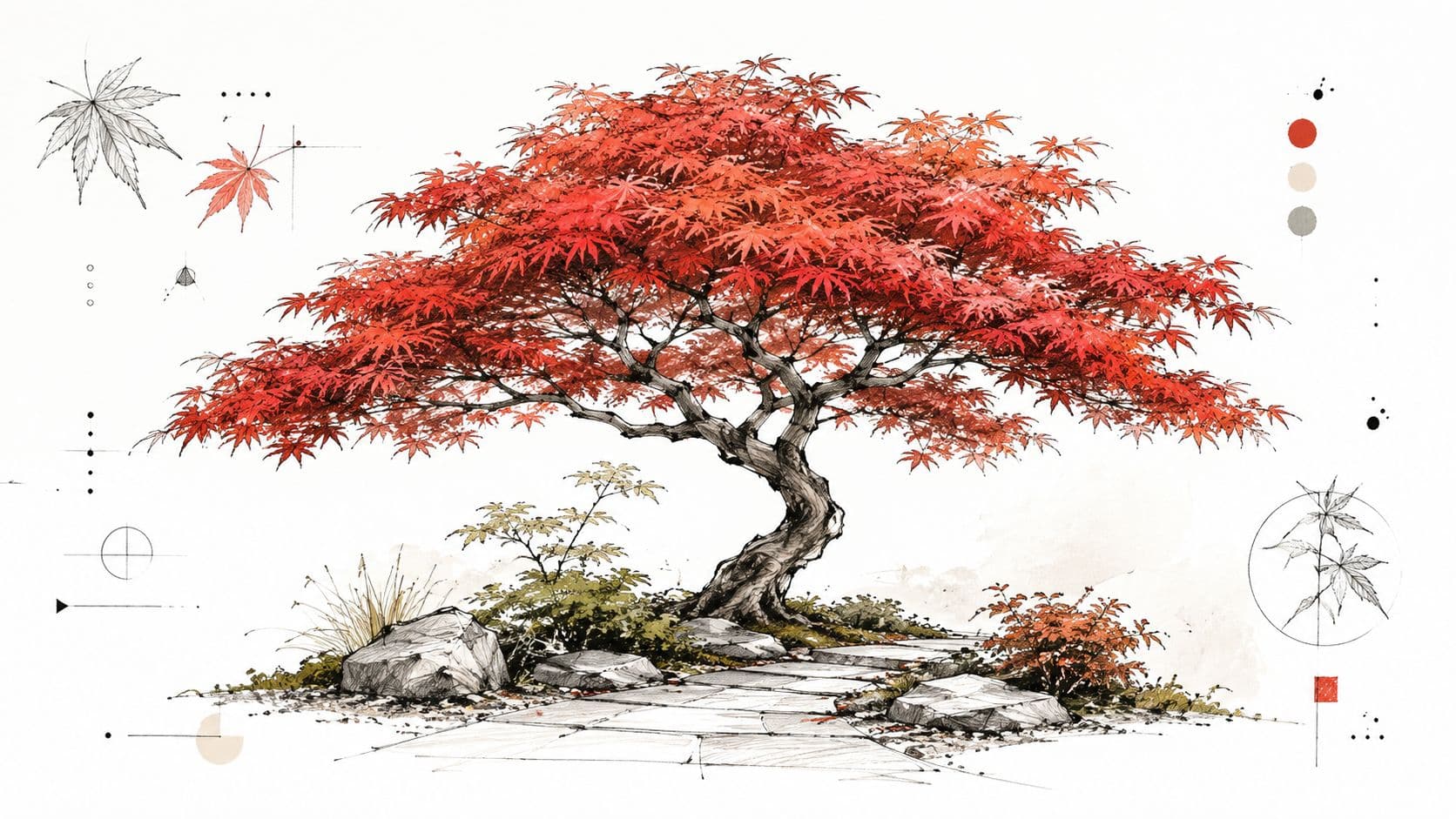
Upload property photos into OutdoorBrite and try a few placements before you commit. That's especially helpful if you're deciding between a Japanese maple near a porch, a weeping cherry at an entry, or a large oak specimen that needs room to breathe. The wrong spot can make a beautiful tree feel cramped. The right spot makes even a modest tree feel intentional.
Give the tree room to perform
A specimen tree needs a clear sightline from the place people stand, walk, and sit. That usually means the front walk, the main window, or the edge of an outdoor room. It also means resisting the urge to crowd the trunk with too many companion plants.
- Choose a tree with year-round presence. Spring flowers are great, but winter branching and bark texture matter too.
- Keep the view open. A specimen tree should be visible from more than one angle.
- Use low companions, not tall fillers. Lower plantings help frame the tree without hiding its form.
OutdoorBrite's environment controls let you preview seasonal lighting and color shifts, which is useful when the tree's silhouette is part of the design. If you're staging a property, that visual clarity can help the tree read as a feature, not just an object in the yard.
3. Native Tree Clusters
Native tree clusters are the easiest way to make a yard look rooted in place. Instead of forcing an imported composition onto the site, you work with local character, soil, and climate. The result usually feels more believable and, in many cases, less demanding to maintain.
This approach is strongest when trees are grouped by shared needs. Put moisture-loving species together, keep sun lovers in open exposure, and avoid mixing trees that want very different root conditions. If you're not sure where to begin, your regional native plant society is a better starting point than a random nursery label.
Let the site choose the palette
OutdoorBrite's Naturalistic and Organic style filters are useful for seeing whether a cluster feels loose and believable or too staged. That matters because native plantings work best when they don't look over-arranged. They should feel like they've had time to establish.
A native cluster can do a lot in a small yard. In a Minnesota setting, a pine and birch grouping can create strong seasonal contrast. In an Arizona property, palo verde and acacia can deliver a distinctly regional look that suits dry conditions. In all cases, spacing should respect mature size so the trees don't end up fighting for the same pocket of soil.
Native clusters age best when the planting plan respects root space first and aesthetics second.
Document the tree locations too. That helps if the property is ever sold, renovated, or assessed for improvements. The layout becomes part of the land story instead of a loose collection of plants.
4. Allee and Avenue Tree Plantings
An allée changes movement. Two parallel lines of trees create a corridor that guides the eye and the body, which is why this style feels formal even when the species are simple. On a driveway, it can make a property feel longer and more established. On a path, it can make a walk feel deliberate.
For this style, measure the full run before you plant anything. The spacing has to work not just now, but at maturity, and the canopy width will determine whether the avenue feels gracious or crowded. Upright trees usually work best because they hold the rhythm of the row without collapsing into each other.
Use the driveway, not just the lawn
Avenue plantings work well for entrances, long sidewalks, and estate-style approaches. A maple-lined drive in New England, a linden allée in a formal garden, or a birch avenue in a modern development all create the same effect, a visible sequence that pulls you forward. The trees become architecture.
OutdoorBrite is helpful when you want to test different spacing densities before calling a contractor. That lets you see whether the row should feel tight and ceremonial or lighter and more open. It also helps with practical checks like vehicle clearance, power lines, and turning radius at the entrance.
Rule of thumb: if the row helps movement but blocks safe visibility, it's the wrong row.
The best allées don't feel forced. They feel like the site was waiting for them.
5. Seasonal Interest Tree Mix
A good seasonal mix keeps the yard interesting when one species is quiet. Spring bloomers can carry the first half of the year, deciduous trees can build summer fullness, and winter branch architecture can keep the design from collapsing visually once the leaves drop. That balance matters more than people think.
Use a seasonal timeline before you plant. You want to know what's blooming, what's coloring, and what still looks clean in bare season. A mix of four or five species usually gives you more variety than relying on one statement tree.
A artistic illustration displaying a single tree undergoing the four distinct seasons from spring to winter.

Build around structure, not just flowers
Balance evergreen and deciduous trees so winter doesn't feel empty. Then add one or two trees with bark texture or branching that stays attractive after leaf drop. Birch, sycamore, and crape myrtle can all contribute visual interest when foliage is gone.
OutdoorBrite's season control is the fastest way to see whether the mix works in spring, summer, fall, and winter. That's where many plans fall apart. A design that looks rich in June can look unfinished in February if the structure isn't there.
The strongest seasonal mix also considers sunlight. A winter sun angle can make branch form look striking, but only if the tree's placement lets that light hit it. That's why virtual previewing is so valuable before a shovel goes in the ground.
6. Privacy Screen and Windbreak Trees
Privacy plantings are performance design, not decoration. They block views, soften noise, and create a more usable outdoor edge. In windy sites, they can also make a patio or side yard feel livable instead of exposed.
The trade-off is maintenance. Dense screens need room, and if you cram them too tightly, you can create disease pressure or constant pruning work. Trees with strong branching from low on the trunk usually screen better than single-stem ornamentals, especially where immediate coverage matters.
Screen for the actual problem
Not every privacy need is the same. A neighbor's second-story window needs a different answer than street traffic or an exposed side yard. OutdoorBrite helps you test sight-line blockage before planting, which is useful when one tree row is supposed to solve a very specific visibility issue.
- For neighbor views, choose dense branching that starts low.
- For wind, use staggered rows rather than a flat wall.
- For tight lots, match mature height to the available strip of land.
The U.S. market for tree trimming and broader landscaping is large, which is one reason low-maintenance planning matters. The broader landscaping services market reached USD 188.8 billion in 2025 and employs 1.4 million+ workers across 692,777 businesses, while tree trimming services were estimated at USD 39.5 billion in 2025 landscape industry statistics. Those numbers point to a simple reality, screens that demand constant intervention cost more to sustain.
A privacy screen should feel like a living boundary, not a maintenance problem disguised as one.
7. Modern Minimalist Tree Design
Minimalist tree design depends on restraint. You're not trying to fill every gap. You're using a few strong forms, clean hardscape, and open space to make each tree matter more. That's why this style fits modern architecture so well.
OutdoorBrite's best free garden design software article is a useful companion if you're comparing a few minimalist layouts before committing. A modern courtyard often looks better in simulation first, because proportion matters more than quantity. One tree in the right place can do more than six trees scattered without intention.
Let form do the work
Select trees with a clearly readable shape, weeping, columnar, or sculptural branching. Then keep the palette tight, usually just a couple of species, so the design reads as deliberate. Gravel, concrete, and metal edging can support the look, but the tree still has to carry the composition.
A minimalist planting also needs winter presence. If the tree only looks good when leafed out, the design loses its impact for half the year. That's why trees with strong branch structure are so valuable in this style.
The cleanest modern landscapes usually leave more open ground than people expect.
That open space isn't wasted. It's part of the design language. It gives the tree air, light, and visual authority.
8. Pollinator and Wildlife Support Trees
Trees can do more than look healthy. They can feed birds, support bees, and give habitat to beneficial insects when species are chosen for flowers, seeds, berries, and structure. That makes the space feel alive in a way ornamental-only planting often doesn't.
The best wildlife-supporting tree plan starts with native species. A native oak can support much more ecological activity than a sterile ornamental, and serviceberry, dogwood, elderberry, crabapple, and hawthorn all have roles in different regions. If you want a helpful reference point for native selection, this native plant picks for 2026 resource is a sensible place to cross-check ideas.
Design for food and shelter
Try to overlap bloom times so pollinators have a steady path through the season. Then add berry or seed producers for fall and winter food. A diverse canopy also creates different perch, shelter, and nesting opportunities, which is part of why mixed height plantings work so well.
OutdoorBrite helps here because you can keep the garden visually polished while still building habitat value. That matters to homeowners who want an outdoor space that supports wildlife without looking wild in a neglected way.
A good wildlife tree plan usually includes more than trees alone. Native shrubs and groundcovers extend the habitat layer and make the planting feel complete. The trees provide the spine, but the layers below help the system function.
9. Tree Grove and Woodland Edge Planting
A grove gives you the feeling of a small forest without needing a forest-sized property. It works especially well along back boundaries, stream edges, and larger suburban lots where a single row would feel too thin. Instead of planting trees in a strict grid, you cluster them the way woods naturally organize.
That approach is especially useful when you want shade and privacy at the same time. Mixed groves can soften a property line and make the yard feel deeper. They also handle the visual transition between maintained lawn and more natural land better than a hard edge does.
Build the grove in layers
Start with canopy species, then add understory trees, then finish with woodland groundcovers, ferns, and shade-tolerant shrubs. OutdoorBrite helps you preview those layers so the mix doesn't end up looking crowded or oddly flat. The goal is depth, not density for its own sake.
A grove usually looks best when it's not evenly spaced. Drifts and clusters feel more believable than straight rows, especially if leaf litter and fallen branches are part of the design. That may sound untidy to some homeowners, but it's often what makes the space feel real.
One practical benefit of this style is that it can be phased in over time. You don't need to install the whole grove at once, which can help with labor planning and budget control. That also gives the trees room to establish without being rushed into a finished look too early.
10. Xeriscaping With Drought-Tolerant Trees
Drought-tolerant tree design starts with honesty about climate. If your site is dry, exposed, or increasingly water-stressed, the smartest approach is one that doesn't fight the weather. Trees like oak varieties, crape myrtle, desert palo verde, acacia, juniper, desert willow, cork oak, stone pine, Texas live oak, and cedar elm can all be part of that conversation depending on region and exposure.
The 2026 drought tolerant yard guide on OutdoorBrite's blog is a useful reference if you're comparing drought-tolerant layouts visually before you convert a lawn or rework a border. You can also use drought resistant lawn alternatives as a related planning reference when the tree plan and the ground plane need to work together.
Make the first years count
Establishment matters more than anything else. Deep watering during the first couple of years helps roots settle, and mulch helps reduce evaporation and heat stress. After that, the design should move toward a lower-input rhythm rather than relying on constant supplemental irrigation.
What not to do: don't treat a drought-tolerant tree like a thirsty lawn replacement. The planting strategy has to match the species.
OutdoorBrite is especially helpful for xeriscapes because you can test how sparse, structured, or lush the composition should feel before installation. That avoids the common problem of a design that saves water but looks barren. Good xeriscaping is lean, not lifeless.
The strongest drought-forward designs use spacing, mulch, and plant selection together. That combination gives the tree enough room to grow without creating unnecessary competition for water.
Comparison of 10 Tree Landscape Ideas
| Design | Implementation complexity 🔄 | Resource requirements ⚡ | Expected outcomes 📊 | Key advantages ⭐ | Ideal use cases 💡 |
|---|---|---|---|---|---|
| Layered Tree Canopy Design | High 🔄🔄🔄, staged, multi-tier planning | Moderate–High (multiple species, higher upfront cost) ⚡⚡ | Layered depth, strong privacy, year‑round interest 📊 | Superior screening, cooling, habitat ⭐⭐⭐ | Privacy-focused homes, noise buffers, staged estate plantings |
| Specimen Tree Focal Points | Low–Moderate 🔄🔄, single high‑impact placement | Low (few trees; may be expensive per specimen) ⚡⚡⚧ | Immediate focal point & curb appeal, seasonal interest 📊 | Dramatic visual impact with minimal planting effort ⭐⭐⭐ | Small gardens, architectural sites, quick curb‑appeal upgrades |
| Native Tree Clusters | Moderate 🔄🔄, species selection & grouping | Low long‑term (low water/inputs after establishment) ⚡⚡⚡ | Sustainable habitat, reduced maintenance, native character 📊 | Cost‑effective long‑term, supports biodiversity ⭐⭐⭐ | Eco‑minded homeowners, rural properties, conservation projects |
| Allee and Avenue Tree Plantings | High 🔄🔄🔄, precise spacing & uniformity | High (many trees, linear space, ongoing shaping) ⚡ | Formal framed views, increased perceived depth/value 📊 | Grand entrance, strong axial definition, resale appeal ⭐⭐⭐ | Long driveways, formal estates, luxury property staging |
| Seasonal Interest Tree Mix | Moderate 🔄🔄, phenology planning across species | Moderate (multiple species, coordinated timing) ⚡⚡ | Continuous seasonal color and structure year‑round 📊 | Sustained visual narrative, wildlife support across seasons ⭐⭐⭐ | Homeowners wanting year‑round beauty, real estate showings |
| Privacy Screen and Windbreak Trees | Moderate 🔄🔄, spacing and species for density | Moderate (rows/staggered plantings, faster growth species) ⚡⚡ | Rapid enclosure, noise reduction, wind protection 📊 | Functional screening, improved comfort and privacy ⭐⭐⭐ | Close neighbors, properties near roads, windy sites |
| Modern Minimalist Tree Design | Moderate 🔄🔄, precise specimen selection & pruning | Low (limited specimens; quality focused) ⚡⚡⚡ | Clean, architectural landscape with low planting density 📊 | Low‑maintenance, suits contemporary architecture, strong form ⭐⭐ | Modern homes, urban courtyards, small contemporary lots |
| Pollinator and Wildlife Support Trees | Moderate 🔄🔄, targeted species for fauna | Low–Moderate (native/adapted species; habitat features) ⚡⚡⚧ | Increased pollinator & bird activity; ecological benefits 📊 | Enhances biodiversity, reduces pesticide need, educational ⭐⭐⭐ | Conservation‑minded yards, family education gardens, eco‑developments |
| Tree Grove and Woodland Edge Planting | High 🔄🔄🔄, complex mixed layering & large scale | High (many trees, substantial space and cost) ⚡ | Immersive woodland feel, deep privacy, robust habitat 📊 | Immersive nature experience, erosion/stormwater benefits ⭐⭐⭐ | Large properties, woodland restoration, naturalistic estates |
| Xeriscaping with Drought‑Tolerant Trees | Moderate 🔄🔄, species suited to arid conditions | Low (minimal irrigation long‑term; water savings) ⚡⚡⚡ | Water‑efficient landscape, drought resilience, low long‑term inputs 📊 | Significant water/cost savings, sustainable in dry climates ⭐⭐⭐ | Arid/semi‑arid regions, water‑restricted properties, low‑irrigation goals |
Start Planting: Turn Your Vision into a Reality
With these tree garden ideas, you've got more than inspiration. You've got a way to judge what your yard can support, what your trees can do, and where the trade-offs begin. The smartest designs protect mature roots, respect mature size, and use the tree as the framework instead of treating it like an afterthought.
Before you buy plants or call a contractor, test the layout visually. OutdoorBrite makes that step practical, because you can upload a photo, compare styles, and see how a tree plan changes with season, lighting, and placement. That matters most in the situations homeowners usually get wrong, mature shade trees, privacy edges, specimen placements, and narrow root-sensitive spaces.
The biggest advantage of virtual planning is clarity. You can see whether a layered canopy feels balanced, whether an allée looks too formal for the site, or whether a minimalist courtyard needs more openness. You can also spot where a design will create future pruning work, which is easier to avoid now than to fix later.
If you're working on a backyard refresh, a front-yard curb appeal project, or a full property redesign, this is the moment to move from guesswork to a real plan. Start with one photo, one tree concept, and one tested layout. Then refine until the space feels right before anything gets planted.
OutdoorBrite Money helps you turn tree ideas into a visual plan before you spend on plants, labor, or hardscape. Visit OutdoorBrite Money to upload a yard photo, test tree placements, and see which design gives your property the best long-term fit.
See your yard reimagined
Start creating