Drought Tolerant Landscaping Plants: A 2026 Design Guide
Create a stunning, low-water garden. Our guide to drought tolerant landscaping plants covers design, selection, regional picks, and maintenance for 2026.
You walk outside, look at the lawn, and see the same problem again. One side is crisp and brown. Another patch is growing fast enough to demand another weekend mow. Then the water bill shows up, and suddenly that “simple yard” feels expensive, fussy, and oddly disappointing.
A lot of homeowners get to this point and assume the only alternatives are gravel, cactus, and a yard that looks bare for half the year. That's where the confusion starts. A good low-water garden doesn't look like a sacrifice. It looks intentional. It has shape, contrast, bloom, movement, and a calmer maintenance routine.
That's why so many people are rethinking the old turf-first approach and turning to tools like Outdoorbrite when they want to picture something better before they start digging. The shift, though, isn't just swapping out a few plants. It's learning how drought tolerant landscaping plants work as part of a whole system that includes layout, soil, irrigation, and upkeep.
Table of Contents
- Your Guide to a Lush Low Water Garden
- What Drought Tolerant Landscaping Really Means
- How to Choose the Right Plants for Your Yard
- Smart Design Principles for Water Wise Gardens
- Our Favorite Drought Tolerant Plants by Region
- Long Term Care for Your Thriving Low Water Landscape
- Visualize Your Drought Tolerant Paradise with AI
Your Guide to a Lush Low Water Garden
You step outside in August and can see the pattern. The lawn is fading in patches, the sunny beds look tired by afternoon, and the hose has started to feel like part of your routine. Many homeowners assume the answer is to swap in a few tougher plants and hope for the best.
A lush low water garden works differently. It behaves more like a well-planned home than a pile of materials. The beauty comes from the full setup: plants that suit the site, soil that holds moisture long enough for roots to use it, mulch that shades the ground, and watering methods that target the root zone instead of the sidewalk. In other words, how you plant matters just as much as what you plant.
That shift is what makes xeriscaping easier to love. You are not settling for a yard that looks sparse or harsh. You are building a garden that stays composed during dry weather, with texture, movement, and color that still feel generous. Lavender can soften the edge of a path. Ornamental grasses can catch the light and move with every breeze. Silver foliage can brighten the hottest corner of the yard. Flowering perennials can carry the display through weeks when a thirstier garden would start to stall.
Homeowners often come to this style for practical reasons, and those benefits are real. Outdoor water use can drop meaningfully with drought-tolerant planting, especially when the design, soil preparation, and irrigation all support the same goal, as noted by Outdoorbrite. The bigger surprise is usually the look and feel. A good low water garden feels calm, full, and intentional.
A good xeriscape teaches you how to get more beauty from each gallon of water.
The yards that age well usually have four traits working together:
- Plants match the place. A plant that likes reflected heat and lean soil will struggle in a damp, shady corner, no matter how drought tolerant the tag says it is.
- The soil helps roots stay comfortable. Healthy soil works like a sponge. It holds water, then releases it gradually instead of letting it rush away.
- Water goes where it counts. Drip lines, basins, and slower soaking help roots grow deeper and stronger.
- The planting feels layered. Groundcovers shade the soil, mid-height perennials fill the middle, and shrubs give the garden shape so it looks rich rather than bare.
If xeriscaping has sounded too stark, too gravel-heavy, or too difficult, that old picture is due for an update. A low water garden can be soft, colorful, and welcoming. It just needs to be built as a system.
What Drought Tolerant Landscaping Really Means
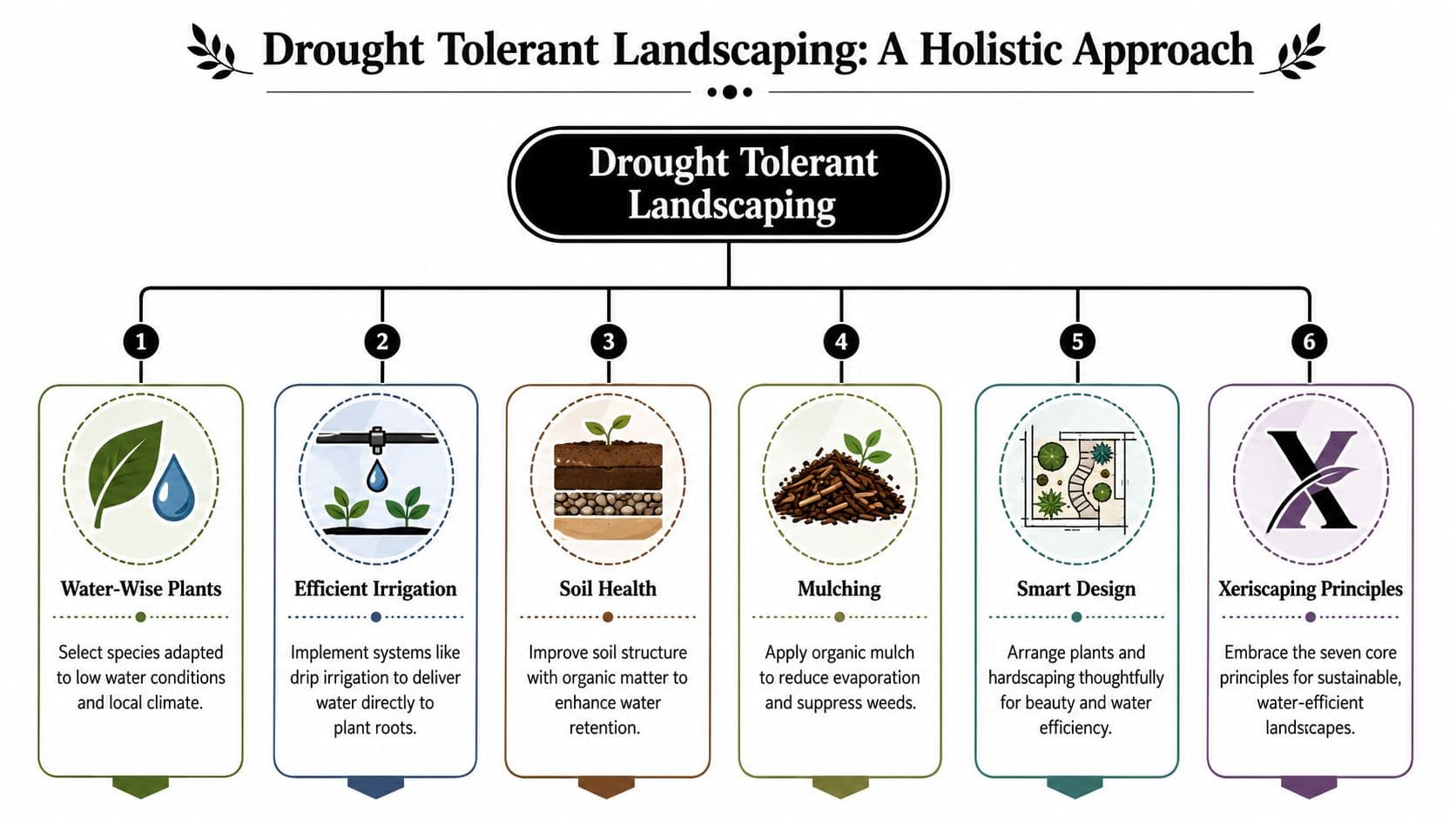
A drought-tolerant design works like a well-tuned system. If one part fails, the rest have to work harder. You can buy all the right plants and still struggle if the irrigation is wrong, the soil dries too fast, or the planting is too sparse to shade the ground.
That's why it helps to think beyond a shopping list. Drought tolerant landscaping plants are only one piece of the picture.
The four parts that work together
Start with plant selection, but don't stop there. Pick plants that are adapted to dry conditions, then notice what they're telling you visually. Many strong performers have leaves built for heat and water stress.
According to the Royal Horticultural Society, many drought-tolerant species share traits such as thick waxy leaves, silver or gray-green foliage, and trichomes (leaf hairs), which reflect sunlight, lower leaf temperature, and reduce water loss. That's why silver-leaved plants are often such smart choices for sunny, dry spots in the garden, as noted by the Royal Horticultural Society guide to drought-resistant plants.
Then comes soil. Healthy soil acts like a reservoir and a buffer. If the soil drains too quickly, water disappears before roots can use it. If it compacts badly, roots stay shallow and stressed. Most home gardens improve when you focus less on “perfect soil” and more on soil structure, organic matter, and keeping the surface protected.
The third part is irrigation. New drought-tolerant plants still need water while they establish. Mature ones usually do better with deeper, less frequent watering than with light daily sprinkles.
The last part is mulch. It's one of the simplest upgrades in any low-water garden and one of the most overlooked.
What drought-tolerant plants look like
Once you know what to look for, plant shopping gets easier. You'll start noticing features that often signal dry-climate performance.
- Silvery foliage: Useful in hot, bright exposures because it reflects light.
- Small or narrow leaves: Often lose less moisture than broad, tender foliage.
- Waxy surfaces: Help slow transpiration.
- Hairy leaves: Those tiny hairs can reduce heat load and moisture loss.
- Fleshy tissues: Common in succulents and some groundcovers that store water.
Practical rule: If a plant looks soft, thirsty, and tropical, don't assume it belongs in the hottest part of a low-water yard.
That doesn't mean every drought-tolerant garden has to look gray or spiky. Plenty of them include soft grasses, flowering salvias, rounded shrubs, and long-blooming perennials. The point is function first. Beauty follows when the plant is comfortable in the place you put it.
How to Choose the Right Plants for Your Yard
Plant choice gets easier when you stop asking, “What's popular?” and start asking, “What's happening in this exact spot?” A front foundation bed that bakes in afternoon sun is a different world from the side yard that stays shaded until noon. Treating them the same is one of the biggest reasons low-water gardens underperform.
Read the site before you buy the plant
Walk your yard at three different times of day. Morning, early afternoon, and late afternoon will tell you more than a plant tag ever will. Notice where heat builds, where water runs off, and where the soil stays damp longer.
Use this quick framework:
- Sun exposure: Full sun, part sun, or bright shade. Be honest here. “Mostly sunny” often means “shaded half the day.”
- Soil behavior: Does water soak in quickly, puddle, or crust over?
- Space: How wide and tall can the plant grow without a yearly wrestling match?
- Microclimate: South-facing walls, reflected heat from pavement, windy corners, and low spots all change how a plant performs.
A common mistake is picking one plant palette for the whole property. A better approach is matching different plants to different conditions. That sounds more complicated, but it usually saves work later.
Here's a simple comparison:
| Yard condition | Plants usually do better when they are |
|---|---|
| Hot reflected heat near driveway | Tough, sun-loving, heat-tolerant |
| Slope or fast-draining bed | Deep-rooted and drought adapted |
| Protected courtyard | Able to handle less airflow and some trapped warmth |
| Bright shade under open trees | More flexible about water and sun |
Why native is not the whole answer
Native plants can be excellent choices, but “native” isn't the same as “right for every spot.” That distinction matters more than most plant lists admit.
As Gardenia's drought-tolerant garden design guide explains, drought tolerance depends heavily on design choices and site conditions. Native plants aren't automatically low-water in every site, and regionally adapted non-natives can outperform them when the conditions don't match. Success comes from matching the plant to your garden's sun exposure, soil, and irrigation method.
That means a native shrub that loves lean, fast-draining soil may struggle in a heavily amended bed that stays damp. Meanwhile, a regionally adapted Mediterranean plant might thrive there with very little fuss.
Don't sort plants into “good” and “bad” based only on origin. Sort them by fit.
A practical shopping list usually includes a mix:
- Structural shrubs for year-round form.
- Flowering perennials for seasonal color.
- Groundcovers to shade soil and reduce bare spots.
- Grasses or grass-like plants for movement and texture.
If you choose with the site in mind, your palette starts to look coherent. Beyond that, it starts to behave like a low-water system instead of a collection of random survivors.
Smart Design Principles for Water Wise Gardens
Good drought-tolerant gardens aren't sparse by accident. They're efficient by design. The layout helps every plant use water better, and it helps the whole yard read as intentional rather than pieced together.
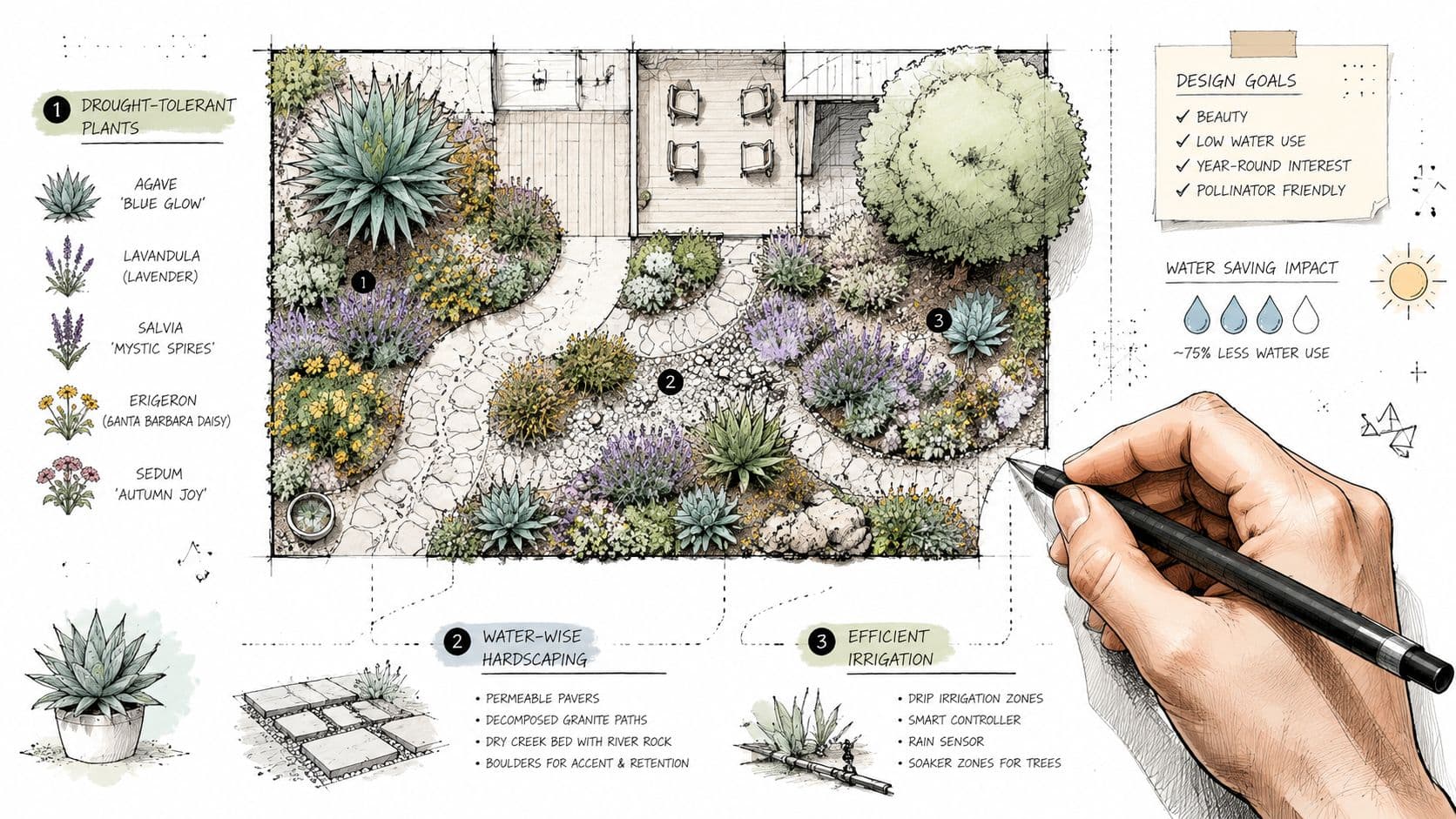
Group plants by thirst level
One of the most useful professional habits is hydrozoning. It means grouping plants with similar water needs together. If thirsty plants and dry-climate plants share the same irrigation line, one group is going to be unhappy.
Create loose zones such as:
- Lowest water areas: Hot edges, hellstrips, gravel beds, and sunny borders.
- Moderate water areas: Entry beds, mixed borders, or spaces where you want a slightly lusher look.
- Higher attention pockets: Containers, edible beds, or a small focal area near seating.
This approach also makes irrigation simpler. You're no longer trying to solve every condition with one timer setting.
Build shade at the soil level
Bare soil loses moisture fast and invites weeds. Dense planting helps solve both problems. That doesn't mean cramming plants shoulder to shoulder on day one. It means designing layers so the ground is gradually covered by living shade.
Use a layered composition like this:
- Tall backdrop: Shrubs or upright grasses
- Middle layer: Flowering perennials and mounding subshrubs
- Edge layer: Groundcovers or low spillers
When leaves cover the soil, sun and wind have less direct access to it. The garden often looks fuller, too.
For watering and moisture retention, irrigation strategy matters as much as plant choice. Yardzen's guidance on drought-tolerant planting recommends deep, infrequent watering, drip irrigation, and a 2- to 3-inch mulch layer to slow evaporation and suppress weeds. That combination encourages roots to grow deeper instead of hovering near the surface.
Shallow, frequent watering trains plants to expect comfort near the top few inches of soil. Deep watering teaches them to search.
A short visual walkthrough can help if you're trying to picture how those pieces come together:
Use hardscaping with purpose
Water-wise design isn't only about plants. Paths, patios, gravel seating areas, boulders, and dry creek features all reduce the amount of irrigated space while giving the yard structure.
The trick is balance. Too much hardscape can make a yard feel hot and severe. Too little can leave you with too many thirsty planting pockets. Aim for planted areas that look generous, then frame them with surfaces that make the space easier to use.
A few design moves work especially well:
- Curved gravel paths: They break up planting beds and reduce lawn area.
- Small patios: They turn the garden into living space, not just something to maintain.
- Rock mulch in select areas: Useful in the right style, but softer organic mulch often performs better around many shrubs and perennials.
- Boulders and berms: Add relief and give the planting a more natural rhythm.
The most successful low-water gardens feel composed. They don't just save water. They guide where water goes, where roots grow, and where your eye lands.
Our Favorite Drought Tolerant Plants by Region
A regional plant list helps, but it only works if you read it as a matching guide, not a shopping list. A lavender that thrives on a sunny slope can struggle in a damp bed by a downspout. The plant is the same. The setting changes everything.
That is the part many roundups skip. Drought tolerance is a system. Plant choice matters, but so do drainage, spacing, mulch, and watering during establishment. A tough plant in heavy, soggy soil is like hiking boots in a flooded basement. Good gear cannot fix the wrong conditions.
Use the chart below as a starting framework, then adjust for your yard's sun, soil, and exposure.
Drought-Tolerant Plant Ideas by Region
| Region | Perennials | Shrubs | Groundcovers |
|---|---|---|---|
| Southwest | Yarrow, Penstemon, Salvia | Agave, Artemisia, Rosemary | Sedum, Thyme |
| Pacific Northwest | Lavender, Yarrow, Echinacea | Ceanothus, Rosemary, Hebe | Creeping thyme, Sedum |
| Midwest | Coneflower, Yarrow, Catmint | Juniper, Sumac, Ninebark | Sedum, Creeping phlox |
| Southeast | Coreopsis, Gaillardia, Salvia | Dwarf yaupon, Rosemary, Loropetalum in dry sites | Frogfruit, Thyme |
| Northeast | Russian sage, Yarrow, Coneflower | Juniper, Bayberry, Potentilla | Sedum, Creeping thyme |
One quick tip before the regional picks. Group plants by similar water needs. If a dry-loving rosemary shares a bed with thirstier companions, irrigation usually gets set for the neediest plant, and the rosemary pays for it.
Southwest
In the Southwest, heat, reflected sun, and fast drainage usually shape the planting plan. This is a good place for strong forms that hold their own against gravel, stone, and wide open sky.
Try combinations like these:
- Agave with Artemisia: Bold structure beside soft, silvery foliage.
- Penstemon with Yarrow: Long bloom season with a lighter, more natural look.
- Sedum at the edge: Useful for softening gravel borders and hardscape lines.
The best Southwestern gardens mix shape as carefully as color. Spiky plants, mounded shrubs, and low spreaders keep the space from feeling stiff or repetitive. Mulch matters here too. If you want help selecting mulch for landscape projects, match it to the plant style and the soil, not just the look.
Pacific Northwest
The Pacific Northwest can carry a softer, greener version of a low-water garden. Dry summers still call for restraint, but the visual effect can feel layered and full rather than sparse.
Good anchors include:
- Ceanothus: Glossy leaves and strong structure.
- Lavender: Fragrance, color, and a clean mounded form.
- Creeping thyme: A tidy choice near paths and stepping stones.
Drainage deserves extra attention in this region. Many drought-tolerant plants dislike winter-wet roots more than summer dryness. Raised beds, sloped planting areas, and gravel worked into the planting design often help these plants live much longer.
Midwest
Midwestern yards ask plants to handle weather swings. Hot spells, cold winters, wind, and open sun all show up in the same garden year.
Look at:
- Coneflower and Yarrow: Reliable color and strong pollinator appeal.
- Ninebark or Juniper: Shrub structure with contrasting textures.
- Sedum: Especially useful in hot, exposed beds.
Prairie-inspired planting often works well here because it matches the climate while still looking orderly when repeated in groups. Three clumps of the same perennial usually read better than one each of six different plants. You get rhythm, easier maintenance, and a calmer overall design.
Southeast
The Southeast adds humidity, summer heat, and disease pressure to the mix. Dry-climate plants can still work, but they need airflow and sharp drainage to stay healthy.
Useful choices include:
- Coreopsis and Salvia: Bright, long-season color in sunny beds.
- Dwarf yaupon: Dependable evergreen structure.
- Frogfruit or thyme: Low coverage where drainage and foot traffic fit.
Spacing is part of plant health here. Beds that are packed too tightly can trap moisture around stems and leaves, which creates stress even if the plant is considered drought tolerant. In this region, a little breathing room often improves performance more than adding one more plant.
Northeast
Northeastern gardens often need to bridge two goals at once. Plants have to handle dry summer stretches, but they also need to suit more traditional home styles and colder winters.
Start with:
- Russian sage and Coneflower: Airy flowers with sturdy summer presence.
- Bayberry or Potentilla: Practical shrubs that fit many foundation and border plantings.
- Creeping thyme and Sedum: Low fillers for edges, slopes, and sunny pockets.
Repetition helps these gardens feel intentional. One shrub, two perennials, and one groundcover repeated through several beds creates a finished look without making the yard busy. It also makes watering simpler because similar plants often want similar treatment.
Across every region, the pattern stays the same. Choose plants that fit your climate, then give them the soil, spacing, and watering style that lets their drought tolerance show up.
Long Term Care for Your Thriving Low Water Landscape
A low-water yard usually looks easiest after it has settled in. The first season is different. You plant in spring, everything looks neat, and by midsummer one shrub looks tired, a patch of mulch has thinned, and one drip emitter has slipped off line. That does not mean the plan failed. It usually means the system needs a little tuning while roots are still getting established.
That idea is easy to miss. Drought tolerance is not just a plant label. It comes from roots growing deep, soil holding moisture evenly, and water reaching the right place at the right pace. In other words, the garden succeeds because the whole setup works together.
The first year is about training roots
New plants need consistent attention while they switch from nursery life to real garden conditions. A plant that can handle dry spells later may still struggle early on if its roots stay shallow or the soil dries unevenly.
Focus on a few habits:
- Water thoroughly during establishment: The goal is moisture several inches down, where roots should be growing.
- Check the soil before watering again: Use your finger, a trowel, or a soil probe. The surface can look dry while the root zone is still moist.
- Watch the plant, not just the schedule: Wilting, pale leaves, scorched edges, or slow growth often point to a mismatch between watering, drainage, and placement.
A simple way to picture it is this. Frequent light watering trains roots to stay near the surface, where heat dries them out fast. Deeper, less frequent watering encourages roots to travel down, like teaching a plant to use the full pantry instead of snacking from the countertop.
Care gets simpler once the system is stable
After plants establish, maintenance shifts from rescue to observation. You are protecting the conditions that make low-water planting work well.
A practical yearly routine includes:
- Refresh mulch: A good mulch layer shades the soil, slows evaporation, and softens temperature swings. If you want help comparing options, this guide on selecting mulch for your garden is useful.
- Prune lightly and with a purpose: Remove dead stems, improve airflow, and keep the plant's natural shape instead of shearing everything into tight forms.
- Replace repeat underperformers: If the same plant struggles season after season, the spot is probably wrong for it. Swapping one poor fit often works better than adding more water.
- Inspect irrigation lines: A clogged emitter or a line that shifted a few inches can leave one plant thirsty and another overwatered.
One small check each month prevents larger problems later.
Seasonal cleanup also affects how the yard feels. Crisp bed edges, fresh mulch, and selective pruning can make the whole space look cared for, even in the hottest part of summer. If you want to show a contractor or family member how those updates might look before doing the work, tools that Generate studio-quality videos fast can help communicate the plan clearly.
The long-term goal is simple: keep the soil covered, keep watering targeted, and keep editing the planting so each spot has a plant that belongs there. That is how a low-water garden stays healthy, attractive, and easier to care for year after year.
Visualize Your Drought Tolerant Paradise with AI
By now the pattern is clear. A beautiful low-water garden isn't built by grabbing a few “tough plants” from the nursery and hoping for the best. It comes from matching plants to place, arranging them in smart layers, watering them correctly, and maintaining the soil surface so moisture stays where roots can reach it.
The hardest part for many homeowners isn't understanding those ideas. It's picturing how they'll look in their own yard. A gravel path may sound great in theory, but what happens next to your existing patio? Will lavender and ornamental grasses feel soft and welcoming or too loose? Will a front yard xeriscape still look polished?
That's where a visualization tool can help turn ideas into decisions. A garden ai design workflow lets you upload a photo of your yard and test styles such as modern xeriscape or Mediterranean planting before buying materials or plants. If you also want to present your ideas more dynamically to family, clients, or a contractor, tools that Generate studio-quality videos fast can help turn still concepts into clearer walkthroughs.

That kind of preview doesn't replace good plant selection or site observation. It supports them. You can compare layouts, test planting density, and spot whether the design feels too sparse, too busy, or just right. For a project like drought tolerant landscaping, where spacing, texture, and balance matter as much as species choice, seeing the result in advance can save a lot of second-guessing.
If you're budgeting for a yard upgrade and want to explore practical tools from the same company, OutdoorBrite Money is a useful place to start while you plan your next outdoor project.
See your yard reimagined
Start creating