
Front Porch Landscaping: Expert Guide for 2026
Learn to plan front porch landscaping with expert advice on site assessment, plant selection, hardscapes, and AI tools. Boost curb appeal today.
You know the feeling. You step onto the porch with keys, grocery bags, or a coffee in hand, and the entry looks acceptable but forgettable. The plants are either too sparse to matter or too crowded to move around, and the whole front of the house feels like it's waiting for a proper plan.
That's where front porch landscaping earns its keep. This isn't just about making the entry pretty. Front yard landscaping has been tied to measurable resale-value gains, with industry sources citing a 15 to 20% return on investment on average (front-yard landscaping value guidance), and front porches are already a mainstream part of new home construction, with 67.2% of roughly 1.0 million single-family homes started in 2024 built with porches, averaging about 100 square feet when they sit on the front of the home (2024 porch construction data). That makes the porch one of the most practical places to spend attention, because it shapes first impression, daily use, and future value all at once.
A well-shaped entry also makes the house feel more finished from the street. If your windows and exterior trim need attention too, a useful companion reference is the Professional Window Cleaning curb appeal guide, because the best porch work usually sits inside a broader curb-appeal plan.
Table of Contents
- Why Front Porch Landscaping Deserves Your Attention
- Assessing Your Porch Site and Design Style
- Planning Your Porch Layout and Space
- Selecting Plants and Hardscape Materials
- Adding Lighting and Decorative Accents
- Maintaining Your Porch and Managing Budget
- Visualizing Your Design with AI Tools
Why Front Porch Landscaping Deserves Your Attention
A front porch starts making an impression before anyone reaches the door. A clear walk, planting that fits the space, and a restrained mix of materials can make a modest entry feel intentional. A crowded bed, oversized containers, or plants that fight the architecture do the opposite, and the problem shows up fast in small entry zones where every inch counts.
The practical case for front porch landscaping is stronger than the decorative one. It helps solve weak curb appeal, awkward circulation, and the lack of structure that leaves a doorway feeling unfinished. It also gives the eye a direct path from sidewalk to entry, which matters in porches that need to work hard in a tight footprint. In my own projects, the biggest mistakes usually come from treating the porch like a display area instead of a passage people use.
Practical rule: if the porch only looks good from one angle, it probably isn't finished yet.
That is why the first questions should be about how people move, where containers can sit without blocking traffic, and which plants will hold up in the local climate. A dry, shaded porch needs a different planting approach than one that gets hot afternoon sun or strong wind, and those differences affect both survival and appearance. AI visualization tools can help here by showing how a planting scheme reads from the street, but they work best after the site limits are clear. If you want a useful curb appeal reference, the Professional Window Cleaning curb appeal guide shows how exterior cleanup and glass care can support the planting, not compete with it.
The main point is straightforward. Good porch landscaping does not try to do everything. It directs movement, softens hard edges, and makes the home feel organized the moment someone approaches.
Assessing Your Porch Site and Design Style
Before a single plant goes in the ground, the porch needs to be measured as a working space, not admired as a photo. Front porches are already a common feature in new construction, and the usable area still changes a lot from house to house.
Measure what the porch actually gives you
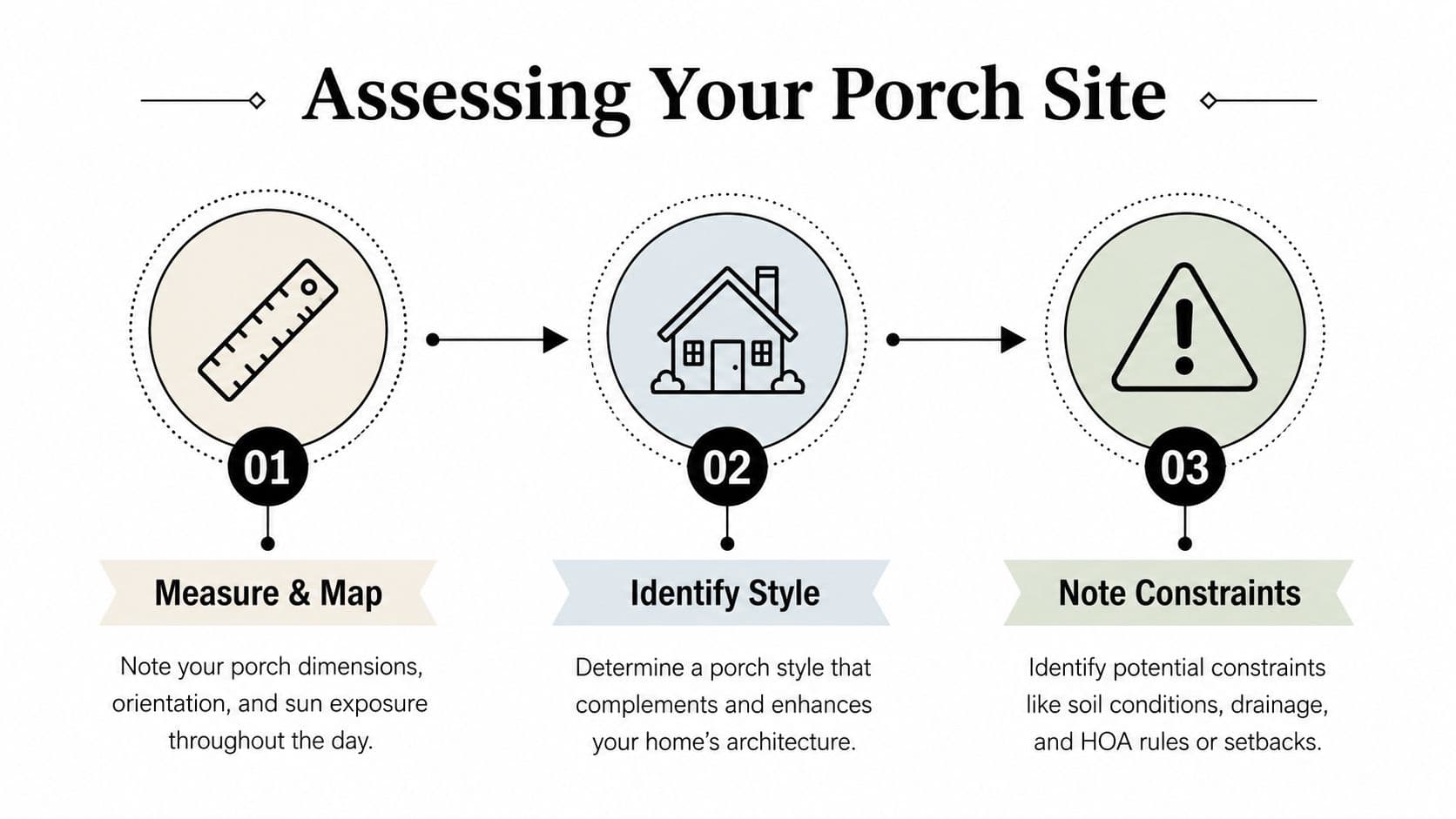
Start with a tape measure and a notebook. Record the porch width, depth, step locations, railing positions, and the width of the main walking path. Then note where the sun hits during the day, where water sits after rain, and which areas feel cramped when two people try to pass.
Those observations matter more than almost any catalog photo. A porch that looks like a blank slate in the morning can become a heat trap by midday, or a drainage problem after the first heavy storm. That is why site analysis comes before plant choice in every serious design workflow, including the guidance used by extension programs and design teaching materials (site analysis and design planning guidance).
Shade changes the plan too. If the porch stays hot for much of the day, or if the front edge gets blasted by sun, a planting plan that looks good on paper can fail quickly without the right support. In those cases, even a practical addition like solar screens for porch shade may be worth considering before you commit to plants that cannot handle the exposure.
Match the house, not just the mood board
Architecture should shape the design language. A craftsman porch usually wants grounded, layered planting and natural materials. A modern entry usually looks better with cleaner lines, fewer species, and stronger repetition. Colonial and farmhouse homes can tolerate more symmetry, but even there, the planting should still respect the proportions of the facade.
The easiest way to get this wrong is to copy a porch you saw online without checking scale. A generous suburban front yard can absorb more visual weight than a narrow townhouse entry. If you are unsure, take photos of nearby homes that feel balanced, then ask what they are doing with spacing, massing, and the height of the planting near the door.
Don't design for the plant store. Design for the house you stand in front of every day.
Note the limits before you choose the style
Style only works when it fits the conditions. A cottage look can be lovely, but not if the shade and drainage are wrong for the plants that create that softness. A minimalist look can read as elegant, but only if the lines stay clean and the accessories stay controlled.
A quick site inventory keeps the project honest, and honest planning usually saves money later. That matters even more for awkward entries where railings, narrow steps, and small landing areas make overplanting feel crowded fast. In practice, the strongest results come from a design that fits the site first, then uses AI visualization tools to test the look before anything expensive gets bought or installed.
Planning Your Porch Layout and Space
Small and awkward entry zones need layout decisions before they need decoration. That's the part most homeowners skip, then they wonder why the porch feels busy even after the plants go in. The issue usually isn't plant quality, it's circulation, sightlines, and the amount of open space left around the door.
Build the plan around movement
Start by drawing the main approach to the door. Mark where someone naturally walks from the sidewalk or driveway, then protect that route before you place anything else. If you're dealing with a tight entry, a clean path matters more than adding another container or shrub.
For porches with limited width, the goal is to make the entrance feel larger, not fuller. A single focal point, a little negative space, and one repeatable plant group usually work better than trying to occupy every corner. That principle comes up again and again in compact-entry work, including the recurring problem of awkward side views and partial screening that homeowners ask about online.
Use height carefully, not aggressively
Vertical accents can help a small porch feel taller, but only if they don't block the facade or the sightline to the door. Think of narrow upright shrubs, tall grasses, or a slim planter near the outer edge of the composition rather than something that crowds the steps.
Practical rule: if a plant makes the entry look hidden from the street, it's doing the wrong job.
This is also where shade solutions can help more than extra planting. If the porch is overheated, a product like solar screens for porch shade may solve the comfort problem more cleanly than stuffing the area with dense greenery.
Keep the layout functional at the door
A porch isn't just a front garden. It's a landing zone for bags, shoes, packages, and people who don't want to trip over a pot. Leave enough breathing room for the door to swing, for visitors to pause, and for any seating or mat to sit without competing with the planting bed.
The cleanest compact layouts usually follow a simple pattern. One side can hold a repeated plant mass. The opposite side can stay quieter. That imbalance often feels more natural than perfect symmetry when the footprint is narrow.
Selecting Plants and Hardscape Materials
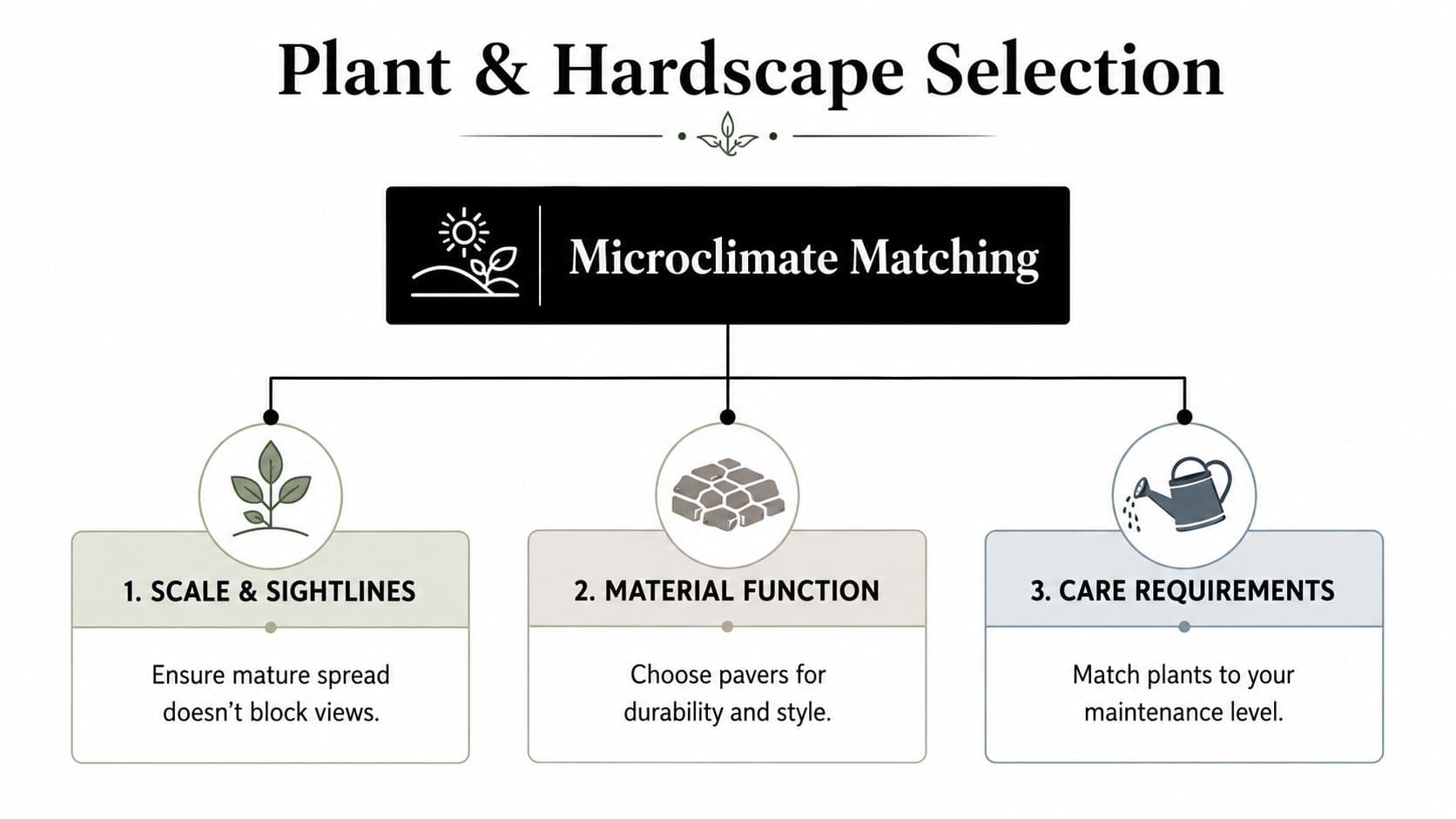
Plant selection for the porch should be treated like microclimate design, not shopping for color. The most common mistakes show up fast. Plants get too tall, crowd the step edge, or collapse visually because they were chosen for the tag photo instead of the actual light and maintenance conditions.
Start with scale and sightlines
A planting guide for porch beds recommends keeping mature heights under 30 inches near the porch edge so the facade stays visible, using odd-numbered groupings, leaving at least 6 inches between the first plant and the step edge, and spacing plants at about 75% of their labeled mature spread. It also advises digging 8 to 10 inches deep, using about 1.5 inches of shredded hardwood mulch, and keeping mulch 3 inches away from stems.
Those are useful guardrails because they keep the design from growing into the walkway. They also help prevent the “too much too close” look that makes many front entries feel smaller than they are. If you're unsure, choose fewer plants with better proportion rather than filling the bed with mismatched pieces.
Pick materials that support the architecture
Hardscape should do more than outline the bed. It should help the porch feel anchored. Natural stone often sits well with traditional homes, while concrete or composite materials can look cleaner in modern settings. Brick, metal, and stone edging all work, but they each send a different message, so the finish has to match the house.
The hardscape vs planting design guide is useful if you're trying to separate what should be built from what should be planted. That distinction matters on small porches, where too much stone can make the entry feel hard, and too much planting can make it feel crowded.
Choose for care, not just beauty
A beautiful planting fails if it's the wrong size, wrong light exposure, or too hard to maintain. That's the hardest truth in porch work, because homeowners often buy for the look they want in week one, then live with the maintenance burden for years. If the house gets harsh sun, choose plants that can handle it. If the bed is shaded, don't force sun lovers into the spot just because the color looks right in the store.
The same source recommends deep watering every 2 to 3 days in hot weather for the first 6 weeks, then shifting most sun plants to one deep soak every 7 to 10 days during drought. That kind of aftercare is where many “easy” designs fail, because the install day is the easy part.
The best porch bed is the one you can keep looking good without resenting it in midsummer.
Adding Lighting and Decorative Accents
Lighting changes the porch from something you pass through into something you notice after dark. I've watched a plain entry become far more inviting with a few well-placed fixtures, while a bright overhead bulb alone made the whole front door feel flat and harsh.
Build light in layers
A good evening porch usually starts at the walkway. Low-voltage path lights can guide movement without blasting the whole front of the house. From there, a small accent fixture can lift an ornamental tree, a planter, or a piece of architecture that deserves attention.
The improvement comes when the light is controllable. Dimmers let you keep the entry visible without turning it into a stage set, and that's one reason nighttime lighting is shifting toward softer, more adjustable layers. It's better for the mood of the porch, and it avoids the hard glare that makes people squint instead of linger.
Let one accent lead the composition
Decorative pieces work best when they support a single focal point. A statement planter, a clean bench, or a pair of matching lanterns can do the job. Once that one idea is in place, everything else should calm down around it.
Seasonal containers are useful here because they let the porch change without forcing a redesign. A welcome mat, house numbers, and mailbox hardware should all support the same visual language. If one of those pieces is loud, the whole entry starts to feel fragmented.
A practical evening setup might include:
- Path lights: place them where people walk, not where they'll be seen from the curb only.
- Accent lighting: use this on a tree, column, or sculptural planter, not on every object in sight.
- Ambient fixtures: lanterns or soft wall lights can make the landing feel warm without overlighting it.
- Functional details: a bench or small stool helps with shoes and packages, as long as it doesn't block the path.
The porch works when those layers feel calm together. Brightness alone doesn't do that. Control does.
Maintaining Your Porch and Managing Budget
A front porch plan only works if it fits real life. If the entry gets heavy use, the planting scheme has to tolerate wear, missed watering, and a little clutter. If you enjoy regular upkeep, you can take on more detail, but the layout still needs to hold together when the porch is not perfectly maintained.
Match the plan to your real schedule
Watering is the first test. New plants need steady moisture while they establish, and morning watering is usually the cleaner routine because it limits evaporation and gives foliage time to dry before evening. Mulch helps hold moisture and slow weeds, but it only does its job if it is refreshed when needed and kept away from stems.
Access matters just as much. Wide, level paths are easier for strollers and wheelchairs, and non-slip surfaces matter whenever rain or irrigation makes the entry slick. If the porch is awkward to move through, it will also be awkward to care for, and the design will slowly drift out of shape.
Practical rule: low-maintenance does not mean no-maintenance. It means the design still reads well when a week gets missed.
Phase the budget so the project can breathe
Porch projects get expensive fast when every detail is built at once. A phased approach usually works better. Start with the hardscape and the main plants, then add accent containers, seasonal color, and extra lighting later if the first round proves itself.
That approach also leaves room for correction. If a plant performs poorly in your actual light or soil, you can change course before the whole bed is locked in. For homeowners trying to stretch funds, DIY front yard landscaping for less is a useful budgeting companion because it reinforces the same principle, build the framework first, then add the extras.
The same idea helps in tight or oddly shaped entries. Small porches punish overbuying, especially when a shrub, urn, or bench looks reasonable on the shelf but crowds the landing once it is installed. I have seen plenty of homeowners save money by using a simple mockup or AI rendering first, then buying only what the entry can support.
Keep the maintenance promise realistic
The safest porch plans are the ones you can keep up. If you travel often, choose plants that can handle irregular care. If you enjoy weekly work, add more seasonal detail, but keep the core structure simple enough that the porch still looks intentional when life gets busy.
Climate belongs in that decision too. A plant that thrives in one region may become a constant repair job in another, so matching the planting list to sun, heat, wind, and winter exposure is worth more than chasing a look that will not last. That is where visual testing helps. A quick AI rendering or photo mockup can show whether the mix feels balanced before you spend on materials, labor, or replacements.
The best budget is not the smallest one. It is the one that gives you a porch you can keep healthy, neat, and welcoming without making every weekend a cleanup project.
Visualizing Your Design with AI Tools
A porch layout looks different in a sketch than it does in your actual doorway, and that's where visualization tools save money. Uploading a real photo of your porch lets you test plant scale, bed shape, and style direction before anything gets purchased or dug in.
Use a photo of the real entry
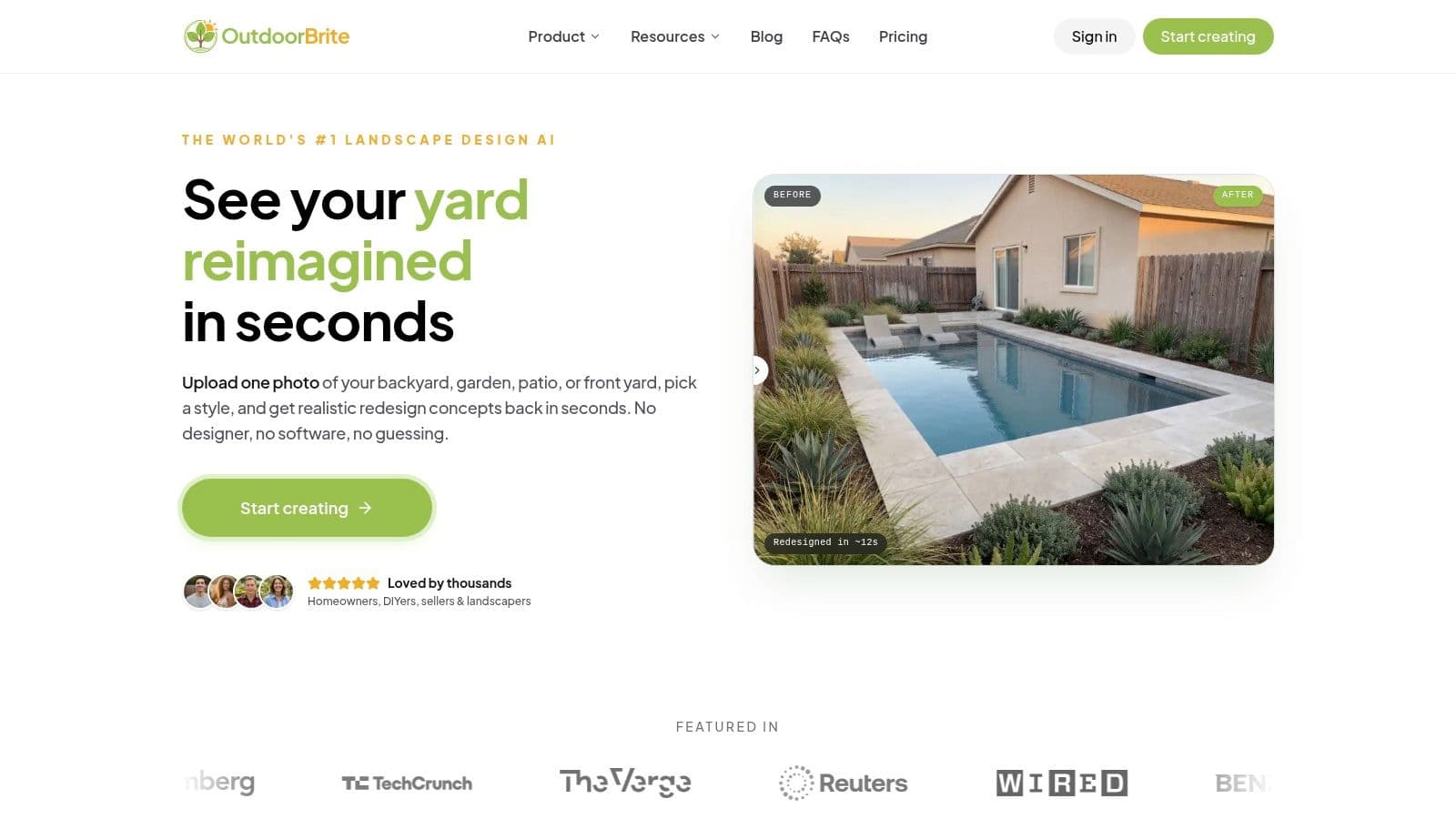
The right workflow starts with a clear image taken from the street or walkway. From there, a design tool can generate concept options for the actual space, which is more useful than imagining a porch in the abstract. OutdoorBrite is one option in this category, and it turns a photo of a yard or front entry into redesign concepts that you can compare and refine.
That matters because porch mistakes are often scale mistakes. A shrub that looks reasonable in a nursery can swallow a small landing once it matures. A render helps you catch that before the credit card charge lands.
Refine the design before you buy
Style selection helps narrow the direction fast. Modern, cottage, Mediterranean, tropical, Japanese zen, and xeriscape looks each push the planting and materials in a different direction, which makes it easier to see what fits the house. An elements editor also lets you test features like planting beds or hardscape changes without committing to them.
If you want to compare software options, the best ai garden design software roundup can help you understand what a photo-based workflow should include. For porch projects, that kind of preview is more than a convenience. It's a guardrail.
Make the tool part of the decision, not the decoration
Use the AI output to answer practical questions. Does the planting still leave the path open? Does the bed feel too full? Does the house lose its proportions when a tall plant goes near the steps? Those are the questions that protect your budget.
The strongest designs usually survive several rounds of simplification. If the first concept looks good only because it's packed with plants, keep editing. The version you can maintain is usually the one worth building.
If you're planning a porch update, use OutdoorBrite to test the layout against a real photo before you buy plants or pavers. It gives you a faster way to see scale, style, and circulation in one place, which is exactly where porch projects usually succeed or fail.
See your yard reimagined
Start creating