How to Measure Square Footage of a Yard Accurately
Learn how to measure square footage of a yard for any shape, convert units, and avoid over-ordering sod or mulch with tape, app, and map methods.
You're standing in the garden center with a cart full of sod, mulch, or pavers, but you're not sure how much your yard needs. The temptation is to pace off the space, multiply two rough numbers, and hope the order works out. That shortcut is fine for a clean rectangle. It's unreliable once the yard includes a patio, curved bed, driveway, slope, or retaining wall.
Learning how to measure square footage of a yard starts with a decision that most quick guides skip: decide which area your project needs. The number for the whole property may not be the number for turf, mulch, irrigation, or planting beds. Measure the right area first, then choose the simplest method that gives you enough accuracy for the purchase or design decision ahead.
Table of Contents
- What Yard Square Footage Really Means for Your Project
- How to Measure a Rectangular Yard With Simple Math
- How to Measure Irregular and Curved Yards Without Guessing
- Choosing the Right Tool for Measuring Your Yard
- Pro Tips to Avoid Costly Measuring Mistakes
- Plan Your Next Outdoor Upgrade With Confidence
What Yard Square Footage Really Means for Your Project
A homeowner ordering new sod may measure from the back fence to the sidewalk, multiply by the lot width, and get a number that includes the house, driveway, patio, planting beds, and side access. The calculation looks exact, yet it measures the wrong area. A sod order requires the turf area, not the full parcel footprint.
Mulch reverses the mistake. Measuring only the grass leaves out the beds that need coverage. A redesign may need separate totals for lawn, hardscape, and plantable soil because each surface affects a different purchase or installation decision.
Practical rule: “Yard square footage” is not one universal number. It is the project-specific area that will receive work.
Define the scope before using a tape:
- Turf only: Count grass areas. Exclude the house, patio, driveway, paths, beds, and surfaces that will not receive sod or seed.
- Mulch or planting beds: Measure every bed separately, including curved edges. Leave out lawn and hardscape.
- Pavers or patio work: Measure the proposed hardscape footprint, rather than the surrounding grass.
- Irrigation: Separate lawn sections or watering zones so coverage reflects the areas that will be watered.
- Whole-site planning: Record front, back, and side yards independently, then combine them if needed.
The right total can also change as the job develops. A contractor estimating sod needs the installable turf area. A designer may need lawn, beds, and hardscape as separate figures. Ordering material from one broad property measurement can create waste, shortages, or both.
For an irregular property, divide the space into 4 to 6 zones and use polygon tracing, triangulation, or a grid overlay. This method can produce measurements accurate to within 2% to 3% in about 10 to 15 minutes, according to square-footage estimating guidance. Treat that range as guidance, not a guarantee. Zoning matters because it exposes areas that a single length-by-width calculation includes or misses.
How to Measure a Rectangular Yard With Simple Math
A rectangular lawn beside a patio can look straightforward until the patio, walkway, or planting bed gets included in the material estimate. Measure the area that will receive the work, then calculate each usable section separately. A tape measure, measuring wheel, or reliable site plan can provide the length and width, provided both measurements use the same unit, preferably feet.
Length × width = square feet
For sod, measure the lawn rectangle. If a patio interrupts it, measure the patio separately and subtract it from the larger footprint. The correct square footage depends on the project, not on the property boundary.
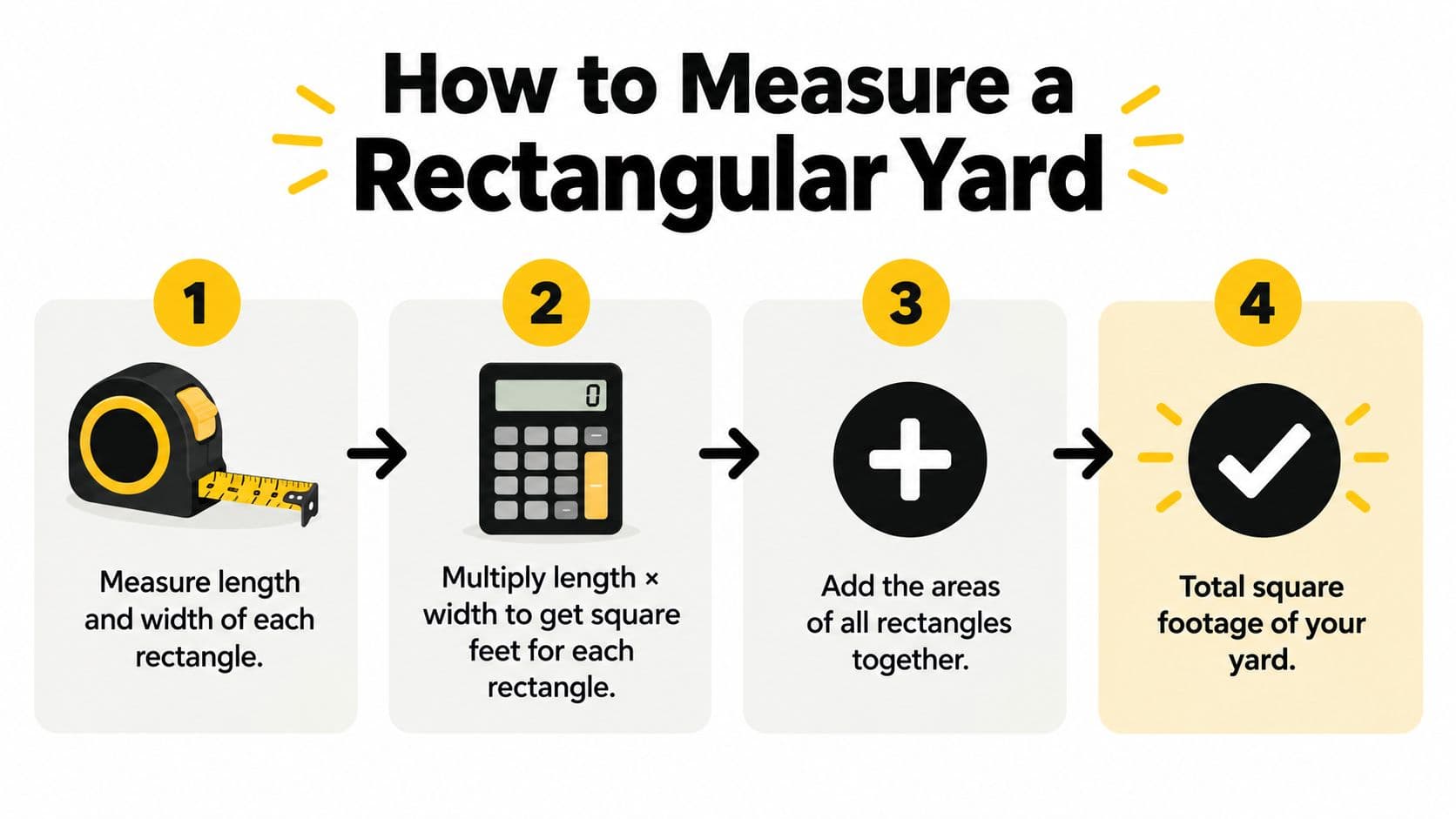
Use the rectangle method in four steps
- Measure the length. Follow the longest straight side of the section.
- Measure the width. Measure across the section at a right angle to the length.
- Multiply the measurements. The result is that section's area in square feet.
- Add separate sections. Calculate every rectangle independently before combining the totals.
Suppose one lawn section measures 40 feet by 25 feet. Its area is 1,000 square feet. A second section measuring 20 feet by 15 feet adds 300 square feet, giving a combined lawn area of 1,300 square feet.
An L-shaped yard needs two rectangle calculations. Separate it at the inside corner, measure both parts, and add their areas. The rectangle-and-add method is also described in land measurement guidance from Williams County, Ohio.
Convert the result when the supplier uses another unit
For smaller outdoor layouts, square yards can match the supplier's ordering unit. 1 square yard equals 9 square feet, so divide square feet by 9. This fixed relationship is documented in Canada's survey instructions.
Using the example above:
- 1,300 square feet ÷ 9 = approximately 144.4 square yards.
- A supplier quoting fabric or another material by square yards can use that converted figure.
For large parcels, 1 acre equals 43,560 square feet, 4,840 square yards, or 10 square chains. Residential work is usually easier to estimate in square feet, while the acre conversion helps check a property record or discuss a larger parcel.
How to Measure Irregular and Curved Yards Without Guessing
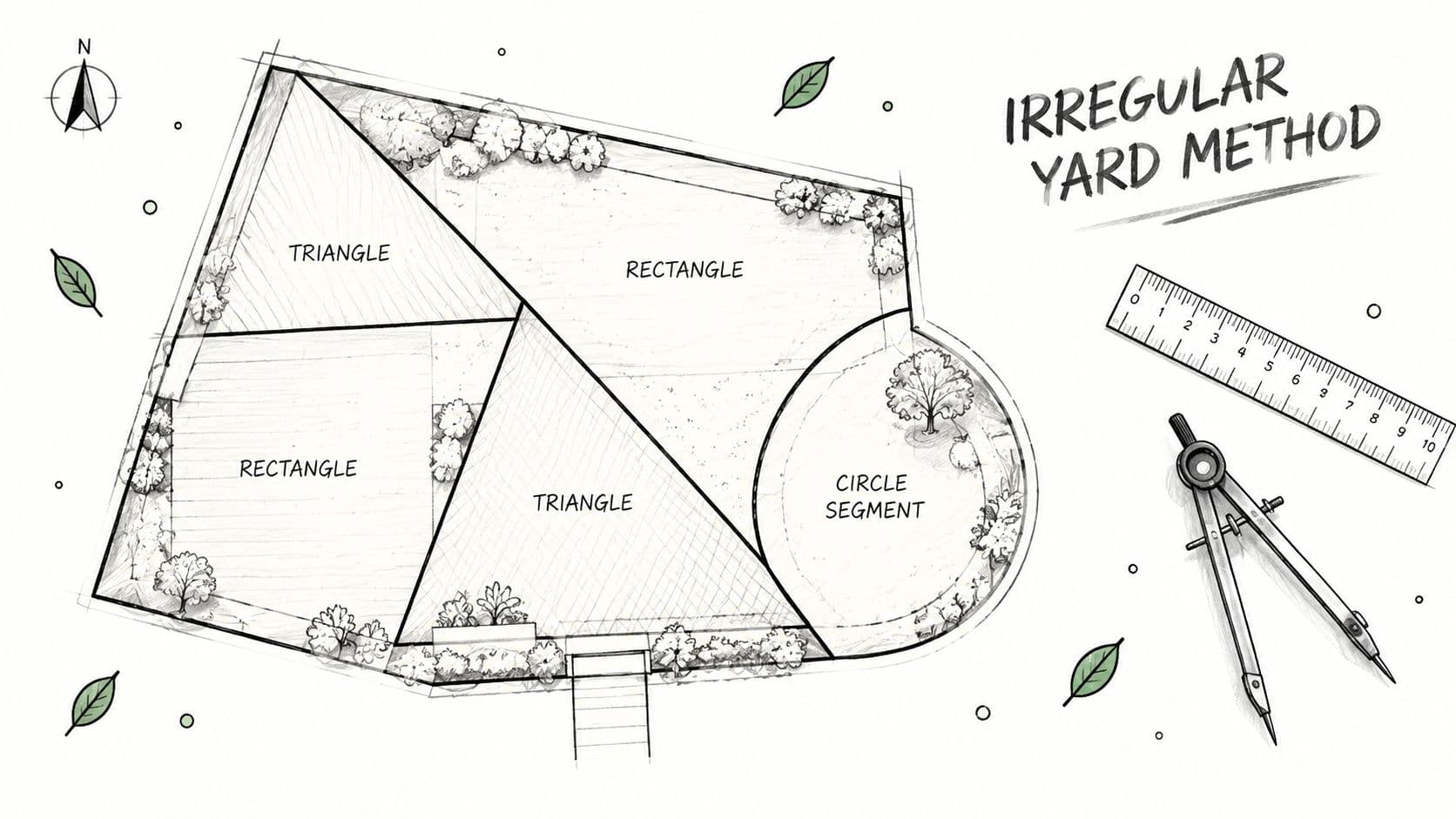
A side yard narrows beside the house, a patio interrupts the lawn, and a curved bed cuts into the remaining grass. One length multiplied by one width will overstate the area you need to seed, sod, irrigate, or fertilize. The reliable field method is to sketch first and calculate second.
Draw a rough overhead plan. Mark the house, fences, property edges, lawn, planting beds, patios, driveways, walkways, retaining walls, and any surface assigned to another project. It does not need to look like a finished plan. It needs clear boundaries showing where each surface starts and ends.
Divide the drawing into shapes
Choose the simplest geometry that follows the actual edges:
- Rectangles: Multiply length by width.
- Triangles: Multiply the base by the perpendicular height, then divide by 2.
- Trapezoids: Use the parallel sides and the height for sections with angled boundaries.
- Circles or partial circles: Measure the radius, calculate the round section, and apply the appropriate fraction for a half or partial curve.
- Narrow strips: Measure them as small rectangles rather than estimating the entire yard in one calculation.
For a curved lawn edge around a bed, approximate the curve with a semicircle or split it into several smaller polygon sections. Smaller sections usually track a changing curve more closely than one oversized shape.
The same process, dividing an irregular site into polygons, measuring each part, subtracting hardscape, and adding the remaining areas, appears in practical lawn-area measuring guidance.
Label each calculated result by surface. Add the lawn sections together, keep mulch beds in a separate total, and record patios or driveways separately. If you started with a larger gross measurement, subtract every area that will not receive the material or service. A retaining wall requires extra attention because its visible footprint from above may differ from the sloped surface that needs coverage.
Use the following video as a visual reference for breaking a complicated outdoor area into manageable measurements.
For a rough check, calibrate a 100-foot step count. Walk the measured distance at your normal pace, record the steps, and use that pace to estimate a boundary that is difficult to access with a tape or wheel. Treat this as a check, not the final figure for a material order where an error affects cost. Convert the final square-feet total to square yards by dividing by 9, as noted in the same lawn measurement guidance.
Choosing the Right Tool for Measuring Your Yard
The right tool depends on the yard, the surface being measured, and the cost of an error. A tape measure gives precise control over short, straight dimensions. A measuring wheel covers long boundaries quickly. Phone apps and satellite maps provide useful first estimates, but tree cover, image quality, property lines, and curved edges can reduce their reliability.
| Method | Best For | Accuracy | Time Needed |
|---|---|---|---|
| Tape measure | Short, straight sections and detailed checks | High when used carefully on accessible edges | Moderate |
| Measuring wheel | Long boundaries, open lawns, and repeated field measurements | Good on firm, fairly level ground | Fast |
| Smartphone GPS app | Rough outdoor estimates and accessible property layouts | Variable, especially near obstacles or under cover | Fast |
| Satellite map tracing | Preliminary planning and large visible areas | Useful for estimates, but dependent on imagery and boundary placement | Fast |
A tape measure is the better choice when you can reach the edges and keep the tape straight. It becomes awkward across planting, fences, steep slopes, or wide lawns. A measuring wheel is faster on open ground, though uneven terrain can push it off course. It also records the route you travel, which may not match the boundary you intended to measure.
Phone GPS apps and satellite tracing help when access is limited. Use them for a first pass, to compare front, back, and side sections, or to check whether field measurements seem reasonable. For large sod orders or permanent hardscape, verify the result on site before placing the order.
For visual planning, Best landscape design apps can connect measurements to a proposed layout. The useful figure is project-specific. A lawn estimate should count only areas receiving grass, while a mulch estimate should exclude turf, paving, and structures.
Choose the method according to the job:
- Quick mulch estimate: Map tracing or a phone app may work when bed edges are clearly visible.
- Small rectangular lawn: A tape measure provides direct, repeatable dimensions.
- Large open lawn: A measuring wheel covers long boundaries efficiently.
- Curved, sloped, or mixed-use yard: Use a sketch and field measurements as the basis, then compare them with satellite imagery.
- Contractor or supplier discussion: Keep the sketch and section totals, not only one final number. That record shows what was counted, what was excluded, and which assumptions still need checking.
Pro Tips to Avoid Costly Measuring Mistakes
Ordering errors usually start before the calculation. They happen when the wrong surface is measured, units are mixed, or a rough estimate is treated as final. Name each area in your notes, record its dimensions, and connect it to the material or work planned there.
Check the math and the site conditions
Use these checks before ordering:
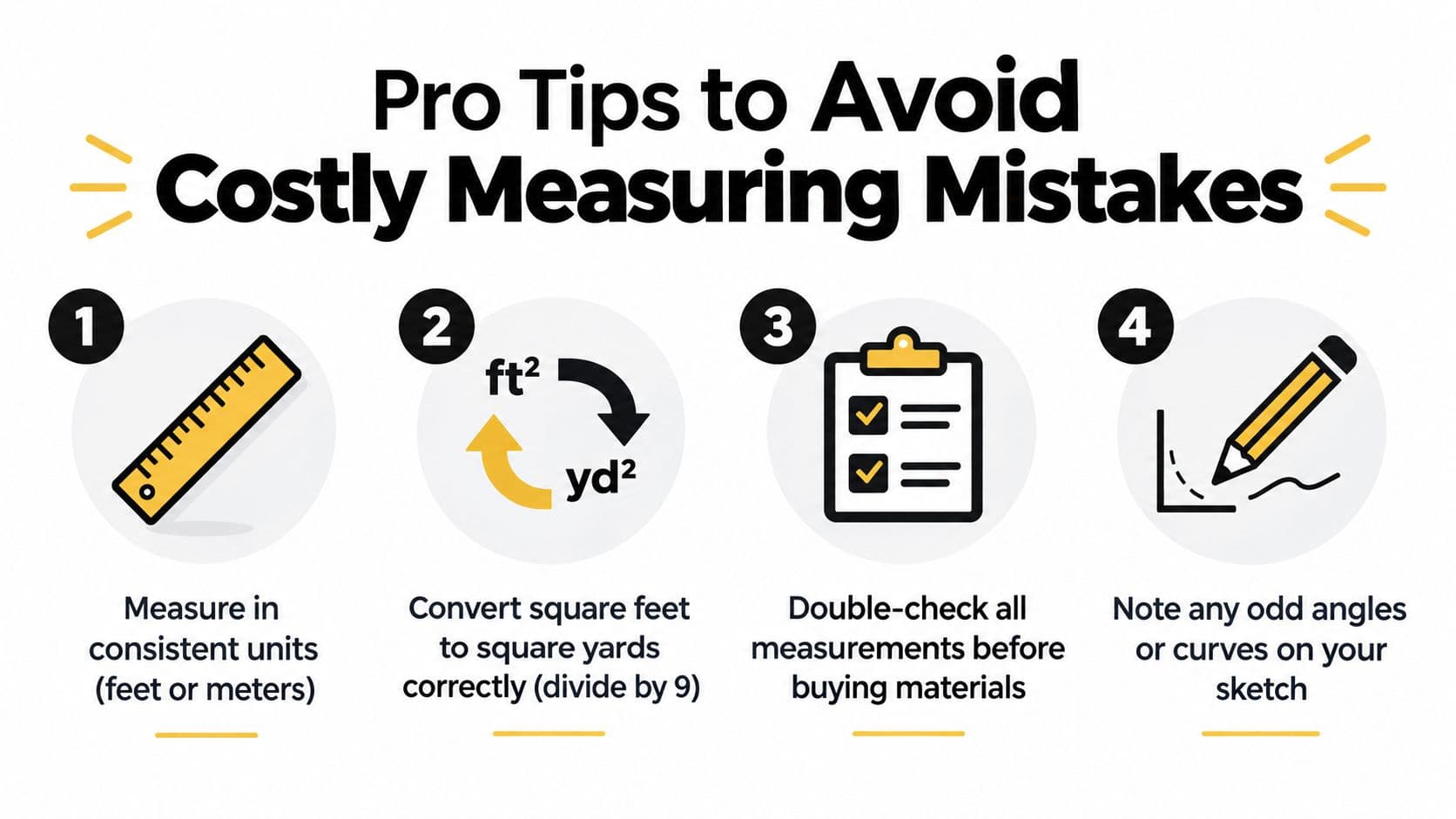
- Use consistent units: Measure every section in feet, or convert the dimensions first. Never multiply feet by inches.
- Separate gross and usable area: Record the full footprint, then subtract patios, driveways, paths, planting beds, structures, and other surfaces that will not receive the material.
- Convert carefully: 1 square yard equals 9 square feet, so divide the completed square-foot total by 9. Do not divide each individual dimension. The conversion is documented in Canada's survey instructions.
- Account for slopes and walls: A sloped lawn may have more surface area than its overhead outline suggests. Measure the surface you will cover, and record terraces or retaining walls separately.
- Verify with another method: Compare tape or measuring-wheel results with a satellite outline, or walk the boundary after calculating it. A mismatch often reveals a missed section or an incorrect boundary.
- Keep a labeled sketch: Place each section's dimensions beside its shape. A supplier can review a questionable figure more easily when the total has a clear calculation behind it.
The usable figure depends on the product. For bark or mulch, measure only the beds and exclude turf, paving, and structures. This guide on how to measure mulch area helps turn bed measurements into a material estimate.
Add a waste allowance only when the work involves cutting, fitting, breakage, or irregular edges. Follow the supplier's guidance rather than applying one rule to every job. Sod, pavers, and curved planting beds have different ordering requirements, so provide the measured area, site shape, and locations needing trimming before the supplier recommends an allowance.
Plan Your Next Outdoor Upgrade With Confidence
A reliable square-footage figure gives you a defensible starting point for the next decision. You can compare sod quantities, estimate mulch coverage, discuss irrigation zones, or ask a contractor for a proposal using the same clearly defined area. Your notes show whether the number covers the whole yard, lawn only, or a particular bed or hardscape section.
Keep the sketch with your measurements. Mark the date, identify the tool used, and record any assumptions about curves, slopes, or areas that you excluded. If the project changes, you can update one zone without measuring the entire property again.
Measurement should also inform design, not just purchasing. Before committing to a new patio, planting bed, pergola, or lawn layout, test whether the proposed feature fits the actual space and leaves enough usable circulation around it. OutdoorBrite's garden ai design lets you use a photo of your own outdoor space to generate redesign concepts and compare possible layouts, which can make the measured areas easier to evaluate visually.

Don't chase unnecessary precision for a rough planting idea, but don't rely on guesswork for a major material order. Define the project area, split complicated boundaries into shapes, subtract what won't be covered, and confirm the result before purchasing.
OutdoorBrite turns a photo of your backyard, garden, patio, or front yard into realistic redesign concepts, helping you test planting beds, patios, pergolas, and other upgrades against the space you've measured. Visit OutdoorBrite to visualize your next outdoor project before you order materials or speak with a contractor.
See your yard reimagined
Start creating