
How to Calculate Mulch Needed for Your Yard
Learn how to calculate mulch needed with simple area, depth, conversion, and worked examples that help you order the right quantity with less waste.
You've measured the flower bed, guessed the depth, and ordered what sounds like enough mulch. Then delivery day arrives, and the pile runs out before the last corner is covered. The problem usually isn't the mulch itself. It's a mismatch between area, depth, units, and purchase format.
Learning how to calculate mulch needed gives you a reliable quantity before you order. You'll measure each bed, choose a practical finished depth, convert the result into cubic feet or cubic yards, and then decide whether bags or bulk mulch make more sense. The same process works for a straight rectangular bed, a circular tree ring, or an irregular planting area.
Table of Contents
- What You Need Before Calculating Mulch
- Calculate Mulch for Rectangular Beds
- Measure Circular and Irregular Garden Beds
- Convert Area, Depth, and Volume Units
- Worked Mulch Calculation Examples
- Choose the Right Mulch Depth
- Order Mulch With Less Waste
What You Need Before Calculating Mulch
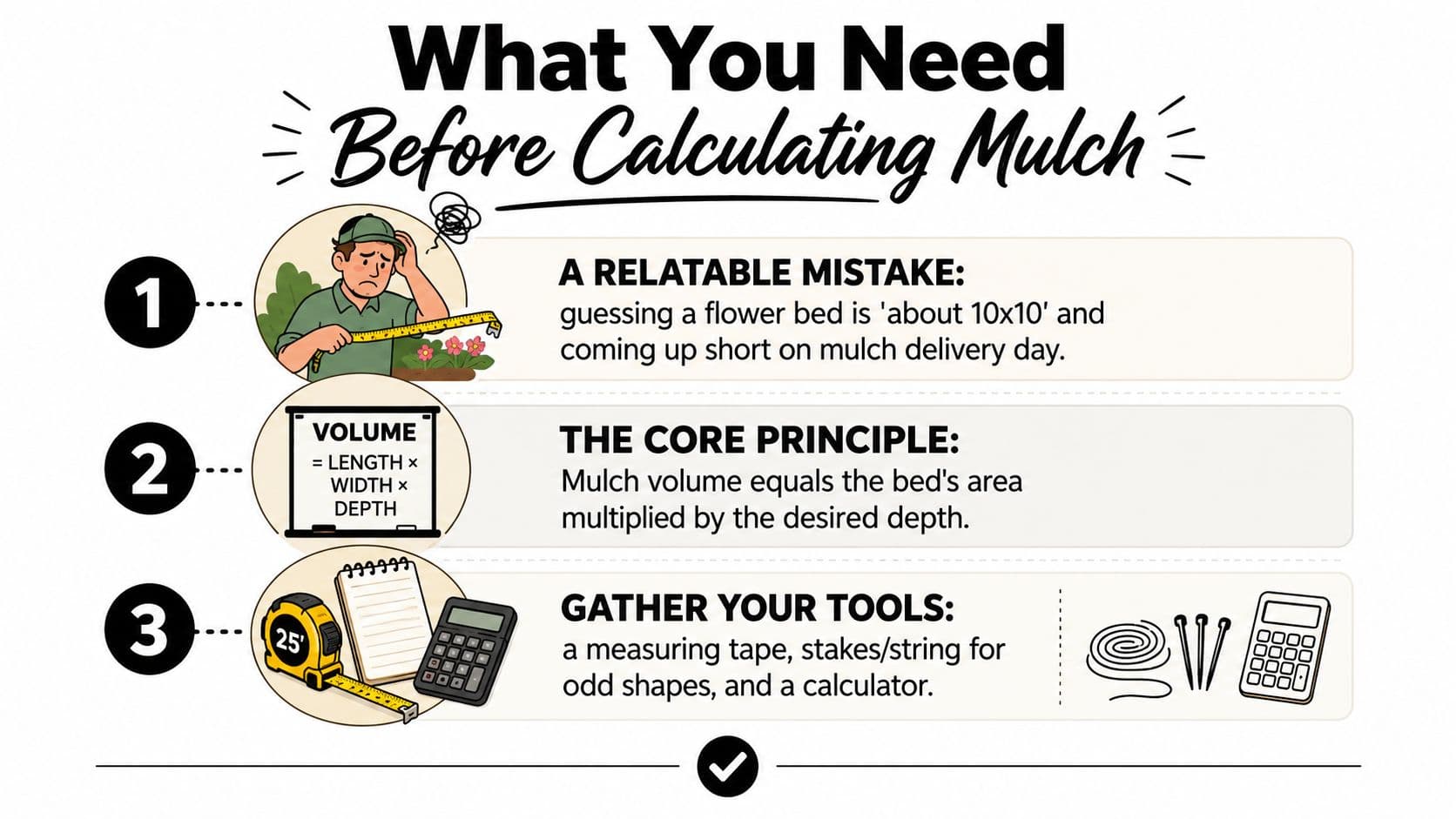
A flower bed that looks “about 10 by 10” may not be 100 square feet. Curved edges, tapered ends, paths, and planting areas hidden by shrubs can all change the result. A small measuring error becomes more noticeable when you're ordering a full delivery, so start with measurements instead of visual estimates.
The basic principle is simple:
Mulch volume = surface area × finished mulch depth.
That means every estimate depends on three measurements or decisions:
- The bed's length and width, or its total area
- The mulch depth you want after spreading
- A consistent unit system for the calculation
Measure straight edges with a long tape measure. A 100-foot tape works well for larger beds, while stakes and string help you trace curves and divide unusual shapes into manageable sections. Keep a notepad or phone nearby, and use a calculator so you don't have to perform several conversions mentally. If you need dependable equipment for repeated outdoor projects, this selection of measuring tools for tradespeople and DIY can help you choose the right tape or measuring accessory.
Measure the ground, not just the outline
For a rectangular bed, record the longest usable length and the average width if the edges taper. For uneven ground, check the deepest and shallowest spots. A sloped or settled bed may need a practical average depth rather than one measurement taken at a single point.
Before multiplying anything, convert your measurements into matching units. Keep the area in square feet and the depth in inches if you're using the shortcut formula. Or convert the depth to feet and calculate cubic feet directly. An AI garden design concept can help you think through bed boundaries and layout, but physical measurements still determine the material order.
The sections below use three shopping-focused approaches: rectangular formulas, circle and triangle calculations for shaped beds, and conversions that turn volume into bags or bulk quantities.
Calculate Mulch for Rectangular Beds
Rectangular beds are the easiest because the area comes from one multiplication:
Length × width = square feet.
Suppose a bed measures 12 feet by 20 feet and you want a 3-inch mulch layer.
Work through the calculation
First find the surface area:
12 × 20 = 240 square feet
Next convert the depth from inches to feet:
3 ÷ 12 = 0.25 feet
Now multiply area by depth:
240 × 0.25 = 60 cubic feet
Finally convert cubic feet to cubic yards. Since 1 cubic yard equals 27 cubic feet, divide by 27, using the standard mulch relationship described by Calculator Soup's mulch calculator:
60 ÷ 27 = approximately 2.22 cubic yards
At 4 inches, the same bed needs a deeper layer:
4 ÷ 12 = 0.333 feet
240 × 0.333 = approximately 80 cubic feet
80 ÷ 27 = approximately 2.96 cubic yards
| Depth (inches) | Depth (feet) | Volume (cubic feet) | Volume (cubic yards) |
|---|---|---|---|
| 3 | 0.25 | 60 | 2.22 |
| 4 | 0.333 | Approximately 80 | Approximately 2.96 |
The one-inch increase adds roughly one-third more volume because the area stays constant while the layer becomes deeper. This is why you should choose the depth before placing an order rather than treating depth as a minor detail.
Practical rule: Keep area and depth in matching units before multiplying. Square feet paired with inches works only when you use the correct conversion factor.
For a faster calculation, multiply square feet by depth in inches, then divide by 324. The same bed at 3 inches is:
240 × 3 ÷ 324 = approximately 2.22 cubic yards
That shortcut is based on the standard coverage relationship, where one cubic yard covers 324 square feet at 1 inch, 162 square feet at 2 inches, 108 square feet at 3 inches, or 81 square feet at 4 inches (Calculator Soup).
Use rectangular math when the bed has straight or nearly straight sides. For circles, wedges, kidney shapes, and curved tree rings, calculate the area in sections instead.
Measure Circular and Irregular Garden Beds
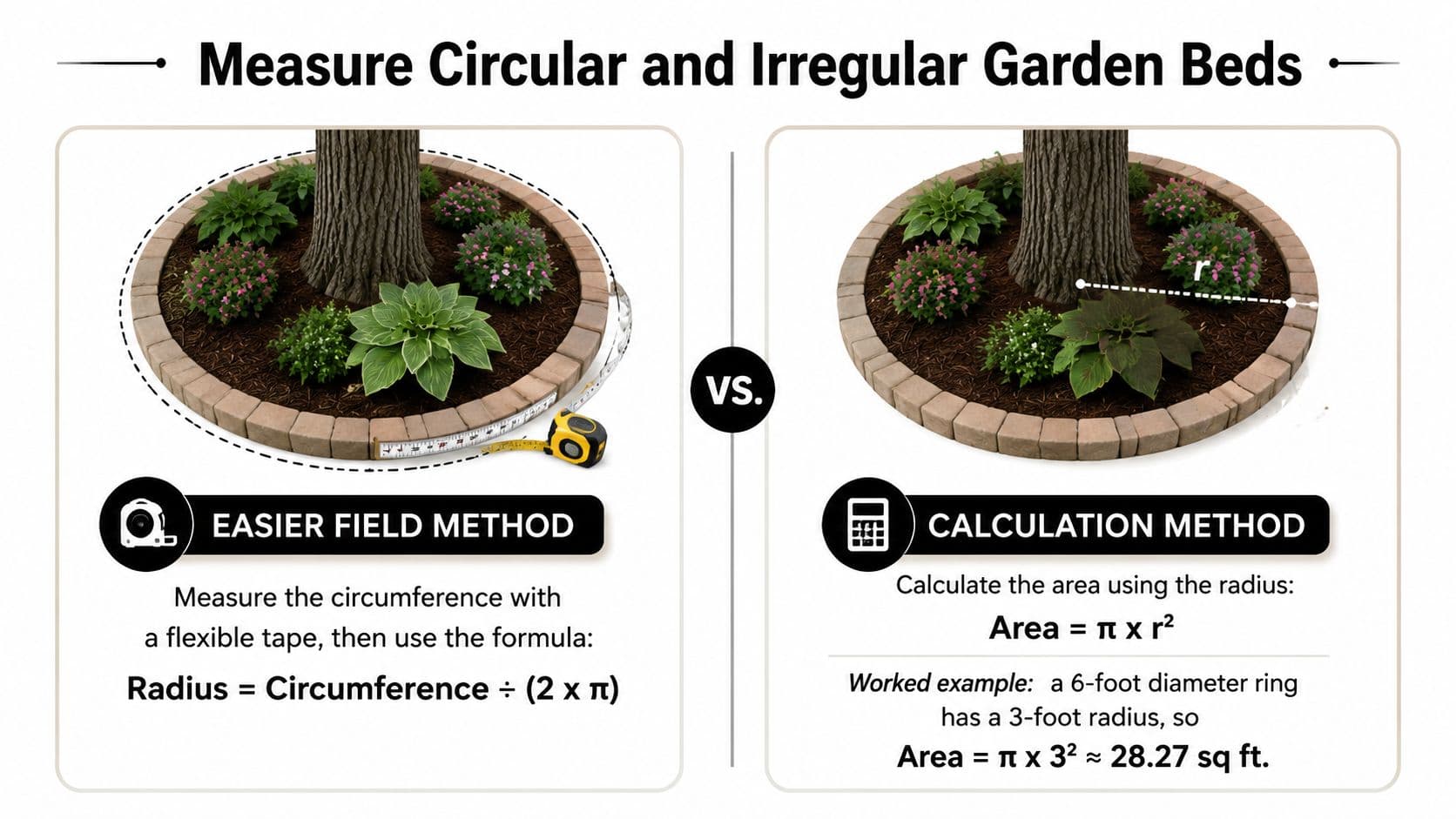
A circular bed needs a radius, which is the distance from the center to the outside edge. If you measured the full diameter, divide it by 2 before calculating. The area formula is:
Area = π × radius²
For a round tree ring with a 6-foot radius, the area is approximately:
3.14 × 6 × 6 = approximately 113 square feet
At 3 inches, convert depth to a quarter of a foot and multiply:
113 × 0.25 = approximately 28.25 cubic feet
28.25 ÷ 27 = approximately 1.05 cubic yards
A triangle uses a different area formula:
Area = base × height ÷ 2
That works well for a wedge-shaped bed beside a patio or fence. If the base is the straight back edge and the height is the distance from that edge to the point, multiply those measurements and halve the result.
| Shape | Field measurement | Area formula | Best use |
|---|---|---|---|
| Circle | Radius, or circumference converted to radius | π × radius² | Tree rings and round beds |
| Triangle | Base and perpendicular height | Base × height ÷ 2 | Wedges and tapered corners |
| Irregular bed | Several simple sections | Add each section's area | Kidney shapes and mixed borders |
For an irregular bed, divide the outline into shapes you can measure confidently. A kidney-shaped bed might become two overlapping circles, or a rectangle plus a triangle. Calculate the area and mulch volume for each section, then add the volumes together.
Don't eyeball a large curve if you can avoid it. A small area error can leave you short by several bags, especially when the bed is deep or the mulch is sold in small packages. Sketch the bed on grid paper, label every length, and mark the sections clearly before entering the numbers.
This video provides another visual walkthrough of measuring and calculating shaped garden areas:
Convert Area, Depth, and Volume Units
Most mulch mistakes come from mixing units. Square feet measure area, while cubic feet measure volume. Inches measure depth, but they can't be multiplied directly by square feet unless you use a formula designed for that combination.
Start with a 200-square-foot bed at 3 inches deep. Convert the depth first:
3 inches ÷ 12 = 0.25 feet
Then calculate:
200 square feet × 0.25 feet = 50 cubic feet
Convert the volume to yards:
50 cubic feet ÷ 27 = approximately 1.85 cubic yards
The wrong approach would be to multiply 200 square feet by 3 inches and call the result cubic feet. That produces a figure with mismatched units, not a valid volume. If you prefer to keep depth in inches, use the established shortcut:
Square feet × depth in inches ÷ 324 = cubic yards
For the same bed:
200 × 3 ÷ 324 = approximately 1.85 cubic yards
Useful ordering conversions
- Square feet to square yards: divide by 9.
- Square feet to square meters: multiply by 0.0929.
- Inches to feet: divide by 12.
- Cubic feet to cubic yards: divide by 27.
- Cubic yards to cubic meters: multiply by 0.7646.
- Two-cubic-foot bag to cubic yards: one bag equals roughly 0.074 cubic yards, based on the standard cubic-foot relationship (Calculator Soup).
| Starting unit | Conversion | Why it matters |
|---|---|---|
| Inches of depth | Divide by 12 to get feet | Lets you calculate cubic feet |
| Square feet | Divide by 9 to get square yards | Useful when a supplier quotes area that way |
| Cubic feet | Divide by 27 to get cubic yards | Required for bulk orders |
| Cubic yards | Multiply by 0.7646 to get cubic meters | Helps compare supplier measurements |
| Two-cubic-foot bag | Roughly 0.074 cubic yards | Helps compare bagged and bulk mulch |
Keep the original measurements in your notes. If a supplier asks for cubic yards, you can show the calculation and verify the quote without starting over.
Worked Mulch Calculation Examples
The formula becomes easier to trust when you see it applied to different yard layouts. These examples use the same sequence: find area, select depth, calculate volume, convert to cubic yards, then choose a practical order quantity.
Project one, a small front bed
An 8-foot by 12-foot bed has:
8 × 12 = 96 square feet
At 3 inches, the volume is:
96 × 3 ÷ 12 = 24 cubic feet
24 ÷ 27 = approximately 0.89 cubic yards
A practical bulk order is 1 cubic yard. If you're buying bags, divide 24 cubic feet by the volume printed on each bag. Check the label, because bag sizes vary.
Project two, a larger backyard area
A 20-foot by 30-foot area contains:
20 × 30 = 600 square feet
At 2 inches:
600 × 2 ÷ 12 = 100 cubic feet
100 ÷ 27 = approximately 3.70 cubic yards
At 1.5 inches, the same area needs:
600 × 1.5 ÷ 12 = 75 cubic feet
75 ÷ 27 = approximately 2.78 cubic yards
That half-inch reduction removes nearly a cubic yard from the estimate. The decision should come from the intended function and site conditions, not from arithmetic alone.
Project three, a circular tree ring
A ring with a 6-foot diameter has a 3-foot radius:
3.14 × 3 × 3 = approximately 28.26 square feet
At 3 inches:
28.26 × 3 ÷ 12 = approximately 7.07 cubic feet
7.07 ÷ 27 = approximately 0.26 cubic yards
| Project | Dimensions | Depth | Cubic yards needed | Suggested order |
|---|---|---|---|---|
| Small front bed | 8 ft × 12 ft | 3 in | Approximately 0.89 | 1 cubic yard |
| Backyard area | 20 ft × 30 ft | 2 in | Approximately 3.70 | Round up according to supplier quantity |
| Circular tree ring | 6 ft diameter | 3 in | Approximately 0.26 | Buy bags or a small bulk quantity |
A price comparison only makes sense after the volume and depth are fixed. If a supplier quotes a price per cubic yard, multiply that quoted price by the selected order quantity. Don't insert a sample price into the estimate without checking the local quote, because mulch prices vary by material and location.
Choose the Right Mulch Depth
Arithmetic tells you how much material fills a chosen layer. It doesn't decide whether that layer suits the bed. Extension guidance commonly uses a finished depth of 2 to 4 inches, a range that balances weed suppression and moisture retention while helping prevent excessive buildup around plants and trunks (LawnStarter).
Use the intended job to select the depth:
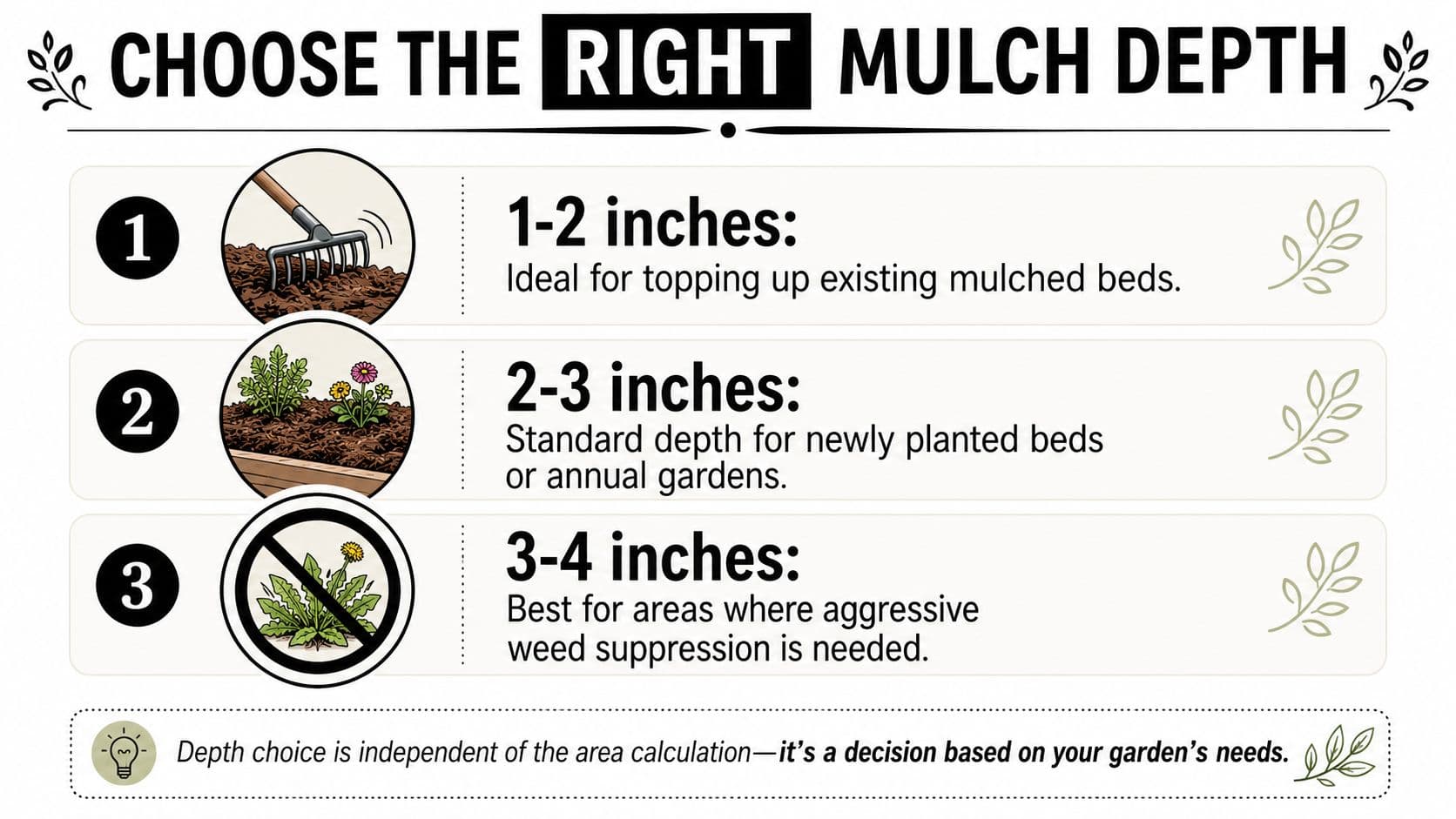
- 1 to 2 inches can suit a bed that already has mulch and needs a light refresh.
- 2 to 3 inches is a practical range for many planting beds around trees and shrubs.
- 3 to 4 inches can suit a bare bed where stronger weed suppression is the priority.
Going deeper isn't automatically better. Excess material can hold too much moisture and restrict air around roots, so don't pile mulch against trunks or stems. Leave the plant base visibly clear, then smooth the mulch outward.
Adjust the decision for the site
Uneven or sloped ground may settle into low spots, so your measured average depth may not look uniform after installation. Heavy clay soil may call for a lighter layer, while local water restrictions can make moisture management more important than a purely decorative refresh. Material choice matters too. Sustainability, drought tolerance, water conservation, and biodegradable or recycled inputs increasingly influence mulch decisions, so mulch shouldn't be treated as interchangeable across every property (Persistence Market Research).
Access affects the shopping format. A narrow path that only allows a wheelbarrow may favor bags, even if bulk material would be easier for a large open area. For more guidance on comparing the top mulches for flower beds, match the material to your plants, climate, and maintenance routine before finalizing the depth.
Order Mulch With Less Waste
Your final volume is the math result. The purchase quantity also depends on settling, small measuring errors, the selling unit, and how easily material can reach the bed. Keep the calculated amount separate from any added buffer so the order remains easy to explain.
- Confirm the depth. Record the finished mulch layer in inches. Depth is a site decision, not something the volume formula chooses for you.
- Verify the area. Recheck every rectangle, circle, triangle, and divided section before adding their areas.
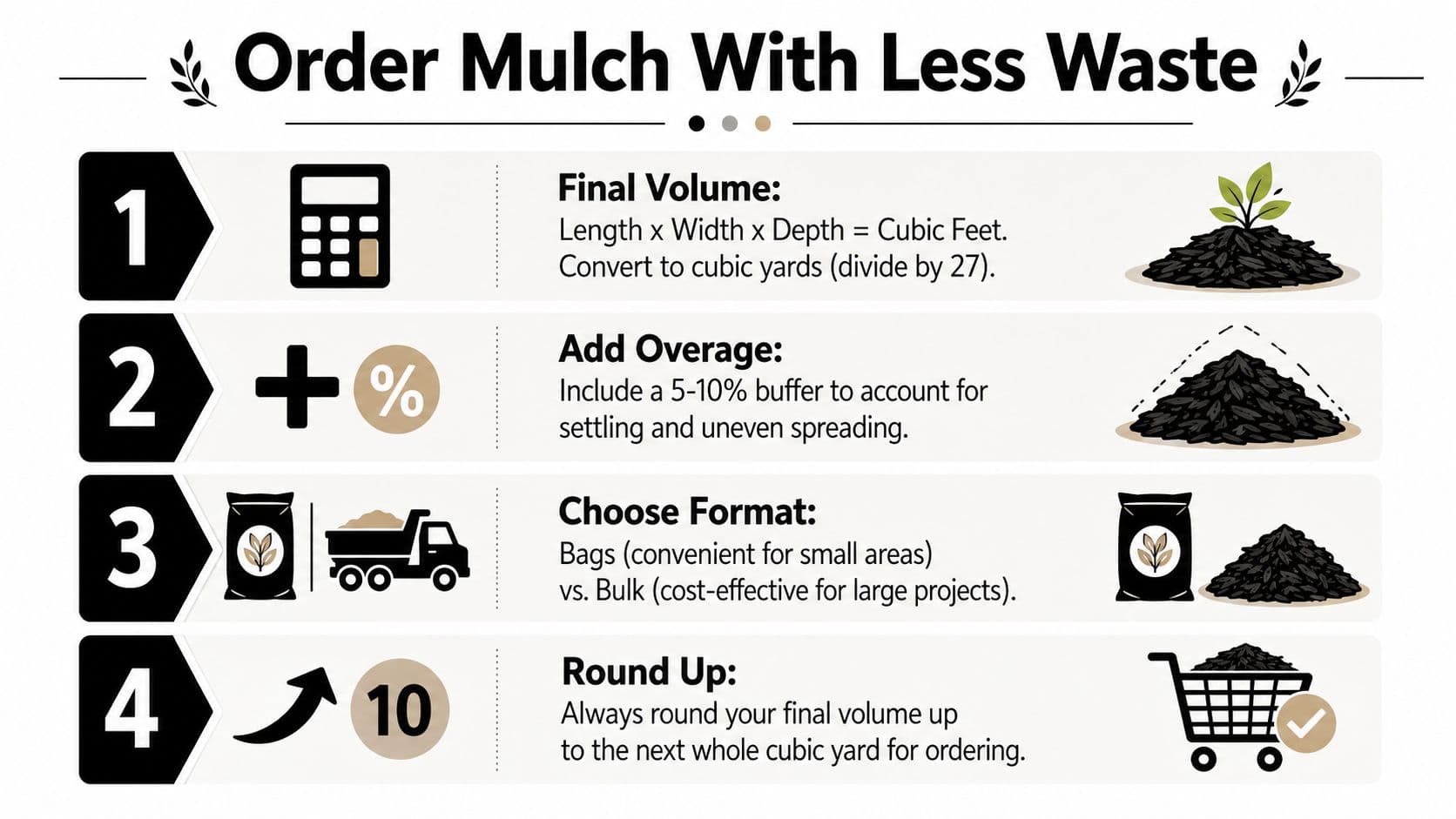
- Calculate volume. Multiply square feet by depth in inches, then divide by 324 to get cubic yards. You can also convert the depth to feet and calculate cubic feet.
- Add a modest overage. A 5 to 10 percent buffer can cover settling, uneven spreading, and minor measurement errors. Keep it separate from the calculated volume instead of hiding it in the formula.
- Choose bags or bulk. Bags suit narrow paths and wheelbarrow access. Bulk usually fits broad beds when a delivery vehicle can reach the property.
- Round up to the selling unit. Bulk may be sold by whole or fractional quantities, while bags must be bought as complete packages.
For the 12-by-20-foot bed at 3 inches, the calculated volume is approximately 2.22 cubic yards. A modest buffer means discussing a quantity slightly above that figure with the supplier, rather than ordering exactly 2.22 and expecting perfect coverage at every edge. The small circular ring from the earlier example may be simpler to cover with bags. For an irregular bed, order from the combined volume of its labeled sections.
Access also affects delivery. Check whether a truck can reach the driveway or unload close to the garden. If bulk material will be moved around the property, this side dump trailer guide for yard projects explains delivery and unloading considerations.
Before ordering: Confirm depth, matching units, total area, cubic volume, bag size, access, and overage in one written note.
Bag capacity varies by product and region, so read the cubic-foot amount printed on the package. Do not assume every bag holds the same volume. For several beds or materials, use this guide to measure outdoor materials accurately and check your manual results.
OutdoorBrite lets homeowners preview planting beds and outdoor layouts from a photo. Its calculators can also help translate measured areas and selected depths into material quantities. Visit OutdoorBrite to review a yard concept and plan mulch, plants, and hardscape before ordering.
See your yard reimagined
Start creating