8 Low Maintenance Front Yard Ideas for 2026
Explore 8 low maintenance front yard ideas, from xeriscaping and groundcovers to hardscaping, lighting, and OutdoorBrite visualization.
The most popular advice for a low maintenance front yard is often the least useful: remove the lawn, spread gravel, and assume the work disappears. It doesn't. Gravel can migrate, artificial turf can need cleaning, dense shrubs can demand repeated pruning, and poorly planned drainage can turn a tidy entry into a repair project.
Start by designing out the chores instead. Match hardscape, groundcovers, plant structure, irrigation, and lighting to your climate, soil, drainage, sun exposure, and tolerance for seasonal work. A useful plan doesn't promise a maintenance-free yard. It reduces the specific jobs you dislike, whether that's watering, mowing, weeding, pruning, clearing runoff, or redesigning failed plantings.
This guide compares eight distinct approaches by the work they remove, with practical trade-offs for hot, dry, wet, shaded, suburban, and compact sites. It also covers establishment care, seasonal checks, material decisions, and a visual workflow using OutdoorBrite. For additional starting points, compare these front-yard design ideas from Task Masters Inc. before you settle on a layout.
Table of Contents
- 1. Xeriscaping With Native Plants
- 2. Permeable Hardscaping
- 3. Ornamental Grasses
- 4. Mulch and Ground Cover Alternatives
- 5. Evergreen Shrubs and Architectural Plantings
- 6. Integrated Lighting
- 7. Synthetic Turf and Artificial Grass
- 8. Hardscape-Forward Design
- Low-Maintenance Front Yard: 8 Options Compared
- Turn the Ideas Into a Yard You Can Keep Up With
1. Xeriscaping With Native Plants
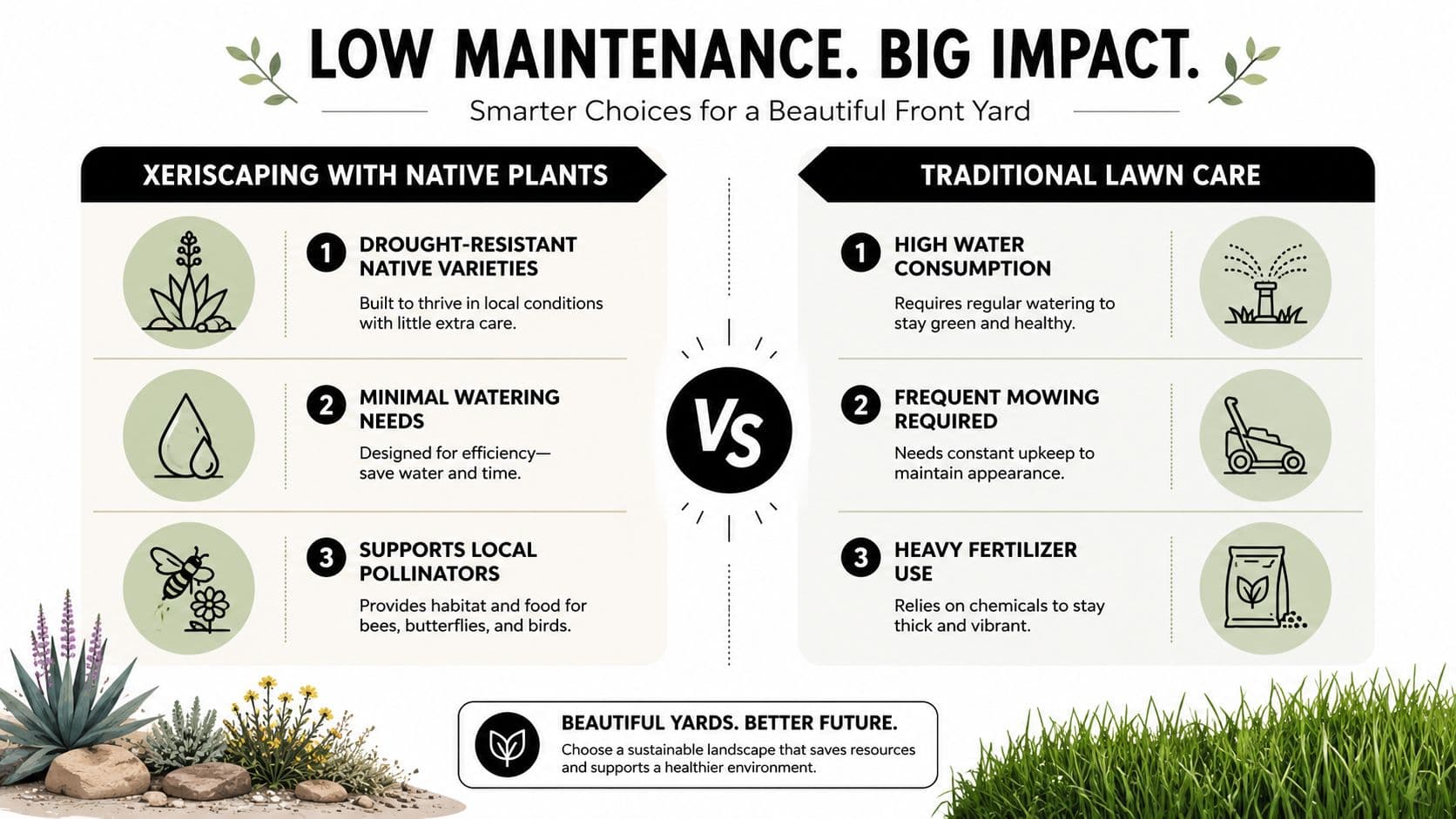
Xeriscaping is the strongest option when watering is the chore you want to remove. It combines site planning, soil preparation, reduced turf, mulch, efficient irrigation, low-water plants, and regular maintenance, a framework associated with the seven xeriscape fundamentals identified by Colorado State University's Xeriscape Task Force in the EPA's water-efficient landscaping guide.
The plant list should come from your region, not from a generic “desert garden” search. A Las Vegas yard might use agave, lantana, and desert rose. A Southern California coastal entry could feature California poppies, sage, and buckwheat. Colorado Front Range homeowners may prefer buffalo grass, pinyon pine, and blanket flower, while an Arizona development may suit brittlebush, desert marigold, and adapted ornamental grasses.
Practical rule: Group plants by water requirements. A thirsty accent plant placed among drought-adapted species usually creates an irrigation problem, not visual variety.
Hydrozoning keeps irrigation targeted. Add organic mulch to planting beds to reduce evaporation and suppress weeds, but keep it away from stems and trunks. Water thoroughly and infrequently after establishment rather than creating shallow, dependent root systems. Ask a local native plant society or cooperative extension for choices that fit your soil and seasonal rainfall.
The water case is substantial. The EPA estimates that outdoor use accounts for about 30% of average household water consumption, and outdoor use can reach 60% in dry climates. Its materials also report that as much as 50% of residential outdoor water can be lost to evaporation, wind, or runoff, making plant selection and irrigation design central to efficiency. Review the sustainable landscaping in dry climates guidance for additional planning context.
Use OutdoorBrite's xeriscape style to test grouped native planting, gravel, mulch, and reduced lawn on a photo of your property before ordering plants. The visual test should answer one question: does the yard still have clear structure in the season when flowers are absent?
2. Permeable Hardscaping
If your recurring problem is runoff, puddling, or muddy edges, permeable hardscaping can remove more work than another planting bed. Permeable pavers and other porous surfaces allow water to pass into a prepared base rather than sending every drop across the driveway or walkway. The surface still needs maintenance, but the work shifts from managing erosion and standing water to keeping joints and pores clear.
The installation base matters more than the paver color. A contractor should assess the native soil, slope, nearby foundations, and likely water flow before selecting the surface. A modest slope, careful edge restraint, and a properly graded aggregate base help the system drain without undermining the path.
For a front entry, use permeable pavers on the driveway, a walkway, or a small landing rather than treating every open area as hardscape. Drought-tolerant groundcovers can soften joints, but they shouldn't be added where foot traffic will crush them or where sediment will quickly fill the gaps.
What reduces maintenance
Sweep the surface regularly so leaves and soil don't clog the joints. Occasional pressure washing may restore infiltration, but aggressive cleaning can remove joint material or damage a finish. Check local building and stormwater requirements before installation, particularly if the project changes the driveway or directs water toward a neighboring property.
A permeable surface is not a substitute for grading. Water still needs a deliberate route when the soil is saturated or the rainfall exceeds infiltration capacity.
A Santa Monica driveway, a Seattle residential path, and an Austin Hill Country entry may all use permeable materials, but the structural design won't be identical. Climate, soil, freeze conditions, and local regulations determine whether the approach works.
Try an AI patio design concept in OutdoorBrite's modern or contemporary styles to compare paver patterns, planting pockets, and walkway widths before you buy materials. You can also browse outdoor tiles for Melbourne for surface inspiration, then verify that any selected product suits your local conditions.
3. Ornamental Grasses
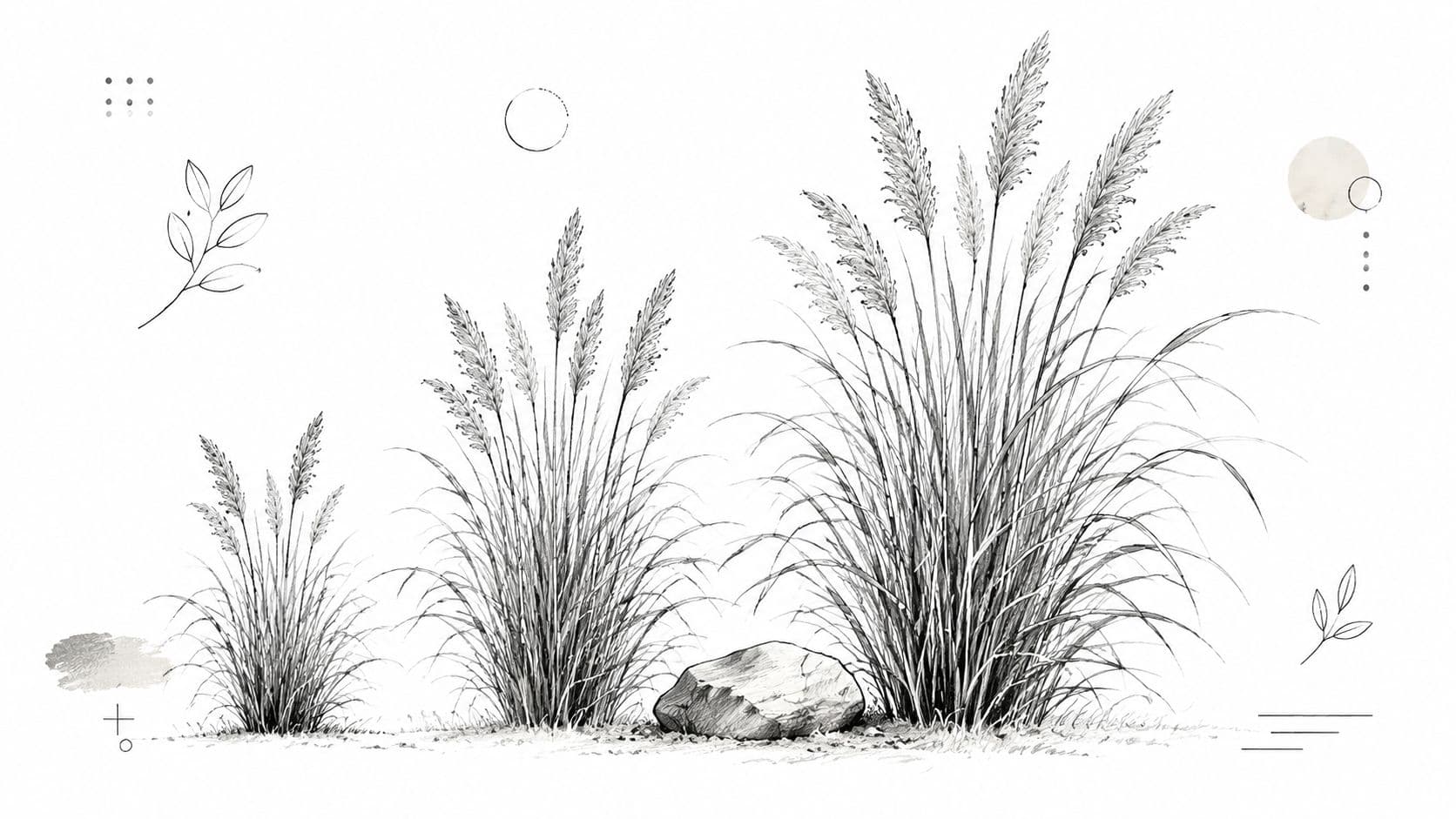
Ornamental grasses remove much of the mowing and edging associated with turf, while preserving movement and texture. They aren't lawn substitutes for play or regular walking, but they can fill broad planting areas with a clear visual rhythm and less frequent intervention.
Purple fountain grass can anchor a modern California garden. Prairie dropseed and big bluestem suit prairie-influenced gardens in the Midwest. Texas properties may combine adapted grasses with sage and desert plants, while feather reed grass can give coastal Northeastern gardens a more vertical form. The right selection depends on winter conditions, soil moisture, mature height, and whether the grass spreads aggressively.
Plant grasses in repeating groups rather than scattering one specimen wherever there's an empty spot. Odd-number groupings can look more natural, but spacing and mature width matter more than a formula. Pair tall varieties with lower groundcovers and perennials so the bed has layers instead of a wall of identical foliage.
The maintenance trade-off
Most ornamental grasses need seasonal cleanup. Cut back deciduous types in late winter before new growth appears, and divide crowded clumps when they lose vigor or outgrow their space. Evergreen grasses may need combing or selective removal rather than a complete cutback. Some varieties can reseed or spread, so check local recommendations before planting.
A four-foot grass placed beneath a window can become a view obstruction. A one-foot blue fescue used along a path may be easier to manage, but it won't provide the same screening effect. Match height to the job, not just the plant tag's appearance at purchase.
Use OutdoorBrite's modern or contemporary styles to compare grass masses with sedums, architectural plants, and stone. Look at the concept from the street and from the front door. A grass design succeeds when the planting reads as deliberate in winter, after the flower display has passed.
4. Mulch and Ground Cover Alternatives
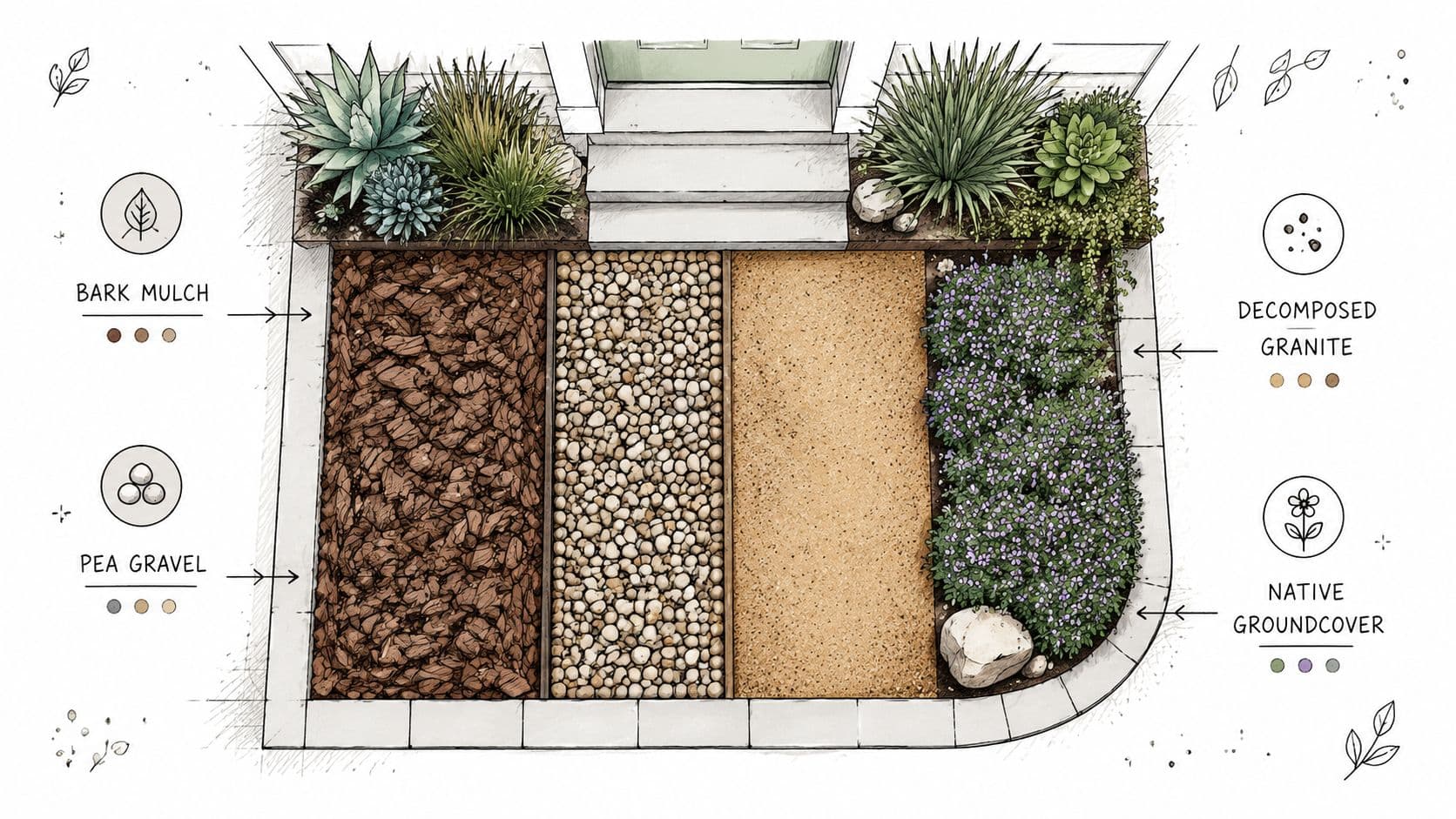
Mulch and groundcovers reduce weeding and exposed-soil maintenance, but they work best as a designed surface system. Bark, wood chips, gravel, decomposed granite, river rock, recycled materials, and living groundcovers each behave differently under rain, wind, foot traffic, and leaf fall.
Organic mulch suits planting beds where improving soil is useful. Rock and gravel are better in dry, open areas where persistent moisture could create problems. A Japanese-inspired gravel bed can look restrained and polished, while decomposed granite can create a practical Southwestern path. Dark mulch offers strong contrast with silver foliage, but it may look harsh if the surrounding architecture already uses heavy dark tones.
Use the material where it earns its keep
Keep mulch at a consistent depth and away from plant crowns. Edging helps contain both bark and gravel, especially beside sidewalks and driveways. Landscape fabric can suppress weeds temporarily, but it can also interfere with nutrient cycling and water movement, so it shouldn't be treated as an automatic layer beneath every bed.
Living groundcovers can be attractive between shrubs, but they still need establishment watering and occasional thinning. Gravel isn't maintenance-free either. It can collect leaves, move downhill, and expose the soil beneath. Choose it because it suits the drainage and visual language of the property, not because it looks like an effortless shortcut.
For material planning, calculate the bed area and desired depth before ordering. OutdoorBrite's mulch calculator can help estimate quantities alongside a visual concept, but confirm measurements on site before purchasing.
The cleanest low-maintenance bed usually has fewer materials, stronger edges, and enough room around each plant for access.
Use OutdoorBrite to compare bark, gravel, and planted groundcover on the same front-yard photo. The visual test is simple: can you see where the bed ends, where people walk, and where water should go?
5. Evergreen Shrubs and Architectural Plantings
Evergreens remove much of the seasonal redesign risk that comes from relying on short-lived flowers or plants that disappear in winter. They provide a stable framework around the entry, driveway, or foundation, so the yard can look composed before annual color and perennials return.
Choose shrubs with naturally compact forms whenever possible. Boxwood, holly, dwarf conifers, compact viburnums, pittosporum, junipers, rosemary, myrtle, and other regional choices can all support different design languages, but no plant is low-maintenance if it has been placed where it must be cut constantly to fit.
A New England entry might use boxwood and dwarf spruce for structure. A Southern property may use holly or pittosporum, while a Western or Mediterranean setting may suit juniper, rosemary, or a compact olive. The examples are starting points, not universal prescriptions. Hardiness, soil drainage, salt exposure, disease pressure, and mature size should decide the final list.
Design for mature form
Use fine-textured foliage beside coarser leaves, and repeat a limited palette across the property. A single sculptural conifer can make a strong focal point, but several unrelated specimens can make a small yard feel cluttered. Grouping plants by water needs also simplifies irrigation.
Prune to preserve shape, not to force every shrub into a geometric block. Late-winter or early-spring pruning often suits many shrubs, but flowering time and species-specific guidance matter. Exposed evergreens may need protection from drying winter winds, and newly planted shrubs still need consistent establishment care.
OutdoorBrite can help show mature-looking evergreen masses against the façade, path, and driveway. Compare a shrub-heavy design with one using grasses and groundcovers. The better option is the one that leaves enough clearance for windows, siding, paving, and future access.
6. Integrated Lighting
Lighting removes nighttime uncertainty and some entryway safety concerns, but it can also create a new maintenance burden if the system is scattered, poorly wired, or overcomplicated. Solar path lights, low-voltage LED fixtures, uplights, and concealed strips can make a sparse planting plan feel intentional after sunset.
Start with the route people use. Light the front walk, steps, address area, and key changes in grade before adding decorative accents. A few carefully aimed fixtures often create more depth than uniform brightness across the entire yard. Warm LED light generally feels more welcoming than harsh cool light, especially against stone, wood, and evergreen foliage.
Solar fixtures need a clear view of the sky and enough direct sunlight to charge reliably. Shade from trees, roof overhangs, and seasonal changes can reduce performance. Low-voltage systems offer more control, but they require thoughtful cable routing, protected connections, and a transformer that can handle the selected fixtures.
Keep the system serviceable
Use timers or motion sensors where appropriate to reduce unnecessary operating time and light spill. Leave access around transformers, connections, and fixtures so a replacement doesn't require disturbing an entire planting bed. Test the arrangement after dark before finalizing positions. A fixture that looks subtle at dusk may glare into a bedroom window later in the evening.
Examples vary by setting. A California driveway may suit solar path lights, while a New England home may benefit from low-voltage uplighting on a specimen tree. A modern entry could use concealed architectural lighting, but the fixture should support the architecture rather than announce itself.
Use OutdoorBrite concepts to test lighting placement alongside planting and hardscape. Treat the nighttime view as a design check, not an afterthought. The goal is to guide the eye and the feet, not turn the front yard into a brightly lit display.
7. Synthetic Turf and Artificial Grass
Synthetic turf removes mowing, routine irrigation, fertilizer application, and many turf weeds, which makes it attractive for homeowners who want a consistently green surface without maintaining natural grass. It can also solve difficult conditions such as heavy shade, restricted water access, or a small high-use area.
The trade-off is that installation quality determines most of the result. A realistic surface needs a stable, well-drained base, secure edges, carefully joined seams, and an infill suited to the use. Cheap products can look artificial, flatten, fade, or feel unpleasant under strong sun. Pet owners should also plan for rinsing, odor control, and drainage rather than assuming the surface cleans itself.
Use synthetic turf selectively. A narrow play patch, a small entry lawn, or a shaded zone may benefit from it, while the rest of the yard can use shrubs, gravel, and native plants. This hybrid arrangement reduces the visual and environmental risk of covering the entire front yard with one material.
Check rules and heat
Some homeowners' associations restrict artificial grass, so review covenants before approving a design. Confirm local requirements for drainage and front-yard appearance as well. In hot climates, exposed synthetic surfaces can become uncomfortable, especially where reflected heat from paving or walls adds to the problem.
Cork and coconut-based infills are among the alternatives homeowners may investigate when they want to avoid conventional rubber options, but every infill still needs product-specific review. Brush the turf against the grain periodically, rinse dust from the blades, and clear leaves before organic debris accumulates.
Use OutdoorBrite to compare a turf patch with a xeriscape or mixed planting concept on the same photo. Ask whether the green area serves a real purpose. If it doesn't, the surface may remove mowing while adding material, heat, cleaning, and replacement concerns.
8. Hardscape-Forward Design
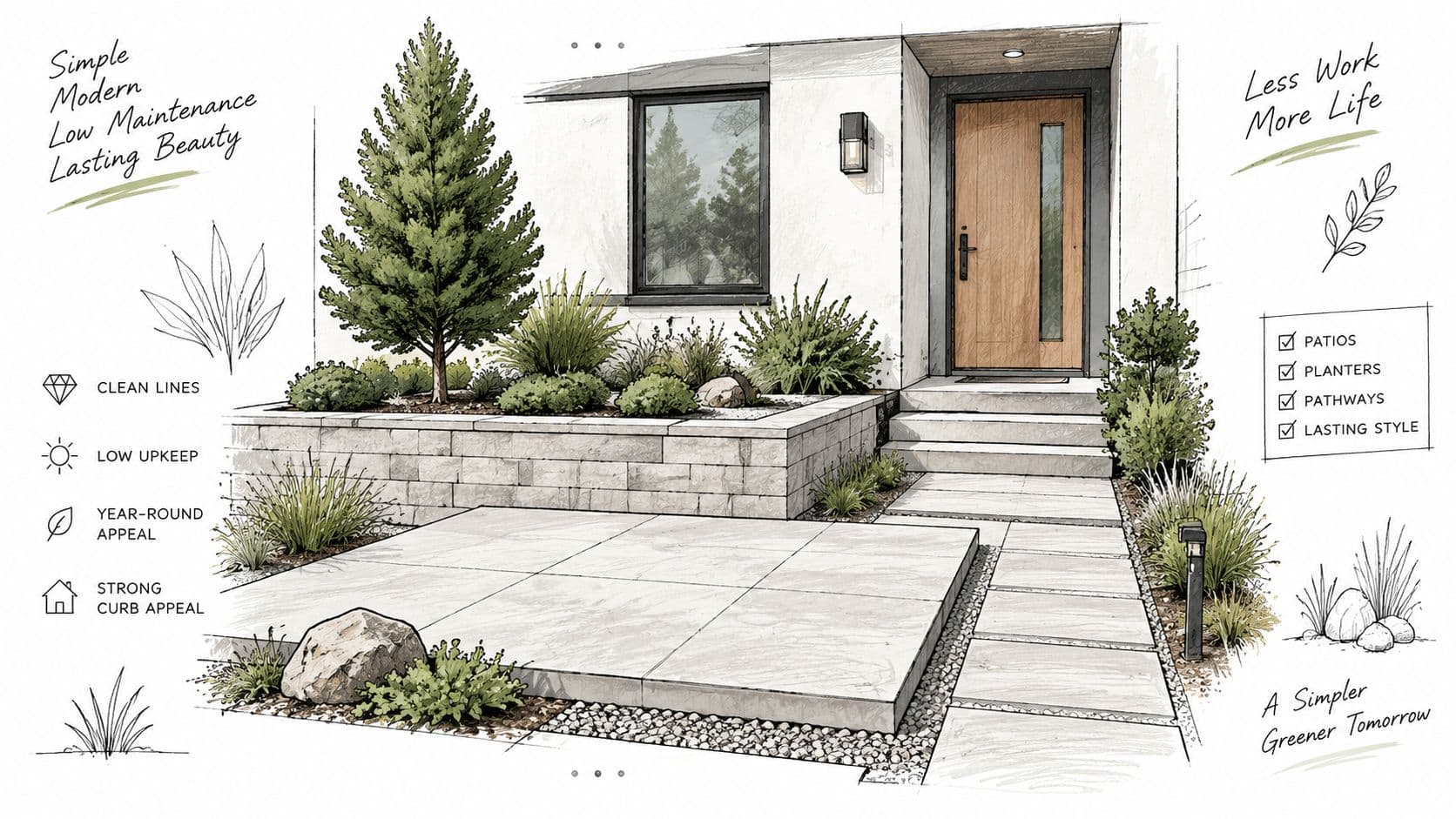
Hardscape-forward planning removes planting density and repeated bed care, replacing some living surface with patios, walls, steps, raised beds, stone features, decks, or pergolas. It suits homeowners who value usable entry space, strong lines, and predictable surfaces more than a densely planted garden.
The approach can be elegant on a compact urban lot, where a permeable landing and a few raised beds create order without leaving awkward strips of lawn. A Southwest property may use stone walls and decomposed granite. A hillside home may need retaining structures to make the front approach usable. A coastal property may combine elevated decking with salt-tolerant planters.
Hardscape doesn't eliminate maintenance. Pavers need cleaning, walls need inspection, wood and composite surfaces need care, and drainage failures can be expensive. The design should slope water away from structures and include access for repairs, cleaning, and planting maintenance. Poor base preparation is one of the fastest ways to turn a supposedly durable front yard into a recurring project.
Keep the built elements human
An entirely paved frontage can look institutional. Add a small number of architectural evergreens, grasses, or raised beds to soften edges and give the eye a living reference point. Use materials that age well, coordinate colors with the house, and respect the scale of the lot. A large patio can overwhelm a small entry, while tiny paving units can make a broad frontage feel visually noisy.
The best hardscape-forward yard has fewer plants, not no plants. Those plants should be easy to reach, easy to irrigate, and large enough to hold their own against the construction.
Use OutdoorBrite's AI front yard design to test a patio, retaining wall, entry path, and planting balance on your actual property. For material comparisons, this Ottawa stamped concrete advice can help frame the choice between stamped concrete and pavers, though local climate and installation standards still control the decision.
Low-Maintenance Front Yard: 8 Options Compared
| Item | Implementation Complexity 🔄 | Resource Requirements 💡 | Expected Outcomes ⭐📊 | Ideal Use Cases | Key Advantages ⚡ |
|---|---|---|---|---|---|
| Xeriscaping with Native Plants | Moderate, requires plant research, hydrozoning and first-season care 🔄 | Low ongoing water; moderate initial labor & plant sourcing; mulch & irrigation set-up 💡 | High water savings; strong ecological benefits; long-term low maintenance ⭐⭐⭐⭐ 📊 | Dry/Mediterranean climates, water-restricted areas, pollinator-focused yards | ⚡ Reduces water bills; supports wildlife; low maintenance once established |
| Permeable Hardscaping (Porous Pavers & Permeable Concrete) | Moderate–High, proper base, grading and skilled installation required 🔄 | Higher upfront cost; engineered base materials, pavers, occasional pressure washing 💡 | Reduces runoff/flood risk; recharges groundwater; regulatory compliance ⭐⭐⭐⭐ 📊 | Driveways, urban sites with stormwater rules, modern curb appeal projects | ⚡ Minimizes pooling and maintenance; durable aesthetic; meets stormwater regs |
| Ornamental Grasses | Low, simple planting and occasional division; one annual cut 🔄 | Low ongoing inputs; initial watering first year; inexpensive plants 💡 | Year‑round texture & movement; drought‑tolerant; minimal care ⭐⭐⭐⭐ 📊 | Low‑maintenance gardens, prairie/modern designs, poor soils | ⚡ Very low water & fertilizer needs; long-lived; low-cost establishment |
| Mulch and Ground Cover Alternatives (Bark, Rocks, Recycled Materials) | Low, easy DIY application; periodic topping and edging 🔄 | Low to moderate cost; choose organic vs inorganic materials; edging tools 💡 | Strong weed suppression; improved moisture retention; defined beds ⭐⭐⭐ 📊 | Bed refinement, weed-prone areas, drought replacement for turf | ⚡ Cheap, fast to implement; reduces weeding and watering; aesthetic flexibility |
| Evergreen Shrubs and Architectural Plantings | Moderate, choose forms/sizes and plan spacing; light pruning 🔄 | Moderate initial purchase & planting; watering to establish; occasional pruning tools 💡 | Year‑round structure and screening; low pruning frequency; winter interest ⭐⭐⭐⭐ 📊 | Northern climates, privacy screens, formal/structured designs | ⚡ Provides lasting structure with minimal seasonal upkeep; good for small yards |
| Integrated Lighting (Solar, LED, Low‑Voltage Systems) | Low–Moderate, solar is DIY; low‑voltage/whole‑yard may need pro wiring 🔄 | Moderate fixture cost; batteries/panels (solar), transformers (low‑voltage) 💡 | Improved safety, extended evening use, elevated curb appeal ⭐⭐⭐ 📊 | Pathways, focal plant/architecture highlighting, safety/security lighting | ⚡ Enhances usability and safety with low energy use; smart control options |
| Synthetic Turf / Artificial Grass | Moderate–High, precise base prep and professional install recommended 🔄 | High upfront cost; drainage system, infill materials; eventual replacement 💡 | Consistent green year‑round; eliminates mowing/watering; durable surface ⭐⭐⭐ 📊 | Water‑restricted regions, shaded/poor soil sites, high‑use yards & rooftops | ⚡ Virtually maintenance‑free lawn substitute; immediate usable surface |
| Hardscape‑Forward Design (Patios, Decks, Retaining Walls, Stone Features) | High, design, grading, drainage and professional construction required 🔄 | Very high upfront cost; heavy materials, skilled contractors, engineering 💡 | Low ongoing plant maintenance; durable outdoor living spaces; high value ⭐⭐⭐⭐ 📊 | Busy homeowners, accessible yards, outdoor living emphasis, hillside sites | ⚡ Dramatically reduces plant upkeep; creates functional, long‑lasting spaces |
Turn the Ideas Into a Yard You Can Keep Up With
Choose the strategy by identifying the chore that repeats most often. If you're constantly adjusting irrigation, start with xeriscaping and hydrozoning. If you mow an area that nobody uses, replace part of it with groundcover, ornamental grasses, or a purposeful hardscape. If weeds dominate, improve bed definition and surface coverage before adding more plants. If runoff damages paths or beds, solve grading and drainage before spending on decorative finishes.
Next, assess the site. Note the hours of direct sun, existing drainage patterns, soil texture, exposed wind, winter conditions, and the space available at mature plant size. Climate matters, but so does microclimate. A plant that thrives in the wider region may still fail beside a hot wall, under a roof drip line, or in compacted soil.
Select one primary strategy, then layer compatible elements around it. A xeriscape can include a permeable path and evergreen structure. A hardscape-forward yard can use raised beds and ornamental grasses. Synthetic turf can remain a small functional zone instead of becoming the entire design. Combining every trend usually creates more maintenance categories, not fewer.
Reserve part of the budget for base preparation, soil improvement, drainage corrections, irrigation adjustments, and establishment care. The EPA reports that the average American home uses about 58,000 gallons outdoors each year, primarily for irrigation, and that nearly one-third of residential water use nationwide is connected to irrigation in its water-use materials. Those figures reinforce the value of reducing unnecessary turf and correcting inefficient irrigation, but a new yard still needs careful care while roots establish. See the EPA landscape water-use efficiency reference for the underlying household water-use context.
Seasonal maintenance cheatsheet
- Spring: Clear winter debris, inspect edging and drainage, repair irrigation, divide crowded grasses when appropriate, and plant during the season best suited to your region.
- Summer: Check soil moisture rather than watering on a fixed habit, inspect emitters and hose connections, clear leaves from permeable surfaces, and confirm solar fixtures still receive direct light.
- Fall: Remove diseased foliage, clear drains and path joints, protect exposed evergreens where needed, and water appropriate plants before freezing conditions arrive.
- Late winter: Prune shrubs according to species, cut back deciduous ornamental grasses before new growth, and review whether any plant has outgrown its allotted space.
Before buying pavers, ordering a truckload of rock, or hiring a contractor, create three versions of your own frontage in OutdoorBrite: a xeriscape, a hardscape-forward layout, and a mixed design. Compare them from the street and the front door, check whether the entry remains clear in every season, and choose the concept that removes the chore you want gone.
OutdoorBrite turns a photo of your front yard into redesign concepts in styles such as modern, Mediterranean, Japanese zen, and xeriscape, so you can compare planting, paving, lighting, and reduced-lawn layouts before committing. Upload your yard and test a practical low-maintenance direction at OutdoorBrite.
See your yard reimagined
Start creating