Low Maintenance Zen Garden Backyard: A Practical Guide
Design a low maintenance zen garden backyard with drought-tolerant plants, gravel layouts, and simple upkeep routines. A practical guide
Saturday morning starts with good intentions. You step outside with pruners, a rake, maybe the mower, and by the time the yard looks acceptable, half the day is gone. That's usually the moment people start searching for a calm backyard that doesn't ask for constant work.
A low maintenance Zen garden backyard works when you treat it as a low-input setting first and a style second. The internet usually sells the look: raked gravel, a sculptural rock, a maple, maybe a lantern. What matters more in real yards is the workload. If the design still needs heavy watering, constant trimming, and seasonal replanting, it isn't low maintenance. It's just minimal-looking.
The useful version is a hybrid. Keep the Zen language of gravel, stone, negative space, and restraint, but combine it with climate-appropriate plants and durable layout choices that hold up in an actual backyard. That's the difference between a space that photographs well once and one that still looks good when you're busy, it's hot, and you'd rather not spend the weekend pulling weeds.
Table of Contents
- Why a Zen Backyard Works for Low Maintenance Living
- The Design Principles That Drive Low Upkeep
- Building the Gravel and Stone Foundation
- Choosing Plants That Practically Take Care of Themselves
- Maintenance Schedule Week by Week
- Adapting the Layout to Small Medium and Large Yards
- Your Planning Checklist Before You Start
Why a Zen Backyard Works for Low Maintenance Living
The appeal is simple. Many want a backyard that feels quiet without becoming another weekly job. Zen-style dry gardens fit that need because they weren't invented as lush, high-input ornament. They developed as a simplified tradition built around rocks, gravel, and minimal planting, with roots going back to the Heian period, the Sakuteiki at the end of the 11th century, and the temple gardens of Kyoto in the Muromachi period, with Ryōan-ji generally dated to the 15th century, as summarized in this history of Japanese dry gardens.
That history matters in the backyard. The style's restraint isn't decorative minimalism for its own sake. It comes from a language that deliberately used fewer living elements and let stone and gravel carry the composition.
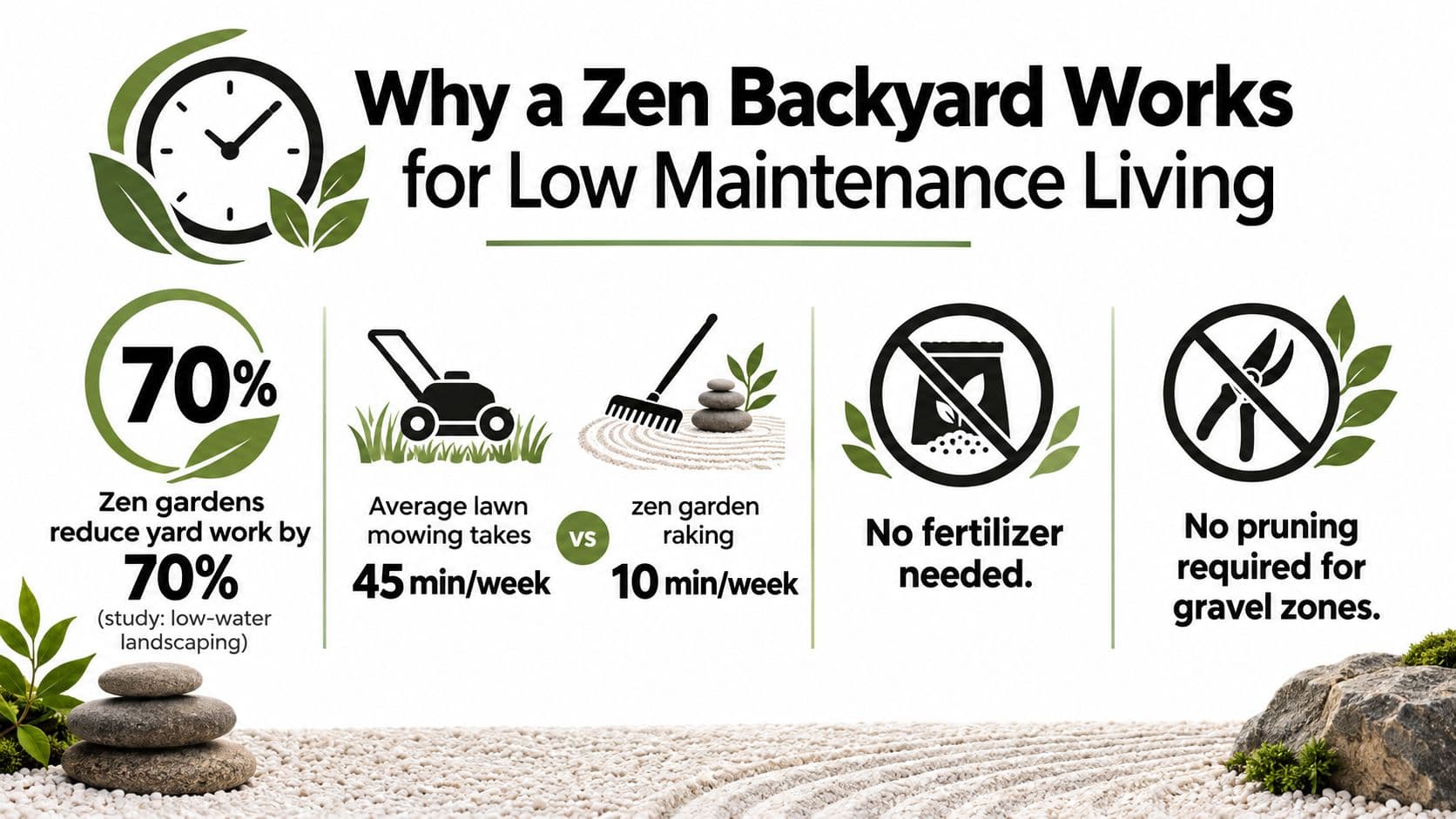
Why the labor drops
A lawn asks for repeat work. Mowing, edging, feeding, patching, watering. A Zen-inspired backyard replaces much of that cycle with static materials that don't grow, don't need fertilizer, and don't care if you skip a week.
A strong practical reason is water use. Xeriscaping and gravel-based designs can reduce irrigation demand by around 50% to 75% compared with conventional lawn-focused landscaping, according to the guidance discussed in this overview of Japanese garden history and dry garden tradition. That's one of the clearest reasons the style keeps showing up in drought-prone or high-water-cost regions.
Practical rule: If your main goal is less work, replace thirsty square footage first. Style details come after that.
What actually works in a backyard
A strict temple-style gravel court can feel severe in a home garden. It also tends to disappoint people who want some shade, softness, or seasonal life. That's why the most durable solution is usually a hybrid layout: gravel field, a few anchored stones, and sparse plants chosen for the site instead of for a mood board.
Water features can still fit, but they need to be built like permanent elements, not decorative add-ons. If you're adapting an old slab for a basin or recirculating feature, guidance on waterproofing existing concrete for water features helps avoid the kind of leak-prone retrofit that turns a calming corner into a maintenance headache.
The core idea is straightforward. Let inert materials do most of the visual work. Let plants support the composition, not carry it.
The Design Principles That Drive Low Upkeep
The best Zen backyards stay easy because the design principles also function as maintenance controls. What looks calm usually is calm to maintain, if you apply the principles on purpose.
Restraint beats abundance
Most failed Zen-style yards have too many ingredients. Too many plant varieties, too many decorative rocks, too many focal points. That clutter doesn't just hurt the look. It creates more edges to trim, more pockets for weeds, and more irrigation zones to manage.
A quieter layout asks fewer questions of the homeowner. One gravel field, one or two stone groupings, and a short plant list usually age better than a collection of features.
Negative space does real work
In Zen design, empty space isn't empty. It's intentional. In maintenance terms, that space is doing the job a lawn used to do, without mowing.
A broad gravel area suppresses visual clutter and limits where weeds can establish if the base is built well. It also gives every stone and plant room to read clearly, which means you don't need many of them.
Asymmetry keeps plant count down
Symmetrical designs tend to duplicate everything. Matching shrubs, mirrored beds, paired accents. That drives up cost and future pruning.
Asymmetry lets you cluster effort where it matters. One anchored side of the yard can hold the shrubs and accent planting while the opposite side stays open. If you want a small-scale reference for the feel of that restraint, this piece on creating a tranquil mini zen garden captures the value of keeping the composition simple.
Stone is your permanent structure
Plants change fast. Stone doesn't. That's why good Zen-inspired yards use stone as the backbone.
Partially buried boulders, flatter viewing stones, and solid edging give the space a finished look even in winter or during a rough season. You're not rebuilding the scene every spring. You're maintaining a stable framework.
Here's the maintenance payoff in plain terms:
| Principle | Design Move | Maintenance Benefit |
|---|---|---|
| Asymmetry | Cluster plants and stone off-center instead of mirroring both sides | Fewer plants to water, prune, and replace |
| Negative space | Use gravel as a deliberate field, not leftover filler | No mowing in that area and less visual clutter |
| Stone structure | Make rocks and edging the permanent anchors | Less seasonal reshaping and re-edging |
| Raking pattern | Keep surface texture simple and repeatable | Quick reset after wind, leaves, or foot traffic |
The easiest Zen yard to maintain is usually the one that feels slightly underfilled when you finish it. Six months later, it looks composed instead of crowded.
Building the Gravel and Stone Foundation
A Zen-style backyard earns its low-maintenance reputation at the base layer. Get the foundation right, and the space can stay tidy with light weekly touch-ups. Get it wrong, and you spend your time chasing escaped gravel, pulling weeds through thin coverage, and re-leveling surfaces after every storm.
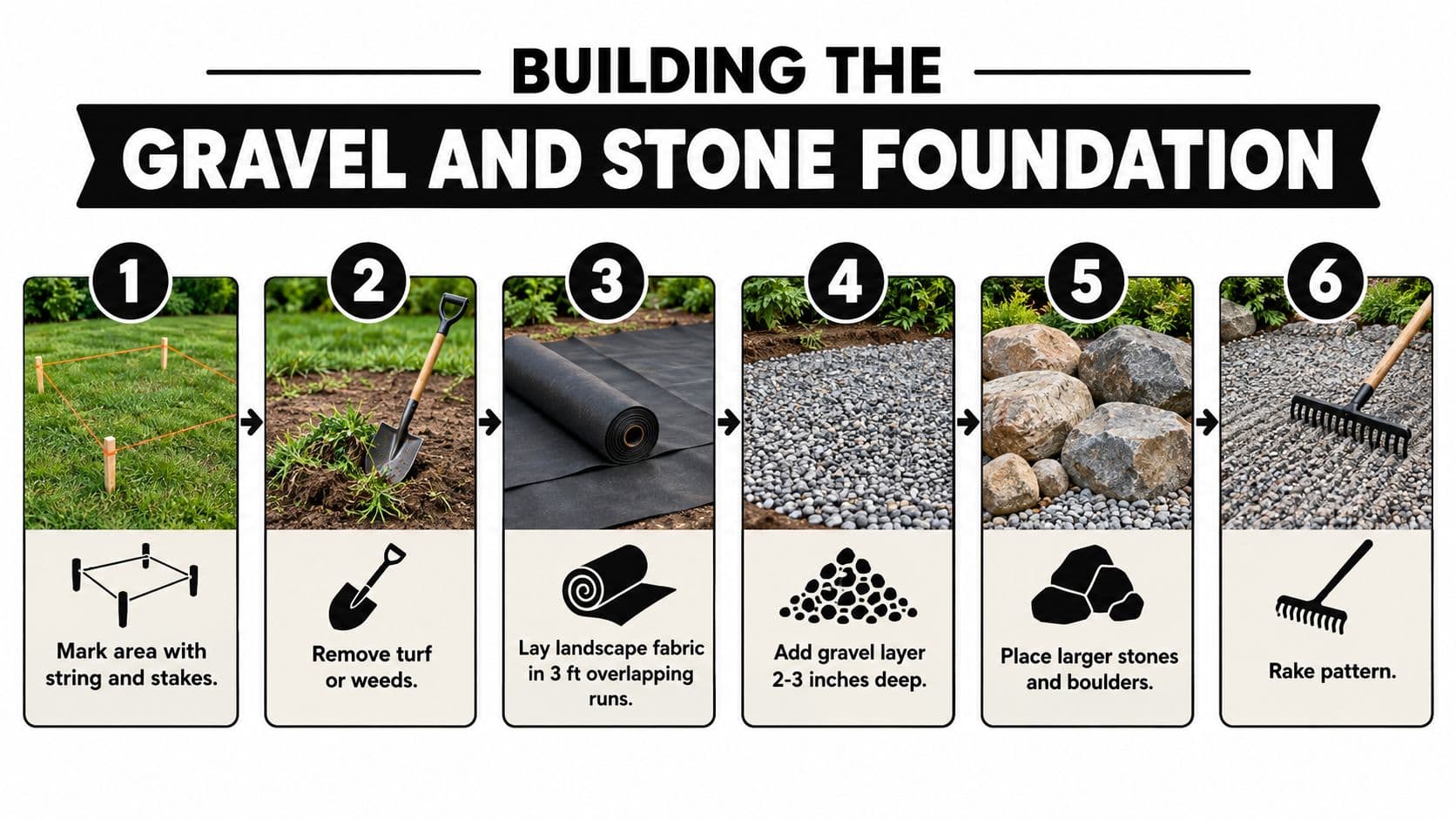
Start with containment
Set the outline from the spots where the yard is used. Stand at the patio, the back door, or the kitchen window, then adjust the shape until it feels calm and balanced. Hose, marking paint, or stakes and string all work.
Strip out turf, weeds, and loose roots before anything else goes in. Then install fabric with full overlap and pin it well, especially on slopes and curves. After that, put in edging before the gravel arrives. Steel edging lasts longest, bender board is easier to bend into soft curves, and stone edging can look great if it is set firmly enough to keep rock from spilling into the lawn.
Gravel migration is one of the first signs of a rushed install. Strong edging saves real cleanup time.
Before ordering, calculate your quantities so the bed ends up deep enough to suppress weeds and hide the fabric. This guide on how to estimate gravel and stone quantities helps prevent thin spots and expensive second deliveries.
Get the gravel depth right
For most backyard builds, a 2 to 3 inch layer of crushed granite or pea gravel over fabric gives the best balance between appearance and upkeep, according to this Zen garden installation and maintenance guide. That same guide notes that gravel usually needs replenishing every 3 to 5 years as it settles and shifts.
I usually steer homeowners toward crushed granite if they want a cleaner raked pattern and less rolling underfoot. Pea gravel is softer visually, but it travels more, especially near stepping stones or along a slope. That trade-off matters more than the color in the sample bin.
Depth matters because shallow gravel fails fast. Fabric starts showing through, weeds root into the thin layer of debris that collects on top, and the rake snags instead of gliding. A little extra material up front is cheaper than redoing the bed next season.
Skip bright white marble chips in most yards. They throw glare, highlight every leaf and twig, and can make a small backyard feel harsher, not calmer. Neutral gray, tan, or weathered brown stone usually gives the quieter look people want and hides day-to-day mess better.
Here's a visual walkthrough if you want to watch the sequence before starting:
Place stones like they belong there
Stone placement decides whether the yard feels grounded or staged. Large stones should sit into the grade, not perch on top of the gravel. Bury part of each one so it reads as permanent and keeps its position over time.
Use fewer stones than you think you need. One or three well-placed pieces usually do more than a scattered collection of decorative rocks. Leave enough open gravel around each grouping so the surface can read as intentional negative space and still be easy to rake in a few minutes.
Stepping stones are worth planning early if anyone will cross the area. They cut down on gravel scatter, protect the surface pattern, and make the hybrid layout usable instead of purely decorative.
Place stone, then check it from the seating area or the window, not from directly overhead. That viewing angle catches awkward spacing fast.
Choosing Plants That Practically Take Care of Themselves
Plants make or break the labor profile. The mistake isn't using plants in a Zen-inspired yard. The mistake is using too many, or choosing species that fight your climate, your soil, or the reflected heat coming off stone.
The right way to build the plant list is by role, not by collecting “Zen” plants from Pinterest.
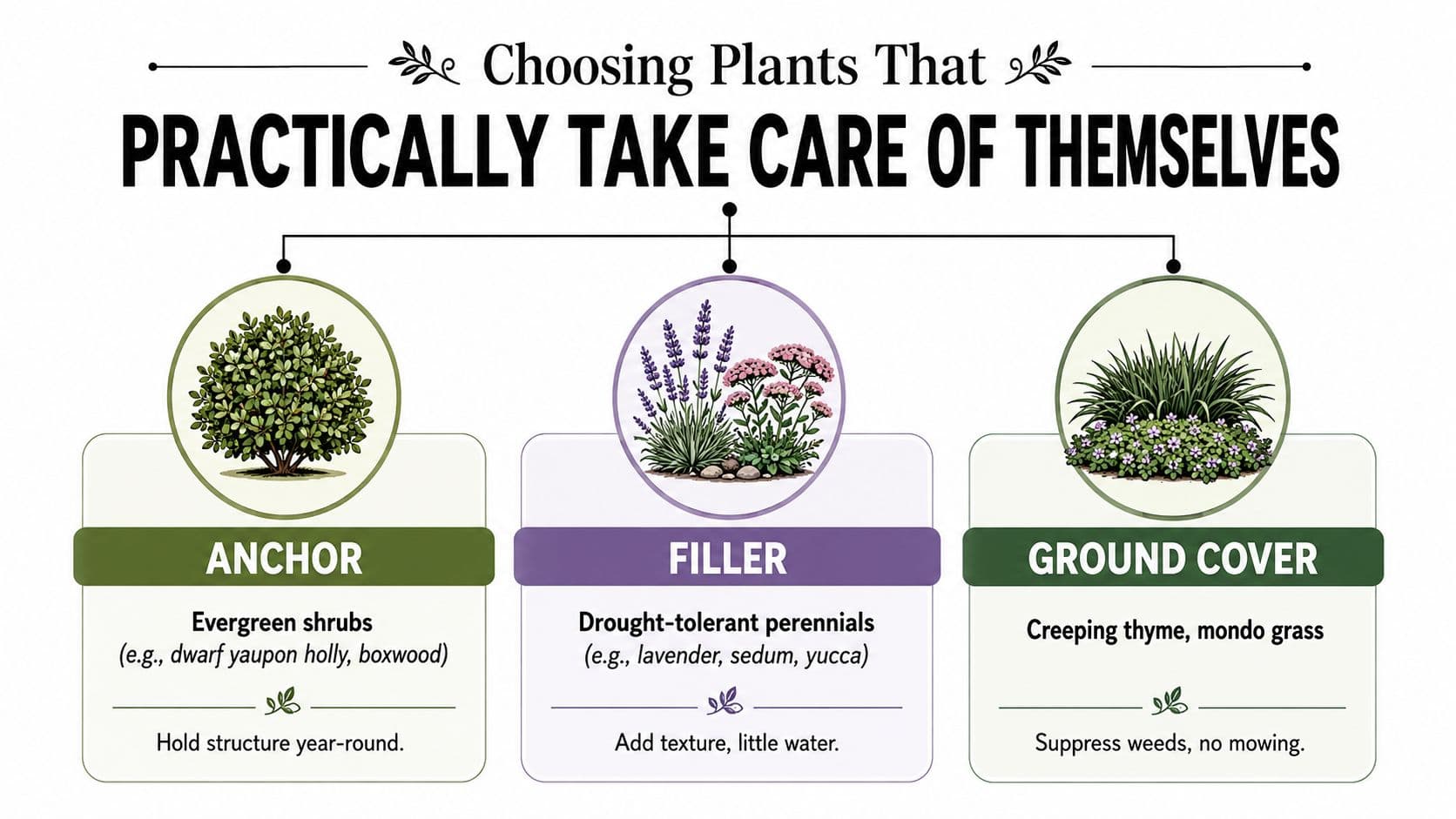
Anchor plants
These hold the composition year-round. Use them sparingly. One strong evergreen often does more than five medium shrubs.
Good anchor types for many home gardens include dwarf yaupon holly, compact junipers such as ‘Blue Star,’ and fraser's photinia in milder zones. The practical test is simple: does the plant keep a stable silhouette without asking for frequent shearing? If not, it doesn't belong in the easiest-care version of this garden.
Failure mode matters. In hot gravel beds, broadleaf shrubs can scorch if the site reflects too much heat. In heavy clay, some conifers struggle if drainage is poor. Match the plant to the microclimate, not the design fantasy.
Ground-level fillers and edges
This layer softens the gravel border and covers the places where weeds would otherwise volunteer. Creeping thyme, dwarf mondo grass, sedum ‘Angelina,’ and blue fescue clumps all have uses, but not in every region.
Creeping thyme can struggle where humidity stays high and air movement is poor. Mondo grass gives a tidy edge but may be slower than people expect. Sedum often shines in lean, fast-draining soils but can sulk in wet conditions. Blue fescue looks clean when it's happy and tired when summer humidity wears it down.
For readers comparing options, this roundup of top low maintenance plants for yards is a useful starting list, but the final call still needs to come from your climate and soil.
Accent plants
Accent plants should be few and deliberate. A Japanese maple can work in a larger or partly shaded yard. Ornamental grasses such as muhlenbergia capillaris can add movement. A single clump of bamboo muhly can do the same in the right setting.
The risk with accents is turning one specimen into six. Then the garden stops reading as calm and starts looking like a mixed border with gravel poured between plants.
A clean rule of thumb is to let the gravel and stone remain the dominant visual field. Plants should feel selected, not abundant.
A Zen-style backyard looks more convincing when each plant has breathing room. Crowding doesn't make it lush. It makes it high maintenance.
Maintenance Schedule Week by Week
A low-maintenance Zen backyard saves the most work after the build, not during it. The payoff is fewer irrigation checks, less pruning, and no weekly mowing across large areas. The trade-off is surface care. Gravel shows leaves, windblown seed, and disturbed patterns fast.
That is why hybrid Zen layouts usually perform better than strict temple-style gravel yards in a home setting. A pure raked gravel court looks clean for about five minutes under a messy tree canopy or in a yard with dogs and kids. Gravel, stone, and a restrained plant palette hold the look with less fuss.
The long-term cost picture is still favorable. Independent xeriscape guidance notes annual maintenance costs around $0.34 to $1.33 per square foot, while also warning that weak upkeep habits can erase water-saving gains, according to this water conservation review.
First year versus established garden
Year one is the correction year. Gravel settles, edging reveals weak spots, and plants show whether the irrigation is set too high or too low. By year two or three, a restrained build usually drops into a lighter routine.
In practical terms, most weekly upkeep is inspection more than labor.
- Clear debris: Remove leaves, seed pods, and twigs before they break down into pockets of compost and weed germination.
- Pull weeds early: Five minutes now beats an hour after a rain cycle.
- Check drip zones: Emitters should water plant roots, not soak open gravel or splash against stone.
- Reset disturbed gravel: One quick pass with a rake after wind, pets, or foot traffic keeps the surface from looking tired.
Monthly work is simple but visible. Re-rake any high-traffic area, top up shallow spots where base material starts to show, and make light pruning cuts only if a shrub is starting to blur the stone layout.
Where the upkeep usually creeps up
Tree litter is the first issue. A Zen-style yard under sweetgum, magnolia, or heavy maple drop will never be as low-input as the same yard under open sky.
Overplanting is the second. Homeowners often add just a few more grasses, just a few more accents, and then the schedule starts to look like a conventional planted yard again. I have seen plenty of gravel gardens become pruning gardens in two seasons.
Watering mistakes are the third. Drought-tolerant plants usually fail from staying wet too long, not from being kept slightly dry.
Here is the planning-level version of the schedule:
| Task | Frequency | Time per session | Annual hours | Estimated annual cost |
|---|---|---|---|---|
| Surface debris removal | Weekly in leaf season, otherwise as needed | Short, light pass | Varies by tree cover | Included in routine upkeep |
| Spot weeding | As needed | Short, targeted pass | Varies by installation quality | Included in routine upkeep |
| Gravel re-raking | Periodic, plus after wind or rain | Moderate session | Varies by exposure | Included in routine upkeep |
| Shrub shaping | Occasional | Light pruning | Low in restrained layouts | Included in routine upkeep |
| Gravel replenishment | Every few years | Larger refresh | Infrequent | Material plus labor if hired |
After establishment, a properly built gravel garden often settles into about 30 to 60 minutes per month of upkeep, as noted in the installation guidance linked above. That number holds up best in yards with modest tree cover, limited lawn edge nearby, and a plant list that stays disciplined.
Adapting the Layout to Small Medium and Large Yards
Zen principles scale well, but the layout needs to change with the footprint. What looks spare and elegant in a compact side yard can feel empty in a broad backyard. What feels rich in a large yard can look cramped in a small one.
The trick is to scale the number of moves, not just enlarge every element.
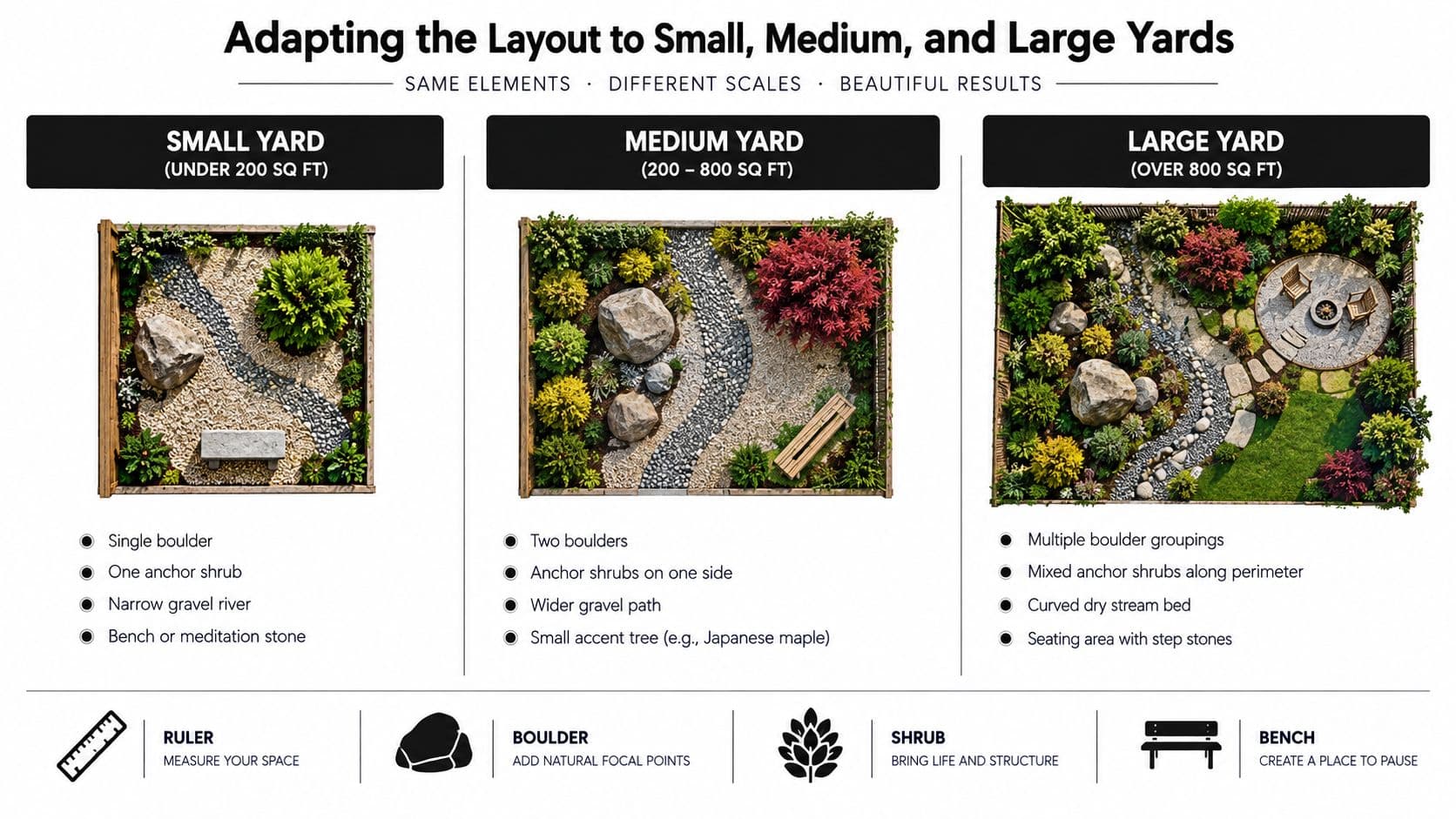
Small yards
In a small yard, keep one focal point and one supporting gesture. That might be a single boulder, one evergreen anchor, and a narrow gravel sweep leading to a bench or basin.
Too many stones in a compact footprint make the yard feel staged. One good rock does more than three mediocre ones in a tiny space. Sightlines matter most here. From the patio door or window, the composition should read in one glance.
Medium yards
A medium yard can handle sequence. Add a path, a secondary stone grouping, and a modest accent plant if the main composition still has room to breathe.
This is often the sweet spot for a hybrid Zen backyard because you can combine a gravel field with sparse planting islands and a sitting edge without overfilling the plan. Homeowners also start caring more about adjacent furniture and social space here. If that part of the project is still taking shape, examples of captivating outdoor living areas can help when you're deciding how a calm garden zone should connect to a usable patio.
Large yards
Large yards need hierarchy. Without it, the design becomes a lot of gravel with scattered objects. Create a primary focal area, then a secondary destination such as a bench, stepping-stone turn, or dry stream gesture.
This is also where the hybrid approach tends to outperform a pure gravel layout. Water-efficiency research shows that converting turf to more efficient yards can save about 34 gallons per year for every square foot converted, according to the Alliance for Water Efficiency report. In practice, that means the best large Zen-inspired backyard is often not a fully stone-covered yard, but a mix of gravel, native plants, and climate-appropriate groundcover.
In big spaces, calm comes from editing. Add one more destination, not ten more features.
Your Planning Checklist Before You Start
The easiest way to keep this project low maintenance is to make the low-maintenance decisions before any gravel shows up. Most expensive fixes happen because homeowners buy stone and plants before they settle drainage, edges, and circulation.
Site and material decisions
Walk the yard with a notebook and answer these first:
- Sun and heat: Which areas bake all afternoon, and which get relief?
- Drainage: Where does water collect or rush through after rain?
- Traffic: Where will people walk, even if you wish they wouldn't?
- Utilities and access: Can materials reach the site without wrecking the rest of the yard?
Then line up the hard materials:
- Gravel quantity: Calculate the coverage for your planned depth.
- Edging type: Steel, stone, or another durable edge that keeps gravel in place.
- Stone selection: Choose fewer, better stones rather than a large mixed pile.
- Fabric and base supplies: Don't downgrade these just because they disappear under the surface.
Plant and layout choices
Order plants after the hardscape is sketched. Not before. Reserve anchor plants first, then fill any remaining gaps with a short list of ground-level species that suit the site.
If you want to test layouts visually on your own yard photo before buying materials, a tool like backyard ai design can help compare a Japanese Zen direction against other low-water options.
Use this pre-build checklist:
- Sketch the plan: Graph paper is enough if the proportions are honest.
- Photograph the yard at different times of day: Sun patterns change the whole plant list.
- Decide on irrigation now: If plants need drip, install it before gravel.
- Choose what to DIY: Gravel spreading is manageable for many homeowners. Heavy stone placement often isn't.
- Get supplier quotes before starting: Boulder and gravel prices can shift enough to change the plan.
A good low maintenance Zen garden backyard starts with editing, not shopping. If the plan looks slightly sparse on paper, that's often a sign you're close.
OutdoorBrite helps homeowners test ideas on their actual yard photos before they commit to gravel, boulders, plants, or a contractor. If you want to compare a Zen-inspired layout against other low-water backyard directions and see how the space could look first, visit OutdoorBrite.
See your yard reimagined
Start creating