10 Mediterranean Landscape Ideas for Every Yard
Explore 10 mediterranean landscape ideas for plants, patios, terraces, lighting, and AI-assisted planning at multiple budgets.
You're choosing between a sunny patio for long dinners, a sloped side yard that keeps washing out, and a front garden that shouldn't demand constant watering. Mediterranean design ideas can solve all three, but only when the plan starts with how you'll use the yard rather than with a pile of terracotta pots and lavender.
The strongest Mediterranean gardens combine a clear purpose, a restrained material palette, climate-appropriate planting, and a maintenance plan you'll follow. The style has deep roots in regions shaped by heat, seasonal dryness, stone, terraces, and limited water. Across the world's five classic Mediterranean-climate biomes, these regions cover only about 2% of Earth's land area while supporting roughly 20% of known vascular plant diversity according to this review of Mediterranean-climate ecosystems.
The ten concepts below treat Mediterranean design as a set of buildable systems. You'll find planting palettes, slope solutions, paving, water features, shade, outdoor rooms, edible gardens, specimen trees, and boundaries, along with budget-conscious variations and OutdoorBrite visualization prompts. If your home leans coastal, you can also borrow the relaxed, sun-washed restraint associated with coastal style furniture without turning the garden into a themed set.
Table of Contents
- 1. Drought-Tolerant Plant Palettes with Native Mediterranean Species
- 2. Terraced Garden Beds and Hillside Landscaping
- 3. Gravel and Stone Hardscaping with Strategic Paving
- 4. Water Features and Fountain Design Elements
- 5. Pergolas, Arbors, and Climbing Vine Structures
- 6. Mediterranean Herb and Kitchen Gardens
- 7. Outdoor Living Rooms with Seating and Dining Areas
- 8. Colorful Tiled Accents and Mediterranean Ceramics
- 9. Mediterranean Cypress, Olive Trees, and Specimen Plantings
- 10. Stone Walls, Rustic Fencing, and Traditional Boundaries
- Mediterranean Landscape: 10-Item Comparison
- Turn Your Favorite Concept into a Testable Yard Plan
1. Drought-Tolerant Plant Palettes with Native Mediterranean Species
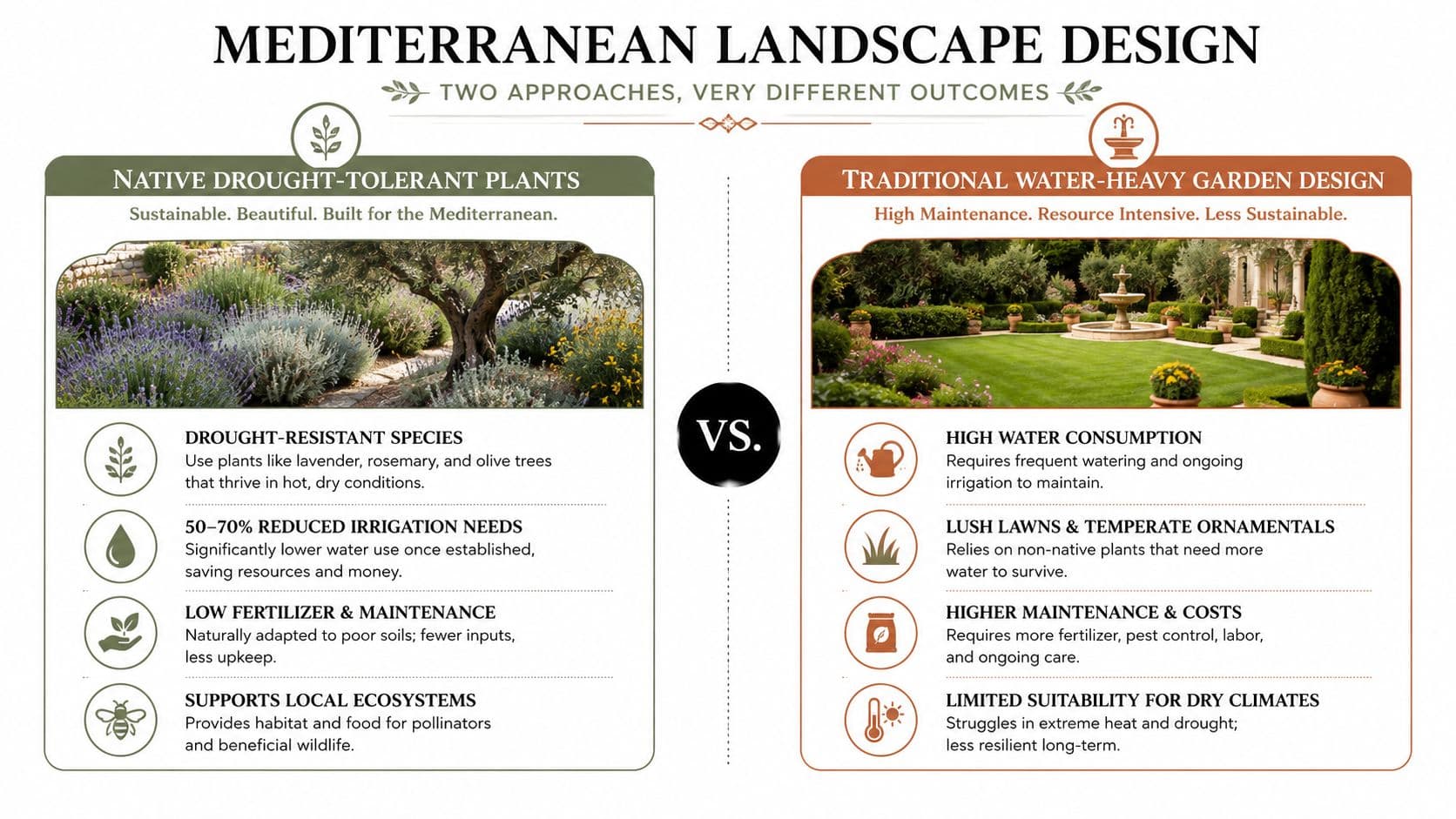
A convincing Mediterranean planting scheme depends less on collecting famous plants and more on matching plants to sun, drainage, winter conditions, and watering zones. Lavender, rosemary, sage, thyme, santolina, rockrose, ornamental grasses, agave, and olive trees can create the familiar silver-green, aromatic character, but they won't all perform equally well in every region.
Start with the site. A hot, sharply drained bed can support plants that struggle in compacted clay, while a shaded urban patio may need regional substitutes with similar foliage, fragrance, or form. Local native plants often make better companions than forcing strictly Mediterranean species into an unsuitable climate.
A useful palette has layers:
- Evergreen structure: Use olive, bay laurel, myrtle, rosemary, or a locally suitable evergreen substitute.
- Fragrant middle layer: Combine lavender, sage, oregano, thyme, and santolina near paths or seating.
- Soft movement: Add blue oat grass, feather grass, yarrow, or another climate-adapted ornamental grass.
- Sculptural accents: Reserve agave, aloe, or similar plants for well-drained beds and containers.
Hydrozone before you mulch: Keep plants with similar moisture needs together, and don't place thirsty pots on the same irrigation schedule as dry gravel beds.
Use mineral mulch to keep the planting visually crisp, but leave space around stems and crowns. Plant in fall or early spring where local conditions allow, so roots can establish before the harshest heat. The ai garden design software can help you test a silver-foliage palette, planting density, and lawn-replacement concept on a photo of your own yard before buying plants.
2. Terraced Garden Beds and Hillside Landscaping
A slope gives you drama, but it also creates runoff, uneven planting conditions, and difficult mowing. Terracing turns the grade into a sequence of usable rooms, with retaining walls, level beds, stairs, and planting bands that slow water and make maintenance more manageable.
The classic reference is the Mediterranean terrace, where stone walls support vineyards, orchards, and garden plots. The method reflects a long history of people reshaping land. Evidence suggests plant and animal domestication began about 8,000 to 10,000 years ago in the eastern Mediterranean, and one synthesis argues that people had transformed most parts of Mediterranean Europe by about 4,000 years ago as discussed in this European Environment Agency report.
You don't need to rebuild the entire hillside. Start with one terrace near the patio, or create a short retaining edge that gives you a level place for a bench. Locally sourced stone usually integrates better with the house and costs less to transport than an imported lookalike, though professional installation may still be necessary.
Build the water-control details first
Retaining walls need drainage behind them. Without it, water pressure can damage the wall, especially after heavy rain or irrigation. Use planting to reinforce the structure visually, with rosemary, lavender, rockrose, grasses, or cascading ground covers spilling over the edges.
For a larger wall, check local requirements and obtain engineering advice before excavation. A terrace that looks inexpensive in a sketch can become a major project once soil removal, access, drainage, stairs, and reinforcement are included.
Place the architectural sketch near the start of your planning process, then review the construction sequence before committing to excavation.
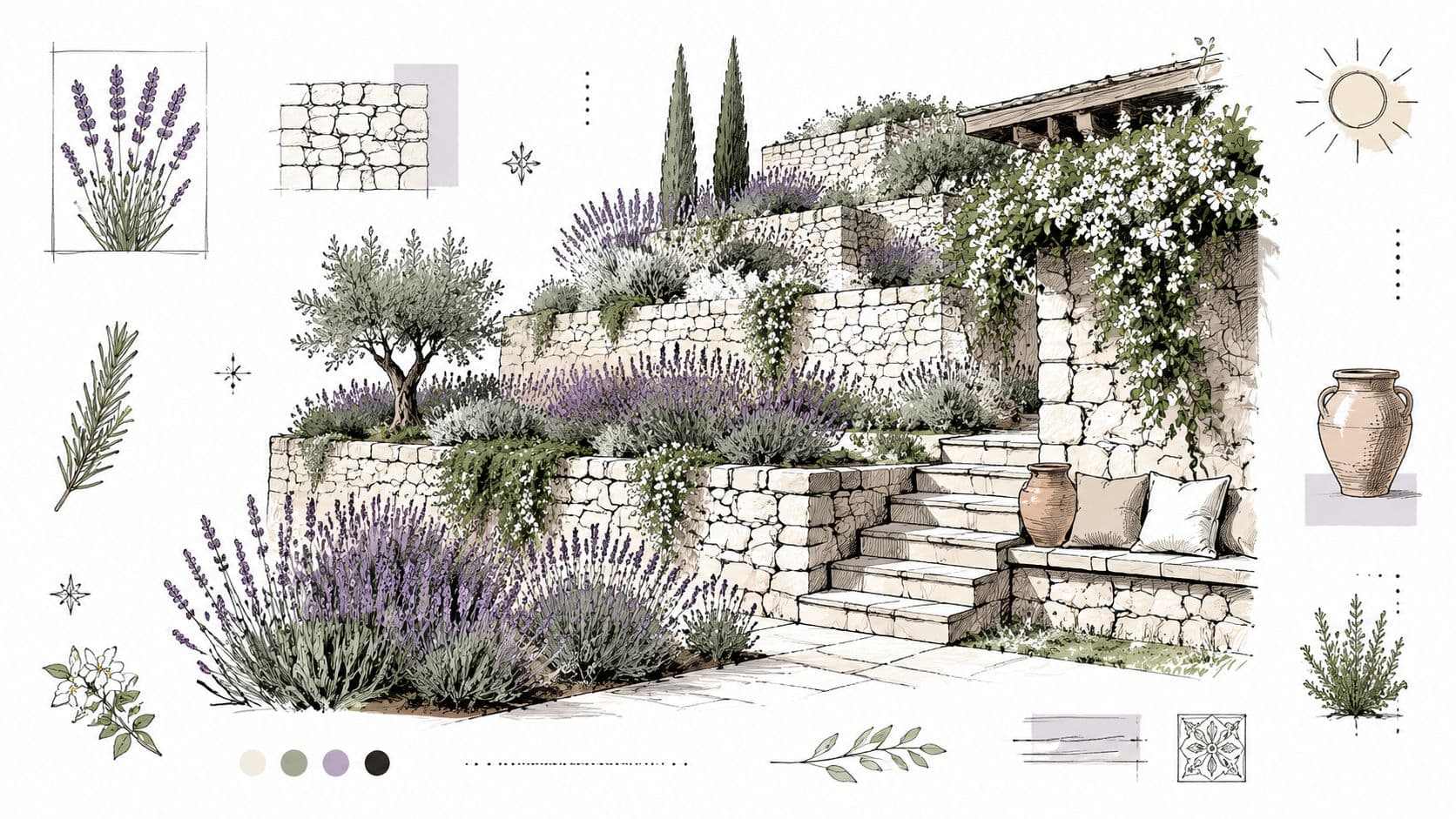
A visual reference can also clarify whether your intended walls feel rustic, formal, or too heavy for the property.
3. Gravel and Stone Hardscaping with Strategic Paving
A Mediterranean yard doesn't need a broad lawn as its default surface. Gravel, decomposed granite, stone, and selective paving can define circulation and outdoor rooms while reducing mowing and irrigated turf. The best designs don't cover every inch with stone. They use hardscape where people walk, sit, dine, or need durable access, then leave deliberate planting pockets for softness.
Warm limestone, travertine, terracotta, natural cobbles, and decomposed granite create a sun-washed palette. Irregular paving patterns generally feel more relaxed than rigid grids, but irregularity shouldn't mean unstable or awkward. Maintain comfortable walking surfaces, solid transitions, and clear edges.
A practical material mix might use gravel for paths and informal seating pads, larger stone pavers for the route from the kitchen, and a few terracotta details around containers. This combination lets you control the budget without making every surface look identical.
Make permeability part of the design
Permeable gravel and sand-set paving can help water move into the soil rather than immediately running across a sealed surface. A Mediterranean-inspired garden project described by Greenhouse Studio used pea gravel, decomposed granite, sand-set stone, and edging to support drainage, flexible use, and a restrained visual language in this garden design account.
Gravel has trade-offs. It migrates onto paths, can be uncomfortable under certain furniture, and needs occasional raking or replenishment. Add edging where gravel meets lawn, paving, or planting beds. If you use natural stone, choose the finish according to the use. A polished surface may look elegant but can become slippery, while a textured finish handles outdoor foot traffic more confidently.
Use OutdoorBrite to compare pale gravel, warm pavers, and a partial lawn replacement directly on your yard photo. Test the amount of hardscape before installation, especially in small spaces where too much stone can make the garden feel hot and stark.
4. Water Features and Fountain Design Elements
Water can make a Mediterranean garden feel settled and generous, but it shouldn't be added automatically. A fountain works when it has a clear viewing position, a manageable scale, and an operating plan. It fails when it's oversized, isolated at the back of the yard, or treated as maintenance-free decoration.
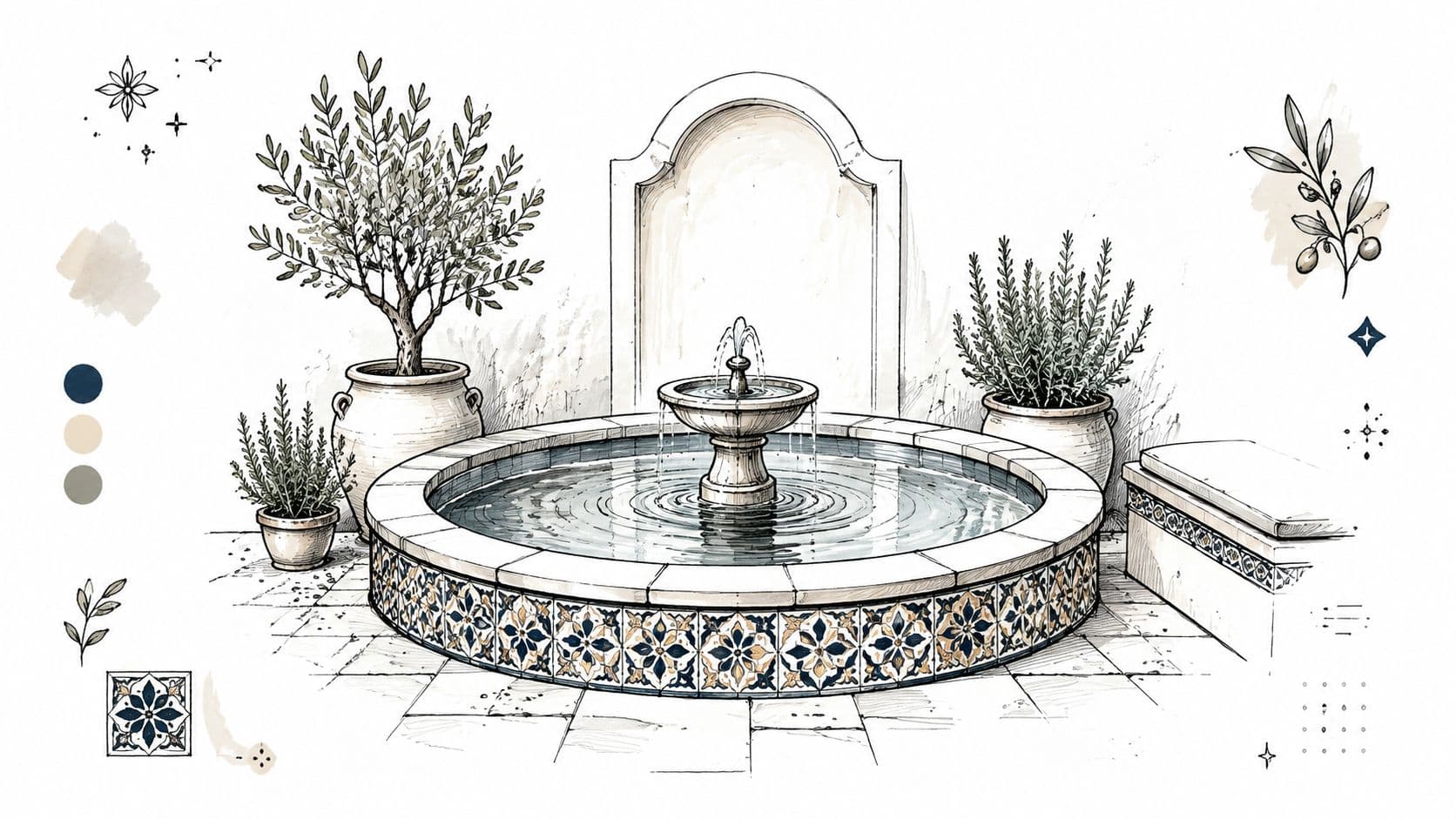
Historic Mediterranean and North African gardens often use water as a focal element and a response to dry conditions. Courtyard basins, channels, tiled fountains, and shallow bowls create sound, reflection, and visual relief. In a modern residential yard, a small recirculating fountain may deliver more enjoyment than an elaborate pool or long watercourse.
Place the feature where you'll experience it. A patio edge, kitchen window, entry court, or seating area is usually better than a hidden corner. Stone, ceramic, and mosaic can connect the fountain to the home's architecture, while a plain basin may suit a contemporary house more effectively than ornate tilework.
Design for responsible operation
A recirculating pump reduces the need to continually replace the water, but evaporation, splashing, algae, and leaks still require attention. Keep the basin accessible for cleaning and position electrical components safely. A solar-powered pump may work in a bright location, though its output can vary with shade and weather.
The water feature also needs to fit the yard's water strategy. Research on 258 households on the Catalan Mediterranean coast found that ornamental gardens were predicted to require the least water, while lawn gardens required the most, and the study identified garden irrigation as a substantial part of domestic outdoor water use in this household irrigation study. A fountain won't cancel out a thirsty lawn, so reduce turf and separate irrigation zones before adding decorative water.
5. Pergolas, Arbors, and Climbing Vine Structures
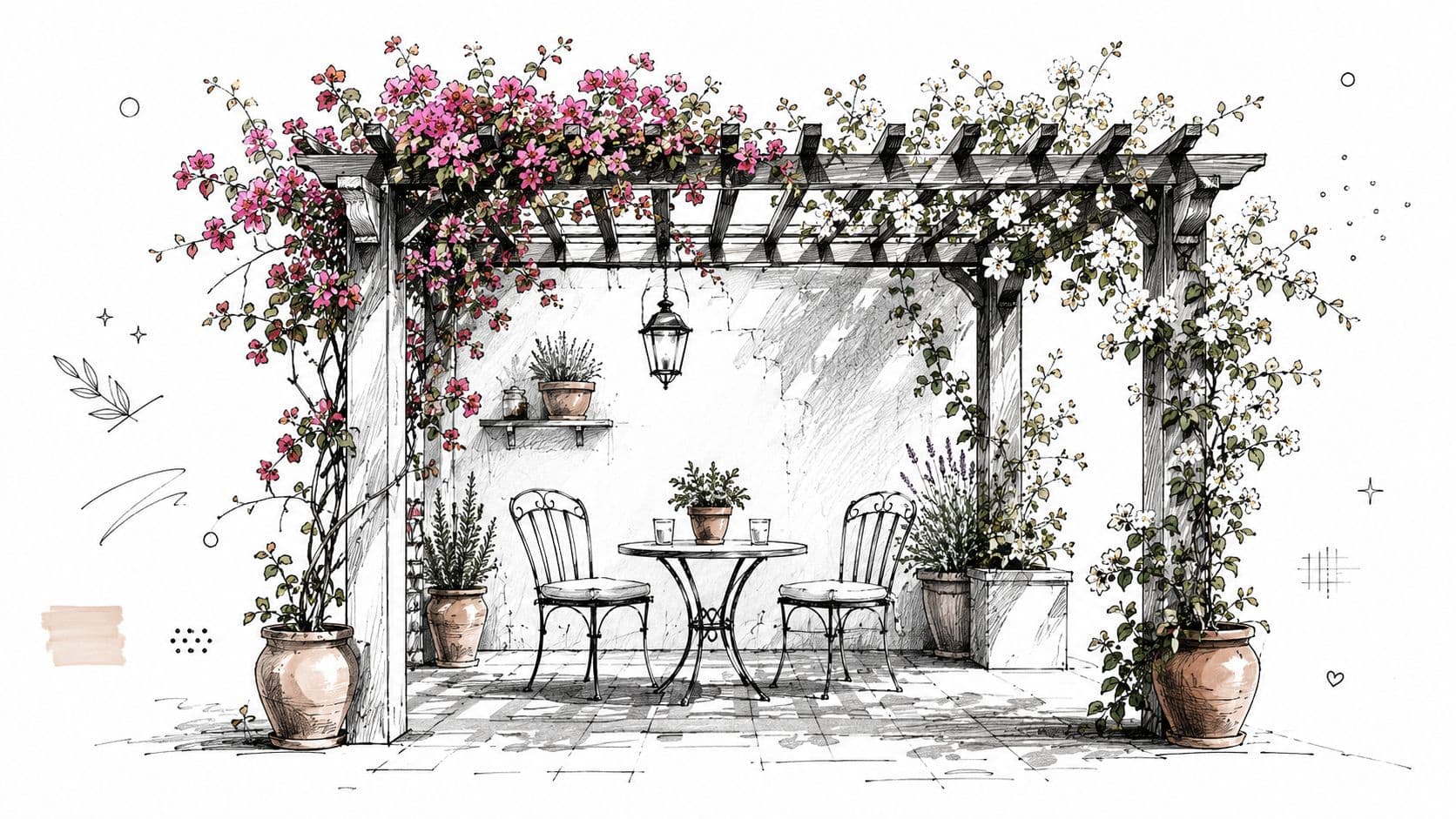
A pergola creates an outdoor room without closing the sky. Its posts frame movement, its beams cast patterned shade, and its vines soften the structure over time. In a Mediterranean yard, it's most useful above a dining table, beside a seating area, or along a path where the transition from house to garden needs more definition.
Choose the structure before choosing the vine. Cedar, durable composite, powder-coated metal, and masonry each create a different character and maintenance profile. Wood offers warmth but needs care. Metal creates a lighter contemporary frame but can become visually harsh if it's too thin or poorly scaled.
Vines also carry real trade-offs. Bougainvillea offers strong color in suitable climates but can be thorny and frost-sensitive. Wisteria creates a dramatic canopy but needs firm support and disciplined pruning. Jasmine supplies fragrance, though its growth and watering needs vary by species and climate.
Treat the pergola as a shade and circulation system
Keep the structure close to the activity it serves. A beautiful pergola placed away from the house may become an unused destination, while one beside the kitchen can support everyday meals. Train vines along the top rather than allowing uncontrolled vertical tangles, and plan access for pruning, guttering, lighting, and repairs.
Use neutral furniture and warm lighting beneath the structure so the planting remains the visual focus. If you're comparing forms, sizes, and vine coverage, these stunning pergola design concepts can help you develop a reference direction before ordering materials. A second practical reference is this Ottawa-Gatineau pergola guide, especially when your local climate differs from the Mediterranean model.
Use a realistic first-year expectation. Newly planted vines won't instantly produce a mature canopy, so combine them with umbrellas or movable shade while the structure develops.
6. Mediterranean Herb and Kitchen Gardens
A herb garden gives Mediterranean style a practical center. Rosemary, oregano, thyme, sage, and basil bring fragrance, texture, and food directly into the daily routine. They also let you introduce the look in a small area, even if the rest of the property has a different design language.
Place the garden near the kitchen door or along a path you use often. Raised beds work well where soil drainage is poor, while terracotta containers offer precise control on patios and balconies. Use pots for plants with different moisture needs, and keep containers close enough to a hose that watering doesn't become a chore.
The design should feel organized rather than crowded. Repeat a few forms, such as clipped rosemary, low thyme, and upright sage, then add terracotta as a supporting material rather than the entire composition. Basil and cilantro can need different care from perennial Mediterranean herbs, so grow them where you can adjust watering and replace them without disturbing the permanent structure.
Build for harvesting, not just appearance
Pinch basil and oregano regularly to encourage useful leafy growth. Harvest herbs in the morning when the foliage is cool and aromatic, and trim rosemary or sage lightly rather than cutting indiscriminately into old woody stems. Keep thyme near paving edges where its fragrance releases as people pass, but don't place it where repeated foot traffic will destroy it.
A small collection of pots beside seating can serve both the cook and the host. Guests experience the scent, while you can reach for herbs without crossing the yard. Use OutdoorBrite to test whether the garden works best beside the kitchen, along a sunny fence, or as a compact container grouping on the patio.
For colder climates, choose hardy regional equivalents or move sensitive containers into shelter. The visual language can remain Mediterranean even when the plant list changes.
7. Outdoor Living Rooms with Seating and Dining Areas
The most successful Mediterranean yards are organized around use. A dining table near the kitchen, a shaded chair facing the garden, or a small conversation area beside a fountain gives the outdoor space a reason to exist. Furniture placement should establish the room before decorative planting fills the edges.
Start with circulation. Leave a clear route from the back door to the dining area, avoid forcing guests through planting beds, and check that chairs can move without catching on walls or planters. A gravel pad can create an informal dining room, while stone paving gives a more stable surface for heavier furniture.
Use several layers of comfort. A pergola or tree may provide permanent character, while an umbrella offers immediate flexibility. Warm evening lighting, weather-resistant cushions, and a nearby serving surface can extend the room's usefulness without adding complex construction.
Keep scale honest
A large sectional can overwhelm a compact courtyard, just as a tiny café table can look lost in a broad lawn replacement. Test furniture footprints with temporary cardboard or painter's tape before purchasing. Place seating toward a strong view, such as an olive tree, a planted slope, a fountain, or a framed architectural opening.
The ai patio design generator can help you compare seating arrangements, table proportions, shade positions, and circulation on your actual patio image. Visualization won't replace measurements, but it can expose an obviously crowded layout before delivery day.
If the budget is limited, prioritize the surface, shade, and seating first. Add tile, fountains, and specimen containers later. A well-proportioned room with simple furniture will feel more finished than an expensive collection of accents with no comfortable place to sit.
8. Colorful Tiled Accents and Mediterranean Ceramics
Tile adds identity quickly, which is both its strength and its danger. A narrow border around a fountain, a tiled stair riser, or a ceramic inset can establish Spanish, Moorish, Portuguese, or Italian influence without covering the entire yard in pattern.
Use decorative tile at points where people naturally pause. Fountain surrounds, seat walls, entry steps, low retaining edges, and outdoor kitchen backsplashes can carry color without competing with the planting. Hand-painted tiles create a crafted feel, while solid-color field tiles keep the installation calmer and often reduce material cost.
Match the tile to the architecture. A strongly geometric Moorish pattern may feel disconnected from a simple modern home, while a restrained blue-and-white accent can link a plain courtyard to coastal Mediterranean references. Terracotta works well with warm stone, but it can show wear and staining, especially in exposed areas.
Spend on the detail people see
A small quantity of well-placed tile usually has more impact than a large area of low-quality pattern. Use complementary plain tiles around a decorative center, and keep grout lines clean and properly sealed. Exterior installation requires attention to substrate movement, drainage, frost exposure where relevant, and the difference between decorative tile and slip-resistant paving.
Before selecting a pattern, test it against the house wall, paving color, and foliage. OutdoorBrite can help you visualize whether blue tile becomes a focal point or adds noise. For a material comparison that may help with indoor and outdoor finish decisions, review this marble versus vitrified tiles guide, then confirm exterior suitability with the tile supplier and installer.
The strongest result treats ceramics as punctuation. Let stone, gravel, foliage, and shade provide the sentence.
9. Mediterranean Cypress, Olive Trees, and Specimen Plantings
One well-placed tree can do more for a Mediterranean composition than a dozen small decorations. Cypress adds vertical emphasis, olive contributes silver foliage and a sculptural trunk, and stone pine creates a broad canopy where the site has enough room. These plants give the garden its long-term structure.
Use cypress to frame a doorway, terminate a sightline, or create rhythm along a drive. Avoid placing a narrow tree randomly in the middle of a small lawn replacement, where it can look like an isolated prop. Olive trees work well as courtyard anchors, but their mature scale, root behavior, fruiting, and local climate suitability need review before planting.
Design for the tree you'll eventually have
Sketch mature dimensions, not nursery dimensions. Keep enough space from walls, paving, overhead utilities, and windows, and consider how shade will move across the garden. A specimen tree should be visible from the rooms and outdoor areas you use most, otherwise you'll pay for a focal point you rarely experience.
Trees need consistent watering during establishment, even when they're drought-adapted later. That temporary demand should be separated from the permanent low-water planting zone. In colder or wetter climates, choose a regional tree with similar upright, silver, evergreen, or sculptural qualities rather than accepting repeated losses.
OutdoorBrite is useful for testing mature-looking tree placement and comparing one central olive with a pair of cypress accents. Keep the visualization as a design aid, then verify the species, mature size, soil tolerance, disease concerns, and local restrictions with a nursery or extension office.
A specimen planting is a long-term investment. Its value comes from developing character, not from looking fully grown on installation day.
10. Stone Walls, Rustic Fencing, and Traditional Boundaries
Boundaries give a Mediterranean garden its edge. Dry-stacked stone, weathered timber, adobe-inspired walls, and wooden gates can define property lines, separate a patio from a service area, or hold a planted slope. They also provide a backdrop for silver foliage, climbing vines, and terracotta.
Local or regional stone usually looks more credible than a material chosen only because it resembles a famous Mediterranean wall. Look at the colors already present in the house, roof, paths, and neighboring surroundings. A low dry-stone edge may feel informal and agricultural, while a tall rendered wall creates privacy but can make a small yard feel enclosed.
Drainage matters whenever a boundary also retains soil. Build the wall for its structural role, not just its appearance. Dry stacking requires skilled placement, stable foundations, and careful attention to water movement. A poor wall can shift, shed stones, or trap moisture against adjacent surfaces.
Use boundaries to create useful rooms
A low wall can double as seating, frame an entry, or define an herb bed. Gaps and planting pockets can soften the masonry with thyme, trailing rosemary, ground covers, or vines. A timber gate adds a human-scale threshold and can make a side yard feel intentional rather than leftover.
Keep the boundary proportionate to the property. Rustic walls should support the design, not dominate it. OutdoorBrite can help compare a pale stone edge, darker regional rock, or a wood-and-stone combination on your actual yard image before you order materials.
Consult local rules before building on a property line or altering a retaining edge. The visual effect may be simple, but the construction responsibilities can be significant.
Mediterranean Landscape: 10-Item Comparison
| Item | Implementation Complexity 🔄 | Resources & Cost ⚡ | Expected Outcomes 📊 | Ideal Use Cases 💡 | Key Advantages ⭐ |
|---|---|---|---|---|---|
| Drought-Tolerant Plant Palettes with Native Mediterranean Species | Low–Moderate; easy care after 6–12 month establishment 🔄 | Low–Moderate; low ongoing irrigation & fertilizer costs ⚡ | 50–70% water reduction; authentic Mediterranean look; supports pollinators 📊 | Water-restricted yards, low‑maintenance landscapes, habitat restoration 💡 | Water savings, low maintenance, ecosystem benefits ⭐ |
| Terraced Garden Beds and Hillside Landscaping | High; requires engineering and staged construction 🔄 | High; significant labor, materials, drainage work ($2k–$15k+) ⚡ | Stabilizes slopes, prevents erosion, creates usable tiers and drama 📊 | Steep or erosion-prone sites needing functional planting and views 💡 | Converts slopes to usable space; strong architectural impact ⭐ |
| Gravel and Stone Hardscaping with Strategic Paving | Moderate; skilled installation needed for durability 🔄 | Moderate–High; material + install ($5–$15/ft²), low upkeep ⚡ | Eliminates lawn maintenance, improves drainage, Mediterranean ambiance 📊 | Patios, pathways, drought-prone yards, low-water designs 💡 | Durable surfaces, low ongoing maintenance, authentic materials ⭐ |
| Water Features and Fountain Design Elements | Moderate–High; plumbing/electrical and permitting often needed 🔄 | High; substantial install and operational costs ($3k–$50k+), ongoing upkeep ⚡ | Cooling microclimate, strong focal point, increased perceived value 📊 | Courtyards, formal gardens, luxury estates seeking focal features 💡 | Auditory/visual centerpiece; cooling and wildlife attractant ⭐ |
| Pergolas, Arbors, and Climbing Vine Structures | Low–Moderate; DIY possible but needs secure anchoring 🔄 | Low–Moderate; material and plant costs, periodic vine maintenance ⚡ | Filtered shade, vertical layering, outdoor “rooms” as vines mature (2–3 yrs) 📊 | Patios, dining areas, pathways needing shade and vertical interest 💡 | Affordable shade solution; supports climbers; enhances outdoor living ⭐ |
| Mediterranean Herb and Kitchen Gardens | Low; simple layouts, basic pruning/harvest skills 🔄 | Low; minimal inputs (pots, soil, seeds), some pest management ⚡ | Fresh culinary herbs, fragrance, pollinator attraction, educational value 📊 | Near kitchens, containers, small yards, edible/utility-focused designs 💡 | Functional produce, sensory appeal, low water once established ⭐ |
| Outdoor Living Rooms with Seating and Dining Areas | Moderate; coordinate furniture, shade, drainage; may need pros 🔄 | Moderate–High; furniture, shade structures, and installation costs ($5k–$30k+) ⚡ | Extended living space, social hub, higher market appeal and usability 📊 | Entertaining homes, indoor‑outdoor lifestyles, climates with long outdoor seasons 💡 | Enhances lifestyle and resale; flexible entertaining space ⭐ |
| Colorful Tiled Accents and Mediterranean Ceramics | Moderate; requires skilled installation for durability 🔄 | Moderate–High; tile material and specialist labor (costly per tile) ⚡ | Vibrant cultural character and long‑lasting decorative focal points 📊 | Fountain surrounds, benches, walls and accent zones needing color 💡 | Durable artistic statement; authentic Mediterranean patterns ⭐ |
| Mediterranean Cypress, Olive Trees, and Specimen Plantings | Moderate; planting straightforward but requires long‑term planning 🔄 | High for mature specimens; slow growth means long horizon and cost ⚡ | Iconic vertical structure, year‑round interest, strong sense of place 📊 | Large properties, driveways, formal allées, focal‑point plantings 💡 | Timeless character, shade, low water once established ⭐ |
| Stone Walls, Rustic Fencing, and Traditional Boundaries | High; skilled masonry and site prep required 🔄 | High; material and labor intensive ($20–$50+/lin. ft), long lifespan ⚡ | Durable boundaries, erosion control, authentic regional texture 📊 | Property delineation, erosion-prone sites, historic or vernacular contexts 💡 | Long‑lasting, authentic aesthetic and structural function ⭐ |
Turn Your Favorite Concept into a Testable Yard Plan
Don't copy all ten concepts at once. A Mediterranean yard usually feels more authentic when it combines one structural idea, one hardscape palette, and one climate-appropriate planting layer. For example, a small front garden might use a gravel and stone surface, a restrained lavender and rosemary palette, and one olive or regionally suitable specimen tree. A sloped backyard might start with a single terrace, a compact seating area, and hydrozoned planting rather than a full hillside reconstruction.
Begin with photographs taken from the rooms and paths that matter most. Include the sunny patio, the sloped side yard, the front approach, and any views from kitchen or living-room windows. Mark slope, drainage problems, existing trees, utility lines, doors, gates, and the places where people naturally walk.
Write down the intended use before choosing materials. Do you need dining space, a quiet sitting area, a safer route across a grade, more privacy, easier access to herbs, or a lower-maintenance front garden? This decision will determine whether your first investment should be a pergola, terrace, path, seating pad, boundary, or planting renovation.
Then choose a budget tier and phase the work. A modest first phase might replace a small lawn section with gravel, add a few climate-appropriate plants, and install a simple seating area. A larger phase could include retaining work, drainage, permanent paving, irrigation changes, lighting, or a specimen tree. Phasing protects the design from becoming a random sequence of purchases.
Sketch circulation and irrigation zones before buying plants. Separate high-, medium-, and low-water areas spatially, and plan a distinct establishment schedule for new planting. A low-water Mediterranean garden isn't automatically a zero-water garden. Established plants may still need deep irrigation during hot months, and newly planted areas need more consistent care while roots develop.
Use OutdoorBrite to upload a yard photograph, test the Mediterranean style, compare layout directions, and refine elements such as pergolas, planting beds, fire pits, paving, and trees. Review several alternatives rather than accepting the first attractive image. Check each concept against real measurements, sun exposure, mature plant size, drainage, structural requirements, lighting, local water restrictions, and the maintenance you're willing to perform.
A xeriscaping redesign study for Mediterranean conditions estimated 57.24% savings in construction costs and 54.91% savings in annual maintenance costs after replacing conventional high-input landscaping with drought-adapted plants, efficient irrigation, and more hardscape in this feasibility study. That result shouldn't be treated as a guaranteed quote for your yard, but it does support a practical principle: design decisions made early can affect both installation and long-term operating costs.
Before hiring help, prepare a simple brief with photographs, measurements, preferred uses, material references, plant constraints, and the visual concept you want to test. Ask contractors about drainage, wall construction, irrigation separation, paving preparation, tree placement, lighting access, and ongoing care. The best Mediterranean design ideas won't just look good in a rendering. They'll remain usable, resilient, and manageable after the first hot season.
OutdoorBrite lets you turn a photo of your yard into realistic Mediterranean design concepts, then compare planting, paving, pergolas, seating, and other elements before spending on materials or installation. Visit OutdoorBrite to test your favorite ideas on your actual space and create a clearer brief for your next DIY project or design conversation.
See your yard reimagined
Start creating