Patio Design for Small Spaces: Create a Stylish Oasis
Unlock your small backyard's potential! Get expert tips on patio design for small spaces, including layout, furniture, & lighting to create a stylish oasis.
You're probably staring at a small patch of concrete, dirt, pavers, or neglected backyard edge and wondering the same thing most homeowners do. Can this space become somewhere you want to spend time, or is it too tight to be useful?
It can work. Small patios often turn out better than large ones because every choice has to earn its place. You notice bad layout faster, but you also feel good planning faster. A smart small patio gives you an outdoor room, not just an outdoor surface.
That matters because patios have become the preferred outdoor extension for new homes. By 2023, 63.7% of new single-family homes in the United States included patios, marking the eighth consecutive year of record growth ([verified data reference unavailable as a public URL]). People want usable, ground-level outdoor living. The challenge isn't whether a patio is worth building. It's whether yours will function once the furniture arrives, the sun shifts, and the seasons change.
Most patio design for small spaces advice stops at decoration. The better approach is to treat the project like a design problem with a sequence. First define the job of the space. Then shape layout, furniture, vertical elements, comfort, and budget around that job. If you can visualize those decisions before buying anything, you avoid the usual mistakes that make small patios feel crowded, hot, dim, or underused.
Table of Contents
- Start with a Vision Not a Shopping Cart
- Master the Layout with Smart Zoning
- Choose Furniture That Works Harder
- Build Up with Vertical Gardens and Smart Surfaces
- Create Ambiance and All-Season Appeal
- Plan Your Budget and Visualize the Result
Start with a Vision Not a Shopping Cart
The first mistake is buying furniture before deciding how the patio should live. A bistro set, sectional, fire pit, and planters can all look great in isolation. Put them together in a compact footprint and the space stops working.
Start with one question. What will you do here most often? Not on holidays. Not in your ideal lifestyle. On an average week.
Define the main job of the patio
A small patio usually works best when it has one primary role and one secondary role. That might be morning coffee plus container gardening. Or dinner for two plus a place to read. Or a family grill zone with flexible extra seating.
If you try to force it into dining area, lounge, outdoor kitchen, play zone, and plant showcase all at once, you'll end up with a cramped layout that looks busier than it feels useful.
Use this quick filter:
- If you eat outside often, prioritize table clearance, chair pullback, and a direct path from the house.
- If you unwind outside, make seating the anchor and let side tables and lighting support it.
- If you host occasionally, design for daily comfort first, then add movable pieces for guests.
- If plants matter most, give them vertical space and protect the walking zone from becoming a pot storage area.
Practical rule: Choose the layout for your most common use, not your biggest fantasy use.
Measure what matters
Homeowners often measure only edge to edge. That gives you total square footage, but not usable space. For patio design for small spaces, you need a field sketch that includes obstacles and conditions.
Record these before you shop:
- Hard dimensions. Width, depth, door swing, steps, utility boxes, downspouts.
- Sun pattern. Morning sun, harsh afternoon exposure, full shade, reflected heat from walls.
- Sight lines. What you see from the kitchen, living room, or back door matters as much as what you see while sitting outside.
- Privacy gaps. Fence height, neighboring windows, open side yards.
- Drainage behavior. Where water collects after rain and how runoff moves.
I like marking these on a simple sketch instead of relying on memory. A lot of expensive mistakes come from forgetting that a back door needs room to open, or that the best furniture spot is also the place where water pools.
Create a rough design brief
Write down three things your patio must do and three things it must not do. That simple list keeps decisions honest.
A useful brief might look like this:
| Must do | Must not do |
|---|---|
| Fit two people comfortably for coffee | Block the back door |
| Allow a grill or serving surface nearby | Require constant furniture moving |
| Feel private from the side fence | Turn into a storage zone |
That kind of clarity saves time. Inspiration is still helpful, but it works best after you know the brief. If you want examples that lean practical rather than flashy, Short Furniture outdoor living ideas can help you compare looks without losing sight of function. For testing layouts before anything gets built, these Best landscape design apps are useful for seeing whether your ideas fit the footprint you have.
Master the Layout with Smart Zoning
You step out the back door with a coffee, and within two strides you're squeezing past a chair leg, a planter, and a grill cart. That is usually a layout problem, not a size problem. Small patios work best when each part has a job and the route through the space stays easy.
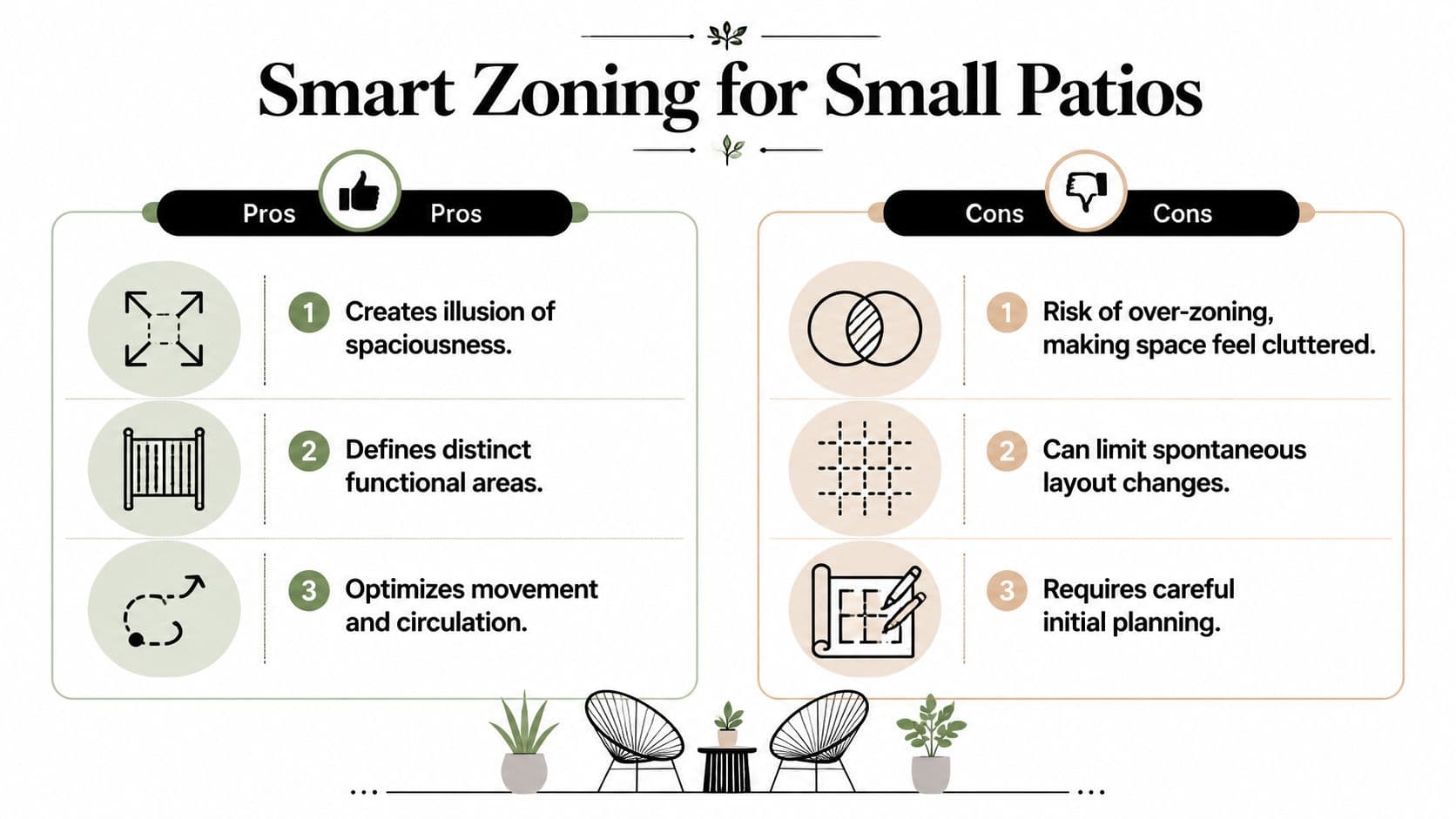
Zoning gives structure without making a compact patio feel chopped up. The goal is simple. A person should understand where to sit, where to eat, and how to move through the space the moment they step outside.
I start with use patterns, not objects. Decide which activity deserves the best position, then assign the secondary use around it. On a narrow patio, that often means placing the main seating area where the view or privacy is strongest, then letting dining or serving sit closer to the house for easier access. I've seen this work especially well in small townhome yards where every foot has to do more than one job.
Size the zones by how people actually use them
The earlier design brief should guide the layout here. If the patio is mainly for morning coffee and the occasional friend, the lounge zone gets priority. If dinner outside happens three nights a week, eating space earns the better footprint.
Avoid planning for your busiest day of the year. That mistake produces bulky layouts that underperform the other 350 days. A small patio used well by two or four people beats an overcrowded one that technically seats six.
As a practical rule, leave enough room for people to sit down, stand up, and pass through without turning sideways or dragging chairs every time. If you have to rehearse the movement in your head and it still feels tight, it will feel worse once the furniture arrives.
Define each zone with light visual cues
Heavy dividers eat space fast. Use quieter signals that mark a change in function without adding width or weight.
- Surface direction. Run pavers one way under the dining spot and another in the lounge area.
- Rugs. One outdoor rug can anchor seating and keep the rest of the patio visually open.
- Planter placement. A pair of containers at the edge of a zone works better than a row of pots scattered everywhere.
- Furniture angle. Turn chairs toward each other to create a conversation area while keeping the outside edge clear.
One warning here. Too many small accents make a compact patio look busy. Two zones are usually enough. Three can work, but only if one of them is very light, such as a grill station or a narrow planting strip.
Protect the walking route first
Circulation should be drawn into the plan from the start. It is not the leftover gap after furniture is placed.
I've seen owners center a table because it looked balanced on paper, then realize no one could reach the gate without bumping a chair. On small patios, a single clear route usually performs better than several partial paths. Start at the door, then trace the easiest walk to every seat, the grill, storage, and any steps or gates. Keep that route open even when chairs are pulled out.
Here's a quick way to check the plan before you buy anything. Mark the furniture footprint with painter's tape or use an AI or layout app to test scale from above. That extra step catches expensive mistakes early, especially on patios with awkward corners or door swings.
| Layout choice | What usually happens |
|---|---|
| One obvious path from entry to seating | The patio feels calm and easy to use |
| Small objects scattered across the route | Movement feels cramped and annoying |
| Furniture packed around every edge | The patio looks full but works poorly |
| One clear focal feature | The space feels deeper and more intentional |
Use surface tone and one focal point to steady the layout
Light-to-mid-tone paving usually makes a compact patio feel more open than very dark surfaces. The effect is visual, but it is real in practice. Dark paving can look rich and dramatic, though it also tends to absorb heat and visually shrink the floor plane in tight yards. I usually reserve darker tones for accents, borders, or pots instead of the whole patio surface.
A focal point helps for the same reason. It gives the eye a destination and keeps the layout from feeling random. That focal point might be a slatted screen, a wall fountain, a compact fire bowl, or a pair of strong planters. If your patio furniture sits on slightly uneven paving, details like a self-stabilising table base from StableTable Scandinavia AB can also keep the space more usable day to day without adding bulk.
Keep the composition simple. One main destination and one clear path are often enough to make a small patio feel settled, useful, and much larger than the measurements suggest.
Choose Furniture That Works Harder
A small patio usually fails at the furniture stage. The layout may be sound, the paving may look right, and then one oversized set arrives and the whole space starts fighting you every time someone pulls out a chair.
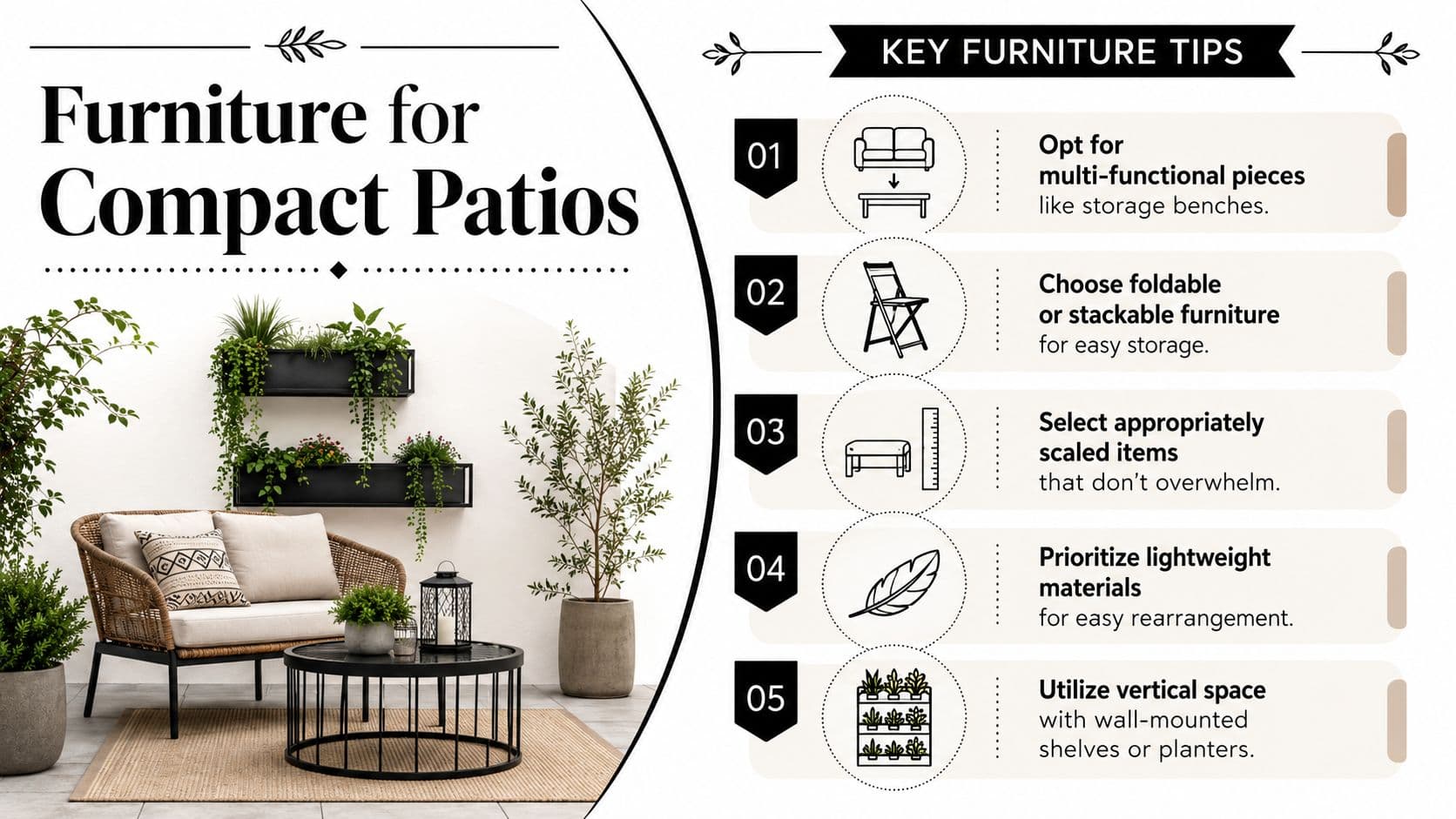
I see the same mistake again and again. Homeowners shop by catalog photo, not by how the patio needs to work on a Tuesday evening, a Saturday lunch with friends, and a wet week when everything has to be shifted or covered. In a compact space, each piece needs to earn its footprint.
Compare smart options against standard ones
Furniture that works hard in a small patio usually does one of three things. It folds away, serves more than one purpose, or keeps the space visually open.
| Standard choice | Better small-space alternative | Trade-off |
|---|---|---|
| Full dining set with wide armchairs | Slim dining chairs or a bench on one side | Slightly less formal seating |
| Large coffee table | Nesting tables | More flexibility, less permanent surface area |
| Deep outdoor sofa | Compact loveseat or corner sectional | Fewer lounging positions |
| Separate storage box | Built-in bench with storage | Less movable, more efficient |
| Heavy side chairs | Foldable or stackable chairs | Sometimes less plush |
Open-framed furniture nearly always reads better than bulky woven pieces with thick arms and backs. The measurements may be close, but the heavier piece makes a tight patio feel crowded faster. I have seen a simple bench and two light chairs outperform a full four-seat matching set in patios that were less than 12 feet across.
Shop by movement, not just by measurements
Tape the furniture size on the ground before you buy. It takes 20 minutes and can save you from a return headache.
Check the patio with real movements, not just dimensions on a product page:
- Can someone pull out a chair and sit without bumping another piece?
- Can two people pass each other without one stepping into a planter bed?
- Can you carry food out from the door without twisting around furniture corners?
- Can one person move the setup for guests, shade, or cleaning?
Those tests matter more than showroom styling. A table can fit mathematically and still feel wrong in daily use. This is also the point where digital planning helps. Before clients order anything expensive, I like to mock up furniture footprints in a simple scaled sketch or an AI visualization so they can spot circulation problems early. That process catches costly buying mistakes before a single chair hits the site.
For a closer look at compact pieces and stable dining setups, StableTable Scandinavia AB is a useful reference, especially if you're tired of outdoor tables that wobble on uneven paving.
A quick video can also help you think through proportion and placement before buying:
What tends to work best
Some furniture combinations solve small-space problems reliably because they match how people use patios.
- Bench plus two chairs gives flexible seating without filling every side of the table.
- Nesting or C-tables provide a place for drinks when needed, then disappear.
- Armless seating often gives you a few extra usable inches per person.
- Storage benches reduce clutter from cushions, candles, and garden gear.
- Dining-height tables with a compact footprint usually work harder than low lounge tables in very small patios.
Material choice matters too. Aluminum and powder-coated steel are easier to move than teak or cast aluminum. That can be the difference between a patio you reconfigure often and one that stays awkward because the furniture is too heavy to bother with. If your planting plan is heading toward low-water garden design, lighter furniture and fewer oversized soft pieces also tend to pair better with the cleaner look.
One warning from the field. Built-ins can be brilliant, but only if the layout is already proven. I like them for dead corners, odd boundaries, and spots where loose furniture always drifts into the path. I avoid them when clients are still figuring out how they want to live in the space, because fixed seating locks in every future decision.
If a piece has one job and takes up a lot of room, skip it.
Buy for your actual patio, with its door swing, grill clearance, storage needs, and daily traffic. Store displays never show those constraints. Your project has to handle them every day, in every season.
Build Up with Vertical Gardens and Smart Surfaces
When floor area is tight, the walls become part of the plan. Fences, privacy screens, exterior walls, and post structures are not background elements. They are working surfaces.
That shift changes a small patio from crowded to composed. Instead of filling the ground with pots, shelves, lanterns, and decor, you move useful features upward and keep the floor open.
Treat vertical space as usable square footage
Vertical design earns its value in several ways. It creates privacy, softens hard boundaries, adds greenery, and frees the walking surface from clutter.
Good vertical moves include:
- Trellises with climbing vines for privacy and softness
- Wall-mounted planters that keep herbs or flowers off the floor
- Slatted wood screens for partial screening without closing the patio in
- Mounted lighting instead of floor lamps
- Narrow shelves for candles, drink trays, or small pots
This is also where restraint matters. A wall covered with too many small accessories can feel busier than a floor full of furniture. Pick one strategy and repeat it. A row of matching planters usually works better than a collage of unrelated pieces.
Choose plants that support the patio instead of swallowing it
Small patios don't need heavy perimeter planting. Dense mixed borders often make compact spaces feel hemmed in.
A cleaner approach is to use fewer plant varieties and repeat them with intention. Grasses, climbing vines, compact shrubs in containers, and upright forms usually support the architecture better than broad, sprawling plants. If your climate runs hot or dry, this is also where low-water garden design can help you choose plants that won't turn into a maintenance burden.
Use plants to frame the patio, not to hide every edge of it.
That difference shows up immediately. Framed patios feel designed. Overplanted patios feel smaller.
Pick a surface that matches the way you live
The ground finish has both practical and visual consequences. It affects heat, maintenance, drainage, furniture stability, and the overall tone of the space.
Here's how common choices behave in small patios:
| Surface | Best for | Watch out for |
|---|---|---|
| Pavers | Clean structure, easy zoning, solid furniture support | Pattern can feel busy if too complex |
| Poured concrete | Minimal look, simple maintenance, modern style | Needs good finishing and drainage planning |
| Wood deck tiles | Softer feel, renter-friendly upgrades in some cases | Can shift or weather unevenly |
| Decorative gravel | Informal gardens, drainage, low cost material feel | Tough for dining chairs and less stable underfoot |
In most compact patios, simpler is better. One surface across the whole footprint makes the area feel larger and calmer. If you want contrast, use a border, an inset pattern, or a rug rather than multiple competing materials.
Lighter finishes often help the patio feel more open, but texture matters too. Slight variation reads natural. Too much contrast reads fragmented. The sweet spot is a surface with enough character to avoid looking flat, but not so much pattern that it steals attention from the rest of the space.
Create Ambiance and All-Season Appeal
A patio that only works on perfect spring afternoons isn't finished. The best small patios hold up at dusk, during a hot spell, on a cool evening, and through the shoulder seasons when people want fresh air but need a little help from lighting, shade, or warmth.
That's the difference between a styled patio and a lived-in one.
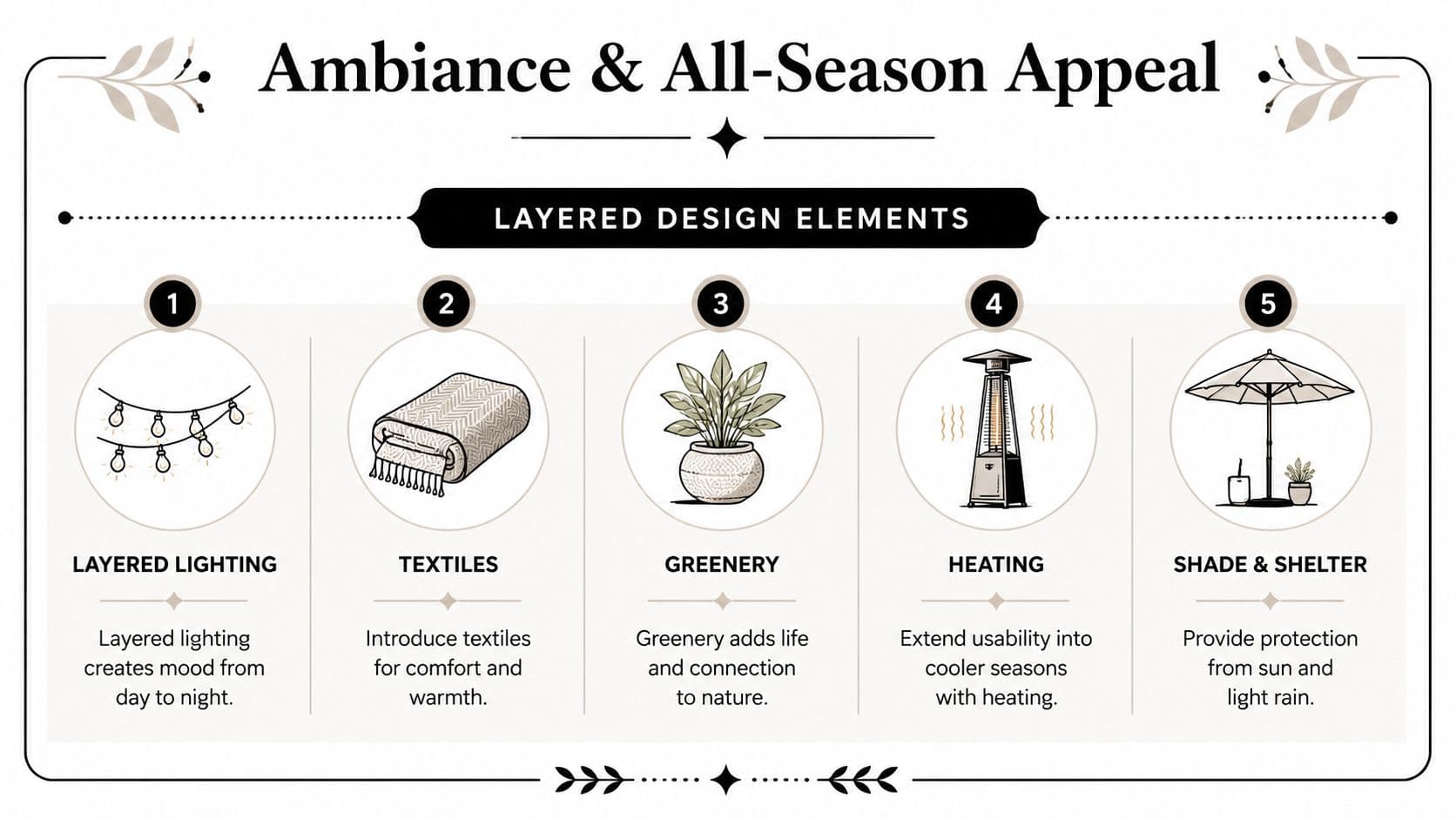
A 2024 NAHB survey found that 68% of homeowners with small outdoor spaces want to use them year-round but lack the design knowledge to adapt layouts for seasonal change (Allied Outdoor Solutions). That gap is real. Most patios fail not because they're unattractive, but because they don't respond well to weather and time of day.
Layer light instead of relying on one fixture
A single bright porch light rarely makes a patio inviting. It lights the door and leaves the rest of the area flat or dim.
Use layers with distinct jobs:
- Ambient lighting for overall glow, such as string lights or overhead fixtures
- Task lighting near a dining surface, grill, or steps
- Accent lighting that highlights plants, screens, or textured walls
Even a very small patio benefits from this approach. Light at different heights makes the space feel deeper and more intentional. It also helps people move safely after dark, which is a practical issue, not just a mood upgrade.
Add soft materials with discipline
Textiles bring warmth quickly. An outdoor rug, seat cushions, and a couple of pillows can make a hard patio feel like a real room. The mistake is using too many patterns or colors in a limited footprint.
A neutral base with one strong accent usually reads better than a pile of competing prints. If your fence, pavers, and furniture already have texture, let the textiles simplify rather than complicate.
Here's a reliable formula:
- Start with a rug that supports the seating zone.
- Add cushions that connect to the surface tones or surrounding planting.
- Introduce one accent color through pillows, a planter, or a throw.
- Repeat that accent lightly instead of adding new colors.
Plan for season shifts before they arrive
Seasonal adaptation is where small patios get surprisingly effective. You don't need a full renovation between summer and fall. You need a layout that accepts seasonal add-ons.
Examples that tend to work:
- For summer heat, use a cantilever umbrella, light fabrics, and airflow-friendly furniture spacing.
- For cool evenings, a compact fire feature, outdoor-safe throw blankets, and warmer lighting make the patio feel usable longer.
- For wet periods, quick-drying materials and good drainage matter more than decorative extras.
- For privacy in leaf-off seasons, screens, evergreen containers, or vertical panels help once surrounding plants thin out.
A year-round patio doesn't need four separate designs. It needs one layout that can flex with small seasonal swaps.
That's where visualization is useful. Seeing a patio in summer light, fall evening conditions, or winter bareness before buying materials can reveal weaknesses you won't catch in a static mood board.
Plan Your Budget and Visualize the Result
A small patio usually goes off budget in one of three ways. The base gets underplanned, the furniture gets bought too early, or the homeowner changes direction after materials arrive. I've seen all three, and the expensive one is almost always the redo.
Skip the price promises. Patio costs vary hard by site conditions, material choice, access, and whether the job needs grading, drainage correction, or permit review. A ground-level gravel patio can stay modest. A compact paved patio with proper edge restraint, base prep, and drainage work is a different job entirely.
Where to save and where not to
In a tight footprint, every dollar should protect function first. Decorative pieces are easy to swap later. Bad prep under the patio is expensive to correct once the surface is finished.
| Save on | Spend carefully on |
|---|---|
| Simple containers and accessories | Base prep and drainage |
| Seasonal decor and pillows | Main seating you'll use often |
| DIY staining or screen finishing | Durable surface materials |
| Add-on side tables | Any built-in element |
That table reflects the trade-offs I recommend on real projects. Clients rarely regret buying fewer pillows in year one. They do regret a cheap chair set that rusts after one season, or a patio that holds water because the slope was guessed instead of measured.
Built-ins deserve extra caution in a small space. A bench, kitchen counter, or fixed fire feature can make the patio feel custom, but it also locks the layout in place. If cooking is on your wish list, low-cost outdoor kitchen solutions can help you sort out what belongs in phase one and what can wait.
Visualization is cheap insurance
Visualization cuts down on the mistakes people make before the first shovel hits the ground. It helps you catch the chair that blocks circulation, the planter that narrows the entry, or the paver tone that fights the house instead of supporting it.
I like mockups because they force real decisions. You can test whether a dining setup leaves enough pull-back space. You can see whether a privacy screen feels useful or heavy. You can compare a warmer paver against a cooler one before paying for delivery. If you want to pressure-test ideas early, a best free patio design app makes that process much clearer.
One good rendering often saves more money than a last-minute change order.
Outdoor projects get easier when you can test ideas before you commit money to materials, furniture, or labor. OutdoorBrite Money helps you upload a photo of your patio or backyard, generate photorealistic redesigns in different styles and seasons, and pressure-test your layout before the project starts. If you want more confidence and fewer expensive do-overs, it's a practical place to begin.
See your yard reimagined
Start creating