Small Landscape Garden Design: Stunning Spaces 2026
Unlock your backyard's potential with expert small landscape garden design. Get 2026 tips on planning, planting, & creating a stunning outdoor space.
Small garden projects often commence in a similar fashion. One spots a plant they love, saves a patio photo, then attempts to squeeze both into a space already contending with awkward shade, a fence line, and a route to the bins.
That's usually where small garden design goes wrong.
A compact garden doesn't give you much room to hide a weak decision. If the path is too tight, you feel it every day. If the plants outgrow the bed, the whole space looks crowded. If the seating is in the wrong place, the garden may look good in photos but never gets used. Good design fixes that by treating a small yard as a planned outdoor room, not a collection of features.
Laying the Groundwork for Your Garden Design
The first job is not choosing plants. It's reading the site correctly.
University extension guidance recommends a practical design sequence of site inventory and analysis, define user needs, create functional diagrams, develop conceptual plans, then produce the final plan, because that order helps resolve circulation, sun exposure, and soil moisture before you commit to materials or plants (University of Florida IFAS Extension). In a small space, that sequence saves a lot of backtracking.
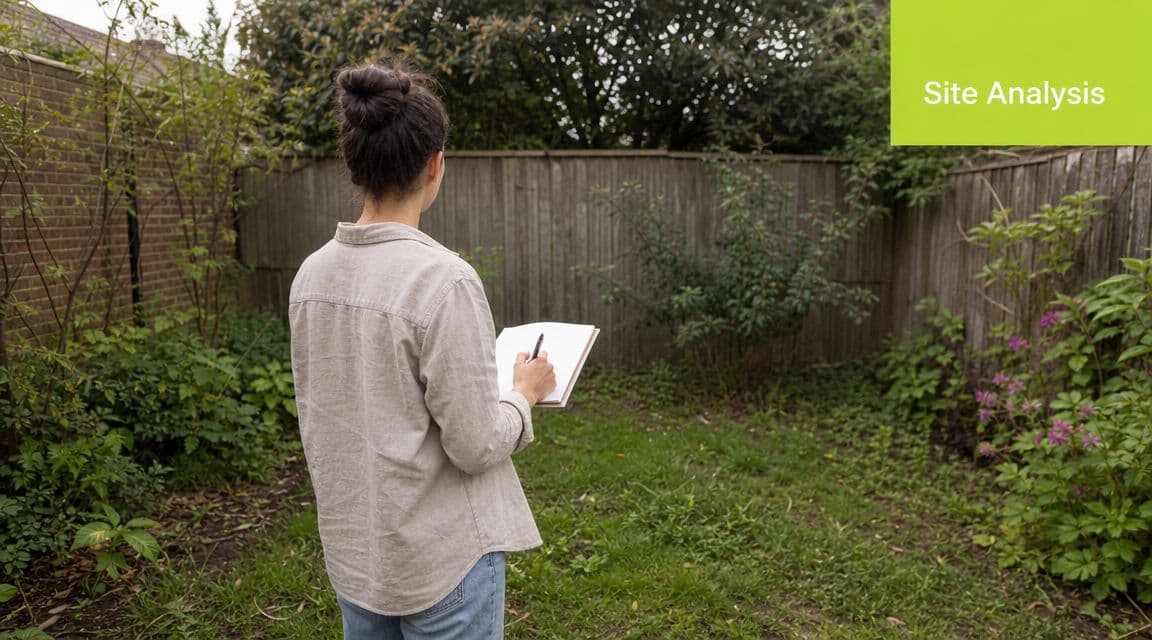
Build a base map first
Use graph paper or a tablet. Measure the full garden, then add every fixed element:
- House walls and doors that affect movement
- Existing patios and paths you may keep
- Fences and neighboring windows that affect privacy
- Drain covers, taps, utility boxes, and downpipes
- Trees you can't remove and their canopy spread
Don't aim for a pretty sketch. Aim for a reliable one.
Beginners often skip this and jump straight to layout ideas. That's how people end up placing a dining area where the back door swing clashes with chairs, or putting a raised bed where water already collects.
Track light and moisture
A small garden can contain several microclimates. One corner may stay cool and damp while a wall-facing strip gets hot and dry. That difference matters more than style references from social media.
Make simple notes over a few points in the day:
-
Morning light
Mark where the first sun lands. -
Midday exposure
Note the hottest surfaces, especially paving and masonry. -
Late-day shade
Check where buildings and fences cut light early. -
After-rain behavior
Watch where water sits and where it drains quickly.
Practical rule: If a spot repeatedly stays wet, windy, or shaded, design for that condition instead of fighting it.
For soil prep, use OutdoorBrite's complete soil guide as a straightforward reference before you buy compost, mulch, or plants that may not suit the ground.
Define how the garden must work
A small yard improves fast when you rank uses instead of trying to fit everything in.
Ask yourself:
- What happens here most often: coffee, dining, kids' play, container growing, dog access?
- What needs clear access: side gate, storage, hose, bins?
- What must feel comfortable: shade, privacy, evening seating?
If you want raised beds as part of that plan, guides that help homeowners create a thriving garden easily can be useful, especially when you're deciding whether food growing belongs in the main social area or in a separate productive zone.
A small garden works better when every square foot has a job. Some areas need to look good. Others need to carry traffic, hide storage, or solve drainage.
That's the foundation of small garden design. Not inspiration first. Accurate constraints first.
Creating Your Master Plan and Defining Your Style
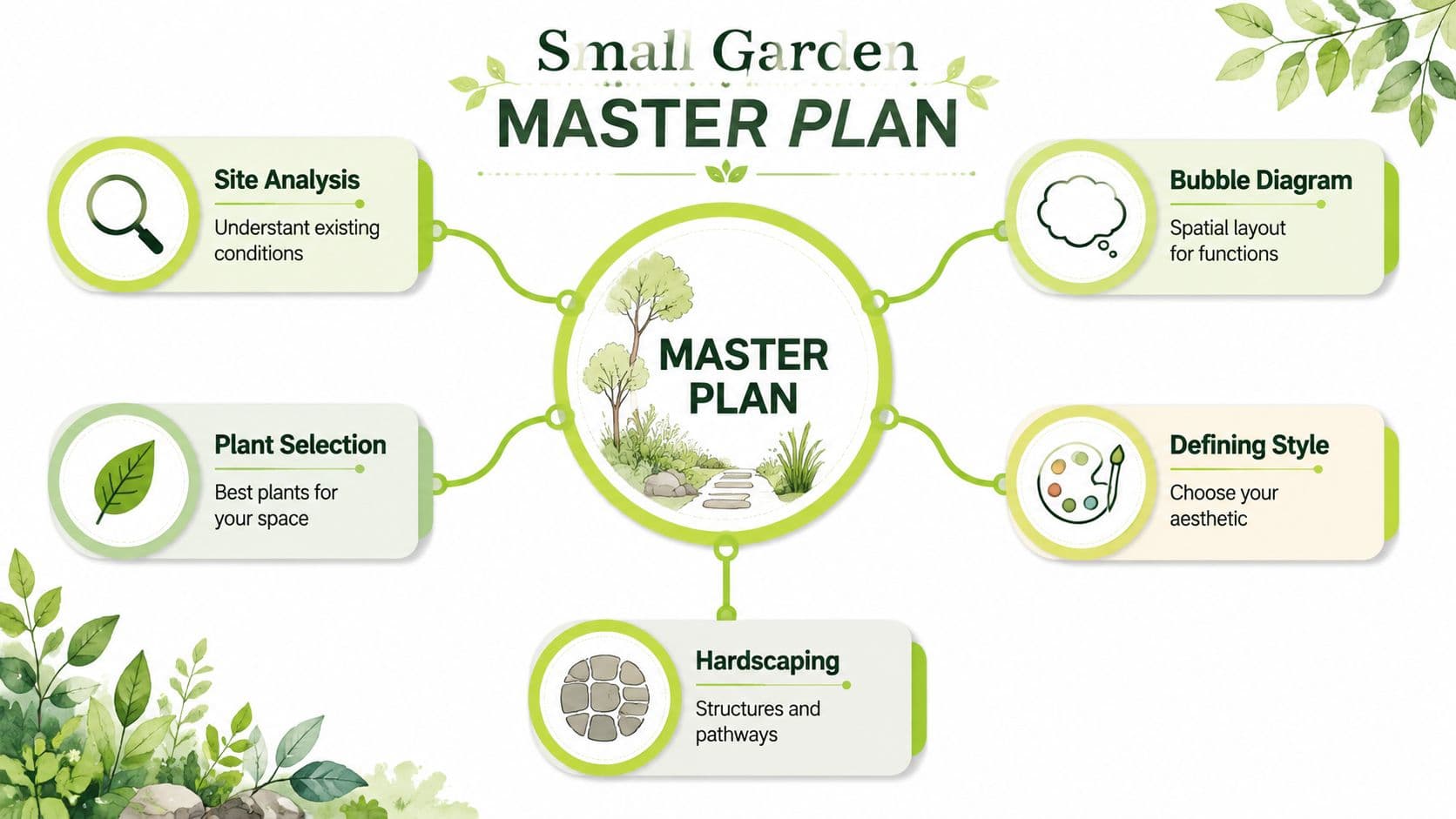
Once the site notes are done, the garden usually becomes easier to solve. You can stop thinking in terms of “What should I add?” and start asking “What belongs where?”
Use bubble diagrams before real drawings
A bubble diagram is one of the simplest planning tools I know. Draw loose circles over your base map for each major use:
- dining
- lounging
- planting
- storage
- path of travel
- screening
The point isn't precision. The point is adjacency.
If the dining bubble sits too far from the door, carrying food becomes annoying. If the path cuts through the seating bubble, the space never feels restful. If storage takes your sunniest patch, your planting options shrink fast. These are easy changes on paper and expensive changes once paving is installed.
Choose a style with restraint
Small gardens benefit from a clear visual language. That doesn't mean strict rules. It means making fewer, stronger choices.
You might lean toward:
| Style | What to emphasize | What to avoid |
|---|---|---|
| Modern | clean paving lines, limited palette, structural planting | too many contrasting finishes |
| Mediterranean | warm materials, containers, drought-tolerant character | crowding the space with ornaments |
| Japanese-inspired | calm composition, texture, asymmetry, negative space | trying to copy every motif |
The principle that matters most is scale, proportion, and simplicity. NC State Extension notes that composition relies on scale, balance, unity, perspective, rhythm, and accent, and that simplicity “strives to create spaces, not fill them” (NC State Extension). In compact gardens, that's not abstract theory. It's practical editing.
The same guidance gives a useful planting rule of thumb: choose plants no larger than half the bed width, so in an 8-foot-wide planting area, plants should generally be no more than 4 feet tall. It also points to human-scale hardscape details such as seating ledges around 18 inches high with an 8-inch cap for sitting. Those measurements are why some gardens feel comfortable and others feel oversized.
Anchor the whole design
Every small garden needs one strong focal point. Not five.
That could be:
- a specimen shrub or small tree
- a water bowl
- a bench against a planted backdrop
- a sculptural pot
- a framed view at the end of a path
A focal point gives the eye somewhere to land. Without it, the garden can feel like a list of unrelated purchases.
If you already love a style, use it to guide material and planting choices. Don't use it as permission to add more stuff.
Smart Hardscaping Strategies for Small Spaces
In a compact garden, hardscape is not background. It decides whether the space is usable.
The strongest small gardens use hard materials for more than one task. A seat wall can also hold back soil. A path can also manage movement and protect planting. A raised edge can define a room without making it feel boxed in.
Make every built element do double duty
Built-in seating usually beats loose furniture in tight spaces because it doesn't drift, wobble, or eat up circulation. If you're weighing options for raised platforms, steps, or compact entertaining areas, practical examples like Silverfox backyard deck solutions can help you compare layouts before you build.
Here's the argument for multi-function hardscaping:
- Built-in edges save space because they remove the need for extra chair depth around the perimeter.
- Permeable surfaces help problem spots where runoff and puddling make a small garden feel messy.
- Level changes create zones so one yard can feel like two or three linked rooms.
That last point matters more than people think. Even a slight shift in paving texture or height can separate dining from planting without adding visual clutter.
Keep materials under control
Too many finishes make a small garden look restless. A simple palette usually works harder.
Try this decision filter:
| If you want... | Choose... | Avoid... |
|---|---|---|
| A calmer look | one main paving material with one accent | several unrelated stone or tile patterns |
| Less maintenance | durable edges and easy-clean surfaces | fussy joints and awkward cuts |
| Better flow | materials that visually connect zones | changing material at every boundary |
If you're testing patio layouts digitally, an ai backyard patio design tool can help compare paving color, seating placement, and circulation before anything is ordered.
Hardscape should reduce friction in daily use. If it looks smart but makes storage, access, or seating worse, it isn't a good small-space solution.
Strategic Planting to Maximize Impact and Minimize Maintenance
Planting comes last because plants are the finishing layer, not the structure.
That order matters. If you choose plants too early, you'll often force the layout to suit a wishlist instead of the site.
Build from top to bottom
A reliable planting sequence is to work from trees, then shrubs, then perennials, then ground cover, so the upper layer, middle layer, and soil surface are filled deliberately rather than randomly. This creates depth without needing a large footprint.
Think in layers:
-
Vertical layer
Climbers, espaliered forms, or a carefully placed small tree pull the eye upward and use space you already have. -
Middle structure
Shrubs create year-round presence and define the garden when flowering plants are out of season. -
Lower layer
Perennials and ground covers soften edges, repeat color, and reduce bare soil that quickly turns into maintenance.
Plant for role, not just appearance
In small garden design, every plant should answer a question.
- Need privacy: use layered screening, not one dense wall of planting.
- Need a focal frame: keep the plants around it simpler.
- Need lower maintenance: repeat a smaller group of dependable plants instead of buying one of everything.
Dense planting can backfire when every plant grows at a similar height and fights for the same space. That kind of fullness looks lush for one season and chaotic after that.
Repeat instead of collecting
Many first-time gardeners shop like decorators. They buy one striking plant after another. In small gardens, that usually creates visual noise.
A better approach is:
| Better choice | Why it works |
|---|---|
| Repeat leaf shape | builds unity without feeling rigid |
| Limit the color range | keeps the garden readable |
| Use fewer, stronger plants | lowers maintenance and clutter |
| Leave breathing room | lets forms develop naturally |
Repetition is what makes a small planting scheme look designed instead of accidental.
If a plant is only attractive for a short moment but awkward for the rest of the year, be careful. Small spaces don't have much room for passengers.
Visualize and Iterate Your Design with AI Tools
Most DIY garden mistakes happen in the gap between plan and reality. The sketch seems fine. The purchase list feels sensible. Then the patio looks too dark, the path reads too narrow, or the planting style doesn't match the house.
That's where visualization earns its place.
Use a real photo, not just mood boards
Mood boards are helpful for taste. They're weak at showing fit.
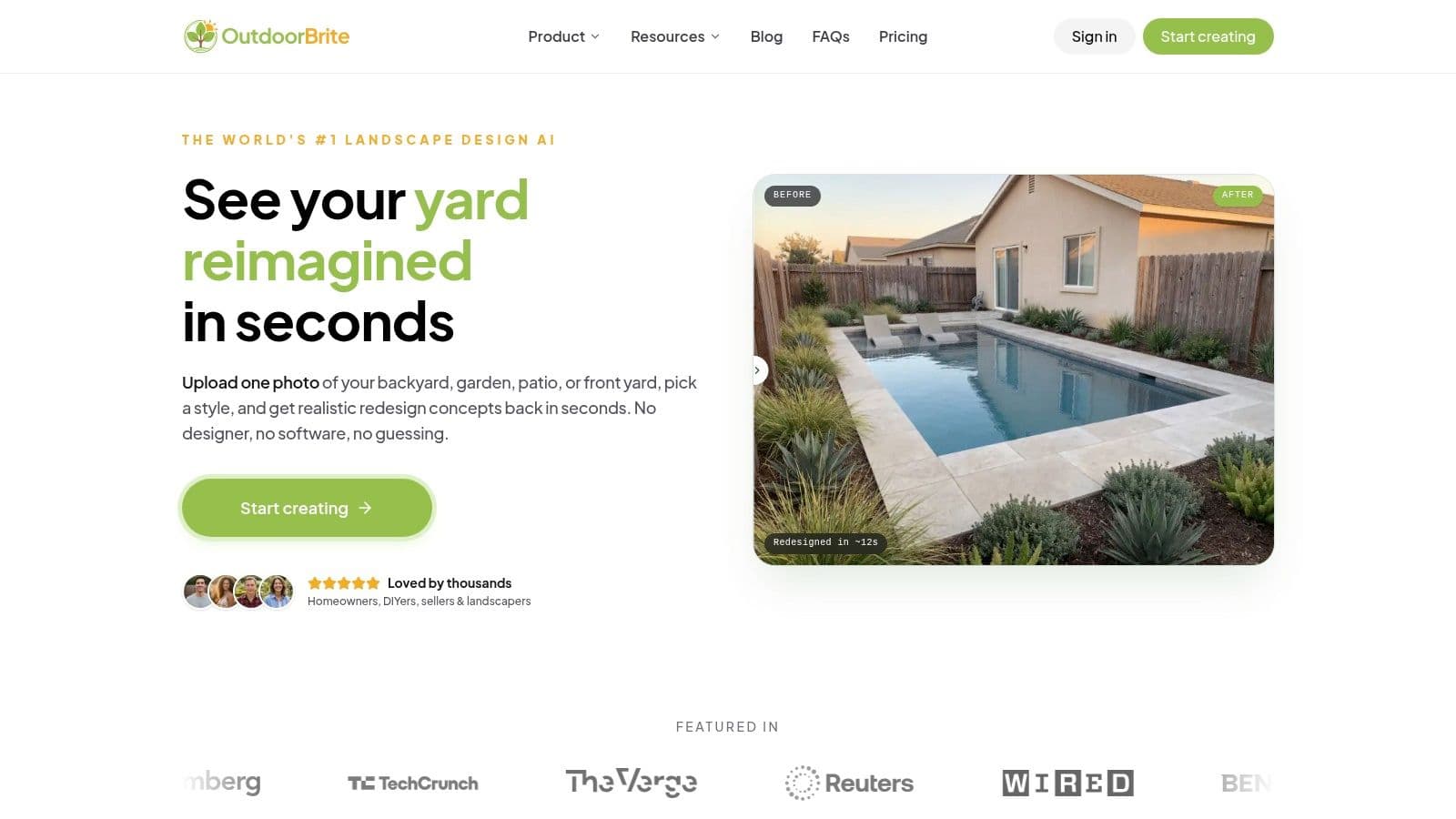
A photo-based workflow is more useful because you can test ideas against your actual fence height, house wall, paving area, and awkward corners. That's the practical value of using ai for garden design. You upload a photo, apply different styles and layout directions, and compare concepts before committing to materials or planting.
This changes the kind of decisions you can make with confidence:
- Does a light paver brighten the garden too much or just enough?
- Will a built-in bench feel elegant or bulky against that wall?
- Does a Mediterranean look suit the brick and boundary lines better than a modern one?
- Will the focal point still read clearly once the planting fills out?
Check the parts that drawings hide
Small spaces are unforgiving because proportions are obvious. Visualization helps you catch issues that aren't clear on a flat plan.
Look closely at:
- Sightlines from the back door and indoor rooms
- Balance between paving and planting
- Visual weight of containers, screens, and furniture
- Seasonal feel if the tool lets you compare conditions
A short video walkthrough can make that process easier to picture.
Treat renders as a filter, not a final blueprint
AI images are most useful when you ask practical questions of them.
Try a simple review pass:
| Question | What to look for |
|---|---|
| Is circulation clear | enough room to move without cutting through seating |
| Does the style suit the house | not just the latest trend |
| Is the planting too busy | especially near focal points and doors |
| Will maintenance creep up | because the design relies on too many fussy details |
A render doesn't replace judgment. It gives you a safer place to exercise it.
That's the modern piece many traditional guides miss. Visualization isn't just for presentation. It's a working step that helps DIY homeowners avoid expensive second guesses.
Common Mistakes to Avoid and Budget-Friendly Solutions
A lot of small-garden advice focuses on making the yard look bigger. That's useful up to a point, but it can push homeowners toward the wrong choices.
A garden that looks spacious in a photo but doesn't fit dining, storage, pets, or comfortable movement is poorly designed. Guidance on small gardens often misses that trade-off. More practical advice is to prioritize the highest-value uses and simplify materials and planting so the space doesn't feel cluttered (Garden Design).
Mistakes that cause the most trouble
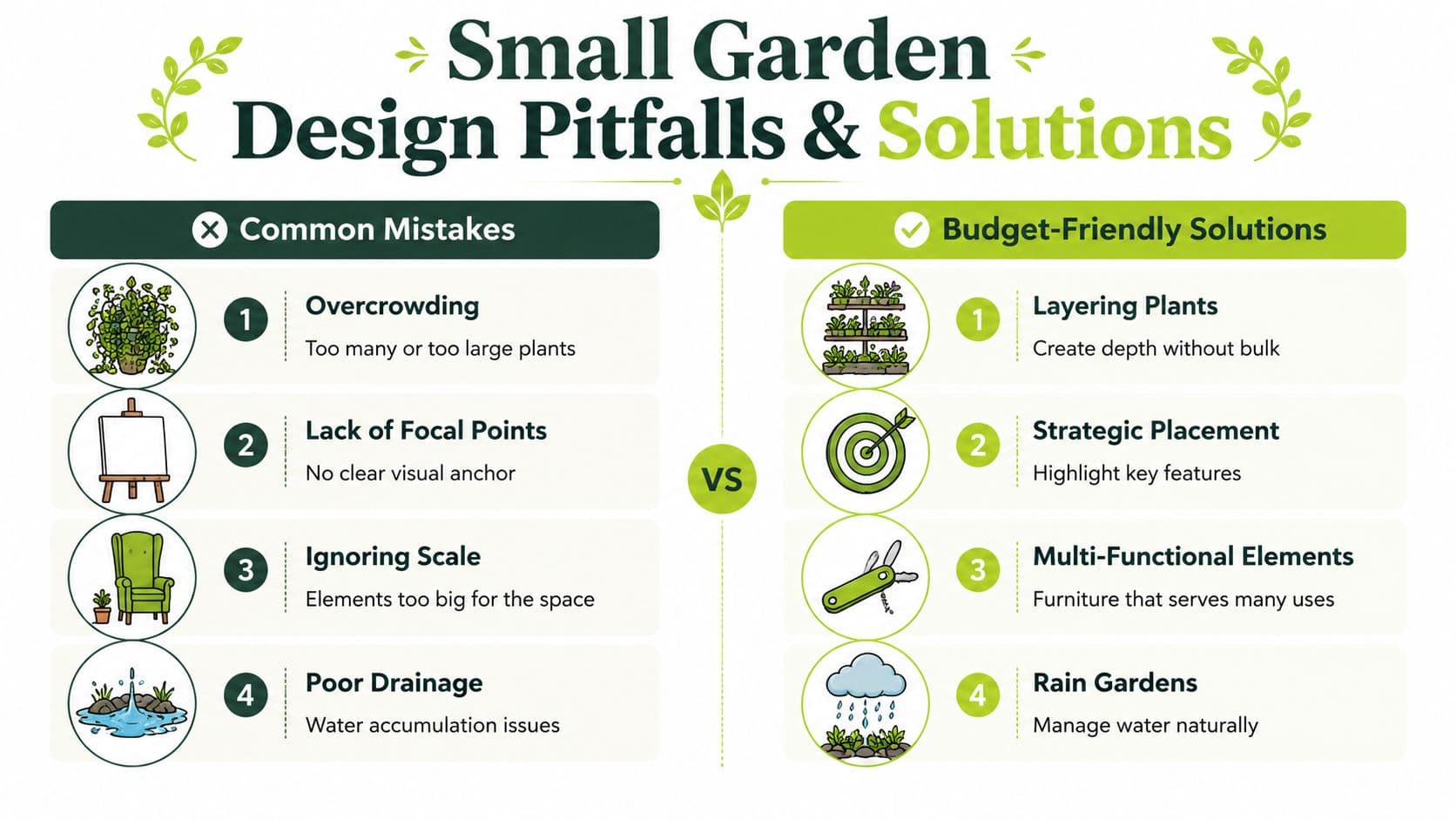
The most common problems aren't dramatic. They're cumulative.
-
Too many features
A fire pit, dining set, water feature, raised beds, and oversized containers may all be appealing. Together, they can make the garden impossible to use. -
Ignoring microclimate
Hot wall edges, damp corners, and windy side passages need different solutions. Generic style copying usually fails here. -
Buying mature-looking impact
Large plants can overwhelm a compact bed quickly and create constant pruning work. -
Treating leftover areas as dead space
Narrow side yards and awkward corners can become useful with durable paths, vertical growing, and simple irrigation planning.
Budget choices that still look intentional
You don't need an all-at-once installation to get a strong result.
| Budget move | Why it helps |
|---|---|
| Phase the project | build the hardscape first, then layer planting over time |
| Buy younger plants | they adapt better and cost less than oversized instant-fill choices |
| Use reclaimed materials selectively | one reused element can add character without making the space look patchy |
| Simplify the palette | fewer materials often look more expensive, not less |
Small gardens don't need more inputs. They need better editing.
One more design principle helps here. People tend to feel enclosed when the vertical edge is at least one-third of the horizontal space, which is a useful way to think about screening and room-making in a compact yard, as noted in the earlier extension guidance. That's often a better path than trying to “open everything up” and ending with a space that feels exposed.
If you keep function, restraint, and site conditions at the center of the process, small garden design becomes much less mysterious. It turns into a series of clear decisions.
If you want to test layouts, styles, and material directions before you spend money on the build, OutdoorBrite gives you a practical way to visualize your actual space from a photo and refine the plan with fewer surprises.
See your yard reimagined
Start creating