Black Poplars Trees: A Complete Planting & ID Guide
Discover how to identify, plant, and care for rare black poplars trees. Our guide covers pros & cons, landscape design ideas, and avoiding common mistakes.
In Britain, black poplar numbers have fallen to about 7,000 wild trees, with only about 600 female trees left, which creates a serious reproductive bottleneck for the species' future according to the Black Poplar report. That single fact alters the perspective one should have on this tree. It isn't just another fast-growing deciduous tree for a damp corner. It's a planting decision with conservation weight.
For homeowners, though, the practical questions come first. How do you tell a true black poplar from a common hybrid? Where can you plant one without causing future trouble? And if you do have room, how do you make such a large, characterful tree work in a modern garden or larger property design?
Black poplars trees reward careful thinking. They have drama, speed, wildlife value, and a silhouette no generic ornamental can match. They also ask for the right ground, the right space, and some restraint from the person managing them.
Table of Contents
- How to Identify a True Black Poplar Tree
- Ideal Planting and Siting for Black Poplars
- Best Practices for Maintenance and Pruning
- Common Pests Diseases and Challenges
- Designing Landscapes with Black Poplar Trees
- Pros and Cons of Black Poplars for Your Yard
How to Identify a True Black Poplar Tree
Many people get stuck at the first hurdle. They see a poplar, assume it's a black poplar, and move on. That's risky, because common ornamental forms and hybrids can look similar at a glance, especially from a distance.
The confusion is well known. The National Parks article on saving Britain's most endangered tree notes that people often struggle to distinguish the true wild European black poplar from common ornamental hybrids, and that misidentification can lead to accidental removal of protected specimens.
Start with the overall shape
If I'm walking a site with a client, I don't begin with leaf details. I step back and study the tree's habit first.
A true black poplar often has a heavier, broader, more irregular outline. Mature specimens can look muscular and slightly untidy in the best possible way. They may lean, carry substantial side limbs, and develop a crown that feels expansive rather than tight.
A Lombardy poplar or similar upright hybrid usually announces itself immediately by its narrow, column-like form. The branches stay more vertical, and the whole tree reads as tall and formal rather than broad and characterful.
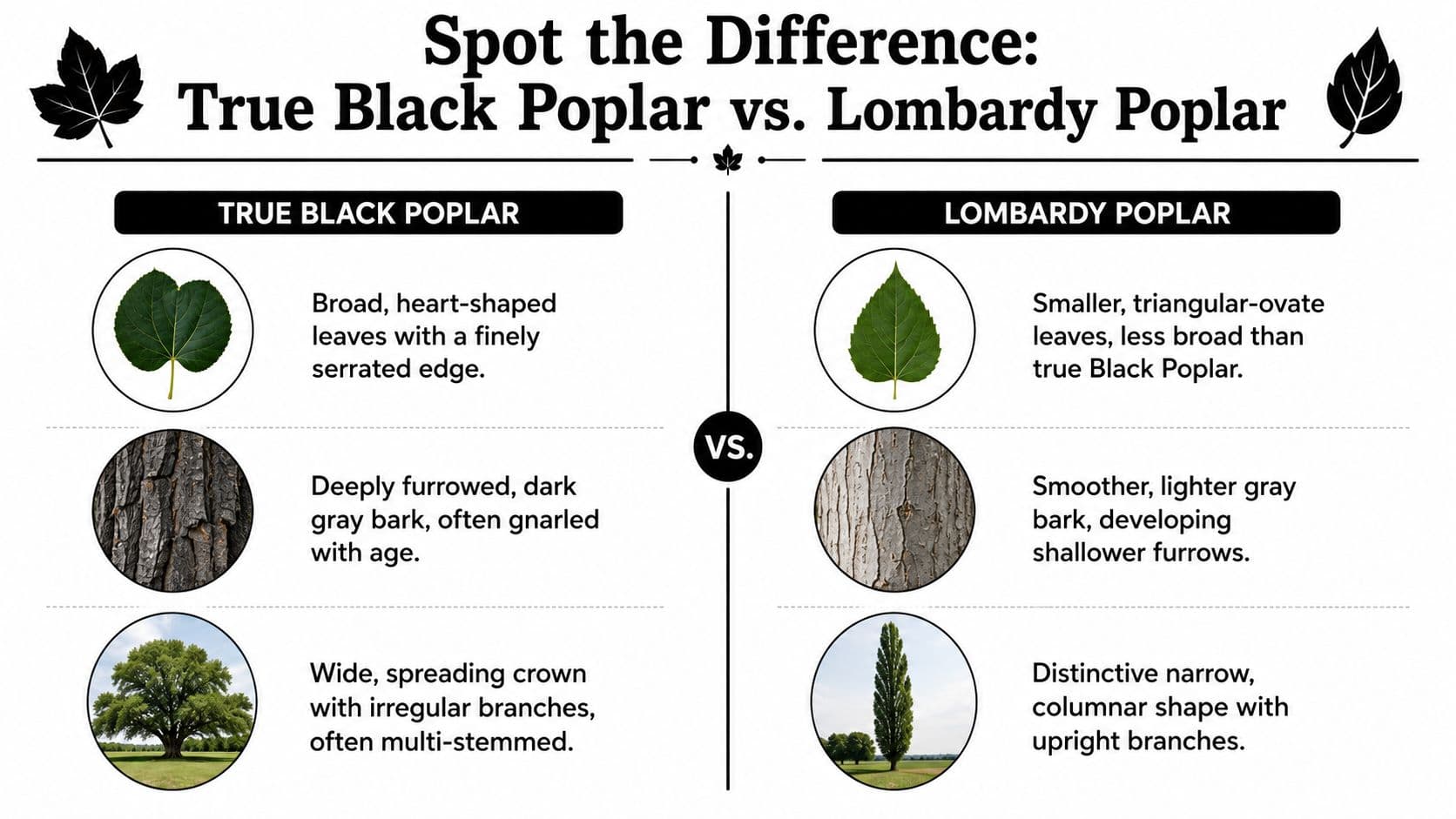
Rough bark alone isn't enough. Form, branching, bark, and leaves need to agree before you call it a true black poplar.
Use a field checklist before making decisions
Once the silhouette suggests black poplar, move closer and check three things.
-
Look at the bark: Mature black poplars often develop dark, furrowed bark with burrs or bossed growths. Older trunks can appear rugged and uneven, not sleek.
-
Check the leaves: Look for broadly triangular to diamond-shaped leaves with a fine serrated edge. Homeowners often expect one perfect textbook shape, but natural trees vary. What matters is the broadness and overall feel, not a single ideal outline.
-
Study the branch carriage: Lower limbs often have weight and sweep. The tree can look as if it has settled into its surroundings over time, rather than being drawn upward like a pencil.
A quick comparison helps:
| Feature | True black poplar | Lombardy-type form |
|---|---|---|
| Crown | Broad, irregular, spreading | Narrow, columnar, upright |
| Bark | Darker, rougher, often burred | Lighter, smoother when younger |
| Branching | Heavy lateral limbs, often leaning | Strongly upright branch pattern |
| First impression | Wild, expressive, substantial | Formal, vertical, architectural |
If you suspect you have a genuine tree on your land, pause before pruning hard, removing it, or altering the surrounding ground. That's one of those moments where caution matters more than speed.
Practical rule: If the tree has burrs, fissured bark, and a broad, leaning crown, treat it as potentially significant until someone experienced confirms otherwise.
Ideal Planting and Siting for Black Poplars
A black poplar doesn't forgive poor siting. You can plant many ornamental trees and correct mistakes later with irrigation, feeding, or pruning. This isn't one of them. If the ground and light are wrong, the tree won't become what you hoped for.
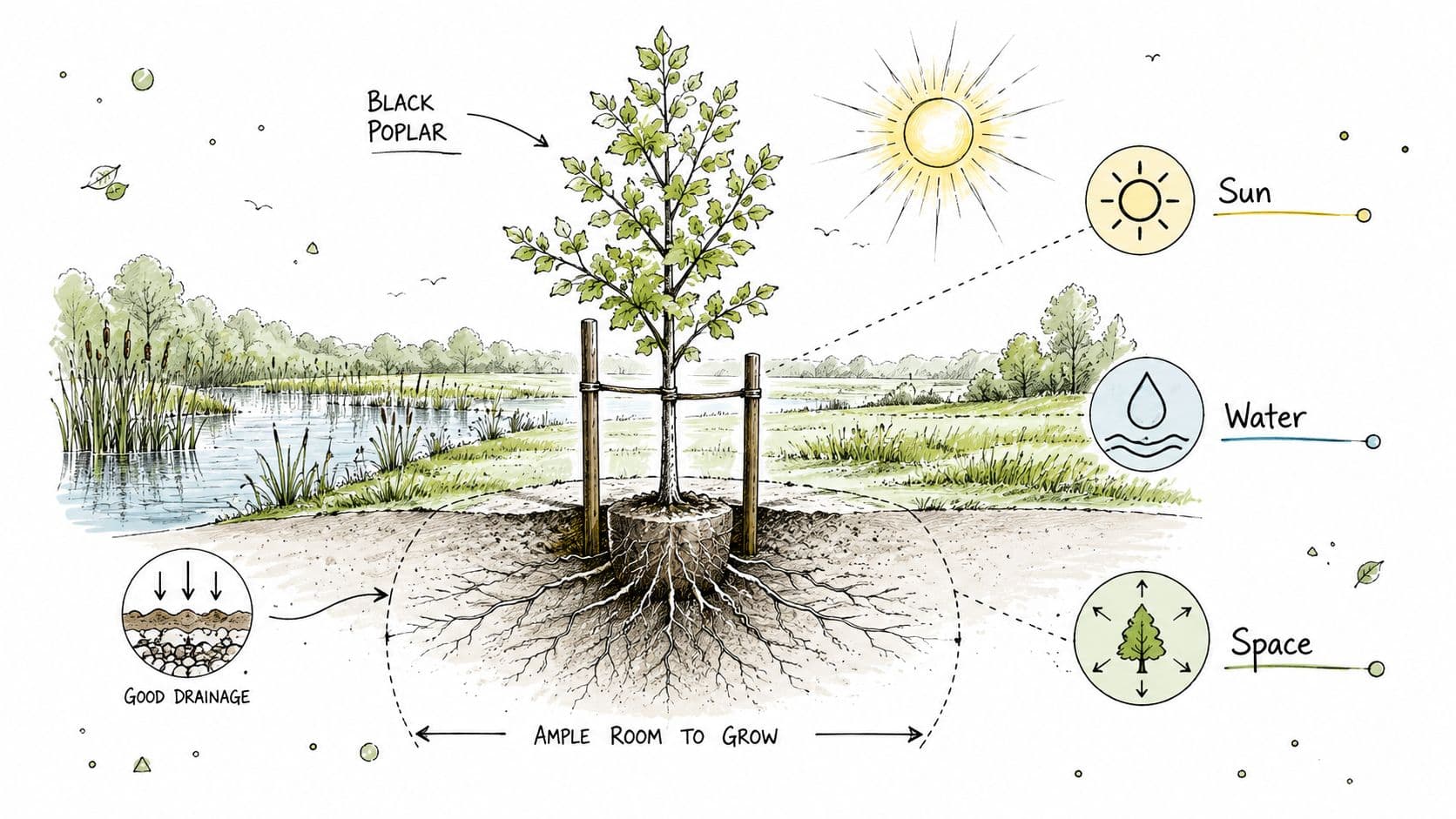
The site matters more than the planting technique
The Woodland Trust notes that the native black poplar depends on lowland floodplains with moist, fertile alluvial loams and a neutral to slightly alkaline pH of 6.5 to 8.0, and that it's intolerant of prolonged waterlogging or deep shade in its black poplar profile. That description sounds technical, but the design lesson is simple. Think moist, open, fertile ground. Don't think dark corner, compacted subsoil, or permanently stagnant wet patch.
This is why black poplars trees often make sense on larger rural plots, stream edges, drainage swales, meadow margins, and broad damp boundaries. They're much harder to justify in a tight suburban garden hemmed in by paving, fences, and neighboring roofs.
A practical siting checklist
When I assess a property for a tree like this, I use a simple checklist rather than a romantic impulse.
-
Water access: The best positions usually have reliable soil moisture. That might mean a ditch line, riverside margin, floodplain edge, or ground that stays evenly damp without becoming permanently sour.
-
Light exposure: Give it open sky. Deep shade from buildings or mature woodland pushes the tree into stress and poor form.
-
Soil condition: Fertile loam is the friendliest option. Heavily compacted builder's fill and thin, exhausted topsoil usually mean trouble.
-
Long-term space: This tree can become very large. Keep it well away from foundations, overhead lines, and places where a full-sized crown would dominate windows or access routes.
One timing detail still matters. If you're planning the job around seasonal conditions, it helps to understand ideal tree planting times so the roots can settle while the tree isn't under peak heat stress.
If you want a quick visual primer before you mark out the site, this overview is useful:
A final design note. If conservation is part of your motivation and you have a suitable larger property, planting authenticated male and female material can matter. But that's a specialist sourcing conversation, not something to improvise from an unlabeled nursery list.
Best Practices for Maintenance and Pruning
Black poplar care is mostly about good judgment. People often damage young trees by fussing over them too much, then ignore structure until the tree is too large to correct easily.
The easiest way to think about pruning is this. Guide a sapling. Don't try to redesign a mature tree. Early decisions shape the framework. Late interventions often create larger wounds, weak regrowth, and a tree that never looks natural again.
Guide the young tree, don't fight the mature one
In the early years, focus on formative pruning. You're looking for a sound main structure, with one clear leader if the planting design calls for a standard tree, and well-spaced side branches that won't rub or compete heavily.
That doesn't mean stripping the tree. It means making a few thoughtful cuts during the dormant season to remove damaged, crossing, or badly placed shoots.
Young black poplar responds best when you nudge its shape, then leave it room to express its own habit.
A common mistake is lifting the canopy too early because the tree looks messy. On a vigorous species, that can create long bare stems and put too much emphasis on weak upper growth. Let the tree build strength first.
What to do in the first years
For the first stretch after planting, keep your attention on establishment rather than aesthetics.
- Water consistently during dry spells: Moisture matters most while roots are expanding into the surrounding soil.
- Mulch the root zone: A broad mulch ring helps conserve moisture and reduces competition from grass.
- Inspect ties and stakes: Support should stabilize, not strangle.
- Remove only what's clearly problematic: Dead wood, broken shoots, and tight crossing growth come out first.
After that, maintenance becomes lighter if the site is right. You'll still inspect the tree, especially after wind, but the goal is to avoid turning a naturally bold tree into a repeatedly topped, over-managed specimen.
If a mature tree develops significant structural defects, bring in an arborist with experience in large broadleaf trees. Big corrective cuts on poplar can create more problems than they solve.
Common Pests Diseases and Challenges
Black poplar has a generous presence, but it isn't bulletproof. The tree can be susceptible to health problems, and the wood database profile for black poplar notes that canker and borers can shorten its lifespan in poor conditions. In practice, that means stress management is part of stewardship.
What to watch on bark, branches, and leaves
The most important threats for most property owners aren't mysterious. They're visible if you look regularly.
-
Canker: Watch for sunken, damaged, or discolored areas on branches or trunk sections. You may also notice dieback beyond the affected point. Canker often takes advantage of stress, old wounds, or poor site conditions.
-
Borers: If insects are tunneling into the wood, you may see holes, frass, weakened limbs, or patches of decline in otherwise leafy branches. Borer pressure is often worse when the tree is already under strain.
-
Caterpillar activity and wildlife interactions: Black poplar supports insects, including moth species associated with poplar. That's part of the tree's ecological value, not automatically a problem. Occasional feeding damage doesn't always justify intervention.
The challenge is learning the difference between normal wildlife use and decline that threatens structure. A few chewed leaves are one thing. Repeated branch dieback, cracking, or areas of trunk deterioration are another.
A sensible response plan
Start with the tree's environment before reaching for treatment.
| Problem | Early sign | First response |
|---|---|---|
| Canker | Localized dieback, damaged bark | Improve vigor, prune out affected small wood if appropriate, avoid unnecessary wounding |
| Borers | Holes, frass, weakening limbs | Reduce stress, inspect watering and soil condition, assess structural risk |
| Branch failure risk | Cracks, deadwood, hanging limbs | Restrict access below, arrange inspection, remove hazards carefully |
That last point matters on large trees. If you're checking limbs after storms or visible cracking, Atomic Exteriors' tree limb damage tips offer a useful homeowner-level guide to what needs urgent attention versus what can wait for a scheduled arborist visit.
Healthy site conditions are your first defense. Weak trees invite secondary problems.
Non-chemical management usually gives the best long-term result. Keep the root zone uncompacted, avoid repeated bark injuries from equipment, remove obviously dead or dangerous wood, and don't over-prune. A stressed poplar is easier for pests and disease to exploit.
Designing Landscapes with Black Poplar Trees
A mature black poplar can become one of the largest visual elements on a property. That single fact should shape every design decision around it.
This tree does not read like a decorative accent. It reads like architecture. The trunk, heavy limbs, and restless crown set the scale for everything nearby, much like a barn or a long stone wall sets the scale in a rural garden. If you place it well, it gives a property gravity and identity. If you place it casually, it can make the house, paving, and smaller plantings feel misplaced.
Where black poplar fits best
Black poplar looks most convincing where there is enough open ground for its size and movement to feel natural.
On a large, informal property, it often belongs near water, a swale, or a damp meadow edge. In that setting, the broad canopy feels connected to the site rather than imposed on it. The effect is strongest when the surrounding planting has a simple rhythm, with grasses, native perennials, and broad masses instead of many small focal points.
A suburban lot can also work, but only if the tree has real breathing room. I advise clients to study the future crown first, then the current sapling. Young black poplars can look manageable in the nursery, but that is a bit like judging a full-grown horse by a foal. The mature form is the one that matters.
For screening, use black poplar only on wide properties where a tall, loose boundary line suits the house and the setting. A narrow side yard, tight patio edge, or small front garden usually asks too much of this species.
Hard surfaces need special care. Before placing any large moisture-seeking tree near paving or utility routes, review Concrete Resurfacing Products, Inc. on tree roots to think through root planning near concrete, paths, and slabs.
Use AI to test scale before planting
Black poplar is one of the clearest cases for digital planning before you plant. The problem is not just height. It is mass, shade, and visual dominance over time.
A simple process works well:
- Take a clear, straight-on photo of the area from the main viewing points.
- Mark the dampest suitable zone, then test one position there.
- Test a second position farther from buildings, paving, and major sightlines.
- Compare how each option changes window views, shade patterns, and the balance between lawn, beds, and built features.
If you want to do that on screen, landscape design software can help you study canopy spread, spacing, and companion planting before you commit.

I also recommend checking the same view at three stages. First planting. Early establishment. Mature presence. That sequence often reveals the truth faster than a plant label does.
The best design with black poplar gives the tree enough room to look intentional, not oversized.
Planting around the tree
Underplanting should be quiet and durable. Black poplar already carries plenty of drama, so the supporting palette should steady the composition rather than compete with it.
Broad drifts of moisture-tolerant grasses, native groundcovers, and simple perennial blocks usually work best. Formal clipped shapes, delicate collector plants, or busy mixed borders often look fussy under such a strong canopy. A calm base lets the bark, branch structure, and shifting light do the work.
That is the design opportunity many guides miss. Black poplar is not just a conservation tree or a fast-growing tree. For the right property, it is a design anchor with historic character. AI tools make it easier to test whether your site can carry that weight gracefully.
Pros and Cons of Black Poplars for Your Yard
A black poplar is the kind of tree that can make a property feel established long before the rest of the planting matures. It can also outgrow a poor site faster than many homeowners expect. That tension is the key decision.
Earlier in the article, we covered why this tree matters from a conservation point of view. For a homeowner, the more practical question is simpler. Do you have enough room, enough moisture, and enough patience to let a very large native tree behave like itself?
Why people say yes
Black poplar earns admiration in ways smaller ornamental trees rarely can.
- Memorable presence: The bark, branching, and broad outline give it an old, sculptural quality that reads as permanent and grounded.
- Fast structure: If your yard feels bare and exposed, black poplar can create height and framework relatively quickly.
- Ecological value: It supports insects and birds better than many decorative tree choices bred mainly for looks.
- Useful on damp ground: Areas that stay wet and frustrate other trees can suit black poplar well.
There is also a design reason people choose it. A black poplar works like a stone fireplace in a room. Once it is in place, everything around it needs to support that focal point rather than compete with it. Homeowners who want to transform your curb appeal with trees often start with neat specimen trees near the house, but black poplar usually looks best where there is open ground around it and enough distance to appreciate its full form.
Why some properties should say no
This is not a forgiving choice for a tight suburban lot.
- Large mature size: Many yards do not have the width or overhead clearance this tree needs.
- Narrow site tolerance: Dry soil, heavy shade, and compacted urban ground often lead to weak growth and stress.
- Potential conflict with built features: Roots, canopy spread, and future scale all need to be considered before planting.
- Ongoing watchfulness: A big poplar benefits from regular inspection, especially after storms or periods of stress.
- Seasonal debris: Female trees may release cottony seed, and large poplars can drop twigs and leaves in ways some homeowners find messy.
A simple way to judge fit is to compare your yard to the tree's natural habits. Black poplar prefers room to stretch, moisture in the soil, and a setting that does not force it into constant compromise. If you have to keep talking yourself into it, the site is probably wrong.
This quick scorecard can help:
| Consideration | Good fit | Poor fit |
|---|---|---|
| Property size | Large garden, estate, meadow edge | Small suburban yard |
| Soil moisture | Reliably moist ground | Dry or sharply drained soil |
| Design style | Naturalistic, park-like, ecological | Tight formal layout |
| Tolerance for maintenance | Comfortable with monitoring a large tree | Wants minimal involvement |
| Conservation motivation | Values planting a rare native tree | Wants a purely decorative specimen |
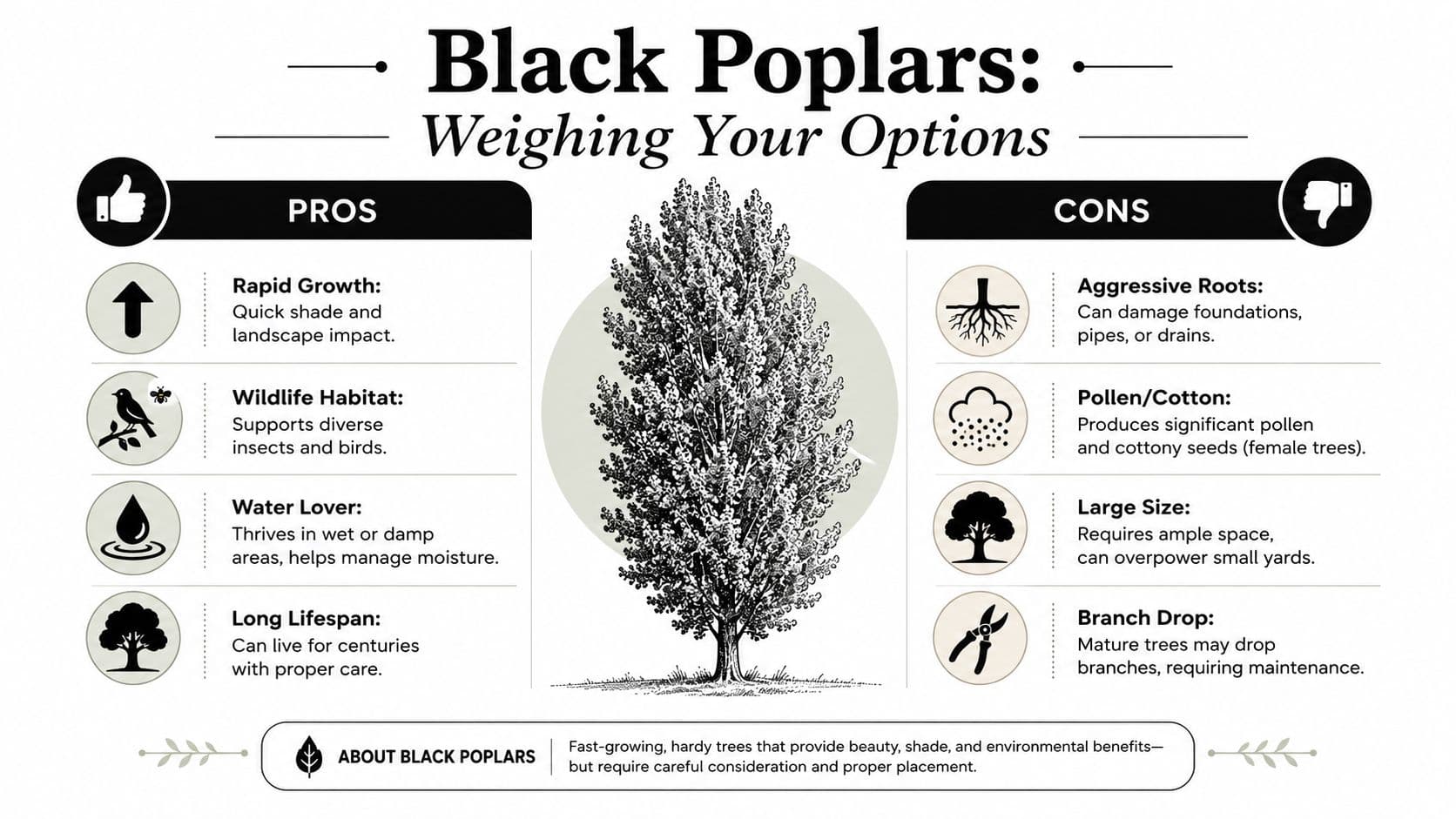
For the right property, black poplar can be extraordinary. It brings history, habitat, shade, and a sense of scale that few other native trees can match.
For the wrong property, it becomes a long argument between the tree and the site. Good design means choosing a tree that can mature well, not just one that looks impressive in the nursery.
If you want to test bold tree placements, compare styles, and visualize major outdoor changes before spending money on planting or hardscape, OutdoorBrite Money helps you turn a simple yard photo into realistic design concepts fast. It's a practical way to see whether a tree as dramatic as black poplar really fits your space before you commit.
See your yard reimagined
Start creating