Cost of Front Yard Landscaping: A 2026 Budget Guide
Plan your budget with our 2026 guide to the cost of front yard landscaping, covering price ranges, labor vs materials, and tips to save.
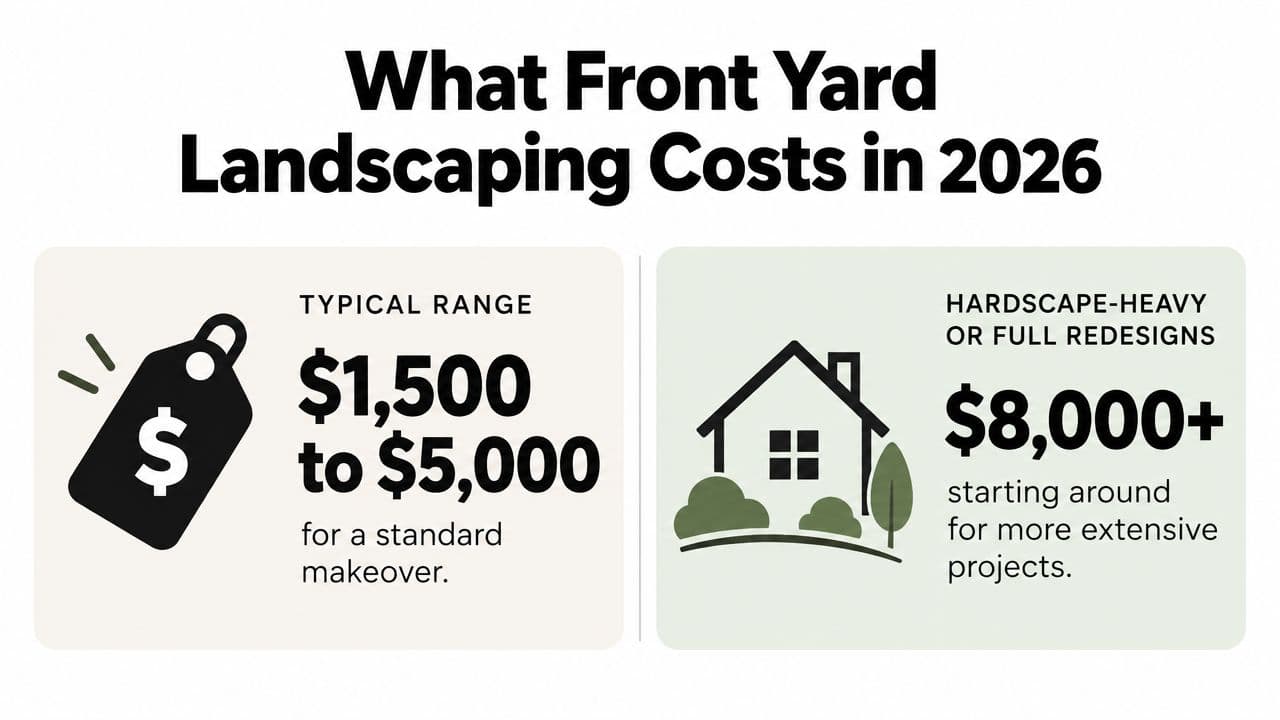
A typical front-yard makeover costs $1,500 to $5,000, while hardscape-heavy work with resloping or walkways can reach $10,000 or more. Labor often drives about 80% of the total, so the design decisions that reduce digging, grading, trenching, and installation time can matter more than choosing cheaper plants.
That's the number homeowners should use for an initial 2026 planning conversation, not as a guaranteed quote. A simple planting refresh sits near the lower end. A redesigned yard with drainage corrections, irrigation changes, masonry, lighting, or a new circulation route moves quickly toward the upper end because you're paying for site work, skilled crews, equipment, and materials that must perform for years.
The smartest way to control the cost of front yard landscaping is to decide what the yard must do before choosing what it should look like. A clean planting bed and mulch refresh is a different project from a sloped entry walk with retaining features. Test those choices visually first, then ask a contractor to price a defined scope.
Table of Contents
- What Front Yard Landscaping Costs in 2026
- Where the Money Actually Goes
- Price Ranges by Project Size and Scope
- Regional and Seasonal Factors That Move the Number
- The Real Cost of Cheap Landscaping
- Three Sample Budgets for Real Yards
- Visualize Before You Spend
- Smart Ways to Lower Your Landscaping Bill
What Front Yard Landscaping Costs in 2026
Most homeowners should plan around $1,500 to $5,000 for a typical front-yard makeover, based on HomeAdvisor's landscaping cost guidance. More complex work involving resloping or hardscaping, such as walkways, can reach $10,000 or more. Those figures create a useful boundary between cosmetic improvement and structural outdoor construction.
A lower-range project might include cleanup, modest planting beds, soil preparation, mulch, edging, replacement sod, or a basic irrigation adjustment. The upper end usually means more labor, more preparation, a broader planting plan, and durable features that need a properly compacted base. Industry guidance also places landscaping broadly around $4.50 to $12 per square foot, which explains why a seemingly small front yard can still produce a bill in the thousands once labor, soil, irrigation, and delivery are included.
What the planning range includes
Before requesting bids, separate the likely base scope from exclusions. A standard makeover may include:
- Preparation: Basic grading, bed excavation, soil conditioning, and removal of limited existing vegetation.
- Softscape: Shrubs, perennials, ground cover, mulch, and possibly a lawn or sod refresh.
- Edges and access: Simple metal or plastic edging, with a modest path only if the site needs one.
- Watering: An irrigation tune-up or limited drip installation, not a full system replacement.
- Finishing: Cleanup, planting, mulch placement, and haul-off agreed upon in the proposal.
Major drainage correction, substantial tree removal, tall retaining walls, extensive excavation, and full irrigation replacement should be treated as separate allowances. If a contractor hides those items inside a vague “garden design” line, the estimate isn't clear enough to sign.
For a useful visual planning aid, homeowners can also review an AI generated site landscaping resource to explore possible arrangements before requesting installation pricing.
Place your yard on the spectrum
Start with three questions. Is the ground already reasonably level? Can workers and equipment reach the site easily? Are you changing only plants, or are you changing how people move through the property?
A flat, accessible lot with existing beds belongs near the lower end. A narrow property with compacted soil, a slope, poor drainage, or a new walkway belongs higher. Design ambition matters just as much as area. A restrained planting plan can stay manageable, while curved beds, stone borders, lighting, irrigation zones, and custom paving create more steps for the crew.
Where the Money Actually Goes
A landscaping estimate is mostly a labor document. HomeGuide's landscaping cost benchmark places the broad planning range around $4 to $12 per square foot and notes that labor can account for about 80% of total cost. That's why replacing a few inexpensive plants rarely changes the invoice as much as simplifying excavation or eliminating a complicated hardscape detail.
| Line Item | Share of Total |
|---|---|
| Design, layout, and project coordination | Qualitative allowance |
| Demolition, excavation, and grading | Qualitative allowance |
| Planting, soil work, and mulching | Qualitative allowance |
| Irrigation, trenching, and adjustments | Qualitative allowance |
| Hardscape installation | Qualitative allowance |
| Materials, plants, stone, and supplies | Remaining share |
The table intentionally avoids pretending that every yard follows one universal percentage split. Crew time changes with access, slope, soil, demolition, plant size, and the number of trades involved. In a labor-heavy project, a cheaper shrub doesn't compensate for hours spent digging through compacted ground or rebuilding a walkway base.
The small lines that become large charges
Irrigation is a common budget trap. A valve may look like a small part, but locating the line, trenching, connecting fittings, testing coverage, and repairing disturbed areas takes time. The same applies to lighting wire, root barriers, soil amendments, drainage outlets, and the compacted aggregate beneath pavers.
Soil volume deserves careful measurement too. Ordering too little creates a second delivery, while ordering too much leaves you paying for material and disposal. Use get dirt depth right from Value Tools to think through topsoil quantities before the contractor finalizes the order. For additional planning, review OutdoorBrite's material calculation tips before buying mulch, soil, sod, or pavers.
Save on hours, not plant quality
If you want to reduce the bill, first reduce unnecessary labor. Keep a sensible bed shape, preserve usable irrigation, avoid moving a healthy mature tree, and don't add a path just because it looks attractive in a rendering.
Design fees, permit requirements, delivery, and debris haul-off can also appear outside the installation line. Ask every bidder whether those costs are included, excluded, or carried as allowances. A good estimate tells you what the crew will do, what materials they'll supply, and what conditions would trigger a change order.
Price Ranges by Project Size and Scope
Square footage helps, but it doesn't tell the whole story. A small yard with a masonry walkway can cost more than a larger yard that only needs planting and mulch because fixed tasks, structural preparation, and skilled installation dominate the project.
| Scope | Typical Price Range | Sample Project |
|---|---|---|
| Small, under 500 square feet of work | Qualitative range only | Cosmetic refresh with mulch, shrubs, flowers, and edging |
| Medium, about 500 to 1,200 square feet | Qualitative range only | Bed redesign with path, lawn refresh, and drip irrigation |
| Large, 1,200 square feet or more, or hardscape-heavy | $10,000 or more for complex work | Full redesign with grading, walkway, lighting, and extensive planting |
The verified national planning figures support a typical makeover range of $1,500 to $5,000, while the same type of front-yard project can climb to roughly $10,000 when resloping and hardscape enter the scope, as summarized by HomeAdvisor's broader landscaping cost guide. Use those figures as the anchor, then adjust for what the crew must physically build.
Small scope
A small project might cover a compact entry bed, new mulch, several shrubs, a few perennials, and refreshed edging. The area is limited, but mobilization, consultation, delivery, and cleanup still exist. That means the cost per square foot can look high even when the total bill is controlled.
Medium scope
A medium project typically changes the visual organization of the yard. The contractor may remove lawn, enlarge planting beds, correct minor grade problems, install a short path, and retrofit drip irrigation. Design decisions become expensive in this stage because every new curve, border, and transition adds layout and installation time.
Large scope
A large redesign may combine planting, a paver walkway, lighting, driveway adjustments, grading, and mature specimens. Structural paving requires excavation and a stable base, not merely attractive surface material. Homeowners comparing paving approaches can use this brick paver patio guide for pros to understand why installation quality matters as much as the paver itself.
Fixed costs spread across a larger project, so the cost per square foot may fall as scope grows. That doesn't make the large project cheap. It means partial work can carry a surprisingly high unit cost when the contractor must mobilize for a small isolated phase.
Regional and Seasonal Factors That Move the Number
National averages are useful for orientation, but your ZIP code determines what a crew must charge to complete the same plan. Soil, access to water, plant availability, permits, and labor conditions all change the estimate before the first plant is selected.
Current 2026 pricing guidance places typical landscaping crew rates around $50 to $120 per hour, depending on specialization and geography, according to Dalton Mills' landscaping pricing resource. Because labor represents such a large share of installation, regional wage pressure can move the final number sharply.
| Factor | Lower-Cost Region Example | Higher-Cost Region Example | Typical Price Impact |
|---|---|---|---|
| Labor market | More readily available crews | Higher specialized labor rates | Can materially raise installation cost |
| Soil | Easy-to-work soil | Compacted, rocky, or clay soil | Adds excavation and preparation time |
| Water access | Straightforward hose or irrigation access | Restrictions or difficult connections | Adds design and installation complexity |
| Plant supply | Common local selections | Premium or less available specimens | Increases sourcing and delivery pressure |
| Permits and rules | Simple residential requirements | More detailed hardscape or drainage review | Adds administrative time and possible fees |
Don't assume a warm climate automatically means an inexpensive project. A region with easy planting conditions may still have expensive labor, strict water rules, or costly material delivery. A lower-cost market may have affordable crews but difficult clay, drainage, or seasonal access.
Season affects scheduling and availability. Spring and early summer are popular installation windows, so contractors may have less flexibility. Late fall can sometimes offer better scheduling options, but any discount depends on weather, crew workload, and the type of work. Frozen ground, extreme heat, drought restrictions, and saturated soil can delay installation or require additional protection and watering.
Before requesting bids, answer three questions:
- What does the ground do in winter? Frost movement and frozen soil can affect timing and construction requirements.
- What water rules apply? Restrictions may change plant selection, irrigation design, and maintenance expectations.
- What needs approval? Check local thresholds for walls, paving, drainage, and changes near the public sidewalk.
The Real Cost of Cheap Landscaping
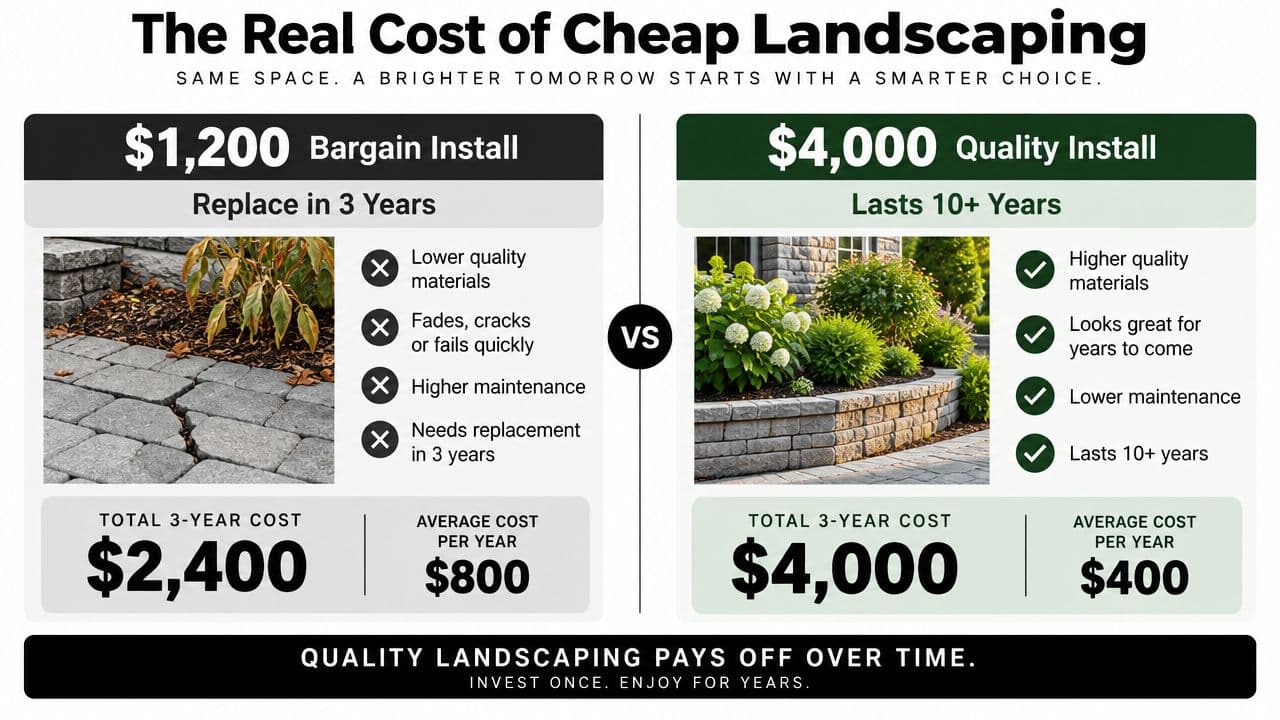
The lowest bid often removes quality from the parts you won't notice until the first difficult season. Thin edging bends, weak plants fail under site stress, and poorly installed paving settles. Replacing those items means paying for demolition and labor again, which is why upfront price alone is a poor buying test.
The supplied bargain-versus-quality comparison uses a $1,200 install replaced in three years and a $4,000 installation lasting ten or more years. Those figures illustrate the principle, not a universal service life. A $1,200 project that needs another $1,200 replacement at the three-year mark has already reached $2,400, while a $4,000 project lasting ten years has a lower annualized cost under that example.
Judge the bid by useful life
Ask what each line item is designed to withstand. Cheap builder-grade edging may warp or pull loose. Discount shrubs may be stressed, undersized, or poorly matched to the site. Untreated wood can deteriorate quickly in wet conditions. A low-cost paver may be acceptable, but a weak base beneath any paver can create the actual failure.
Price test: Divide the installed cost by the years you reasonably expect the feature to serve. Then include removal, disposal, replacement materials, and another installation charge.
Three substitutions deserve particular scrutiny:
- Thin-gauge steel edging: It may cost less initially but can deform during installation or freeze-thaw movement.
- Bargain bagged sod: It may fail if delivery, soil preparation, and watering aren't coordinated.
- Decorative contractor-grade pavers: They may not suit areas exposed to vehicle loads or poor base construction.
Spend less on decorative extras before you spend less on structure, drainage, soil preparation, or plant quality. Those are the elements that determine whether the front yard still works after the first season.
Three Sample Budgets for Real Yards
The cleanest way to understand a quote is to match it to the yard's existing condition. The following examples are planning scenarios built from the verified national ranges and cost structure, not promised prices. Your local labor market, access, materials, and site conditions will determine the actual proposal.
| Budget Tier | Yard Profile | Scope of Work | Total Range | Labor % | Materials % |
|---|---|---|---|---|---|
| Cosmetic refresh | Compact, mostly level yard with healthy existing beds | Mulch, selective shrubs, edging, limited lawn repair | Qualitative lower-range project | Majority of total | Remainder |
| Mid-range redesign | Moderate planting area with tired beds and minor irrigation issues | New bed layout, planting, drip retrofit, path, focal tree | Qualitative mid-range project | Large share of total | Remainder |
| Hardscape-inclusive overhaul | Sloped or poorly organized yard requiring structural work | Grading, retaining feature, paving, lighting, full planting plan | $10,000 or more for complex work | Dominant share of total | Remainder |
The cosmetic refresh
A mostly level yard with usable soil and functioning irrigation is the easiest candidate for a controlled refresh. Keep the bedlines, remove only failing plants, refresh mulch, repair a limited lawn area, and replace edging where it has failed. The labor share will still dominate because cleanup, planting, and haul-off take time, but you avoid demolition and reconstruction.
This is the right tier for homeowners who want better curb appeal without changing how people enter the house. Don't add a path unless the current circulation is unsafe or genuinely inconvenient.
The mid-range redesign
A medium project earns its cost when the existing layout is the problem. Redefine the beds, create a stronger focal point near the entry, use drip irrigation where appropriate, and make the path feel intentional rather than tacked on. Keep healthy trees and usable utility routes whenever possible.
The largest risk is scope creep. A homeowner starts with new beds, then adds lighting, drainage, a new lawn, and a widened walk. Price those additions separately so you know which feature is consuming the budget.
The structural overhaul
A sloped yard or one with drainage problems needs to be designed as a construction project, not a planting exercise. Build grading, retaining work, paving, and drainage as a coordinated system. Phasing plants and lighting may be practical, but phasing a wall or paving base incorrectly can compromise the finished work.
Ask the contractor to identify what must be installed together for structural integrity. Soil preparation, drainage, base construction, and retaining elements usually belong in the same coordinated phase. Decorative planting and some lighting can wait.
Visualize Before You Spend
The most expensive landscaping mistake is approving a design you haven't seen on your own property. A plant that looked balanced on paper may block a window at maturity. A curved bedline may fight the walkway. A path may consume more paving, excavation, and edging than expected.
Those choices are easy to change while they remain visual decisions. They become expensive once the crew has removed lawn, hauled soil, installed base material, or planted around a fixed layout. Use a photo of the actual front yard, not a generic inspiration image, and test the proportions against the house, sidewalk, driveway, windows, and neighboring views.
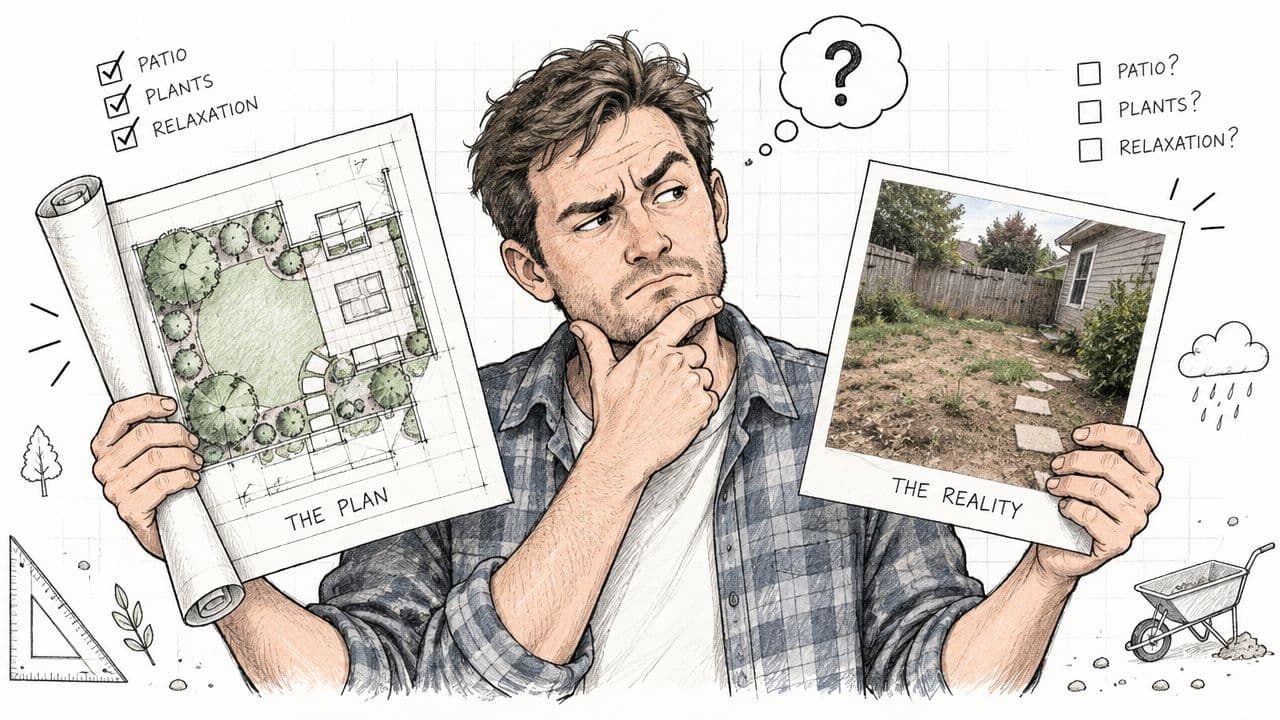
Make the visual decisions first
OutdoorBrite turns a photo of a front yard into redesign concepts, lets users compare styles, and supports visual adjustments to features such as planting beds, pavers, lighting, and other yard elements. That makes it useful for testing layout and scale before you ask a contractor to price the final plan.
You can also compare options through the best free garden design software, especially if you want to sketch bed boundaries and planting relationships before committing to a detailed installation plan.
Use the visual draft to answer practical questions:
- Does the entry remain visible from the street?
- Does the tree leave enough clearance for windows and utilities?
- Does the path connect the places people walk?
- Does the material palette fit the house, driveway, and existing masonry?
- Can the design be built in phases without disturbing completed work?
A rendering won't replace a site inspection, grade measurement, or utility check. It will expose bad proportions and unwanted features early, when changing them costs nothing more than another design decision.
Smart Ways to Lower Your Landscaping Bill
The best savings come from reducing rework. Don't chase the cheapest plant list while approving a layout that requires demolition, new irrigation, extra grading, and complex edging. Make the design simpler first, then decide which work you can perform safely yourself.
- Phase the project deliberately. Build drainage, grading, walls, and paving in the correct sequence. Add ornamental plants, mulch refinements, and some lighting later if the infrastructure allows it.
- Keep sound bedlines and irrigation. Demolition and replumbing can erase the savings from choosing less expensive plants. Change only what improves the function or solves a real maintenance problem.
- Buy locally when practical. Regional suppliers may reduce delivery distance and handling, particularly for heavy soil, stone, mulch, and paver materials.
- DIY the softscape, hire the technical work. Planting and mulching may suit a capable homeowner. Grading, drainage, retaining construction, and structural paving deserve experienced installation.
- Lock the design before signing. A visual plan reduces mid-project changes, material substitutions, and change orders. Use budget-friendly front yard ideas to refine the wish list before the estimate becomes a contract.
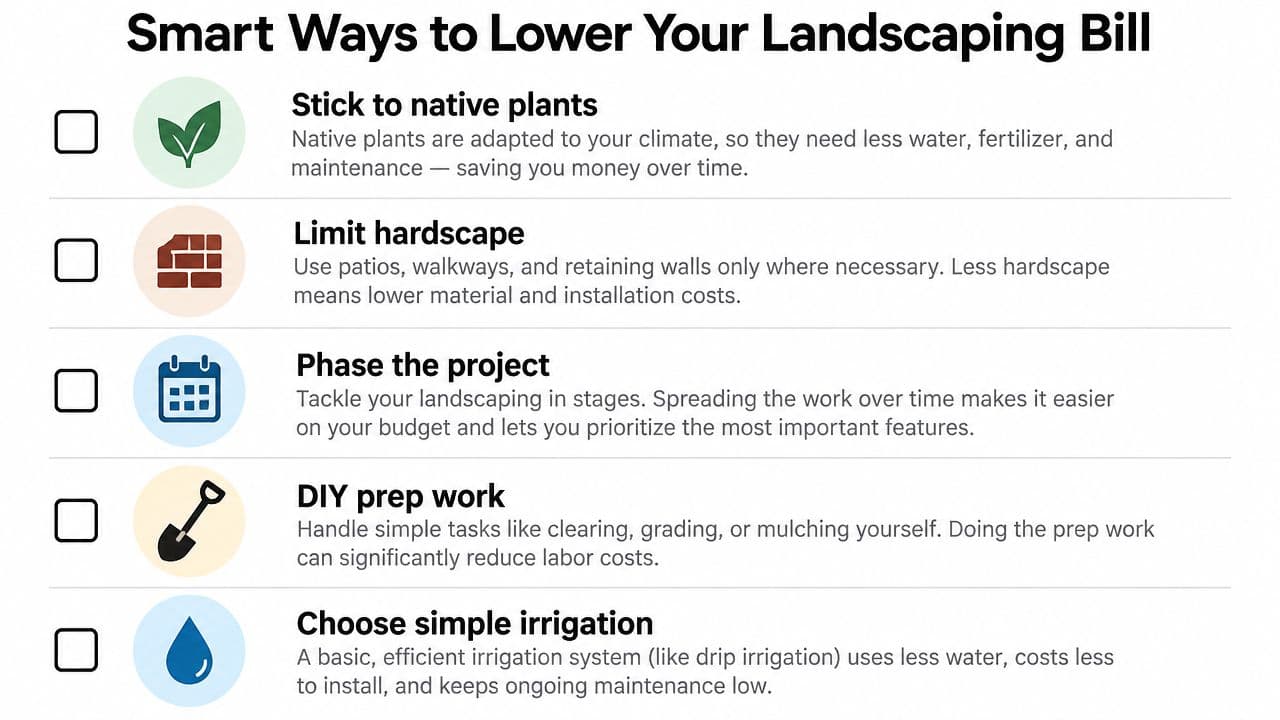
A screenshot-ready checklist is simple: preserve usable infrastructure, simplify the geometry, separate structural work from decoration, do safe planting work yourself, and approve the visual layout before ordering materials.
OutdoorBrite helps you turn a photo of your own front yard into realistic yard concepts, compare styles, and test planting beds, paths, pavers, and lighting before construction begins. Visit OutdoorBrite to settle the visual plan first, then take a clearer scope to your landscaper and request an estimate you can evaluate.
See your yard reimagined
Start creating