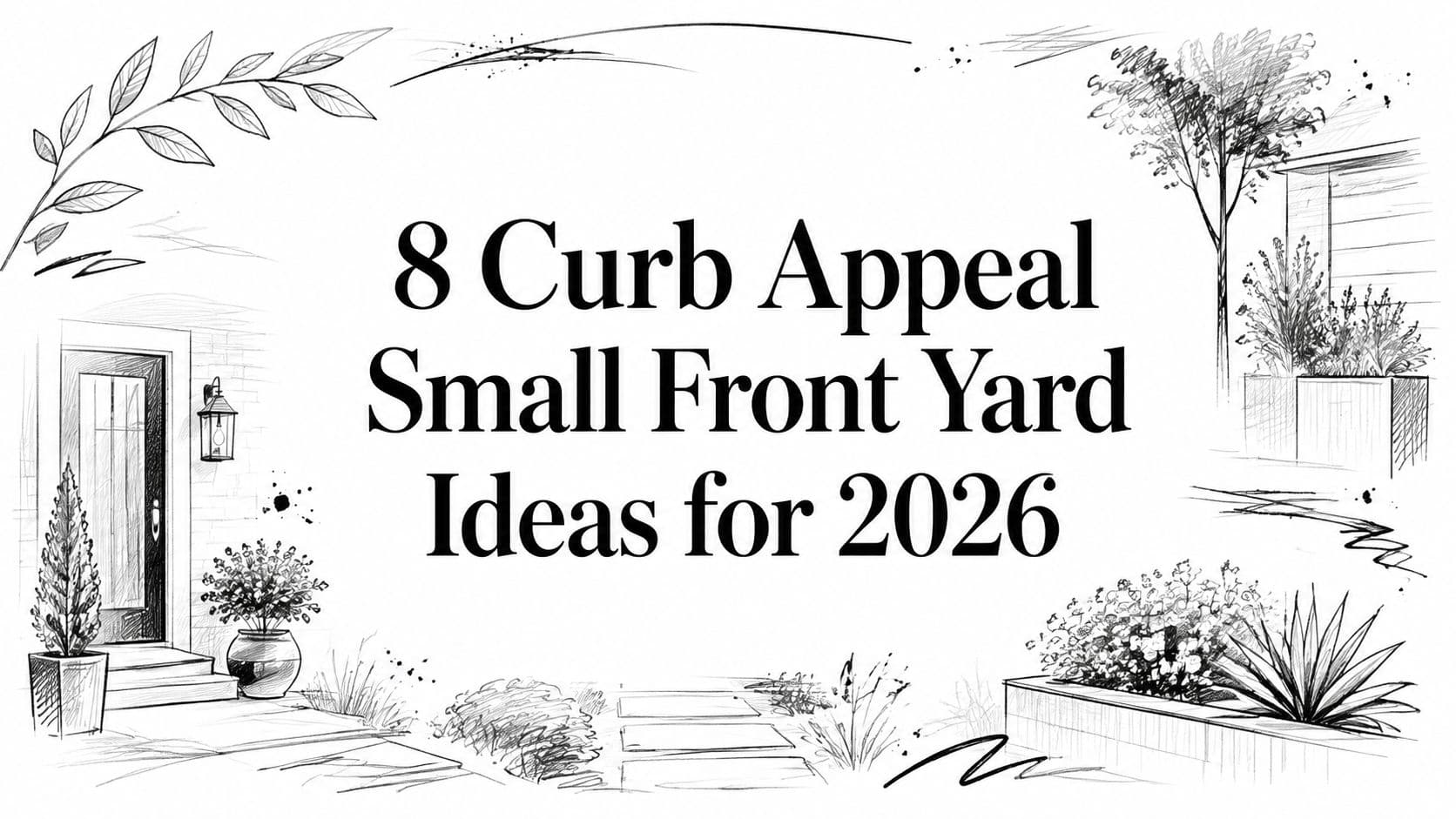
8 Curb Appeal Small Front Yard Ideas for 2026
Transform your curb appeal small front yard with 8 budget-friendly ideas for layout, plants, hardscape, lighting, and DIY upgrades.
A small front yard doesn't need more plants to look better. That popular advice often produces the opposite result, a crowded strip of greenery that hides the entry, narrows the walking route, and makes maintenance harder. Strong curb appeal for a small front yard comes from editing: one clear focal point, an open sight line, a restrained planting palette, and details that still look intentional after sunset.
The eight ideas below treat the yard as a visual composition rather than a smaller version of a large outdoor space. You can make hardscape or xeriscaping the permanent foundation, then add flexible layers such as containers, lighting, or seasonal color as your budget and preferences change. That approach also accommodates practical pressures such as drainage, permeable surfaces, vehicle access, and possible EV charging without forcing every feature into the planting bed.
Before buying materials, use OutdoorBrite to place design concepts over a photo of your actual property. Comparing a narrow bed, a paver route, a container arrangement, or a xeriscape layout on the existing facade can expose proportion problems before they become expensive purchases.
Table of Contents
- 1. Minimalist Front Garden with Strategic Plantings
- 2. Container Gardens and Potted Plant Arrangements
- 3. Layered Lighting Design for Evening Curb Appeal
- 4. Hardscaping Focal Points with Pavers and Stone
- 5. Vertical Gardening and Green Walls
- 6. Focal Point Entry Features
- 7. Low-Maintenance Xeriscaping with Gravel
- 8. Seasonal Color Rotations and Native Plant Combinations
- 8-Point Small Front Yard Curb Appeal Comparison
- Build the Look in the Right Order
1. Minimalist Front Garden with Strategic Plantings
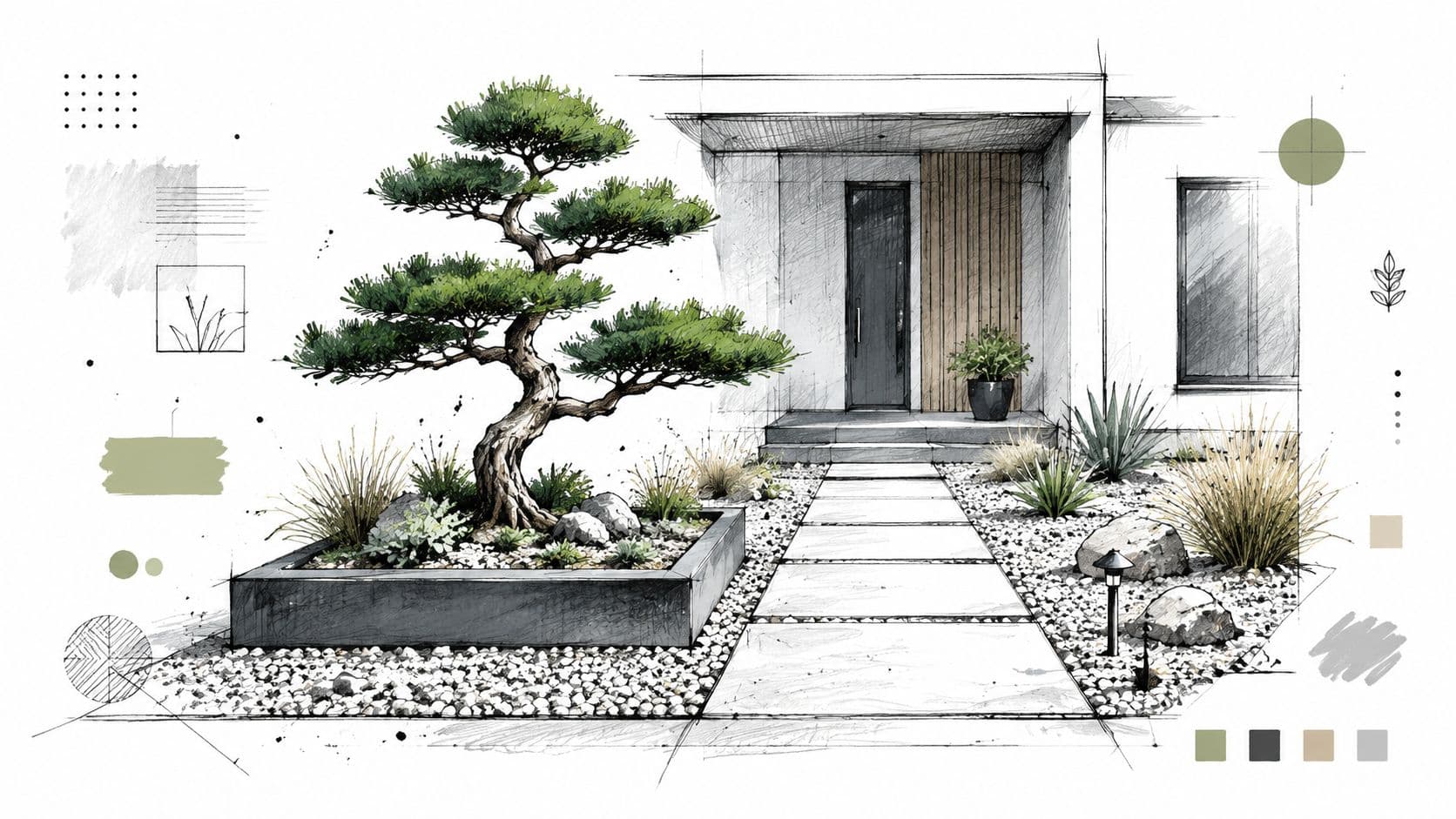
Minimalism works when the empty space looks deliberate. In a compact front yard, a simple field of gravel, paving, or lawn can give one sculptural plant far more presence than a crowded border gives a dozen competing specimens. The design should read clearly from the sidewalk: a path leads to the door, a focal plant supports the architecture, and the remaining ground plane provides visual breathing room.
A Japanese-inspired entrance might pair fine gravel, a few large stepping stones, and one carefully positioned evergreen. A mid-century home may suit rectangular concrete planters with architectural grasses, while an urban townhouse could use sleek paving with a compact specimen shrub. Match the hardscape to the home. Warm stone can soften a traditional facade, while precise concrete or dark gravel may reinforce a contemporary one.
Keep the composition open
Use the rule of thirds rather than placing the largest feature directly in the center. An off-center tree, planter, or boulder creates movement while keeping the doorway visible. Choose plants with year-round structure, such as textured evergreens or ornamental grasses, and check their mature size before planting. A plant that needs constant cutting to stay off the walkway was the wrong choice from the start.
A useful working target is to leave at least 50% of the visible front yard open or unplanted. That figure comes from the design brief rather than a universal landscaping standard, so treat it as a composition guide, not a regulation. The open area might be gravel, paving, lawn, or mulch, depending on drainage and the character of the house.
Practical rule: If you can't identify the entry, the path, and the focal point from the curb, remove something before adding anything.
Test plant positions with OutdoorBrite's elements editor, then walk the route yourself. The best minimalist front garden isn't empty. It's selective.
2. Container Gardens and Potted Plant Arrangements
Containers give a small front yard something permanent beds can't, flexibility. You can test color, move plants away from a failing location, change the arrangement by season, and avoid rebuilding compact or poor soil. They're especially useful for renters, new homeowners, and anyone who wants curb appeal without committing to excavation.
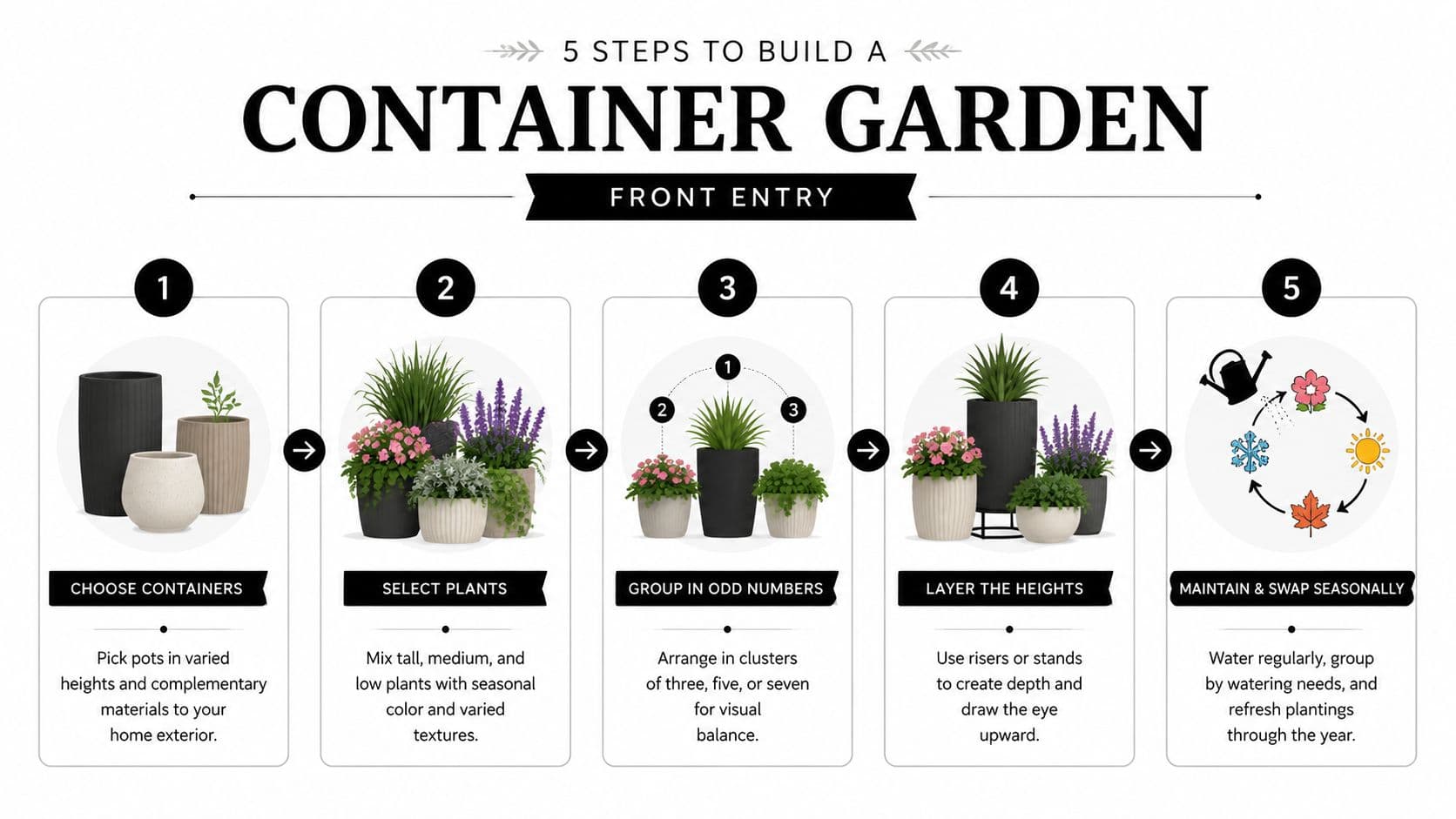
Start at the entry rather than scattering pots around the property line. A pair of matching planters can frame a traditional doorway, while an asymmetrical cluster can suit a modern facade. Mediterranean homes often work well with terracotta, lavender, or an olive plant. A cottage-style house can handle more relaxed combinations, including weathered containers with varied foliage. For a Scandinavian-inspired exterior, use fewer containers in white, charcoal, or other quiet finishes.
Build height without clutter
Arrange containers in odd-number groups, such as three or five, when a cluster needs visual rhythm. Vary height with a plant stand, a low plinth, or a taller container, but keep the route clear and avoid creating a bottleneck near the threshold. A tall pot placed beside the door can provide vertical emphasis. A low bowl can soften the edge of the path without obstructing feet, deliveries, or accessibility.
Use OutdoorBrite to preview container locations and seasonal combinations against the actual house. That matters because a pot that seems modest in isolation may dominate a narrow facade once its mature plant is included.
- Match care needs: Group plants with similar water and light requirements so one container doesn't stay wet while another dries out.
- Check drainage: Every container needs adequate drainage holes and a stable base to reduce the risk of waterlogged roots.
- Coordinate finishes: Repeat one exterior color, material, or shape so varied plants still feel connected.
- Plan for weight: Large pots become difficult to move, particularly after watering, so place them where they can stay.
The trade-off is maintenance at eye level. Containers dry faster than ground beds and may need regular watering, feeding, deadheading, and seasonal replacement. If you want flexibility without daily attention, use a smaller number of substantial containers with durable foliage instead of many small pots filled with short-lived color.
3. Layered Lighting Design for Evening Curb Appeal
Daylight isn't the only time buyers, guests, or neighbors see a front yard. Lighting can extend the composition into the evening, but a small space has little room for glare and visual noise. The aim isn't to flood the facade. It's to make the route legible, give the entry warmth, and reveal one or two features after dark.
Use three layers. Task lighting belongs along steps and the walking route. Ambient lighting comes from wall sconces, porch fixtures, or a softly illuminated entry. Accent lighting highlights a tree, textured wall, architectural shrub, or distinctive paving detail. A contemporary house may suit discreet ground-level fixtures, while a traditional home could use lantern-style sconces flanking the doorway.
For more detailed fixture placement and layout inspiration, see these pathway lighting ideas. If electrical work is required, consult a qualified installer, such as a provider experienced in outdoor space lighting installation Brisbane, and follow local requirements.
Prevent a washed-out facade
Bright, poorly aimed fixtures erase plant texture and create harsh shadows. Choose adjustable lights, shielded path fixtures, and dimming where the system allows it. Test the arrangement at night before fixing every fitting in place. Look from the sidewalk and from inside the house, since glare that seems attractive outside can shine directly into windows.
Solar path lights can reduce wiring work for simple routes, though their performance depends on exposure, placement, and product quality. Low-voltage systems offer more control but require careful cable routing and suitable installation. Keep fixtures out of the main footfall and avoid aiming light toward the street or neighboring windows.
This video offers a visual reference for combining entry and outdoor lighting without treating every surface as a spotlight.
A small yard usually needs fewer fixtures than homeowners expect. One well-lit path, a readable door, and a restrained accent can create more depth than a bright, uniform wash.
4. Hardscaping Focal Points with Pavers and Stone
Hardscape gives a small front yard structure that plants alone may not provide. A permeable paver route, natural stone path, gravel apron, or low accent wall can define movement and create year-round interest without occupying the entire space with living material. It also creates a practical foundation for future additions, including containers, lighting, and low planting.
Begin with the route from sidewalk, driveway, or parking area to the front door. The path should feel obvious and comfortable, not like an afterthought squeezed between plants. Rectangular permeable pavers suit a clean contemporary entry. Irregular flagstone can support a Mediterranean or cottage character, while stacked stone may work as a low wall or integrated planter edge.
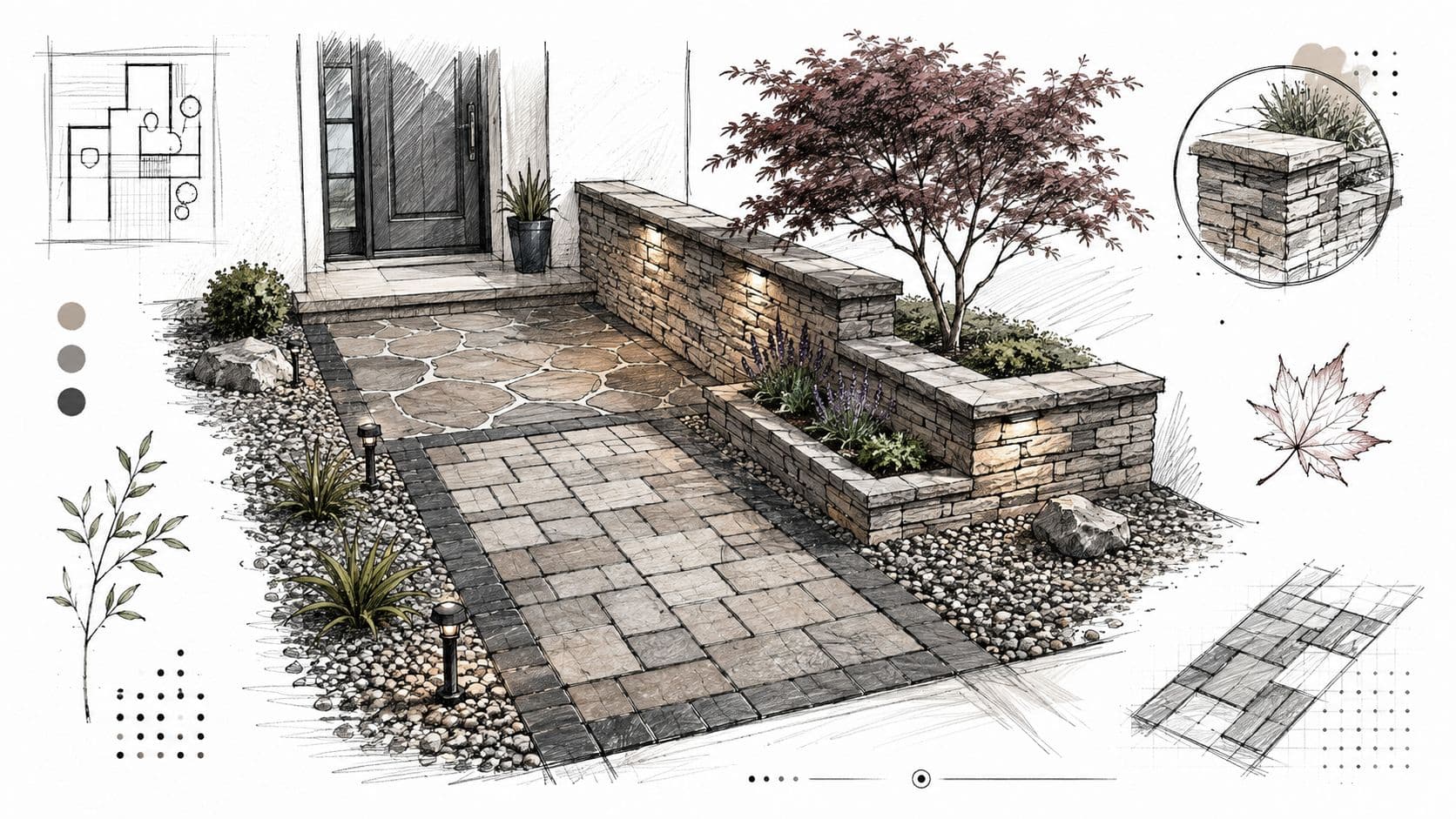
Use material changes sparingly
A contrasting band, altered laying pattern, or small landing can mark the entry without making the yard look busy. Repeating the house's masonry, trim color, or roof tone helps the hardscape belong to the property. Too many materials create visual fragments, especially where the yard is visible from a short distance.
Permeable surfaces deserve special consideration where runoff, local water management, or future vehicle use affects the layout. Recent coverage on front-yard trends highlights the growing relevance of EV charging, permeable hardscape, and runoff management as homeowners rethink how front gardens function. That makes surface selection a planning decision, not just a decorative one. Confirm local rules and site conditions before installation, particularly where driveways, drainage, or utility access are involved.
Use OutdoorBrite's elements editor to compare paver patterns and material tones on your property photo. Its hardscape calculators can also help organize material quantities, but final measurements should be checked against the site and the installer's specifications. Get multiple contractor quotes, and ask how each proposal handles base preparation, drainage, edging, and future access.
Pair hardscape with a narrow planting seam, a container, or a few groundcovers. Without that softer counterpoint, a compact yard can feel more like a parking surface than an entry garden.
5. Vertical Gardening and Green Walls
Vertical planting works best when it solves a specific problem, such as softening a fence, framing a doorway, or adding height beside a narrow townhouse entry. Treat the wall, path, and doorway as one composition, so the structure supports the architecture and keeps the entry as the visual priority.
A modular green wall can add pattern beside a modern entrance. A trellis with jasmine or clematis may suit a Mediterranean facade, while a timber support with climbing roses can reinforce a cottage style. Wall-mounted planters and stacked containers provide a less permanent starting point when the site's light, watering needs, and maintenance demands are still uncertain.
Design for mature weight and access
Climbers need a suitable support system. Mature vines can place significant weight on trellises, fasteners, and walls, so confirm that the structure can handle the plant as it develops, not just the lightweight nursery specimen. Keep the trellis accessible for pruning, inspection, and repainting. Place it far enough from a narrow path to allow for future foliage without reducing clear passage.
Light and water change quickly on a wall. Select species for the actual exposure, climate, and reflected heat of the facade. Living wall systems may need integrated irrigation, while container towers need a reliable way to reach every pot. Plants with attractive foliage generally provide a steadier composition than designs that depend entirely on a brief flowering period.
- Start light: Use a freestanding trellis or lightweight container system before attaching a permanent structure.
- Preserve the door: Keep the entry outline and hardware visible from the street.
- Repeat a texture: Echo leaf shape or container material elsewhere so the vertical element belongs to the wider yard.
- Plan pruning: Leave enough room to work without standing in the traffic path.
Review the sight line from the sidewalk before installation. OutdoorBrite can help visualize a trellis, green wall, or climbing plant against the existing facade before drilling into masonry or ordering a modular system. In a small front yard, height earns its place when the feature stays within bounds. A trellis that overshadows the path defeats the purpose.
6. Focal Point Entry Features
The entry is the single most visible element in a small front yard. A well-chosen door, arbor, pair of sconces, or architectural accent establishes hierarchy, clarifies the sight line from the street, and gives the rest of the composition a clear limit.
Start by deciding what visitors should notice first. On a modern home, a matte black door beneath a geometric steel arbor can define a restrained planting bed. A traditional facade may suit a red door, black shutters, and evergreen framing. Mediterranean architecture can support an arched detail with terracotta containers, while a minimalist home may work better with a natural wood door and a simple floating canopy. For structure proportions and placement ideas, see this Arbors and arches guide.
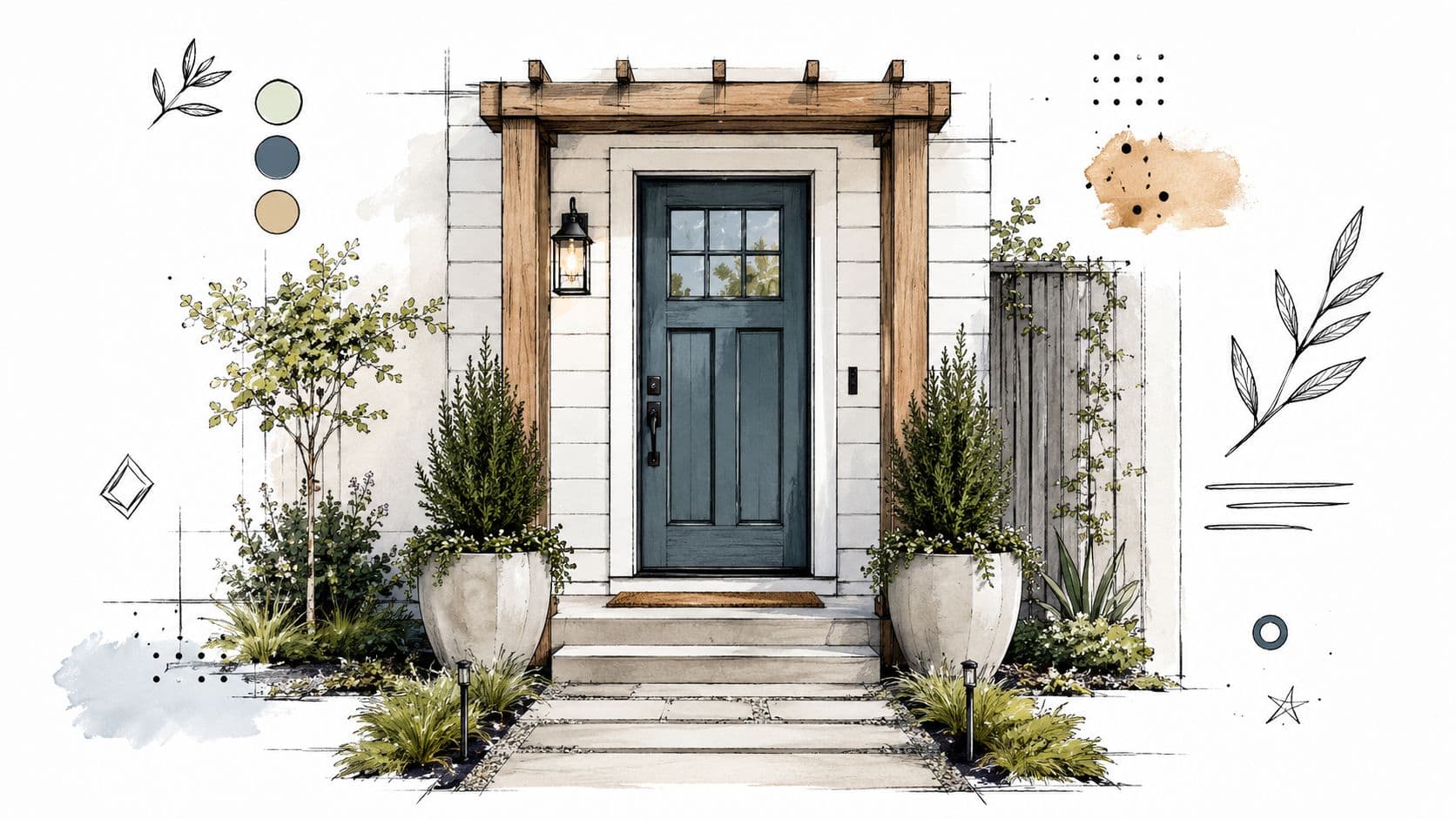
Make the focal point approachable
Keep the feature visible, reachable, and easy to maintain. A bold door color loses impact beside a dense collection of pots, signs, decorative objects, and competing paving patterns. If the door carries the emphasis, keep adjacent colors quiet. If the arbor leads the composition, frame it with plants rather than hiding it with mature growth.
Symmetry brings order to a traditional facade. Matching planters or sconces can settle both sides of the door, while an asymmetrical arrangement feels more contemporary when its visual weight remains balanced. A tall planter on one side may need a low bed, step, or light on the other.
Use AI front yard design to test door colors, entry structures, path alignments, and planting restraint on a photograph of the actual property. Viewing the full facade helps reveal whether a blue door, dark arbor, or wood accent supports the siding and trim before materials are purchased.
Add lighting that keeps the focal point readable after sunset. Use containers for seasonal color so the permanent bed does not need frequent rebuilding. The strongest entry feature gives the yard direction without forcing every other element to compete for attention.
7. Low-Maintenance Xeriscaping with Gravel
Xeriscaping is more than replacing lawn with gravel. A convincing small front yard combines drought-tolerant plants, texture, drainage-aware surfaces, and a clear layout. The result can feel contemporary, Mediterranean, Southwestern, or regionally native, depending on the palette and materials.
Use gravel, decorative mulch, boulders, sedums, succulents, ornamental grasses, and shrubs suited to local conditions. A Southwestern composition might use boulders and gravel around sculptural drought-tolerant plants. A Mediterranean design could combine lavender, rosemary, and stone. A modern scheme may rely on repeated grasses and carefully spaced succulents rather than a random collection of low-water plants.
Group plants by water needs. This makes irrigation more efficient and prevents a high-water plant from forcing the entire bed into a maintenance pattern that doesn't suit the rest of the design. Improve soil according to local conditions, apply mulch at an appropriate depth, and water new plants according to their establishment needs before reducing irrigation. Exact watering requirements depend on species, climate, soil, and exposure, so local guidance matters more than a universal schedule.
Keep gravel from looking unfinished
Define the gravel with sturdy edging and use larger stones or pavers to establish a route. Repetition gives the bed order. A few plant groupings with different textures will generally look more intentional than isolated specimens scattered across every corner.
The easy front yard landscaping for 2026 guide can help you compare low-maintenance directions, while OutdoorBrite's xeriscape style options let you preview gravel, planting beds, and hardscape on the actual property.
Recent trend coverage points toward native plants, drought-tolerant species, no-mow alternatives, and eco-lawns, but trend adoption shouldn't override site fit. Choose plants for mature size, rainfall, sun, soil, and maintenance capacity. Native plant guidance, such as this Australian native plant guide, can be useful when adapted to the local region rather than copied directly.
8. Seasonal Color Rotations and Native Plant Combinations
Build the structure first: evergreen shrubs, grasses, and a clear path. Then place seasonal color where it strengthens the entry or a sight line from the street. This approach keeps a compact yard readable while allowing the planting to change through the year.
Evergreen shrubs or grasses can hold the composition through winter. Spring bulbs and early bloomers fill gaps around that framework. Summer perennials and annuals add color near the door, while fall foliage, berries, and persistent seed heads maintain interest after flowers fade. Choose plants that contribute more than one quality, such as foliage texture, form, flowers, fruit, or winter structure.
Design the planting calendar before the bed
Map bloom periods and mature heights before buying. A summer plant that hides a later-season flower may look good on paper but disappear from the street. Place tall structure behind, midsize seasonal plants through the center, and low edging or groundcovers beside the path. Keep the entry visible at every growth stage.
Native plants can suit local conditions and provide habitat value, but “native” does not automatically mean compact, tidy, or maintenance-free. Check mature size, spread, soil preference, sun exposure, and pruning needs with a local cooperative extension or native plant society.
- Reserve the framework: Install or retain evergreen structure before adding temporary color.
- Use containers for experiments: Test an unfamiliar seasonal combination without disturbing the permanent bed.
- Repeat rather than collect: Repeated flower colors or foliage shapes create more cohesion than unrelated specimens.
- Protect winter texture: Leave suitable ornamental grasses and seed heads standing when they remain safe and attractive.
Limit seasonal changes to the areas most visible from the sidewalk and front door. That reduces replacement work and keeps the composition focused. Containers can hold higher-maintenance annuals, while permanent beds carry the structure.
OutdoorBrite can preview seasonal palettes on the house photo, helping show whether a combination supports the facade or overwhelms it. In a small front yard, seasonal change should refresh the composition, not replace it.
8-Point Small Front Yard Curb Appeal Comparison
| Approach | Implementation (🔄) | Resources (⚡) | Expected Outcomes (⭐ 📊) | Ideal Use Cases | Quick Tip (💡) |
|---|---|---|---|---|---|
| Minimalist Front Garden with Strategic Plantings | Moderate, precise design and placement required | Low, few specimens, simple hardscaping | ⭐⭐⭐⭐ 📊 High visual clarity; makes small yards feel larger | Modern/contemporary homes; low-maintenance owners; urban lots | Use structural plants, apply rule of thirds, keep ≥50% open space |
| Container Gardens and Potted Plant Arrangements | Low, simple placement, easy to rearrange | Low–Moderate, pots, potting mix, regular watering | ⭐⭐⭐ 📊 Immediate focal points; highly flexible seasonally | Renters, poor soil, balconies, seasonal styling | Group in odd numbers; match pots to home; group by water needs |
| Layered Lighting Design for Evening Curb Appeal | Moderate–High, design + electrical or quality solar work | Moderate, fixtures, controls, possible electrician | ⭐⭐⭐⭐ 📊 Dramatic nighttime appeal; improves safety and perceived value | Sellers, evening entertaining, security-focused properties | Layer task/ambient/accent lights; test at night; use dimmers |
| Hardscaping Focal Points (Pavers, Pathways, Accent Walls) | High, skilled design and professional installation often needed | High, premium materials, contractor costs | ⭐⭐⭐⭐⭐ 📊 Permanent structure and strong ROI; year‑round interest | High-traffic entries, poor soil, owners wanting low upkeep | Choose permeable options; pair with softscaping to soften look |
| Vertical Gardening and Green Walls | Moderate, requires secure mounting and irrigation planning | Moderate, modular systems/trellises; irrigation recommended | ⭐⭐⭐⭐ 📊 High visual impact; multiplies planting area vertically | Narrow urban yards, limited ground space, dramatic statements | Ensure structural support, select climate‑appropriate climbers |
| Focal Point Entry Features (Doors, Arbors, Architectural Accents) | Low–Moderate, simple updates to small structures; permits for permanent builds | Low–Moderate, paint, planters, optional small structures | ⭐⭐⭐⭐ 📊 Immediate curb‑appeal boost; organizes the landscape visually | Sellers, budget‑conscious homeowners, homes with strong architecture | Test door colors on a photo; balance bold elements with restraint |
| Low‑Maintenance Xeriscaping (Drought‑Tolerant Plants & Gravel) | Moderate, planning, soil prep, proper plant selection | Low–Moderate, drought plants, gravel, mulch; long‑term water savings | ⭐⭐⭐⭐ 📊 Major water savings and low ongoing maintenance | Arid/drought-prone regions, water‑restricted areas, eco‑minded owners | Group by water needs, mulch 2–3" deep, choose native species |
| Seasonal Color Rotations and Native Plant Combinations | High, requires research, timing, and succession planning | Moderate, diverse bulbs, perennials, periodic replacements | ⭐⭐⭐⭐ 📊 Continuous year‑round interest; supports pollinators and biodiversity | Homeowners wanting evolving displays and ecological benefits | Map bloom times; layer heights; plant evergreen structure first |
Build the Look in the Right Order
Start with a photograph taken from the street, then measure the front yard, entry route, driveway edge, existing beds, and any areas where utilities or drainage limit construction. Don't design from the property line alone. The important view includes the facade, door, windows, sidewalk, parking area, and the sight line visitors follow as they approach.
Next, identify the entry focal point. That may be the front door, a short path, an arbor, a specimen plant, or a small architectural wall. Choose one primary feature, then protect it with clear circulation. A narrow yard feels smaller when containers pinch the route, shrubs cover the steps, or a decorative feature blocks the door from the sidewalk.
Select one main strategy before adding details. Minimal planting with hardscape creates a different maintenance pattern from a container-led entry. Xeriscaping may reduce lawn care but still requires thoughtful plant grouping, weed control, and gravel management. Vertical planting saves ground space but introduces structural, irrigation, and pruning responsibilities. Lighting adds evening value but needs careful aiming, safe installation, and testing after dark.
A sensible sequence looks like this:
- Document the site: Photograph the property in daylight and note sun, shade, slope, drainage, parking, and access.
- Protect movement: Mark the walking route before placing beds, pots, walls, or lighting.
- Choose the foundation: Decide whether the main visual field will be lawn, gravel, permeable paving, planted bed, or a measured combination.
- Establish the focal point: Give the entry one dominant feature and keep supporting elements quieter.
- Add flexible layers: Use containers, lighting, and seasonal color as the budget allows.
- Check mature scale: Confirm plant height, spread, water needs, and maintenance access before installation.
- Verify requirements: Review drainage, permeable-surface, driveway, electrical, structural, and neighborhood rules where relevant.
Preview combinations with OutdoorBrite before committing to plants, pavers, lighting, or structures. The tool can turn a photo of the front yard into realistic concepts, apply styles such as modern, cottage, Mediterranean, Japanese zen, or xeriscape, and let you compare elements on the actual property. That visual check won't replace measurements, horticultural advice, contractor estimates, or local approvals, but it can help you reject weak layouts early.
The strongest curb appeal small front yard design isn't the one that fills every available patch. It's the one that makes the door easy to find, the route comfortable to use, the materials feel connected to the architecture, and the maintenance realistic for the household. Edit first. Add only what improves the composition.
OutdoorBrite lets you upload a photo of your front yard, compare styles, and place features such as planting beds, pathways, containers, lighting, and xeriscape elements before buying materials. Visit OutdoorBrite to preview a small-front-yard concept on your own property and refine the layout before starting the work.
See your yard reimagined
Start creating