Foundation Plantings for Front of House: 2026 Design Guide
Master foundation plantings for front of house with our 2026 guide. Learn design principles, plant selection, & avoid costly mistakes for great curb appeal.
You're standing at the curb, looking at the front of your house, and something feels off. Maybe the foundation bed is bare and flat. Maybe old shrubs have swallowed the windows. Maybe you know the house could look warmer and more polished, but every online guide seems to give the same advice and none of it quite fits your home.
That's where foundation plantings for front of house get confusing. The basic ideas sound simple, but real houses aren't all the same. A low ranch doesn't need the same treatment as a tall colonial. A modern facade can look awkward with a thick hedge under every window. And if your front steps, downspouts, or overhangs create odd little microclimates, plant choice becomes part design and part problem-solving.
Think of foundation planting like dressing a person. The goal isn't to cover everything. The goal is to make the proportions feel right, highlight the good features, and create a finished look that feels natural. A well-designed planting bed can make a house look grounded, inviting, and cared for. A poor one can make the whole front yard feel heavy or fussy.
Table of Contents
- What Are Foundation Plantings and Why They Matter
- The Core Principles of Professional Foundation Design
- How to Create Your Planting Layout and Spacing Plan
- Choosing Plants for Four Seasons of Curb Appeal
- Common Foundation Planting Mistakes to Avoid
- Prototype Your Ideas with AI Design Tools
What Are Foundation Plantings and Why They Matter
You pull into the driveway after a long day, look at the front of your house, and something feels off. The siding, windows, and porch may be fine on their own, yet the whole front still looks bare, top-heavy, or unfinished. That missing layer is often the foundation planting.
Foundation plantings are the trees, shrubs, grasses, and perennials placed around the base of the home, usually near corners, entry walks, and selected wall sections. They work like the right shoes and jacket on an outfit. The house is still the main piece, but the planting helps it look grounded, balanced, and complete.
Their purpose is bigger than hiding concrete. A well-designed bed softens hard lines, guides attention toward the front door, and creates a smooth transition from house to yard. It also has practical jobs. Plants near the home need to suit the harsher conditions often found there, such as reflected heat, drier soil, limited rain reach under eaves, and the need to keep air moving around walls and windows. The University of Maryland Extension explains that the area beside a house often creates a difficult growing site because of overhangs, poor soil, and heat reflected from pavement and walls, which is why plant choice and placement matter so much near the foundation.
That is why the old method of planting one tight row of identical shrubs across the whole facade causes so many problems. It treats every house the same, whether you have a low ranch, a tall two-story colonial, deep porch columns, or awkward offset windows. Homes are not built from one template, so the planting should not come from one either.
Good foundation planting supports the architecture instead of swallowing it.
The goal is visual transition. You want the house to feel settled into the site, not dropped onto it. A simple way to judge your design is to stand at the curb and ask, “Does this planting help my eye move comfortably from the lawn to the entry to the house?” If the answer is yes, you are on the right track.
This design-first mindset matters even more on tricky facades. A blank wall, an off-center door, or windows at uneven heights can make standard advice feel useless. That is where many homeowners get stuck. They do not need a longer plant list. They need a clearer process for shaping, balancing, and testing ideas before they dig.
That is also why modern planning tools are so helpful. Once you understand what foundation planting is supposed to do, you can mock up options and see how different shapes, sizes, and layers change the look of the house before you commit to real plants.
The Core Principles of Professional Foundation Design
The easiest way to understand foundation design is to think about clothing. A good outfit has structure, contrast, and a few repeated elements that tie everything together. Your house needs the same treatment. If everything is the same height, same shape, and same color, the front looks flat. If every plant is different, it looks busy.
Why the old approach falls short
The old “shrubs lined up at attention” style usually ignores scale and rhythm. It treats every house like it needs a green wall. That often blocks windows, crowds steps, and makes the front of the home feel shorter and heavier than it is.
Professional-looking beds use variation with purpose. You want a backbone, supporting layers, and a few accents. That's what gives the planting depth.
How designers build a balanced bed
A widely used design rule is to build the bed with about 50% evergreens, 25% deciduous or flowering shrubs, and 25% perennials, while also giving the bed a depth of 6 to 8 feet and at least 1 foot of clearance between the largest plant and the exterior wall, according to Monrovia's foundation planting design guide. That mix works because each group plays a different role.
Here's how to consider this:
- Evergreens are the jacket. They give shape and year-round structure.
- Flowering or deciduous shrubs are the shirt. They add seasonal personality and movement.
- Perennials are the accessories. They bring detail, softness, and small moments of color.
That doesn't mean every bed must look formal. It means every bed needs a visual framework.
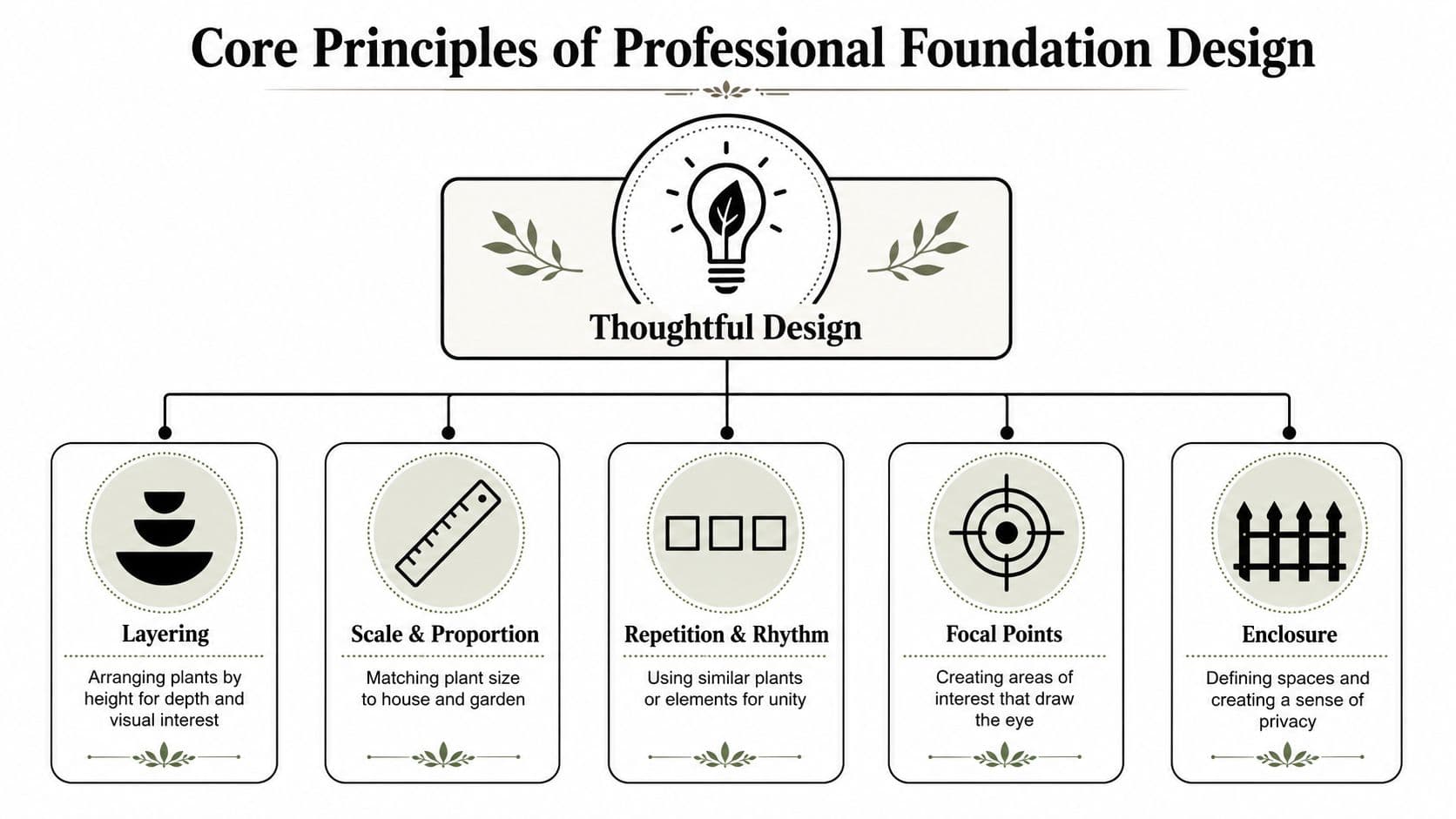
Layering
Place taller material toward the back of the bed, medium forms in front of or between those anchors, and lower plants at the edge. This gives the bed depth so it reads as a composition instead of a strip.
Scale and proportion
A small cottage can be overwhelmed by bulky shrubs. A broad two-story facade often needs stronger plant shapes to avoid looking skimpy. Always match the mature plant size to the scale of the house, not the size of the nursery container.
Practical rule: Buy plants for who they become, not who they are on planting day.
Repetition and rhythm
Repeating a plant, shape, or foliage color helps the bed feel calm. You might repeat rounded evergreen mounds at both corners, or echo one flowering shrub near the entry and again near a walkway transition.
Focal points
Not every part of the front yard needs equal visual weight. The front door, steps, porch, or a corner turn usually deserves more attention than a long blank wall. A focal point could be a stronger plant form, a contrasting texture, or a simple grouping that says, “look here.”
Enclosure
This principle gets overlooked. A foundation bed can make the entry feel sheltered and welcoming without making it feel boxed in. Low edging plants near the walk and slightly taller forms near corners help create that sense of gentle containment.
A polished design doesn't come from rare plants. It comes from arranging ordinary plants in a way that suits the house.
How to Create Your Planting Layout and Spacing Plan
A new homeowner often stands in front of the house with a cart full of shrubs and the same question: where does any of this go? The answer starts long before plant shopping. A strong foundation bed is planned the way you would plan furniture in a room. You measure first, note the doors and windows, and make sure people can move through the space comfortably.
Start at the street, because that is where the composition will be read. Look at the full face of the house, then notice the parts that interrupt it or need softening. Corners, windows, steps, vents, downspouts, and the route to the front door all affect the layout. The soil matters too. Ground near the wall is often dry from roof overhangs, while areas near downspouts can swing between soggy and dry.
As noted earlier, extension guidance supports two planning ideas that are easy to remember. Plants close to the house should tolerate drier conditions, and the tallest shrubs usually look best when they stay visually below the height of the house corners. That gives the bed a settled, supportive look instead of making it compete with the structure.
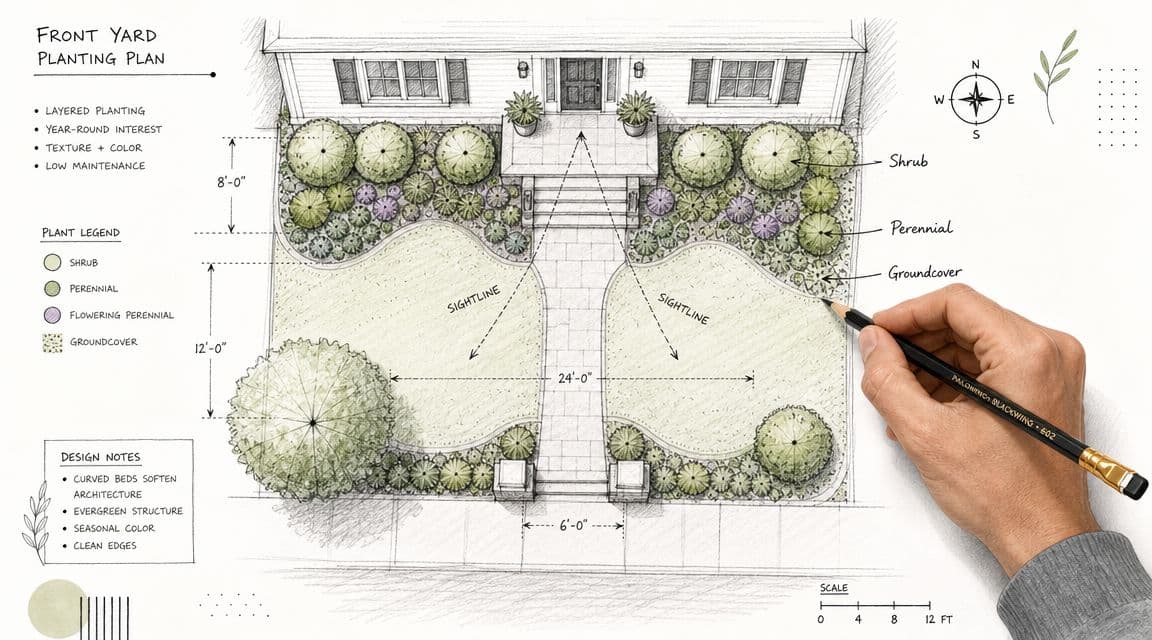
Before you sketch, gather a few facts from the site:
- Measure the bed depth: Check the distance from the wall to the lawn, driveway, or walkway.
- Track sun and shade: Notice which sections bake in afternoon sun and which stay protected.
- Mark fixed obstacles: Include vents, meters, hose bibs, utility boxes, and downspouts.
- Test the approach to the door: Leave enough room so plants never squeeze the entry path.
- Note awkward architecture: Bays, offset entries, split facades, and long blank walls need different spacing patterns.
If you are budgeting while you plan, review understanding landscaping expenses before you buy plants, edging, or mulch. It helps you decide where structure matters most and where you can keep things simple.
Next, make a basic overhead sketch. It does not need to be pretty. Draw the wall line, windows, steps, walkways, and corners, then place broad plant masses before you think about individual varieties. That step trips up many beginners. They try to assign specific plants too early, when what they really need is a map of shapes and spacing.
Different houses call for different layouts. A symmetrical facade often looks best with balanced masses near each side of the entry. A ranch house usually needs a rhythm of anchors and lower groupings so the front does not read as one long strip. A split-level or uneven facade takes more judgment. Instead of treating each wall section like its own little project, use plant groupings to connect the whole front of the house into one composition. That is where rigid rules fall short, and where design process matters more than copying a standard plan.
You can even test those unusual layouts before planting. Set the nursery pots in place, then stand at the curb and near the front walk. Better yet, mock up the bed with simple shapes in a photo editor or an AI image tool so you can compare options for a tricky corner, an off-center door, or a tall blank wall. That short experiment can save years of pruning or a costly replant.
Spacing is where many beds go wrong. Shrubs should be placed for their mature width, not for the size of the pot on planting day. If a plant is expected to spread four feet wide, draw and place it as a four-foot plant now. The bed may look sparse at first. That is healthy. It is the gardening version of buying a child a winter coat with room to grow.
For soil prep, drainage, and bed preparation before installation, this OutdoorBrite guide to planting soil is a helpful companion.
Leave breathing room between masses, near the walk, and under windows. A foundation planting should soften the house, not press against it. If the layout feels a little open in year one, you are probably spacing it correctly.
Choosing Plants for Four Seasons of Curb Appeal
Once the layout is set, plant selection gets easier because each spot already has a job. That's the right way to choose. Don't begin with “What's pretty?” Begin with “What does this area need?”
Choose by job, not just by looks
Think in roles.
Evergreens hold the structure together when flowers are gone and perennials are dormant. They're the bones of the bed. Flowering or deciduous shrubs add seasonal change, whether that's blooms, leaf color, or a softer habit. Perennials and groundcovers finish the front edge, soften mulch lines, and add detail close to the walk.
The strongest beds usually mix these jobs so the front of the house never looks empty for long. A bed made only of blooming shrubs can look lively in one season and flat in another. A bed made only of evergreens can feel static. The mix is what makes it read as complete.
If you want inspiration for combinations and plant personalities, this roundup of top plants for curb appeal can help you compare textures and front-yard roles. For broader exterior ideas that tie planting into the whole look of the property, homeowners in the region may also like this guide on how to improve curb appeal in Upstate SC.
Foundation plant selection by role and season
| Plant Type | Primary Role | Seasonal Interest | Examples |
|---|---|---|---|
| Evergreen shrubs | Structure and visual backbone | Year-round foliage presence | boxwood, holly, inkberry, dwarf arborvitae |
| Flowering shrubs | Mid-layer color and contrast | blooms, leaf change, branching texture | hydrangea, azalea, spirea, weigela |
| Perennials | Edge detail and repeating accents | flowers, foliage texture, seasonal return | hosta, daylily, coral bells, salvia |
| Groundcovers | Bed finish and soil coverage | foliage spread, texture, seasonal bloom in some types | creeping juniper, liriope, sedum, pachysandra |
| Ornamental grasses | Movement and vertical punctuation | foliage texture, seed heads, winter form | feather reed grass, fountain grass, sedge |
| Small specimen plants | Focal interest near entry or corner transitions | special form, bark, color, or habit | dwarf conifers, compact Japanese maple, clipped topiary |
A few simple matching ideas make selection easier:
- For sunny, hot foundations: Look for plants that tolerate dry conditions near walls and reflected heat.
- For shaded fronts: Favor foliage contrast and strong evergreen presence so the bed still reads clearly from the street.
- For modern homes: Use a tighter palette with repeated forms.
- For cottage or traditional homes: Blend evergreen structure with softer flowering layers.
A plant earns its place when it looks good for more than one moment of the year.
That's why foliage, shape, and winter presence matter so much. Flowers get attention, but structure carries the design.
Common Foundation Planting Mistakes to Avoid
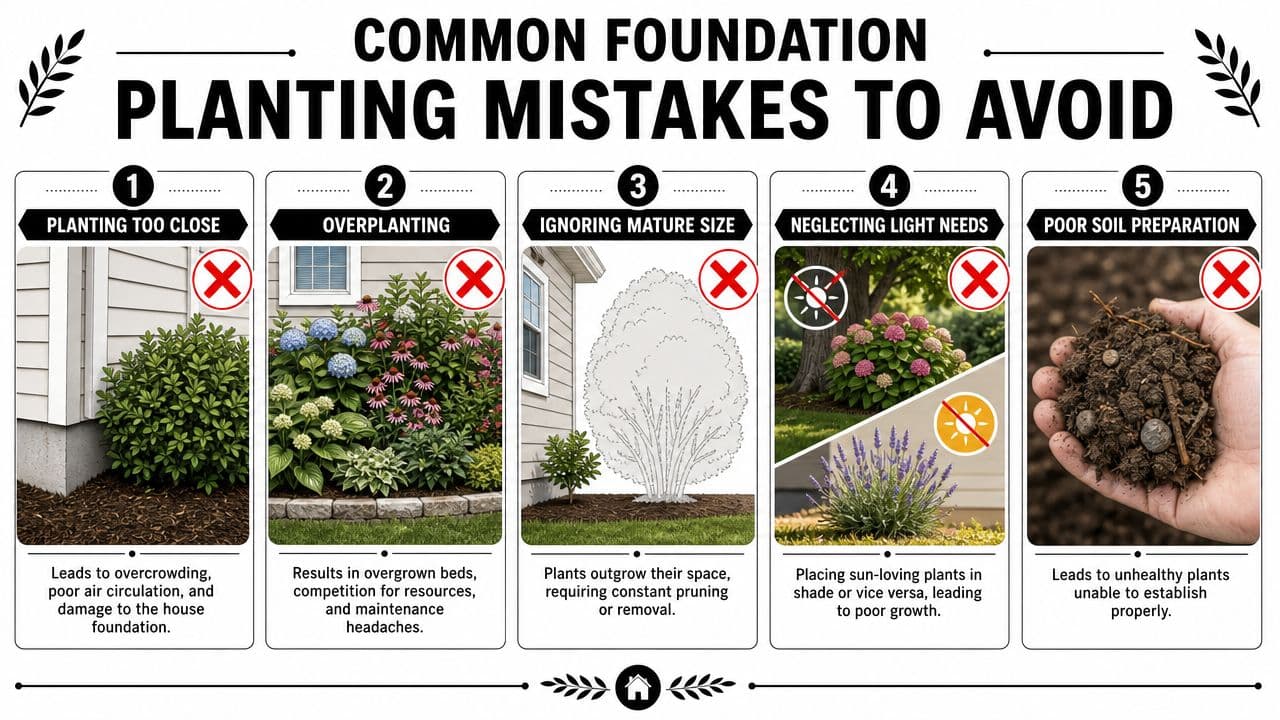
Most disappointing foundation beds don't fail because the homeowner picked “bad” plants. They fail because the design ignored mature size, house conditions, or the way the bed would look after a few growing seasons.
The mistakes that cause trouble later
One of the biggest errors is planting too close to the wall. Illinois Extension advises not placing plants within 1.5 feet of the foundation because soil there is often too dry for good growth, and other guidance recommends 18–24 inches of clearance. That spacing improves air circulation, reduces disease pressure, and helps prevent overgrowth that leads to constant pruning, as summarized in this Botanical Interests guide to foundation plants.
Other problems show up just as often:
- Using one plant over and over: A row of identical shrubs can make the house look stiff and dated.
- Ignoring winter appearance: If everything disappears or turns messy in the cold season, the front of the house loses its frame.
- Forgetting the microclimate: The dry zone under eaves and the uneven moisture near downspouts can stress plants quickly.
- Blocking windows and steps: This shrinks the house visually and makes the entrance feel crowded.
What to do instead
The fix is usually simple, but it takes restraint.
Choose plants that fit their mature space. Leave breathing room near the wall. Mix structure with seasonal interest. And let parts of the facade stay visible. The house is supposed to be part of the composition.
Here's a practical way to self-check your plan:
- Step to the curb: If the door disappears, the planting is too dominant.
- Look at the corners: If corner plants feel taller or bulkier than the architecture can handle, scale them down.
- Check the bed edge: If the front line is all one height, add contrast with lower drifts or varied textures.
- Picture three years ahead: If you already know the shrubs will need constant shearing, choose different ones now.
A foundation bed should soften the home, not turn into a haircut you have to repeat every month.
Prototype Your Ideas with AI Design Tools
The hardest part of foundation design often starts after you learn the basic rules. The tricky part is figuring out how those rules should change for your particular house.
Some homes make that decision harder than expected. A small cottage can look overwhelmed by standard shrub groupings. A split-level may have wall sections that do not line up in a clean, easy way. A modern front elevation can look better with only a few well-placed plant masses, much like a simple outfit can look sharper than one with too many accessories.
At this point, many homeowners stall. They can sense that a standard template will not quite fit, but they do not want to spend money testing ideas in real life. A useful point raised in this discussion of foundation planting ideas is that you do not need a continuous row of shrubs across the entire foundation. What matters is how the planting frames the architecture, especially when the house has unusual proportions or a less traditional facade.
AI visualization helps because it turns a plan on paper into something you can judge with your own eyes. That shift matters. Looking at a plant list is a bit like reading clothing sizes without seeing the person wearing them. You know the pieces, but not how they work together.
With a tool built for ai for landscape design, you can upload a photo of your home and test different approaches before you buy plants or edge a bed. OutdoorBrite Money is one example. It creates visual concepts from your home photo so you can compare a restrained design, a fuller layered planting, or a mixed style based on the architecture you already have.
This is especially helpful when your house does not match the usual examples in gardening articles.
- For a low ranch: compare stronger upright corner accents with softer, wider plant groupings that keep the house from looking flatter.
- For a modern exterior: test a minimal layout with open space and repeated forms against a more traditional border to see which one suits the facade.
- For a split-level: try separate planting groups that visually connect different wall heights without forcing one continuous bed.
- For a house with awkward window placement: check whether lower mounded plants keep the windows feeling open while still giving the base of the house enough weight.
After you test a few options, patterns become easier to spot. One version may make the entry stand out more clearly. Another may show that the left side of the house needs more visual weight than the right. That kind of feedback is hard to get from a sketch alone.
After you've tested a few concepts, watch a walkthrough like this to see how visual planning can shape a front-yard redesign:
The goal is not to let software make the design for you. The goal is to reduce guesswork and make better decisions with your actual house in view. Once you can compare ideas on a photo of your own front yard, the design process usually feels less abstract, less risky, and much easier to act on.
If you want to improve curb appeal without wasting money on plants that will not suit your home, OutdoorBrite Money gives you a practical way to preview ideas first. You can test front-of-house foundation planting concepts on a real photo of your home, compare different styles, and choose a direction with a clearer picture of what will work.
See your yard reimagined
Start creating