French Country Style Outdoors: A Practical Design Guide
Learn French country style for outdoor spaces: materials, palettes, planting and how to adapt it to any lot or climate.
You're standing at the back door with a phone full of saved garden photos, a yard that doesn't match any of them, and a cart at the nursery you aren't sure you should pay for. That's the usual starting point. French Country style helps because it's not a shopping list. It's a system you can scale down, adapt for your climate, and build in stages, starting with layout before you buy a single plant.
Table of Contents
- What Makes a Garden Read as French Country
- Lay Out the Garden Around One Strong Axis
- Adapting the Look to Lot Size and Climate
- Materials That Carry the Look
- Color Palettes That Stay Muted Outdoors
- Planting Choices That Keep the Look and Habitat
- Test Your Layout and Plan Upkeep
What Makes a Garden Read as French Country
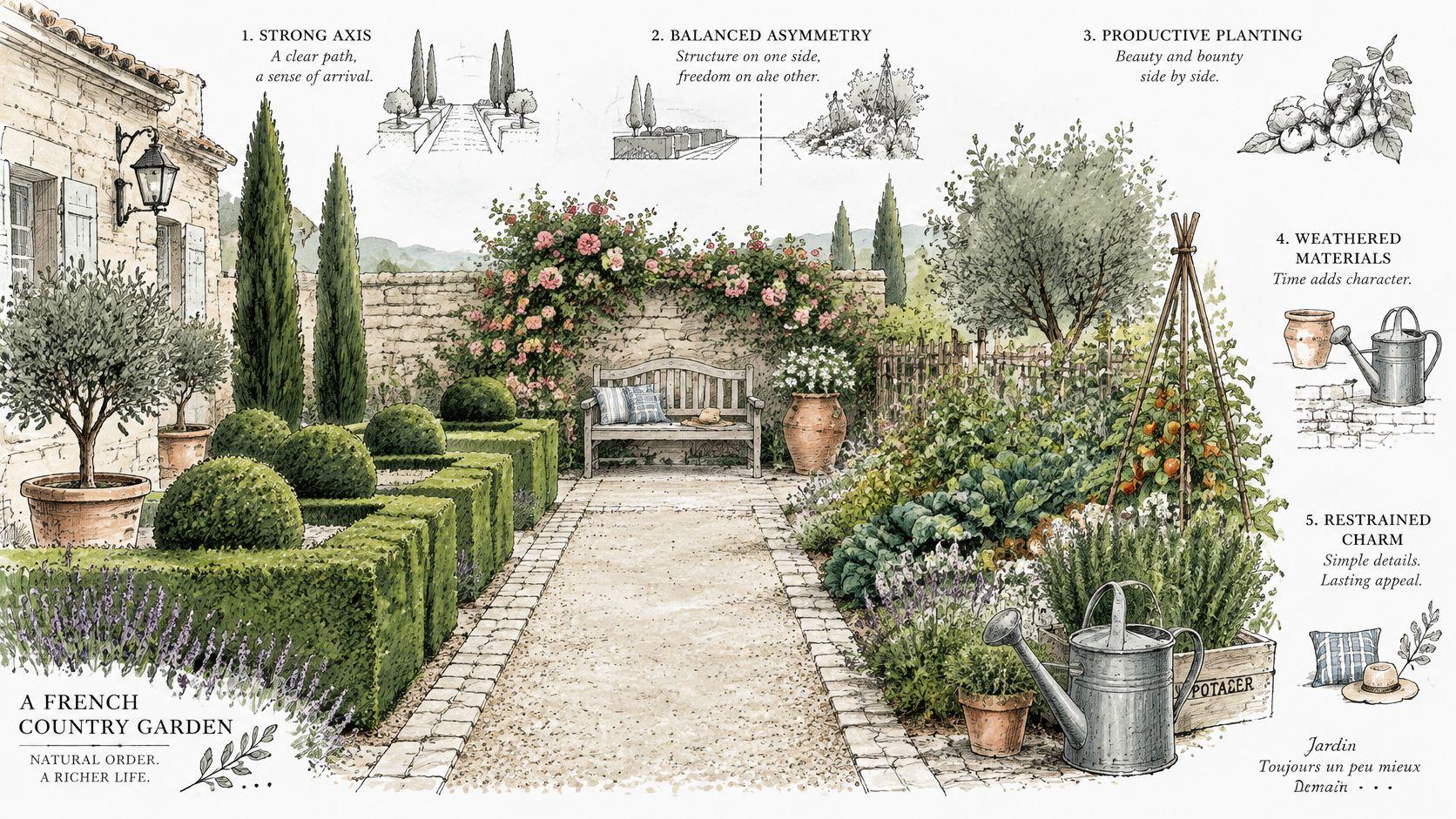
French Country style outdoors is a controlled tension between formal structure and relaxed, productive planting. It isn't a pile of rustic furniture, pale paint, or distressed signs. If you want to check your own yard against the look, look for five traits working together, not one decorative object doing all the work.
- One readable axis: A straight sightline runs from the house or terrace into the garden.
- Two or three repeated materials: Stone, wood, and dark metal show up more than once, weathered rather than shiny and new.
- A muted warm palette: Cream, ochre, sage, and dusty blue carry the color, not saturated brights.
- Abundant, slightly loose planting: Herbs, roses, and perennials spill a little over edges instead of sitting in tight, clipped balls.
- A visible destination: A fountain, tree, urn, or bench gives your eye somewhere to land.
Say you've got a plain rectangular lot. A gravel path runs straight from the back door to a stone bench under a small tree. Lavender and roses lean over the path edges, terracotta pots of herbs sit on the steps, and a dark iron gate repeats the metal of a small bistro set. Nothing there is expensive on its own. The plot reads as French Country because the path is ordered and the planting is lived in.
The Short History Worth Knowing
The roots sit in the seventeenth-century French estate tradition, where house, interiors, and grounds were planned as one composition. The Château de Vaux-le-Vicomte garden was built primarily between 1658 and 1661 by architect Louis Le Vau, garden designer André Le Nôtre, and decorator Charles Le Brun. Its garden covers approximately 33 hectares, or about 81.5 acres, with a main visual perspective extending roughly 1,500 meters. That distance and symmetry made the property feel larger and more theatrical, which is the same trick a short axis performs in a suburban yard.
What the style is not matters just as much. Heavy distressed clutter, competing surface patterns, and bright plastic accents break the reading instantly, even if each piece is labeled rustic. For indoor cues that pair well with this outdoor approach, French Country inspiration from Woodstock Furniture shows how the same muted palette and worn materials work inside the house. Outdoors, I'd start with layout, since that's the trait the other four depend on.
Lay Out the Garden Around One Strong Axis
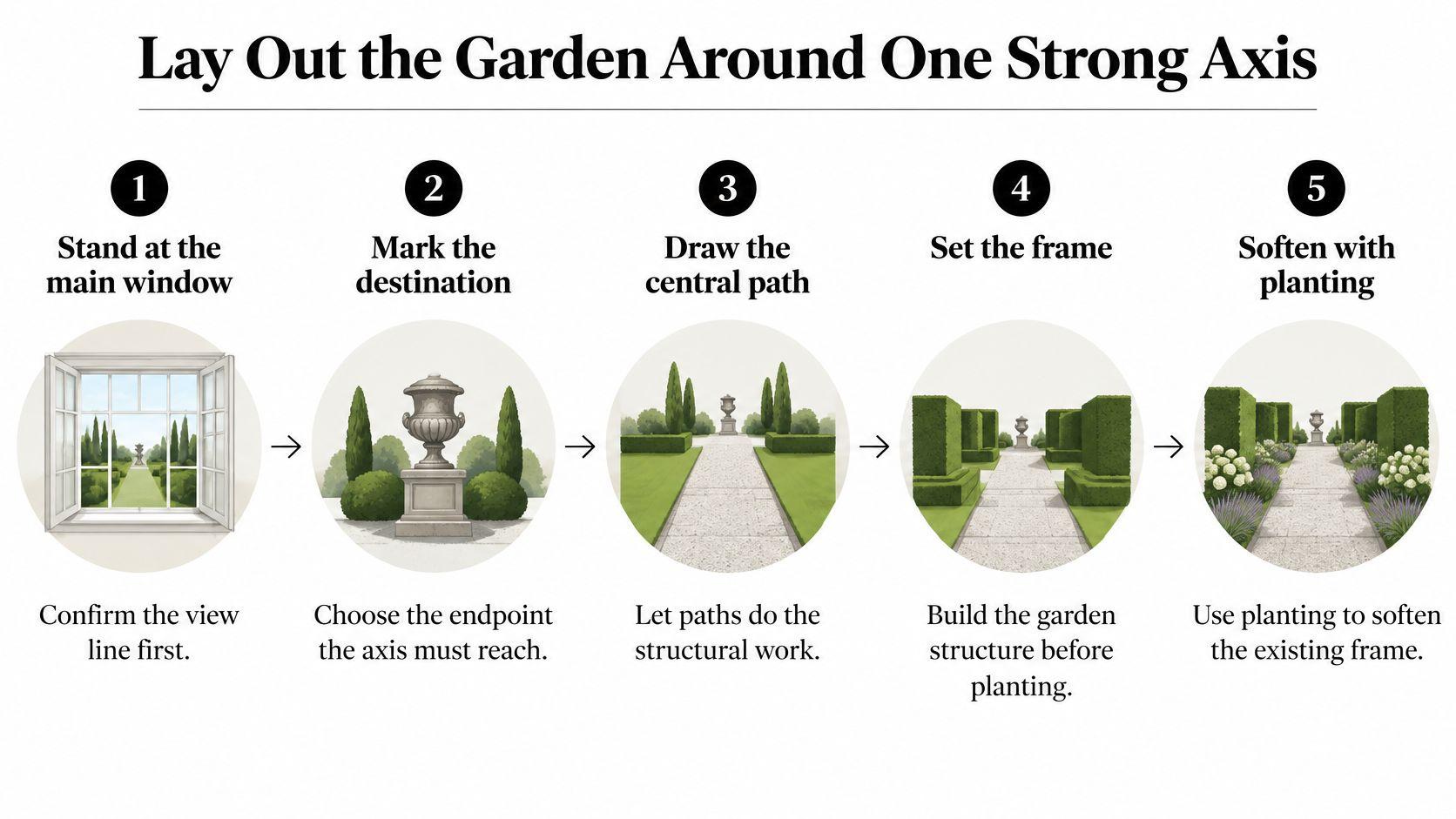
Layout comes first because paths and sightlines do the structural work. Planting only softens a frame that already exists. If you plant first and add paths later, you'll spend the season moving perennials that were in the wrong place. The visual below summarizes the sequence before you mark anything on the ground.
The French garden tradition behind this is the jardin à la française. An Oxford Academic history of the French garden describes its defining traits as geometric organization, strong axial views, repeated symmetry, clipped vegetation, and ornamental parterres. For a home garden, you borrow the geometry and relax the clipping.
Seven Steps, in Order
- Stand at the main window. Stand at the back door and sight your main line toward the far corner, then mark it with a hose or string. Confirm the view line first, because the axis must start where people look.
- Mark the destination. Choose the endpoint the axis must reach, such as a fountain, urn, tree, or bench. A visible end point makes the whole layout read as intentional rather than accidental.
- Draw the central path. Let paths do the structural work by laying gravel or paving along the line, about as wide as the back door. Matching the path width to the door ties the garden proportions to the house.
- Set the frame. Build the garden structure before planting by placing rectangular or symmetrical beds on each side of the path. Repeated edges create coherence even before anything blooms.
- Edge the beds low. Frame beds with low hedges or simple edging, and favor naturally compact shrubs. You keep the clipped look without committing to constant topiary work.
- Soften with planting. Use planting to soften the existing frame with mixed perennials, herbs, roses, and a fruit tree if you've got room. Leave one or two loose zones so the garden doesn't feel like a palace courtyard.
- Check from indoors. Look from a window and confirm your eye lands on the destination. If it doesn't, move the destination rather than the path, since the path is the expensive part to redo.
This short video walks through the same sightline logic in a real yard.
Practical rule: Repeated edges and aligned paths give order, while varied plant height, texture, and bloom timing keep the space from feeling strict.
When you're done, you should have a sketch you can measure, with a path width, bed sizes, and one destination. That's enough to price gravel and edging before you talk about plants at all.
Adapting the Look to Lot Size and Climate
French Country style doesn't transfer unchanged to every yard. The visual cues survive when materials and planting respond to your rain, heat, frost, and soil. Copying a Provence photo plant for plant in a cold or wet region usually gives you dead lavender and cracked pots by spring.
Scale by Lot Size First
A small yard needs restraint. One short axis, one pollinator bed, and paving near a third of the area is enough, because two competing axes in a tiny plot just look busy. A mid-size suburban lot can carry a full axis with two beds per side and a seating destination without crowding. A large rural lot earns the extras, a secondary path, an orchard corner, or a habitat edge of native shrubs and grasses along the boundary.
Climate changes the details, not the structure. Hot, dry sites need shade over paving so stone doesn't become unusable at midday, plus darker gravel that won't glare. Wet sites need drainage under gravel paths and raised beds on the axis so roots don't sit in standing water. Cold sites need frost-rated materials and planting that holds some structure through winter.
| Situation | Layout Scale | Paving Share | Water and Drainage Note |
|---|---|---|---|
| Large rural lot over 600 m² | Secondary path and native habitat edge | Under 20% | Rain capture and permeable gravel |
| Hot dry climate | Shade over paving and drought-tolerant beds | Darker gravel instead of pale stone | Drip irrigation and mulch |
| Wet climate | Raised beds on the axis | Permeable gravel and slope-aware paths | Drainage under paths and no standing water |
| Cold climate | Evergreen structure for winter | Frost-rated stone and terracotta only | Winter-hardy plants and insulated pots |
The regional translation is the part most guides skip. Guidance on plants for a French countryside style garden notes that English lavender is generally suited to zones 5 to 8, roses to roughly zones 4a to 8b, and jasmine mainly to zones 9 to 10. Those gaps are why classic species should be treated as optional in the United States, United Kingdom, Canada, Australia, and Mediterranean climates alike.
Match water availability, heat, winter exposure, and drainage first. A substitute that thrives looks more French than an authentic plant that's struggling.
Decide scale first, climate second, and plants last. That order prevents the most common waste in this style, buying the signature plants before you know whether your site can keep them alive.
Materials That Carry the Look
French Country style depends on patina and material contrast more than ornament. The Spruce guide to French interior design identifies the core vocabulary as weathered stone, exposed wood beams, terracotta, lime-plaster-like walls, wrought iron, aged hardware, and muted warm colors. Outdoors, that same list becomes paving, edging, pots, pergolas, and gates.
Why These Surfaces Work
Rough stone and aged timber absorb and scatter light instead of reflecting it sharply. That low reflective intensity is why these materials feel calm next to cream, ochre, dusty blue, and soft green. High-gloss finishes do the opposite, they create hard contrast and make everything nearby look newer and colder.
Choose two or three dominant materials and repeat them across walls, edging, planters, and furniture. Limestone, terracotta-toned paving, and dark aged metal is a reliable trio. Mixing many competing surface patterns breaks the cumulative coherence the style relies on, so a new material should have to justify itself against the ones you've already picked. That repetition applies across your patios, walkways, and retaining walls, since those elements set the material tone for everything planted around them.
| Element | Typical Material | Durability Check |
|---|---|---|
| Paving | Limestone or reclaimed-look stone | Choose freeze-thaw rated stone for your region |
| Walls and edging | Lime-plaster-look render or stone | Use exterior-rated finishes, not interior lime paint |
| Pots and paving accents | Terracotta | Frost-rated only; hollow pots crack in freeze-thaw |
| Pergola and bench | Weathered oak or cedar | Seal or oil every one to two years |
| Gates and furniture | Dark aged iron or steel | Powder-coated or galvanized to resist rust |
Decorative aging can't replace structural performance. Specify every finish against your local freeze-thaw cycles, moisture, and ultraviolet exposure before you buy, not after it fails. A mechanically distressed finish on a durable base material is fine. A soft, porous product sold on its aged look alone is not.
Finish with the planting cues that tie hardscape to the kitchen garden tradition. Herbs in terracotta on stone steps, a clipped rosemary or lavender edge, and seasonal flowers in the beds connect the built elements to a lived-in rural space. Those small, useful touches read as more authentic than any ornamental plaque or faux-aged sign.
Color Palettes That Stay Muted Outdoors
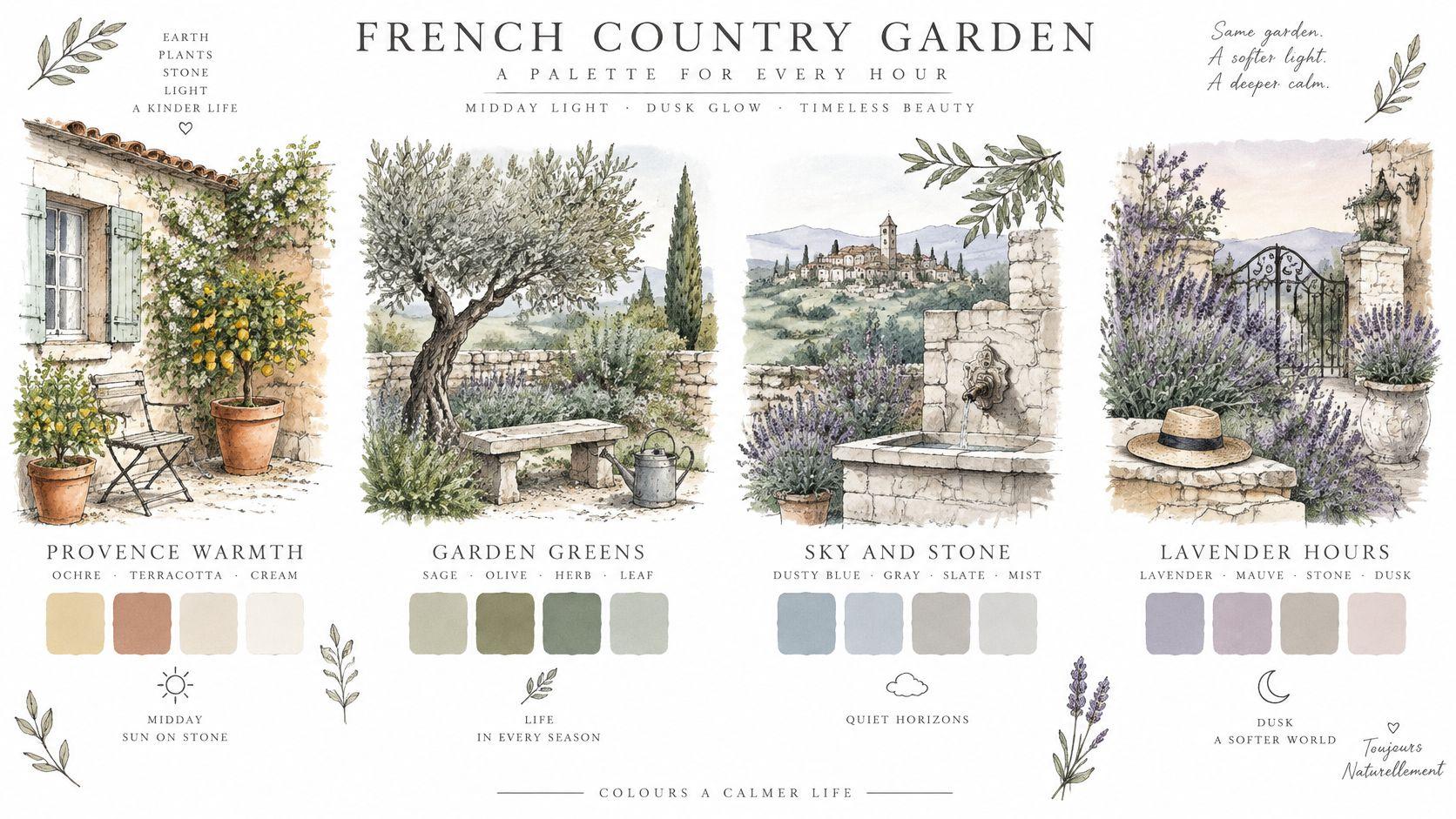
Outdoor color shifts with sun angle and season, so a palette has to stay calm at midday and at dusk. A cream that looks warm in the store can read stark white on a south-facing wall at noon. That's why I'd test before committing to paint, fabric, or gravel across the whole yard.
Use one dominant base color, one supporting color, and one accent used in no more than three places, such as a pot, a shutter, or a bench cushion. Then hold paint or fabric swatches against your actual stone or wood at midday and again in evening light. If a color only works in one of those lights, it doesn't work.
The illustration below sets the four palettes side by side so you can compare their temperature and contrast.
| Palette | Core Colors | Works Best With | Avoid |
|---|---|---|---|
| Warm Provence | Ochre, terracotta, cream | Limestone and lavender | Bright white trim |
| Soft coastal | Cream, dusty blue, sage | Pale gravel and weathered wood | High-gloss paint |
| Muted garden | Sage, lavender grey, cream | Dark iron and green foliage | Saturated purple |
| Stone and iron | Stone grey, aged black, cream | Terracotta accents | Many bright accent colors |
Saturated purples and high-gloss finishes are the two fastest ways to break the soft, aged reading. Gloss reflects hard light, and saturated color pulls focus away from the planting. Matte or eggshell finishes in greyed tones sit back and let foliage carry the saturation instead.
Pick one palette and carry it through everything, cushions, pots, painted wood, and flower color. Switching palettes between the terrace and the beds makes the garden feel like two projects. Consistency, more than any single color, is what holds the look together outdoors.
Planting Choices That Keep the Look and Habitat
The classic planting list is what readers recognize first, lavender, roses, rosemary, boxwood, and loosely overflowing borders. Those plants carry fragrance, soft color, and the productive feel of a kitchen garden. The problem is assuming they're mandatory. They're cues, and cues can be translated.
The Assumption Worth Dropping
Authentic French Country planting doesn't require importing traditionally French species. A Better Homes and Gardens 2026 garden trends report cited an 82% increase in demand for native species since 2020, linking them with wildlife support, soil health, and stormwater management. Formal geometry can still define your paths and outdoor rooms while native perennials, edible herbs, and locally appropriate shrubs fill the beds inside that frame.
| Classic Choice | Hardiness Reference | Climate-Adapted Substitute | Habitat Note |
|---|---|---|---|
| English lavender | Zones 5-8 | Russian sage with silver foliage | Pollinator-friendly and drought-tolerant once established |
| Rosemary | Zones 8-10 for most cultivars | Creeping thyme | Low-growing, attracts bees, tolerates poor soil |
| Garden roses | Zones 4a-8b | Hardy shrub roses such as Rosa rugosa | Check invasive status locally before planting |
| Jasmine | Zones 9-10 | Hardy clematis on a trellis | Provides shelter for birds; choose cultivars for local summers |
| Boxwood edging | Check local hardiness | Dwarf native shrub suited to your region | Provides winter cover; confirm hardiness with a local nursery |
Read the table by function, not by name. Russian sage gives you the silver foliage and haze of bloom that lavender provides, with better drought tolerance once established. Creeping thyme replaces rosemary's low fragrant edge in colder yards where rosemary won't overwinter. Hardy shrub roses keep the bloom and hips with far less spraying, though Rosa rugosa is invasive in some regions, so check your local list before planting it. Hardy clematis on a trellis does jasmine's vertical job where winters are too cold.
Adding a Habitat Layer
Mix edible herbs and native shrubs directly into the beds rather than segregating them. Keep one loose edge zone where insects can shelter and stems can stand through winter. Add a shallow water dish with a stone in it for insects to land on, and place a bee hotel where it gets morning sun and shelter from driving rain.
- Layer heights: Groundcover, mid-height perennials, and one small tree or large shrub give birds food and cover at different levels.
- Sequence bloom: Choose plants so something flowers from spring into fall, which keeps pollinators fed across the season.
- Leave seed heads: Standing stems feed birds and shelter insects, and they suit the relaxed side of this style.
For more planting combinations that support pollinators inside a designed bed, these butterfly garden tips for DIY landscapers translate well to a French Country border. The beds still sit inside your axis and edging, so the yard looks intentional rather than abandoned.
A slightly loose edge reads French and needs less pruning and irrigation than a strictly clipped border.
Accept some looseness as part of the design, not a maintenance failure. You'll cut back less often, water less once plants are established, and still keep the romantic overflow the style is known for.
Test Your Layout and Plan Upkeep
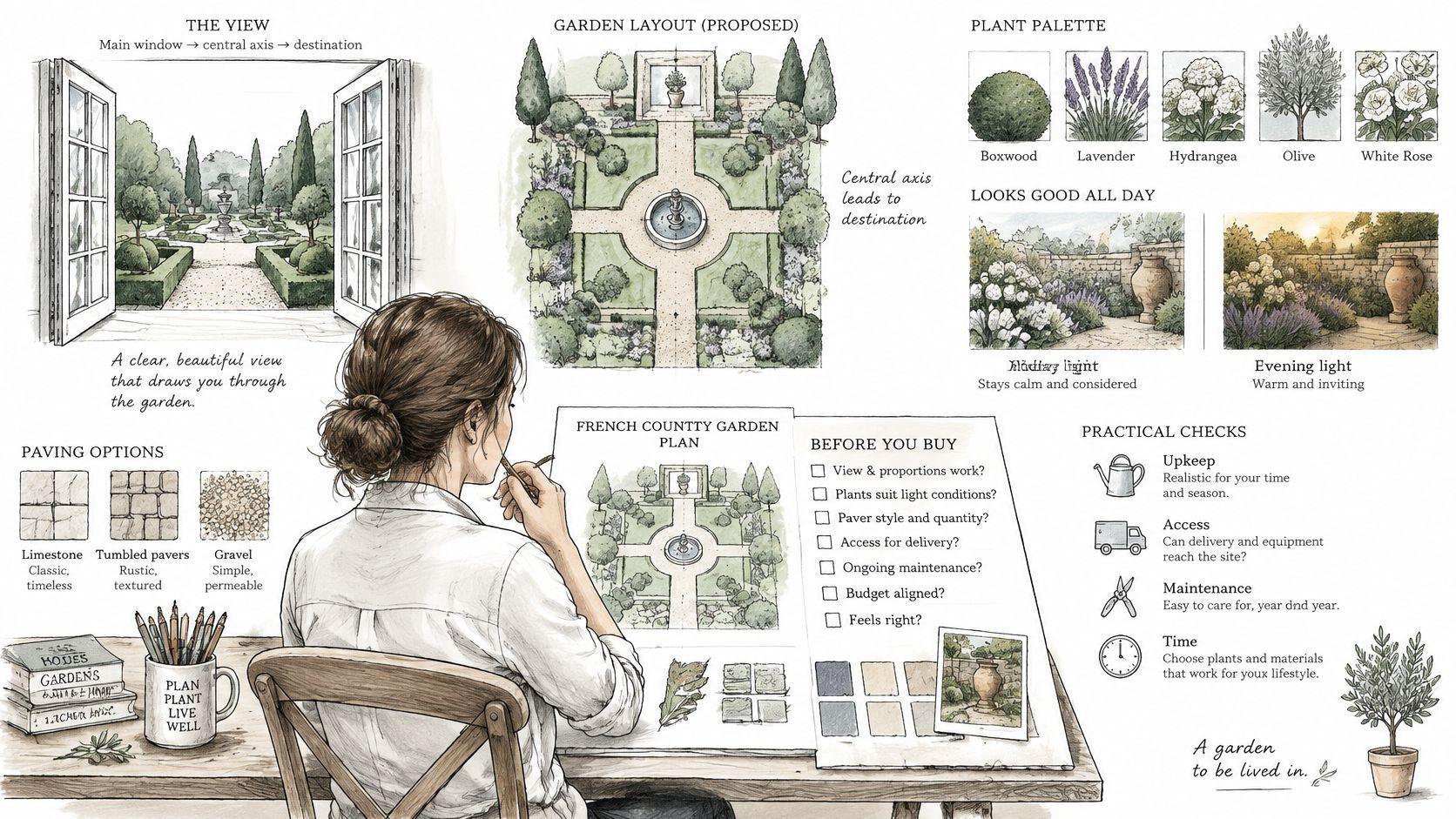
Before you buy pavers or plants, run your plan against four checks. The axis should still land on its destination from the main window. The palette should hold under both midday and evening light. The planting should match your climate and the water you can supply. The new check is habitat, at least one loose zone should exist for insects and low maintenance.
The Photo Test
Photograph the yard from the back door with the house and garden in frame, then compare three layouts side by side on that real view. Seeing options on your own space settles decisions faster than sketches, because proportions and existing trees stop being guesses. Our advice for the photo is to shoot the patio or the bare space with the house and yard in frame for context. You can also compare modern, cottage, desert, tropical, and Mediterranean styles on your own photo if you want to confirm French Country is really the direction you prefer.
The sketch below shows the kind of working plan worth taking to a nursery, layout, plant palette, and practical notes on one page.
If you want to test layouts digitally before committing, this roundup of the best free garden design software covers options that work from a photo or a simple plan view. Whichever tool you use, keep the house and property lines fixed and only change surfaces, beds, and planting. That constraint keeps the concept buildable.
A Realistic Upkeep Plan
- Seal timber on schedule: Weathered oak or cedar needs sealing or oiling every one to two years, or the patina becomes rot.
- Clip edges sparingly: One or two trims a year on low hedges keeps the frame readable without weekly work.
- Let the loose zone work: That area absorbs pruning and irrigation you'd otherwise spend on a clipped border.
- Refresh gravel, don't replace it: Rake and top up thin spots instead of re-laying whole paths.
Take your chosen layout, palette, and planting list to a nursery or contractor as one package. Then start with one axis and one bed rather than the whole yard. You'll live with the proportions for a season, adjust planting density, and extend the same materials when you're confident. I'd rather see one finished axis than a whole yard of half-started beds.
Upload one photo of your yard to OutdoorBrite and compare French Country alongside modern, cottage, Mediterranean, and other styles on your own space in seconds, keeping your house and layout intact. You'll get realistic concepts with planting and materials you can refine, download, and take to a nursery or contractor before spending on pavers and plants.
See your yard reimagined
Start creating