Leccino Olive Tree: A Complete Growing Guide
Learn how to grow and care for the leccino olive tree, an Italian classic. Get tips on planting, pruning, and harvesting for a bountiful crop.
Leccino is widely grown around the world and prized for cold hardiness, but it's self-incompatible, so a single tree planted alone will struggle to produce a meaningful harvest without a nearby pollinizer. That one fact changes almost every planting decision, from where you place the tree to what you plant beside it.
Table of Contents
- Why the Leccino Olive Tree Is Not What You Think
- The History and Origins of the Leccino Cultivar
- Climate, Soil, and Growing Conditions Leccino Prefers
- How to Plant, Water, Fertilize, and Prune a Leccino Olive Tree
- Pollination Requirements and Compatible Olive Cultivars
- Harvesting Timing, Oil Quality, and What to Expect from Leccino Olives
- Using Leccino Olive Trees in Garden Design and Yard Placement
Why the Leccino Olive Tree Is Not What You Think
The biggest mistake with a Leccino olive tree is assuming it behaves like a self-sufficient backyard fruit tree. It doesn't. Leccino is self-incompatible, which means a lone tree can grow beautifully and still set very little fruit if there isn't a compatible pollinizer nearby.
That's the part retail listings often soften. A healthy trunk, glossy leaves, and strong vegetative growth don't automatically translate into a crop. In practice, the tree can look excellent all season and still disappoint at harvest if the pollen story is wrong.
Why the marketing version falls short
Leccino has earned its reputation for resilience because it survives in places where other olives struggle, and that reputation is real. It's also a historically established Italian cultivar that spread far beyond its original growing region, especially over the last 50 years, as olive production expanded in markets such as California, Chile, and Australia (Leccino overview). But resilience is not the same as independence.
Practical rule: If you want fruit, don't ask only whether Leccino will live. Ask what will pollinate it.
The useful way to think about Leccino is as a reliable production tree that still depends on orchard logic. That means spacing, wind movement, and nearby compatible cultivars matter. It also means a homeowner who buys one tree for a patio corner and expects buckets of olives may be disappointed, even with excellent care.
A good Leccino can still be worth planting. The point is to buy it for what it is, not for a fantasy version of a “set it and forget it” olive. Its value comes from toughness, adaptability, and a long commercial track record, not from self-sufficiency.
The History and Origins of the Leccino Cultivar
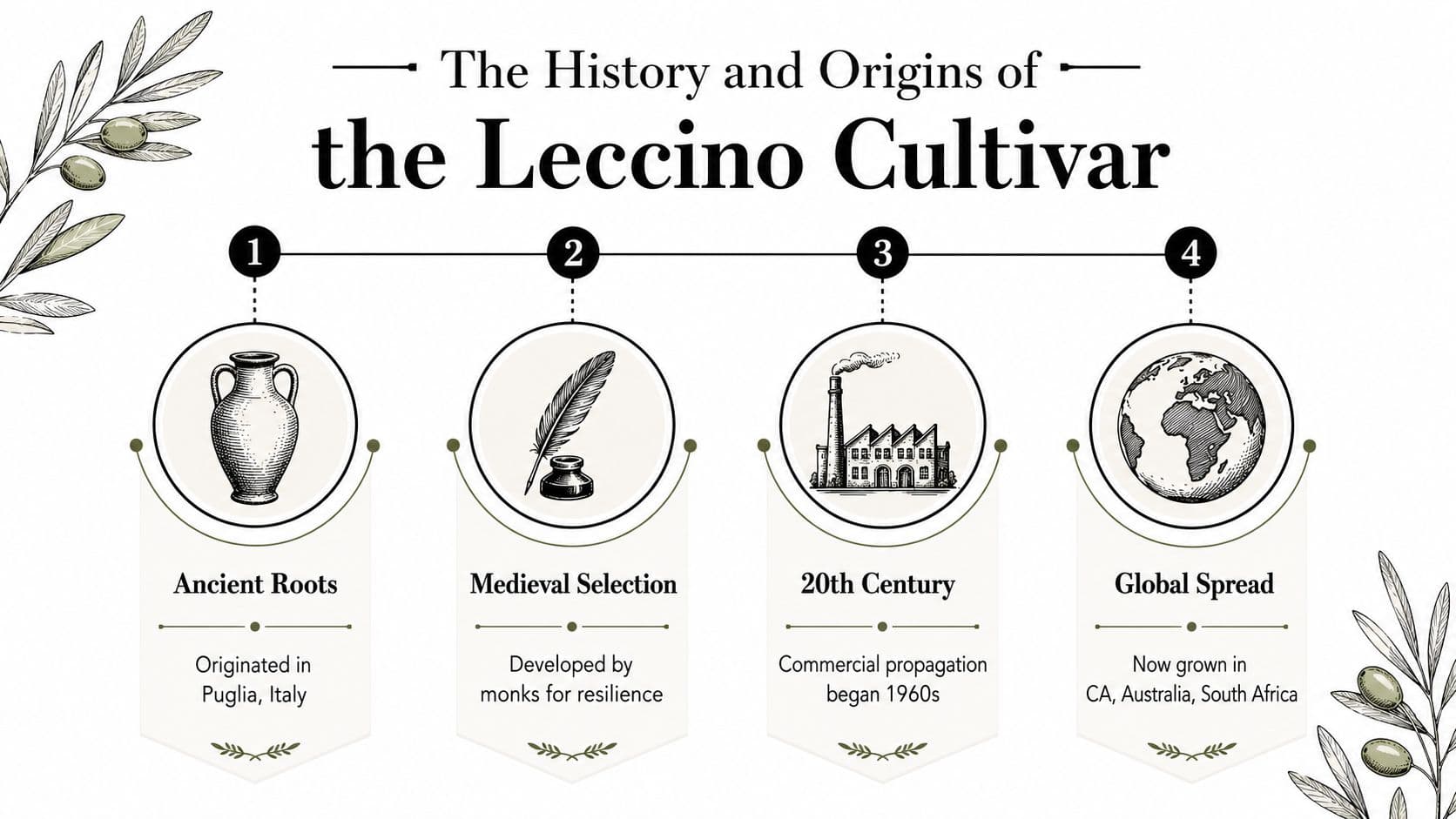
Leccino comes out of old Italian olive culture, not modern branding. Written references appear near the end of the Middle Ages, and the name is usually tied to Lecce in southern Italy, though some accounts point to Tuscany. Italian olive history sources describe it as a long-established cultivar with deep regional roots, which matches what growers have seen in the field for generations. Its value was never mystery. It was durability.
That long history matters because Leccino earned its place the hard way. It was already known as a reliable tree before modern nurseries and retail catalogs turned it into a bestseller, and its spread across Mediterranean farming was gradual rather than sudden. For a plain-language cultivar profile, see the Leccino overview. For growers trying to understand how this old variety moved from local use into broader planting, the point is simple, it survived because people kept replanting it.
From survival tree to commercial standard
The big reputation shift came after the 1985 frost in Italy, when some regions lost up to 90% of their olive trees. Replanting followed, and Leccino became a favored choice because it handled low temperatures better than many alternatives. In some places, the Forestry Service handed out seedlings free of charge, which helped carry the cultivar from one region into many others (frost and replanting history).
That cold event did more than damage orchards. It changed grower behavior. Once farmers had watched a tree survive conditions that wiped out more tender cultivars, Leccino stopped being just a familiar Italian olive and became a practical reset option for cold-prone sites. I have seen that same logic repeated by growers who value a tree that comes back after a bad winter, even if it is not the flashiest choice in the nursery row.
Leccino later gained attention for another reason, tolerance in areas affected by Xylella fastidiosa. Studies and field observations continue to inform planting decisions in those regions, and the cultivar's reputation for resilience has kept it in discussion where other olives have been lost. The same survival instinct that made it useful after frost also made it a candidate for difficult disease pressure, though no grower should mistake tolerance for immunity.
The practical takeaway is that Leccino became commercially important because it proved itself in hard conditions, then kept proving itself in ordinary ones. A grower who wants a candid market snapshot can also look at the olive listing on Shopifarm, which shows how Leccino sits among other olives offered to gardeners and orchard planners. Its history is not a story of perfect ease. It is a record of repeated use by people who needed a tree that could take a hit and keep producing.
Climate, Soil, and Growing Conditions Leccino Prefers
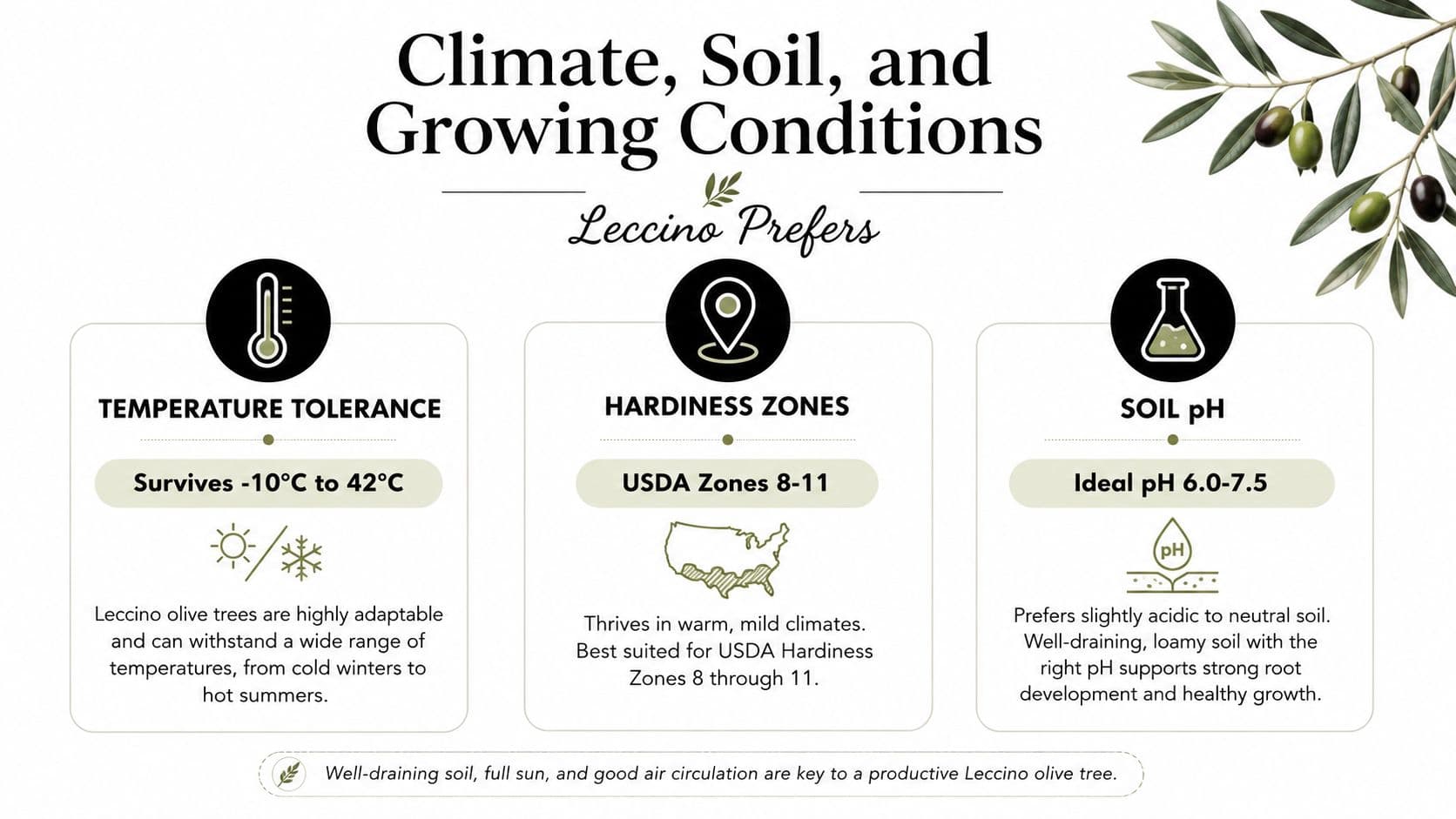
Leccino pays you back in sites that give it full sun, open air, and sharp drainage. Grow it where winter cold is real but not brutal, and where summer heat does not sit trapped around the canopy all day. The cultivar is generally described as hardy and adaptable, with tolerance spanning -10°C to 42°C, and cultivation guidance commonly places it in USDA Zones 8-11. That range explains why it fits many Mediterranean-style gardens and warmer orchard regions, but it does not make the site choice automatic. In practice, the tree still reacts to exposure, soil texture, and how long water lingers around the roots.
Soil decides more than many owners expect. Leccino prefers well-drained ground with an ideal pH of 6.0-7.5. Heavy soil that stays wet will slow establishment and can leave the tree looking dull even when the canopy seems healthy aboveground. The growing conditions infographic data reflects that same basic rule, the roots need air as much as they need moisture. If the root zone behaves like a sump, the tree will never perform like a true dryland olive.
Canopy position changes fruiting potential
One of the least discussed parts of Leccino management is that the tree does not fruit evenly everywhere. Research on Leccino shows that inflorescence traits and floral quality vary by canopy position, so the productive wood is not spread uniformly through the tree (Leccino canopy research). Outer and upper branches usually receive better light, while crowded interior wood tends to lag. Pruning decides how much of that canopy gets enough sun and air to flower well.
Grower's rule: Dense canopies give patchy yield. Even light across the framework gives a more dependable tree.
That is the part casual buyers miss. A young Leccino can look forgiving in a nursery pot, then become uneven once it matures and shades itself. The tree is adaptable, but its fruiting still follows microclimate inside the canopy, especially where shading, humidity, and air movement change from branch to branch.
Heat is becoming the harder test. In warm regions, summer stress can push the tree harder than its cold-hardiness reputation suggests, especially when intense sun hits exposed foliage and interior wood dries out fast. Cold tolerance still matters, but it should not distract from the fact that hot spells and poor airflow can weaken performance in places that once seemed safely within Leccino's comfort zone. Some orchard decisions now depend as much on managing heat load as on surviving winter.
If you are setting up a site from scratch, the ground matters more than any quick fix. Good drainage, decent structure, and enough sun do most of the work before the tree ever settles in.
How to Plant, Water, Fertilize, and Prune a Leccino Olive Tree
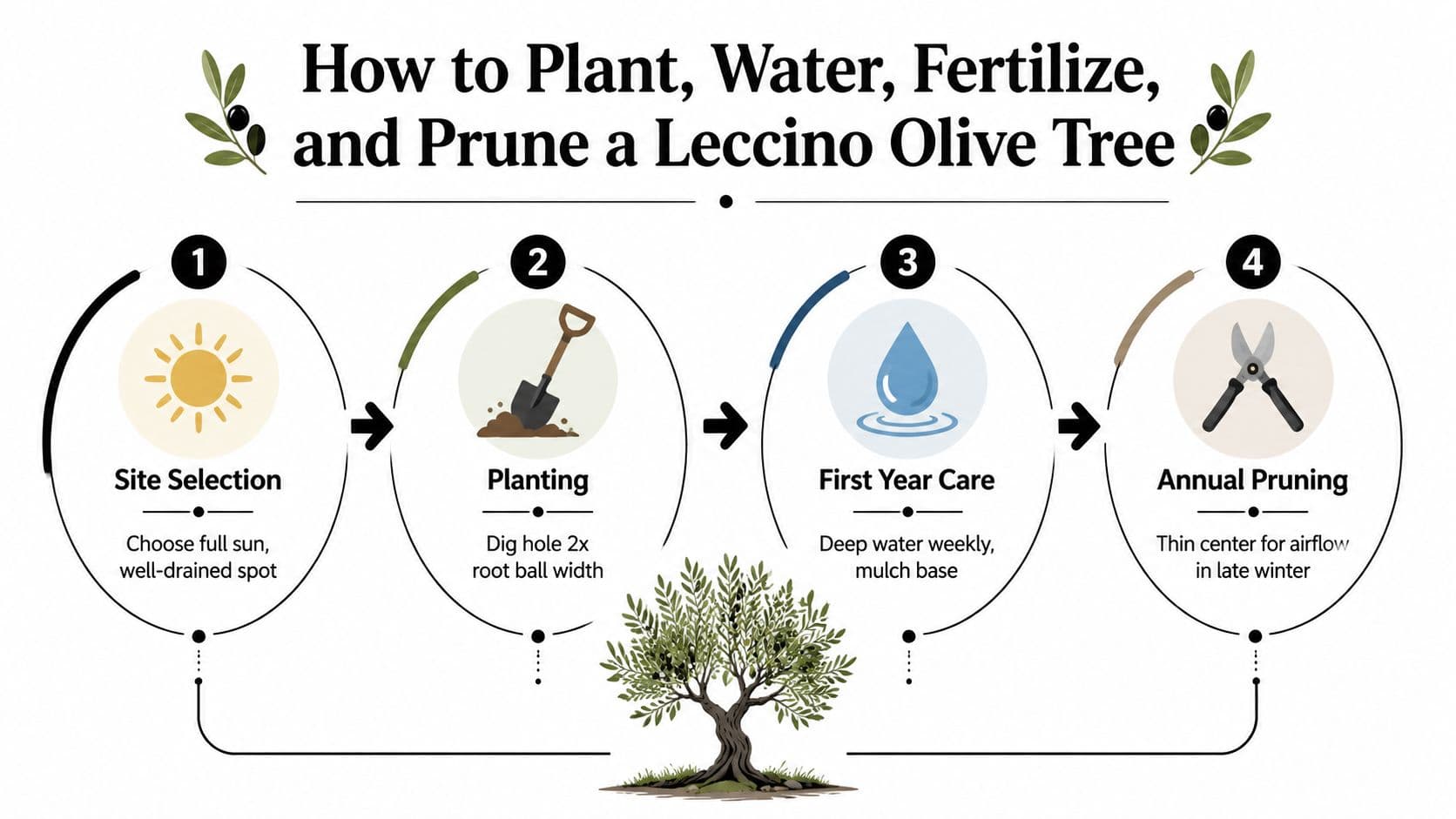
A Leccino does best when you treat it like an orchard tree from the start. Give it full sun, open air, and soil that drains well, then dig a planting hole wide enough to loosen the root zone without burying the trunk flare. Water management matters, but drainage has to come first.
For soil prep, the practical rule is simple, improve structure without turning the planting area into a bathtub. If the ground is compacted or slow to drain, deal with that before the tree goes in. For a clear primer on prep sequencing, the guide to getting dirt ready for planting is a solid starting point.
Planting and first-year care
Use a hole wider than the root ball, then backfill with the native soil you removed unless the site is extremely poor. That helps roots move outward into the surrounding ground instead of circling inside a pocket of amended mix. Keep the root flare visible, water thoroughly after planting, and mulch lightly around the base without piling mulch against the trunk.
Good establishment beats heavy feeding. A young olive usually responds better to steady moisture and oxygen at the roots than to aggressive fertilizer.
During the first growing season, water thoroughly and on a regular rhythm rather than with shallow sprinkles. Mature olives can handle relative dryness once established, but a new tree is building roots and cannot be treated like a desert shrub. If the soil dries hard and cracks around the root ball, growth will stall. For specific timing advice, see our OutdoorBrite Money planting tips.
Late winter is often the cleanest window for planting in many yards, because the tree is less stressed and the ground is still workable. First-year care is mostly about restraint. Keep the root zone evenly moist, avoid heavy fertilizer, and let the tree spend its energy on roots instead of top growth.
Feeding and pruning with a long view
Fertilize lightly and at the right time. The tree is vigorous by nature, so overfeeding can push leafy growth at the expense of balanced structure. The goal is steady, functional growth that supports flowering wood, not a flush of soft shoots that later need to be cut back.
Pruning should build a strong framework early. Keep a central leader or a clear open structure, remove crossing wood and water sprouts, and thin crowded interior growth so light can reach fruiting zones. That matters with Leccino because canopy position directly affects flowering quality and yield, and shaded interior wood rarely carries the same performance as branches that sit in better light.
Late winter usually gives the cleanest view of the branch system, and it is easier to shape the tree before active growth starts. Once the tree matures, the job is not heavy haircutting. It is controlled thinning so the canopy stays bright, airy, and productive. In a home yard, that usually means a few careful cuts can do more than a hard prune.
Pollination Requirements and Compatible Olive Cultivars
Leccino is where a lot of home growers get the story wrong. The tree is self-incompatible, so it does not set fruit well on its own and needs pollen from another compatible olive nearby. Olive pollen moves by wind, not by bees, so the question is not whether the tree blooms. The question is whether pollen can reach the flowers in enough quantity to matter, and that depends on what is planted around it. Leccino pollination guidance
Distance is part of the problem, but so is site layout. Guidance for Leccino pollination points to keeping a compatible cultivar within about 20 ft. to improve fruit set, and that advice reflects how easily wind can be broken up by fences, walls, hedges, and tight suburban corners. A tree may look fine and still underperform if the pollen source is tucked too far away or sits where air barely moves. Leccino pollination guidance
Best companion cultivars
The most practical companions are Frantoio, Pendolino, Maurino, and Moraiolo. They are used because their bloom periods fit Leccino well enough to support cross-pollination, and they show up often in mixed plantings where fruit set matters more than tidy symmetry. Leccino pollination guidance
- Frantoio: A solid companion for growers who want a familiar Italian pairing in an orchard or a larger yard.
- Pendolino: Often used as a pollinizer because it fits into mixed plantings without adding much complexity.
- Maurino: A workable choice when the goal is to add another compatible olive to the planting mix.
- Moraiolo: Useful in traditional Mediterranean systems where several cultivars are grown together and cross-pollination is part of the plan.
Some nursery listings make Leccino sound capable of carrying itself, and that is where expectations get inflated. The tree is vigorous and can flower well, but vigor is not the same thing as reliable fruit set. A single Leccino can look healthy, hold a strong canopy, and still give a thin crop if there is no matching pollen source nearby. Leccino pollination guidance
That trade-off matters. If you are planting for shape, shade, or a tough Mediterranean look, Leccino can still make sense on its own. If you want a dependable harvest, cross-pollination is the part that deserves attention first, because a lone tree in the yard often performs better on paper than it does in the basket.
Harvesting Timing, Oil Quality, and What to Expect from Leccino Olives
Leccino tends to ripen early and fairly evenly, so the harvest usually comes in a tight window, often in October and November. That uniform ripening helps with logistics, but it also leaves less room for hesitation. Pick too late and the fruit shifts past the stage that gives clean oil. Go too early and you leave usable yield hanging on the tree.
The fruit is medium-sized and releases fairly easily once it reaches maturity. That makes picking less laborious, but it also means you need to watch the canopy closely as color change advances. A crop that starts shedding at the right time can move from ready to overripe fast, especially on a tree with exposed upper limbs or uneven fruiting inside the canopy.
What the oil tends to be like
Leccino oil usually falls in the 17–22% yield range by fruit weight, with some sources clustering it at 18–21%. The profile is generally mild and lightly fruity, which suits home presses and small batches where a softer oil is preferred. It is not a forceful oil, and that is part of its appeal.
Leccino harvest characteristics notes that the fruit is suitable for timely picking, and that practical detail matters more than any marketing line about easy harvests. In real use, the best oil usually comes from olives taken before full ripeness, when freshness is still in the fruit and the press keeps the character cleaner.
Handling decides a lot. Bruised olives, deep piles left sitting too long, or a slow trip to the mill all cut into the clean profile Leccino can give. The cultivar has some tolerance for less-than-perfect conditions, but it does not fix poor harvest handling.
A mature Leccino rewards disciplined timing more than casual neglect. Harvest at the right stage, move the fruit quickly, and do not assume the tree's forgiving reputation means the crop can be ignored. Canopy position also matters, because fruit on the outside often matures differently from fruit held deeper in shade, and that difference shows up in the basket.
For growers trying to judge placement and harvest access before planting, ai for garden design can help test where the tree will sit in the yard. That kind of planning is useful when you want easy picking, lower fruit drop trouble, and a better read on which side of the canopy will carry the best crop.
Using Leccino Olive Trees in Garden Design and Yard Placement
Leccino earns its place as a structural tree, and that is how I'd use it in a yard. Its drooping habit and dense foliage suit Mediterranean courtyards, coastal plantings, and modern spaces that need a calm, architectural anchor. Put it in the right spot and it softens hard lines without turning fussy or formal.
Placement decides whether it looks balanced or cramped. Give it full sun and real breathing room, because this tree performs best when the canopy can open naturally instead of being pressed against a wall that traps heat and cuts airflow. If you're planting more than one olive, space them so light still reaches the lower and middle canopy, since shaded interiors carry less fruit and weaker growth.
The cleanest approach is to design in layers. A Leccino can stand on its own near a patio, or it can sit at the edge of a mixed planting and read like a small orchard tree with a purpose. It also works well with stone, gravel, terracotta, and restrained planting palettes, because its form already brings enough visual weight to anchor the composition.
For layout work before you buy, ai for garden design lets you test placements without guessing. A photo-based concept render helps when you're choosing between a tree near seating, along a driveway, or farther back in the yard where fruit drop matters less and harvest access changes.
The YouTube walkthrough below shows how a redesign workflow can be used before a tree ever goes in the ground.
Good placement solves three problems at once, sun exposure, visual balance, and easy harvest access. If you can stand back and read the tree's shape, reach the fruit without fighting the canopy, and keep the root zone out of standing water, the site is doing its job. That is the difference between a tree that looks right for years and one that becomes a nuisance after the first few seasons.
If you're planning a Leccino planting and want help visualizing the layout before you commit, visit OutdoorBrite Money. It lets you turn a yard photo into a realistic redesign, so you can test olive placement, style, and spacing with far less guesswork. For a tree like Leccino, that preview can keep a handsome tree from ending up in the wrong place.
See your yard reimagined
Start creating