Modern Front Yard Drought Tolerant Landscaping
Design a modern front yard drought tolerant landscaping plan with style, curb appeal, and real water savings. Practical steps, plant picks, and budget tips.
You're standing on the porch, looking at a lawn that has gone brown despite regular watering. The latest restriction changed your schedule, the water bill climbed, and the front yard still looks tired from the street. Replacing the grass sounds simple until you start asking practical questions: What will survive the summer, where will rain go, and how can the result look deliberate instead of like a pile of gravel?
Modern front yard drought tolerant landscaping works when those questions are answered together. The strongest designs treat the frontage as a water-budgeted yard with a clear visual composition, not as a plant-shopping exercise. You decide where water matters, where structure matters, and where low-water planting can carry the design.
Table of Contents
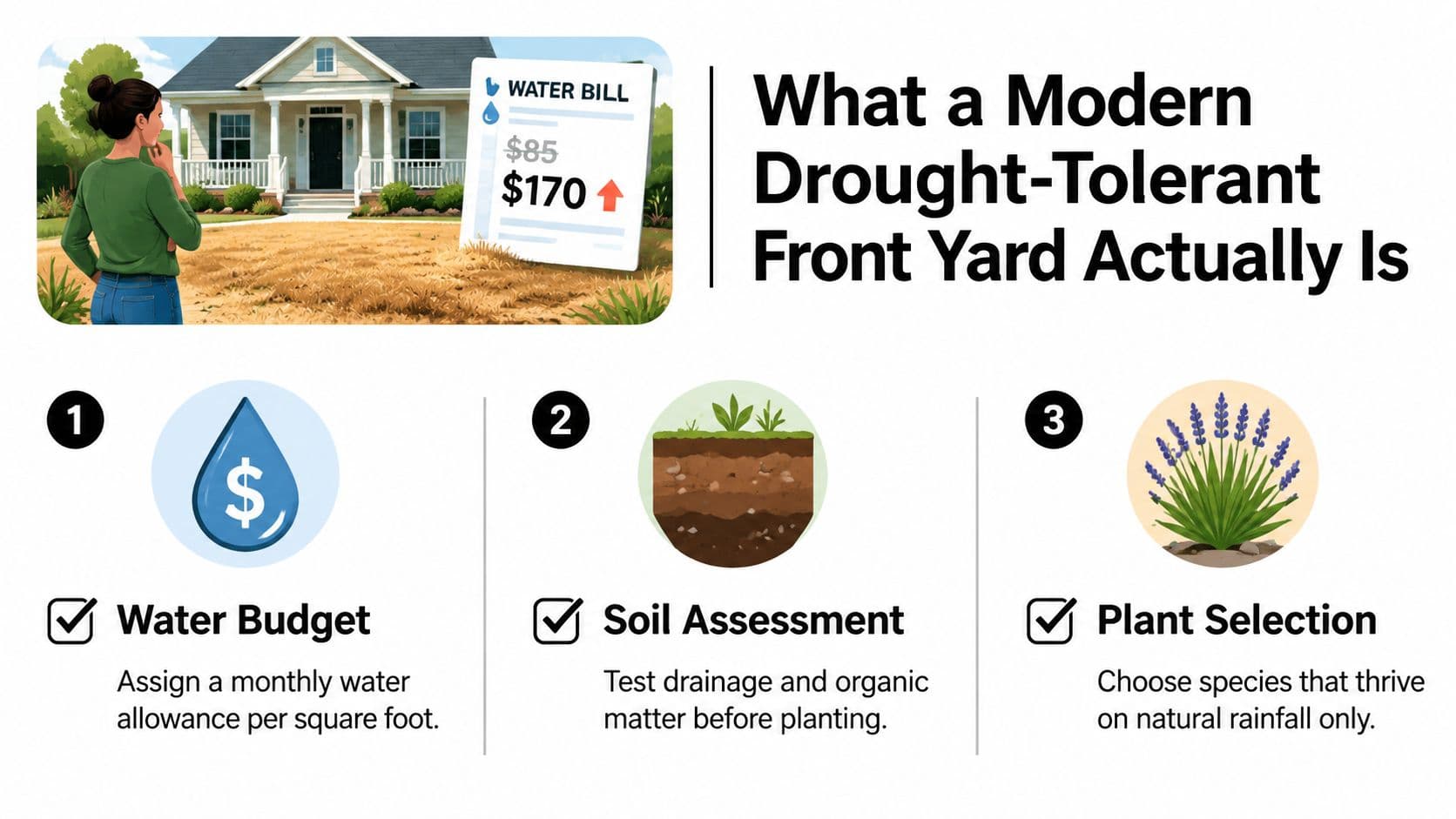
- What a Modern Drought-Tolerant Front Yard Actually Is
- Design Principles That Make It Look Modern
- A Plant Palette Built Around Your Climate
- Hardscape and Materials That Hold the Design Together
- Irrigation and Drainage That Keep the Savings Real
- Installation Order From Demolition to Mulch
- Realistic Budgets and a Year-One Maintenance Schedule
What a Modern Drought-Tolerant Front Yard Actually Is
The modern approach grew from xeriscape, a term Denver Water adopted and promoted in 1981. A public demonstration garden followed in May 1982, helping move water-wise yard design from a specialist idea into a visible municipal practice. Denver's longer water-use trend shows why that shift matters. Despite the metro population nearly doubling since 1980, the five-year average fell from about 70,000 million gallons in 1976–1980 to about 66,000 million gallons in 2016–2020, as reported by Westword's account of Denver Water and xeriscape.
That history doesn't mean every modern yard should copy a traditional xeriscape. A polished front yard usually combines massed low-water plants, structured hardscape, deliberate negative space, and targeted irrigation. It may include a small lawn panel, a shaded tree canopy, or a few higher-water accents near the entry. It shouldn't look like a cactus collection unless that's the homeowner's style.
Practical rule: Design the front yard for the view from the sidewalk first, then assign water to the areas that earn visual attention.
A native plant garden and a drought-tolerant garden aren't identical. Native plants can be excellent choices, but a native species may still need supplemental water in an exposed urban site. Artificial turf can eliminate routine irrigation, but it introduces a different set of questions about heat, texture, drainage, and replacement. The practical middle ground is a planted system that uses climate-adapted species, efficient delivery, mulch, and enough hardscape to make the composition easy to read.
Walk the lot before choosing plants
Before opening a plant catalog, sketch the site on one page. Mark the following:
- Sun exposure: Record morning, midday, and afternoon sun, then check how that changes by season.
- Slope and runoff: Identify where water currently ponds, washes toward the sidewalk, or collects beside the foundation.
- Soil behavior: Squeeze a sample to understand texture, then perform a simple percolation test in likely planting beds.
- Existing infrastructure: Locate irrigation stub-outs, valves, electrical lines, gas lines, downspouts, and utility boxes.
- Public sightlines: Stand across the street and on the sidewalk. Note which windows, steps, house numbers, and entry path need framing.
- Rules and constraints: Check HOA limits, municipal hardscape rules, visibility requirements, and restrictions on front-yard fencing or drainage changes.
Microclimates can change within a few feet. A south-facing strip against stucco may reflect heat onto lavender or agave, while a parkway below a mature street tree may stay cooler but compete aggressively for moisture. A fence can create a wind shadow, and a narrow strip beside pavement can heat roots far more than an open bed.
The constraint that shapes everything else is the amount of lawn you're removing and what replaces it. A large gravel field may reduce irrigation but create glare and feel unfinished. A dense planting bed may look generous at maturity but require more establishment care and pruning. If you're using visualization before construction, an ai front yard design tool can help compare bed shapes and material layouts on the actual property, but the site audit still determines whether the concept will survive.
Write the plan as zones, not as a shopping list. Draw the entry path, lawn or usable panel, major tree, planting masses, drainage direction, and irrigation valves. A contractor should be able to understand the intended structure without guessing where each plant belongs.
Design Principles That Make It Look Modern
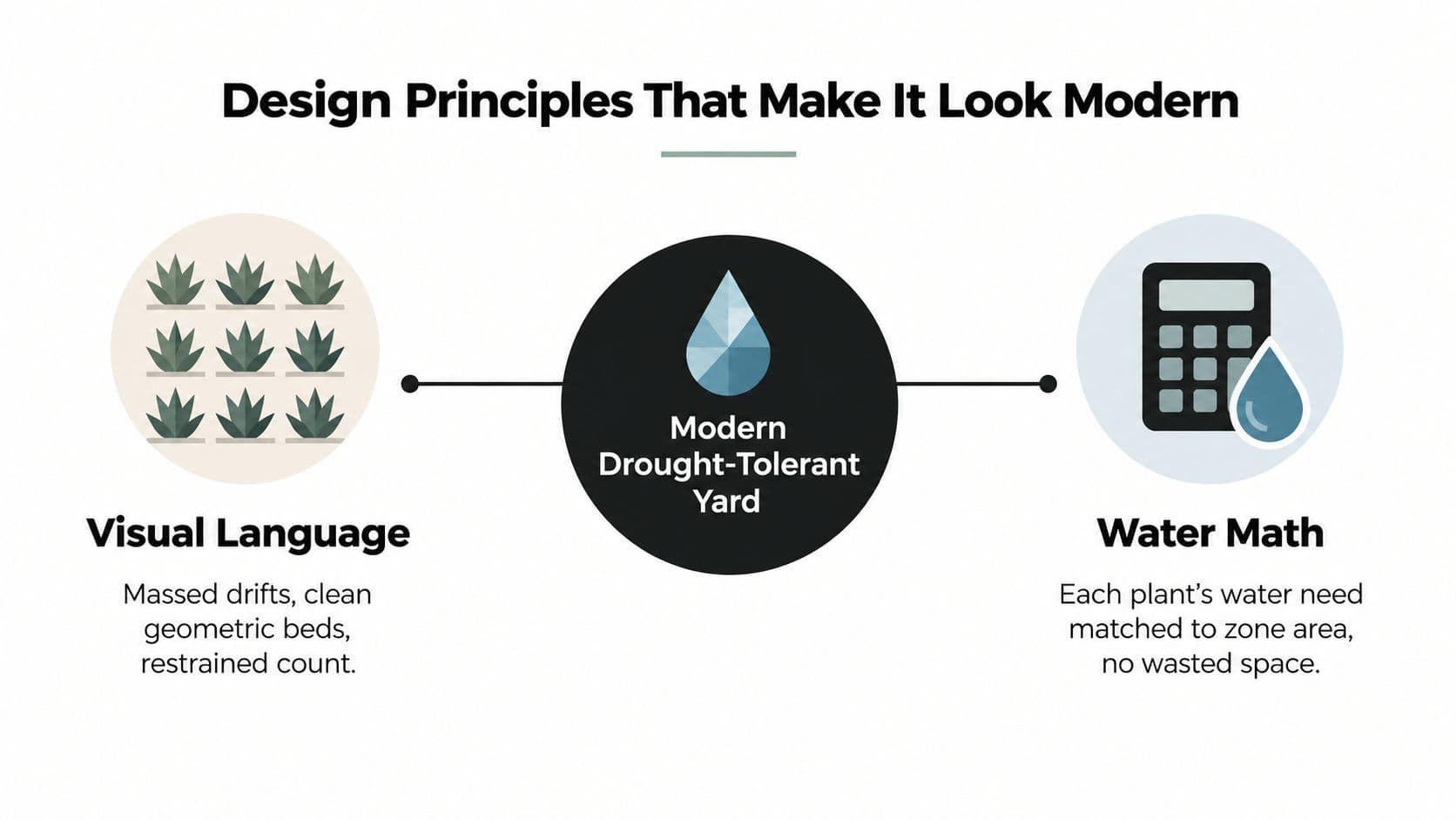
A modern yard looks calm because it repeats decisions. Use broad planting drifts, crisp bed lines, restrained species choices, and one dominant ground texture. Three repeated shrubs read as an intentional rhythm. Nine unrelated one-off plants often look like leftover inventory, even when every plant is attractive on its own.
The same restraint improves water performance. Group plants by need into hydrozones, then keep higher-water planting close to the areas where people look, such as the porch, front steps, or a prominent window. The University of Georgia Xeriscape guide recommends zoning no more than 10% of the yard for high-water use, 30% or less for moderate-water use, and at least 60% for low-water use.
Let geometry do the visual work
A strong composition might use a rectangular gravel field, a narrow concrete band, and two sweeping planting beds that frame the walkway. Within those beds, repeat one architectural grass, one flowering perennial, and one evergreen shrub. The repetition gives the eye a pattern, while the open ground makes the plants feel deliberate rather than crowded.
Avoid mixing decomposed granite, bright river rock, bark, and several colors of decorative stone in the same view. A single ground texture creates continuity and makes weeds, fallen leaves, and irrigation repairs easier to see. Clean steel or concrete edging can separate that texture from planting without adding another competing material.
The best modern front yards also leave room for plants to mature. Overpacking creates an instant garden that becomes a pruning problem. Spacing plants according to mature spread makes the geometry stronger in later years, even if mulch and stone remain visible during the first season.
A Plant Palette Built Around Your Climate
Plant names create false confidence when climate, soil, and summer humidity are ignored. A clean modern palette can use similar visual roles in very different regions, but the actual species need to change. Agaves, ornamental grasses, lavender, salvias, manzanita, and yucca may form a visual backbone in dry climates, while humid regions need substitutes that tolerate wet summers and heavier soils.
The table below is a starting framework. Mature size varies by cultivar and site, so confirm the tag and local extension guidance before setting spacing.
Modern Drought-Tolerant Plant Palette by Climate Zone
| Plant | Mediterranean | Cold-Arid | Humid Subtropical | Mature Size | Design Role |
|---|---|---|---|---|---|
| Agave | Strong choice in sharp drainage | Use hardy cultivars where winter allows | Often unreliable in wet, cold soils | Cultivar-dependent, commonly broad rosettes | Architectural focal point |
| Ornamental grass | Blue fescue or fountain grass | Blue grama or hardy feather reed grass | Muhly grass or another humidity-tolerant selection | Low mounds to tall screens | Repeated movement and structure |
| Lavender | Reliable in sun and lean soil | Hardy selections in protected, well-drained beds | Often short-lived in wet summer conditions | Compact shrub form | Fragrance and gray foliage |
| Salvia | Mediterranean salvias perform well | Penstemon or hardy salvia substitutes | Heat-tolerant perennial salvias with good drainage | Low clumps to upright stems | Flowering rhythm |
| Manzanita | Excellent evergreen structure | Not suited to severe winter cold | Generally poor choice in humid summers | Large shrub to small tree, depending on species | Sculptural evergreen mass |
| Yucca | Strong in dry, sunny beds | Hardy yucca types are useful | Can suffer where soil stays wet | Rosette, often with a tall flower spike | Vertical accent |
| Rosemary | Useful as a low hedge or spillover shrub | Use only in protected microclimates | Can work with excellent drainage | Low to medium evergreen shrub | Edible, fragrant edge |
| Yaupon holly | Not a typical dry-Mediterranean anchor | Winter limits apply | Reliable evergreen structure | Shrub or small tree forms | Hedge and foundation structure |
| Coontie | Not suited to cold winters | Fails in severe freezes | Useful in warm, humid conditions | Low, spreading cycad-like form | Bold evergreen mass |
In Mediterranean regions such as coastal California, central Chile, and southern Australia, rosemary, ceanothus, dwarf olives, lavender, and manzanita create a restrained palette. In cold-arid cities such as Denver, Salt Lake, and Boise, blue grama, penstemon, Apache plume, yucca, and hardy grasses are safer choices. In humid subtropical areas such as Houston, Atlanta, and the coastal Carolinas, muhly grass, yaupon holly, and coontie are more dependable than plants that resent wet roots.
Plan the composition around mature form, not nursery height. Put a large evergreen where it can frame the house without blocking windows, repeat grasses at consistent intervals, and reserve flowering perennials for a controlled drift. For more regional ideas, compare these choices with practical drought tolerant landscaping tips. If some lawn remains necessary for play or access, review climate-appropriate water-saving lawn options instead of assuming every grass behaves the same way.
Hardscape and Materials That Hold the Design Together
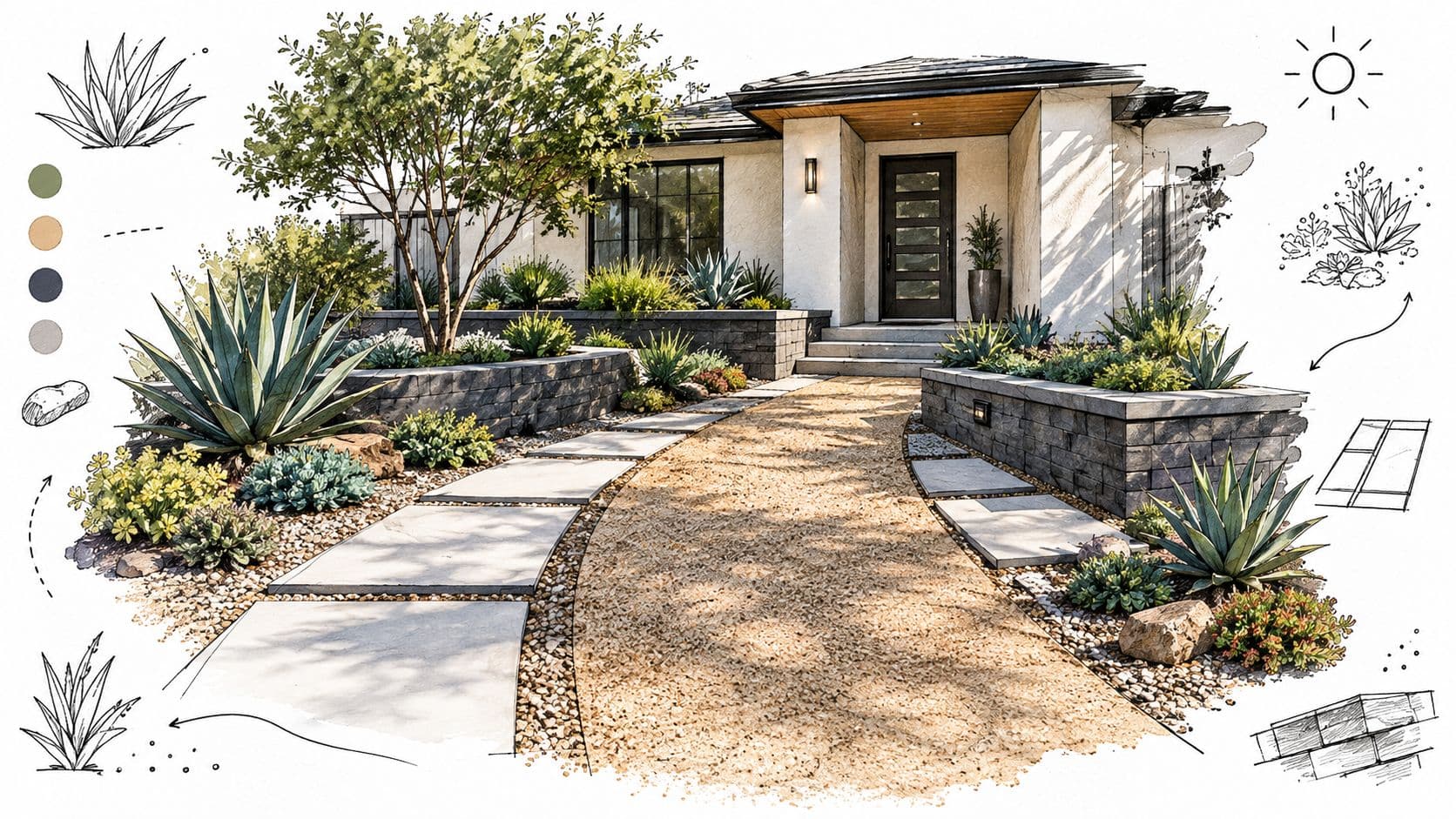
Hardscape is the skeleton of the front yard. It sets circulation, controls the edge of planting beds, and gives the eye a stable structure while plants grow in.
Decomposed granite works well for paths and open forecourts because its fine texture feels quieter than large decorative stone. It needs proper compaction and, where foot traffic is regular, a stabilized base or binding treatment. Without that preparation, it can migrate onto sidewalks, develop ruts, and lose the crisp geometry that made it attractive.
Permeable concrete pavers suit driveways and arrival zones where water needs to move through the surface. Their open joints can help direct runoff toward prepared base layers and planting areas, but the system only performs when excavation, aggregate depth, edge restraint, and grading are installed correctly.
Build the material palette from the ground up
Use steel edging where gravel meets planting or pavement, especially in regions with freeze-thaw movement. Plastic edging can flex and rise, leaving a ragged line. Cast-in-place concrete bands, board-formed retaining walls, and large-format porcelain can supply the minimalist vocabulary, but each needs a stable base and carefully controlled transitions.
Slope planted areas away from the foundation and avoid creating a low pocket beside the house. Let paths and patios drain toward planting where appropriate, while keeping runoff off neighboring property and public walks. The details matter more than the material label. A beautiful paver fails when the base settles, and a simple gravel path succeeds when its edges, slope, and compaction are right.
For broader ideas about how paths, walls, seating, and other outdoor components work together, this backyard landscape elements tutorial offers useful planning context. Keep the front-yard palette restrained, usually with one primary paving material, one ground cover, and one edge treatment.
Irrigation and Drainage That Keep the Savings Real
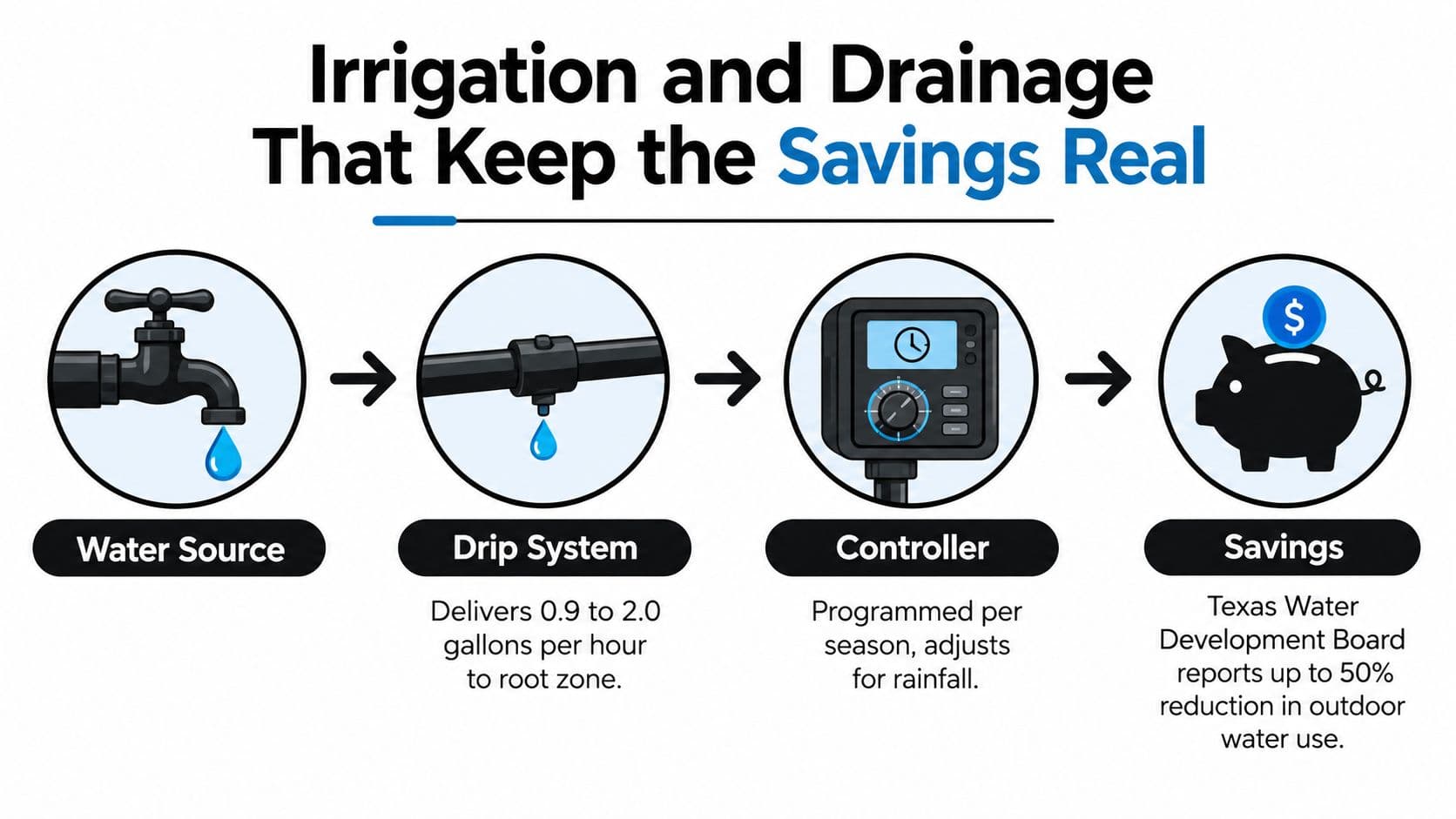
Water delivery should be designed as a performance system, not added after planting. Drip lines and emitters place moisture near roots, but they only save water when valves, pressure, runtime, and drainage match the hydrozones.
Texas Water Development Board data report that buffalograss and no-grass xeriscapes average about a 31% reduction in water use, or roughly 175 gallons per day, compared with traditional St. Augustine lawns. The same source reports that drought-tolerant grasses reduced consumption by 27% in homes without irrigation systems and 7% in homes with irrigation systems, showing how strongly system design affects the result. These figures are summarized in the Texas Water Development Board xeriscaping guide.
Separate zones and establishment care
Give each hydrozone its own valve. A young tree, a low-water shrub bed, and a succulent grouping shouldn't share one schedule just because they sit beside one another. Use pressure-compensating emitters on slopes, inline drip for curved beds, and emitters sized to canopy and soil rather than placing one emitter beside every plant by habit.
New trees and shrubs need more regular irrigation while roots establish. Mature drought-tolerant plants can survive with less water, but they may still use substantial moisture when irrigation is readily available. A practical rollout increases watering during the first season, then tapers frequency as roots expand. Underwatering establishment plants can kill the very garden intended to reduce long-term consumption.
Grade swales toward planting beds where the soil can accept runoff, and keep the foundation protected. A smart controller with a rain shut-off can prevent scheduled irrigation after a storm, but it won't correct poor drainage or a valve that waters every zone alike. Use this residential grading and drainage guide when the site has ponding, a sloped driveway, or runoff near the house.
A short visual demonstration can help homeowners understand why emitter placement and controller programming matter before installation.
Installation Order From Demolition to Mulch
A disciplined sequence prevents crews from damaging finished work and prevents the homeowner from paying twice for buried systems. Start by removing lawn, weeds, failed edging, and debris, then haul everything away before setting final grades.
- Demolition and haul-off: Strip the old lawn and expose the actual soil, roots, irrigation lines, and hidden drainage problems.
- Rough grading: Establish the final fall away from the house, with at least a 2% slope where site conditions and local requirements call for it.
- Soil preparation: Amend planting beds enough to improve root growth and drainage. Build compacted road base under hardscape rather than relying on loose soil.
- Hardscape installation: Install pavers, concrete bands, decomposed granite, walls, and steel edging first. The planting beds should be framed by finished edges, not guessed from the plant layout.
- Irrigation: Trench supply lines, install valves and drip, and cap spare ends for future expansion before plants occupy the beds.
- Planting: Set the largest trees and shrubs first, then work down to grasses, perennials, and groundcovers. Keep the top of each root ball flush with finished grade.
- Mulching: Apply roughly 2 to 3 inches of inorganic mulch such as decomposed granite or crushed lava rock where it suits the modern composition. Use bark only where its texture belongs.
Call for utility locates before digging. In the United States, that means contacting 811. Schedule physically demanding work for cooler parts of the day, and avoid planting during heat waves or immediately before a forecast freeze.
Realistic Budgets and a Year-One Maintenance Schedule
Budget pressure usually shows up first in hardscape, drainage, and irrigation, not in the final plant list. A homeowner can save by handling tear-out or planting, but cutting the base preparation often creates the most expensive failures later.
| Project Scope | Typical Cost | What Drives the Price |
|---|---|---|
| DIY tear-out and planting for a 500 sq ft front yard | $1,500 to $3,500 in materials | Soil, mulch, drip components, plants, edging, and disposal |
| Designer-installed planting conversion | $8,000 to $15,000 | Labor, layout, soil preparation, irrigation, plant size, and access |
| Full design-build with hardscape and lighting | $18,000 to $35,000 in many metro markets | Paver or concrete area, drainage, electrical work, walls, grading, and labor |
These planning ranges come from the project scope described in the brief and should be treated as budgeting guidance, not a quote. The largest variable is usually the amount and complexity of hardscape. A small number of well-placed plants beside a difficult driveway can cost more than a larger planting bed with easy access.
Protect the first year
Drought-tolerant doesn't mean maintenance-free. During the first growing season, inspect drip lines, pull weeds, and deadhead monthly. Give newly planted material deep soakings every 7 to 14 days during the first year when conditions require it, then reduce cycles as roots establish. Prune once in late winter when appropriate, and refresh mulch or rock in spring.
After the second year, many yards need fewer irrigation cycles and less frequent attention, but mature plants still need observation. Remove dead growth, keep sightlines clear, repair shifted edging, and adjust emitters as canopies expand.
Homeowners usually ask five questions:
- Will it hurt resale? A water-wise yard is more likely to be accepted when it looks intentional. Clean edges, visible organization, and a maintained entry matter more than a rare plant list.
- Can some lawn remain? Yes. Keep a small usable rectangle or a single accent panel instead of scattering weak turf through every bed.
- When will it look full? Expect open spaces during the first year. Mulch, stone, and repeated forms can make those gaps look designed while plants mature.
- Is a permit required? Softscape work often doesn't require one, but check local rules for grading, impervious surfaces, drainage, and front-yard structures.
- What mistake wastes the most water? Running spray irrigation across a drip-planted bed wets weeds and misses the root zones that need consistent delivery.
Before approving the installation, confirm the water zones, mature plant sizes, drainage direction, material palette, and first-year care schedule. The best modern drought-tolerant front yard is the one that still looks intentional, performs reliably, and suits the homeowner in year three.
OutdoorBrite lets you upload a front-yard photo and compare modern xeriscape concepts using real planting, gravel, and hardscape ideas before committing to construction. Visit OutdoorBrite to test a design direction on your own property, then take the clearest concept to your designer or contractor.
See your yard reimagined
Start creating