Tara Prairie Dropseed: A Complete Planting and Design Guide
Learn how to grow and design with Tara prairie dropseed. Covers planting, care, companion plants, seasonal interest, and tips for visualizing it in your yard.
You're probably standing in a nursery, holding a little grass in a pot, and trying to answer a practical question that the tag can't settle for you. Will it stay tidy in a small bed, or will it turn into one more plant that looks great in the catalog and overwhelms the border at home? Tara prairie dropseed was bred for exactly that kind of decision, a refined, compact native grass that gives you the texture of prairie dropseed without the bulk that can make the straight species hard to place in a residential setting.
Table of Contents
- Why Tara Prairie Dropseed Deserves a Spot in Your Landscape
- Understanding the Tara Cultivar and How It Differs from the Species
- Planting and Establishing Tara Prairie Dropseed Successfully
- Seasonal Interest and Year-Round Landscape Value
- Companion Plants and Design Pairings That Work
- Common Problems and How to Avoid Them
- Visualizing Tara Prairie Dropseed in Your Yard Before You Plant
- Where to Buy and Final Planting Tips
Why Tara Prairie Dropseed Deserves a Spot in Your Landscape
A small front bed leaves little room for error. The plant has to carry native character, stay orderly, and leave enough breathing room for the rest of the design. Tara prairie dropseed does that well. It is a dwarf selection of prairie dropseed, selected and introduced by Roy Diblik of Northwind Perennials, and it brings a prairie plant into the kind of tight space that sits beside a walk, a porch, or a narrow foundation strip without looking oversized. New Moon Nursery
A native grass that reads clean in a home garden
Tara's value shows up in the way it sits in the planting. It keeps the fine, fountain-like texture that makes prairie dropseed useful in design, but the plant stays small enough to read as deliberate instead of unruly. Its foliage sits around 12 inches tall, the flowering culms rise another 12 inches, and the plant settles into an overall mature height of about 24 inches in the common nursery description. Some references place it at roughly 18 inches tall with flowers to 24 inches and a spread near 24 inches, which still keeps it firmly in the compact category. JNI Plants
That scale matters around doors, sidewalks, and tight patios. A grass that stays modest can give you repetition, softness, and movement without covering edging or hiding lower perennials. It also fits where a native look needs to sit comfortably beside curated decor, hardscape, and a few stronger focal plants, the kind of setting you might review through Farmhouse World garden decor.
Practical rule: if the space can't handle a 3-foot fountain habit, Tara is the better starting point than the species.
Hardiness is another reason I keep returning to it in residential work. The cultivar is described as suitable from USDA Zones 3–9, and it tolerates dry, rocky, loamy, clay, and gravelly soils as long as drainage is decent. In a yard, that mix of toughness and restraint is exactly what makes a plant feel dependable instead of demanding.
Understanding the Tara Cultivar and How It Differs from the Species
What you're buying
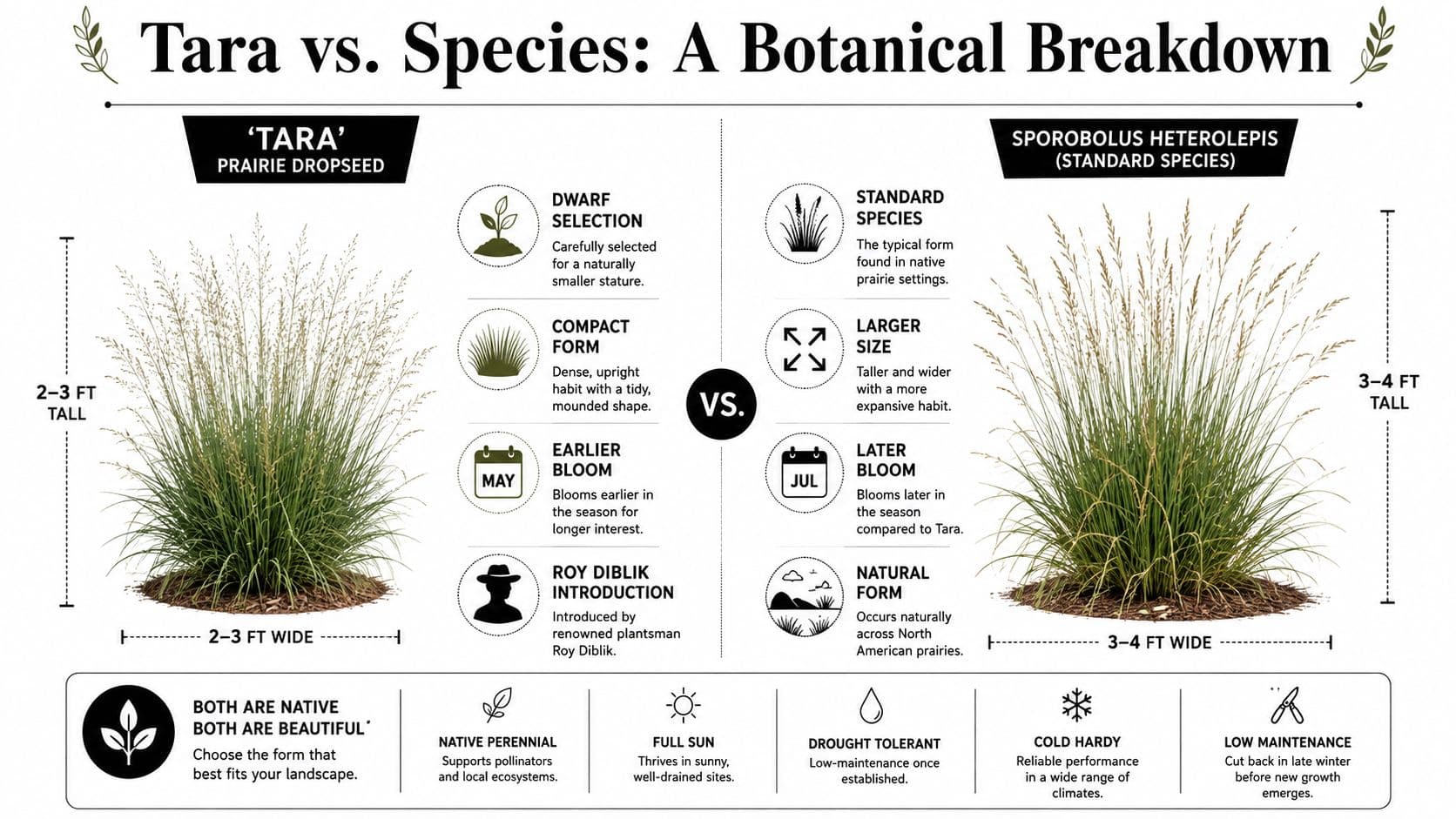
Tara is a clump-forming, warm-season cultivar of Sporobolus heterolepis, selected for a more compact habit and sold as a dwarf prairie dropseed with a tighter, more upright vase shape than the species. That difference is the whole point of the cultivar. You get a plant that is meant to repeat cleanly in designed beds, rather than one that varies the way seed-grown material often does. New Moon Nursery
The practical difference shows up at eye level and in the outline of the bed. The species is often read as a broader fountain, while Tara usually matures around 18 to 24 inches tall and wide. In a border, that makes the cultivar read as a controlled mass of fine texture. The straight species still has its place, especially where a looser silhouette can spread across a larger area and breathe. JNI Plants
Why the form changes the design
When I place Tara in a plan, I use it in the foreground. It works well along a path, at the front edge of a mixed border, or repeated in a small drift where the goal is texture without bulk. The standard species still earns a place in larger prairie-style plantings, but Tara solves a residential problem more directly. A compact garden can look crowded fast if the grass opens too wide or starts to obscure lower plants.
The texture matters as much as the size. Fine leaves are easy to miss on a flat plant list, but in a real bed they influence whether a composition feels soft and deliberate or busy and crowded. Tara helps create that softer finish, especially when it is set beside broader leaves, stronger flower forms, or hard edges that need a plant to take the tension out of the scene.
Its adaptability also makes it easier to trust in the field. Tara is described as tolerant of full sun, dry to average well-drained soils, and tougher ground types like clay, gravel, and slopes. That does not mean it wants rich, soggy soil. It means the plant can keep its shape in the same places where many ornamentals start to look tired, and that is why it has a clear place in low-maintenance residential work. New Moon Nursery
The straight species has its own production story, and that helps explain why breeders pushed for a smaller form. Prairie dropseed seed production is documented by the Tallgrass Prairie Center with roughly 16,000 seeds per ounce, a 1,000-seed weight of 1.90 g, and lab averages around 86% pure live seed, 96% purity, 20% germination, and 55% dormancy in purchased lots. Those figures point to the variability you can get from seed-grown material, and they help explain why a selected cultivar like Tara has practical value for ornamental planting. Tallgrass Prairie Center
Planting and Establishing Tara Prairie Dropseed Successfully
A Tara planting works best when the site is settled before the plant is. I have seen this grass look awkward for its first few seasons in the wrong spot, then settle into one of the cleanest clumps in the border once the roots finally caught up. That patience pays off, but only if the bed is right from the start, especially in mixed plantings where its fine texture has to be read against broader leaves and heavier flower forms.
Site first, then plant
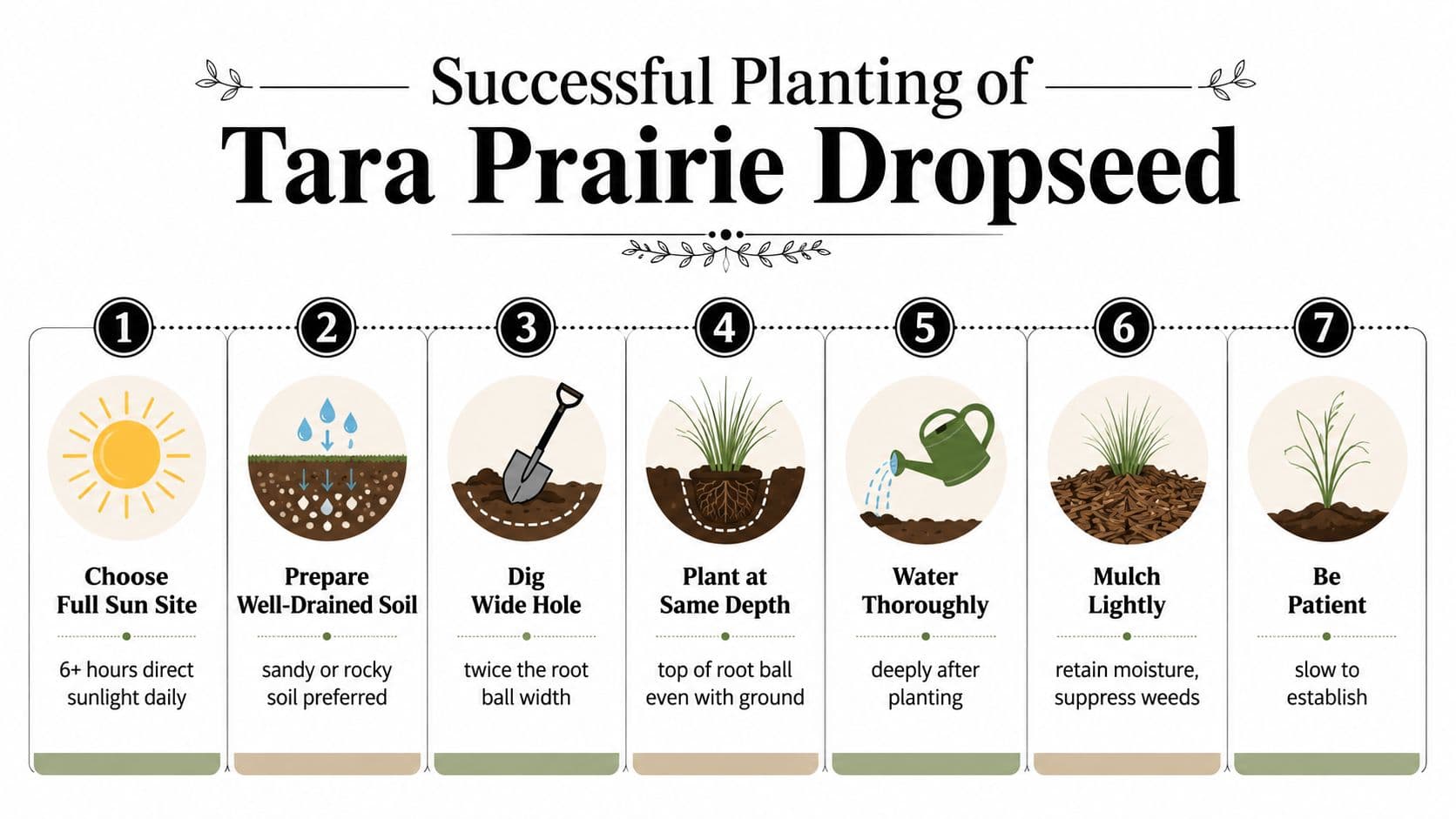
Start with full sun and a well-drained site. Prairie dropseed is described by the University of Wisconsin Extension as happiest in full sun and average to dry, well-drained soils, and Tara follows that same pattern. If the spot stays wet after rain, keep looking. This grass is a poor fit for soggy corners, irrigation-heavy foundation beds, or any place where water lingers.
Tara can handle rocky, clay, and gravelly soils, which is why it earns a place in slopes and low-input beds. Drainage still decides the outcome more than soil texture alone. A heavier clay bed can work if water moves through it, but standing water and constant wetness will slow establishment and shorten the plant's useful life. Starting with healthy soil helps, but for Tara that means structure and drainage, not richness.
How to get it established without losing patience
The honest trade-off with prairie dropseed is its pace. It is slow-growing and slow to establish, and University of Wisconsin Extension notes it can take about four years to reach blooming size. That first stretch is about root building, not immediate impact, so the plant should be judged on whether it is settling in, not whether it is already filling the bed.
Plant in spring if you can. That gives the roots the longest runway before winter and makes watering easier to manage through the first growing season. Set the crown at the same depth it was in the pot, water it in thoroughly, then let the soil dry between waterings instead of keeping it constantly damp.
Practical rule: if you keep babying Tara with frequent water, you can slow it down more than you think.
Space matters too. In a mass planting, leave enough room for each clump to read as its own mound, because overcrowding turns the planting into a single strip and hides the fine texture that makes the grass useful in the first place. For a specimen, give it clear air on all sides so the vase shape can be seen from more than one angle. That is where Tara earns its keep, not as a filler, but as a restrained form that gives a border structure without weight.
Division is usually the better route for gardeners who want to multiply it, since prairie dropseed has difficult germination and a fibrous, short-rhizomatous root system that responds well to division once the plant is established. New Moon Nursery describes Tara as a compact selection with the same general toughness as the species, which is useful context when you are deciding where to place it and how much room to give it. New Moon Nursery
If you want to test the layout before digging, use a planning pass like starting with healthy soil before committing to the bed. Tara rewards that kind of deliberate setup far more than guesswork.
Seasonal Interest and Year-Round Landscape Value
Spring is when Tara earns trust fast. Fresh green blades push up in a tight mound, and the plant looks settled before many perennials have sorted out their own shape. That early restraint helps in formal edges and tight mixed borders, where a grass that looks finished early can hold the planting together instead of reading like a plug waiting to grow up.
Late-season movement without bulk
By late summer into early fall, Tara sends up airy flower panicles that sit above the foliage without flattening it. The effect stays quiet rather than showy, which is useful in borders that already carry a lot of bloom color and need one calm, fine-textured layer to keep the whole composition from feeling busy. In that sense, Tara gives you the same prairie character people value in the species, but in a smaller, easier-to-place package.
The flower and seed structure also carries ecological weight. The USDA Forest Service notes that prairie dropseed responds well after fire and has been used in roadside revegetation and prairie rehabilitation, so this is a grass with a real working history, not just ornamental appeal. That matters in a residential setting too, because the seed heads extend the season and give birds a reason to linger when the rest of the border starts to tire. USDA Forest Service
Winter is part of the design
Once the growing season closes, Tara does not vanish. The foliage keeps a warm, fine texture that catches frost and snow, and that gives beds some structure when many other perennials collapse or disappear. I have used it in front foundations that otherwise looked thin in winter, and it made those beds feel deliberate instead of empty.
The practical trade-off is patience. Tara is slow to establish, so it pays to place it where you can let it mature without trying to force it into instant impact. The long-lived nature of prairie dropseed also helps justify that wait. Seed-production guidance from the Tallgrass Prairie Center describes productive stands that can persist for a long time, which is part of why this grass works so well as a permanent design anchor once it is established. Tallgrass Prairie Center
In mixed borders, the fine texture reads best when you give it room to show its outline. That means using it where the mound can catch low light, where frost can outline the blades, and where nearby plants do not drown out its shape. A slow grass is easy to undervalue in the first season, so the better approach is to place it with the future in mind and let the form build over time.
Companion Plants and Design Pairings That Work
Pair it by contrast, not by sameness
Tara looks strongest beside plants that change the rhythm of the border, through leaf shape, flower form, or timing. A useful guide to companion planting is gardener's guide to companion planting, but the working rule in a dry sunny bed is straightforward. Give Tara something beside it that has a different outline, because its fine texture gets lost if everything around it carries the same height and density.
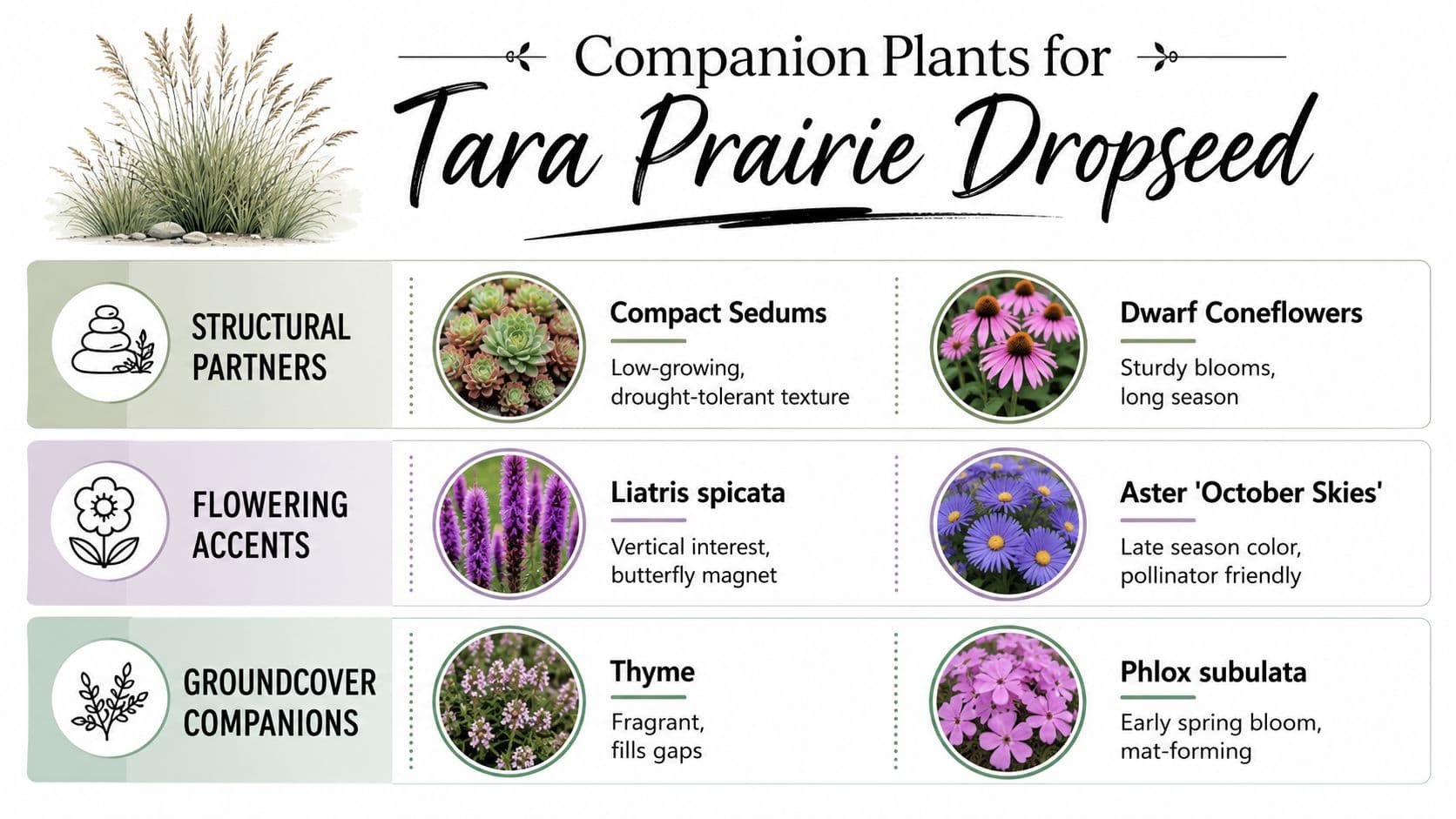
For structural partners, compact sedums are a good fit because they stay low and stay clean in the same lean sun. Dwarf coneflowers also work well, since their sturdy flowers can hold their own beside the airy blades of the grass. For stronger vertical notes, Liatris spicata adds a narrow, upright counterpoint, while Aster ‘October Skies’ carries the planting into late season without clashing with Tara's texture. For the front edge, thyme and Phlox subulata soften the transition and fill open pockets while the grass is still settling in.
Urban Man Caves is useful here because the same principle applies in small residential beds, keep the composition layered and avoid a flat row of plants that all read the same from the walk or patio.
Where it fits in a real border
A good sunny foundation bed can place Tara at the front edge, dwarf coneflowers just behind it, then a few taller accents like liatris farther back. That creates a clear height sequence and keeps the grass visible instead of tucking it under broader plants. In a wider drift, repeat Tara in small groups so the texture reads as a band across the bed, not as scattered clumps that never connect.
The plant match matters as much as the visual one. Tara prefers lean, drained soil and full sun, so it belongs with companions that do not need heavy irrigation or rich amendments. That keeps the planting honest and easier to maintain in a residential setting, where mixed beds have to look good without constant correction.
Before you commit, sketch the layout in garden plans for full sun that work. Tara is one of those grasses that looks modest on its own, then earns its place when you see how the fine mound plays against sturdier neighbors and open mulch spaces. In my own projects, that is often the difference between a bed that feels intentional and one that looks assembled without a plan.
Good design habit: if a companion plant wants wetter soil, heavier feeding, or a very different light level, it usually belongs elsewhere.
A low, drought-tolerant companion can help hold the composition together while Tara establishes slowly. That patience matters. The grass is not fast, and early on it can look too small for the space, but the right partners keep the bed looking finished while the clumps build.
Common Problems and How to Avoid Them
The problems are usually cultural, not mysterious
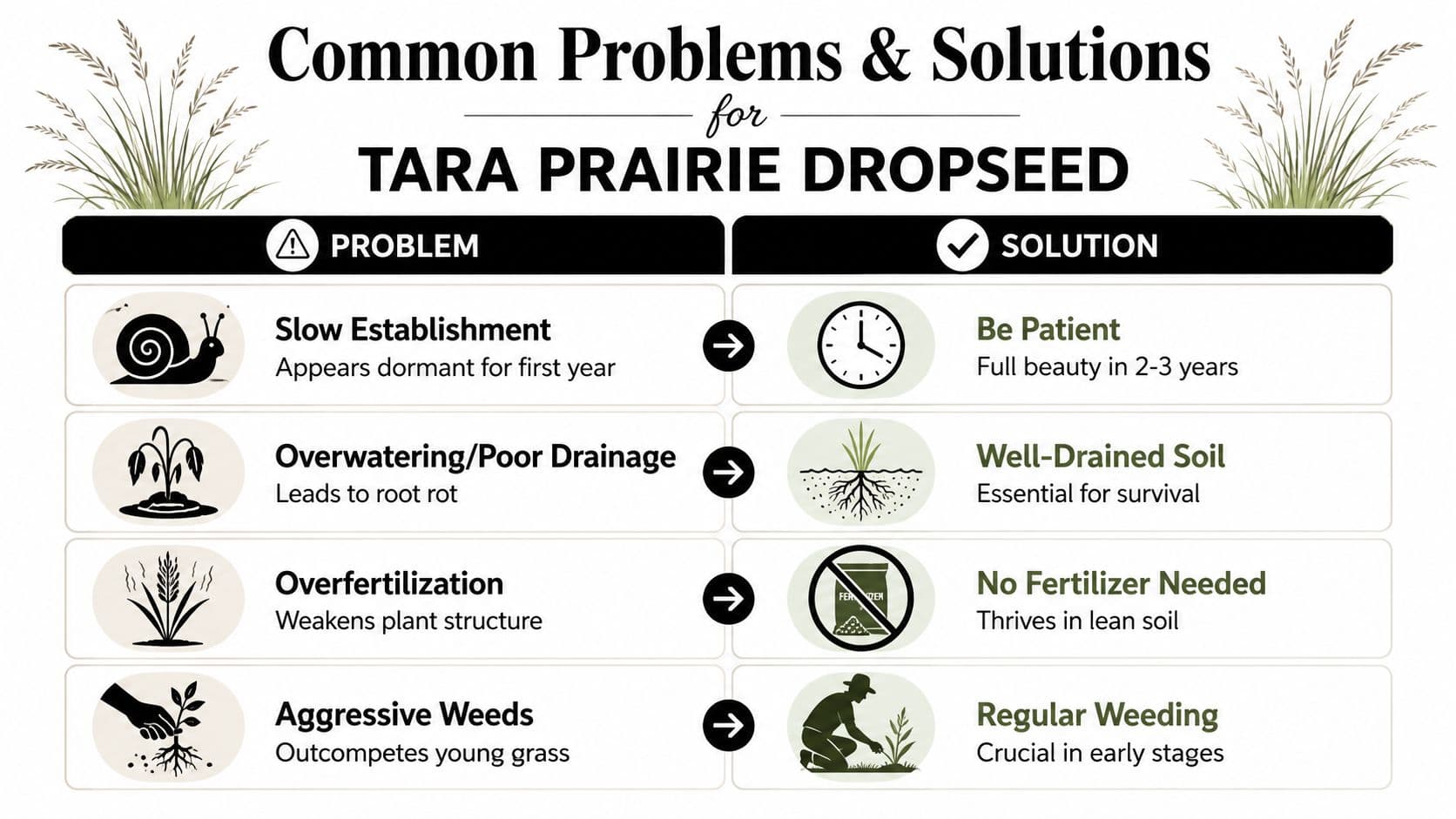
The biggest mistake is impatience. A lot of gardeners expect an ornamental grass to look finished in one season, then decide it is underperforming because it is still small and reserved. Prairie dropseed is slow to establish, so Tara needs time before it looks like the plant in a mature border photo. That is the trap with this grass, it reads as modest in year one, then starts to make sense once the clump fills out and the fine arching leaves settle into the planting.
Overwatering is the next common failure. This grass prefers dry to average, well-drained soil, and constant moisture can weaken growth and invite root trouble. In a hot, dry planting bed, people often think more water is the answer, but Tara usually responds better to deep watering and then a chance to dry out. In residential beds, I have seen more plants suffer from kindness than neglect, especially when irrigation runs on the same schedule as thirstier perennials.
Old clumps, crowding, and clean growth
Center die-out can happen in older clumps of many grasses as they age. When a clump looks tired in the middle, divide it rather than trying to rescue the center with fertilizer or more water. Because prairie dropseed has a fibrous, short-rhizomatous root system, division is a practical way to renew the plant once it is established.
Crowding can also create its own trouble. Tara itself is not known for heavy pest or disease pressure, but poor air circulation in a packed planting can still lead to fungal issues. Keep the spacing honest, especially in mass plantings where people are tempted to overfill the bed on day one. Fine texture only works when each plant has room to read as an individual mound, then join the group visually instead of fighting it.
Why nursery-grown plants matter
There is also a conservation reason to buy carefully. Prairie dropseed is listed as endangered in Ohio and North Carolina, and the USDA Forest Service notes its wider role in roadside revegetation and prairie rehabilitation. That makes nursery-grown cultivars a smarter choice than wild collecting, because you get a dependable garden plant without putting pressure on fragile native stands.
For a quick field guide to the most common mistakes, the University of Wisconsin Extension also notes that prairie dropseed is slow to establish and prefers well-drained sites, which matches what I see in client gardens. A well-sited Tara usually looks restrained at first, then settles in with very little drama once the root system is established.
Visualizing Tara Prairie Dropseed in Your Yard Before You Plant
A plant this fine-textured can be hard to judge from a nursery pot. The essential question is how Tara will read beside your steps, along the foundation, or where a bed meets lawn. I like to work those decisions out on the screen first, because scale is where this grass either earns its place or gets lost.
A photo-based layout tool lets you test the planting against your own house, paths, and hard edges before you commit. With OutdoorBrite's ai garden design generator, you can upload a yard photo and try Tara in a few different spots before buying a flat of plants. I would test a narrow border line, a small drift near a walk, and a repeated planting at the front of a mixed bed. That makes it easier to see whether the grass reads as a soft accent or fades into the background.
The same check helps with texture balance. Tara's fine blades can disappear beside bold foliage if the spacing is too tight or the plant is buried in visual clutter, while the same grass looks sharp when it gets a clean edge and some breathing room. If you are working with a contractor, a rendered view gives everyone the same target instead of trying to describe proportion from memory.
Slow establishment also changes how you should place it. Tara does not give you instant fullness, so the first planting plan should account for open space around each clump and the fact that the bed will look sparse before it settles in. That is where patience matters most, because people often overfill the area on day one and then regret it when the grass finally reaches its mature presence.
For broader layout ideas and bed flow, landscaping design ideas for backyard can help you think through the structure of the yard before you fine-tune plant selection.
The best way to avoid a planting mistake is to see the composition in your own yard before you spend money on the first plant.
Where to Buy and Final Planting Tips
Look for Tara by name, not just prairie dropseed. The straight species and the cultivar are not the same thing in size or habit, and a label that only says prairie dropseed may leave you with a plant that's better for a prairie meadow than a small foundation bed. Native plant nurseries and specialty perennial growers are usually the best sources, and many online retailers will ship dormant or container-grown stock.
Buy in spring if you can. That gives you the longest establishment window and the best chance of seeing the plant settle in before its first winter. Start with a small number of plants, place them where you can watch the scale work, and then repeat the pattern if it fits.
The basic formula is simple, full sun, well-drained soil, and patience during establishment. If you pair that with companions that share the same lean, sunny conditions, Tara stops feeling like a risky specialty grass and starts behaving like a dependable design tool.
If you want to test where Tara prairie dropseed belongs before you commit to digging, OutdoorBrite can help you mock up the bed from an actual photo of your yard. Visit OutdoorBrite to try placements, compare layouts, and make the grass work with your real space before you buy.
See your yard reimagined
Start creating