Tropical Landscape Design: A Complete 2026 Guide
Master tropical landscape design with our step-by-step guide. Learn to create lush, heat-moderating gardens that thrive in any climate.
Dense canopy changes a tropical yard more than almost any decorative planting choice. In tropical microclimate research, the average difference between 0% and 100% canopy cover reached 5.2°C for mean temperature and 10.2°C for maximum temperature, which is why layout comes before plant shopping in serious tropical design.
That catches many homeowners off guard. They start by pinning images of palms, heliconias, and glossy leaves, then wonder why the finished garden still feels hot, wet, and hard to use in the middle of the day. A tropical garden isn't just a plant collection. It's a heat-control system, a drainage system, and only after that, a style.
The best tropical design works because it accepts the climate instead of fighting it. Heat, humidity, fast growth, heavy rain, fungal pressure, and maintenance load all shape what will last. If the layout creates shade in the wrong place, if water has nowhere to go, or if the plant palette looks lush for six months and collapses into disease and overgrowth after that, the design failed no matter how good it looked on installation day.
Table of Contents
- Why Tropical Gardens Are Thermal Machines, Not Just Decor
- Assessing Site Conditions and Drainage Needs
- Building a Layered Plant Palette
- Adapting the Tropical Look to Non-Tropical Zones
- Integrating Hardscaping and Lighting
- Planning Maintenance and Budget
- Using AI Tools to Visualize Your Design
Why Tropical Gardens Are Thermal Machines, Not Just Decor
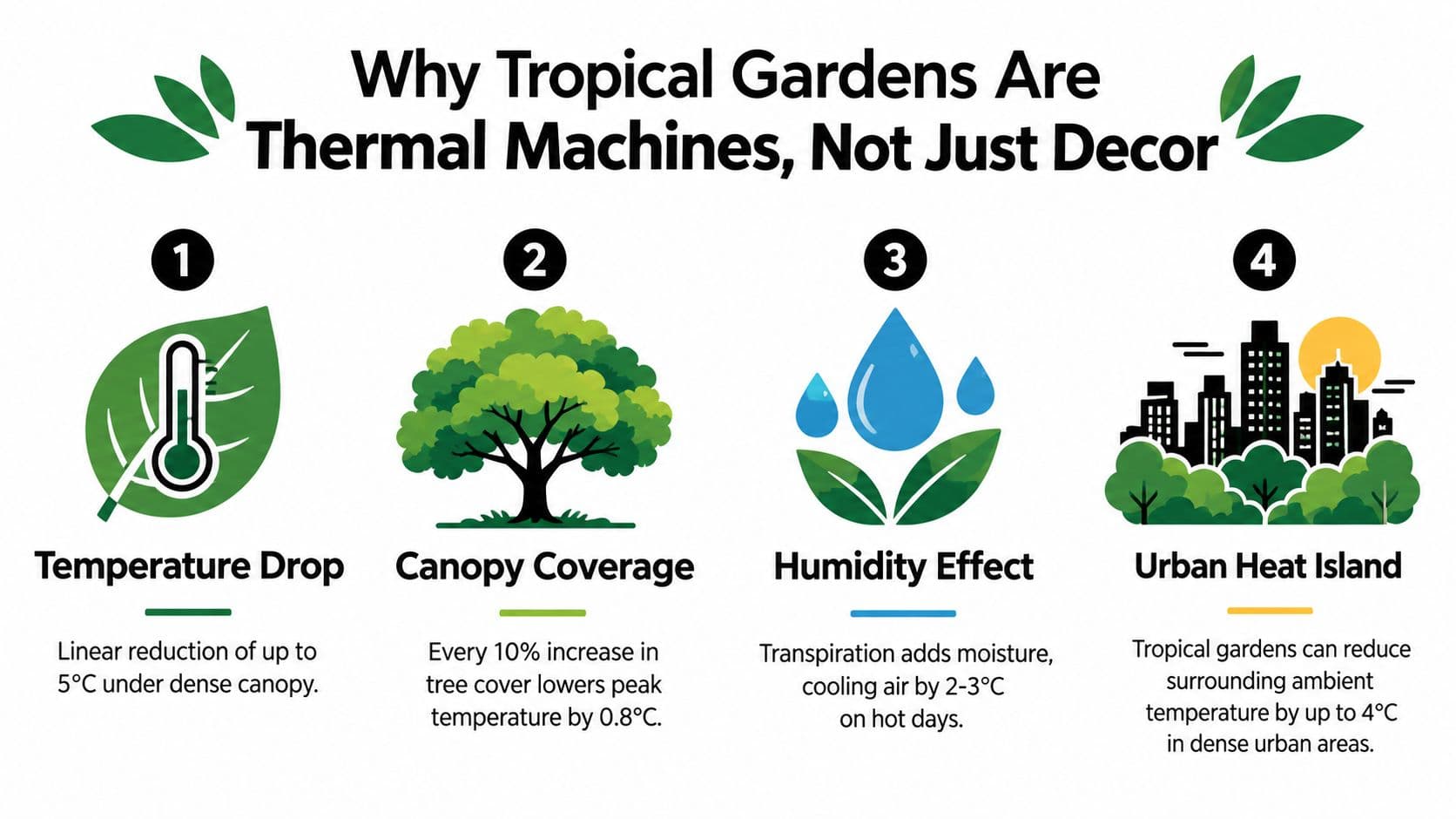
A tropical garden can lower surface heat, extend the hours a yard feels usable, and reduce the stress that sun and humidity put on plants. That starts with layout. I place canopy first because once the sun hits paving, walls, and seating areas for several hours, the whole garden stores heat and gives it back long after the light shifts.
Research on tropical urban microclimates found a negative linear relationship between canopy cover and daytime heat, with the average difference between 0% and 100% canopy-cover sites reaching 5.2°C for mean temperature and 10.2°C for maximum temperature in the study manuscript. In practice, that gap decides whether a terrace works for lunch, whether a path is comfortable barefoot, and whether a west-facing wall turns the seating area into a heat reflector by mid-afternoon.
How the canopy works
Canopy placement determines whether the garden is usable at all. Shade changes air temperature, but it also cuts radiant load on the surfaces people touch and sit near. A cool garden is usually one where the designer controlled sun angles, reflected heat, and exposure time before choosing feature plants.
- Upper canopy cools hard surfaces: Broad shade keeps patios, paths, and walls from absorbing as much heat through the day.
- Mid-story reduces body-level glare and reflection: Smaller trees and large shrubs intercept bounced heat from paving and masonry.
- Understory protects the root zone: Dense lower planting helps soil hold moisture and stay cooler between rain events.
- Layering stretches usable hours: Filtered shade keeps outdoor rooms comfortable longer than open lawns or fully exposed courtyards.
Practical rule: If the dining terrace takes full afternoon sun and there is no overhead shade strategy, the design is asking furniture and cushions to solve a heat problem they cannot solve.
Where the style came from
This performance-first approach has deep roots. UNESCO describes Sítio Roberto Burle Marx as a place where Modernist art ideas were fused with local typologies and tropical plants to create the modern tropical garden, a form that has influenced parks and gardens worldwide since the mid-20th century in UNESCO's documentation.
That history matters because the strongest tropical gardens were never just about bold foliage. They were built around climate response, plant behavior, and spatial control. Big leaves and saturated color give the style its visual identity, but comfort depends on where shade falls, how moisture moves, and how each layer of planting supports the microclimate around the house.
Assessing Site Conditions and Drainage Needs
Most tropical gardens fail from below, not above. Homeowners see yellowing leaves, root decline, fungus, and mosquito activity, then blame the plants. The issue is usually water movement.
In humid tropical climates, precipitation commonly exceeds evapotranspiration, and poor hydraulic conductivity can lead quickly to waterlogging and root-zone aeration failure according to FAO guidance for humid tropical drainage. That's why I never begin with a planting plan. I begin with where water sits after heavy rain, how long it stays there, and which parts of the yard already tell the truth through moss, sparse turf, exposed roots, or stained walls.
What to inspect before you draw anything
Walk the site during or right after rain if you can. A tropical property reveals itself fast under stress.
-
Map the wet spots
Low corners, downspout discharge zones, fence lines, and compacted lawn edges often hold water first. -
Check soil response
If the top looks dry but a shallow scrape reveals sticky, sour, airless soil, roots will struggle. -
Read the structures
Damp marks on retaining walls, algae on paving, and settled patios often point to repeated drainage failure. -
Identify water pathways
Water always chooses a route. Your job is to find it before hardscape blocks it.
A good grading sketch is often more valuable than an early plant list. If you're sorting out slopes swales and permits, that planning work should happen before anyone starts pricing feature planting or pavers.
Drainage sizing is not a decorative decision
FAO guidance gives a design discharge range of 10 to 15 mm/day and frames drainage planning as a process of identifying problem lands, characterizing hydrology and soil limits, and confirming technical, socio-economic, and environmental feasibility before sizing the work in the FAO reference. In plain terms, you don't guess.
Main drains also need capacity for both average wet-season requirements and extreme rainfall events, with capacity often set using an extreme event such as a one-in-5-year storm in that same FAO drainage guidance. That's the trade-off many homeowners resist. Bigger drainage work isn't glamorous, but undersizing it means paying twice.
A tropical garden can survive mediocre styling for a while. It won't survive chronic waterlogging.
For homeowners who already have blocked channels, overflowing area drains, or recurring ponding near paved zones, practical service references like WhatsDemand drain solutions can help you understand the maintenance side of drainage systems before redesign begins.
Flat sites and shaped sites need different thinking
| Site condition | What usually works | What often fails |
|---|---|---|
| Flat lowland yard | Open flow paths, collector drains, reduced grade traps | Sealed edges that trap runoff in beds |
| Peat or soft ground | Drain layout that respects contour behavior | Random trenching without soil understanding |
| Patio-heavy backyard | Surface falls, permeable joints where suitable, relief drainage | Large impermeable areas with no overflow plan |
On dome-shaped peat sites, field drains should run parallel to contour lines and collectors perpendicular to them in the FAO guidance above. Most residential sites won't be true peat systems, but the lesson still applies. Drain layout must follow land behavior, not visual symmetry.
Building a Layered Plant Palette
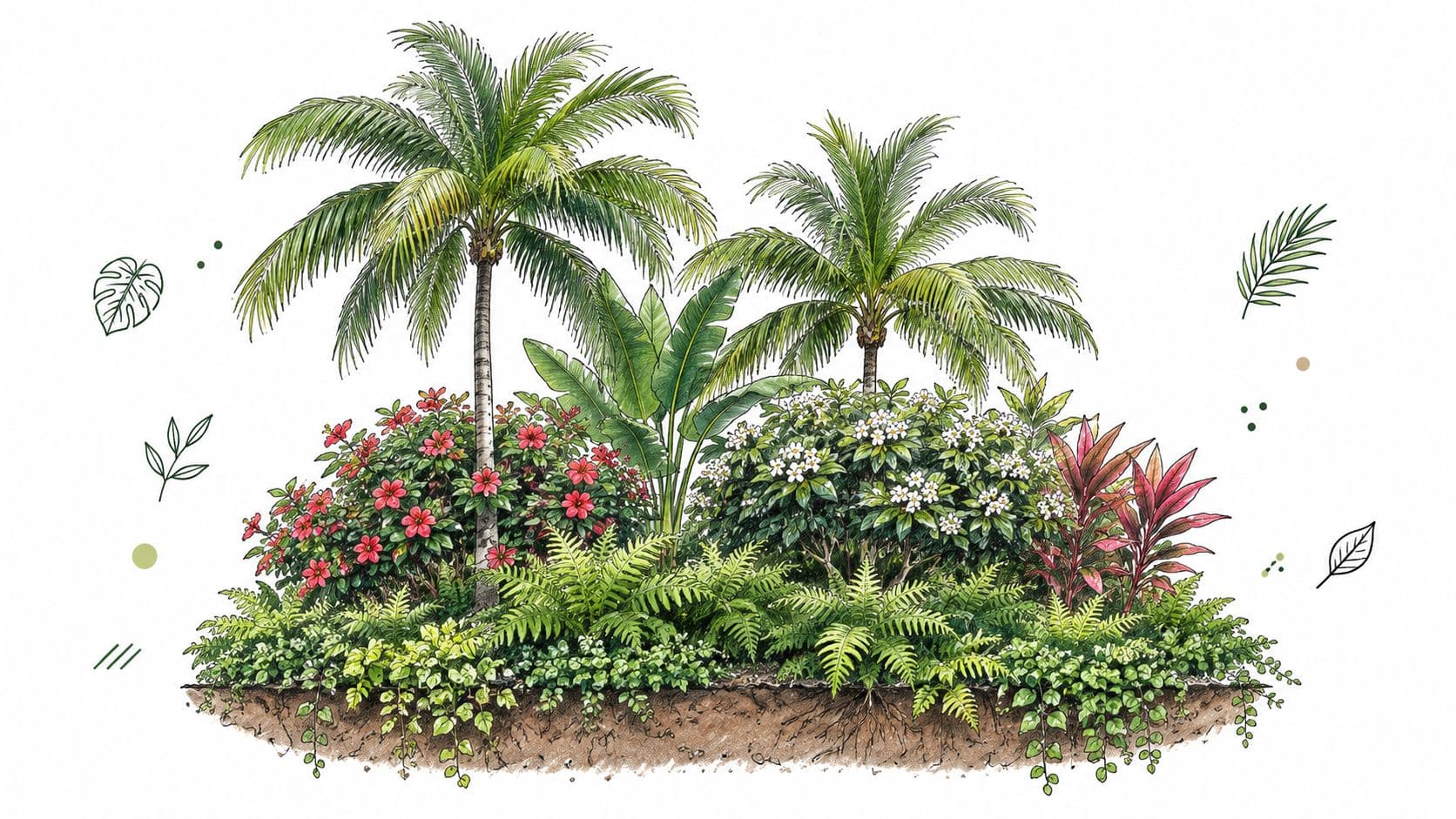
A tropical garden earns its comfort from structure first. Planting is the part that controls shade, humidity at ground level, airflow through seating areas, and how much heat hard surfaces throw back at the house. The plant list matters, but the arrangement matters more.
Before judging appearance, assess whether each plant can handle the site conditions and the owner's maintenance capacity. An applied campus-design study on tropical planting noted that successful selection balanced adaptability, aesthetics, lower maintenance demand, and ecological value in the Bio Conferences study. That lines up with real residential work. Plants that need constant correction rarely stay attractive for long.
Use a scoring mindset, not impulse buying
Sort the planting into layers first. Then score likely candidates against the conditions they will face.
- Climate and soil fit: Skip species that resent prolonged humidity, poor air movement, or seasonally wet root zones.
- Growth rate and pruning load: Fast growers can fill space quickly, but they also create repeat labor and disposal costs.
- Thermal performance: Favor plants that cast useful shade, cool the soil surface, or soften reflected heat near paving and walls.
- Pest and disease pressure: Dense tropical planting needs enough spacing to dry down after rain and irrigation.
- Visual role: Each plant should support a clear job in the composition instead of competing for attention.
This approach prevents a common mistake. Homeowners buy tropical plants one by one from a nursery bench, then end up with a collection rather than a coherent garden.
Build by layer, not by isolated specimens
A layered palette works best when each tier changes the microclimate in a specific way.
Upper structure
This layer creates the canopy. Shade trees and well-placed palms reduce solar gain over patios, paths, and west-facing windows, which changes how the whole yard feels in the afternoon. A sparse canopy may look tidy on install day, but it often leaves the garden hot and visually thin for years.
Middle mass
Enclosure happens. Large shrubs, understory trees, and broad-leaf foliage plants hold humidity in check when they are spaced correctly, and they filter views without blocking all airflow. Crowding this layer is a frequent error. The result is stagnant air, more disease pressure, and a garden that needs constant cutting back from walks and walls.
Ground plane
Groundcovers, low ferns, edging plants, and mulch finish the soil surface. Their job is practical as much as visual. They reduce splash during rain, limit weed germination, and keep the root zone cooler.
Use fewer species in stronger groups. Repetition gives tropical planting weight, and clear roles keep maintenance predictable.
What usually works and what usually disappoints
| Decision | Usually works | Usually disappoints |
|---|---|---|
| Canopy planting | Trees positioned to shade living areas and hard surfaces | Trees pushed to the boundary while patios stay exposed |
| Feature plants | Repeating a few structural species through the plan | Buying one specimen of every bold plant available |
| Mid-layer density | Layering for privacy with gaps for airflow | Packing shrubs tightly against fences and walls |
| Ground plane | Continuous cover with mulch where planting is thin | Bare soil pockets that stay damp and invite weeds |
| Water use | Irrigation matched to soil drainage and rainfall patterns | Treating every tropical plant as if more water always helps |
Mosquito pressure belongs in the palette discussion too. Dense, shaded planting near seating can make a yard more comfortable thermally while also creating resting zones for insects if air movement is poor and water collects in leaf axils, pots, or drainage low spots. If that is already a problem on site, guides such as diy vs pro mosquito control Miami help clarify the difference between occasional treatment and a broader control plan. Good design still does part of the work by reducing stagnant water and avoiding overly congested planting around outdoor living areas.
A tropical palette should feel lush, but it should also be legible. Clear canopy, controlled mid-layer mass, and a calm ground plane usually outperform a crowded mix of dramatic plants.
Adapting the Tropical Look to Non-Tropical Zones
A lot of homeowners want a tropical garden without living in a tropical climate. That's possible, but only if you separate the look from the exact plant list.
Recent coverage points to a shift toward modern tropical and subtropical styling rather than a pure jungle look, with structural planting, cleaner lines, and fewer plant varieties in this tropical garden guide. That's good news for cooler or seasonal regions because structure travels better than tenderness does.
True tropical planting versus tropical effect
The easiest way to compare the options is to stop asking, “Can I grow the same plants?” and start asking, “What visual qualities am I trying to recreate?”
| Goal | True tropical approach | Non-tropical adaptation |
|---|---|---|
| Bold foliage | Tender large-leaf species | Hardy broad-leaf substitutes with similar mass |
| Lush density | High-diversity layered planting | Fewer species, repeated in stronger groups |
| Resort feel | Palms and humidity-loving understory | Architectural evergreens, containers, clean paving |
| Year-round impact | Continuous tropical growth | Structural framework with seasonal accents |
Many gardens go wrong. Homeowners chase the “jungle” image, then spend half the year protecting tender plants or replacing losses. A subtropical interpretation often looks better because it's more controlled and doesn't pretend winter doesn't exist.
The smarter route in cool or seasonal climates
Use a permanent backbone of hardy structural plants. Then add the obvious tropical notes in containers, seasonal accents, or sheltered microclimates. That lets you keep the mood without betting the whole design on plants that may fail after one rough season.
A workable strategy often includes:
- Structural repetition: Repeat strong foliage forms rather than mixing dozens of novelty plants.
- Container flexibility: Move tender feature plants when weather turns against you.
- Cleaner hardscape lines: Crisp edges and simple paving help the garden still read as tropical-inspired when some plants are dormant.
- Winter legibility: Make sure the space still has shape when peak summer foliage is gone.
The most convincing non-tropical tropical garden usually isn't the lushest one in August. It's the one that still makes sense in the off-season.
The practical gap in a lot of tropical-style advice is that it mentions overwintering and plant substitution only briefly. In reality, those two decisions determine whether the design becomes a yearly rescue operation or a stable setting with a tropical character.
Integrating Hardscaping and Lighting
Hardscape determines whether a tropical garden stays cooler, drains cleanly, and remains usable after rain. Plant choice matters, but layout does more of the thermal work. A shaded path can feel noticeably different from an exposed one, and a patio that reflects heat back into the seating area will stay uncomfortable no matter how lush the borders look.
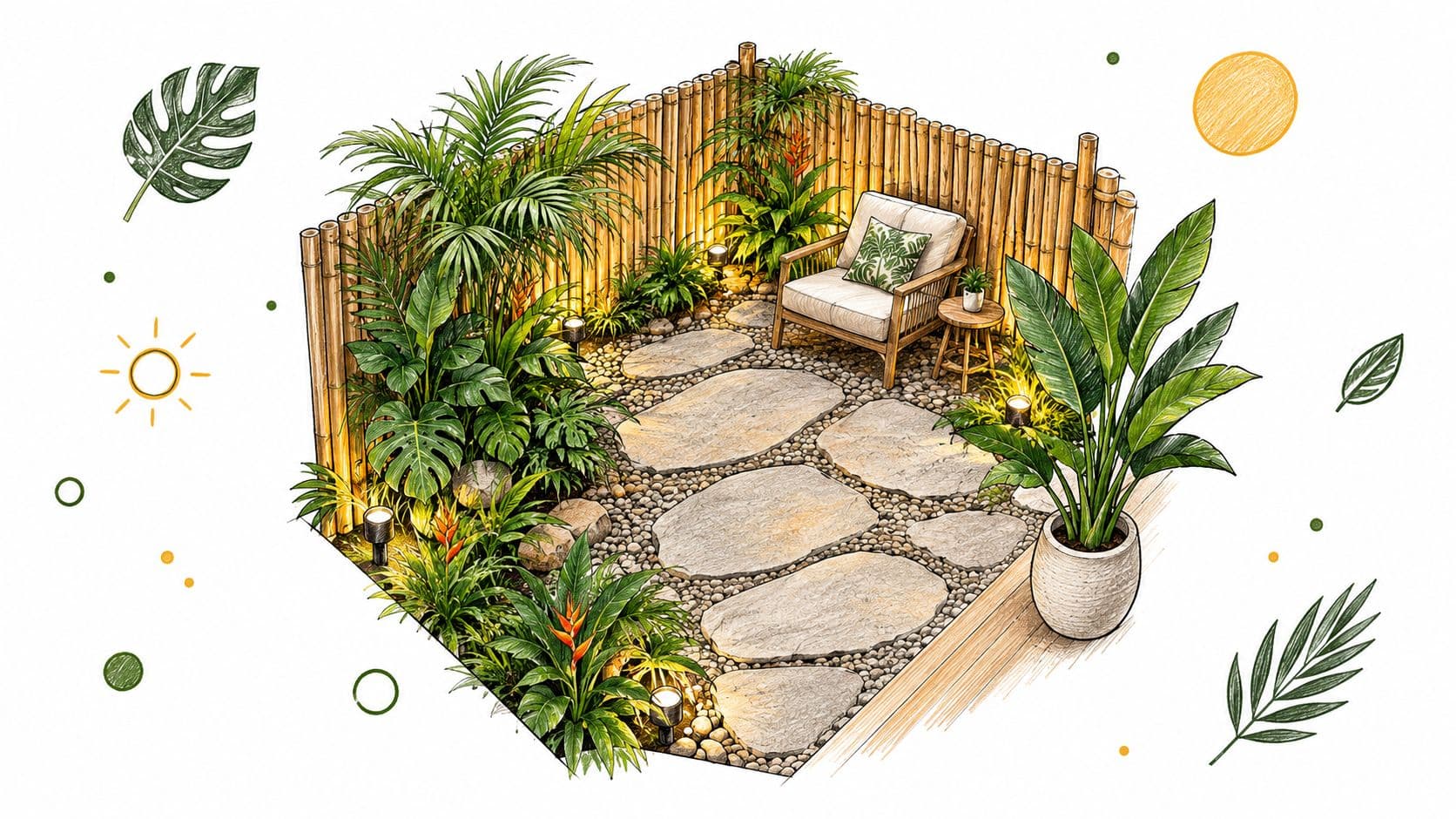
I treat paving, walls, screens, and lighting as part of the garden's cooling system. Surfaces either absorb and re-radiate heat or stay relatively forgiving under partial shade. Vertical elements either block drying winds and create shelter, or they trap humidity where air should move. If those pieces are set in the wrong place, the planting ends up compensating for mistakes it cannot fully solve.
Materials that behave well in tropical settings
The best material palette usually looks quiet and works hard. Natural stone, textured concrete, gravel used in contained zones, timber details, and bamboo screening all have a place, but only if they suit the site's runoff pattern and the amount of maintenance the owner will keep up with.
A few trade-offs matter more than style boards suggest:
- Dense, reflective paving stays crisp visually, but it can increase glare and hold heat into the evening.
- Textured or permeable surfaces are often more comfortable to walk on and usually fit better beside heavy planting.
- Large built features give the garden structure, but they need root space and planting depth around them or they read as hot, exposed objects.
- Light decorative pieces can look fine at installation and then disappear once the foliage fills out.
For homeowners comparing long-term labor, hardscape vs planting maintenance gives a useful breakdown of how built areas and planted areas age differently.
Lighting should support depth and temperature comfort
Bad lighting flattens a tropical garden. Good lighting reveals layers, keeps paths safe, and avoids turning the patio into a bright stage surrounded by darkness.
Start with circulation. Light steps, path changes, and thresholds first. Then use a small number of accent fixtures for trunks, broad leaves, or a canopy edge that gives the space height at night. Seating areas usually benefit from softer, lower-output light so the eye can still read the darker planting beyond.
Fixture placement affects comfort too. Uplighting aimed carelessly into low foliage creates glare and draws attention to moisture on leaves, insects, and visual clutter. A tighter lighting plan often looks better than a brighter one.
Here's a useful visual reference for how outdoor spaces can be composed around built and planted elements:
Place outdoor living where the garden already works
Pergolas, benches, showers, and dining zones perform best in parts of the yard that already have afternoon shade, air movement, and dry footing. I usually see problems when a homeowner chooses the view first and the microclimate second. The result is predictable. More umbrellas, more fans, more cleaning, and a space that still sits empty in the hottest part of the day.
A tropical garden feels convincing when built elements follow the same logic as the canopy. Shade where people linger. Drainage where water collects. Openings where breezes can move through. Get those relationships right, and the space feels cooler, calmer, and easier to use year-round.
Planning Maintenance and Budget
A tropical garden fails on maintenance before it fails on looks. If the layout traps humidity, blocks access, or pushes fast growers too close to paving and walls, the space runs hot, wet, and expensive no matter how good the plant list looked on install day.
Budgeting needs to follow performance, not impulse. Put money into the parts that control water, root room, access, and long-term canopy size first. Decorative spending comes later. Homeowners often reverse that order because foliage and pots deliver an instant result. The usual outcome is torn-up paving, transplanted plants, and a second round of labor that should have been avoided.
The maintenance plan should match how the garden behaves through the year, especially in warm, wet weather when growth rates jump. In practice, that means accounting for four recurring jobs:
- Canopy control: Fast growth changes shade levels, airflow, roof clearance, and visibility more quickly than many owners expect.
- Moisture management: Beds that stay wet too long invite rot, fungal pressure, and mosquito breeding well before plants visibly decline.
- Pest checks: Dense planting with stagnant air gives slugs, scale, and mildew an easy foothold.
- Edge enforcement: Groundcovers, gingers, bananas, and other vigorous spreaders need clear boundaries or they start consuming circulation space.
Access matters as much as aesthetics.
If a crew cannot reach a drain outlet, clean under large leaves, or prune the back side of a clump without stepping through other plants, routine care gets skipped. Then the garden loses the very structure that makes a tropical composition feel intentional. I would rather see fewer plants with proper spacing than a crowded install that looks lush for six months and unruly after one growing season.
Pruning is another budget signal. A good tropical garden needs selective cutting to preserve shape, airflow, and sightlines. It should not require constant shearing just to keep paths open. When every maintenance visit turns into size control, the design likely used the wrong plant in the wrong place, or too many aggressive species too close together.
How to phase the budget without sabotaging the design
I usually split spending into work that is expensive to reopen and work that can wait.
| First-phase spending | Later-phase spending |
|---|---|
| Drainage fixes | Decorative feature pots |
| Grading and base hardscape | Extra accent planting |
| Primary canopy trees | Specialized lighting upgrades |
| Irrigation where truly needed | Optional focal ornaments |
Spend first on the parts that are difficult and costly to redo once roots, paving, and utilities are in place.
That order protects more than the budget. It protects the cooling logic of the garden. If runoff still cuts through beds or water stands near the house, adding more tropical planting only hides the fault for a while. Fix the system first, then add the layers that make it feel rich.
Using AI Tools to Visualize Your Design
A tropical garden can cool a yard or trap heat in the wrong places. That is why visualization matters before any planting starts. The question is not whether a bed looks lush on screen. It is whether canopy placement, paving area, and circulation work together to reduce glare, hold usable shade, and keep water moving where it should.
Flat sketches rarely show how a small shift in tree position changes afternoon comfort. In practice, a few feet can decide whether a seating area stays usable in summer or bakes against reflective paving. Dense planting can also look convincing in a rendered image while creating blocked access, poor airflow, and damp corners that stay messy after rain.
Tools such as AI garden design are useful for testing those layout decisions on a photo of your actual yard. I treat them as a fast way to compare canopy spread, planting density, path width, and the balance between softscape and hard surfaces before a client spends money on trees, edging, or drainage corrections.
Use the output like a draft, not a plan.
Check each concept against four practical questions. Where will shade fall in the hottest part of the day? What surface is holding heat and reflecting it back into seating zones or windows? Where does runoff go once beds, borders, and paving edges are added? How large do the plants become after a few growing seasons, not on installation day?
OutdoorBrite lets homeowners upload a yard photo and test tropical garden design ideas directly on that space. That makes it easier to compare options and rule out attractive layouts that would run hot, feel cramped, or fight the site's drainage pattern.
See your yard reimagined
Start creating