8 Best Trees for Clay Soil: Tough Native Picks for 2026
Explore the best trees for clay soil, from red maple to bald cypress. Compare drainage tolerance, mature size, root habits, and planting tips.
Your backyard puddles after a storm, then hardens into cracked ground by midsummer. Heavy clay can trap water around roots, limit oxygen, and resist lateral root growth. A tree that thrives in loose loam may decline quickly in the same location.
The best trees for clay soil aren't one universal group. The right choice depends on whether your yard has standing water, seasonal flooding, compaction, alkaline soil, or summer drought. This roundup sorts eight tough species by the specific clay problem they handle, then adds planting details, trade-offs, clearance guidance, and cultivar notes. Before buying, you can also prepare desert soil for planting to understand how soil structure affects establishment.
Table of Contents
- 1. Red Maple solves changing moisture conditions
- 2. River Birch handles seasonally wet clay
- 3. Bald Cypress solves standing water
- 4. Swamp White Oak tolerates flooding and alkaline clay
- 5. Willow Oak fits compacted urban clay
- 6. Bur Oak solves summer drought in heavy clay
- 7. Thornless Honeylocust tolerates compaction and alkaline soil
- 8. Black Tupelo handles wet clay and seasonal flooding
- Top 8 Trees for Clay Soil, Comparison
- Matching the Right Tree to Your Clay Yard
1. Red Maple solves changing moisture conditions
Red maple, Acer rubrum, fits yards where clay swings between wet spring conditions and drier summer soil. Utah State University Extension lists red maple among trees capable of growing in clay and emphasizes matching the species to waterlogging, compaction, and poor aeration, rather than choosing by appearance alone (Utah State University Extension guidance on clay soils).
Its strong point is adaptability. Red maple provides quick shade, attractive branching, and vivid autumn color, while its tolerance of moist soil makes it more forgiving than many trees that require consistently well-drained ground. It still needs oxygen around its roots, so it isn't a solution for a hollow that stays saturated after every storm.
Plant it wide, not deep
Prepare a broad planting bed instead of dropping the root ball into a narrow pit. Seattle's municipal tree guidance recommends a hole at least twice the width of the root system on compacted, clayey, or poorly drained sites, while warning that excessive depth can place the roots below grade where water collects (Seattle tree planting guidance).
Set the root flare at grade or slightly above it. Spread mulch across the root zone, keep it shallow enough to avoid holding excess moisture, and pull it away from the trunk. Cultivars such as ‘October Glory’ and ‘Franksred’ are useful where dependable fall color matters, but local climate and mature canopy still control whether they fit.
Placement rule: Map the house, patio, lawn, utilities, and sightlines before planting. OutdoorBrite's tree landscape ideas for any yard can help you visualize the canopy before the tree outgrows the planting bed.
2. River Birch handles seasonally wet clay
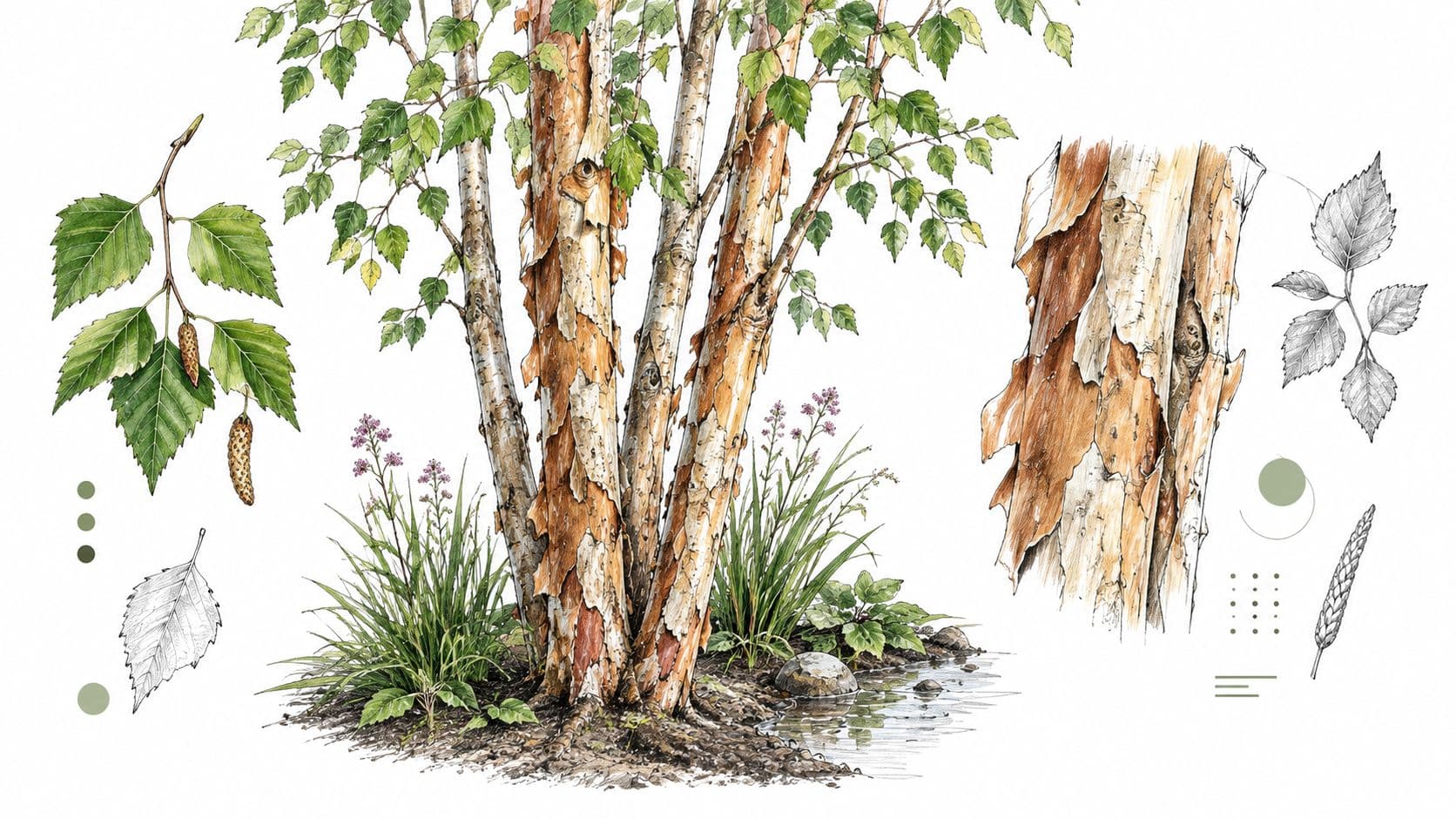
River birch, Betula nigra, is a practical pick for clay that stays moist through part of the year but doesn't remain permanently flooded. Its natural association with streambanks and floodplains makes it well suited to rain gardens, pond margins, drainage swales, and low sections of a residential yard.
The peeling bark adds interest well beyond the growing season. Multi-stem forms create a natural woodland character, while cultivars such as ‘Heritage’ and ‘Dura-Heat’ offer useful improvements in bark appearance and heat tolerance. The species is especially valuable when a homeowner wants a wet-site tree that still looks intentional in a designed garden.
Give the root zone room to breathe
River birch can tolerate wet soil, but it won't thrive in compacted clay with no available oxygen. Test the location after rain, then plant on a slightly raised or gently sloped area if water lingers. Missouri planting guidance treats drainage as satisfactory when a test hole drains within 18 to 24 hours. Water remaining for two days or longer signals poorly drained soil and supports choosing a wet-soil species, raising the planting area, or building a mound (Missouri drainage testing guidance).
Avoid late spring or early summer pruning when sap flow is heavy. Prune during late dormancy instead, and keep mulch off the trunk. Before planting, prepare your yard for new plants by clearing construction debris, identifying runoff paths, and loosening the surrounding bed rather than creating a small pocket of amended soil.
River birch is a poor fit for a dry, exposed site that receives no irrigation during establishment. It also needs enough overhead and lateral space for its mature crown, particularly when planted as a group.
3. Bald Cypress solves standing water
Bald cypress, Taxodium distichum, belongs at the wettest end of this list. It tolerates saturated clay, standing water, and periodic flooding better than most large trees, which makes it a strong candidate for pond edges, stormwater features, and persistent low spots.
Its soft, feathery foliage turns rust-orange in autumn before dropping. The mature form provides a distinctive vertical presence, but this isn't a small ornamental tree for a tight foundation bed. In wet conditions, bald cypress may produce knees. Those woody projections are part of the tree's characteristic growth and shouldn't be covered with mulch or cut casually.
Raise the tree when the site is flat
Houston's tree-planting guidance recommends a hole two to three times wider than the root ball, slightly shallower than the root ball, and a planting position somewhat above the original soil level. The guidance identifies this approach as particularly important in heavy clay because it improves drainage (Houston tree planting guidance).
Plant in spring where local conditions support it, water well while roots establish, and keep competing lawn away from the trunk. A mature bald cypress needs generous clearance from buildings, driveways, septic fields, and utility corridors. The exact distance depends on local planning requirements and the final size of the selected tree, but a low, wet area away from structures is safer than a narrow side yard.
A wet-tolerant tree still needs correct elevation. Don't bury the root flare in an attempt to stabilize it.
Use bald cypress where the water problem is real. If the site only has dense but reasonably draining clay, a drought-capable oak may provide better long-term performance and less wet-site management.
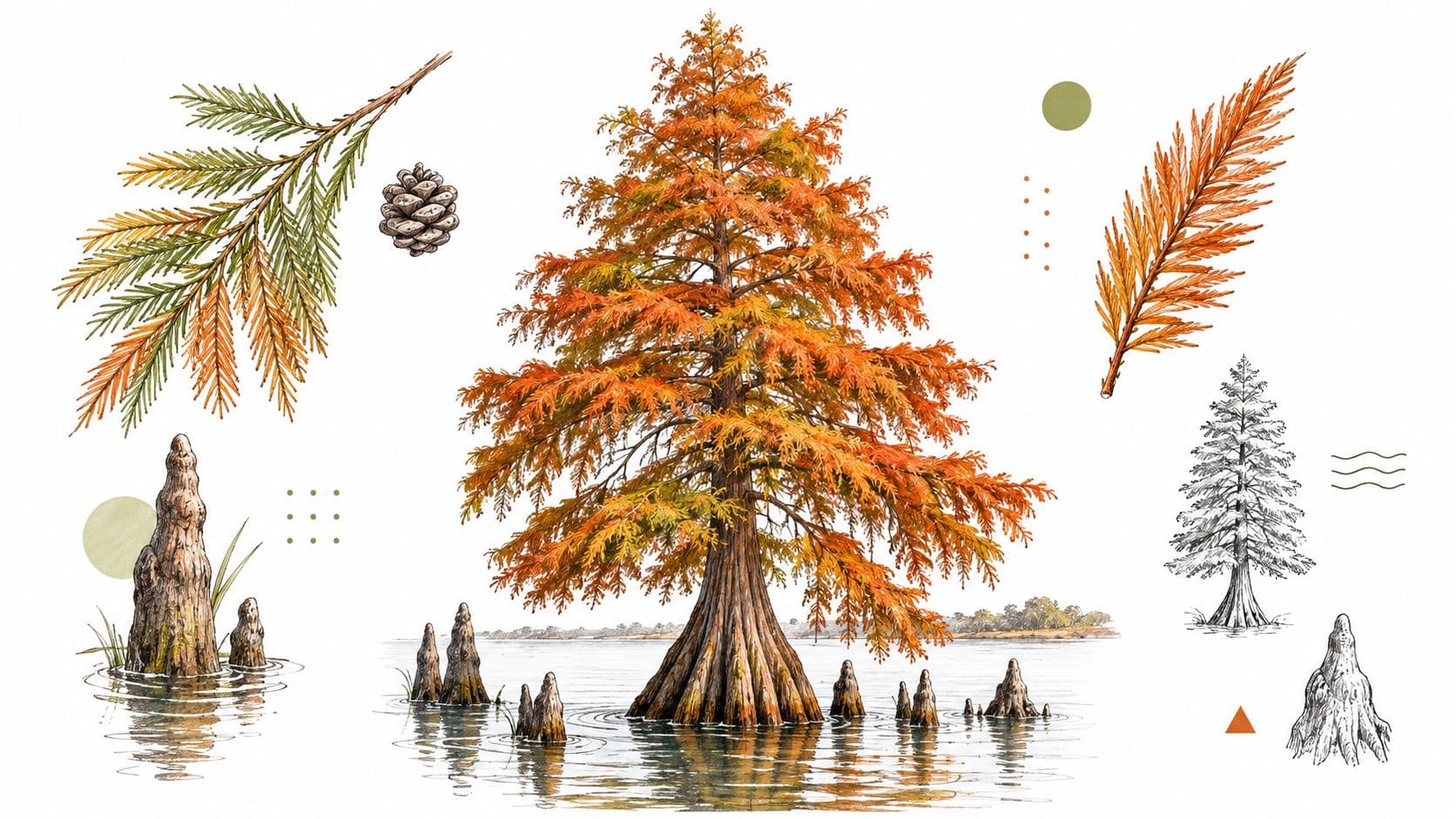
A useful visual reference for its wet-site form is below.
4. Swamp White Oak tolerates flooding and alkaline clay
Swamp white oak, Quercus bicolor, is a strong choice for homeowners who want an oak but have wet clay, seasonal flooding, or alkaline ground. It combines wet-site tolerance with a broad, rounded canopy and long-term shade value. Utah State University Extension includes several oak-adjacent wet-site choices in its clay-soil guidance, while emphasizing that the limiting condition at the planting site should determine the species (Utah State University clay soil reference).
This oak suits a large lawn, park-like garden, or wetland edge better than a narrow foundation strip. Its mature roots need room to explore, and its canopy will eventually influence lawn, paving, and nearby planting beds.
Plant during moist conditions, then protect the root zone
Early spring planting works well when the soil is workable and naturally moist. Dig wide and shallow, set the root flare at or slightly above final grade, and backfill with the native soil. Iowa State University Extension recommends leaving as much as one-third of the root ball or root mass above surrounding grade in poorly drained or compacted soil, then covering the exposed portion with suitable soil or mulch rather than burying it below grade (Iowa State University planting guidance).
Water thoroughly during dry summers while the root system develops. Don't add a heavily amended pocket inside a narrow hole. A sharp transition between loose amended soil and dense clay can restrict outward roots and hold water around the root ball.
Keep the trunk and major roots away from concrete and driveways. Test soil conditions before purchase, especially where alkaline soil may trigger iron-related leaf symptoms. Swamp white oak is tougher than many oaks on wet ground, but it still needs adequate room and a planting grade that doesn't funnel runoff directly into the trunk.
5. Willow Oak fits compacted urban clay
Willow oak, Quercus phellos, is suited to urban sites where clay is compacted, drainage is imperfect, and the tree must coexist with lawns or paved areas. Its narrow leaves give the canopy a lighter texture than many broad-leaved oaks, and its rounded crown provides useful shade without creating the dense visual mass of a low-branched species.
This is a better candidate for a broad lawn, boulevard, or properly sized planting island than for a tiny tree pit. Its tolerance has limits, particularly where construction traffic has destroyed soil structure. Loosen the wider root zone before planting and protect it from repeated foot and vehicle traffic.
Watch the canopy and the leaves
Keep the root zone mulched and free of competing grass. Prune during late winter to remove crossing, weak, or poorly attached branches while the tree is young. In alkaline clay, monitor for iron chlorosis, which appears as yellow leaves with greener veins. Correcting the symptom won't fix a poorly suited site, so check drainage and pH before reaching for a nutrient treatment.
Plant at least 10 feet from walkways where local conditions and mature root spread make that clearance appropriate. For wider planning decisions, compare the best months for planting trees with your local weather and soil workability rather than planting when clay is sticky enough to smear or compact.
Willow oak makes sense when you want a native shade tree with urban tolerance and a relatively open crown. It isn't the first choice for a basin that remains flooded, nor is it ideal for a small patio border where roots and canopy have nowhere to expand.
6. Bur Oak solves summer drought in heavy clay
Bur oak, Quercus macrocarpa, is the long-term choice for large properties where clay becomes hard and drought-prone during summer. It tolerates heavy soil, dry periods, and short-term flooding, making it more versatile than many trees that handle only wet or only dry conditions.
The trade-off is scale. Bur oak is a massive tree, so it belongs on a large lawn, rural property, estate, campus, or naturalized woodland edge. Its thick, corky bark and broad crown create strong visual presence, while its long life rewards careful placement more than quick visual results.
Give a large oak a large root zone
Plant seedlings or small container trees in spring to reduce transplant stress. Mulch the root zone in a broad ring, keep the trunk clear, and water through extended drought while the tree establishes. A wide planting area matters more than a deep hole. Iowa State guidance supports broad, shallow preparation in compacted or poorly drained ground, with the root flare kept visible rather than buried (Iowa State tree planting guidance).
Keep the eventual canopy well away from structures, overhead lines, septic systems, and high-use paving. A bur oak forced into a narrow residential side yard becomes a clearance problem even if the soil itself suits it. Don't choose it because the young tree looks manageable. Plan for the mature tree first.
Best use: Choose bur oak when the site has heavy clay but drains well enough between storms and the property can accommodate a broad, long-lived canopy.
It isn't the right answer for permanent standing water. In that situation, bald cypress or another wet-soil species gives roots a better match to the site's oxygen and drainage conditions.
7. Thornless Honeylocust tolerates compaction and alkaline soil
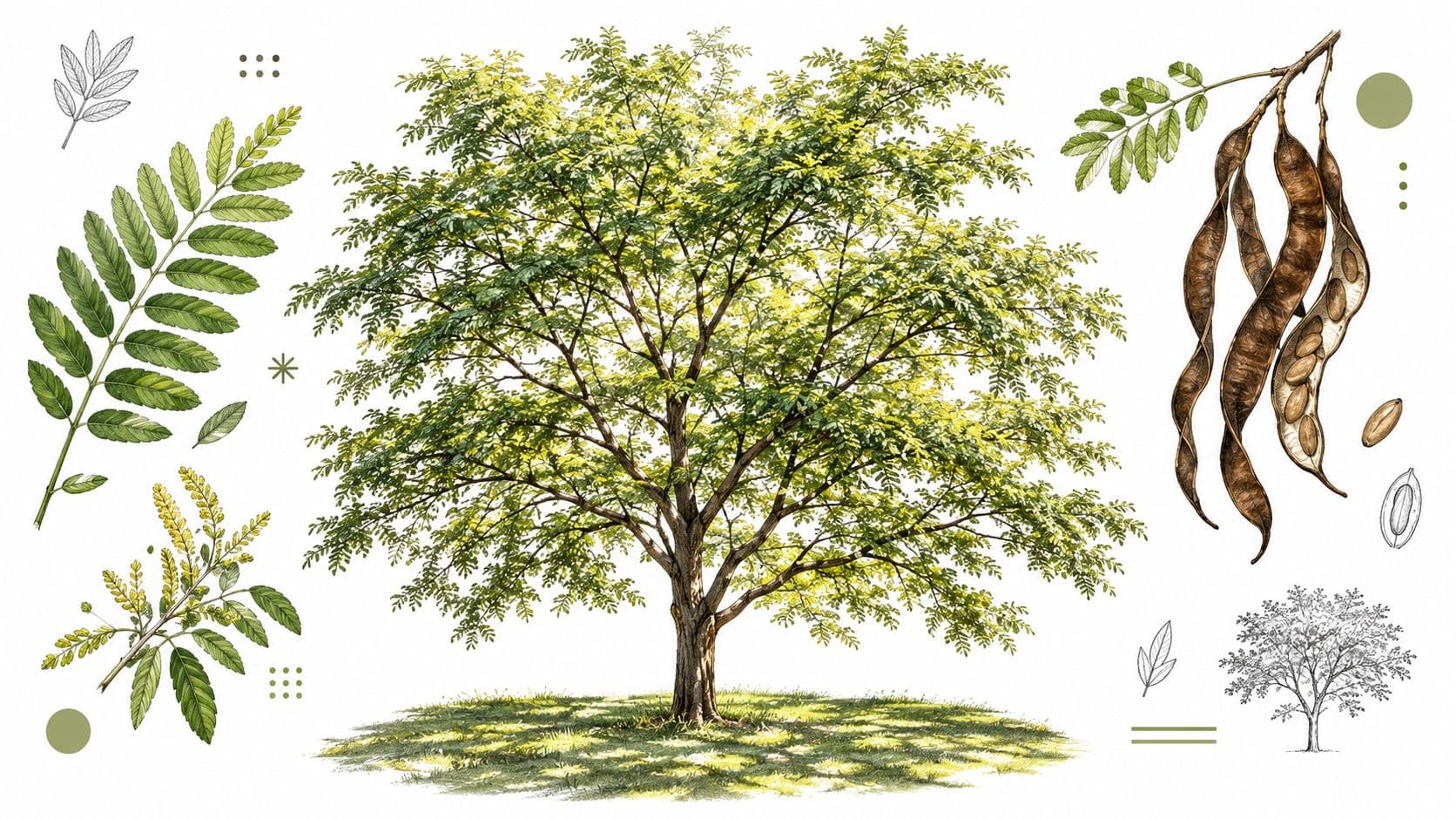
Thornless honeylocust, Gleditsia triacanthos var. inermis, earns its place on difficult urban sites. It tolerates compacted clay, alkaline conditions, and the stress of boulevards, parking areas, and lawns. Its open canopy casts dappled shade, so grass and lower planting can often remain viable beneath it.
Nursery labels require attention. The wild form has large thorns, while the garden selection should be explicitly thornless. Seedless or fruitless cultivars such as ‘Shademaster’ and ‘Skyline’ are useful where pod litter would be a nuisance near patios, pools, or paved outdoor rooms.
Train the structure early
Prune young trees to develop a strong central leader and remove weak or crossing branches before they become large defects. A compacted site still needs a broad planting zone, and roots won't use a narrow pocket effectively if surrounding soil has been compressed by construction traffic.
Place the tree far enough from patios, pools, walks, and buildings to account for canopy spread, surface roots, and litter. A clearance of 15 to 20 feet may be appropriate for the listed use cases, but confirm the mature width and local site constraints for the cultivar you buy.
Honeylocust is useful when you want filtered shade rather than a dense canopy. It doesn't belong in a permanently wet hollow because it tolerates clay. Where soil remains saturated, choose a tree whose roots are adapted to that oxygen-limited condition instead of expecting urban toughness to overcome waterlogging.
8. Black Tupelo handles wet clay and seasonal flooding
Black tupelo, or black gum, Nyssa sylvatica, is a strong choice for wet woodlands, rain gardens, wetland buffers, and clay that floods periodically. It offers excellent autumn color, a pyramidal young form, and a more rounded crown with age. Its ecological value also makes it a good fit for naturalistic gardens planted with ferns, sedges, and other moisture-loving species.
This tree isn't as forgiving of rough transplanting as a smaller container-grown plant. Choose a young container-grown tree rather than buying an oversized specimen that has already experienced substantial root disturbance. The goal is to let the root system expand gradually into the surrounding clay.
Keep moisture consistent during establishment
Plant in spring when soil conditions are workable. Keep the root zone consistently moist during the first growing seasons, but don't turn a poorly drained site into a permanent basin around the trunk. A broad mulch ring helps moderate the shallow root zone. Keep mulch away from the bark and avoid covering the root flare.
Black tupelo works best when the rest of the planting reinforces the site's moisture pattern. Pair it with sedges, ferns, and other wet-site plants rather than placing thirsty lawn directly under the canopy. On a yard that becomes dry and hard in summer, improve the planting bed and irrigation plan before assuming a wetland tree will solve the problem.
Its strongest role is a transition tree. Place it where lawn gives way to a drainage swale, rain garden, pond edge, or naturalized planting. That setting supports its form and reduces the temptation to overmanage a tree that performs best with a compatible plant community.
Top 8 Trees for Clay Soil, Comparison
| Tree | 🔄 Implementation Complexity | ⚡ Establishment Effort | ⭐ Expected Outcomes | 📊 Ideal Use Cases | 💡 Key Advantages / Tips |
|---|---|---|---|---|---|
| Red Maple (Acer rubrum) | Moderate, fast growth, shallow roots can need management | Low–Moderate, regular early watering; room for rooting | Quick shade, reliable fall color; moderate lifespan in urban stress | Streets, clay yards, stormwater basins, residential shade | Adaptable to wet/dry clay; plant in wide bed, mulch 2–3" away from trunk; choose sturdier cultivars |
| River Birch (Betula nigra) | Moderate, multi‑stem forms; pruning timing important | Moderate, prefers moist sites; mulch but keep off trunk | Distinctive exfoliating bark and good wet‑site performance; moderate longevity | Rain gardens, bioswales, pond/stream edges | Thrives in wet clay; plant in groups for effect; avoid late‑spring pruning; select 'Heritage'/'Dura‑Heat' |
| Bald Cypress (Taxodium distichum) | Low–Moderate, slow to establish; manage knees/trip hazards | Moderate, tolerates standing water; needs ample space | Long‑lived, highly waterlogged‑tolerant, strong wind resistance | Pond edges, wetlands, stormwater features, restoration | Exceptional wet‑site tolerance; plant in spring, keep knees exposed, site 20–25 ft from structures |
| Swamp White Oak (Quercus bicolor) | Moderate, slow early growth; benefits from stable site | Moderate, deep watering first years; tolerates alkaline soils | Long‑lived, wildlife value, strong root anchoring and broad canopy | Parks, wetland edges, municipal plantings on compacted clay | Urban/transplant tolerant oak; avoid planting near foundations, test pH and amend if needed |
| Willow Oak (Quercus phellos) | Low–Moderate, faster oak growth but prune for structure | Low–Moderate, tolerates compaction; monitor for chlorosis | Rapid canopy development for an oak; light, lawn‑friendly shade | Street trees, parking islands, lawns and patios | Handles urban stress and clay; prune in late winter, mulch root zone, allow root space |
| Bur Oak (Quercus macrocarpa) | Moderate–High, very large, slow early establishment | High, needs long‑term space and low‑intervention maintenance | Very long‑lived, drought and clay tolerant, excellent wildlife value | Large estates, prairie/savanna restoration, open campuses | Exceptional tolerance and longevity; plant seedlings, provide 40–50 ft clearance |
| Thornless Honeylocust (Gleditsia inermis) | Low, fast, easy to establish but may need formative pruning | Low, rapid establishment; tolerates compaction and alkaline soil | Fast shade with dappled light; supports turf beneath canopy | Parking lots, boulevards, large lawns | Very adaptable and fast; confirm thornless/seedless cultivar, prune young trees for strong structure |
| Black Tupelo (Nyssa sylvatica) | Moderate, taproot complicates transplanting; slow to mature | Moderate–High, keep root zone moist early; can be scarce in nurseries | Brilliant early fall color, strong wildlife/fruit value, long‑lived | Wetland buffers, naturalistic plantings, rain gardens | Outstanding fall color and bird fruiting; buy small container stock, mulch wide ring and protect root zone |
Matching the Right Tree to Your Clay Yard
Start with the water pattern, not the nursery tag. Clay that stays wet after storms needs a different tree from clay that becomes drought-hard and cracked in summer. A tree can tolerate clay in general and still fail on your property because the soil is compacted, the planting hole sits below grade, or construction fill has buried the original root zone.
Dig a test hole and fill it with water. Time the drainage, then use the result to guide the planting decision. Missouri guidance treats water that drains within 18 to 24 hours as satisfactory, while water remaining for two days or longer points toward wet-soil species, raised planting, or a mound (Missouri drainage testing guidance).
Match the tree to the actual problem
- Standing water: Start with bald cypress, river birch, or black tupelo. Raise the planting grade where possible, keep the root flare visible, and avoid creating a deep basin around the root ball.
- Seasonal flooding: Consider swamp white oak, river birch, black tupelo, or bald cypress. Confirm that the site drains enough between wet periods to support the chosen species.
- Compaction: Red maple, willow oak, thornless honeylocust, and swamp white oak can be useful, but only after you loosen a broad root zone and prevent further traffic over it.
- Summer drought: Bur oak is the strongest match on this list for large properties with heavy clay that becomes dry and hard. Young trees still need deep watering during establishment.
- Mixed wet and dry conditions: Red maple and river birch can handle changing moisture better than trees that require either saturated or sharply drained soil, but neither should be forced into a permanently flooded or completely dry site.
Planting technique often matters as much as species. Seattle recommends making the hole at least twice the root-system width on compacted or poorly drained sites, while Houston recommends a hole two to three times wider than the root ball and slightly shallower. These recommendations widen the available rooting zone without placing the root ball below surrounding grade (Seattle planting guidance).
Protect the site after planting
Keep the trunk flare visible. Use native soil as backfill unless a qualified local professional has identified a specific amendment strategy, because a narrow pocket of loose soil inside dense clay can collect water and restrict lateral root movement. Spread mulch across the surrounding root zone, keep it off the trunk, and don't compact the bed with lawn equipment or foot traffic.
Clearance matters just as much as soil tolerance. Estimate mature canopy width, identify utilities and drains, preserve the existing grade, and keep large species away from foundations and paving where roots, construction damage, and clay shrink-swell movement could create problems. Clay tolerant doesn't mean foundation safe.
For an existing tree growing in compacted clay, don't start by cutting roots or rototilling the area. University of Delaware guidance describes radial trenches from the trunk toward the drip line as a soil-improvement approach that limits root damage to no more than one-third of the root system (Oregon State University tree selection and care guidance). Have an arborist assess the site before excavation, especially near a mature tree, foundation, or utility route.
Finally, place the canopy before you place the tree. OutdoorBrite lets you test a concept on a photo of your actual yard, compare planting layouts, and see how a mature shade tree may relate to your house, patio, pool, lawn, and planting beds. For broader outdoor styling, a Farmhouse World outdoor decor guide can help connect the tree placement with the rest of the garden.
OutdoorBrite turns a photo of your yard into realistic yard design concepts, so you can test a clay-tolerant tree's placement, canopy, and surrounding planting beds before you buy. Upload your space, compare styles, and refine the design with elements such as paths, patios, and planting areas by visiting OutdoorBrite.
See your yard reimagined
Start creating