Front Yard Landscaping Ideas with Rocks No Grass: Top 8
Discover 8 stunning front yard landscaping ideas with rocks no grass. Save water & boost curb appeal with xeriscaping, pavers, and stone designs.
Trade Your Mower for Modern, Low-Maintenance Curb Appeal
Tired of spending weekends mowing, watering, edging, and then fighting the same weeds a few days later? You're not the only homeowner staring at the front yard and wondering why so much work still produces such an average result. Grass often asks for the most attention in the most visible part of the property.
That's why more homeowners are moving toward front yard design ideas with rocks no grass, especially when they want a cleaner look, lower upkeep, and a yard that still feels designed instead of stripped down. Rock-based designs can look sharp, architectural, natural, or even lush when the plant choices and materials are handled well. The difference comes down to layout, stone size, grade, and restraint.
The mistake I see most often is treating rock as a shortcut. It isn't. A good rock yard needs a plan for drainage, edging, plant spacing, and maintenance from day one. Done well, it saves time and water and gives the house a stronger front presence. Done poorly, it turns into a hot, weedy, scattered mess.
Below are eight workable designs that go beyond inspiration photos. Each one includes practical build notes, good material pairings, and the trade-offs that matter before you start tearing out lawn.
Table of Contents
- 1. Xeriscaping with Decorative Rock Gardens
- 2. Modern Hardscape Design with Permeable Pavers
- 3. Rustic Boulder and Stone Arrangement Landscapes
- 4. Decorative Gravel and Crushed Stone Landscaping
- 5. Dry Riverbed and Stream Rock Design
- 6. Architectural Stone Mulch and Stepping Stone Gardens
- 7. Recycled and Sustainable Rock Landscaping
- 8. Polished and Decorative Aggregate Rock Features
- 8-Option Front Yard Rock Landscaping Comparison
- Visualize Your Grass-Free Yard Before You Build
1. Xeriscaping with Decorative Rock Gardens
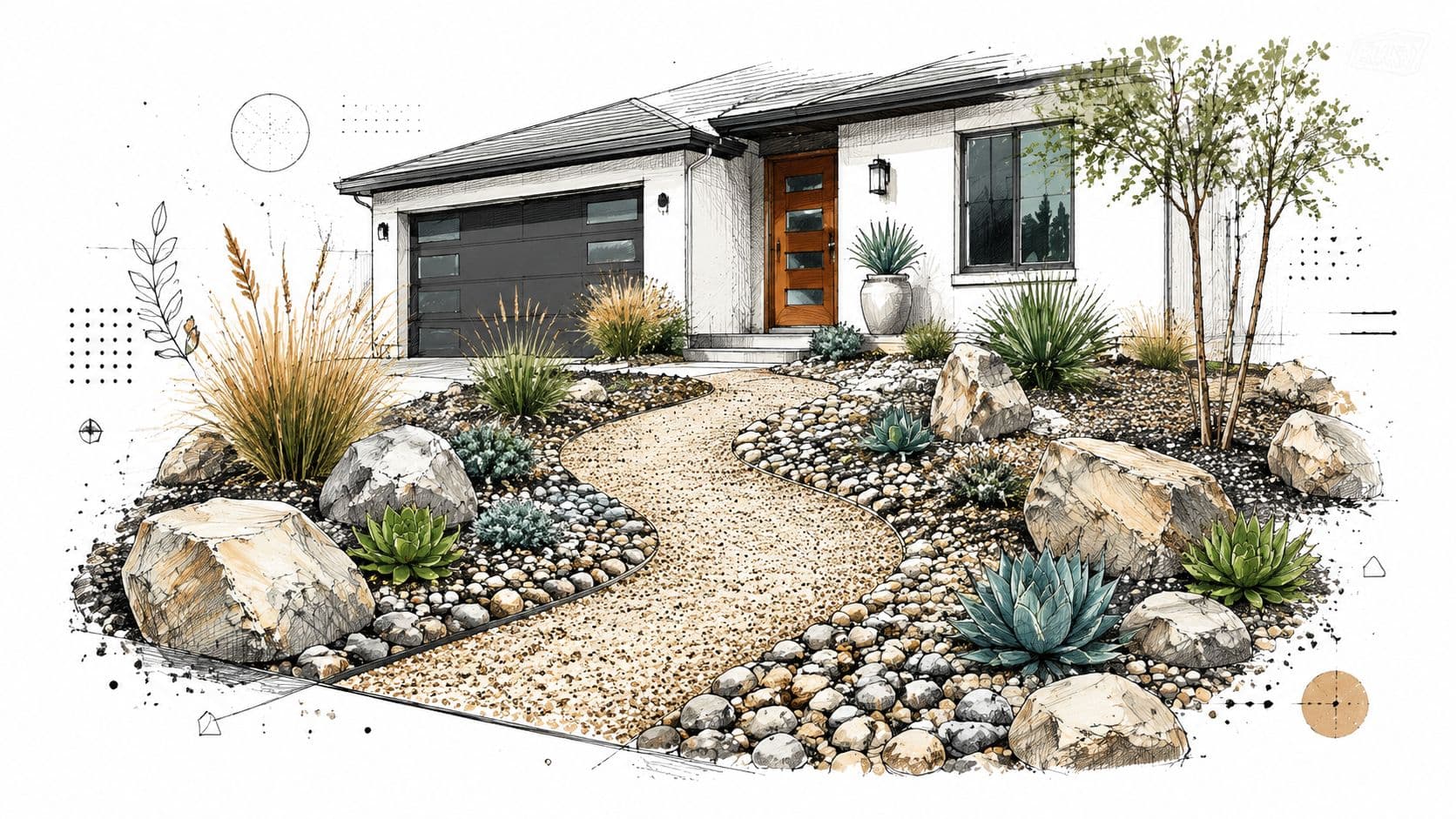
If you want the most proven path away from turf, start here. Xeriscaping gives you structure without forcing the yard to feel barren. It works especially well on ranch homes, desert-modern facades, stucco exteriors, and any lot where the sun hits hard for most of the day.
What makes it practical is the mix of drought-tolerant plants and mineral ground cover. Rock and gravel in these layouts can suppress weeds by 80 to 90 percent, retain soil moisture by up to 40 percent, and reduce irrigation needs by 50 to 60 percent annually, according to the cited guidance in Martha Stewart's rock landscaping overview. Those gains matter most when the planting plan is sparse but intentional.
Build it like a planting system, not a gravel dump
A reliable material palette is crushed granite, pea gravel, river rock, and one or two statement boulders. Pair those with agave, yucca, aloe, red yucca, dwarf olive, lavender, salvia, or ornamental grasses depending on your climate. Warm-toned rock usually reads better against stucco and brick, while gray and charcoal stone suit more modern elevations.
For layout, keep the biggest visual weight near the entry path or a front corner of the house. Then repeat smaller planting pockets so the yard looks composed from the street and from the front window.
- Use visible layers: Mix boulders, mid-size rock, and fine gravel so the yard has depth instead of one flat texture.
- Choose edging early: Steel or stone edging keeps gravel from creeping into walks and driveway joints.
- Space plants for maturity: Small nursery plants look far apart at install, but crowding them is what makes rock gardens age badly.
Practical rule: In good xeriscaping, plants are the punctuation. Rock is the background.
Before buying material, it helps to discover xeriscaping with OutdoorBrite and mock up a few versions of the yard. Rock color shifts more than one might expect once it's spread across a full frontage in direct sun.
The trade-off is heat. Large rock fields can reflect and hold warmth, so soften them with plants near entries, windows, and seating zones.
2. Modern Hardscape Design with Permeable Pavers
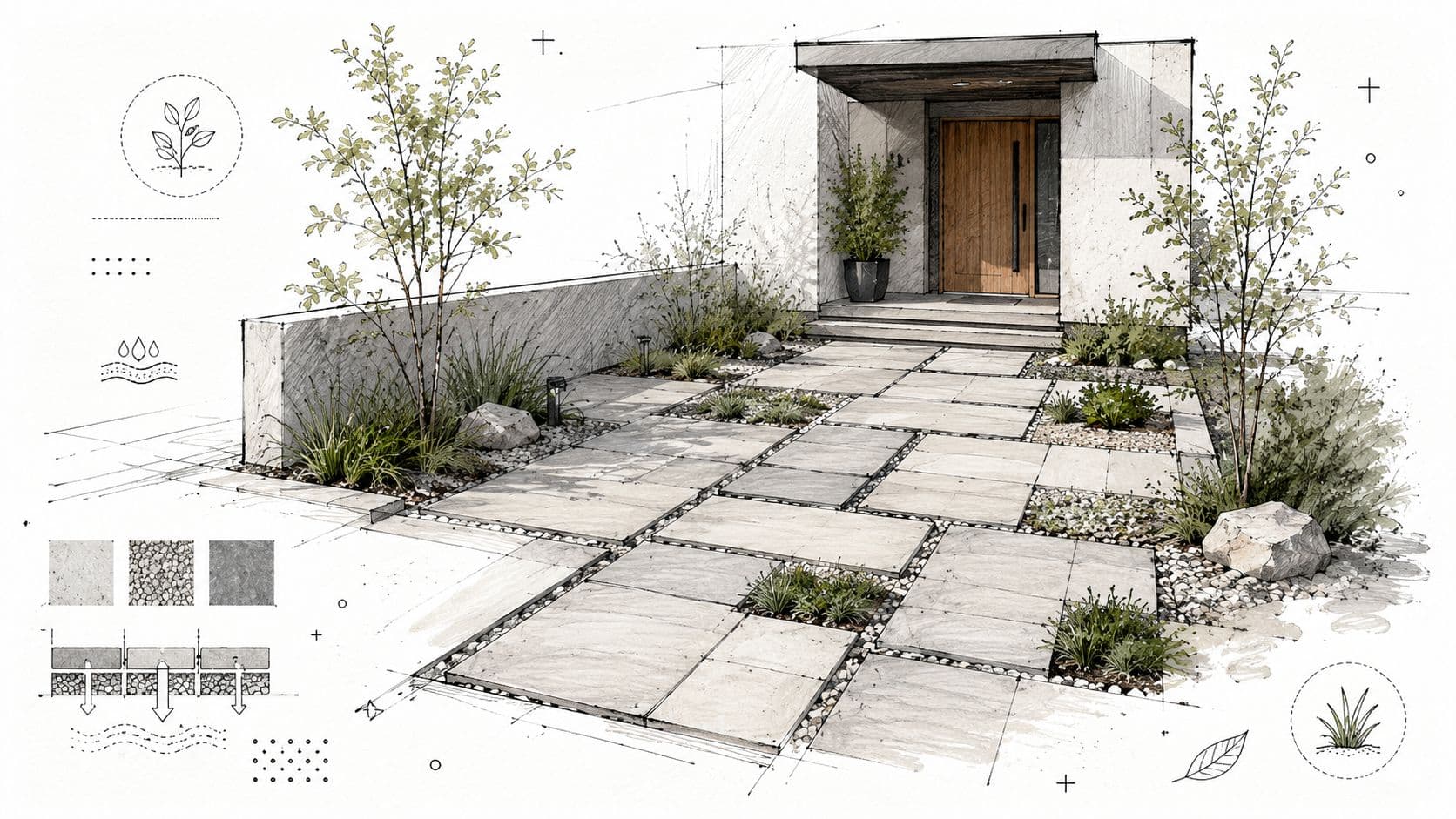
Some homeowners don't want a garden feel at all. They want a front yard that looks architectural, quiet, and deliberate. Permeable pavers do that well because they create usable surface area while still letting the design breathe.
This approach fits narrow front yards, contemporary homes, and properties where you need clear walking routes from curb to door. I also like it for small lots where a full planting bed would make the frontage feel cluttered.
Where this layout earns its keep
Use pavers for the path, a forecourt, or a widened entry zone. Then frame those hardscape panels with gravel beds, upright plants, or low sculptural planting pockets. Gray, beige, and charcoal pavers stay versatile and don't trap you into one plant palette.
A clean modern front yard usually relies on repetition. Repeat one paver shape, one gravel color, and a tight plant list. That discipline is what makes it look expensive.
Hardscape-heavy yards don't forgive sloppy edges. If lines wander, the whole design loses its modern character.
A practical build stack is compacted base, bedding layer, pavers, and tightly managed joints. In planting breaks, keep selections simple. Think lomandra, dwarf grasses, agave, boxy shrubs, or columnar accents that echo the geometry of the paving.
- Use planting pockets sparingly: A few well-placed cutouts look stronger than trying to force greenery into every gap.
- Control joints carefully: Joint fill and edge restraint matter if you want the surface to stay crisp.
- Match the home style: Permeable pavers can look sterile in front of a cottage or traditional farmhouse unless you soften them with looser planting.
If you're weighing pavers against beds, gravel, and planting mass, it helps to spend a few minutes understanding outdoor design choices before you commit. Many front yard landscaping ideas with rocks no grass work best when the hardscape and planting load stay balanced.
The trade-off is cost and install precision. This is usually less forgiving than a gravel-first design, but it rewards that extra precision with a cleaner finished result.
3. Rustic Boulder and Stone Arrangement Landscapes
This style works when the site already has a natural feel or when the house needs visual weight. Boulders can anchor a wide yard better than shrubs alone, especially on sloped lots or lots that feel too open from the street. They're also one of the easiest ways to make a no-grass front yard look intentional from day one.
The mistake is setting large stones on top of the soil like props. Realistic boulder placement needs mass, embedment, and spacing. If every rock shows its full height, the scene looks staged.
How to keep boulders from looking dropped in
One practical reference from a no-lawn front garden build shows how raised rock gardens can work structurally as well as visually. That documented installation raised soil level by 12 to 14 inches, used half-circle stone features buried about one-third of their height for a more natural aged look, and kept plants raised about 1 to 1.5 inches above the gravel base to prevent stem rot and manage moisture properly, as described in this no-lawn front garden guide.
That's the principle I'd carry into any boulder-focused front yard. Sink stones enough that they appear rooted. Then cluster them where grade changes, near a driveway edge, or as a focal point visible from the sidewalk.
Good plant pairings include blue fescue, sedum, dwarf pine, juniper, thyme, lavender, or native grasses depending on region. Use fewer species than you think you need. Rustic stone compositions get stronger when the forms are bold and the plant list is edited down.
- Buy for shape, not just size: A broad low boulder often looks better than a tall round one.
- Leave breathing room: Rocks need negative space around them or they lose presence.
- Think from inside the house: Place the strongest grouping where you'll also see it from the front window.
This style is low maintenance once established, but it's hard to revise after installation. Moving mature boulders isn't a casual weekend correction.
4. Decorative Gravel and Crushed Stone Landscaping
Decorative gravel is the most flexible option on this list. It can lean modern, Mediterranean, desert, coastal, or minimal depending on color and what you pair it with. It's also one of the easiest ways to replace lawn in stages instead of doing a full front-yard overhaul at once.
The best gravel yards don't rely on one rock type from property line to property line. They use zones. A main field of one gravel, a path material that contrasts with it, and a few planted islands or boulder accents give the eye somewhere to rest.
Best uses and common mistakes
If you're installing gravel around fresh planting, precision matters more than most DIY guides admit. Professional desert-style installs often use brown deserty rock over weed barrier fabric at a depth of about 2 inches over the root zone, then hand-arrange material around plants, tamp carefully, and water heavily right after installation to help plants establish, as shown in this installation-focused video reference.
That same guidance matters for plant health. The recommendation to keep plant bases raised above the final gravel layer helps avoid moisture trapped against stems. In arid climates, that method is associated with reducing stem rot by up to 40 percent in the referenced guidance.
Gravel is easy to spread and easy to get wrong. Most failures come from too much depth around stems and no defined edge at the perimeter.
For plant pairings, try cistus, rosemary, salvia, euphorbia, yarrow, dianella, or low native grasses. For a cleaner look, keep gravel size consistent in each zone and let plant form provide the contrast.
If you're comparing options beyond turf, sustainable landscaping alternatives can help you sort out when gravel is the right finish and when another approach would serve the yard better.
The trade-off is movement. Loose gravel migrates into sidewalks and driveways unless edges are firm and foot traffic is directed with stepping stones or pavers.
5. Dry Riverbed and Stream Rock Design
A dry riverbed is one of the smartest front yard landscaping ideas with rocks no grass when the property already has runoff issues. It gives water a visible route and turns a drainage problem into a feature. Even on flat sites, it can guide the eye from one side of the yard to the entry and create motion in a space that would otherwise feel static.
This style works best when it follows the land instead of fighting it. Straight channels almost always look forced. Broad curves, varied stone sizes, and planted edges read more naturally.
Here's a visual reference for the look in motion:
Make it look natural and work like drainage
Start with the “source” point. That might be a downspout outlet, a slope break, or a corner where runoff collects. Use larger boulders and chunkier stone there, then taper toward smaller stream rock as the bed moves through the yard.
Plant the banks, not the center. Good companions include ornamental grasses, deer grass, liriope in milder climates, dwarf shrubs, or drought-tolerant perennials that can soften the edges without swallowing the stone pattern. Let the center stay legible.
A dry riverbed usually looks best when the rest of the yard stays restrained. If every area has its own decorative move, the stream loses its purpose.
- Follow real water movement: Even a decorative channel should respect existing grade.
- Vary the edge: Slightly irregular margins feel more believable than smooth machine-made curves.
- Use repetition carefully: Repeat the same boulder type so the bed feels tied together.
The trade-off is maintenance after storms. Leaves, silt, and displaced rock collect in low spots, so the feature needs occasional reshaping to keep its clean lines.
6. Architectural Stone Mulch and Stepping Stone Gardens
This is the option I suggest when someone wants order without a fully paved front yard. Stone mulch gives beds a finished look, while stepping stones create direction and rhythm across the space. It suits modern homes, transitional homes, and compact lots where every path line matters.
It also solves a common front-yard problem. People cut across the same area from driveway to porch, wear out whatever's planted there, and then wonder why the entry always looks messy. A stepping-stone route answers that behavior directly.
The layout matters more than the stone
The strongest version uses one consistent stepping material such as slate, limestone, or porcelain-look pavers, then frames it with angular stone mulch in a neutral tone. Architectural rock works because it stays put better than rounded pea gravel and reads as deliberate rather than casual.
Keep the planting beds tight and graphic. Strappy grasses, clipped shrubs, low succulents, and a few upright accents work well. This isn't the style for a dozen flower varieties fighting for attention.
A useful design move is to widen the path near the porch or front door. That little flare makes the entry feel resolved instead of ending in a narrow trail. Then repeat the stone mulch in adjacent beds so the route feels integrated with the rest of the yard.
Use stepping stones to direct feet where you want them, not where the shortest shortcut would naturally happen.
The trade-off is that alignment matters. If the path spacing feels awkward or drifts off axis with the front door, people notice immediately. Mocking it up with an AI visualization before install is especially useful here because path geometry is hard to judge from a sketch alone.
7. Recycled and Sustainable Rock Landscaping
Not every rock yard has to start with newly quarried material. Recycled concrete, reclaimed stone, salvaged boulders, and reused base materials can produce a front yard with character and a lighter environmental footprint. This approach often looks best when you embrace the variation instead of trying to make recycled material mimic brand-new aggregate.
I like this style for casual modern homes, industrial-inspired exteriors, and renovation projects where the architecture already has some roughness or patina. It can also be a smart fit when budget matters but you still want the front yard to feel designed.
Where recycled materials make sense
Use reclaimed chunks as edging, salvaged stone as focal accents, and recycled base where it won't be the visible finish. Then top-dress with a more controlled gravel or decorative rock so the overall look stays intentional. The front yard should feel composed, not like leftover construction material was scattered around.
One practical angle that doesn't get enough attention is weed management without relying on chemical herbicides. The cited Home Depot reference notes a content gap around long-term weed control in rock-only yards and points to emerging biological suppression strategies, including sharp-edged lava rock combined with organic mulch under plants, with 2025 to 2026 trials in arid zones reportedly showing 40 percent higher efficacy in that context, according to Home Depot's rock landscaping ideas page.
That doesn't mean every recycled yard needs lava rock. It does mean the best sustainable yards treat weed control as a layered system. Material choice, plant cover, edge control, and ongoing spot maintenance all matter.
- Ask for samples: Recycled batches vary widely in color and texture.
- Use rough materials where toughness helps: Utility paths and side transitions are better candidates than formal front entries.
- Explain the aesthetic to everyone involved: Recycled material should look intentionally rugged, not unfinished.
The trade-off is inconsistency. If you want a polished, luxury finish, recycled aggregate usually isn't the right lead material.
8. Polished and Decorative Aggregate Rock Features
This is the high-style end of rock landscaping. Polished stones, marble chips, black basalt, white quartz, colored glass aggregate, and other specialty materials can make a front yard look sharp and editorial when used in measured doses. They're best treated like jewelry, not fabric.
The mistake is covering the whole yard in premium aggregate and expecting it to stay elegant. Specialty stone tends to show debris, displacement, and staining more readily than ordinary gravel. It looks best in accent zones where you can maintain it.
Use premium rock as an accent, not a blanket
Frame a sculptural planting bed near the entry, create a clean strip along a modern walkway, or highlight a specimen pot or boulder grouping. White and light-toned chips can brighten a shaded front yard, while black basalt gives strong contrast against silver foliage or pale architectural walls.
Plant choices should be simple and textural. Think agave, horsetail in controlled settings, clipped boxwood where climate allows, mondo grass, phormium, or sculptural succulents. Premium rock wants disciplined companions.
The visual payoff comes from contrast. Earlier source material noted that replacing mulch with rocks of varying colors and textures can increase visual contrast, but you don't need to repeat those figures to apply the lesson. Contrast is exactly why these accent materials work best in smaller, focused areas.
- Reserve it for focal points: Entry courts, mailbox beds, and view corridors are stronger than full-lot coverage.
- Check glare and heat: Light stone can throw brightness, and dark stone can read heavy in hot sun.
- Plan for cleaning: Leaves, dust, and soil splash show up fast on polished surfaces.
This approach has the highest maintenance-per-square-foot ratio on the list. It's worth it when you want impact in a limited area, not when your main goal is the least possible upkeep.
8-Option Front Yard Rock Landscaping Comparison
| Design Option | Implementation Complexity 🔄 | Resources & Cost ⚡ | Expected Quality / Impact ⭐📊 | Ideal Use Cases | Key Advantages & Tips 💡 |
|---|---|---|---|---|---|
| Xeriscaping with Decorative Rock Gardens | Moderate, design/plant selection and initial installation effort | Moderate–High upfront (rocks, drought plants, irrigation); low ongoing costs | ⭐⭐⭐⭐, strong water savings, low maintenance, long-lasting aesthetic | Arid climates, water-restricted areas, modern curb appeal | Water-efficient; use landscape fabric, mix rock sizes, refresh every 2–3 yrs |
| Modern Hardscape Design with Permeable Pavers | High, requires proper grading and professional install for drainage | High materials & labor; durable and replaceable pieces | ⭐⭐⭐⭐, excellent drainage reduction, contemporary visual clarity | Urban front yards, driveways, sustainable builds, high-traffic areas | Reduces runoff; apply polymeric sand, test layouts virtually before committing |
| Rustic Boulder & Stone Arrangement Landscapes | High, heavy equipment and precise placement needed | High cost for large boulders and installation logistics | ⭐⭐⭐⭐, strong sculptural focal points, permanent and low-maintenance | Large properties, statement focal areas, naturalistic or Japanese-inspired designs | Bold focal elements; arrange in odd numbers, source locally to reduce cost |
| Decorative Gravel & Crushed Stone Landscaping | Low, simple prep and DIY-friendly installation | Low cost; economical for large coverage; periodic refreshing required | ⭐⭐⭐, fast visual change, good drainage, moderate durability | Budget projects, mid-century or coastal styles, quick updates | Most affordable; install fabric and edging, combine sizes for texture |
| Dry Riverbed & Stream Rock Design | Medium, needs careful planning for flow and composition | Moderate, mixed boulders and graduated gravel; maintenance to retain pattern | ⭐⭐⭐⭐, artistic, guides sightlines and improves erosion control | Sloped sites, drainage-focused landscapes, artistic focal corridors | Functional and aesthetic; plan flow, use larger stones "upstream" then smaller downstream |
| Architectural Stone Mulch & Stepping Stone Gardens | Medium, requires precise layout and defined bed edges | Moderate–High, premium stone mulch and stepping materials | ⭐⭐⭐⭐, polished, organized look with durable pathways | Contemporary homes, structured gardens, areas with regular foot traffic | Stable underfoot; space stepping stones 18–24 in, use uniform materials for cohesion |
| Recycled & Sustainable Rock Landscaping | Medium, sourcing varies; installation similar to standard rock methods | Low–Moderate, often less expensive but variable availability/quality | ⭐⭐⭐, strong environmental benefit, unique mixed-material aesthetic | Eco-conscious projects, municipal/community gardens, budget green builds | Low impact option; request samples, verify recycled asphalt safety and consistency |
| Polished & Decorative Aggregate Rock Features | Medium, careful placement and ongoing upkeep for premium look | Very High, luxury materials (marble, glass), higher maintenance | ⭐⭐⭐⭐⭐, high-luxury visual impact, boosts curb and market value | High-end estates, real estate staging, artistic landscape installations | Best used as accents; maintain regularly, avoid full-coverage for cost efficiency |
Visualize Your Grass-Free Yard Before You Build
Rock-based front yards look simple from a distance. Up close, they're all about proportion, material color, spacing, and how the hard surfaces meet the house. That's why so many grass-removal projects go sideways. The homeowner picks a rock they liked in a small sample, installs too much of it, and ends up with a yard that feels flat, harsh, or disconnected from the architecture.
A visualization step fixes a lot of that before money gets spent. Instead of guessing, upload a photo of your actual front yard into a design tool like OutdoorBrite and test different directions. Try warm gravel versus gray stone. Compare a paver-led layout against a dry riverbed concept. See whether the yard needs more planting mass, fewer materials, or stronger edging.
This is especially useful when you're choosing among front yard landscaping ideas with rocks no grass that have very different personalities. Xeriscaping feels softer and more planted. Permeable pavers feel structured and modern. Boulder compositions feel grounded and natural. Decorative aggregate accents feel refined and high contrast. All of those can work, but not all of them will fit your house, lot shape, and maintenance tolerance.
It also helps with the practical side. Contractors can price a project more accurately when the concept is clear. DIY homeowners can estimate material zones more confidently. Real estate-minded sellers can test curb appeal improvements before committing to a full install. Even small choices, like whether the stepping stones should run straight or offset, become easier when you can see them on the actual site.
The biggest benefit is restraint. Most front yards improve when the design gets edited, not added onto. A visualization makes it easier to spot when there are too many rock types, too many disconnected beds, or not enough plant structure to soften the mineral surfaces. That alone can save you from expensive corrections later.
A grass-free front yard doesn't have to feel stark. It can feel calm, modern, natural, or lush in a dry-climate way. The right rock-based design gives you less mowing, less watering, and a stronger first impression. The smart move is to see it before you build it.
If you want to test these ideas on your own property before buying stone or hiring a crew, try OutdoorBrite Money. Upload a front-yard photo, generate realistic redesigns in seconds, and compare rock colors, plant groupings, and path layouts so you can move forward with a plan that suits your home.
See your yard reimagined
Start creating