Ground Covers Instead of Grass: 8 Options for 2026
Replacing lawn? Compare 8 ground covers instead of grass with site suitability, pros and cons, and planting density tips for low-maintenance yards.
You know the three spots. The side yard between the house and the fence that gets two hours of sun and stays patchy no matter how much seed you throw at it. The bank behind the patio that greens up in April and washes into ruts by July. The strip along the walk where feet and a dog have worn the turf down to hard, compacted soil.
Those are the spots where a lawn costs the most in water, fertilizer, and weekend hours, and they're also where a well-chosen ground cover earns its keep. American households use nearly 8 billion gallons of water outdoors every day, mostly to irrigate yards and gardens, according to the EPA's WaterSense statistics and facts, and in dry climates outdoor use can reach 60% of household consumption.
This guide sorts eight proven ground covers by the conditions they handle, whether that's foot traffic, deep shade, dry slopes, wet edges, or cold northern sites. Each entry names the way that plant usually fails, gives a spacing plan so you can count and price plants before you order, and states plainly what you give up when the mower goes away. If you're testing something unusual on a hot, dry bank first, this guide to growing Little Pal in tough spots covers a tougher-still option for exposed ground.
Table of Contents
- 1. Creeping Thyme (Thymus serpyllum)
- 2. White Dutch Clover (Trifolium repens)
- 3. Sedum (Stonecrop)
- 4. Creeping Jenny (Lysimachia nummularia)
- 5. Kinnikinnick (Arctostaphylos uva-ursi)
- 6. Mondo Grass (Ophiopogon japonicus)
- 7. Blue Star Creeper (Pratia pedunculata)
- 8. Ajuga (Bugleweed, Ajuga reptans)
- Ground cover options compared by traffic, shade, climate, and best site
- Matching Each Ground Cover to the Spot Grass Lost
1. Creeping Thyme (Thymus serpyllum)
Best for: sunny dry banks, flagstone joints, thin soil over ledge, curb strips that never hold moisture.
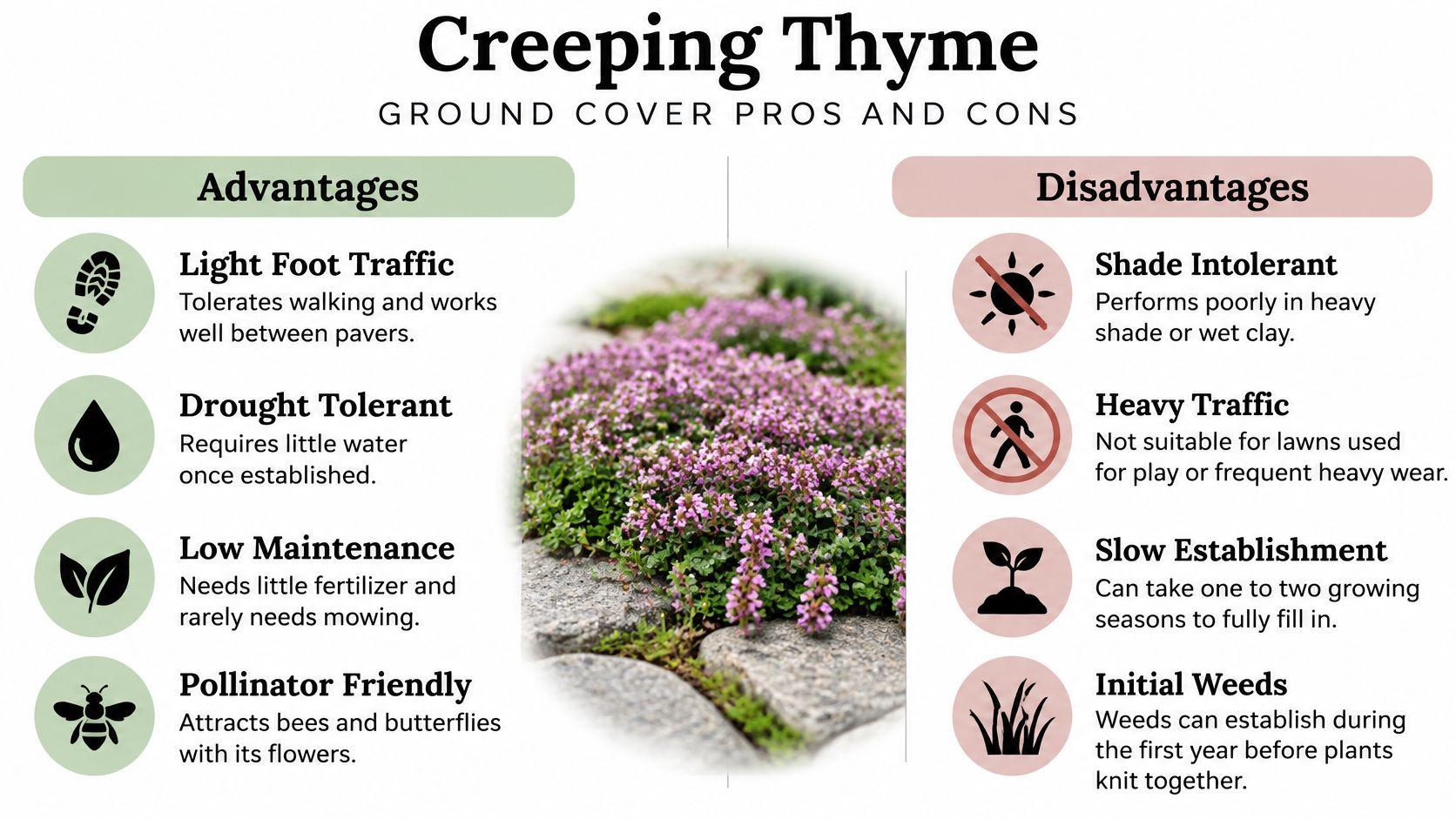
Thyme forms a 2 to 4 inch mat of tiny leaves that releases scent underfoot and flowers in late spring and summer in pink, purple, or white. Bees work the flowers hard. For a plant sold as a lawn substitute, its real talent is staying alive where turf bakes: a south-facing slope, the gravel margin beside a driveway, the cracks between pavers on a patio.
Treat the swap as a land-use decision, not a decor one. A widely cited 2005 study estimated turfgrass covered about 1.7% of the contiguous United States, roughly 40 million acres, more than the area planted to individual irrigated crops such as corn or wheat, as summarized in CSA News coverage of the turf industry. University of Maryland Extension describes ground covers as a "living mulch" that suppresses weeds, slows stormwater, holds soil, and substitutes for lawn where ground is too steep, small, or awkward to mow.
Spacing and fill-in
Plugs on 12 inch centers give you one plant per square foot, so a 200 square foot bank takes about 200 plants and knits together over two seasons. Six inch centers use four times the plants and close the mat in one season. Seed is cheaper and noticeably less even, so plan on over-sowing the thin patches in year two.
If you're stripping turf first, these staged mulch replacement installation tips explain the smothering timeline so you aren't planting into half-dead grass.
Where it fails
Thyme rots in wet winter clay and thins out under trees. Repeated mowing and heavy dog traffic tear it apart. Work sand or fine gravel into the top 4 inches before planting, water through the first three weeks, then switch to occasional deep soaking, and shear lightly after flowering to keep the mat tight.
2. White Dutch Clover (Trifolium repens)
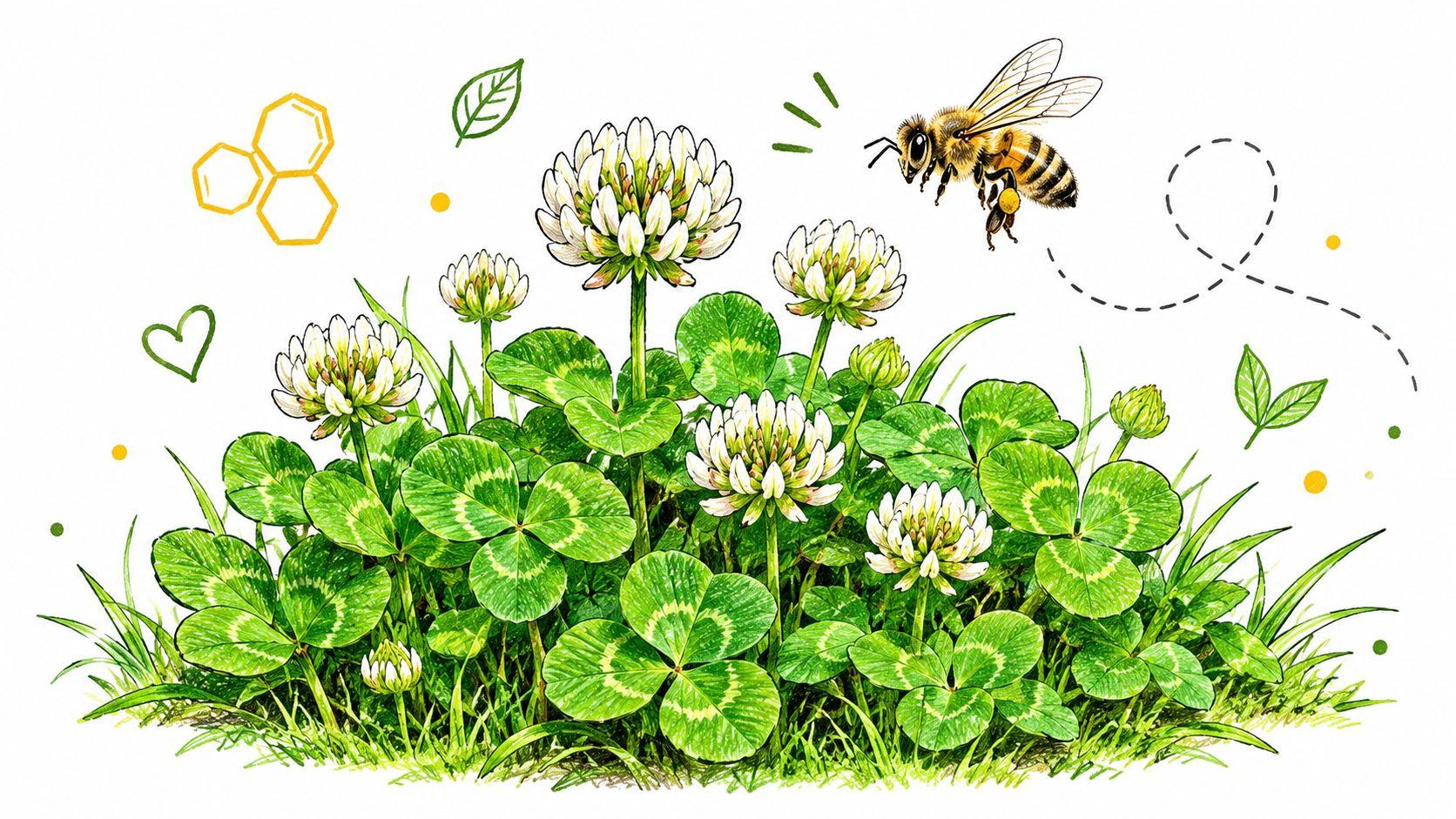
White Dutch clover can fill thin turf in mild-summer yards, orchard rows, and vegetable paths where a low, walkable cover is useful. Root-nodule bacteria fix nitrogen, so clover needs less fertilizer than a conventional lawn. Micro-clover cultivars have smaller leaves and a lower growth habit than standard white clover.
The reality check on lawn swaps
A UCLA analysis of roughly 1,000 Los Angeles properties in turf-replacement programs found that shrubs were the most common replacement, appearing at 14.6% of properties, followed by artificial turf at 9.6%. About one-third of participants had a nearby neighbor who also built a replacement garden, according to the UCLA Institute of the Environment turf-replacement study. Clover can be cheaper to establish and needs less fertilizer than turf, but it does not outwear a lawn. Choose it for the right spot rather than for durability.
Clover covers ground and feeds it at the same time. It still won't survive a dog running the same fence line every afternoon.
What it costs you
Flowers attract bees, so mow before bloom if children play barefoot on the path. Wet clover can be slick. Repeated traffic wears it thin at gateways and mower turns; use another surface where feet or paws follow the same route every day.
For broad, lightly used areas, seed clover alone or mix it with thin turf. Sow in early spring or early fall into soil roughed up with a rake, then keep the surface moist until it knits. Mow at 3 to 4 inches to keep the cover dense and shade out weeds. See OutdoorBrite's ground cover comparison for how clover compares with other options.
3. Sedum (Stonecrop)
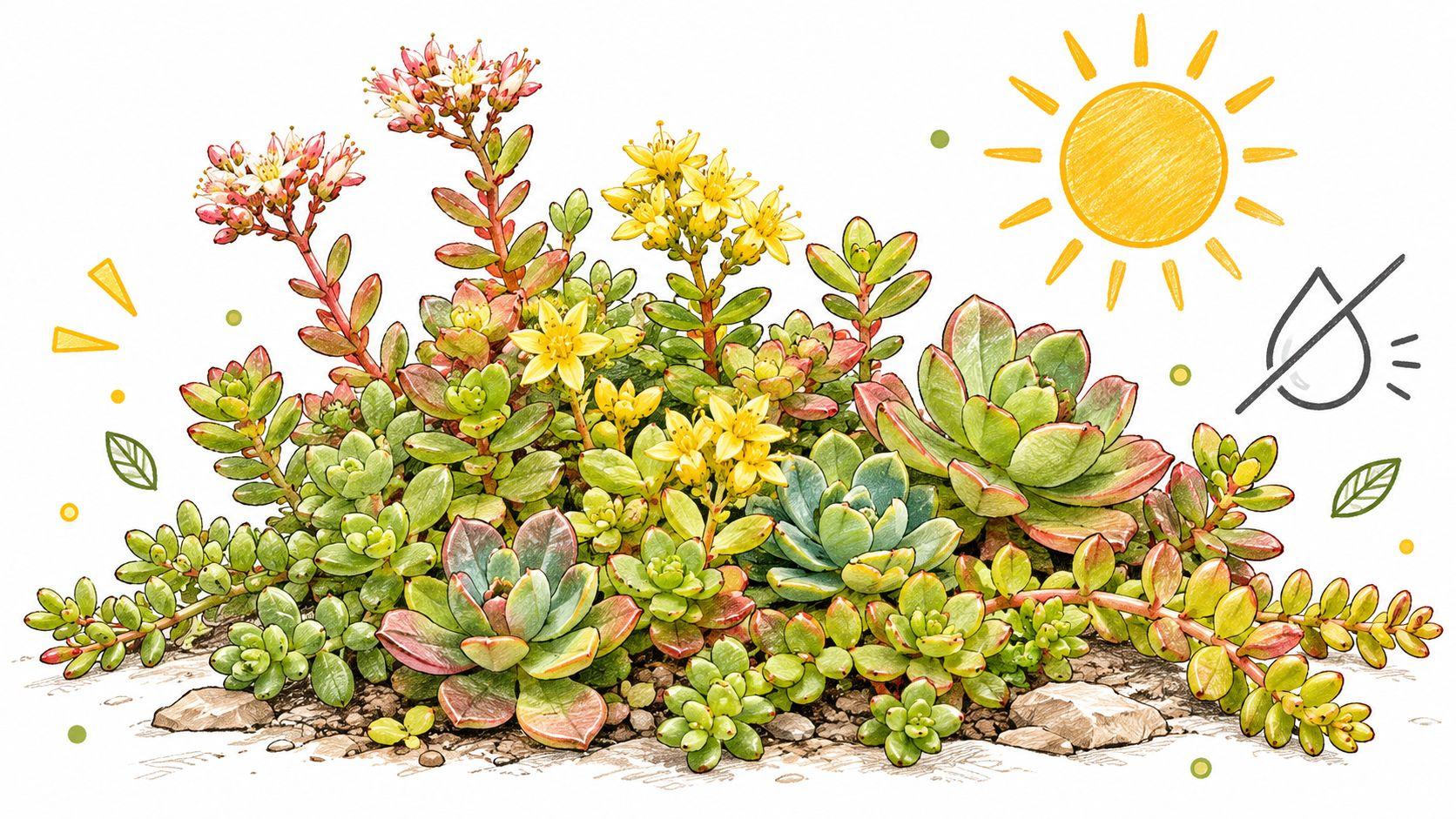
On a sun-baked slope where grass thins and soil washes downhill, low-growing sedum can hold the surface with little irrigation once established. Its fleshy leaves store water, but the plant needs sharp drainage and direct sun. Green roofs on commercial buildings use sedum mixes for the same reason: the plants tolerate thin growing media and heat, so they want grit, sun, and neglect.
Not every sedum is a drought hero
Choose by species, not by the broad label “sedum.” A 2024 greenhouse experiment at Ferdowsi University found that Phyla nodiflora performed best across most measures under drought stress, while Sedum acre was particularly sensitive. The study also found Festuca arundinacea grew best at 60% field capacity, indicating moderate rather than extreme drought tolerance, as reported in the Ferdowsi University drought-stress study.
Spacing and establishment
- Set plugs 6 to 12 inches apart in gritty soil amended with gravel. A quarter-inch grit topdressing helps keep crowns dry.
- Water thoroughly, then let the surface dry before watering again. Daily sprinkling keeps roots shallow and can rot crowns.
- Avoid shade and wet clay. Sedum tends to stretch and flop in shade, while waterlogged soil can cause it to disappear over winter.
- Keep regular foot traffic elsewhere. Sedum mats can crumble under repeated use, so plant them on slopes and sunny edges rather than paths.
For variegated cultivars, see these variegated sedum watering and soil tips.
Watch how a pro plants a sedum slope without losing plants to rot in the first season.
4. Creeping Jenny (Lysimachia nummularia)
Say your downspout dumps onto a strip that stays boggy until June, or the pond edge slumps into mud every spring. That's creeping Jenny's territory. Round, bright green leaves on trailing stems, small yellow flowers in early summer, and a growth rate that fills a damp edge in a single season.
It's the plant for the wet end of the moisture spectrum, which is the opposite of what most lawn-replacement lists cover. Where turf drowns and moss takes over, creeping Jenny gives you a full carpet that looks deliberate. It softens pond margins, rain garden lips, and the shaded damp border behind a garage.
Check before you plant: your state or provincial invasive species list is the authority here, not the garden center tag. Creeping Jenny has escaped cultivation in parts of North America.
Containment and care
- Give it a barrier: a 6 inch buried root barrier or a bottomless container keeps runners out of adjacent beds.
- Space 12 to 18 inches apart: it closes fast, so a light planting goes a long way and saves money.
- Keep it damp through dry spells: foliage browns and crisps in dry sun, which is the fastest way to make the planting look abandoned.
- Trim stray runners each season: walk the edge with pruners in late spring and cut anything heading where you don't want it.
It is not a traffic surface and not a drought plant. Dry, full sun kills it. Put it where the ground stays cool and moist, and it will outcompete weeds within a season.
5. Kinnikinnick (Arctostaphylos uva-ursi)
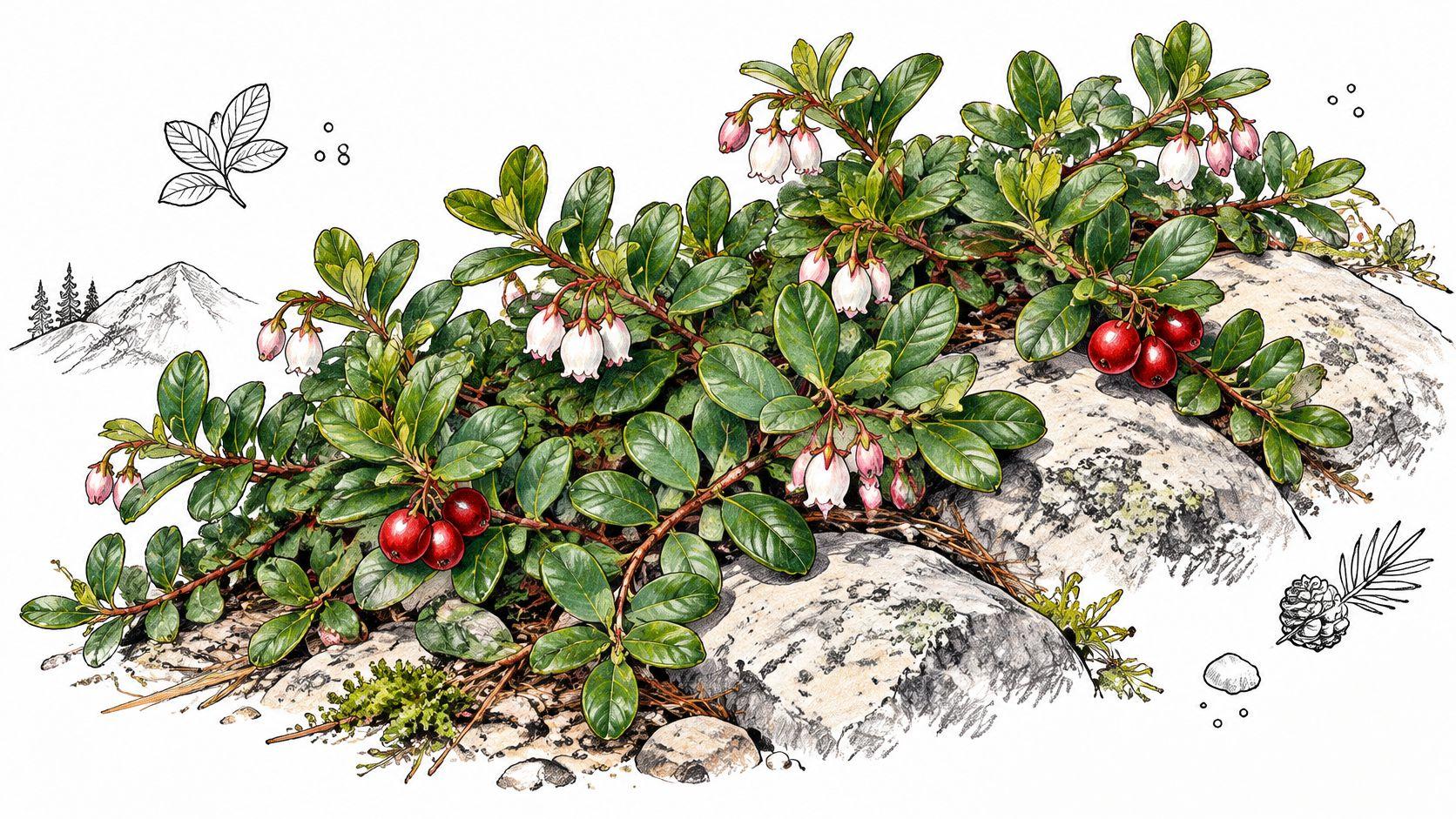
Kinnikinnick, or bearberry, is a native evergreen that spreads into a low mat of glossy leaves with small pink-white bell flowers and red berries that birds strip in fall. For cold northern yards, it's one of the few ground covers that stays green through winter and shrugs off wind.
It suits exactly the sites where turf gives up in cold country: sandy banks, rocky slopes, lean acid soil, and exposed positions with no irrigation. Use it to hold a bank that erodes every spring melt, or to cover the rough ground between a deck and a tree line.
Why "drought tolerant" needs a number
A University of California study of 17 ground-cover species and one turfgrass found several candidates, including Vinca major, Baccharis pilularis, Drosanthemum hispidum, and Hedera helix, held acceptable visual quality at approximately 30 to 40% of reference evapotranspiration, while species such as Potentilla tabernaemontanii and hybrid Gazania had requirements closer to cool-season turf, per the UC ground cover water-conservation study. Specify plants by target ETo fraction, sun, and drainage, not by the phrase "low water."
Spacing and slow starts
Set plants 18 to 24 inches apart. Kinnikinnick spreads slowly and sulks after transplant, so allow two full seasons before it closes, and buy larger liners if you can't wait. Mulch lightly for the first year, water thoroughly every couple of weeks through the first summer, then stop. Skip the fertilizer; rich soil makes it leggy and short-lived. It fails in heavy clay, in standing winter water, and in deep shade.
6. Mondo Grass (Ophiopogon japonicus)
Despite the name, mondo grass isn't a grass at all but a lily-family perennial with narrow, dark leaves that form a dense clump. That matters because it does something turf can't: it grows in dry shade under mature trees, in root-choked foundation beds, and in the narrow joints between pavers where a mower can't reach.
Standard mondo runs 8 to 10 inches tall. The dwarf form, often sold as 'Nana', sits at 2 to 3 inches and does the work of a low carpet between stepping stones and along path edges. Both hold color through winter in mild climates, which is why coastal and southern gardens lean on them.
Mondo is a shade plant. Plant it in full afternoon sun in a hot climate and you'll spend the summer watering a brown carpet.
Density and renovation
- Plant in odd-numbered clumps: groups of three or five fill a bed faster and look less like a grid than single divisions.
- Space 6 to 8 inches apart in staggered rows: that's the density that closes a border in two seasons.
- Trim in late winter: run the mower over dwarf plantings or shear with hedge shears to cut old foliage before new growth pushes.
- Divide crowded clumps every few years: lift, split with a spade, and replant the outer divisions.
It takes moderate traffic at best, so keep it to path edges and borders rather than a route to the shed. It fails in waterlogged soil and in deep freezing without snow cover, where foliage burns.
7. Blue Star Creeper (Pratia pedunculata)
Small courtyards and paver joints are where this earns its keep. Tiny round leaves, star-shaped blue or white flowers through the warm months, and a thin dense mat that handles stepping traffic in mild climates. It's the closest thing on this list to a walkable carpet, and it's also the most oversold as a full lawn replacement.
University of Connecticut Extension notes that most ground covers cannot tolerate repeated mowing, heavy foot traffic, or other wear, so a homeowner trading turf for plants may gain lower mowing demand while losing usable play, pet, and entertaining space, per UConn Extension's alternative lawn guidance. University of Maryland Extension adds that these plants need weeding and mulching while they establish and may need edge barriers to stop them spreading. The distinction that matters is between a visual lawn replacement and a traffic-tolerant living surface. They are different products.
Spacing and the traffic test
- Space 6 to 9 inches apart: tight spacing is what makes it read as a surface rather than a scattering of plants.
- Keep it moist through establishment: a dry spring will set it back a full season.
- Use part shade in hot climates: full afternoon sun scorches the thin leaves.
- Hand-weed, never spray: broadleaf herbicide will wipe out the mat along with the weeds.
It's not a cold-climate plant. Northern winters knock it back or kill it outright, so treat it as a zone-appropriate choice for mild coastal and subtropical gardens. For everything else, use it between pavers where its lack of wear tolerance never gets tested.
8. Ajuga (Bugleweed, Ajuga reptans)
Ajuga is the shade answer for yards where the turf under the trees has thinned to moss and mud. Glossy leaves in bronze, purple, or variegated forms, blue flower spikes in spring, and a dense mat that outcompetes weeds once it's up.
The practical use is a north foundation strip or a tree-root zone where grass has failed after three reseeding attempts. Say you have a bed 6 feet deep and 30 feet long along the north wall. That's 180 square feet, which at 8 to 12 inch spacing means roughly 100 to 180 plants. Order in trays of 18 or 32 to cut the per-plant cost, and expect to fill gaps the second spring.
Containment and renovation
- Edge it or regret it: ajuga runs, and it will not stop at the lawn line you drew in your head.
- Divide every few years: lift and split crowded clumps in early fall to keep the center from dying out.
- Keep it out of full sun in hot climates: leaves scorch and the mat thins.
- Avoid wet, poorly drained spots: crown rot takes whole patches after a wet winter.
It does not take foot traffic. Crowns crush and don't recover, so it belongs in beds, not on the route between the back door and the grill. In mild, moist climates check local guidance first, because ajuga has naturalized in parts of North America and can move into woodland areas.
Ground cover options compared by traffic, shade, climate, and best site
| Item | Foot Traffic Tolerance | Shade Tolerance | Hardiness (USDA Zones) | Best Site |
|---|---|---|---|---|
| Creeping Thyme (Thymus serpyllum) | Light traffic | Low; prefers full sun | 4–9, depending on cultivar | Sunny, well-drained sites; between pavers |
| White Dutch Clover (Trifolium repens) | Moderate; less tolerant than turf of heavy wear | Tolerates partial shade | 3–9 | Low-maintenance lawns and garden living mulch |
| Sedum (Stonecrop) | Poor | Low; prefers full sun | 3–9 for many hardy types | Dry slopes, green roofs, and shallow sunny soil |
| Creeping Jenny (Lysimachia nummularia) | Poor; avoid heavy traffic | Good; tolerates partial shade | 3–8 | Moist, partly shaded borders and pond edges |
| Kinnikinnick (Arctostaphylos uva-ursi) | Poor; avoid foot traffic | Tolerates light shade | 2–6 | Dry, well-drained slopes and sandy or rocky sites |
| Mondo Grass (Ophiopogon japonicus) | Moderate; avoid heavy traffic | Excellent; tolerates full shade | 6–10 | Shady gardens, path edges, and areas between pavers |
| Blue Star Creeper (Pratia pedunculata) | Light traffic | Good; prefers partial shade in hot climates | 7–10 | Moist paths, stepping stones, and small lawn-like areas |
| Ajuga (Bugleweed, Ajuga reptans) | Poor; avoid heavy traffic | Excellent; tolerates partial to full shade | 3–9 | Shady borders and areas beneath trees |
Matching Each Ground Cover to the Spot Grass Lost
Start with the condition that keeps grass from surviving. A hot, dry slope points toward sedum or kinnikinnick; thyme also suits sunny, well-drained ground. A wet edge is a better fit for creeping Jenny. Under a maple, compare mondo grass and ajuga, then check their light needs and your USDA zone before buying.
Establishment takes planning. Many ground covers need a season or more to fill in, and regular watering while roots settle. They are not maintenance-free at planting time. If plants fail in their first summer, replacing them adds cost and delays coverage.
The cheapest ground cover is the one matched to the site. The wrong choice can mean buying plants twice.
Use the spacing guidance above to estimate quantities. Sketch the bed shapes on a yard photo, measure each area, and calculate how many plants fit at the recommended spacing. Planting closer can fill gaps sooner, but increases the number of plants you need.
OutdoorBrite can turn a yard photo into redesign concepts for comparing planting styles and bed layouts. Its garden design tool returns bed and border shapes alongside the planting, and lets you compare a xeriscape version against a cottage version of the same strip side by side. Confirm drainage, plant suitability, and local invasiveness rules with a qualified professional before planting. For evergreen choices in shade, Little Green Leaf's shade planting guide covers options that hold their leaves through winter.
Upload a photo at OutdoorBrite to compare a lawn-to-bed redesign on your own yard before buying plants.
See your yard reimagined
Start creating