How Much Sod Do I Need? a Step-by-Step Calculator Guide
Learn how much sod do I need for your lawn: measure the area, add a fair waste allowance, convert to pallets, and order with confidence.
You're standing on bare dirt with a tape measure in one hand and a supplier's price list in the other, trying not to order a pallet too many or run short on the last strip. That's the usual spot where people start guessing. Don't. The answer to how much sod do I need comes from three numbers you can get in one walk around the yard, your net turf area, your waste percentage, and your supplier's pallet coverage. Get those right and the order writes itself.
Table of Contents
- Sod Quantity Table for Common Lawn Sizes
- How to Measure Your Lawn Shape by Shape
- How Much Waste to Add and Rounding to Pallets
- Worked Examples for Three Common Yards
- Check Turf Choice and Water Before You Order
- Confirm Your Order Before You Buy Sod
Sod Quantity Table for Common Lawn Sizes
A row in this table is only as good as the grass you can keep alive after it lands. Order the area that will get water through establishment. Sod on a dry side strip still arrives as a full pallet, then dies and leaves you paying for dirt again.
Suppliers often price by the square yard. Divide square feet by 9. A 1,000 square foot lawn is 111.1 square yards. A 5,000 square foot lawn is 555.6 square yards. Give that yard figure when the quote is by the yard, not by the foot.
Sod order by measured lawn area
| Measured area (sq ft) | Square yards | Order at +5% (sq ft) | Order at +10% (sq ft) | Pallets at +10% |
|---|---|---|---|---|
| 500 | 55.6 | 525 | 550 | 2 |
| 1,000 | 111.1 | 1,050 | 1,100 | 3 |
| 2,000 | 222.2 | 2,100 | 2,200 | 5 |
| 3,779 | 420 | 3,968 | 4,158 | 10 |
| 5,000 | 555.6 | 5,250 | 5,500 | 13 |
How to read your row
The first column is net turf area: house, driveway, patio, paths, and beds already taken out. Lot size is not lawn size. If a strip will not get a hose or an irrigation zone while the rolls knit in, pull that strip out of the measured area before you choose a row. The quantity should follow the turf the yard can hold, not the outline on a plat map.
Use +5% on a plain rectangle with straight edges and few cuts. Use +10% where curves, tree rings, winding beds, and tight corners force you to trim pieces. A front yard with one curved bed and a walkway usually belongs in the second group.
Pallet counts use about 450 square feet per pallet, then round up. Divide the +10% square footage by 450:
- 550 ÷ 450 = 1.22, so 2 pallets. One pallet stops at 450 and leaves the job short.
- 1,100 ÷ 450 = 2.44, so 3.
- 2,200 ÷ 450 = 4.89, so 5.
- 4,158 ÷ 450 = 9.24, so 10.
- 5,500 ÷ 450 = 12.22, so 13. Twelve pallets cover 5,400 and miss about 100 square feet.
Do not reverse the math. Two pallets on a 550 square foot order are not 275 square feet of coverage each. They are 900 square feet of product (2 × 450) because the supplier will not split the unit. The 5,000 square foot row works the same way: 13 × 450 = 5,850, which clears 5,500. Coverage still varies by supplier and product, so confirm the pallet size before you pay. A smaller pallet means more pallets than the table. A larger one may let you drop one.
Practical rule: Always round up to whole pallets. A partial pallet calculation is a plan to stop mid job.
You are buying living material in fixed units, cut fresh for delivery, not exact footage off a shelf. I round up even when the overage is only a tenth of a pallet. A small surplus replaces a torn roll or a corner cut short. A shortage means bare dirt, a second delivery fee, and a later cut that may not match in color. Extra rolls you cannot water are waste of a different kind, so shrink the area first, then round the pallet count up.
How to Measure Your Lawn Shape by Shape
A driveway that cuts across a side yard turns that strip into a triangle, not a clean rectangle. Call it a rectangle and you either buy sod for pavement or leave a wedge the rolls never cover.
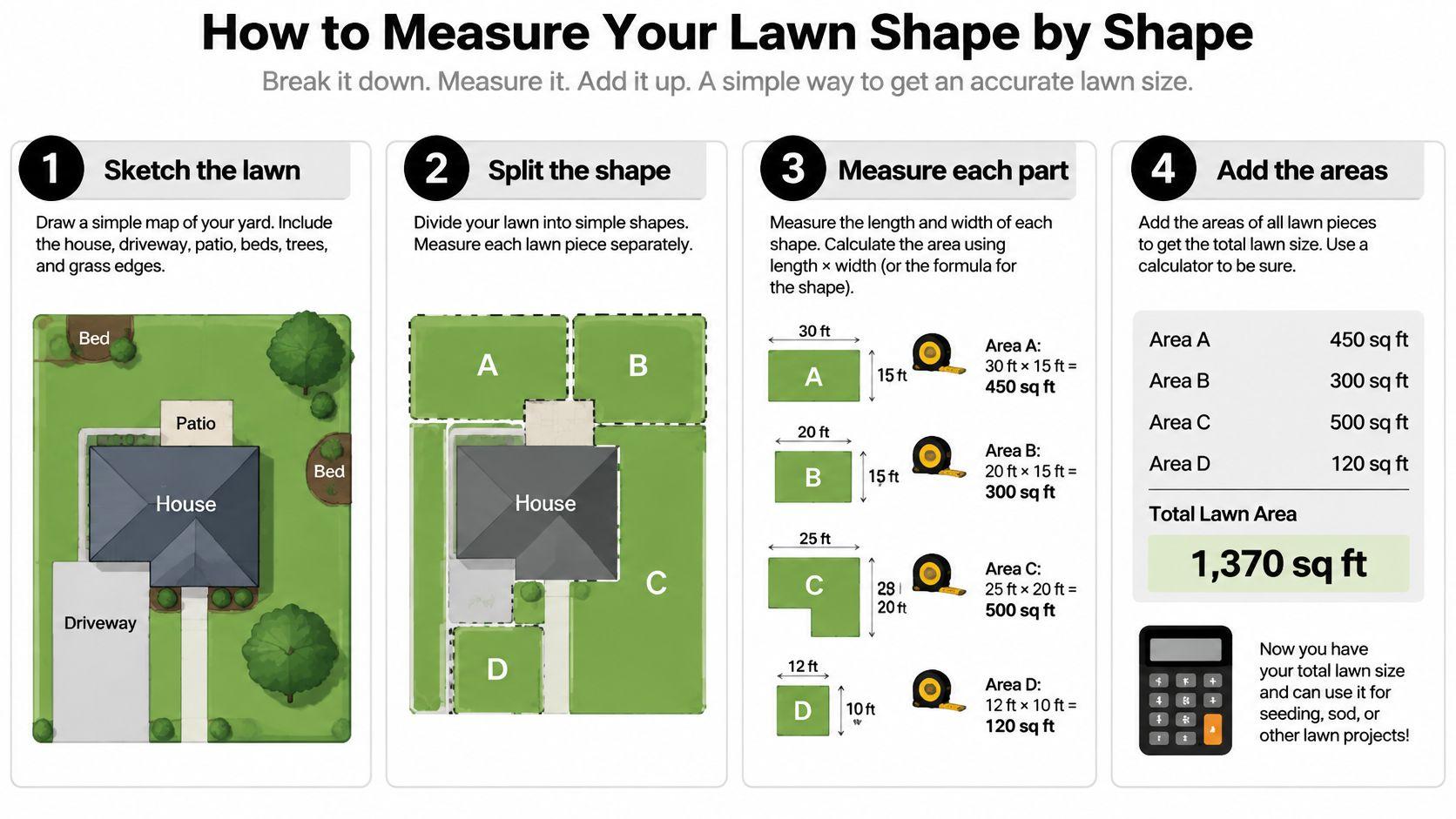
Split the outline, measure each piece, and add only the grass you mean to keep. The awkward edge becomes arithmetic you can check on paper before a supplier prices the load. Sod is living material, so that total should be turf the yard can keep alive, not every green patch that looks fine on a cool morning.
The six steps
-
Sketch the lawn on paper. Mark the house, driveway, patio, beds, trees, and the edges where grass grows. The sketch does not need to be pretty. It needs to show what gets sod and what does not, so you do not measure the same corner twice or miss a side strip.
-
Split irregular turf into simple shapes. Draw lines that turn the lawn into rectangles, triangles, and circles. Rectangles use length × width. Triangles use base × height ÷ 2. Circles use 3.14 × radius². A half circle around a bed is the circle result divided by two.
-
Measure each shape in feet. Use a long tape or a measuring wheel on the bigger sections, and write every measurement on the sketch beside its shape. Stay in feet. Mixing inches into one side of a multiplication can wreck the total. I recommend writing the unit next to every number so a later pass does not treat inches as feet.
-
Subtract what will not get sod. Measure patios, beds, paths, sheds, and play structures, calculate those areas the same way, and take them out. Leave out corners you plan to mulch or stop watering. Skipping this step is how a tight lawn turns into rolls stacked on the driveway with nowhere to go.
-
Add the remaining shapes. That sum is your net turf area, the figure the order is built on. The same session also sets how much soil, compost, and fertilizer the beds and turf will need, so one careful pass feeds the rest of the job.
-
Convert if the supplier sells by the yard. Divide square feet by 9. Keep both numbers on the sketch so you can answer either unit on the phone without redoing the math.
Why one big rectangle fails
A single rectangle drawn around a curved, L-shaped, or kidney-shaped lawn counts corners that are not turf. That overstatement alone can push the order well past the grass you will lay. Measuring the whole property instead of the turf is worse, because house, drive, and hardscape get priced as lawn.
Map narrow strips and corners on their own. A long side strip measured separately usually cuts cleaner than the same ground swallowed into one large rectangle. For pacing and awkward edges, the North Georgia lawn measuring guide from Barefoot Organics walks through the same shape-by-shape approach with regional yards in mind. Our notes on measuring a yard with irregular boundaries cover curved borders in more detail.
Run one sanity check before you call anyone. The net total must be smaller than the single rectangle that wraps the whole lawn. If it is not, a shape was counted twice. Write the final net figure at the top of the sketch and circle it. Every later adjustment starts from that number.
How Much Waste to Add and Rounding to Pallets
Waste isn't sloppiness. It's the material you lose cutting around edges, curves, sprinkler heads, and trees, plus the piece that tears when you unroll it on a hot afternoon. Order the exact measured area and you'll run short. Order too much cushion and you're paying for perishable grass that dries out on the pallet.
Three waste bands
- Simple rectangle, about 5%: Straight edges, few obstacles, long runs of full pieces. Cutting loss stays low.
- Moderately curved yard, about 7%: A few beds, a curved walkway, one or two trees. Most suburban front yards land here.
- Highly irregular yard, about 10%: Many curves, borders, tree rings, and tight corners where nearly every edge piece gets trimmed.
Those bands line up with the Purdue University Extension sod guidance, which recommends ordering about 10% extra to cover measurement mistakes and cutting waste around corners and edges. In Purdue's worked example, a 3,779 square foot lawn converts to approximately 420 square yards, and the additional 10% equals 42 square yards, producing a final order of 462 square yards.
Why blanket percentages backfire
Slapping 15% on a plain rectangle doesn't make you safer. It makes you poorer. Sod is cut fresh and doesn't store. Excess pieces heat up in the stack, yellow, and die within a day or two in warm weather. You can't return them, and you can't hold them for next month's patch job.
Match the percentage to the shape instead. Say your net area is 2,000 square feet with a few curved beds. At a 7% allowance, you order 2,140 square feet. That's a real cushion for the cuts you'll make, without buying a surplus pallet to throw away.
The right waste number comes from counting your curves and corners, not from picking the biggest percentage for comfort.
Rounding to pallets and rolls
A typical pallet contains about 50 square yards, or approximately 450 square feet, though coverage varies by supplier and product. That variation matters more than expected. Two suppliers can both say "one pallet" and deliver different coverage, and "one roll" is not a universal area unit either.
Confirm three things before you order. Ask for the exact piece or roll dimensions, the square feet per pallet, and the minimum order. Then divide your order quantity, waste included, by the pallet coverage and round up to complete pallets. A short load interrupts installation and leaves visible seams where the second batch meets the first.
Write your final number two ways, in square feet and in pallets, and check both against the supplier's listing. The same net area drives your other material estimates too, so once you've measured carefully, you can estimate your mulch needs with OutdoorBrite for the beds you subtracted.
Worked Examples for Three Common Yards
Numbers make more sense when you watch them move through a real yard shape. Here's a short clip showing the measuring and calculation process before the examples.
Example 1 a plain backyard rectangle
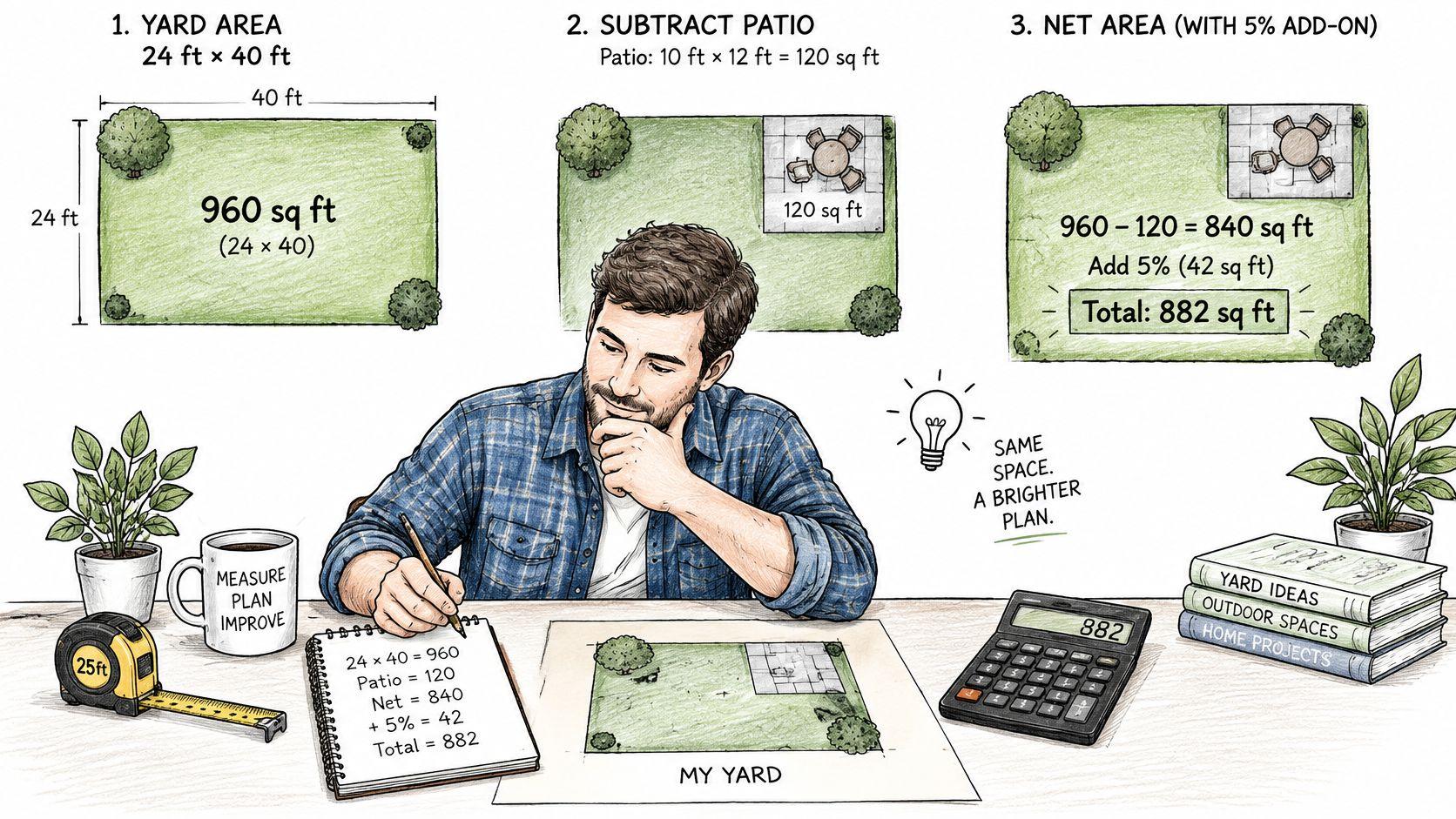
Say the backyard measures 24 by 40 feet. That's 960 square feet. A patio takes up 120 square feet, so subtract it and you're at 840 square feet net. The shape is simple, so add 5%. That gives 882 square feet. Two pallets at 450 square feet each cover 900, so you order 2 pallets and keep a small working surplus.
Example 2 a front yard with curves
Say the front yard has a curved bed and a tree border. After you remove a 150 square foot walkway, the shapes add up to 1,850 square feet net. The curves will eat material at every edge, so add 7%. That gives about 1,980 square feet. Divided by 450, that's 4.4 pallets, which rounds up to 5 pallets. Ordering four would leave you roughly 180 square feet short with the most visible part of the yard unfinished.
The photo below shows the measuring step that produces these numbers, tape out, dimensions written down shape by shape.
Example 3 a sloped side yard with a triangle
Say the side yard is a 30 by 20 foot rectangle, which is 600 square feet, plus a triangle with a 20 foot base and 12 foot height. The triangle is 20 × 12 ÷ 2, or 120 square feet. Add them for 720, subtract an 80 square foot shed, and your net is 640 square feet. Add 10% for the angled edges and slope, giving 704 square feet. Order 2 pallets.
That extra 10% mostly covers the triangle. Diagonal cuts produce offcuts you can't always reuse, because the trimmed piece is the wrong shape for the next gap. On a slope, you'll also stake or pin pieces and trim more carefully at the edges, which adds a little more loss.
The scale behind pallet math
It helps to know how small a residential order really is. The USDA turf sod economic assessment puts one acre at a maximum of 43,560 square feet, so a 450 square foot pallet covers about 1.03% of an acre before waste. A homeowner needing 1,000 square feet would theoretically require 2.22 such pallets, so the practical order rounds up to 3 pallets.
Write down your own three numbers now, net area, waste percentage, and pallets. Then compare them with whichever example looks most like your yard. If your pallet count is far off that example for a similar size, recheck your subtractions before you recheck anything else.
Check Turf Choice and Water Before You Order
A pallet of the cheapest sod can still be the expensive order. Area math assumes every square foot will root and stay green on your water supply. It will not. Order for the turf this yard can keep alive.
EPA WaterSense guidance on turfgrass and water efficiency says low-water-use or drought-tolerant turf, paired with properly selected irrigation components, can reduce irrigation demand, and that turf belongs where it has a practical function and suits the local climate. Drought-tolerant varieties still differ in how much water they use and how well they recover after a dry spell. That gap shows up on the water bill, and in how many pieces you replace next season.
Run this check before you finalize
- Regional climate match: Does this grass handle your winters and your summer heat, or are you buying it because the name is familiar?
- Shade on the site: How many hours of direct sun does each section get? Deep shade under a mature tree may never hold turf well.
- Soil type: Heavy clay holds moisture and slows rooting. Sandy soil drains fast and needs more frequent watering while roots establish.
- Irrigation availability: Can you water daily during establishment? If not, timing and variety matter more than the price per square foot.
- Drought exposure: Will this lawn face watering restrictions in August?
This check changes the quantity, not only the variety. A 300 square foot corner in deep shade that thins every year does not earn its place in the order. Turn it into a planting bed and you drop those 300 square feet from the sod count and from every future water bill. That cut can take you down a full pallet.
For the lawn that remains, choose a drought-tolerant sod that matches sun, soil, and how often you can water. On small strips that stay hard to water, and where living turf keeps failing, weigh artificial grass insights from OutdoorBrite before you buy another roll that will brown out.
Order sod for the lawn you can keep alive, not the largest lawn you can draw on the sketch.
Before you commit, ask the supplier three questions about this variety. What are the exact piece dimensions? What is the pallet coverage? When does delivery land relative to your planting day? Sod should go down the day it arrives. A load that sits two days before your crew shows up is a survival problem no waste percentage can fix.
Confirm Your Order Before You Buy Sod
The invoice says 12 pallets. The sketch says 13. Sod is cut to order, arrives heavy, and starts dying if it sits, so that gap has to be closed before money changes hands.
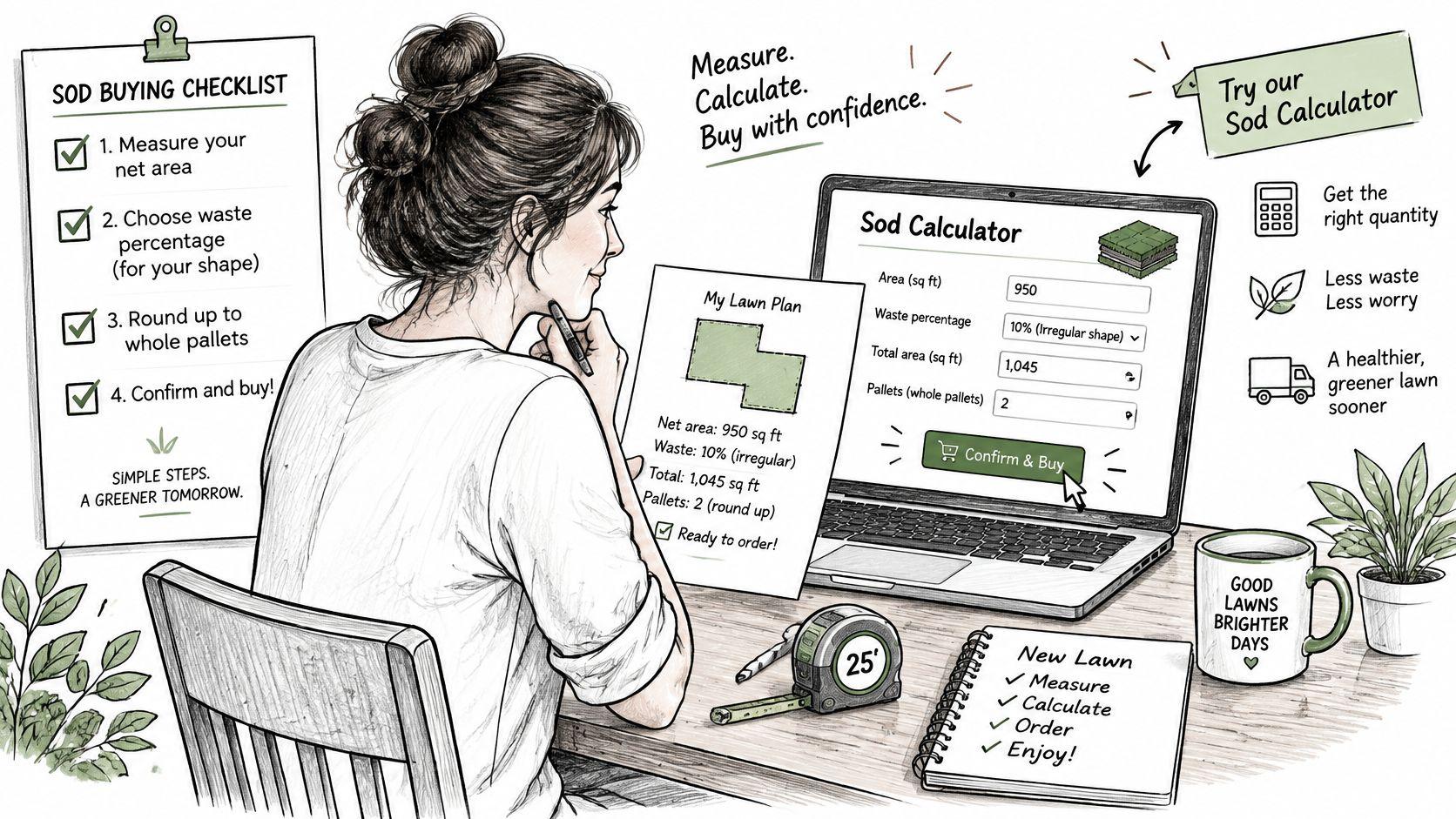
Work the numbers in this order, while the measurements are still fresh. Add the shapes, then subtract patios, beds, and paths. Apply the waste percentage that matches your curves and corners. Round up to whole pallets or rolls. An exact theoretical square footage is not a deliverable order, and it is not the lawn you can keep watered through the first hot weeks.
Your pre order checklist
- Net area measured: Shapes added, patios, beds, and paths subtracted.
- Waste percentage chosen: Matched to your curves and corners, not a blanket guess.
- Quantity rounded up: Whole pallets or rolls, never the exact theoretical figure.
- Supplier coverage confirmed: Square feet per pallet, roll dimensions, and minimum order in writing.
- Variety matched to site: Climate, shade, soil, and watering checked so the quantity is turf this yard can keep alive.
Budget is the last reason to be precise, and it is a sharp one. House Digest reported that in 2024, DIY sod material costs were $0.30 to $0.85 per square foot, or approximately $2,600 to $7,500 for one-fifth of an acre. At those rates, every extra 100 square feet of waste adds roughly $30 to $85 in material you will throw away.
OutdoorBrite pairs a sod calculator with subscription-based design concepts of your own yard, so the pallet count and the lawn you intend to keep can be checked in the same pass. OutdoorBrite does not replace an architect, designer, contractor, arborist, or horticulturist. Verify feasibility, plant suitability, materials, drainage, utilities, permits, and cost with a qualified professional before spending money or starting work.
Run the confirmed net area through the sod calculator on OutdoorBrite, set that quantity beside the written pallet coverage, and place the order only when the two agree.
See your yard reimagined
Start creating