10 Japanese Garden Plants for Calm, Year-Round Design
Discover 10 Japanese garden plants for Japanese-style yards, with hardiness zones, growing needs, and design roles to help you plan a balanced garden.
The most repeated advice about Japanese gardens is about objects: a stone lantern, a raked gravel bed, a red maple in a pot. Copy that and you get a garden that photographs well in May and looks thin by February. Planting carries the style through the year, and every plant in the tradition earns its place by doing a structural job, not by looking Japanese.
The tradition behind it is long. Japanese garden plants have a documented history of more than 1,400 years, running from the Asuka period through the Nara, Heian, Kamakura, Muromachi, and Edo periods and into the modern era. The Edo period alone, 1603 to 1867, made more than 40 plant types and approximately 3,000 cultivars fashionable, selected for seasonal color, flower form, foliage, rarity, and regional taste, as the BGCI account of Japanese gardens sets out.
Well-maintained public Japanese gardens across North America hold to that standard, and they are the reason so much home planting gets measured against it. The ten plants below are evaluated on two axes: what each one needs to thrive, and the structural role it plays in the design, whether that is anchor, screen, groundcover, or seasonal accent. Each entry also flags where the plant fails, because that is the information that saves you money at the nursery.
Table of Contents
- 1. Japanese Maple (Acer palmatum)
- 2. Japanese Black Pine (Pinus thunbergii)
- 3. Hinoki Cypress (Chamaecyparis obtusa)
- 4. Satsuki Azalea (Rhododendron indicum hybrids)
- 5. Japanese Camellia (Camellia japonica)
- 6. Japanese Iris (Iris ensata)
- 7. Hakone Grass (Hakonechloa macra)
- 8. Mondo Grass (Ophiopogon japonicus)
- 9. Japanese Holly (Ilex crenata)
- 10. Yoshino Cherry (Prunus × yedoensis)
- Japanese Garden Plants at a Glance
- Building a Balanced Japanese Garden Plant Palette
1. Japanese Maple (Acer palmatum)
No plant buys more atmosphere per square meter. Acer palmatum is a small, multi-stemmed deciduous tree or large shrub with lobed leaves and branching that stays sculptural when bare. In a courtyard it's the focal anchor; in a bigger border it carries the main seasonal accent.
It's also the plant on this list that fails most often, and usually for the same three reasons: hot afternoon sun, dry wind, and wet clay. Give it dappled light or morning sun with afternoon shade, moist but well-drained slightly acidic soil, and a wide mulch ring kept clear of the trunk.
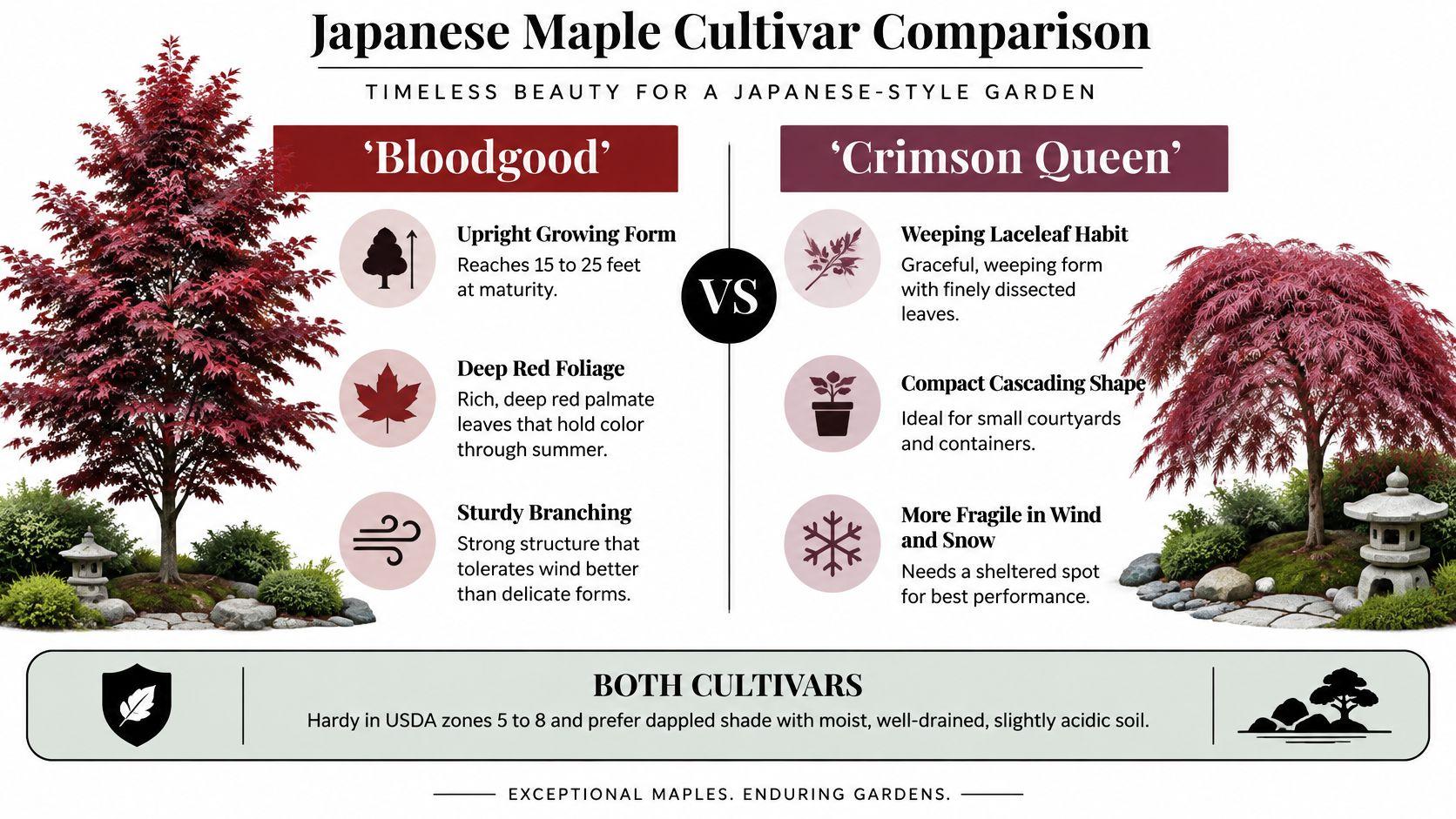
Pick the cultivar, then pick the spot
'Bloodgood' holds deep red in more sun. 'Crimson Queen' is a weeping dissectum with fine foliage that scorches easily and wants shelter from wind. The cultivar decides both the color and the mature shape, so compare leaf and habit at the nursery instead of ordering from a photograph.
Climate is now part of the choice. The 2025 Chelsea Flower Show placed Japanese-inspired planting alongside drought-tolerant schemes, rainwater harvesting, salt-tolerant plants, and low-fertility gravel soils, per Appleyard Flowers' coverage of the show. In a hot-summer city, a maple in full sun is a watering schedule, not a design decision.
Practical rule: prune in late winter while the tree is dormant, take out crossing branches first, and never shear the canopy into a ball.
If stone is part of the composition around the tree, read the raked gravel and stone layout basics before you order gravel, so the tree sits in a setting rather than in a lawn.
2. Japanese Black Pine (Pinus thunbergii)
Pinus thunbergii is the evergreen anchor that holds a Japanese composition together through winter. Dark rugged bark, twisted branching, tolerance of salt wind: on a coastal site it's the most dependable structural tree you can plant, and the one that improves with age.
The shaping is a spring job, and it's the reason pines look the way they do in temple gardens.
What the pine needs from you
Full sun and well-drained soil, and never heavy wet clay. In spring, cut the new candles back by half or more to force compact growth, then thin needles and old interior growth so light and air reach the inner branches.
- Budget for a pruner: cloud pruning is a skill, not a hedge cut, and a badly cut pine stays badly cut for years.
- Give it air: three meters from a wall is a working minimum for a trained tree.
- Don't crowd the base: underplant with low moss or a single rock, not a mixed border of perennials.
A pine bought at two meters will need a decade of spring work before it reads as a trained tree. If that's not the project you want, buy a pine that's already shaped or choose a hinoki for the same anchor role.
3. Hinoki Cypress (Chamaecyparis obtusa)
Hinoki is the slowest plant here and the one that most reliably looks expensive a decade after planting. Fine, fan-shaped foliage, dense habit, rich green that holds through winter: it works as a vertical anchor in a courtyard and as a screen at the back of a border.
The trade-off is pace. A hinoki in a five-liter pot takes years to make a meter, which is why nurseries charge for size. Buy the height you need at planting and save yourself the wait.
Where hinoki fails
- Afternoon sun and dry wind: foliage scorches on south and west faces. Morning sun with afternoon shade is the safe site.
- Wet ground: roots want moist but well-drained, slightly acidic soil. Mulch to keep them cool and water through the first two dry seasons.
- Wrong scale: in a small courtyard, use a dwarf cultivar or a container, or the tree outgrows the composition in five years.
Its timber is why the species is famous, and the main shrine buildings at Ise Jingu are rebuilt in hinoki under the shikinen sengu ritual. Garden gates and fences are usually cedar instead, and lightweight timber for British weather explains how that timber behaves outdoors if you're building around the planting.
4. Satsuki Azalea (Rhododendron indicum hybrids)
Many gardeners buy azaleas for three weeks in late spring and then live with them for the other forty-nine. That's the wrong way to choose one, and it's why so many satsuki in home gardens end up as sad green lumps behind a fence.
Buy for the shrub, not the flower. Satsuki form dense, compact, fine-textured evergreen mounds that clip well and hold the front of a border through winter, with seasonal accent duty in late spring. The bloom is the bonus, not the reason.
The conditions satsuki actually wants
Dappled shade with protection from strong afternoon sun. Acid soil improved with peat or pine bark, draining freely but never drying to dust. A mulch of pine needles or bark to keep the roots cool and the moisture even.
Satsuki set next year's buds on this year's growth. Prune within a few weeks of flowering, or you're cutting off the next display.
The common mistake is shearing a hedge of azaleas in autumn for tidiness. Do it after bloom instead. For companions that share the same light and soil, OutdoorBrite's flowering shrub picks are a sensible shortlist before you commit a whole border.
5. Japanese Camellia (Camellia japonica)
Camellia earns its place on timing. Glossy evergreen foliage plus flowers in winter and early spring, when nothing else in the border is doing anything, makes it the seasonal accent that keeps a Japanese-style planting alive in the cold months.
The catch is bud timing. Camellias set buds through summer and open them slowly, so a dry spell in late summer costs you the flowers you were counting on. Water through dry periods while buds are forming, not after they drop.
Sasanqua is the better bet for a small garden: it flowers from autumn, takes more sun than C. japonica, and clips into a low screen.
Siting and the petal problem
Partial shade, shelter from cold wind and hot afternoon sun, and soil that drains. Camellia collections are a fixture of historic estates and Japanese-style gardens across the southeastern United States for exactly this reason.
- Match the species to your season: C. japonica for late winter and spring, sasanqua for autumn and a longer window.
- Clear the ground: remove spent flowers promptly, because fallen petals on wet soil spread petal blight.
- Don't prune hard: camellias flower on older wood, and a heavy cut costs two seasons of bloom.
A camellia in a pot by a sheltered door, watered and shaded from afternoon sun, will out-perform a larger one planted in a hot open bed. Scale the plant to the shelter you have.
6. Japanese Iris (Iris ensata)
Japanese iris proves that a Japanese-style garden isn't automatically a dry garden. It wants wet feet, full sun, and a place at the water's edge, and it repays that with large flat blooms in purple, blue, white, and pink on stiff upright stems.
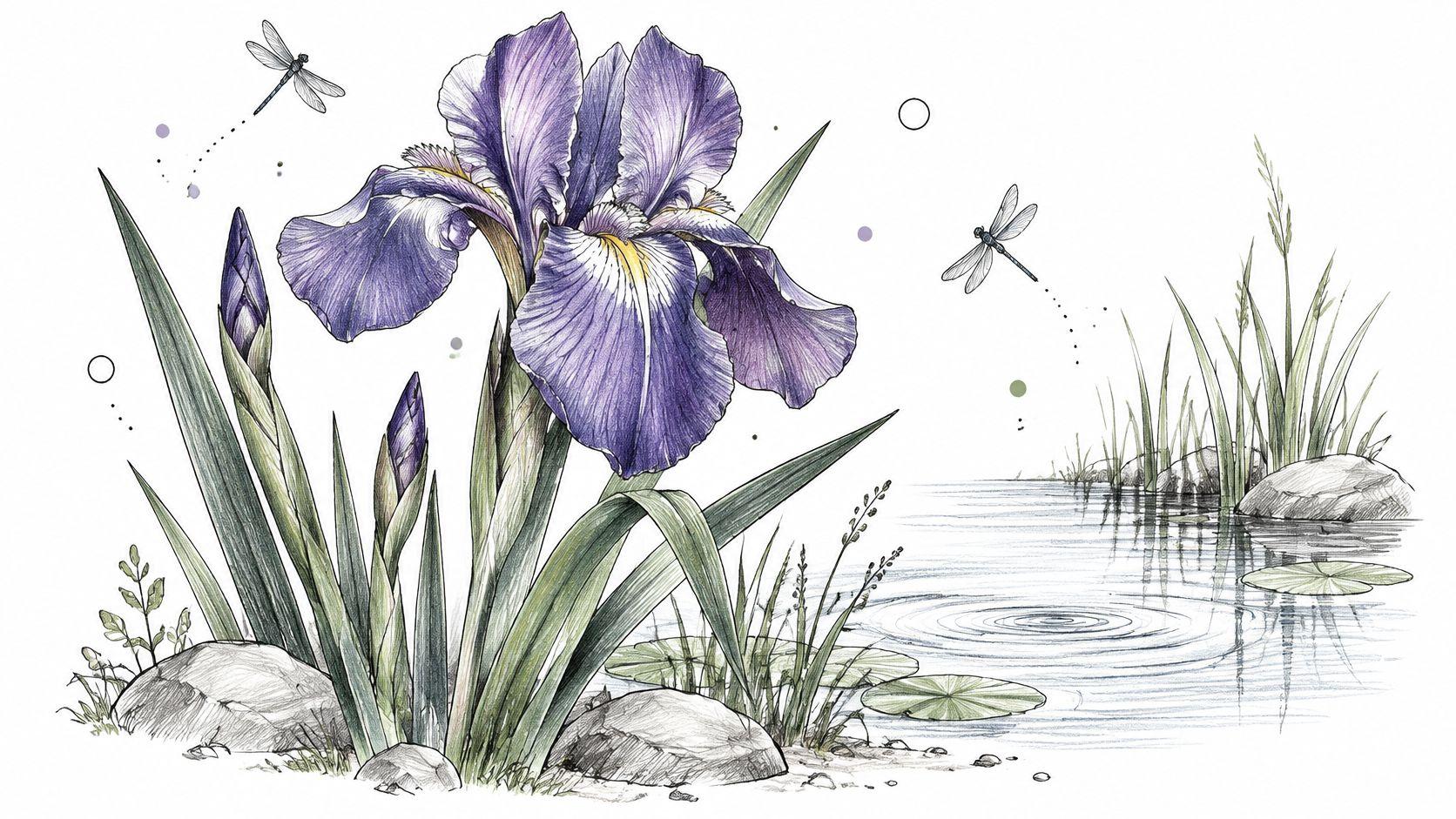
Set crowns at soil level, or just below the waterline at a pond margin, in moist slightly acidic soil. Divide clumps every three or four years in late summer to keep them vigorous, and pair them with ferns and Hakone grass for texture contrast.
Moisture is a specification, not a habit
How wet is the interesting part. In a study of Farfugium japonicum, a broad-leaved shade plant from the same planting tradition, volumetric soil-water content of 0.10 m³/m³ produced only 46.7% survival, while treatments at 0.20 m³/m³ or higher exceeded 80% survival and 0.30 m³/m³ gave the best growth and quality, as reported in the Journal of People, Plants, and Environment study.
For an iris bed, that means "moist" needs a number and a sensor rather than a calendar. Zone the irrigation so the pond margin gets water the maples and pines never see, and mulch heavily to hold it.
A single low-maintenance irrigation assumption across every layer of a Japanese-style garden is how you drown the wet-loving plants and starve the dry ones in the same season.
7. Hakone Grass (Hakonechloa macra)
Hakone grass does the thing most groundcovers in this style can't: it moves. The arching foliage ripples in the slightest breeze and brightens shade that would otherwise be a green void, which is why it's the default groundcover for the shaded middle layer.
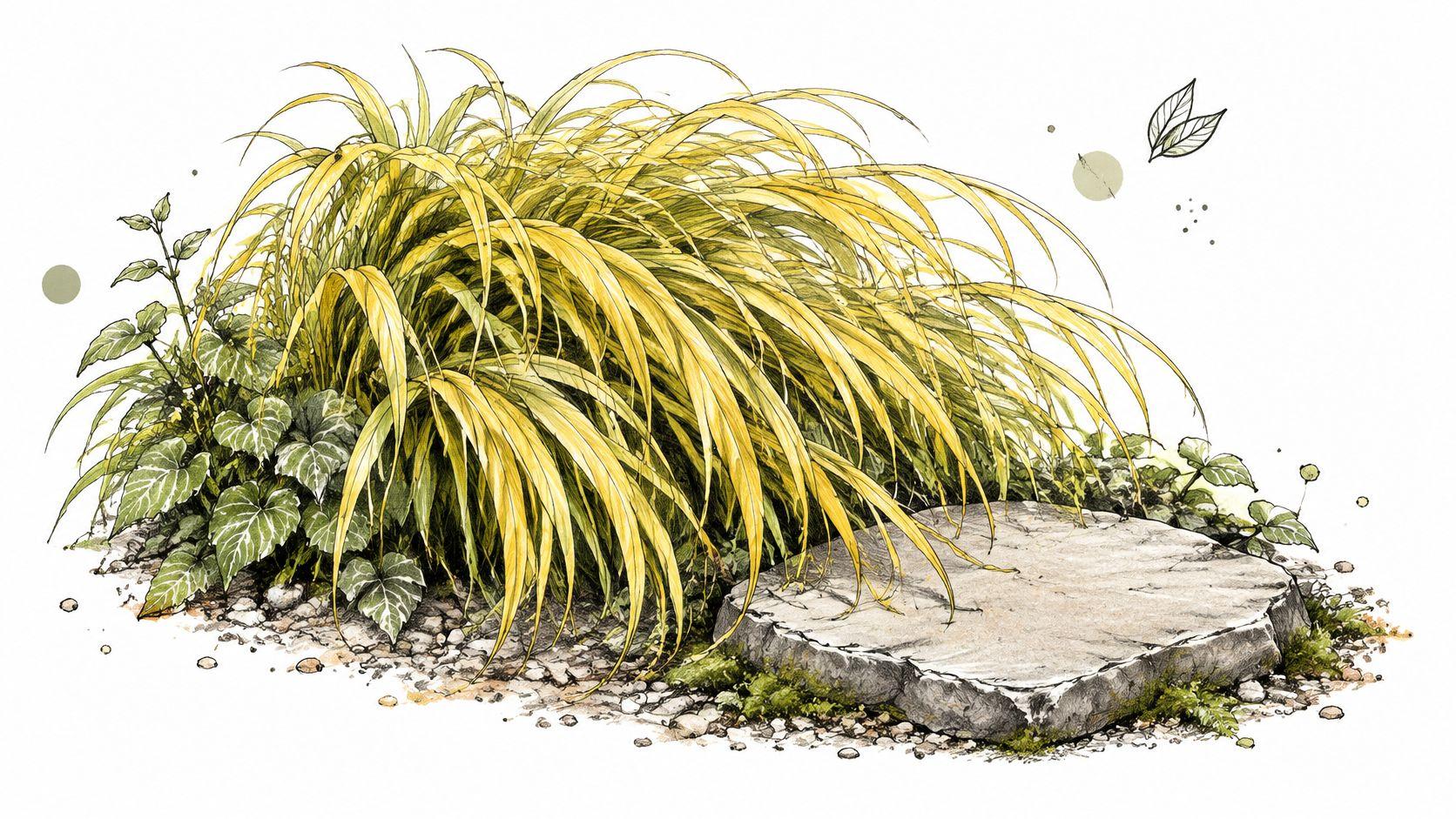
Plant in shade or dappled light in moist, humus-rich soil. Golden forms beside a dark-leaved maple give you contrast without a single flower. Cut back the dead foliage in late winter before new growth starts, and divide clumps in spring when the center thins.
What it won't do
Hakone grass is not a drought plant and not a sun plant. In dry shade the tips brown by midsummer; in full afternoon sun the whole clump scorches. It's also slow to fill, so a border planted from a few pots looks sparse for two seasons.
Use it in drifts along a path or spilling over a stone edge, where the movement is visible at walking height. For alternative textures in the same role, browse ornamental grass options before you commit an entire bed to one cultivar.
8. Mondo Grass (Ophiopogon japonicus)
Mondo grass is the closest thing to a no-fail groundcover in this palette, and the plant that most convincingly replaces lawn in a small Japanese-style garden. Evergreen, fine-textured, tolerant of dry shade once established, and content between stepping stones where a mower can't reach.
Space plugs 6 to 8 inches apart for a filled carpet within one to two seasons, shear the clumps once in late winter to clear tired blades, and run a barrier edge where the planting borders turf, because the clumps creep outward slowly but steadily. Black mondo earns its place as a dark line against pale stone or gravel in modern Japanese-inspired designs.
Ground plane, with history
Low grass is part of the structure of the style, not an afterthought. Zoysiagrasses have been used in Japanese gardens for more than 1,000 years, and the earliest known description of building a garden with lawn appears in Sakutei-ki, thought to have been written around 1156 to 1158, as the Wiley study of Zoysia in Japanese garden history sets out. Edo-era daimyo gardens used Zoysia to clothe artificial hills and tie ponds into stroll gardens, and gardens in that tradition still lean on pine, hinoki, camellia, evergreen azalea, moss, and low grass-like plants to hold the ground plane together.
The ecological check matters as much as the look. Non-native groundcovers can escape the bed and naturalize, so run any bulk purchase against your regional invasive plant list before you commit. Mondo grass itself clumps rather than runs, which keeps it better behaved than most lawn substitutes, but a dense planting still needs that physical edge where it meets real turf.
9. Japanese Holly (Ilex crenata)
Clipped, rounded forms without boxwood's disease pressure: that is the case for Japanese holly. Small leaves, dense growth, tolerance of shearing, evergreen year-round, it handles screening and structural massing in one plant and reads as a clipped boulder wherever a design needs weight at ground level.
Site it in full sun to partial shade on well-drained, slightly acidic soil. Shear hedges in late spring or early summer once new growth hardens. Water thoroughly for the first two years, and again in dry winters, when cold wind pulls moisture from the foliage faster than the roots can replace it. Where winter wind is a given, shelter the planting or expect scorched foliage after hard winters.
Shade tolerance isn't drought tolerance
Plant lists can mislead. In a controlled evaluation of 120 shrub species and cultivars across 44 genera, mean leaf turgor-loss point was -2.76 MPa, spanning -1.48 to -4.23 MPa, per the HortScience evaluation of shrub drought tolerance. Spiraea japonica 'Little Princess' sat at -2.78 MPa, while the wild-origin plant measured less drought-tolerant in the same study, so cultivar choice can matter as much as species choice.
On a hot, exposed urban site, two shrubs sold under one species name can behave completely differently in July. Shortlist regionally hardy plants first, then favor cultivars with measured water-stress traits, especially where a hedge repeats in mass and one dead run breaks the line you paid for.
10. Yoshino Cherry (Prunus × yedoensis)
Yoshino cherry is a twenty-year decision made in one week of spring. The blossom is the most famous seasonal accent in Japanese planting, and the trade-off is a fast-growing, relatively short-lived tree with surface roots and little tolerance for compaction.
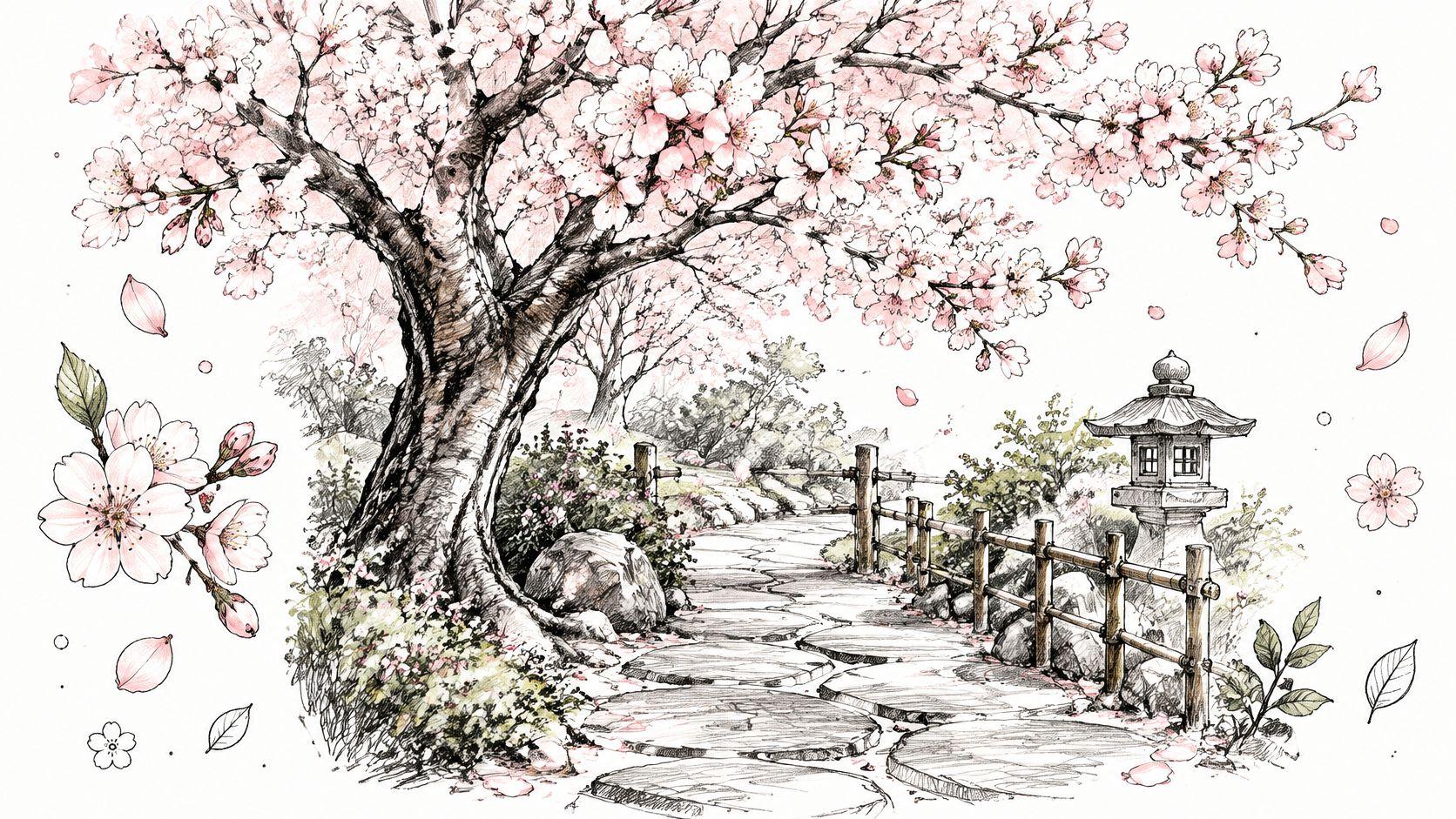
Plant in full sun in well-drained soil with room for a broad canopy. Keep it away from driveways, patios, and lawn routes where foot traffic compacts the root zone. Prune only after flowering, and lightly, because heavy cuts invite canker and borers.
Maintenance realities
- Debris season: plan for a fortnight of petals on paths and in gutters every spring.
- Pests and canker: watch the trunk for gumming and dieback, and get a local extension diagnosis rather than guessing at sprays.
- Short service life: a cherry is not an anchor. Pair it with an evergreen that will still be standing when the cherry isn't.
One useful frame: the cherries along Washington's Tidal Basin trace back to a gift of trees from Tokyo, which is why the species reads as public spectacle as much as private garden plant. In a small yard, one cherry at the end of a view line is enough.
Japanese Garden Plants at a Glance
Read the role column first. Height and zone tell you whether a plant survives on your site, but the role column tells you whether the garden still works once it does. Heights below are typical sizes in cultivation; where a species runs far larger in the wild, that figure is shown so you know what regular pruning is holding back.
| Item | Hardiness (USDA Zones) | Light Needs | Mature Height | Best Garden Role |
|---|---|---|---|---|
| Japanese Maple (Acer palmatum) | 5–8 | Dappled shade or morning sun; afternoon shade | 15–25 ft | Focal tree for small gardens and courtyards |
| Japanese Black Pine (Pinus thunbergii) | 5–9 | Full sun | 40–60 ft in the wild; smaller with pruning | Sculptural evergreen structure |
| Hinoki Cypress (Chamaecyparis obtusa) | 4–8 | Partial shade or morning sun | 60–80 ft in the wild; smaller in cultivation | Refined evergreen backdrop or screen |
| Satsuki Azalea (Rhododendron indicum hybrids) | 6–9, depending on cultivar | Dappled shade | 2–6 ft, depending on cultivar | Flowering shrub, hedge, or bonsai |
| Japanese Camellia (Camellia japonica) | 7–9 | Partial shade | 6–15 ft | Shade-loving foundation or woodland shrub |
| Japanese Iris (Iris ensata) | 4–9 | Full sun to light shade | 24–36 in | Pond-edge or rain-garden perennial |
| Hakone Grass (Hakonechloa macra) | 5–9 | Partial to full shade | 12–18 in | Shady groundcover or path edging |
| Mondo Grass (Ophiopogon japonicus) | 6–10 | Partial to full shade | 6–12 in | Groundcover between pavers and along paths |
| Japanese Holly (Ilex crenata) | 5–7 | Partial shade to full sun | 3–20 ft, depending on cultivar | Clipped hedge, topiary, or foundation planting |
| Yoshino Cherry (Prunus × yedoensis) | 5–8 | Full sun | 30–40 ft | Spring-flowering specimen tree |
Two cautions on the numbers. Zones mark the cold limit, not the comfort zone: a camellia rated to zone 7 still drops buds in an exposed spot, and a maple rated to zone 8 scorches in afternoon sun. Cultivar swings matter just as much, since a holly sold as a 3 ft dwarf and one bred to reach 20 ft share the same species name. Check the label's mature height against the gap you are filling before anything goes in the cart.
Building a Balanced Japanese Garden Plant Palette
Build the palette in three layers, in this order: evergreen structure, seasonal accent, ground plane. Get the first layer right and the garden still reads correctly in January, which is the test most Japanese-style plantings fail.
Evergreen structure means two or three plants, not eight. Hinoki for a courtyard, Japanese holly for a clipped hedge line, black pine if you have the space and the patience for annual pruning. These are the plants that hold the composition when everything else is bare.
Seasonal accents should be chosen for different months rather than different colors. A maple for autumn, a satsuki azalea for late spring, a camellia for winter gives you interest across three seasons without a bed of shrubs that all bloom in the same fortnight and then vanish.
Ground plane comes last: Hakone grass in shade, mondo grass along paths and between stones, Japanese iris at the wet edge. These tie the composition together, cover soil, and cut weeding to almost nothing once they knit.
Before you buy anything, check four things for every plant on your list: light through the day, soil moisture in winter as well as summer, the coldest temperature your site records, and the mature size on the label. A hinoki bought for a two-meter gap and a cherry bought for a small front yard are both errors that cost real money in five years.
Then sketch. Draw the bed shapes to scale and mark the mature canopy circle of each tree. Overlap is what makes a planting read as one composition instead of a collection of pots. Our Japanese style applies a planting plan and bed layouts to a photo of your own yard, which you can then take to a nursery as a shopping list.
Water is the other plan. Zone irrigation by moisture need rather than convenience, because the iris and the maple don't want the same schedule and the pine wants less than either. Soil sensors beat timers in any bed with mixed layers, especially where a moisture-loving understory sits beside drought-hardy shrubs.
One last check with real consequences: confirm each species against your regional invasive list, and keep running bamboo out of the plan unless it's behind a barrier or in a container. Locally native shrubs, sedges, and ferns can take the groundcover role in a design that still reads Japanese, and they cost less to keep alive. If you're starting from a bare plot with no established beds, planning gardens for New Town plots covers the layout stage that comes before plant selection.
A calm, year-round Japanese-style garden comes down to getting the planting layers and the bed shapes right before you spend money on trees. OutdoorBrite turns a photo of your own backyard, garden, or front yard into realistic Japanese-style concepts with bed layouts and a plant list you can take to a nursery, and you can compare styles side by side to see which one suits the space. Visit OutdoorBrite to test a palette on your actual garden and refine the plants before you buy.
See your yard reimagined
Start creating